
Trusted by 300+ companies








Why 100+ Companies Trust Axipro for SOC 2:
- 6 Week Certification Timeline
While traditional consultants take 6-9 months, we get you SOC 2 ready in 6 weeks. - 100% First-Attempt Pass Rate
Zero failed audits in 5+ years. Our certified auditors know exactly what examiners look for, because many of them have been on the other side of the table. - Transparent, Affordable Pricing
No surprise fees. No bloated retainers. No revised timelines. Clear scope, fixed-cost engagements that fit startup budgets and enterprise needs.
Our SOC 2 Services Cover Everything:
SOC 2 Type I Certification
Perfect for companies that need to prove compliance fast. Get your audit report in 6 weeks.
SOC 2 Type II Certification
The gold standard for enterprise sales. We guide you through the observation period and audit prep with continuous monitoring.
SOC 2 Readiness Assessment
Not sure where to start? Get a free gap analysis showing exactly what you need to do to certify.
Multi-Framework Compliance
Adding ISO 27001, HIPAA, or PCI DSS? We leverage 60-70% control overlap to certify multiple frameworks simultaneously.
Ongoing Compliance Support
Annual renewals, surveillance audits, and continuous monitoring so you’re always audit-ready.
How it Works: Our 6-Week SOC 2 Process
We guarantee SOC 2 readiness in 6 weeks or less. Here is how the work breaks down.
Week 1: Scoping and Gap Assessment
We map your current state against the Trust Services Criteria you need. You leave week one with a clear list of every gap that needs to close before the audit.
Weeks 2 and 3: Control Design and Implementation
We help your team implement the missing controls: access reviews, encryption standards, vendor management, change management, monitoring. Where you already have something working, we keep it. Where you don’t, we provide templates, policies, and configurations you can adopt immediately.
Weeks 4 and 5: Automation and Evidence Collection
We connect your systems to a compliance platform (Drata, Vanta, or Thoropass, depending on your stack). The platform automates evidence collection. By the end of week five, your evidence is collecting itself in the background.
Week 6: Audit Preparation and Handoff
We run a final readiness review, address any last-mile findings, and hand you over to an independent auditor with a complete evidence package. From this point forward, the audit itself runs on the auditor’s timeline, typically two to four weeks for Type 1 and the length of your observation window for Type 2.
The 6-week clock applies to everything Axipro controls: scoping, implementation, evidence collection, and audit preparation. The independent audit happens after.

G2 Clients Trust AxiPro
Trusted by clients on G2, Axipro stands out for real support, clear communication, and fast results. Our clients’ stories show how we simplify compliance and build lasting trust through genuine partnerships.
The Axipro SOC 2 Difference:
Without Axipro
- DIY with online templates
- Software platform alone
- Generic consultant retainer
- 6-12 month timelines
- Disappears after certification
What You Get With Axipro
- Custom policies built for your business
- Drata/Vanta + expert guidance to actually use it
- Fixed-scope engagement with clear deliverables
- 6 weeks to certification. No excuses or extra costs.
- 100% audit pass rate, guaranteed
- Ongoing support for renewals and growth
- Dedicated PM. 10 000+ hours of implementation under our belt
SOC 2 Compliance and Why It Matters for Your Business
SOC 2 compliance is now a standard requirement for SaaS companies, fintech platforms, and cloud service providers that handle customer data.
Axipro helps organizations achieve SOC 2 readiness and certification faster by combining compliance expertise with modern automation platforms such as Drata and Vanta.
Our SOC 2 consulting services help you:
prepare for SOC 2 Type 1 and Type 2 audits
implement security controls aligned with the AICPA Trust Services Criteria
streamline evidence collection and documentation
reduce audit timelines and operational friction
SOC 2 Compliance is vital for service organizations handling sensitive data. It ensures they follow strict rules for security, availability, processing integrity, confidentiality, and privacy. Certified Public Accountants (CPAs) conduct thorough audits based on AICPA guidelines, resulting in Type 1 or Type 2 Certification. Type 1 Certification checks control design and implementation at one time, while Type 2 Certification examines control effectiveness over a period, often six months or more.
SOC 2 assesment reports, derived from these audits, reassure stakeholders, especially those using outsourced software storing customer data online. These reports show the organization’s commitment to protecting data integrity and confidentiality. SOC 2 Compliance confirms reliability and trustworthiness, highlighting the organization’s dedication to strong controls and security.
Reach SOC 2 Compliance in 6 Weeks or Less
Schedule Your Free SOC 2 Assessment Today
Benefits of SOC 2 Implementation
Risk Assessment
Start with a thorough risk assessment to identify potential vulnerabilities and threats to your systems.
Implement Controls
Implement necessary controls and policies to address the identified risks. This may include access controls, encryption, and regular monitoring.
Documentation
Document your processes, policies, and controls. This documentation will be crucial during the audit process.
Pre Assessment
Consider a pre-assessment to evaluate your readiness for the official audit. This step helps you identify and address any gaps.
Official Audit
Engage a qualified third-party auditor to conduct the SOC 2 audit. They’ll assess your controls, policies, and overall compliance with the trust service criteria
SOC 2 Type 1 vs Type 2: Which One Does Your Business Actually Need?
Most founders asking about SOC 2 are not sure which type their customer is asking for. Here is the short answer.
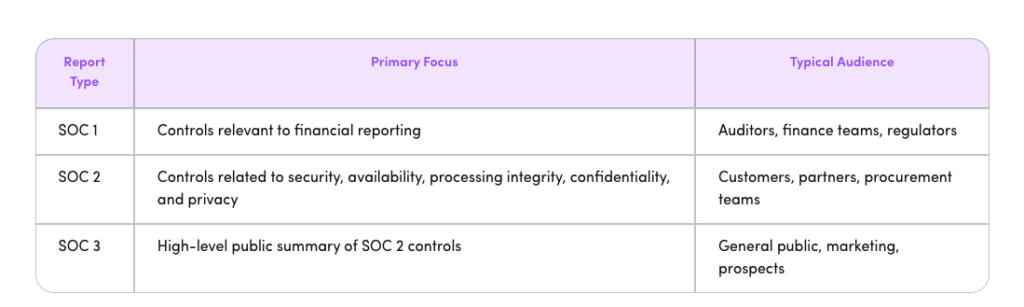
SOC 2 Type 1 confirms that your security controls are properly designed at a single point in time. It is a snapshot. Auditors look at your policies, systems, and processes on one specific date and confirm everything is in place.
SOC 2 Type 2 confirms that those same controls actually worked over a period of time — typically 3 to 12 months. Instead of a snapshot, it is a track record.
Which one do enterprise buyers expect?
Almost always, Type 2.
When a prospect asks for “your SOC 2 report,” 9 times out of 10 they mean Type 2. Type 1 is rarely accepted on its own by mature buyers. It is often used as a stepping stone — companies pursue Type 1 first to unblock a deal quickly, then transition to Type 2 over the following observation window.
When Type 1 makes sense
- You have a deal on the line and need proof of compliance in weeks, not months.
- You are early-stage and want to demonstrate progress to investors or pilot customers.
- You plan to follow up with Type 2 within the next 6 to 12 months.
When Type 2 is the right call
- An enterprise customer has explicitly asked for it.
- You are entering procurement processes with mid-market or large companies.
- You want one report that lasts you a full year of sales conversations.
If you are unsure, the cheapest path is to scope the work for Type 2 from day one and run a Type 1 as an intermediate milestone. That avoids paying twice for the same readiness work.
Who We Serve
We work with companies whose customers demand proof of security before signing. The specific challenges differ by industry.
SaaS and B2B Software
SaaS companies are usually the first to hit a SOC 2 wall. The trigger is almost always a procurement team blocking a contract until a report is on the table. The challenge is moving fast enough to keep the deal alive while building controls that scale beyond the first audit. Most of our SaaS clients close their first SOC 2 within six weeks of engagement.
Fintech and Financial Services
Fintech companies operate under tighter scrutiny than typical SaaS. Banking partners, payment processors, and regulators all expect proof of strong controls. SOC 2 is often the floor, not the ceiling — many fintech clients also need ISO 27001, PCI DSS, or specific regulatory attestations. We help fintech teams build a compliance foundation that supports multiple frameworks without rebuilding from scratch each time.
Cloud Service Providers and Infrastructure
Cloud providers face a unique challenge: their customers are often the ones being audited, and they pull on their providers for evidence. A clean SOC 2 Type 2 report is no longer optional — it is a sales tool. We help cloud and infrastructure companies design controls that satisfy both their auditors and the inherited control requirements of their downstream customers.
Outsourcing and BPO Providers
BPO firms handle sensitive client data at scale, often across multiple jurisdictions. SOC 2 is the most common framework requested by enterprise clients before they will outsource a process. The challenge for BPO providers is implementing controls that survive frequent staff turnover and varied client environments. We design SOC 2 programs around process consistency rather than individual heroics.
Regions Served- SOC 2 Compliance Services Worldwide
Axipro provides expert SOC 2 compliance services to companies across the globe, with deep expertise in regional regulatory requirements and international standards.
SOC 2 Compliance Services in the United States
We serve SaaS companies, fintech startups, and cloud service providers across the USA, including major tech hubs like San Francisco, New York, Austin, Denver, Seattle, and Boston. Our remote-first delivery model means same-time-zone support regardless of location, with rapid response times for urgent enterprise sales deadlines.
SOC 2 Compliance Services in Bahrain & GCC
With our Main Office located in Bahrain, Axipro is a trusted SOC 2 compliance partner for companies across Bahrain, UAE, Saudi Arabia, Qatar, and the broader GCC region. We help Middle Eastern technology companies achieve SOC 2 certification to compete for global enterprise contracts and unlock opportunities for international expansion.

SOC 2 Compliance Services in the United Kingdom
From London to Manchester and across the UK, Axipro delivers SOC 2 certification aligned with both US trust service criteria and UK GDPR requirements. Ideal for UK-based SaaS companies expanding into the US market or serving American enterprise customers.
SOC 2 Compliance Services in Australia & New Zealand
Serving companies across Sydney, Melbourne, Auckland, and beyond, Axipro provides SOC 2 certification services that satisfy both APAC and global enterprise requirements.
SOC 2 Compliance Services in Singapore & Southeast Asia
Singapore-based companies and APAC operations trust Axipro for SOC 2 certification aligned with PDPA requirements and international security standards.
SOC 2 Compliance Services in EMEA
In late 2025, Axipro opened a Lisbon office to better serve the EMEA region. We now count on a distributed team in Lisbon, Berlin, Amsterdam, and London. Across Europe, the Middle East, and Africa, we deliver SOC 2 certification that complements GDPR compliance and regional data protection requirements.
Reach SOC 2 Compliance in 6 Weeks or Less
Schedule Your Free SOC 2 Assessment Today
SOC 2 Customer Stories

SOC 2 Resource Hub

Gartner predicts that by 2028, 90% of enterprise software engineers will use AI code assistants, up from less than 14% in early 2024. SOC 2 and ISO 27001 change management controls were written before that shift, and both rest on an assumption that AI-generated code breaks outright: the person who approved a change wrote it, or at least fully understood it. Neither the AICPA nor ISO has published AI-specific change management requirements, so auditors apply the existing controls, SOC 2 CC8.1 and ISO 27001 Annex A 8.32, to commits no human authored. Most teams discover the mismatch mid-audit, when a sample pulls up a 2,000-line agent-generated pull request that was approved in four minutes. This guide maps AI code generation to both frameworks: what each one requires, the risks AI coding assistants introduce, the workflow that satisfies auditors, and the evidence they request when GitHub Copilot, Cursor, or Claude Code shows up in your SDLC. Why AI-Generated Code Breaks Traditional Change Management Change management controls assume a human bottleneck. AI removes it in three places at once. The Volume Problem: AI Commits at Machine Speed A single developer running an agentic coding tool can open more pull requests in a
SOC 2 has no fixed evidence retention period. The AICPA doesn’t tell service organizations to keep evidence for one year, three years, or seven. What it does require is proof that every in-scope control operated across the entire audit period. That’s stricter than it sounds, because a log that expires before your auditor samples it is a control you can no longer prove. That makes evidence retention one of the few SOC 2 topics where a configuration default can cost you a clean report. Below, we walk through what the AICPA and the Trust Services Criteria require and how long to keep each type of evidence. We also cover where HIPAA, PCI DSS, ISO 27001, and GDPR change the answer, and how to store and automate evidence so it holds up when the auditor tests it. For most SaaS teams, the short answer is this. Keep evidence for the current observation period plus at least one prior period, and keep security logs searchable for 12 months. Go longer only when a contract, a regulation, or a legal hold says you have to. What Is SOC 2 Evidence Retention vs. Data Retention: Key Distinctions Teams often lump the two into one
You can get a SaaS company ready for a SOC 2 audit in six weeks, but you’ll feel every one of them. Most published timelines say three to six months. For a company with no project owner, no identity provider, and nothing written down, that’s about right. A cloud-native startup that already has the basics in place and can protect some time is a different story, and it can fit the work into six hard weeks. This plan walks through that route one week at a time. Each week has an owner, an hour estimate, and a clear test for when it’s finished. The free Google Sheet version turns the plan into a tracker you can hand out to owners and update in your weekly standup. Before you start, know what you’re signing up for. At the end of week 6 you’ll be audit-ready, which isn’t the same as holding a Type II report. Nobody can get you a Type II in six weeks. This is also the do-it-yourself route, and it takes a lot of hours. We’ll show you where those hours go and what the faster option looks like. Is Six Weeks Realistic for Your Company? Six weeks
An AI agent reads a customer record, decides a refund is warranted, and calls the payments API. The trail it leaves looks nothing like a human doing the same job. The log says a user logged in, a service account made three API calls, and the transaction cleared. It doesn’t say why the agent decided on a refund, what it read first, which model version did the reasoning, or who gave the agent permission to act in the first place. That missing “why” is the whole audit problem. This article covers what ISO/IEC 42001:2023 and the SOC 2 Trust Services Criteria expect from AI agent audit logs, where the two overlap, the fields a log needs to satisfy both, how long to keep records, what you shouldn’t record, and how to package it all for an auditor. It’s written for the CTO, platform lead, or founder who owns compliance for a product that now ships with autonomous agents and needs a certification and a Type II report without running two separate logging programs. The Compliance Gap: Traditional Application Logs vs. AI Agent Audit Logs Why Standard Logs Fall Short for Autonomous Agents Application logs were built for deterministic software. Same
Most companies start their first SOC 2 or ISO 27001 project in a spreadsheet, only to have it fall apart in week 6. This is typically when they’ll call us asking us to implement a GRC system that scales. Excel holds 154 controls fine. The trouble starts when an auditor sends over an evidence request list, two frameworks need updating at once, and a control owner who hasn’t opened the file since March edits the wrong row. This article gives you a free GRC workbook template built to take into consideration the hundreds of engagements we’ve guided. It walks you through each tab and tells you plainly when you’ve outgrown it. We’ve worked with hundreds of companies implementing SOC 2 + ISO 27001 and to be honest, for 80% of cases, using excel is feasible and even advised. Its a tool most of the staff knows and using it cuts onboarding times from weeks to a few hours. It also makes it accessible to the whole organization. The workbook covers all 33 SOC 2 Common Criteria plus the Availability, Confidentiality, Processing Integrity, and Privacy criteria, all 93 ISO 27001:2022 Annex A controls, a crosswalk between the two, and the evidence,
A SOC 2 penetration test costs between $1,000 and $30,000 for most companies. A typical SaaS scope, meaning one web application, its API layer, and the cloud infrastructure behind it, usually lands between $2,000 and $20,000. Early-stage startups with a narrow scope can get an auditor-accepted test for $1,000 to $8,000, while enterprises with multiple products and hybrid infrastructure regularly spend $20,000 to $50,000 or more. The spread is wide because “penetration test” covers everything from an automated scan with a cover page to weeks of manual testing by senior engineers. Auditors know the difference, and so do the enterprise customers who asked for your SOC 2 report in the first place. This guide breaks down what drives the price, where the hidden costs sit, and how to buy a test that holds up in fieldwork without overpaying for it. What Is SOC 2 Penetration Testing? A SOC 2 penetration test is a simulated attack on your systems, performed by a qualified security professional, scoped to the environment covered by your SOC 2 report. The tester tries to exploit real weaknesses the way an attacker would: broken access controls, injection flaws, misconfigured cloud services, exposed credentials. The output is a
A green dashboard is not an audit opinion. Compliance automation platforms like Vanta, Drata, Secureframe, and Hyperproof have made SOC 2 readiness faster and cheaper, but every audit cycle produces the same pattern: controls that sat at “passing” for months come back from the auditor with exceptions or requests for re-testing. The four controls below account for a disproportionate share of those rejections, and they all fail for the same underlying reason. The tool confirmed that evidence exists. The auditor tested whether the control actually operated. This article walks through each of the four: what auditors reject, why, and how to fix the evidence before fieldwork starts. Why Compliance Tools Show “Passing” But Auditors Still Reject Controls The Gap Between Automated Checks and Auditor Judgment Compliance platforms run continuous control monitoring: API calls that check whether a configuration exists, a document is uploaded, or a task is marked done. That’s real value. It catches drift, keeps evidence in one place, and saves weeks of screenshot collection. An audit is a different exercise. A SOC 2 examination is an attestation performed by a CPA firm under AICPA standards, and the auditor’s job is to form an independent opinion on whether your
Most SOC 2 preparation effort goes into access controls, encryption, and vendor reviews. Then the auditor’s first evidence request arrives, and item one has nothing to do with technology: show us your board charter, your meeting minutes, and proof that your board operates independently from management. That’s CC1.2, and it causes more last-minute scrambling than almost any technical control in the framework. This guide explains what CC1.2 requires, provides a board charter template with sample language that auditors accept, and covers the situation most startups actually face: satisfying the criterion without a traditional board of directors. What Is a SOC 2 Board Charter and Why It Matters for CC1.2 A board charter is a formal document that defines your board’s purpose, composition, authority, meeting procedures, and oversight responsibilities. Outside of compliance, it’s a corporate governance tool and a good idea in general for companies with shareholders. Inside a SOC 2 audit, it’s the primary design evidence for CC1.2, the criterion that asks whether an independent body oversees management and the internal control environment. The charter matters because CC1.2 is one of the few criteria where the control is a document plus behavior. The charter establishes the structure. The auditor then
After a SOC 2 and ISO 27001 engagement, there are two documents out of the whole pile that actually close deals: the SOC 2 attestation report and the ISO 27001 certificate. Everything else your engagement produces exists to create those two, support them, or keep them alive for another year. Companies routinely ask their auditor for a SOC 2 certificate, which doesn’t exist. They send a prospect their full ISMS documentation when a one-page certificate would have done. They pay for six months of readiness work and then can’t say what they’re holding at the end of it. So here’s the full list. What a SOC 2 engagement produces, what an ISO 27001 engagement produces, what a combined program produces, and who gets to see each one. Understanding SOC 2 and ISO 27001 Engagement Outputs The Core Difference: Report vs. Certificate SOC 2 is an attestation. A licensed CPA firm examines your controls against the Trust Services Criteria under standards set by the AICPA, then writes up what it found and signs an opinion. No certificate. No logo from the AICPA. No pass or fail stamp. What you get is the report, and it usually runs 60 to 120 pages.
FAQ
Frequently Asked Questions
What is SOC 2 Compliance ?
SOC 2 compliance (Service Organization Control 2) is a framework developed by the American Institute of Certified Public Accountants (AICPA) to assess and report on the security, availability, processing integrity, confidentiality, and privacy controls implemented by service organizations. It provides assurance to clients and stakeholders regarding the effectiveness of controls in place to protect their data and ensure the reliability of services.
Who Needs SOC 2 Compliance ?
Any service organization that processes or stores sensitive customer data on behalf of its clients may benefit from SOC 2 compliance. This includes cloud service providers, data centers, software as a service (SaaS) providers, managed service providers, and other entities entrusted with handling client information.
What are the Trust Service Criteria (TSCs) for SOC 2 Compliance ?
The Trust Service Criteria (TSCs) for SOC 2 compliance include security, availability, processing integrity, confidentiality, and privacy. These criteria serve as the foundation for evaluating the effectiveness of controls implemented by service organizations to safeguard client data and ensure the reliability of services.
How is SOC 2 Compliance Assessed ?
SOC 2 compliance is assessed through independent audits conducted by certified public accountants (CPAs) or audit firms. During the audit process, the auditor evaluates the design and operating effectiveness of controls based on the Trust Service Criteria (TSCs). Upon successful completion of the audit, the service organization receives a SOC 2 report detailing the results of the assessment.