
Researchers who buy second-hand drives off online marketplaces keep finding the same thing: live data.
A widely cited study by Blancco Technology Group found that 42% of used drives sold on eBay still held recoverable information, including financial records and personal data the previous owners assumed was long gone. The drives were not hacked; they were thrown away by organizations that treated deleting a file as the same thing as destroying it.
Secure data disposal is where many compliance programs fail. ISO 27001, SOC 2, and GDPR all demand it, but they describe it in different languages, enforce it through different mechanisms, and punish failure in very different ways.
This article sets out what each framework requires, where the requirements overlap, and how to run a single disposal program that satisfies all three at once.
Why Secure Data Disposal Matters Across Compliance Frameworks
Disposal is the last link in the data lifecycle, and the easiest one to skip. An organization can run flawless access controls, encryption, and monitoring for years and still cause a reportable breach the moment one unwiped laptop leaves the building. A recoverable drive in a recycling skip is functionally identical to an open database on the internet, and auditors and regulators know it.
Most disposal failures are unforced errors: a control that was already written into policy but never carried through to the actual hardware. The gap between having a disposal policy and proving this specific drive was destroyed is exactly where audits and breach investigations live.
Defining Secure Data Disposal: Key Terms and Concepts
What Is Secure Data Disposal?
Secure data disposal is the end-to-end process of removing data and the equipment that holds it from active use, in a way that prevents its recovery. It covers the full lifecycle end: deletion of data while a system is still live, sanitisation of media that will be reused, physical destruction of media that will not, and the safe handling of equipment that is recycled, returned to a lessor, or sold. Disposal is the goal. The methods are how you get there.
What Is Secure Data Destruction?
Secure data destruction is the subset of disposal that renders media permanently unusable or its contents mathematically irretrievable. Shredding a drive, pulverising it, incinerating it, or destroying the encryption keys that make an encrypted disk readable are all forms of destruction. Destruction is one route to disposal, and it is the right route when the data is highly sensitive, or the media will never be reused.
Secure Data Disposal vs. Secure Data Destruction: What Is the Difference?
The distinction matters more than it looks. Disposal is the outcome you owe to every framework: data gone, unrecoverable, equipment handled appropriately. Destruction is just one of the methods. You can dispose of data without destroying the hardware by sanitising a drive thoroughly enough to reuse it. Confusing the two leads to two classic mistakes: destroying assets that could have been securely wiped and reused, and assuming a quick deletion counts as disposal when it does not.
Important: Emptying the recycle bin, formatting a drive, or hitting delete does not dispose of data under any of these frameworks. Standard deletion only removes the pointer to the data; the bits remain until they are overwritten. Every framework discussed here expects the data to be unrecoverable, which is a far higher bar than not visible.
What ISO 27001 Requires for Secure Data Disposal
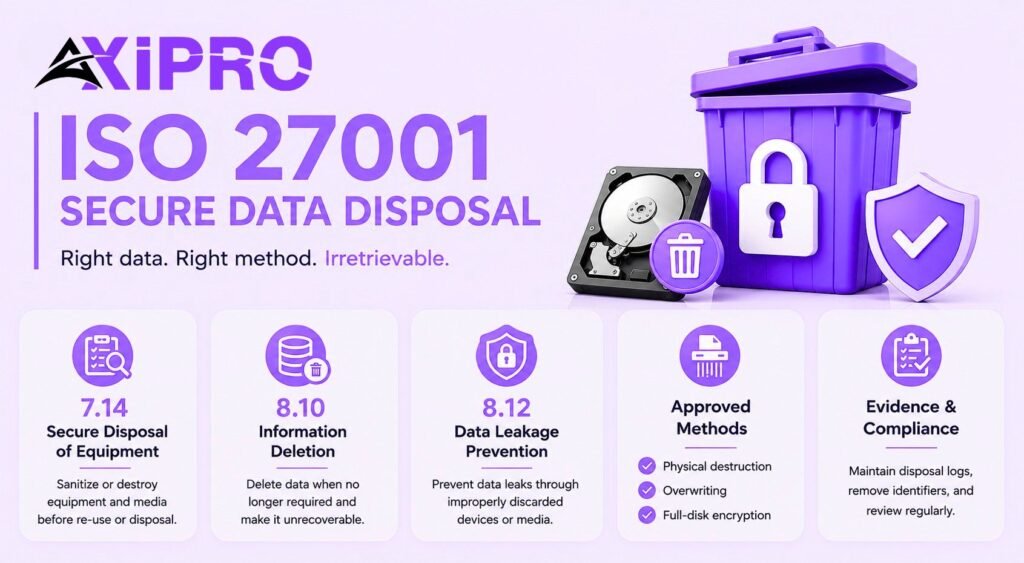
ISO/IEC 27001 handles disposal through a small cluster of Annex A controls that auditors read as a single process rather than in isolation. The two controls that do most of the work are 7.14 and 8.10. For a deeper look at how these controls fit into a broader compliance program, see our ISO 27001 implementation guide.
ISO 27001 Annex A 7.14: Secure Disposal or Re-Use of Equipment
Annex A 7.14 is a physical control. Before any equipment is disposed of or reused, the organisation must check whether it holds information assets or licensed software and ensure those are permanently erased or the media physically destroyed.
It applies to servers, laptops, desktops, mobile devices, printers, network gear, and any storage media: if it ever processed information, it is in scope. The control replaces the older 2013 clause 11.2.7 and adds explicit expectations around removing identifying markings and handling end-of-occupancy scenarios.
ISO 27001 Control 8.10: Information Deletion
Annex A 8.10 is a technological control, and it focuses on the data rather than the box. It requires information stored in systems, devices, or media to be deleted when it is no longer required, and rendered unrecoverable. The cleanest way to keep these straight: 8.10 governs the data while it is in use or reaches its retention limit; 7.14 governs the hardware at end of life. Most retention-driven deletion sits under 8.10; most decommissioning sits under 7.14.
ISO 27001 Control 8.12: Data Leakage Prevention and Its Role in Disposal
Control 8.12 is rarely filed under disposal, but improperly discarded media is one of the oldest data leakage channels there is. A drive that leaves your control with recoverable data on it is a leak, regardless of how it left. Treating disposal as part of your leakage prevention posture forces the right question at the right time: what could walk out the door on this device, and has it actually been removed?
Physical Destruction and Irretrievable Erasure Under ISO 27001
ISO 27001 offers two broad routes: physically destroy media that holds information, or erase and overwrite it so retrieval by a malicious party is precluded. The standard cross-references ISO/IEC 27040 for detailed sanitisation methods. The unifying requirement is that recovery should be impractical, not merely inconvenient. Deletion alone never satisfies this.
Overwriting, Full-Disk Encryption, and Other Approved Methods
Overwriting user-accessible storage with multiple passes is acceptable for many sensitivity levels. Full-disk encryption changes the economics of disposal entirely: if a device is encrypted from day one and the keys are properly managed, secure disposal can be as simple as destroying the keys, a technique known as cryptographic erasure. The catch is that the encryption must be native, comprehensive, and the key destruction verifiable.
Pro Tip: Encrypt endpoints and drives at provisioning, not at disposal.
Encrypt endpoints and drives at provisioning, not at disposal. When full-disk encryption is in place from the start, retiring a device becomes a near-instant crypto-erase rather than a multi-hour overwrite or a trip to the shredder. This single decision turns disposal from a bottleneck into a checkbox, and it satisfies the irretrievability bar in all three frameworks.
Handling Damaged or End-of-Life Equipment Under ISO 27001
A common and dangerous assumption is that a broken device is a safe device. It is not. A laptop that will not boot can still have its drive removed and read on another machine. Damaged equipment must be sanitised or destroyed with the same rigour as working equipment, and the disposal record should reflect that the data risk was assessed regardless of the hardware’s condition.
Removal of Labels, Markings, and Asset Controls Before Disposal
Equipment often carries asset tags, network identifiers, classification labels, or owner details. Annex A 7.14 expects these to be removed before assets leave the organisation, because they hand an outsider a map: which network the device sat on, how sensitive its data was, who owned it. Stripping identifiers is a small step that closes a surprisingly useful reconnaissance gap.
How Secure Disposal Fits Into Your ISMS
Disposal does not stand alone in an ISMS. It depends on 5.9 (an accurate inventory of assets, so you know what needs disposing), 7.10 (storage media handling across its lifecycle), and 8.24 (cryptographic key management, which underpins crypto-erase). A documented disposal policy, disposal logs, and periodic review are what turn these controls from intentions into evidence.
What SOC 2 Requires for Secure Data Disposal
SOC 2 is an attestation built on the AICPA’s Trust Services Criteria, and disposal lives mainly in the Confidentiality category. Unlike ISO 27001, SOC 2 does not prescribe methods. It tests whether the controls you describe are designed properly and, in a Type 2 report, whether they operated effectively over a period.
SOC 2 Trust Service Criteria Relevant to Data Disposal
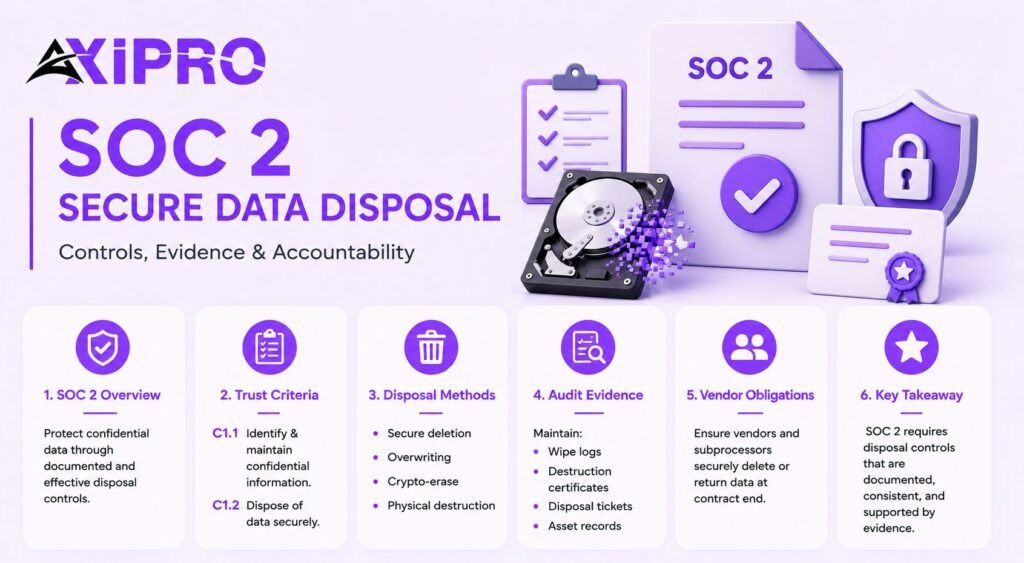
Two confidentiality criteria do the heavy lifting. C1.1 requires the entity to identify and maintain confidential information. C1.2 requires the entity to dispose of confidential information to meet its confidentiality objectives. Where the Privacy category is in scope, disposal of personal information is tested as well, and several criteria in the CC6 series touch on how confidential data is accessed and handled across its lifecycle.
Logical and Physical Data Disposal Requirements Under SOC 2
SOC 2 expects both logical disposal (secure deletion, overwriting, crypto-erase of data in systems) and physical disposal (destruction or sanitisation of the media itself). The framework cares less about which specific method you choose and more about whether the method is appropriate to the data’s sensitivity, applied consistently, and documented. A control that exists only on paper will not survive a Type 2 examination.
Audit Trail and Evidence Requirements for SOC 2 Disposal Compliance
This is where SOC 2 is unforgiving. C1.2 is not satisfied by a policy; it is satisfied by evidence that disposal happened. Auditors look for destruction certificates, sanitisation logs, deletion tickets, and asset records that tie a specific device or dataset to a specific disposal event. A disposal control with no retained evidence is, for audit purposes, a control that did not happen.
Insider Note: Auditors increasingly distrust the green tick from a generic compliance platform. What earns a clean opinion is a destruction certificate or wipe log linked to a specific hardware identifier or asset tag, plus the ticket showing who authorised the disposal. Native evidence in your own asset management or ticketing system carries more weight than a policy PDF stored in a tool that never touched the actual drive.
Vendor and Subprocessor Disposal Obligations Under SOC 2
Your data does not stop being your responsibility when a vendor holds it. SOC 2’s vendor management expectations mean you must ensure subprocessors and disposal contractors handle confidential data appropriately, including deleting or returning it at the end of a contract. In practice, this shows up as contractual disposal clauses, vendor due diligence, and evidence that data was actually purged when a relationship ended.
What GDPR Requires for Secure Data Disposal
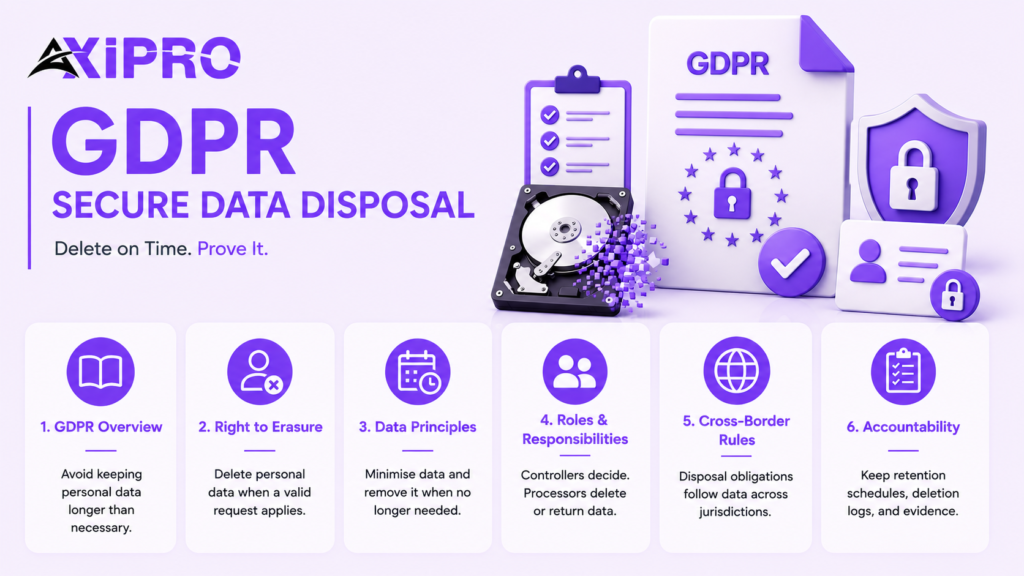
GDPR is not a checklist of disposal methods. It is a law that makes holding data longer than you should, or failing to delete it on a valid request, a legal liability. The relevant obligations are spread across several articles, with the official text available through EUR-Lex.
GDPR’s Right to Erasure and What It Means for Disposal Processes
Article 17, the right to erasure (or right to be forgotten), lets individuals request deletion of their personal data, and obliges the controller to erase it without undue delay when a valid ground applies — for example when the data is no longer needed or consent is withdrawn. The right is not absolute: Article 17(3) preserves data needed for legal obligations, the defence of legal claims, and a handful of other reasons. The UK ICO’s guidance on the right to erasure is a practical reference for handling these requests. The operational point: you must be able to find and delete an individual’s data on demand, including in backups, within a defined timeframe.
Data Minimisation and Storage Limitation Principles
Two of GDPR’s core principles in Article 5 drive disposal even when no one has asked for it.
Data minimisation (5(1)(c)) says you should only hold data that is adequate, relevant, and limited to what you need.
Storage limitation (5(1)(e)) says you must not keep personal data in identifiable form for longer than necessary. Together they make routine, scheduled deletion a legal requirement, not a tidy habit.
Anonymising data so irreversibly that it is no longer personal data is the one route that lets you keep it indefinitely.
Controller and Processor Responsibilities for Secure Disposal Under GDPR
Responsibility splits along the controller and processor line. The controller decides why and how data is processed and owns the erasure decision. The processor, under Article 28, must delete or return all personal data at the end of the service, at the controller’s choice, and delete existing copies unless law requires retention. This is why end-of-contract deletion clauses are not boilerplate; they are how a controller discharges a legal duty through a third party.
Cross-Border Data Disposal Considerations Under GDPR
GDPR follows the data, not the building. If personal data of EU residents sits with a processor or sub-processor in another jurisdiction, the disposal obligations travel with it. Cross-border arrangements need to make clear who deletes what, when, and how that deletion is evidenced — so a transfer does not become a place where data quietly outlives its retention period beyond your reach.
Documentation and Accountability Requirements for GDPR Disposal
Article 5(2) makes the controller accountable, meaning able to demonstrate compliance, not merely compliant. For disposal, this means retention schedules, records of processing activities under Article 30, logs of erasure requests and how they were handled, and evidence that deletion actually occurred. If a regulator asks how you handle disposal, “we delete data when we are done with it” is not an answer; the schedule and the logs are.
Side-by-Side Comparison: ISO 27001 vs. SOC 2 vs. GDPR on Data Disposal
Framework Type, Scope, and Applicability
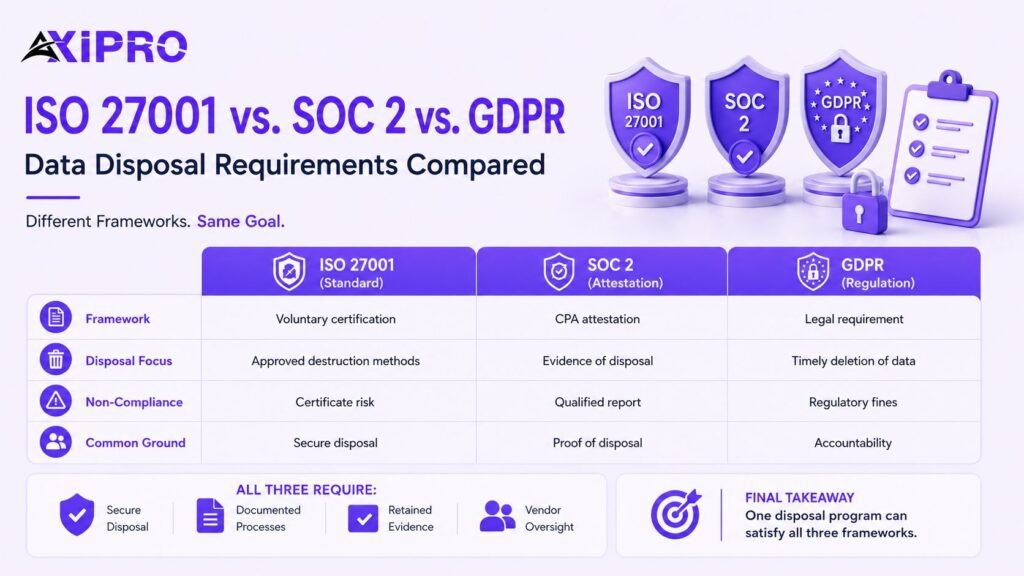
The three differ at the root. ISO 27001 is a certifiable standard you adopt voluntarily. SOC 2 is an attestation a CPA firm performs against your described controls. GDPR is law, and it applies whether you like it or not the moment you process EU or UK residents’ personal data.
Specific Disposal Requirements and Controls
ISO 27001 is the most prescriptive about how, pointing to recognised sanitisation methods and physical destruction. SOC 2 is method-agnostic but evidence-obsessed: it cares that you disposed of it and can prove it. GDPR is outcome-driven: the data must be gone when its lawful basis ends, and you must be able to demonstrate that it is.
Certification vs. Regulation: Consequences of Non-Compliance
The stakes scale with the mechanism. Fail ISO 27001, and you risk a nonconformity and, ultimately, your certificate. Fail SOC 2, and you get a qualified report that every prospect’s security team will read. Fail GDPR, and you face administrative fines that can reach €20 million or 4% of global annual turnover, whichever is higher, alongside the reputational damage of a public enforcement action.
Overlaps and Synergies Between the Three Frameworks
Despite the different language, the three frameworks point in the same direction. All of them require that disposed data be unrecoverable, that disposal be governed by policy, that it be evidenced, and that it extend to third parties who hold your data. Build to the strictest common denominator, and you satisfy all three. A single, well-evidenced disposal program is the efficient answer, not three parallel ones.
We’ve written a full article on ISO 27001 vs. SOC 2 mapping, which you can read here.
Approved Methods for Secure Data Disposal That Satisfy All Three Frameworks
None of the three frameworks invents its own sanitisation techniques. They lean on established standards, and the one auditors and regulators recognise most often is NIST Special Publication 800-88, which sorts methods into three levels: Clear, Purge, and Destroy. The most recent revision modernised the guidance for cloud and encrypted environments and points to the IEEE 2883 standard for the technical procedures.
Physical Destruction of Storage Media
Shredding, pulverising, disintegrating, or incinerating media is the Destroy tier, reserved for the most sensitive data or any media you will never reuse. It is the most certain method and the least flexible: destroyed media cannot be resold or redeployed, and with high-density chips, the shred particle size matters. Done right, recovery is infeasible.
Cryptographic Erasure and Full-Disk Encryption
Cryptographic erasure encrypts all stored data and then destroys the keys, leaving the data mathematically unreadable. It is fast, supports reuse, and is the preferred route under modern guidance, provided the encryption is native to the device and every copy of the key is irreversibly destroyed and verified. This is the single highest-leverage disposal method for a modern fleet.
Data Overwriting and Degaussing
Overwriting replaces existing data with new patterns and sits in the Clear or Purge tiers depending on rigour. Degaussing, which scrambles magnetic fields, works on traditional hard drives and tape but does nothing useful on solid-state drives. SSDs need firmware-level secure erase or crypto-erase, because wear-levelling spreads data across cells that ordinary overwriting never reaches. Matching the method to the media is not optional.
Worth Knowing: The most recent revision of NIST 800-88 deliberately demoted degaussing and shifted detailed techniques to IEEE 2883, precisely because so many techniques designed for spinning disks do nothing on flash storage. If your disposal policy still treats degaussing as a catch-all, it is now describing a method that fails silently on most of the drives you actually own.
Cloud Data Deletion and Confirmation from Providers
You cannot shred a drive you do not own. In the cloud, disposal means using the provider’s deletion mechanisms, understanding their deletion and backup timelines, and obtaining contractual confirmation that data is purged when you delete it or close the account. The shared-responsibility model does not absolve you of the disposal obligation; it just changes how you discharge and evidence it.
Secure Disposal of Endpoint Devices and Off-Premises Assets
Laptops, phones, and home-office equipment are where disposal discipline tends to break down, because the assets are mobile and often out of sight. A remote employee’s old laptop sold or recycled without a wipe is the same risk as an unshredded server, with less oversight. Track these assets, wipe or crypto-erase them on return, and record the disposal like any other.
Worth Knowing: NIST 800-88
The most recent revision of NIST 800-88 deliberately demoted degaussing and shifted detailed techniques to IEEE 2883, precisely because so many techniques designed for spinning disks do nothing on flash storage. If your disposal policy still treats degaussing as a catch-all, it is now describing a method that fails silently on most of the drives you actually own.
Cloud Data Deletion and Confirmation from Providers
You cannot shred a drive you do not own. In the cloud, disposal means using the provider’s deletion mechanisms, understanding their deletion and backup timelines, and obtaining contractual confirmation that data is purged when you delete it or close the account. The shared-responsibility model does not absolve you of the disposal obligation; it just changes how you discharge and evidence it.
Secure Disposal of Endpoint Devices and Off-Premises Assets
Laptops, phones, and home-office equipment are where disposal discipline tends to break down, because the assets are mobile and often out of sight. A remote employee’s old laptop sold or recycled without a wipe is the same risk as an unshredded server, with less oversight. Track these assets, wipe or crypto-erase them on return, and record the disposal like any other.
Building a Data Disposal Policy That Covers ISO 27001, SOC 2, and GDPR
Key Elements of an Equipment and Data Disposal Policy
A policy that covers all three frameworks needs a few load-bearing parts: a clear scope of what counts as in-scope data and equipment, retention schedules that trigger deletion, approved methods matched to data sensitivity, an authorisation step before disposal, and a requirement to retain evidence. It should name the standards you align to, so an auditor can see the lineage from policy to practice. Our implementation guide includes a policy template structured around these elements.
Roles and Responsibilities: Who Owns Data Disposal?
Disposal fails when everyone assumes someone else handles it. Assign ownership explicitly: who authorises a disposal, who performs the wipe or destruction, who verifies it, and who retains the record. Under GDPR, a data protection officer or equivalent should oversee erasure decisions, while IT and asset management typically execute and evidence the physical work.
Documenting and Evidencing Disposal for Audits
Evidence is the through-line across all three frameworks, so design for it from the start. Capture a destruction or sanitisation record for every asset, tied to a serial number or asset tag, noting the method, the date, the person who authorised it, and the verification step. Store these where they are easy to retrieve, because an auditor will ask to see the certificate for a specific device, not a description of the process.
Third-Party and Supplier Disposal Obligations
Contracts are the mechanism for extending your standard to vendors. Disposal clauses should specify end-of-contract deletion or return, the method, the timeline, and the evidence the supplier must provide. Due diligence before onboarding and periodic checks afterward keep these from becoming dead letters — which matters because a supplier’s disposal failure is still your breach to report.
Integrating Disposal Controls Into Your Broader ISMS
Disposal should not be a standalone document. Tie it to your asset inventory, your data classification scheme, your retention policy, and your incident response plan, so a change in one updates the others. When disposal is wired into the wider management system, it stops being an annual scramble before an audit and becomes a routine, evidenced control.
Common Gaps and Mistakes in Secure Data Disposal Compliance
Failing to Address Cloud and Virtual Storage
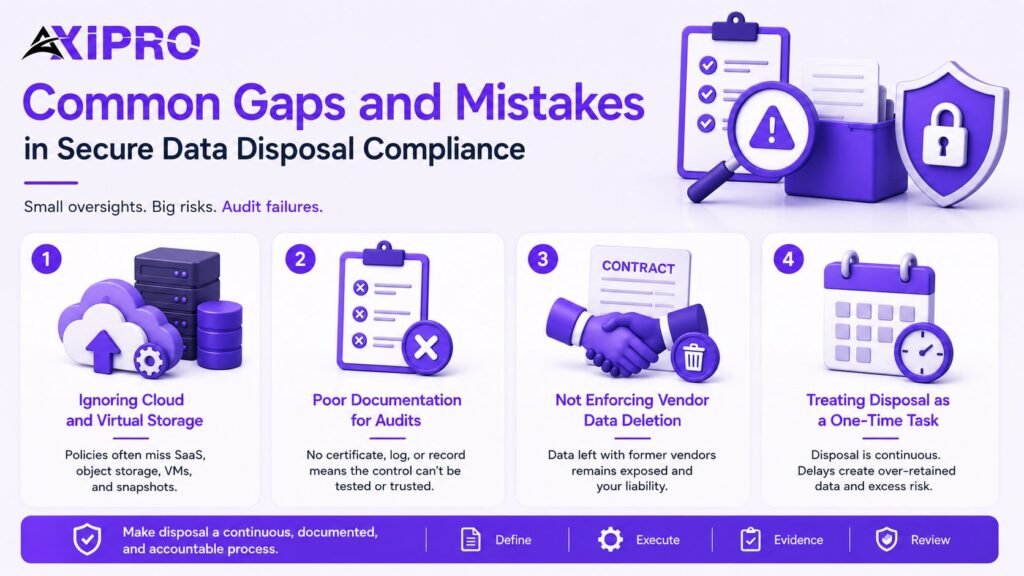
Many disposal policies still read as if all data lives on physical drives in a server room. They say nothing about deleting data from SaaS platforms, object storage, virtual machines, or snapshots — leaving a large share of the organisation’s data outside any disposal process at all. If a policy cannot answer how we dispose of data in this cloud service, it has a hole.
Inadequate Documentation for Audit Purposes
The most common audit failure is not bad disposal; it is undocumented disposal. Data may have been wiped correctly, but with no certificate, log, or asset record to prove it, the control cannot be tested and is treated as absent. The fix is mechanical: never dispose of anything without generating and retaining a record.
Overlooking End-of-Contract Data Deletion with Vendors
Organisations carefully delete their own data and then forget the copies sitting with former vendors. When a contract ends, the obligation to ensure the supplier deletes or returns data is easy to miss in the rush of offboarding. Without a closeout step and evidence of deletion, that data lingers indefinitely — fully exposed and entirely your liability.
Treating Disposal as a One-Time Task Instead of an Ongoing Control
Disposal is not a project you finish; it is a control you operate. Data reaches retention limits continuously, devices retire on a rolling basis, and erasure requests arrive without warning. Treating disposal as something you do once before an audit guarantees a backlog of over-retained data and stale equipment — which is precisely the risk all three frameworks exist to prevent.
Bringing It Together
ISO 27001, SOC 2, and GDPR speak different dialects, but they ask for the same thing: data that is genuinely unrecoverable once it has served its purpose, disposal governed by policy and matched to the data’s sensitivity, evidence that each disposal actually happened, and the same discipline extended to every vendor who touches your data.
Build one program to the strictest of the three, document everything, and treat disposal as a continuous control rather than an annual chore. Get that right and a single, well-run process clears all three frameworks at once — while closing the gap that causes most avoidable breaches.
Frequently Asked Questions
Does ISO 27001 Require Certificates of Destruction?
The standard does not name certificate of destruction as a mandatory artefact, but it requires you to evidence that information was rendered irretrievable — and a destruction or sanitisation certificate is the most practical way to do that. Auditors routinely expect a record tied to a specific asset, so in practice you should produce and retain one.
How Does GDPR Define Adequate Erasure of Personal Data?
GDPR does not prescribe a technique. It requires that personal data be erased so it can no longer be used to identify the individual, including in backups, within a reasonable timeframe. Irreversible anonymisation can also satisfy the obligation, because data that can no longer identify anyone is no longer personal data under the regulation.
Can a Single Disposal Policy Satisfy ISO 27001, SOC 2, and GDPR at the Same Time?
Yes, and that is the efficient approach. Because the frameworks overlap heavily, a policy built to the strictest common requirements — unrecoverable disposal, method matched to sensitivity, retained evidence, vendor coverage, and routine scheduled deletion — will satisfy all three. You map the single policy to each framework’s specific clauses rather than maintaining three separate programs. See our implementation guide for a worked example of how this mapping looks in practice.
What Happens if a Third-Party Vendor Fails to Dispose of Data Properly?
The accountability usually stays with you. Under GDPR the controller remains responsible for personal data even when a processor mishandles disposal, and under SOC 2 a subprocessor’s failure reflects on your control environment. Strong contractual disposal clauses and evidence of deletion reduce the risk, but they do not transfer the underlying responsibility away from you.
Is Deleting a File the Same as Secure Data Disposal Under These Frameworks?
No. Ordinary deletion removes the reference to a file while leaving the underlying data recoverable until it is overwritten. None of the three frameworks accepts this as disposal. Secure disposal requires sanitisation, overwriting, cryptographic erasure, or physical destruction to a standard where recovery is infeasible.
How Often Should Data Disposal Procedures Be Reviewed?
At least annually, and after any significant change: a new system, a new vendor, a shift to cloud storage, or a change in the underlying standards. The periodic updates to NIST 800-88 are a good example of why review matters — guidance on which technical methods are considered current does change, and a policy that lags behind it is a policy that no longer fully holds up under scrutiny.
What Evidence of Secure Disposal Is Needed for a SOC 2 Audit?
Auditors look for records that tie a disposal event to a specific asset or dataset: destruction certificates, sanitisation or wipe logs, deletion tickets, and updated asset inventories, along with the authorisation that approved the disposal. For a Type 2 report, this evidence must span the whole review period, not a single point in time.