

Most organizations think their AI governance is further along than it is. McKinsey’s 2026 AI Trust Maturity Survey of roughly 500 organizations found an average maturity score of 2.3 out of 4, and only about a third reported level three or higher in strategy, governance, and agentic AI oversight. Adoption is outpacing control, and regulators have noticed.
An AI governance maturity model gives you a way to measure that gap honestly. This guide covers what a maturity model is, the six dimensions it should measure, the five levels most models use, and how to assess your own organization and build a roadmap to the next level.
What Is an AI Governance Maturity Model?
An AI governance maturity model is a structured framework that describes how capable an organization is at governing its AI systems, usually across five progressive levels. The concept borrows directly from the Capability Maturity Model (CMM) that software engineering has used since the early 1990s: define the capability, describe what it looks like at each stage of development, and score yourself against it.
The purpose is diagnosis. A maturity model tells you where governance is strong, where it’s theater, and where it doesn’t exist at all.
How It Differs from General AI Governance Frameworks
Frameworks like the NIST AI Risk Management Framework or ISO/IEC 42001 tell you what good governance contains: policies, risk assessments, accountability structures, monitoring. A maturity model tells you how well you’re doing those things today. The framework is the destination. The maturity model is the odometer.
That distinction matters in practice. Plenty of companies can point to an AI policy document. Far fewer can show that the policy changes what teams actually ship.
Why Enterprises Need a Maturity Model
Three reasons.
- First, budget: you can’t prioritize governance investment without knowing which dimension lags.
- Second, accountability: a maturity score gives boards something concrete to track quarter over quarter.
- Third, regulation: the EU AI Act and frameworks like ISO 42001 assume a functioning management system, and a maturity assessment is the fastest way to find out whether yours would survive scrutiny.
Let Axipro help you build a business continuity plan that's practical, compliant, and audit-ready.
Schedule Your Free Assessment Today
Core Dimensions of an AI Governance Maturity Model
A useful model measures more than policy coverage. Six dimensions show up consistently across the credible models, including the IEEE-USA flexible maturity model built on the NIST AI RMF.
- Strategy and leadership. Does the organization have a stated position on AI risk, an executive owner (increasingly a Chief AI Officer), and board visibility? Gartner’s 2025 polling found 55% of organizations now have an AI board or dedicated oversight committee, which means nearly half still govern by improvisation.
- Policies, standards, and accountability. Written policies mapped to regulations, a RACI matrix for AI decisions, and clear escalation paths. Many organizations adapt the three lines of defense model from financial risk: the teams building AI, the risk function overseeing them, and internal audit checking both.
- Data governance and model lifecycle. Training data lineage, quality controls, and lifecycle management from development through deployment, monitoring, and retirement. This is where AI governance meets MLOps, and where mature organizations maintain an AI register, a live inventory of every model and system in production.
- Risk, compliance, and ethics. Risk classification of AI systems, impact assessments, bias and fairness testing, and explainability requirements. Banks will recognize the DNA of model risk management under SR 11-7 here.
- People, skills, and culture. Training, role clarity, and whether people outside the governance team actually understand their obligations.
- Tools, automation, and monitoring. Drift detection, automated policy checks, audit logging, and dashboards. Governance that lives in spreadsheets caps out around level three.
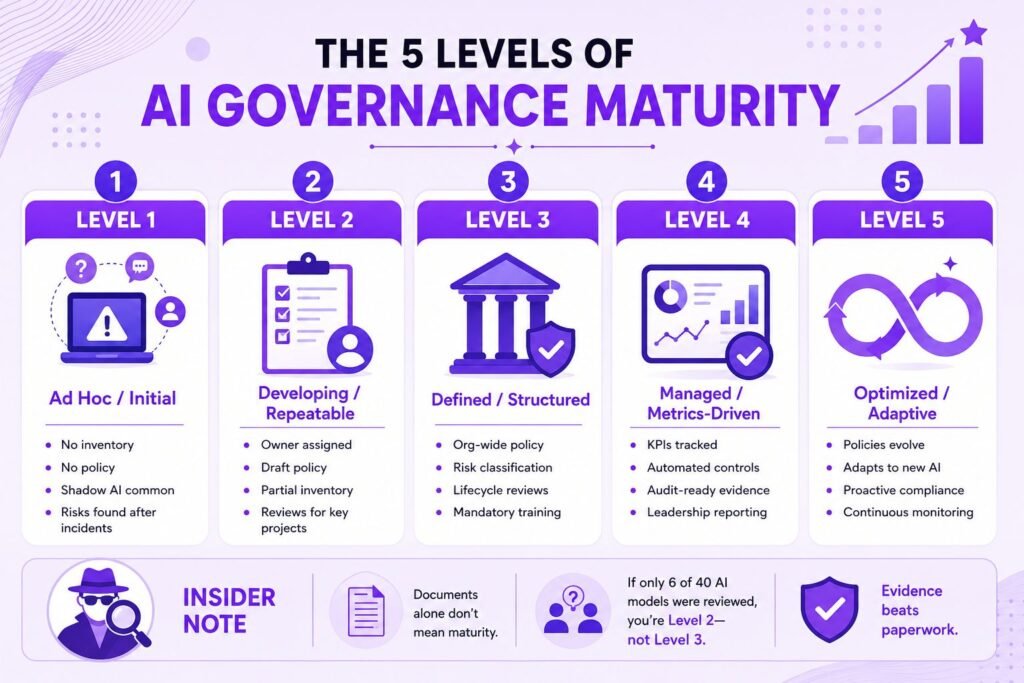
The 5 Levels of AI Governance Maturity
Level 1: Ad Hoc / Initial
AI use happens without oversight. There’s no inventory, no policy, or a policy nobody follows. Shadow AI is common, and risk surfaces only when something breaks publicly.
Level 2: Developing / Repeatable
Someone has been assigned responsibility. A draft policy exists, a partial inventory exists, and reviews happen for high-profile projects. The practices are repeatable but depend on specific people rather than defined processes.
Level 3: Defined / Structured
Governance is documented, standardized, and applied across the organization. There’s a governance committee, a risk classification scheme, defined lifecycle gates, and mandatory training. Most organizations pursuing ISO 42001 certification are working to reach and formalize this level.
Level 4: Managed / Metrics-Driven
Governance produces numbers. Coverage rates, review cycle times, incident counts, and risk reduction are measured and reported to leadership. Controls are enforced by tooling rather than goodwill, and audits confirm the system works as described.
Level 5: Optimized / Adaptive
Governance improves itself. Monitoring feeds back into policy, controls adapt to new model types (agentic systems being the current test), and the organization anticipates regulatory change rather than reacting to it. Almost nobody is here yet, and that’s fine. Level 5 is a direction, not a deadline.
Insider Note: In assessments, the most common self-scoring error is claiming level 3 on the strength of documents alone. If your policy says every model gets a pre-deployment review and your inventory shows 40 models but your review log shows 6, you’re at level 2. Evidence beats paperwork every time, and auditors check the logs first.
AI Governance Maturity Matrix
The matrix crosses dimensions with levels so you can score each one independently. Organizations are rarely uniform: it’s normal to sit at level 3 on policy and level 1 on monitoring.
For scoring, keep the rubric simple: 1 to 5 per dimension, scored on evidence you could show an auditor, not on intentions. Board-level indicators (does the board see AI risk reporting?) and operational indicators (does every production model have a completed impact assessment?) should be scored separately, because they fail independently.
How to Assess Your Current AI Governance Maturity
Start with a baseline self-assessment. Pull together a cross-functional group covering engineering, legal, risk, security, and the business owners of major AI use cases, and score each dimension against the matrix. Half a day is usually enough for a first pass.
For each dimension, the assessment comes down to a few blunt questions. Do we know every AI system we run? Who approved the last model that went to production, and can we prove it? When did we last test a model for bias or drift? Would our documentation survive an external audit? What happens, step by step, when an AI system misbehaves?
The signs of each level are usually obvious once you look. If the answer to “who owns this?” is a shrug, that’s level 1. If it’s a name, level 2. If it’s a role with a documented mandate, level 3 or better.
For benchmarking, McKinsey’s 2026 data is a reasonable reference point: the average organization sits between levels 2 and 3, with technology and financial services ahead of other sectors. If you’re at level 2, you’re normal. Staying there is the problem.
Pro Tip: Score your Agentic AI
Score your agentic AI use separately from everything else. Autonomous agents that take actions, call tools, and chain decisions break assumptions that traditional model governance relies on, and McKinsey added agentic governance as its own dimension in 2026 for exactly this reason. A level 3 program for predictive models can easily be level 1 for agents.
Aligning the Maturity Model with Established Frameworks
- NIST AI Risk Management Framework. The AI RMF organizes governance into four functions: Govern, Map, Measure, and Manage. It deliberately avoids prescribing a rigid maturity scale, which is why the IEEE-USA model built a questionnaire and scoring rubric on top of it. If you want a US-anchored, sector-neutral basis for your maturity dimensions, start here.
- ISO/IEC 42001. Published in December 2023, ISO 42001 is the first certifiable AI management system standard. It follows the same Plan-Do-Check-Act structure as ISO 27001, which makes it a natural extension for organizations that already run an ISMS. In maturity terms, certification roughly demonstrates a defined, audited level 3 with elements of level 4.
- EU AI Act. The Act’s obligations phase in over several years, and the timeline moved in 2026: under the Digital Omnibus agreed in May and formally endorsed in June 2026, obligations for standalone high-risk systems under Annex III shift to December 2, 2027, and AI embedded in regulated products under Annex I to August 2028. Penalties still reach €35 million or 7% of global turnover for prohibited practices. The extension buys time, but the high-risk obligations still assume exactly the inventory, documentation, and lifecycle controls that levels 3 and 4 describe.
- OECD and other global standards. The OECD AI Principles, adopted by nearly 50 countries, underpin most national AI policies and give multinationals a common vocabulary. ISO/IEC 23894 adds AI-specific risk management guidance that pairs well with 42001. GDPR continues to apply alongside all of it wherever personal data is involved.
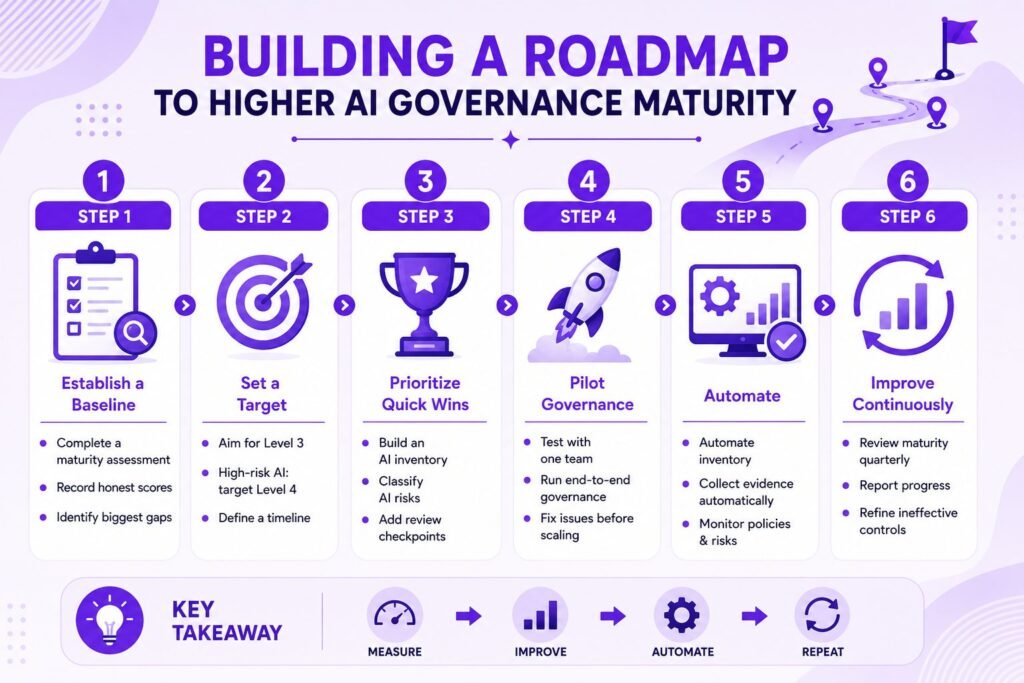
Building a Roadmap to Advance Maturity
Step 1: Establish a baseline. Run the self-assessment above and write the scores down, including the embarrassing ones. The baseline only works if it’s honest.
Step 2: Define a target maturity level. Level 3 across all dimensions is the right target for most enterprises within 12 to 18 months. Regulated industries and anyone deploying high-risk systems under the EU AI Act should aim for level 4 on risk, lifecycle, and monitoring.
Step 3: Prioritize gaps and quick wins. An AI inventory is almost always the first quick win: it’s cheap, fast, and everything else depends on it. Follow with risk classification and a lightweight review gate for new deployments.
Step 4: Run a governance pilot sprint. Pick one business unit or one model class and run the full governance process end to end for 60 to 90 days. A pilot surfaces the friction (unclear ownership, slow reviews, missing evidence) before you scale the pain organization-wide.
Step 5: Scale with automation and tooling. Manual governance doesn’t survive contact with dozens of models. Automate inventory updates, evidence collection, monitoring alerts, and policy checks. Gartner’s 2025 research found organizations investing in third-party AI governance tools were 1.9 times more likely to report high value from generative AI.
Step 6: Quarterly review and continuous improvement. Reassess maturity quarterly, report the trend to the board, and retire controls that create work without reducing risk. Maturity that isn’t re-measured decays.
Let Axipro help you build a business continuity plan that's practical, compliant, and audit-ready.
Schedule Your Free Assessment Today
Metrics and KPIs to Measure Maturity Progress
- Governance coverage metrics answer “how much of our AI estate is actually governed”: percentage of AI systems in the inventory, percentage risk-classified, percentage with completed impact assessments, and training completion rates.
- Risk reduction indicators track whether governance changes outcomes: AI incidents per quarter, time to detect and resolve model issues, drift alerts actioned, and bias findings remediated.
- Operational and efficiency metrics keep governance honest about its own cost: average review cycle time, percentage of reviews meeting SLA, and evidence collection effort per audit.
- Business outcome and ROI metrics connect governance to value, which is what keeps it funded. Gartner’s 2025 survey found that organizations running regular AI assessments were three times more likely to report high value from generative AI. Done well, governance also speeds delivery, because approvals stop being bespoke investigations.
Common Pitfalls When Implementing a Maturity Model
- Treating maturity as a checklist. A maturity model measures capability. An organization that writes twelve policies in a quarter hasn’t advanced a level; it’s produced twelve documents. Advancement means behavior changed and you can prove it.
- Ignoring cross-functional ownership. AI governance owned solely by legal produces policies engineers ignore. Owned solely by engineering, it produces monitoring nobody reports upward. The maturity assessment itself should be cross-functional, and so should the operating model that follows.
- Underinvesting in monitoring and automation. This is the most common ceiling. Organizations reach level 3 on documentation and stall because every control is manual. Without drift detection, automated evidence collection, and continuous checks, level 4 stays permanently out of reach.
Where to Go from Here
An AI governance maturity model turns a vague obligation into a measurable program: six dimensions, five levels, a baseline score, and a roadmap. The organizations getting this right treat maturity as an operating metric, reassess quarterly, and automate early. With EU AI Act high-risk deadlines now set for late 2027, the window to build toward level 3 deliberately, rather than in a panic, is open but not indefinite.
Frequently Asked Questions
When should an organization adopt an AI governance maturity model?
As soon as AI touches production systems or customer-facing decisions. Earlier is cheaper: retrofitting governance onto dozens of deployed models costs far more than building gates before scale.
Who owns the maturity assessment?
A single accountable executive (CAIO, CISO, or chief risk officer depending on structure) with a cross-functional working group doing the scoring. Ownership without cross-functional input produces blind spots; input without a single owner produces stalemate.
How long does it take to move between levels?
Moving from level 1 to 2 can take a quarter. Level 2 to 3 typically takes 6 to 12 months because it requires standardization across teams. Level 3 to 4 depends heavily on tooling investment and often takes another year.
How often should maturity be reassessed?
Quarterly for the operational scorecard, annually for a full formal assessment. Anything less frequent and the score stops reflecting reality; AI estates change too fast.
Is a maturity model required for EU AI Act compliance?
No. The Act requires specific outcomes (risk management, documentation, human oversight, monitoring) rather than any particular maturity model. But a maturity assessment is the most practical way to find out how far you are from those outcomes, and ISO 42001 certification built on a level 3+ program is emerging as the cleanest way to demonstrate readiness.