

The world’s first comprehensive AI law is not a single switch that flips on in August 2026. It is a layered regulation that has been activating in stages since February 2025. As of May 2026, it is already being rewritten to give companies more time on the hardest parts. Anyone trying to plan around a single deadline is working from a map that no longer matches the territory.
The law’s reach is also global. Just as GDPR exported European privacy norms worldwide, the EU AI Act is producing a Brussels Effect for artificial intelligence: a regulation drafted in Europe that becomes the de facto global standard. Companies in the US, the UK, Bahrain, and anywhere else with EU customers or EU-facing outputs are already in scope, whether or not they have a European office.
This guide cuts through the noise. It explains what the EU AI Act actually requires, who it applies to, which rules are already live, which were just pushed back by the EU’s recent simplification deal, and what the penalties really look like for companies of different sizes.
What Is the EU AI Act?
The EU AI Act (Regulation (EU) 2024/1689) is a horizontal law that sets harmonised rules for developing, placing on the market, and using artificial intelligence systems across the European Union. It is the first comprehensive AI law passed by any major regulator anywhere in the world, and it entered into force on 1 August 2024.
The Act takes a risk-based approach. Rather than regulating AI as a single category, it sorts AI systems into tiers based on the harm they could cause to health, safety, or fundamental rights. The higher the risk, the stricter the obligations. Prohibited uses are banned outright. High-risk uses are heavily regulated. Most everyday AI — like spam filters and product recommenders — is left alone.
The law also creates a separate, parallel regime for general-purpose AI (GPAI) models, the foundation models behind systems like ChatGPT, Claude, and Gemini. That regime is enforced at the EU level rather than at the national level.
Why Was the EU AI Act Created?
The official answer is to foster trustworthy AI in Europe. The real answer is broader: the EU watched generative AI go mainstream in late 2022 and concluded that existing law — particularly GDPR — was not enough to address the specific risks AI systems pose. Opacity in decision-making, bias in hiring tools, biometric surveillance, and the manipulation potential of generative models all sat uneasily in the regulatory gap between data protection law and product safety law.
The EU’s stated goals are to protect health, safety, and fundamental rights, while preserving innovation and the single market. The political subtext is the Brussels Effect: do for AI what GDPR did for privacy, and let European rules become the global default by virtue of market access. Brazil, Canada, the UK, several US states, and Gulf jurisdictions, including Bahrain, are already drafting AI rules that borrow heavily from the EU framework. For a broader view of how AI governance is likely to evolve through the end of the decade, the trajectory is already becoming clear.
Who Does the EU AI Act Apply To?
The Act does not apply to AI itself. It applies to people and organisations that build, sell, or use AI systems. Article 3 defines those roles without reference to company size, so a two-person startup is in scope on the same legal basis as a Fortune 500 enterprise.
Providers and Developers
A provider is anyone who develops an AI system — or has one developed — and places it on the EU market or puts it into service under their own name or trademark. Providers carry the heaviest load of obligations, particularly for high-risk systems: risk management, technical documentation, conformity assessment, post-market monitoring, and incident reporting.
A provider is distinct from a downstream developer who simply integrates a third-party AI component. But the line moves: if you take a general-purpose model and put your name on the resulting product, you can become a provider yourself.
Deployers and Operators
A deployer is anyone using an AI system in a professional capacity. If you are a bank running a credit-scoring model you bought from a vendor, you are a deployer. Deployers have lighter obligations than providers but still carry real ones: ensuring human oversight, monitoring system behaviour, informing affected individuals, and conducting fundamental rights impact assessments where required.
The term operator in the Act is an umbrella that covers providers, deployers, importers, distributors, and authorised representatives.
Application Outside the EU
This is where many non-EU companies get caught. The AI Act applies extraterritorially. A US LLC training a model in Texas, a UK firm running an AI hiring tool, or a Bahrain-based fintech using AI for credit scoring is in scope the moment the output affects someone in the EU. If a US company develops an AI hiring tool and a German employer uses it on German candidates, the US provider is in scope — even with no EU office. The trigger is whether the system’s output is used in the Union, not where the company sits.
Pro Tip: Selling AI tools to EU customers outside the EU.
If you sell AI tools to EU customers from outside the EU, you must appoint an authorised representative established in a Member State before placing high-risk systems on the market. This is not optional and is one of the most commonly missed obligations for non-EU providers.
The Risk-Based Approach: How the EU AI Act Classifies AI Systems
The framework sorts AI systems into four tiers. The obligations scale with the tier.
Unacceptable Risk: Prohibited AI Practices
Article 5 prohibits eight categories of AI practice outright. These prohibitions became enforceable on 2 February 2025, well before the rest of the Act. The banned practices are:
Subliminal or manipulative techniques are designed to distort behaviour and cause significant harm. Exploitation of vulnerabilities related to age or disability. Social scoring by public or private actors — the kind of system that assigns citizens a trustworthiness rating based on their behaviour.
Predictive policing based solely on profiling. Untargeted scraping of facial images to build recognition databases. Emotion inference in workplaces and schools. Biometric categorisation that infers sensitive attributes like race or sexual orientation. And real-time remote biometric identification in public spaces for law enforcement, with only narrow exceptions.
Maximum fines for breaches of Article 5 are EUR 35 million or 7% of worldwide annual turnover, whichever is higher.
High-Risk AI Systems
The Act’s main regulatory weight falls here. The clearest example — and the one most organisations will recognise — is hiring algorithms: AI used to screen CVs, rank candidates, or score applicants against a job profile. Under the Act, those systems are high-risk by default, with all the documentation, oversight, and conformity-assessment obligations that come with the classification.
High-risk systems are split into two groups. The first covers AI used as a safety component in products already regulated under existing EU sectoral law: medical devices, machinery, toys, lifts, and vehicles.
The second is the Annex III list — a defined set of standalone AI use cases in sensitive areas: biometric identification, critical infrastructure, education and vocational training, employment and worker management (where the hiring algorithm sits), access to essential private and public services like credit scoring and insurance, law enforcement, migration and border control, and administration of justice and democratic processes.
A 2023 study by appliedAI of 106 enterprise AI systems found that 18% were high-risk, 42% low-risk, and 40% were unclear, which gives a sense of how much classification work most organisations still have ahead of them.
Limited or Transparency Risk
This middle tier covers AI systems that are not high-risk but still warrant disclosure. Chatbots must tell users they are talking to a machine. Deepfakes and AI-generated content must be labelled. Emotion recognition and biometric categorisation systems must inform the people they observe. These are transparency obligations, not full compliance regimes.
Minimal or No Risk
Everything else. Spam filters, AI in video games, basic recommender systems, predictive text. The AI Act introduces no rules for AI deemed minimal or no risk. The vast majority of AI systems currently used in the EU fall into this category, though other laws — GDPR compliance, consumer protection, and sectoral rules — still apply.
Requirements for High-Risk AI Systems
Providers of high-risk AI systems carry the heaviest compliance burden under the Act. The requirements form an interlocking set of obligations covering the entire lifecycle of the system, from design through post-market monitoring.
Technical and Data Standards
Every high-risk system needs a risk management system that runs continuously throughout the system’s life — not a one-off pre-launch checklist. Training, validation, and testing data must meet quality criteria around relevance, representativeness, and accuracy. Bias must be identified and addressed, particularly where it could affect protected characteristics.
Technical documentation must be prepared before the system is placed on the market and kept up to date. Automatic logging must be built into the system to enable traceability of outputs.
Systems must reach an appropriate level of accuracy, robustness, and cybersecurity. After satisfying those requirements, the system goes through a conformity assessment, receives a CE mark, and is registered in an EU-wide database before it can be sold.
Obligations on Operators of High-Risk AI Systems
Deployers of high-risk systems must use the system in accordance with the provider’s instructions, ensure adequate human oversight by people with the necessary competence and authority, monitor the system for malfunctions or unexpected behaviour, keep automatic logs, and inform workers (and their representatives) before deploying a high-risk AI system in the workplace. Public-sector deployers and certain private operators in finance and insurance must also conduct a Fundamental Rights Impact Assessment before first use, assessing impact against the rights protected under the Charter of Fundamental Rights of the European Union.
Transparency Requirements
Across the high-risk regime, transparency runs as a thread. Deployers must be given enough information to understand how the system works, what its limitations are, and how to interpret its outputs. End users affected by automated decisions have the right to an explanation and to contest outcomes.
Insider Note: The Commission’s Digital Omnibus package, agreed politically on 7 May 2026, ties the application of high-risk obligations to the availability of harmonised technical standards. If those standards are not ready, the high-risk deadlines slip to late 2027 or August 2028, depending on the system type. Most organisations are still planning around August 2026; the practical date may now be later for many of them.
Rules for General-Purpose AI (GPAI) Models
GPAI models are regulated separately from AI systems. They sit upstream of most products that integrate them, so the Act treats them as a distinct layer with its own enforcement track inside the AI Office.
What Qualifies as a General-Purpose AI Model?
A GPAI model is one that shows significant generality, can competently perform a wide range of distinct tasks, and can be integrated into many downstream systems. Providers of GPAI models — defined as those trained above 10²³ floating-point operations — must meet transparency obligations and comply with EU copyright law.
A subset of these, GPAI models with systemic risk, face additional obligations. The current threshold is models trained with more than 10²⁵ FLOPs, which covers a small set of frontier models from a handful of providers.
Core Obligations for GPAI Providers
All GPAI providers face three core obligations. They must maintain detailed technical documentation of the model and share information with downstream developers integrating it. They must comply with EU copyright law, including respecting a clear opt-out for rightsholders who do not want their work used for training. And they must publish a detailed summary of the content used for training, using a template issued by the AI Office — the most novel of the three, since it forces transparency over training data in a way no other major jurisdiction currently requires.
Providers of systemic-risk GPAI models do all of the above and must additionally evaluate their models for systemic risks, conduct adversarial testing, assess and mitigate identified risks, report serious incidents to the AI Office without undue delay, and maintain an adequate level of cybersecurity. The GPAI rules became applicable on 2 August 2025, with full enforcement powers entering application on 2 August 2026.
Code of Practice for General-Purpose AI
To bridge the gap between the law coming into force and harmonised technical standards being published, the Commission worked with independent experts and over 1,000 stakeholders to develop the General-Purpose AI Code of Practice, finalised in July 2025. The Code has three chapters: Transparency, Copyright, and Safety and Security. The first two apply to all GPAI providers; the third only to systemic-risk providers.
Signing the Code is voluntary, but providers that do not sign must demonstrate alternative adequate means of compliance for the Commission to approve. The Safety and Security chapter has been drafted on the assumption that only about 5 to 15 providers worldwide will currently meet the systemic-risk threshold — a deliberately narrow group covering the makers of the most advanced frontier models.
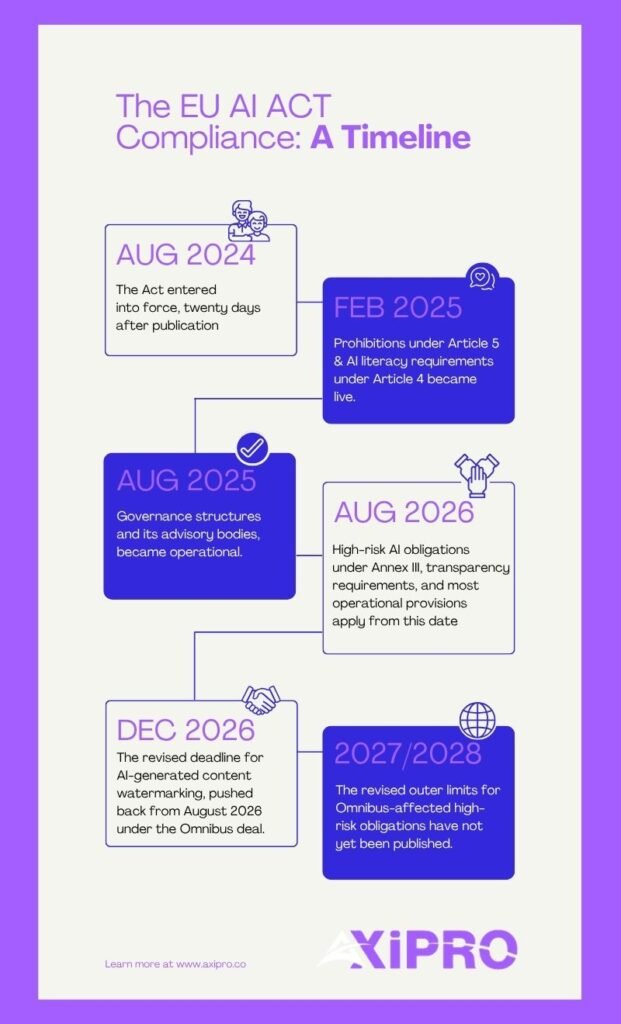
EU AI Act Compliance Timeline and Application Dates
The Act applies in stages, and those stages have been moving. The May 2026 political agreement on the Digital Omnibus has reset several of the later deadlines. Here is the current picture:
1 August 2024 — The Act entered into force, twenty days after publication in the Official Journal. This is not a compliance deadline; it is the moment the law became part of the EU legal system.
2 February 2025 — Prohibitions under Article 5 became enforceable. AI literacy requirements under Article 4 also became live. These two chapters are already in full effect.
2 August 2025 — GPAI obligations became applicable. Governance structures, including the AI Office and its advisory bodies, became operational.
2 August 2026 — The headline general application date. High-risk AI obligations under Annex III, transparency requirements, and most operational provisions apply from this date — subject to the Omnibus caveat that where harmonised standards are not available, certain deadlines shift further.
Late 2027 / August 2028 — The revised outer limits for Omnibus-affected high-risk obligations where harmonised standards have not yet been published. For Annex I embedded systems (safety components in regulated products), the deadline now falls in August 2027.
2 December 2026 — The revised deadline for AI-generated content watermarking, pushed back from August 2026 under the Omnibus deal.
Governance and Enforcement
The AI Act is enforced through a hybrid model. The Commission, through the AI Office, holds direct enforcement powers over GPAI models. Member States enforce most of the rest through national market surveillance authorities.
The EU AI Office
The European AI Office sits inside the Commission’s Directorate-General for Communications Networks, Content and Technology (DG CNECT). It enforces the rules for general-purpose AI models EU-wide and supports national governance bodies. Its powers include conducting evaluations of GPAI models, requesting information and measures from model providers, and applying sanctions.
The Office works alongside three advisory bodies: the European Artificial Intelligence Board (Member State representatives), the Scientific Panel of Independent Experts, and the Advisory Forum (stakeholders from industry, civil society, and academia).
EU AI Act Fines and Penalties
The penalty structure has three tiers, set out in Article 99.
Prohibited practices (Article 5): Up to EUR 35 million or 7% of worldwide annual turnover, whichever is higher.
Most other breaches (high-risk obligations, GPAI rules, transparency requirements): Up to EUR 15 million or 3% of worldwide annual turnover, whichever is higher.
Providing incorrect or misleading information to authorities: Up to EUR 7.5 million or 1% of worldwide annual turnover, whichever is higher.
The “whichever is higher” formula means the percentage almost always wins for companies of any meaningful size. These penalties exceed GDPR’s maximum of EUR 20 million or 4% of turnover, making the AI Act the second-highest percentage-based penalty regime in EU digital regulation.
For SMEs and startups, the formula is inverted: the fine is the lower of the fixed amount or the percentage. A startup with EUR 2 million in revenue that breaches Article 5 faces a maximum fine of EUR 140,000 — not EUR 35 million. The reduction is real but not trivial; EUR 140,000 can still be existential for an early-stage company.
Important: The turnover used to calculate the percentage is group-level, not entity-level. A subsidiary deploying a prohibited AI system can expose the parent company’s full global revenue to the percentage calculation. This is the same trap that caught several companies under GDPR.
Supporting Compliance and Innovation
AI Regulatory Sandboxes
By 2 August 2026, every Member State must have at least one national AI regulatory sandbox operational. These are controlled environments where providers can develop, train, validate, and test AI systems under regulatory supervision before placing them on the market. Providers participating in sandboxes remain liable under applicable liability laws but are protected from administrative fines if they follow sandbox guidelines in good faith.
SMEs and startups get priority, free access to sandboxes. Documentation generated through sandbox participation can be used to demonstrate compliance with the Act, which materially reduces the cost of getting a high-risk product to market. The Omnibus deal also introduces an EU-level sandbox for cross-border or particularly complex cases.
AI Literacy Requirements Under Article 4
Article 4 has been live since 2 February 2025. It requires providers and deployers to ensure a sufficient level of AI literacy among their staff and others operating AI systems on their behalf. There is no mandated curriculum, no minimum number of hours, no certificate.
What organisations need is a documented program covering: general understanding of AI, the organisation’s role as provider or deployer, the specific risks of the AI systems in use, and role-appropriate depth (a compliance officer needs different training from a software engineer).
Insider Note: Standalone enforcement of Article 4 is unlikely to be a regulator’s first priority. The real risk is that absence of a documented AI literacy program becomes an aggravating factor in enforcement action for some other breach. Treat it as foundational, not optional.
How the Commission Is Simplifying EU AI Act Implementation
The Digital Omnibus, presented by the Commission on 19 November 2025 and politically agreed on 7 May 2026, is the most significant softening of the AI Act since it was adopted. As reported by the Financial Times, the package reflects sustained pressure from European industry — particularly German manufacturing — and broader anxiety in Brussels (sharpened by the Draghi report on European competitiveness) that the EU has been over-regulating itself out of the AI race.
Key changes include: conditioning the application of high-risk obligations on the availability of harmonised technical standards, with deadlines pushed to late 2027 or August 2028 where standards lag; narrowing the definition of “safety component” so that AI which merely assists users will not automatically be high-risk; extending simplified requirements to small mid-cap companies (SMCs), a new category sitting between SMEs and large enterprises; reinforcing the AI Office’s enforcement powers; expanding sandbox access including an EU-level sandbox; and pushing the AI-generated content watermarking deadline from August to 2 December 2026.
Small Business Guide to the EU AI Act
There is no general size exemption. A microenterprise developing a high-risk AI system has the same core obligations as a multinational. But the Act builds in specific support measures that meaningfully change the compliance calculus for smaller players.
These include the inverted fine calculations described above, free priority access to regulatory sandboxes, simplified technical documentation requirements, and the principle of proportionality applied to fees for third-party conformity assessment.
The Commission must regularly assess the cost of compliance for SMEs and consult them directly when developing standards and implementing acts. The Omnibus deal extends several of these concessions to the new SMC category as well.
For SMEs grappling with AI governance alongside broader data management obligations, frameworks like ISO/IEC 42001 — the international standard for AI management systems — can provide a useful structural backbone that satisfies both regulatory and certification goals simultaneously.
How Axipro Helps Clients Navigate the EU AI Act
EU AI Act compliance is not a single workstream. It sits at the intersection of technical auditing, data governance, legal interpretation, and product design — and it has to be maintained as the regulation itself keeps moving. Axipro’s AI Governance team supports clients across four areas.
AI Risk Categorisation.
We inventory the AI systems already in use across an organisation, map each one against the Act’s risk tiers, and flag the systems most likely to fall under the high-risk regime. For most clients, this is the single highest-value first step, since the appliedAI research found 40% of enterprise AI systems sit in a grey zone where the classification is unclear without expert review.
Governance Framework Design.
We help clients build the internal policies that the Act requires in practice: risk management procedures, data quality standards, transparency disclosures, AI literacy programs, and the documentation that ties them together. The goal is a framework that satisfies Article 4 today and scales to the high-risk requirements as they come into effect.
Conformity Assessments.
For clients with high-risk systems, we prepare the technical documentation, run pre-assessment audits, and coordinate with notified bodies on the mandatory certification process so that systems clear the CE-marking and EU database registration steps before they go to market.
Continuous Monitoring.
Compliance is not a launch event. Models retrain, use cases shift, and the regulation itself changes — the Omnibus deal being the clearest recent example. We provide continuous monitoring so that as AI systems and rules evolve, the compliance posture stays intact.
For organisations building, deploying, or selling AI in markets that touch the EU, the next twelve months are when planning becomes execution. Contact the Axipro Global Consulting Team to scope an AI governance review for your business.
What Is the EU AI Act in Simple Terms?
It is a single EU regulation that classifies AI systems by risk and applies different rules to each tier — from outright bans on the most harmful uses, to mandatory transparency and risk management for high-risk uses, with most everyday AI left alone.
What Types of AI Are Covered Under the EU AI Act?
Any software system meeting the Act’s definition of an AI system: one that operates with varying levels of autonomy, may exhibit adaptiveness after deployment, and infers from its inputs how to generate outputs such as predictions, content, recommendations, or decisions. Both narrow AI systems and general-purpose AI models are covered, with separate regimes for each.
What Is Considered High-Risk AI Under the EU AI Act?
Two groups: AI used as a safety component in products already regulated under EU sectoral law (medical devices, machinery, vehicles), and standalone AI in the Annex III use cases — biometrics, critical infrastructure, education, employment, essential services, law enforcement, migration, and administration of justice.
When Does the EU AI Act Take Full Effect?
The headline date is 2 August 2026, but several obligations are already live (prohibitions and AI literacy since February 2025; GPAI rules since August 2025), and several others now apply later (Annex I high-risk in August 2027; some Omnibus-affected obligations as late as August 2028).
What Are the Maximum Fines Under the EU AI Act?
Up to EUR 35 million or 7% of worldwide annual turnover for prohibited practices; EUR 15 million or 3% for most other breaches; EUR 7.5 million or 1% for misleading authorities. For SMEs, the lower of the fixed amount or the percentage applies rather than the higher.
Does the EU AI Act Apply to Companies Outside the EU?
Yes. If the output of an AI system is used in the EU, the provider is in scope regardless of where they are based. Non-EU providers of high-risk AI systems must appoint an authorised representative established in a Member State.
How Does the EU AI Act Affect Small Businesses and Startups?
The same core obligations apply as for large companies, but with inverted fine calculations, free priority sandbox access, simplified documentation requirements, and proportional fees for third-party conformity assessment. The Omnibus extends several of these concessions to the new small mid-cap category.
What Is the EU AI Office and What Role Does It Play?
A unit inside the European Commission that enforces GPAI obligations EU-wide, coordinates national authorities, runs the AI Pact and Service Desk, and develops most of the secondary legislation and guidance underpinning the Act.
Is AI Dangerous? Why Does the EU Feel Regulation Is Necessary?
The EU’s position is not that AI is inherently dangerous, but that certain uses of AI can cause serious harm to health, safety, and fundamental rights — and that existing law does not adequately cover those uses.
The risk-based approach is the EU’s attempt to regulate the harmful uses without smothering everything else. Whether the balance is right is now the central political question, and the May 2026 Omnibus deal is evidence that even the EU is not fully convinced it landed in the right place the first time.


