SOC 2

SOC 2 Compliance Services: Get Certified in 6 Weeks

Expert-led SOC 2 Type I and Type II certification for companies worldwide. 100% audit pass rate, all under 6 weeks. Serving the USA, UK, EMEA, GCC, Singapore, Australia, New Zealend and beyond.

Trusted by 200+ companies

Why 100+ Companies Trust Axipro for SOC 2:

  • 6 Week Certification Timeline
    While traditional consultants take 6-9 months, we get you SOC 2 ready in 6 weeks.
  • 100% First-Attempt Pass Rate
    Zero failed audits in 5+ years. Our certified auditors know exactly what examiners look for, because many of them have been on the other side of the table.
  • Transparent, Affordable Pricing
    No surprise fees. No bloated retainers. No revised timelines. Clear scope, fixed-cost engagements that fit startup budgets and enterprise needs.


Our SOC 2 Services Cover Everything:

SOC 2 Type I Certification

Perfect for companies that need to prove compliance fast. Get your audit report in 6 weeks.

SOC 2 Type II Certification

The gold standard for enterprise sales. We guide you through the observation period and audit prep with continuous monitoring.

SOC 2 Readiness Assessment

Not sure where to start? Get a free gap analysis showing exactly what you need to do to certify.

Multi-Framework Compliance

Adding ISO 27001, HIPAA, or PCI DSS? We leverage 60-70% control overlap to certify multiple frameworks simultaneously.

Ongoing Compliance Support

Annual renewals, surveillance audits, and continuous monitoring so you’re always audit-ready.

Reach SOC 2 Compliance in 6 Weeks or Less

Schedule Your Free SOC 2 Assessment Today

How it Works: Our 6-Week SOC 2 Process

We guarantee SOC 2 readiness in 6 weeks or less. Here is how the work breaks down.

Week 1: Scoping and Gap Assessment

We map your current state against the Trust Services Criteria you need. You leave week one with a clear list of every gap that needs to close before the audit.

Weeks 2 and 3: Control Design and Implementation

We help your team implement the missing controls: access reviews, encryption standards, vendor management, change management, monitoring. Where you already have something working, we keep it. Where you don’t, we provide templates, policies, and configurations you can adopt immediately.

Weeks 4 and 5: Automation and Evidence Collection

We connect your systems to a compliance platform (Drata, Vanta, or Thoropass, depending on your stack). The platform automates evidence collection. By the end of week five, your evidence is collecting itself in the background.

Week 6: Audit Preparation and Handoff

We run a final readiness review, address any last-mile findings, and hand you over to an independent auditor with a complete evidence package. From this point forward, the audit itself runs on the auditor’s timeline, typically two to four weeks for Type 1 and the length of your observation window for Type 2.

The 6-week clock applies to everything Axipro controls: scoping, implementation, evidence collection, and audit preparation. The independent audit happens after.

G2 Clients Trust AxiPro

Trusted by clients on G2, Axipro stands out for real support, clear communication, and fast results. Our clients’ stories show how we simplify compliance and build lasting trust through genuine partnerships.
The Axipro SOC 2 Difference:

Without Axipro

What You Get With Axipro

SOC 2 Compliance and Why It Matters for Your Business

SOC 2 compliance is now a standard requirement for SaaS companies, fintech platforms, and cloud service providers that handle customer data.

Axipro helps organizations achieve SOC 2 readiness and certification faster by combining compliance expertise with modern automation platforms such as Drata and Vanta.

Our SOC 2 consulting services help you:

  • prepare for SOC 2 Type 1 and Type 2 audits

  • implement security controls aligned with the AICPA Trust Services Criteria

  • streamline evidence collection and documentation

  • reduce audit timelines and operational friction
SOC 2

SOC 2 Compliance is vital for service organizations handling sensitive data. It ensures they follow strict rules for security, availability, processing integrity, confidentiality, and privacy. Certified Public Accountants (CPAs) conduct thorough audits based on AICPA guidelines, resulting in Type 1 or Type 2 Certification. Type 1 Certification checks control design and implementation at one time, while Type 2 Certification examines control effectiveness over a period, often six months or more.

SOC 2 assesment reports, derived from these audits, reassure stakeholders, especially those using outsourced software storing customer data online. These reports show the organization’s commitment to protecting data integrity and confidentiality. SOC 2 Compliance confirms reliability and trustworthiness, highlighting the organization’s dedication to strong controls and security.

Reach SOC 2 Compliance in 6 Weeks or Less

Schedule Your Free SOC 2 Assessment Today

Benefits of SOC 2 Implementation

Risk Assessment

Start with a thorough risk assessment to identify potential vulnerabilities and threats to your systems.

Implement Controls

Implement necessary controls and policies to address the identified risks. This may include access controls, encryption, and regular monitoring.

Documentation

Document your processes, policies, and controls. This documentation will be crucial during the audit process.

Pre Assessment

Consider a pre-assessment to evaluate your readiness for the official audit. This step helps you identify and address any gaps.

Official Audit

Engage a qualified third-party auditor to conduct the SOC 2 audit. They’ll assess your controls, policies, and overall compliance with the trust service criteria

SOC 2 Type 1 vs Type 2: Which One Does Your Business Actually Need?

Most founders asking about SOC 2 are not sure which type their customer is asking for. Here is the short answer.

SOC 2 Type 1 confirms that your security controls are properly designed at a single point in time. It is a snapshot. Auditors look at your policies, systems, and processes on one specific date and confirm everything is in place.

SOC 2 Type 2 confirms that those same controls actually worked over a period of time — typically 3 to 12 months. Instead of a snapshot, it is a track record.
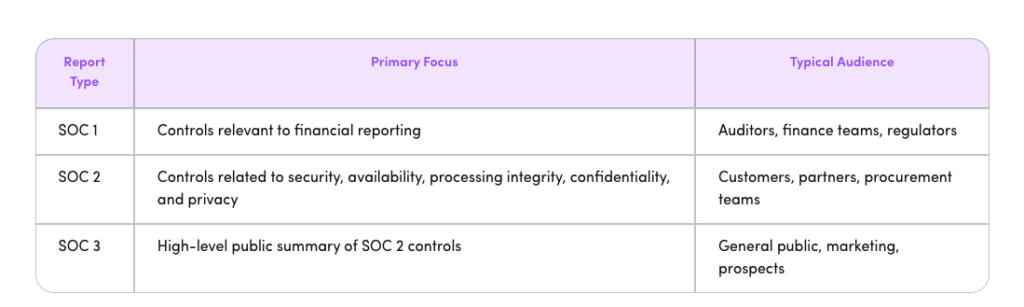
Which one do enterprise buyers expect?

Almost always, Type 2.

When a prospect asks for “your SOC 2 report,” 9 times out of 10 they mean Type 2. Type 1 is rarely accepted on its own by mature buyers. It is often used as a stepping stone — companies pursue Type 1 first to unblock a deal quickly, then transition to Type 2 over the following observation window.

When Type 1 makes sense

  • You have a deal on the line and need proof of compliance in weeks, not months.
  • You are early-stage and want to demonstrate progress to investors or pilot customers.
  • You plan to follow up with Type 2 within the next 6 to 12 months.

When Type 2 is the right call

  • An enterprise customer has explicitly asked for it.
  • You are entering procurement processes with mid-market or large companies.
  • You want one report that lasts you a full year of sales conversations.

If you are unsure, the cheapest path is to scope the work for Type 2 from day one and run a Type 1 as an intermediate milestone. That avoids paying twice for the same readiness work.

Who We Serve

We work with companies whose customers demand proof of security before signing. The specific challenges differ by industry.

SaaS and B2B Software

SaaS companies are usually the first to hit a SOC 2 wall. The trigger is almost always a procurement team blocking a contract until a report is on the table. The challenge is moving fast enough to keep the deal alive while building controls that scale beyond the first audit. Most of our SaaS clients close their first SOC 2 within six weeks of engagement.

Fintech and Financial Services

Fintech companies operate under tighter scrutiny than typical SaaS. Banking partners, payment processors, and regulators all expect proof of strong controls. SOC 2 is often the floor, not the ceiling — many fintech clients also need ISO 27001, PCI DSS, or specific regulatory attestations. We help fintech teams build a compliance foundation that supports multiple frameworks without rebuilding from scratch each time.

Cloud Service Providers and Infrastructure

Cloud providers face a unique challenge: their customers are often the ones being audited, and they pull on their providers for evidence. A clean SOC 2 Type 2 report is no longer optional — it is a sales tool. We help cloud and infrastructure companies design controls that satisfy both their auditors and the inherited control requirements of their downstream customers.

Outsourcing and BPO Providers

BPO firms handle sensitive client data at scale, often across multiple jurisdictions. SOC 2 is the most common framework requested by enterprise clients before they will outsource a process. The challenge for BPO providers is implementing controls that survive frequent staff turnover and varied client environments. We design SOC 2 programs around process consistency rather than individual heroics.

Regions Served- SOC 2 Compliance Services Worldwide

Axipro provides expert SOC 2 compliance services to companies across the globe, with deep expertise in regional regulatory requirements and international standards.

SOC 2 Compliance Services in the United States

We serve SaaS companies, fintech startups, and cloud service providers across the USA, including major tech hubs like San Francisco, New York, Austin, Denver, Seattle, and Boston. Our remote-first delivery model means same-time-zone support regardless of location, with rapid response times for urgent enterprise sales deadlines.

SOC 2 Compliance Services in Bahrain & GCC

With our Main Office located in Bahrain, Axipro is a trusted SOC 2 compliance partner for companies across Bahrain, UAE, Saudi Arabia, Qatar, and the broader GCC region. We help Middle Eastern technology companies achieve SOC 2 certification to compete for global enterprise contracts and unlock opportunities for international expansion.

SOC 2 Compliance Services in the United Kingdom

From London to Manchester and across the UK, Axipro delivers SOC 2 certification aligned with both US trust service criteria and UK GDPR requirements. Ideal for UK-based SaaS companies expanding into the US market or serving American enterprise customers.

SOC 2 Compliance Services in Australia & New Zealand

Serving companies across Sydney, Melbourne, Auckland, and beyond, Axipro provides SOC 2 certification services that satisfy both APAC and global enterprise requirements.

SOC 2 Compliance Services in Singapore & Southeast Asia

Singapore-based companies and APAC operations trust Axipro for SOC 2 certification aligned with PDPA requirements and international security standards.

SOC 2 Compliance Services in EMEA

In late 2025, Axipro opened a Lisbon office to better serve the EMEA region. We now count on a distributed team in Lisbon, Berlin, Amsterdam, and London. Across Europe, the Middle East, and Africa, we deliver SOC 2 certification that complements GDPR compliance and regional data protection requirements.

Reach SOC 2 Compliance in 6 Weeks or Less

Schedule Your Free SOC 2 Assessment Today

SOC 2 Customer Stories
Axipro led Sertalink through a streamlined process, achieving ISO 42001 and ISO 22301 certification within a defined, fast-track timeline. Using a structured, end-to-end approach, Axipro implemented all required controls, policies, and continuity requirements and prepared Sertalink for external audit without rework or delays. A rigorous pre-audit readiness review ensured full alignment with certification requirements before the final assessment.
For VidLab7, achieving ISO 27001 and SOC 2 compliance required clarity, coordination, and a partner who understood the fast-moving world of AI and SaaS. They turned to Axipro for structured advisory support that would help them prepare efficiently without slowing down innovation.
In less than 3 months, The QA Company achieved ISO 27001 certification, completed GDPR compliance, and prepared for ISO 42001, strengthening trust and governance.
For MediConCen, pursuing ISO 27001 certification wasn’t just about compliance; it was about trust and transparency
In less than 3 months, The QA Company achieved ISO 27001 certification, completed GDPR compliance, and prepared for ISO 42001, strengthening trust and governance.

SOC 2 Resource Hub

Researchers who buy second-hand drives off online marketplaces keep finding the same thing: live data.  A widely cited study by Blancco Technology Group found that 42% of used drives sold on eBay still held recoverable information, including financial records and personal data the previous owners assumed was long gone. The drives were not hacked; they were thrown away by organizations that treated deleting a file as the same thing as destroying it. Secure data disposal is where many compliance programs fail. ISO 27001, SOC 2, and GDPR all demand it, but they describe it in different languages, enforce it through different mechanisms, and punish failure in very different ways.  This article sets out what each framework requires, where the requirements overlap, and how to run a single disposal program that satisfies all three at once. Why Secure Data Disposal Matters Across Compliance Frameworks Disposal is the last link in the data lifecycle, and the easiest one to skip. An organization can run flawless access controls, encryption, and monitoring for years and still cause a reportable breach the moment one unwiped laptop leaves the building. A recoverable drive in a recycling skip is functionally identical to an open database on the internet, and auditors and regulators know it. Most disposal failures are unforced errors: a control that was already written into policy but never carried through to the actual hardware. The gap between having a disposal policy and proving this specific drive was destroyed is exactly where audits and breach investigations live. Defining Secure Data Disposal: Key Terms and Concepts What Is Secure Data Disposal? Secure data disposal is the end-to-end process of removing data and the equipment that holds it from active use, in a way that prevents its recovery. It covers the full lifecycle end: deletion of data while a system is still live, sanitisation of media that will be reused, physical destruction of media that will not, and the safe handling of equipment that is recycled, returned to a lessor, or sold. Disposal is the goal. The methods are how you get there. What Is Secure Data Destruction? Secure data destruction is the subset of disposal that renders media permanently unusable or its contents mathematically irretrievable. Shredding a drive, pulverising it, incinerating it, or destroying the encryption keys that make an encrypted disk readable are all forms of destruction. Destruction is one route to disposal, and it is the right route when the data is highly sensitive, or the media will never be reused. Secure Data Disposal vs. Secure Data Destruction: What Is the Difference? The distinction matters more than it looks. Disposal is the outcome you owe to every framework: data gone, unrecoverable, equipment handled appropriately. Destruction is just one of the methods. You can dispose of data without destroying the hardware by sanitising a drive thoroughly enough to reuse it. Confusing the two leads to two classic mistakes: destroying assets that could have been securely wiped and reused, and assuming a quick deletion counts as disposal when it does not. Important: Emptying the recycle bin, formatting a drive, or hitting delete does not dispose of data under any of these frameworks. Standard deletion only removes the pointer to the data; the bits remain until they are overwritten. Every framework discussed here expects the data to be unrecoverable, which is a far higher bar than not visible. What ISO 27001 Requires for Secure Data Disposal ISO/IEC 27001 handles disposal through a small cluster of Annex A controls that auditors read as a single process rather than in isolation. The two controls that do most of the work are 7.14 and 8.10. For a deeper look at how these controls fit into a broader compliance program, see our ISO 27001 implementation guide. ISO 27001 Annex A 7.14: Secure Disposal or Re-Use of Equipment Annex A 7.14 is a physical control. Before any equipment is disposed of or reused, the organisation must check whether it holds information assets or licensed software and ensure those are permanently erased or the media physically destroyed. It applies to servers, laptops, desktops, mobile devices, printers, network gear, and any storage media: if it ever processed information, it is in scope. The control replaces the older 2013 clause 11.2.7 and adds explicit expectations around removing identifying markings and handling end-of-occupancy scenarios. ISO 27001 Control 8.10: Information Deletion Annex A 8.10 is a technological control, and it focuses on the data rather than the box. It requires information stored in systems, devices, or media to be deleted when it is no longer required, and rendered unrecoverable. The cleanest way to keep these straight: 8.10 governs the data while it is in use or reaches its retention limit; 7.14 governs the hardware at end of life. Most retention-driven deletion sits under 8.10; most decommissioning sits under 7.14. ISO 27001 Control 8.12: Data Leakage Prevention and Its Role in Disposal Control 8.12 is rarely filed under disposal, but improperly discarded media is one of the oldest data leakage channels there is. A drive that leaves your control with recoverable data on it is a leak, regardless of how it left. Treating disposal as part of your leakage prevention posture forces the right question at the right time: what could walk out the door on this device, and has it actually been removed? Physical Destruction and Irretrievable Erasure Under ISO 27001 ISO 27001 offers two broad routes: physically destroy media that holds information, or erase and overwrite it so retrieval by a malicious party is precluded. The standard cross-references ISO/IEC 27040 for detailed sanitisation methods. The unifying requirement is that recovery should be impractical, not merely inconvenient. Deletion alone never satisfies this. Overwriting, Full-Disk Encryption, and Other Approved Methods Overwriting user-accessible storage with multiple passes is acceptable for many sensitivity levels. Full-disk encryption changes the economics of disposal entirely: if a device is encrypted from day one and the keys are properly managed, secure disposal can be as simple as destroying the keys, a technique known as

A business continuity plan that has never been tested is, to a SOC 2 auditor, a document and nothing more. The Availability criteria do not award credit for a polished plan sitting in a shared drive. They ask for evidence that you ran the plan, watched it work or fail, recorded what happened, and fixed what broke. That gap — between having a plan and proving it works — is where most availability findings originate. Business continuity plan testing for SOC 2 is the exercise that turns your plan into auditable evidence. It maps directly to Availability criterion A1.3, one of the few SOC 2 controls that explicitly requires you to test something rather than merely document it. This guide covers what counts as a valid test, the test types auditors accept, a step-by-step process, the exact evidence you need, and the mistakes that turn a routine review into a finding. What Is Business Continuity Plan Testing in the Context of SOC 2? Business continuity plan (BCP) testing is the structured validation of whether your organization can keep critical operations running — and restore them within defined targets — during a disruption. In a SOC 2 context, the testing is not freeform. It must produce dated, traceable evidence that the recovery procedures in your plan actually work, that the people involved know their roles, and that systems and data come back within your stated recovery objectives.   Why SOC 2 Requires Business Continuity Plan Testing SOC 2 is an attestation against the AICPA’s Trust Services Criteria, and the Availability category exists specifically for organizations that make uptime or resilience commitments to customers. A plan you never exercise cannot demonstrate operating effectiveness over the audit period — which is the entire point of a Type 2 examination. Testing is the control that converts a static plan into a recurring, observable activity an auditor can sample. SOC 2 Trust Services Criteria and BCP Testing Requirements Availability is one of the five Trust Services Criteria, and it is optional, included only when your service commitments warrant it. When in scope, it is built around three sub-criteria: A1.1 addresses capacity management. A1.2 addresses recovery infrastructure and backup processes. A1.3 addresses the testing of recovery procedures. BCP testing lives squarely in A1.3, with A1.2 supplying the backups and infrastructure that the test validates. Availability Criteria A1.2 and A1.3 Explained Per the AICPA’s Trust Services Criteria, A1.2 requires the entity to design, implement, operate, and monitor environmental protections, recovery infrastructure, and data backup processes that meet its availability objectives. In plain terms: you need real backups, stored away from production, with recovery infrastructure ready to use. A1.3 then requires the entity to test recovery plan procedures supporting system recovery to meet its objectives. The two work as a pair: A1.2 builds the capability, A1.3 proves it functions. Important: The most common A1.3 gap is not a missing test. It is a test that never validated the recovery objectives. Teams run a tabletop, write “no issues found,” and move on — but the plan claims a 4-hour RTO that no one ever measured against an actual restore. If your plan states recovery targets, your test evidence must show whether you met them. A test that does not measure against your RTO and RPO leaves the most important question unanswered.   What Auditors Look for During a BCP Test Review Auditors want proof that the test happened, proof that it was meaningful, and proof that it led somewhere. Concretely, that means a test plan with a defined scenario, a dated record of execution with participants, results measured against your recovery objectives, a list of gaps or issues found, and evidence that those issues were remediated. A test that finds nothing and changes nothing is treated with suspicion — because real tests almost always surface something.   Types of Business Continuity Plan Tests Accepted for SOC 2 SOC 2 does not mandate a specific test type. It expects the rigor of the test to match the criticality of what you are protecting. The four common approaches sit on a spectrum from low-effort, low-disruption to high-effort, high-assurance. Tabletop Exercises A tabletop exercise is a facilitated discussion where key personnel talk through a disruption scenario and their responses. It is cheap, fast, and excellent for confirming that people understand their roles and that the plan reads coherently. Its limit is obvious: nobody actually recovers anything. For many organizations a tabletop is a legitimate annual test, especially in the first audit cycle, but auditors expect more rigor as a program matures. Walkthrough and Simulation Tests A simulation applies a specific scenario and asks the team to perform recovery actions, not just describe them. It is more involved than a tabletop and far better at exposing the gaps that only appear when people touch the tools. Simulations are where teams discover that a runbook references a system that was decommissioned, or that the on-call engineer lacks the access the plan assumes. Full Interruption Tests A full interruption test shuts down primary systems and shifts operations entirely to the recovery environment. It is the most comprehensive validation available and the only one that proves your failover genuinely works end to end. It also carries real operational risk, so it demands thorough planning and is usually reserved for mature programs and the most critical systems. Parallel Testing Parallel testing activates recovery systems alongside production without taking the primary offline, then compares the two to confirm the recovery environment performs as expected. It delivers much of the assurance of a full interruption test while sparing the business the disruption. For most SaaS and cloud-hosted services, parallel testing of failover and restore is the sweet spot between confidence and risk. How to Test Your Business Continuity Plan for SOC 2 Compliance The sequence below aligns with the contingency planning process in NIST’s Contingency Planning Guide, SP 800-34, which auditors widely treat as authoritative for resilience practices. Each step produces an artifact, and the artifacts together form

A SOC 2 auditor will not ask whether you have an incident reporting policy. They will ask you to pull a specific incident from the last twelve months and walk them through it: when it was detected, who classified it, when it was escalated, who was notified, and how it was closed. The policy is the easy part. The part that fails audits is the gap between what the document says and what the timestamps actually show. Incident reporting sits at the center of the SOC 2 System Operations criteria, and it is one of the most frequently exception-flagged areas in Type 2 reports. The reason is consistent: teams treat reporting as paperwork generated after the fire is out, rather than as a controlled process that produces evidence at every step. This guide breaks down how to build a reporting process that an auditor can test, sample, and sign off on without a finding. What Is the Incident Reporting Process in SOC 2? The incident reporting process is the documented, repeatable sequence your organization follows from the moment a security event is detected to the moment the incident is formally closed and archived. It governs how events are logged, classified, escalated, communicated, and recorded. Reporting is not a single notification email. It is the connective tissue that links detection, response, and post-incident review into an auditable chain. How SOC 2 Defines a Security Incident SOC 2 does not hand you a rigid statutory definition. It works through the AICPA’s Trust Services Criteria, which frame an incident around a failure, or potential failure, of the system to meet the organization’s service commitments and security objectives. In practice, a security incident is any event that compromises, or could compromise, the confidentiality, integrity, or availability of systems or data. The criteria expect you to define this threshold yourself and apply it consistently, which is precisely what auditors test against. What Qualifies as a Reportable Security Incident Under SOC 2? An event becomes reportable when it crosses the threshold your own policy sets. The distinction matters. A blocked phishing email is a security event. A user who clicked the link and entered credentials is a reportable incident. SOC 2 rewards organizations that draw this line explicitly, because a clear definition is what makes consistent triage possible. Vague language like “significant events will be reported” invites the auditor to ask who decides what counts as significant, and on what basis. Examples of Security Incidents Relevant to SOC 2 Common reportable incidents include unauthorized access to production systems, credential compromise, malware or ransomware infection, data exfiltration or accidental disclosure, denial-of-service events affecting availability, lost or stolen devices holding company data, and misconfigurations that expose data to the public. Vendor and subprocessor breaches that touch your data belong on this list, too, since the criteria extend your responsibility into the supply chain. How Incident Severity Levels Are Established and Classified Severity classification drives everything downstream: how fast you respond, who gets pulled in, and which notification clocks start ticking. Most mature programs use a tiered scheme tied to business impact rather than technical noise. The point is not the labels you choose but the fact that the labels map to defined response times and escalation paths, and that the mapping is documented before an incident occurs, not invented during one. Auditors quietly judge your maturity by how few P1s you declare and how consistently you apply the tiers. A program that labels everything critical looks panicked; one that never escalates looks asleep. The strongest signal is a severity matrix with response-time SLAs next to each tier, and ticket history showing the tiers were actually applied as written. SOC 2 Incident Reporting Requirements There is no single “incident reporting requirement” in SOC 2. The obligation is distributed across several Common Criteria, and the auditor assembles a picture from all of them. Understanding which criteria govern reporting tells you exactly what evidence to keep. Which SOC 2 Trust Services Criteria Govern Incident Reporting? Incident reporting lives mainly in the CC7 (System Operations) series. CC7.2 covers monitoring system components to detect anomalies that may signal an incident. CC7.3 requires you to evaluate detected events to determine whether they are incidents and to take action. CC7.4 governs the response itself, including containment, eradication, and communication. CC7.5 addresses recovery and remediation. Communication obligations also reach into CC2.2 and CC2.3, which deal with internal and external information flow, and third-party incidents implicate CC9.2 on vendor risk. These are points of focus, not a checklist, but auditors use them to frame their testing. For a deeper look at how these criteria map to your broader compliance program, see our SOC 2 compliance guide. What Evidence Do Auditors Expect From Your Incident Reporting Process? Auditors want artifacts with time references, not assertions. That means incident tickets showing detection and closure timestamps, severity classifications with the name of who assigned them, escalation records, communication logs, and post-incident review notes. In a Type 2 examination they will trace one real incident end to end. Evidence pulled from a staging environment, or any artifact with no clear date, gets challenged immediately. Who Is Responsible for Reporting Security Incidents? Everyone reports; a defined role decides. SOC 2 expects that all staff know how to raise a suspected incident, and that a named function, often a security lead or incident commander, owns the determination of severity and the decision to escalate. The auditor will look for evidence that this ownership is real: a RACI chart is fine, but ticket history showing the right person actually classified and closed incidents is better. Step-by-Step SOC 2 Incident Reporting Process The following sequence maps cleanly to the lifecycle in NIST’s Computer Security Incident Handling Guide (SP 800-61), which auditors widely recognize as authoritative. NIST withdrew Revision 2 in April 2025 and released Revision 3, which reorganizes the lifecycle around the six functions of the Cybersecurity Framework 2.0. The underlying steps below remain the same; the framing simply shifts toward continuous risk management.

Most SOC 2 auditors will pick a handful of recent hires from your employee list and request one specific artifact: the completed background check, dated before the start date, sourced from a documented vendor. If you cannot produce it, that is an exception in your report. The control sits inside CC1.4, the Common Criteria provision the AICPA derives from COSO Principle 4, and it is one of the most reliably tested items in a first-year SOC 2 examination. Background screening is not the most technically complex part of SOC 2. It is, however, one of the most procedurally fragile. The policy looks simple on paper. Then a contractor starts a week early because someone needed help shipping a release, the vendor screening gets postponed, and a year later an auditor finds the gap in twenty minutes. This guide explains what SOC 2 actually requires when it comes to background checks, what auditors look for in practice, and how to build a screening programme that holds up under sampling. What Is a SOC 2 Background Check? A SOC 2 background check is the pre-employment screening a service organisation performs to verify that the people it hires can be trusted with access to systems and data inside the SOC 2 scope. It is the operational evidence that supports the abstract principle baked into the Trust Services Criteria: the organisation hires competent people of sound integrity, and it can prove it. In practice, that means a documented check performed by a third party that returns verified information about identity, criminal history, employment history, and, depending on the role, education and credit. The check is run against every new hire before they get logical or physical access to systems within scope. The result is stored, mapped to a named employee, and retrievable on demand. It is worth being clear on one thing: SOC 2 does not prescribe what a background check must contain. The AICPA criteria describe outcomes, not procedures. Your policy is what defines what gets checked, on whom, and how often. The auditor then tests whether you followed your own policy.   Why SOC 2 Background Checks Are Important Insider risk is one of the few attack vectors that perimeter security cannot fix. An employee or contractor with legitimate credentials and undisclosed motives sits inside the network from day one. Background checks are how mature security programmes reduce the probability of that scenario before it begins. According to the Verizon 2024 Data Breach Investigations Report, insider threats continue to represent a persistent and costly category of security incidents, reinforcing why personnel vetting remains a foundational control. Auditors care for a related reason. The Control Environment criteria (CC1) sit at the top of the SOC 2 framework because everything else rests on the assumption that the people running the controls are competent and trustworthy. Skip the screening step, and the rest of the audit is built on a weaker foundation. That is why background check evidence is one of the first things auditors sample, and why a missing or late check shows up as an exception even when the rest of your control environment is strong. Insider Note: Auditors do not just check that the screening happened. They check the timing. A background check completed two months into employment is often treated the same as no check at all, because access to in-scope systems was granted before the control was operative. Time stamps matter as much as the document. SOC 2 Background Check Requirements Which Trust Service Criteria Require Background Checks? Background checks are explicitly referenced in the Common Criteria that apply to every SOC 2 engagement, regardless of which optional Trust Services Categories you include. The two controls that matter most are CC1.1 and CC1.4. CC1.1 establishes the entity’s commitment to integrity and ethical values. Background checks support this by demonstrating due diligence in selecting people who meet the organisation’s standards of conduct. CC1.4 is more direct: it derives from COSO Principle 4, which states that the entity demonstrates a commitment to attract, develop, and retain competent individuals in alignment with objectives. Within CC1.4, evaluating individual backgrounds is named as a specific point of focus. That is the hook auditors use. Because these are Common Criteria, they apply regardless of whether you are scoping Security only or adding Availability, Confidentiality, Processing Integrity, or Privacy. There is no version of SOC 2 that escapes them. Who Needs to Be Background Checked for SOC 2? The short answer: anyone whose role gives them logical or physical access to systems, data, or facilities within your SOC 2 scope. The longer answer requires you to draw the line in your own policy and stick to it. At a minimum, this includes full-time employees who join the organisation after the policy is in place. Most mature programmes extend the requirement to part-time employees, contractors who receive credentials, and outsourced personnel performing in-scope work. Vendors are usually handled differently — through contractual flow-down requirements rather than direct screening — but the principle is the same: people inside the trust boundary must be vetted. Roles with privileged access (engineers with production credentials, finance staff with payment system rights, support personnel handling customer data) often warrant deeper screening than baseline roles. Documenting this risk-based approach in your policy is good practice and helps you defend the design of your control during the audit. What Types of Checks Must Be Performed? The Trust Services Criteria do not specify which checks to run. That decision sits with the organisation, informed by role, jurisdiction, and regulatory context. A common baseline for SOC 2 purposes covers several distinct areas. Identity verification confirms the candidate is who they claim to be. Criminal history — national, state, or county-level depending on jurisdiction — flags relevant offences. Employment verification confirms the work history disclosed during hiring. Education verification matters for roles where credentials are material. For positions touching finance, payments, or fiduciary responsibility, a credit check may be appropriate. For roles with global reach, a global

A company that already holds a SOC 2 report has, by most industry estimates, already built somewhere between 60 and 80 percent of what ISO 27001 certification requires. Yet only a small fraction of organizations actually capture that overlap. Teams run the second framework as a fresh project, rewrite policies that already exist, and re-collect evidence they already have on file. The result is paying twice for the same security program. SOC 2 to ISO 27001 mapping is the discipline that stops this. It is a control crosswalk: a structured comparison that shows which SOC 2 controls already satisfy which ISO 27001 requirements, where the genuine gaps sit, and what new work the second framework actually demands. Done well, it turns the second audit from a rebuild into a mapping exercise. What Is SOC 2 to ISO 27001 Mapping? SOC 2 to ISO 27001 mapping links each SOC 2 Trust Services Criterion to its corresponding ISO 27001 clause or Annex A control. The output is a single control library: each control is defined once, tagged to both frameworks, and backed by evidence that both auditors will accept. Worth being clear about upfront: a crosswalk does not make you compliant with anything. It shows where coverage already exists and where it does not. The real work still sits in control design, evidence discipline, and keeping the mapping current as systems and vendors change. A spreadsheet built once and never touched again becomes an audit liability, not an asset. For a structured starting point, a thorough SOC 2 to ISO 27001 gap analysis will surface those liabilities before an auditor does.   SOC 2 Trust Services Criteria: An Overview SOC 2 is an attestation framework from the American Institute of Certified Public Accountants (AICPA). It is built on five Trust Services Categories: Security, Availability, Processing Integrity, Confidentiality, and Privacy. Security is the only mandatory category, and every SOC 2 report includes it. The Security category is evaluated through the Common Criteria, written as CC1 through CC9, containing 32 individual criteria in total. CC1 through CC5 cover the control environment, communication, risk assessment, monitoring, and control activities, and they align directly with the COSO internal control framework. CC6 through CC9 are more technology-specific, covering logical and physical access, system operations, change management, and risk mitigation. A SOC 2 audit produces one of two report types. A Type 1 report assesses control design at a single point in time. A Type 2 report assesses both design and operating effectiveness across an observation window, usually 3 to 12 months. A licensed CPA firm issues the report. SOC 2 is an attestation, not a certification, and there is no such thing as a SOC 2 certificate. ISO 27001 Annex A Controls: An Overview ISO/IEC 27001 is the international standard for an information security management system, or ISMS. The current version, ISO 27001:2022, has two distinct layers, and the distinction matters for any mapping effort. Clauses 4 through 10 define the management system itself: organizational context, leadership, planning, risk treatment, support, operations, performance evaluation, and improvement. These clauses are mandatory. Annex A is the second layer, a reference catalogue of 93 controls grouped into four themes: Organizational (37 controls), People (8), Physical (14), and Technological (34). The 2022 revision consolidated the previous 114 controls and 14 domains and added 11 new controls covering areas such as threat intelligence and cloud security. Annex A controls are not all mandatory. Organizations select controls based on a risk assessment and record their choices, including any exclusions and the reasoning behind them, in a Statement of Applicability. Certification is granted by an accredited body, lasts three years, and requires annual surveillance audits. Learn more about what the full certification process involves.   Key Structural Differences That Affect Mapping The two frameworks share a large security foundation, but they are built differently, and a mapping that ignores the structural gaps will fail. Understanding ISO 27001 vs SOC 2 at a structural level is the prerequisite for any mapping work worth doing. Four differences matter most. ISO 27001 certifies a management system, while SOC 2 attests to a set of controls. ISO Clauses 4 through 10 have no direct SOC 2 equivalent, because SOC 2 never asks you to prove you run a continuous, governed program; it asks only whether specific controls met specific criteria during the review period. Scope differs too. An ISO 27001 ISMS is expected to cover the organization broadly, while SOC 2 scope is set at the level of a system or service. The outputs differ as well: ISO produces a pass or fail certificate, whereas a SOC 2 report can carry noted exceptions or a qualified opinion and still be a valid, useful report. And because SOC 2 Type 2 tests evidence across a defined window, a control that worked only on audit day will not pass. The most common mapping mistake is treating ISO 27001 as SOC 2 plus a few extra controls. It is not. The Annex A controls map cleanly, but the ISMS management clauses, including internal audit, management review, and continual improvement, are a separate body of work with no SOC 2 starting point. Budget for them as net-new.   SOC 2 Common Criteria to ISO 27001 Control Mapping The Common Criteria map to ISO 27001 with a high degree of overlap. The table below is a practical starting crosswalk for the CC series. It lists the primary ISO 27001 references rather than every possible match, and your auditor’s judgment will shape the final mapping. SOC 2 Common Criteria Topic Primary ISO 27001:2022 References CC1 Control Environment Clauses 5 (Leadership), 6 (Planning), A.5.1, A.5.2, A.6.1–A.6.4 CC2 Communication and Information Clause 7.4 (Communication), A.5.1, A.6.3, A.8.2 CC3 Risk Assessment Clause 6.1 (Risk Assessment), A.5.7, A.8.8 CC4 Monitoring Activities Clause 9 (Performance Evaluation), A.5.35, A.5.36, A.8.16 CC5 Control Activities Clause 6.1.3 (Risk Treatment), A.5.37, A.8.9 CC6 Logical and Physical Access A.5.15–A.5.18, A.5.31, A.7.1–A.7.4, A.8.2–A.8.5, A.8.18 CC7 System Operations and Incident Response A.5.24–A.5.28, A.8.15, A.8.16 CC8

A well-built SOC 2 runbook is the difference between a finding and a clean opinion. It converts the abstract language of a control into a sequence of actions someone actually performed, in a verifiable order, with a paper trail attached. Auditors do not fail companies for having incidents. They fail them for not being able to prove how those incidents were handled. This guide shows you how to build a runbook that holds up under scrutiny — covering what a SOC 2 runbook is, what makes it audit-ready, how it differs from a playbook, the components every runbook should include, the control areas where runbooks are expected, and how to keep them current between annual examinations. What Is a SOC 2 Runbook? A SOC 2 runbook is a documented, repeatable procedure that operationalises a specific SOC 2 control. Where a policy states what must happen and why, a runbook states exactly how: the trigger, the steps, the people, the systems touched, the evidence captured, and the sign-off that closes it out. Runbooks live closest to the engineers and operations staff actually doing the work. They are the layer auditors care about most because they are where the control either operates or fails. A well-written runbook turns a control objective into something testable, traceable, and survivable across staff turnover. SOC 2 Runbook vs. SOC 2 Playbook: Key Differences The terms get used interchangeably, but they describe two different artefacts. The cleanest distinction is scope and audience. Dimension Runbook Playbook Scope One specific procedure Multi-step strategy across functions Audience Engineers, on-call responders, operations teams Leadership, legal, communications, incident response coordinators Detail Level Commands, queries, exact tooling Decisions, escalation paths, stakeholder roles Example Isolating an affected EC2 instance using a documented AWS CLI command Coordinating a ransomware response across legal, PR, and law enforcement Length Short, tactical, and scannable Longer, narrative, and decision-oriented A mature SOC 2 programme uses both. The playbook frames the response. The runbook executes pieces of it. Why SOC 2 Auditors Expect Runbooks The AICPA’s Trust Services Criteria describe what auditors test, but at the level of objectives, not procedures. CC7.3 says you must respond to security incidents. It does not tell you how. The runbook is your answer to how. Auditors are looking for two things when they evaluate a control: that it was designed appropriately, and that it operated effectively across the audit period. Runbooks are how you show both. The document itself is the design. The completed runbook artefacts (tickets, logs, sign-offs, post-mortems) are the operating evidence. Which SOC 2 Trust Services Criteria Require Runbook Documentation Every Common Criteria area benefits from runbooks, but the strongest expectation sits in CC6 (logical and physical access), CC7 (system operations, including incident detection and response), CC8 (change management), and CC9 (risk mitigation, vendor management, and BCP/DR). For a deeper look at how these criteria are structured and what auditors are actually testing, the Trust Services Criteria breakdown is worth reading before you start mapping your runbooks. If your scope includes the Availability criteria, A1.2 and A1.3 will require runbooks for failover, restoration, and capacity management. Confidentiality and Privacy add data handling and retention runbooks on top. If you are still determining which criteria apply to your organisation, a structured gap analysis is the most reliable starting point. Why Your Organization Needs a SOC 2 Runbook The common failure pattern is not the absence of policies. It is the absence of a credible bridge between the policy and what people actually do at 2am during an incident. How Runbooks Demonstrate Control Effectiveness to Auditors Auditors sample. For a Type II report covering twelve months, they will pull a population of incidents, changes, access reviews, or vendor onboardings, and trace a sample of them end to end. Without runbooks, that trace usually breaks. Engineers describe what they did from memory, ticket histories are inconsistent, and the auditor has no baseline to test against. With runbooks, the auditor compares the documented steps to what actually happened in the artefacts. If the runbook says approval is required, the ticket should show it. If it says evidence must be retained for ninety days, the log should be there. The runbook turns a subjective conversation into an objective trace. Runbooks as Evidence: Avoiding the Audit Evidence Trap A specific failure mode is what practitioners call the evidence trap: the control exists, the team is doing the right thing, but nothing was captured at the time. Three months later, the SIEM has rotated the logs, the on-call engineer has left, and the only record is a Slack thread no one can find. Runbooks prevent this when they make evidence capture a step in the procedure itself, not an afterthought. A line in the runbook that reads export the relevant CloudTrail entries to the incident folder before remediation is what stands between you and a qualified opinion. Pro Tip: Build evidence capture into the runbook as a numbered step, not a footer note. Auditors test what is written. If “save the screenshot” is step 7, it gets done. If it is buried in a paragraph at the bottom, it usually does not. SOC 2 Type I vs. Type II: How Runbooks Support Each A SOC 2 Type I report assesses the design of controls at a single point in time. For Type I, the runbook itself, together with the policies it references, is most of what auditors need. Type II is a different beast. It tests operating effectiveness over a period (typically six to twelve months), and that is where runbooks earn their keep. Each completed run produces evidence: a ticket, a log entry, a screenshot, a signed approval. Over twelve months those artefacts become the case for control effectiveness. Without runbooks, evidence collection is reactive and full of gaps. With them, it is a byproduct of normal work. For a fuller picture of what to expect across both report types, the SOC 2 compliance checklist is a useful companion to this guide.   Core Components

SOC 2 compliance is a critical trust signal for organizations handling sensitive data. Unlike ISO standards, SOC 2 reports are private attestations issued by licensed CPA firms, making verification essential.  To verify a SOC 2 report, you need to review the auditor’s opinion, audit period, report type, scope, and any control exceptions, then confirm the auditor’s AICPA registration and request a bridge letter if the report is outdated. In today’s cybersecurity-driven business environment, SOC 2 compliance has become one of the most recognized trust signals in the industry. Whether you are a SaaS provider handling customer data or an enterprise evaluating third-party vendors, a SOC 2 report plays a central role in proving that security controls are properly designed and operating effectively. Verifying a SOC 2 report, however, is not as simple as checking a public registry. Unlike ISO 27001, SOC 2 is not a public certification. Despite being regulated by the AICPA, there is no central database or government portal where you can confirm a company’s compliance status. Instead, SOC 2 is a private attestation report, issued by an independent CPA firm. That makes verification a matter of careful review and disciplined due diligence. If you want to understand how SOC 2 stacks up against other frameworks, our breakdown of ISO 27001 vs SOC 2 is a good place to start. This guide explains how to properly verify a SOC 2 report, what to watch for, and how expert partners like Axipro help organizations achieve and maintain SOC 2 compliance so their reports hold up to real scrutiny. Why Verifying a SOC 2 Report Matters SOC 2 reports are widely used across vendor risk management, enterprise procurement decisions, security questionnaires, and customer trust and sales cycles. Because SOC 2 reports are private and shareable only under NDA, verification responsibility falls entirely on the recipient. Accepting an outdated, poorly scoped, or improperly audited SOC 2 report can expose your organization to serious security and compliance risks. According to IBM’s Cost of a Data Breach Report, the average cost of a data breach continues to climb year over year, and third-party vendor relationships remain one of the most common attack vectors. Treating SOC 2 verification as a formality is not just sloppy governance; it is a liability. Knowing how to verify a SOC 2 report, and working with the right compliance experts, is not optional. It is essential. Step 1: Thoroughly Review the SOC 2 Report Key Sections Once a company provides its SOC 2 report (typically under a Non-Disclosure Agreement), your first step is a structured internal review. There are five areas you must examine closely. The Auditor’s Opinion is the single most critical section of the report. The opinion should be Unqualified (also called Unmodified). A Qualified, Adverse, or Disclaimer opinion is a major red flag and should immediately prompt further questions. An unqualified opinion means the auditor found no material issues with how controls were designed or operated during the audit period. The Report Period and Date tell you whether the report is still relevant. SOC 2 reports are generally considered valid for 12 months. Confirm the exact audit period, for example, October 1, 2024 to September 30, 2025, and flag anything older than that as potentially unreliable without additional assurance documentation. The Report Type is equally important. A SOC 2 Type I assesses whether controls were properly designed at a single point in time. A SOC 2 Type II evaluates whether those controls actually operated effectively over a defined period, typically six to twelve months. For most enterprise customers, SOC 2 Type II is the expected standard, and anything less should be treated with appropriate skepticism. The Scope of Services, found in the System Description section, must explicitly include the product or service you are evaluating. A SOC 2 report that does not cover the relevant system offers limited assurance, regardless of how clean the auditor’s opinion is. Exceptions and Control Failures in the testing results section deserve careful attention. Look for exceptions, failed controls, or deviations from expected behavior. Not all exceptions are disqualifying, but you need to assess whether they represent a material risk to your data or operations. If the report contains a significant number of exceptions or a pattern of failures in critical areas, that is a conversation worth having with the vendor before proceeding. If you want a structured checklist to guide this review process internally, we have put one together here. Step 2: Verify the Auditor’s Credibility A SOC 2 report is only as trustworthy as the CPA firm that issued it. This step is non-negotiable. The auditor must be a licensed CPA firm authorized to perform SOC engagements under the standards set by the American Institute of Certified Public Accountants (AICPA). The AICPA is the governing body for SOC reporting, and any firm issuing these reports must be formally registered with them. Beyond registration, AICPA requires CPA firms to undergo periodic peer reviews to ensure quality and professional standards are maintained. You can check a firm’s peer review standing directly through the AICPA peer review database or verify their status through the relevant state board of accountancy. This is a free, publicly accessible check that takes minutes, and skipping it is a mistake. An unlicensed or non-peer-reviewed firm issuing a SOC 2 report is not just a compliance risk, it is a sign the report may not be worth the paper it is written on. Axipro works closely with reputable, AICPA-registered audit firms, helping clients select the right auditor and ensuring the engagement meets all professional and regulatory expectations from the start. Step 3: Request a Bridge Letter When There Is a Coverage Gap SOC 2 reports cover a defined period. If the most recent report ended several months ago and the next audit is still in progress, you are operating in a coverage gap, a window of time where you have no formal attestation of current control effectiveness. In this situation, you should request a Bridge Letter, sometimes

EORs are often the leaders in data security compliance. As the responsible party for payroll and HR data, the burden of SOC 2 compliance is greater for them than for other companies. But SOC 2 compliance doesn’t have to be complicated. In this article, we’ll guide EOR firms through the process with an easy, step-by-step approach. What Is SOC 2 Compliance and Why Does It Matter for EOR Providers? Understanding SOC 2 and Its Role in Employer of Record Services An Employer of Record processes payroll data, national identification numbers, bank account details, tax filings, and employment records for workers across dozens of countries. In a single month, a mid-sized EOR platform may handle more sensitive personal data than many healthcare organisations. That concentration of risk is precisely why SOC 2 compliance has moved from a nice-to-have to a procurement prerequisite for clients who take data security seriously. SOC 2 is a security auditing framework developed by the American Institute of Certified Public Accountants (AICPA). It evaluates service organisations against a set of Trust Services Criteria covering security, availability, processing integrity, confidentiality, and privacy. Unlike prescriptive frameworks such as PCI DSS, SOC 2 does not mandate a specific list of controls. Instead, it requires organisations to demonstrate that the controls they have designed and implemented actually work. For EOR providers, this flexibility is both useful and demanding. Useful because it allows controls to be tailored to the specific realities of multi-country payroll operations. Demanding because evidence of effective control operation must be documented and sustained continuously — not assembled in the weeks before an audit. Why EOR Providers Are High-Value Targets for Data Security Risks EOR platforms sit at a uniquely dangerous intersection of data sensitivity, operational scale, and third-party dependency. They act as the legal employer in multiple jurisdictions, which means they hold the kind of data that attracts two distinct threats: financially motivated attackers looking for payroll and banking credentials, and regulatory enforcement bodies scrutinising how personal data crosses borders. The attack surface is broad. EOR providers connect client company HR systems to local payroll engines, tax authorities, benefits administrators, and banking rails. Each integration is a potential entry point. A misconfigured API between an EOR platform and a client HRIS can expose employee records without any external attacker involved at all. The regulatory exposure compounds the security risk. Under the GDPR alone, penalties for serious data breaches can reach €20 million or 4% of global annual turnover, whichever is higher. For an EOR operating in Europe, Southeast Asia, and Latin America simultaneously, the regulatory surface is enormous. The Business Case for SOC 2 Compliance in the EOR Industry Enterprise clients and their procurement teams increasingly require SOC 2 Type II certification before signing EOR contracts. A successful audit signals that an EOR provider has implemented and sustained effective security controls over time — not just designed them on paper. That distinction matters enormously in a market where a single data breach can destroy client relationships overnight. SOC 2 compliance also de-risks the EOR provider itself. Organisations that have gone through the audit process typically discover and remediate control gaps they did not know existed. The internal discipline required to sustain a Type II audit programme produces a more operationally mature organisation, regardless of what any individual client requires. Pro Tip: Type 1 vs Type 2 In the EOR market, SOC 2 Type II has become the de facto security signal that enterprise procurement teams look for when vetting providers. Type I is no longer sufficient for most Fortune 1000 clients. If an EOR is starting the compliance journey today, the goal should be Type II from the outset. Which Trust Services Criteria Apply to EOR Providers? Security (Common Criteria) Security is the only mandatory Trust Services Criterion in a SOC 2 audit. It covers nine areas of control (CC1 through CC9) grounded in the COSO framework, spanning governance, risk management, access controls, system operations, change management, and incident response. For EOR providers, the security criterion is the foundation on which everything else sits. Access control is particularly critical. EOR platforms grant dozens or hundreds of internal staff access to employee PII and payroll data, often differentiated by country and client. Multi-factor authentication, role-based access, and rigorous user provisioning and deprovisioning processes are baseline expectations for any SOC 2 auditor. Availability Availability assesses whether systems perform as expected and are accessible to users when required. For EOR providers, payroll processing is time-critical. A system outage on a payroll run date does not just affect internal operations — it directly impacts employees’ ability to receive pay on time, which creates legal exposure in many jurisdictions. Availability controls for EOR providers should address capacity planning, disaster recovery, and system resilience. Demonstrable recovery time objectives and tested business continuity plans are the evidence auditors will want to see. Confidentiality Confidentiality applies to any information designated as confidential within the system, including client business information, employment contracts, salary benchmarking data, and any other data the EOR has committed to protect beyond basic legal requirements. It requires both clear data classification processes and active controls to prevent unauthorised disclosure. EOR providers often hold confidential commercial information on behalf of multiple clients who may be competitors of one another. Logical segregation of client data is therefore not only a security best practice but a direct requirement under the confidentiality criterion. Processing Integrity Processing integrity evaluates whether systems process data completely, accurately, in a timely fashion, and without unauthorised modification. This criterion is particularly relevant to payroll operations, where a calculation error can result in incorrect tax remittances, underpaid employees, or regulatory violations. Input validation controls, reconciliation procedures, and audit trails that confirm payroll data moved accurately from source to payment are the core of a processing integrity programme for EOR platforms. Privacy Privacy goes beyond confidentiality to address how personal data is collected, stored, used, retained, and disclosed in line with the AICPA’s Generally Accepted Privacy Principles. It applies when an organisation collects

In March 2026, a regional conflict in the Middle East did something that stress tests and tabletop exercises rarely manage to do: it took down cloud infrastructure across multiple availability zones at the same time, in the same region, without warning. AWS data centers in the UAE and Bahrain were impacted. Banking apps went offline. Payments failed. Delivery platforms stopped. And a significant portion of the affected organizations had done everything “right” by conventional standards — multi-AZ deployments, redundancy within the region, documented continuity plans. It wasn’t enough. This article breaks down what happened, what it revealed about how most organizations think about availability, and what a more resilient architecture actually looks like. If your systems run on cloud infrastructure — in any region — this case is worth understanding closely. What Happened: The March 2026 Incident Regional conflict in the Middle East caused physical and infrastructural disruption to AWS facilities across the UAE and Bahrain. Based on publicly reported information, the incident involved power outages affecting data center operations, physical damage to infrastructure facilities, connectivity loss across affected environments, and service degradation spanning multiple availability zones within the same region — simultaneously. That last point is the one that matters most. AWS designs its availability zones to be isolated from one another — separate power, cooling, and networking — so that a failure in one zone doesn’t cascade into another. Under normal failure conditions, that isolation holds. But this wasn’t a normal failure condition. It was a regional-scale disruption. The “rooms” were fine. The “building” was the problem. “Availability zones are designed to handle localized failures, not regional ones. This incident sits firmly in the second category.” The result was that organizations with multi-AZ architectures — which many rightly considered robust — still went down. There was no in-region fallback left to use. Business Impact: What Actually Went Offline The impact was not subtle. Banking platforms experienced downtime that prevented customers from accessing accounts or completing transactions. Payment processors were unable to process transactions. Mobility and delivery platforms halted operations entirely. Customer-facing applications became unavailable across the board. This wasn’t degraded performance or slower load times. It was a full loss of availability for any system that lived entirely within the affected region. The AWS Well-Architected Framework acknowledges that regional failures, while rare, are a defined risk category — and designing for them requires a fundamentally different approach than designing for AZ failures. Organizations with multi-region architectures kept operating. Everything else stopped. That single architectural decision — single-region versus multi-region — was the difference between availability and a complete outage. What Risks Actually Materialised This incident didn’t create new risks. It exposed ones that were already there, quietly embedded in architectural choices and compliance assumptions that had never been stress-tested at this scale. Regional Single Point of Failure The most common pattern among affected organizations: applications, databases, and backups all deployed within a single region. When that region became unavailable, there was no secondary environment to take over. No warm standby, no traffic rerouting, no automated failover. Just downtime. This is the architectural equivalent of backing up your data to a drive sitting next to your laptop. It works until it doesn’t. The Limits of Availability Zone Redundancy Availability zones are a powerful tool — but they’re a tool designed for a specific class of failure, and understanding that class matters. Think of an availability zone as a separate floor in a building. If one floor has a problem, you move to another floor. But if the entire building loses power — or becomes inaccessible — floor redundancy doesn’t help. You needed another building entirely. That’s what a region is. And this incident took down the building. Pro tip: When mapping your architecture against a business continuity plan, explicitly define your regional failure scenario. “What happens if this entire region becomes inaccessible for 24 hours?” is a question that exposes gaps that AZ-level planning will never catch. Infrastructure-Level Disruption Is Not Solvable at the Application Layer Power outages. Connectivity loss. Physical damage. These are not conditions that clever application architecture can work around if your infrastructure is entirely contained within the affected geography. No amount of microservices design, caching strategy, or auto-scaling helps when there’s no power reaching the data center. This is an important framing shift for engineering teams who own availability: some failure modes require infrastructure-layer responses, not code-layer ones. The Compliance Gap: Controls on Paper vs. Controls in Practice Perhaps the most uncomfortable implication of this incident. In many environments — particularly those undergoing ISO/IEC 27001:2022 certification or SOC 2 audits — availability controls are documented but don’t reflect the actual system architecture. Redundancy is listed as a control. It’s just redundancy within a single region, which, as this event demonstrated, is insufficient for regional-scale disruptions. The control passes an audit. It fails a real incident. This is the exact gap that compliance frameworks are designed to close — and that audit processes sometimes fail to catch. Cloud Hosting and SOC 2 Compliance Requirements Choosing AWS or Azure doesn’t hand you a SOC 2 compliance. It hands you a shared responsibility model, which means your provider secures the physical infrastructure and you secure everything running on top of it — including whether your architecture can actually deliver on your availability commitments. Auditors know this distinction well. When they evaluate your Availability criteria, they’re looking at your controls, not your provider’s SOC 2 report. What that means in practice: your recovery objectives need to be real numbers tied to a real architecture, not placeholders in a policy document. Your failover plan needs test records behind it. And your cloud provider should appear in your vendor risk register with an annual review of their own audit reports. A single-region deployment with no tested failover isn’t compliant in any meaningful sense. It’s a documentation exercise waiting to be disproved. The March 2026 incident made this concrete. Organizations that had documented availability controls but confined their entire infrastructure to

FAQ

Frequently Asked Questions

What is SOC 2 Compliance ?

SOC 2 compliance (Service Organization Control 2) is a framework developed by the American Institute of Certified Public Accountants (AICPA) to assess and report on the security, availability, processing integrity, confidentiality, and privacy controls implemented by service organizations. It provides assurance to clients and stakeholders regarding the effectiveness of controls in place to protect their data and ensure the reliability of services.

Any service organization that processes or stores sensitive customer data on behalf of its clients may benefit from SOC 2 compliance. This includes cloud service providers, data centers, software as a service (SaaS) providers, managed service providers, and other entities entrusted with handling client information.

The Trust Service Criteria (TSCs) for SOC 2 compliance include security, availability, processing integrity, confidentiality, and privacy. These criteria serve as the foundation for evaluating the effectiveness of controls implemented by service organizations to safeguard client data and ensure the reliability of services.

SOC 2 compliance is assessed through independent audits conducted by certified public accountants (CPAs) or audit firms. During the audit process, the auditor evaluates the design and operating effectiveness of controls based on the Trust Service Criteria (TSCs). Upon successful completion of the audit, the service organization receives a SOC 2 report detailing the results of the assessment.

While there are no guarantees, ISO 9001 can help you to improve your success in several ways.

Firstly, the areas that need working on that are identified by the ISO 9001 auditing process will help you to focus on the parts of your business that are holding you back from reaching your potential.

Secondly, by showing people that you have taken the time to become ISO 9001 accredited you are proving your commitment to giving the best quality service to your customers possible. This is likely to improve customer confidence, and thus help you build your client base, boosting profits.

Furthermore, increasing success is as much about reducing costs as it is about increasing profits. By going through the ISO 9001 accreditation process you may find areas of your business that can be streamlined, cutting costs and improving efficiency.