
Table of Contents

Reach SOC 2 Compliance in 6 Weeks or Less.

  /

  / SOC 2 Background Checks: All You Need to Know

SOC 2 Background Checks: All You Need to Know

Most SOC 2 auditors will pick a handful of recent hires from your employee list and request one specific artifact: the completed background check, dated before the start date, sourced from a documented vendor. If you cannot produce it, that is an exception in your report.

The control sits inside CC1.4, the Common Criteria provision the AICPA derives from COSO Principle 4, and it is one of the most reliably tested items in a first-year SOC 2 examination.

Background screening is not the most technically complex part of SOC 2. It is, however, one of the most procedurally fragile. The policy looks simple on paper. Then a contractor starts a week early because someone needed help shipping a release, the vendor screening gets postponed, and a year later an auditor finds the gap in twenty minutes.

This guide explains what SOC 2 actually requires when it comes to background checks, what auditors look for in practice, and how to build a screening programme that holds up under sampling.
SOC 2 Background Checks

What Is a SOC 2 Background Check?

A SOC 2 background check is the pre-employment screening a service organisation performs to verify that the people it hires can be trusted with access to systems and data inside the SOC 2 scope. It is the operational evidence that supports the abstract principle baked into the Trust Services Criteria: the organisation hires competent people of sound integrity, and it can prove it.

In practice, that means a documented check performed by a third party that returns verified information about identity, criminal history, employment history, and, depending on the role, education and credit. The check is run against every new hire before they get logical or physical access to systems within scope. The result is stored, mapped to a named employee, and retrievable on demand.

It is worth being clear on one thing: SOC 2 does not prescribe what a background check must contain. The AICPA criteria describe outcomes, not procedures. Your policy is what defines what gets checked, on whom, and how often. The auditor then tests whether you followed your own policy.


Why SOC 2 Background Checks Are Important

Insider risk is one of the few attack vectors that perimeter security cannot fix. An employee or contractor with legitimate credentials and undisclosed motives sits inside the network from day one. Background checks are how mature security programmes reduce the probability of that scenario before it begins. According to the Verizon 2024 Data Breach Investigations Report, insider threats continue to represent a persistent and costly category of security incidents, reinforcing why personnel vetting remains a foundational control.

Auditors care for a related reason. The Control Environment criteria (CC1) sit at the top of the SOC 2 framework because everything else rests on the assumption that the people running the controls are competent and trustworthy. Skip the screening step, and the rest of the audit is built on a weaker foundation. That is why background check evidence is one of the first things auditors sample, and why a missing or late check shows up as an exception even when the rest of your control environment is strong.

Insider Note: Auditors do not just check that the screening happened. They check the timing. A background check completed two months into employment is often treated the same as no check at all, because access to in-scope systems was granted before the control was operative. Time stamps matter as much as the document.
Reach SOC 2 Compliance in 6 Weeks or Less

Schedule Your Free SOC 2 Assessment Today

SOC 2 Background Check - Criteria

SOC 2 Background Check Requirements

Which Trust Service Criteria Require Background Checks?

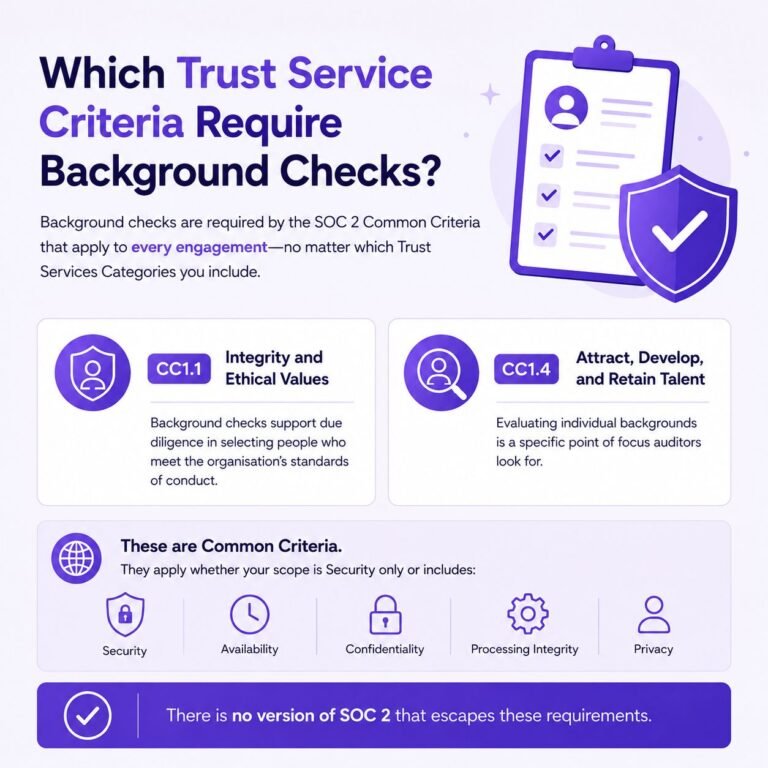
Background checks are explicitly referenced in the Common Criteria that apply to every SOC 2 engagement, regardless of which optional Trust Services Categories you include. The two controls that matter most are CC1.1 and CC1.4.

CC1.1 establishes the entity’s commitment to integrity and ethical values. Background checks support this by demonstrating due diligence in selecting people who meet the organisation’s standards of conduct. CC1.4 is more direct: it derives from COSO Principle 4, which states that the entity demonstrates a commitment to attract, develop, and retain competent individuals in alignment with objectives. Within CC1.4, evaluating individual backgrounds is named as a specific point of focus. That is the hook auditors use.

Because these are Common Criteria, they apply regardless of whether you are scoping Security only or adding Availability, Confidentiality, Processing Integrity, or Privacy. There is no version of SOC 2 that escapes them.
Who Needs to Be Background Checked for SOC 2?

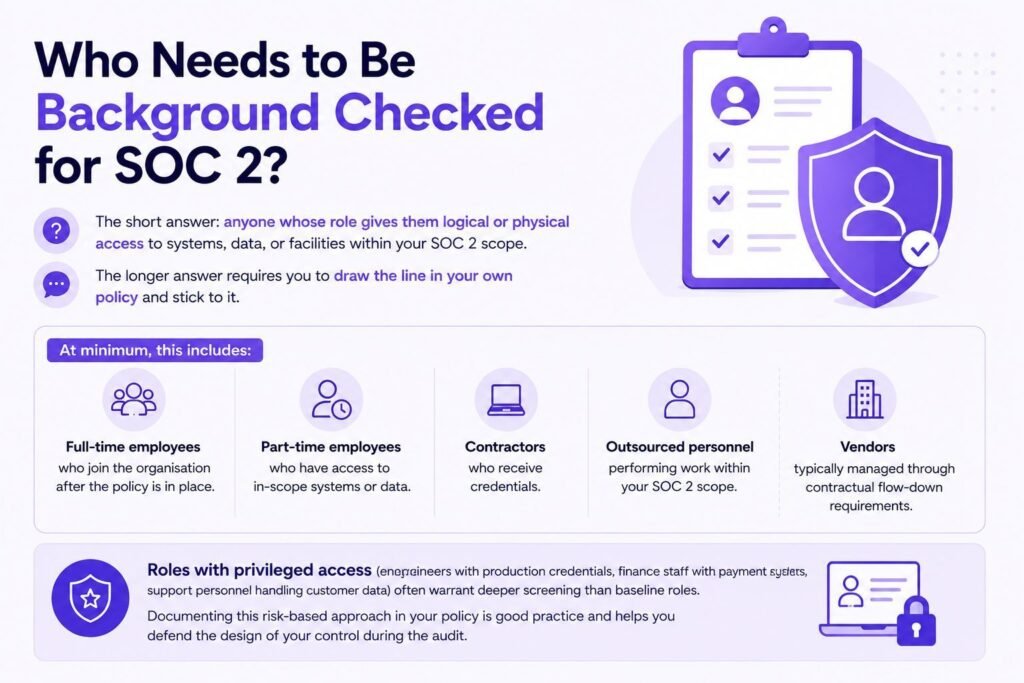
The short answer: anyone whose role gives them logical or physical access to systems, data, or facilities within your SOC 2 scope. The longer answer requires you to draw the line in your own policy and stick to it.

At a minimum, this includes full-time employees who join the organisation after the policy is in place. Most mature programmes extend the requirement to part-time employees, contractors who receive credentials, and outsourced personnel performing in-scope work. Vendors are usually handled differently — through contractual flow-down requirements rather than direct screening — but the principle is the same: people inside the trust boundary must be vetted.

Roles with privileged access (engineers with production credentials, finance staff with payment system rights, support personnel handling customer data) often warrant deeper screening than baseline roles. Documenting this risk-based approach in your policy is good practice and helps you defend the design of your control during the audit.
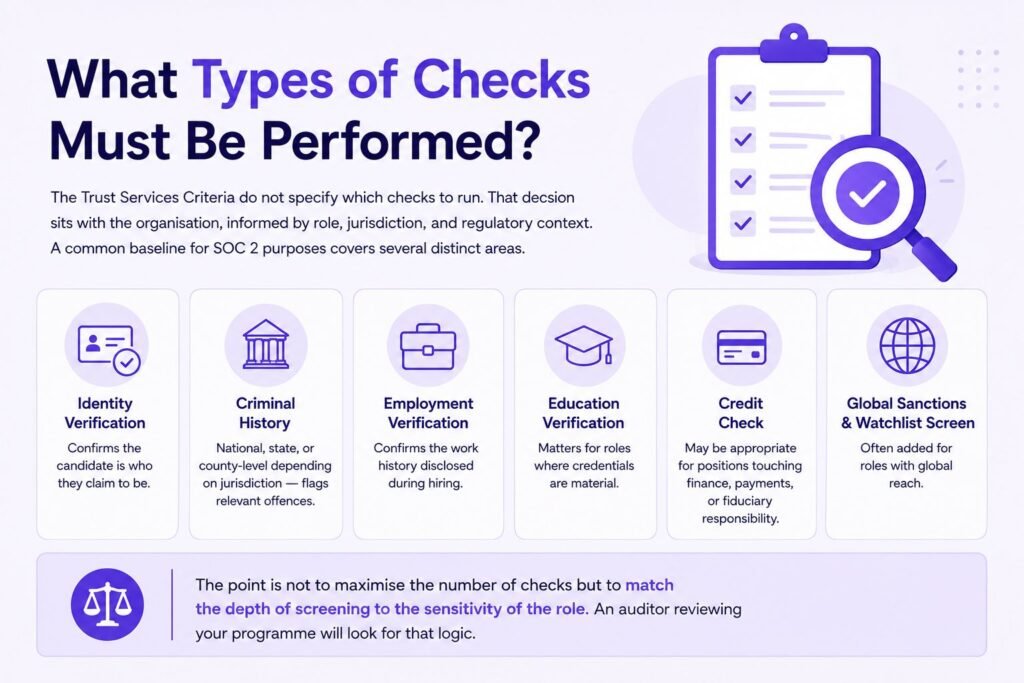
What Types of Checks Must Be Performed?

The Trust Services Criteria do not specify which checks to run. That decision sits with the organisation, informed by role, jurisdiction, and regulatory context. A common baseline for SOC 2 purposes covers several distinct areas.

Identity verification confirms the candidate is who they claim to be.

Criminal history — national, state, or county-level depending on jurisdiction — flags relevant offences.

Employment verification confirms the work history disclosed during hiring.

Education verification matters for roles where credentials are material. For positions touching finance, payments, or fiduciary responsibility, a credit check may be appropriate. For roles with global reach, a global sanctions and watchlist screen is often added.

The point is not to maximise the number of checks but to match the depth of screening to the sensitivity of the role. An auditor reviewing your programme will look for that logic.

Pro Tip: Build a screening matrix that maps role categories

Build a screening matrix that maps role categories (engineer, finance, support, executive) to specific check types. Reference this matrix in your background check policy. When an auditor asks why a particular hire received a particular set of checks, the matrix is your answer — and it removes the discretion that creates inconsistency.

What SOC 2 Auditors Expect to See

Documentation and Evidence Requirements

Auditors test SOC 2 controls through sampling, not blanket review. Expect them to request a list of all employees and contractors hired during the audit period, then pick a representative sample — often between five and fifteen people, depending on company size. For each name on that sample, they will ask for the completed background check report (or evidence summarising its completion, since some organisations retain only a confirmation rather than the full report for privacy reasons), the date the check was completed (which must precede the date of system access), the name of the screening vendor used, and evidence that any adverse findings were reviewed and adjudicated according to policy.

Auditors are looking for consistency. If your policy says screening completes before the start date, every sample must show that. If your policy says re-screening occurs every two years for long-term staff, expect a sample of tenured employees and a request for refresh evidence. For a structured walkthrough of what evidence to prepare across the full audit lifecycle, the SOC 2 compliance checklist is a useful starting point.

Roles and Responsibilities for SOC 2 Background Check Compliance

Background screening is one of the few SOC 2 controls that crosses HR, security, legal, and operations in equal measure. Confusion about ownership is a common reason controls fail.

A workable division typically gives HR end-to-end operational responsibility — running the check, retaining the record, notifying the hire. Security or compliance owns the policy itself and the mapping to SOC 2 controls. Legal owns the regulatory perimeter, particularly Fair Credit Reporting Act (FCRA) obligations in the US and equivalent laws elsewhere. The hiring manager is the gate that prevents access provisioning before clearance is confirmed.

Write these roles into the policy explicitly. An auditor reading your documentation should be able to identify the responsible owner for each step without asking.

Ongoing Monitoring and Continuous Compliance

The SOC 2 Type 2 examination tests whether your controls operated effectively over time, not just whether they exist on paper. That changes how you think about screening. Continuous compliance means three things in this context. First, every new hire goes through the policy, every time, with no exceptions tolerated without documented justification. Second, periodic re-screening for high-trust roles — typically every two to three years — captures changes that occur after employment begins. Third, exception handling is itself a documented control, with risk acceptance, approval, and remediation timelines recorded.

Worth Knowing: A 2024 CFPB advisory

A 2024 CFPB advisory opinion clarified that consumer reporting agencies must prevent the reporting of information that has been legally sealed or expunged, and must avoid duplicative records. This shifts some compliance risk onto the screening provider — which is precisely why vendor selection matters for SOC 2.

Reach SOC 2 Compliance in 6 Weeks or Less

Schedule Your Free SOC 2 Assessment Today

How to Embed Background Checks Into Your Hiring Workflow for SOC 2

Background Check Policy Best Practices

A SOC 2-ready background check policy answers six questions clearly: who is subject to screening (employees, contractors, others); what checks are run for each role category; when the check must be completed relative to the start date; how adverse findings are reviewed and adjudicated; who owns each step; and how records are retained and for how long.

Avoid policies that read like aspirations. Auditors test against the policy as written. If the policy says “background checks are performed prior to employment,” every sample must show that. A weaker but more accurate policy — “background checks are initiated prior to start date and completed within 30 days” — is often the better choice because it matches operational reality. To understand how this kind of policy gap becomes an audit finding, see our guide on how to avoid common SOC 2 pitfalls.

Training and Awareness for SOC 2 Compliance

The people who recruit, onboard, and provision access need to understand the screening policy as a hard control, not a recommendation. The two failure modes worth training against are urgency pressure — a hiring manager pushing for early access because the role is critical — and inconsistency, where different recruiters apply the policy differently for similar roles.

Annual security awareness training is a natural place to reinforce this. So is the onboarding process for new hiring managers, recruiters, and HR business partners. The SANS Security Awareness programme is one widely used framework for structuring this kind of training at scale.

How to Document Background Checks for Your SOC 2 Audit

For each hire, retain a record that includes the candidate’s name, the screening vendor, the date the check was completed, the scope of the check performed, and any adjudication notes if findings required review. Store these records in a system that the audit team can access without ad-hoc retrieval. A centralised HRIS or compliance platform is the usual choice. Email folders are not.

When the auditor samples, you should be able to produce the evidence within hours, not days. Audit response time is itself a signal of programme maturity.
Why SOC 2 Background Checks Matter

Benefits of SOC 2 Background Checks

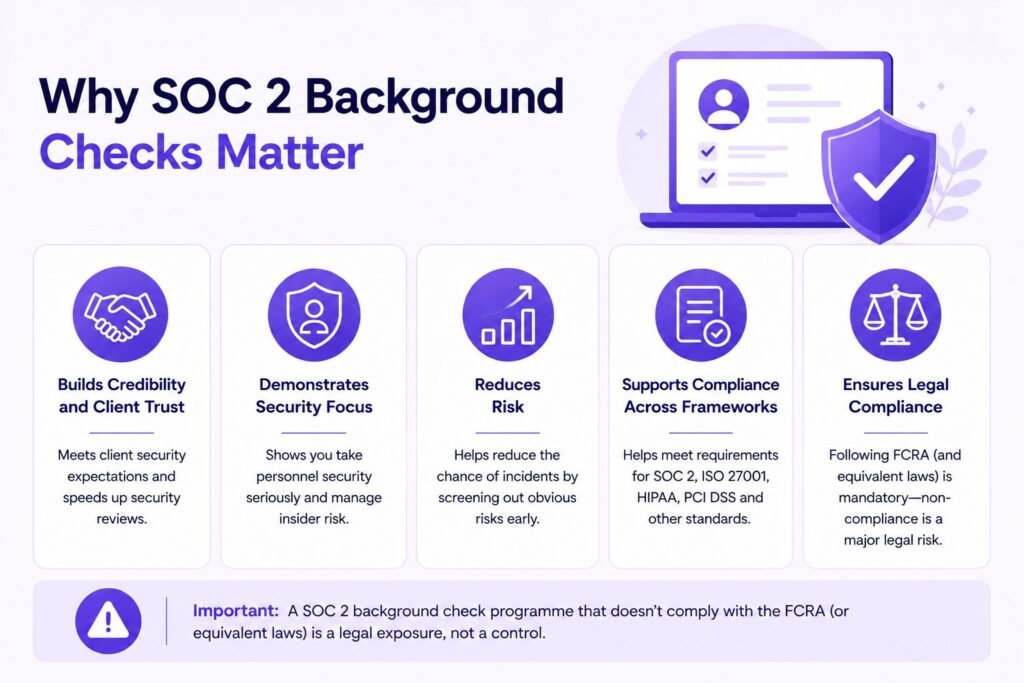
Credibility and Client Trust

Enterprise procurement teams routinely ask whether your hiring process includes background screening as part of their security review process. A clean answer with documented evidence shortens security review cycles and removes a friction point that often delays deals. As noted in Gartner’s research on enterprise security posture, buyers increasingly scrutinise personnel controls as part of third-party risk assessments — making your screening programme a commercial as well as a compliance asset.

Demonstrable Security Focus

Screening is one of the most visible signals that an organisation treats personnel security seriously. It anchors the conversation about insider risk and gives security leaders something concrete to point to when clients, auditors, or board members ask how the organisation manages human-layer risk.

Risk Management

The link between pre-employment screening and reduced incident rates is well established. The Society for Human Resource Management (SHRM) notes that background checks are among the most consistent risk mitigation tools available at the hiring stage. Screening will not catch every risk, but it removes the most obvious ones at the cheapest point in the employment lifecycle.

Regulatory Compliance Across Multiple Frameworks

Background checks support compliance with frameworks well beyond SOC 2. ISO 27001 references personnel screening in Annex A.6.1.1. HIPAA requires workforce clearance procedures for anyone accessing protected health information. PCI DSS mandates background investigations for personnel with access to cardholder data environments. A well-designed programme satisfies several of these requirements at once, making it one of the more efficient investments in your compliance portfolio.

Important: A SOC 2 background check programme that does not also comply with the Fair Credit Reporting Act in the US — or equivalent laws elsewhere — is a legal exposure, not a control. Disclosure forms, written consent, pre-adverse action notices, and final adverse action notices are mandatory when a US-based hiring decision is based even partly on screening results. Class-action settlements in this space run into tens of millions of dollars annually.

Frequently Asked Questions

Is ISO 27001 compliant with GDPR?

ISO 27001 is compatible with GDPR and supports many of its requirements, particularly around security of processing, access control and incident management. It is not, by itself, a complete route to GDPR compliance, because it does not address privacy-specific obligations such as lawful basis and data subject rights.

No. Certification proves you have a working information security management system. GDPR compliance additionally requires lawful basis, transparency, consent where relevant, handling of data subject rights, data protection impact assessments and lawful international transfers. A certified ISMS covers the security pillar of GDPR, not the whole regulation.

No. GDPR is European Union law, enforced by national supervisory authorities. ISO standards are voluntary frameworks published by the International Organization for Standardization. They can support legal compliance, but they are not laws and cannot replace one.

If you process personal data of individuals in the EU, GDPR compliance is legally required. ISO 27001 remains optional, but it provides the security backbone that GDPR expects and is often demanded by customers and partners. Most organisations handling EU personal data benefit from running both.

GDPR is the legal obligation, so its requirements cannot wait. In practice, building the ISMS first is efficient, because it produces much of the risk assessment and many of the “appropriate technical and organisational measures” GDPR requires. The pragmatic answer is to plan them together rather than strictly sequencing one before the other.

GDPR carries administrative fines of up to €10 million or 2% of global turnover for less severe breaches, and up to €20 million or 4% for serious ones, whichever is higher. ISO 27001 has no legal penalty. Failing an audit means losing or not obtaining the certificate, which is a commercial consequence rather than a fine.

Organisations that handle significant volumes of EU personal data and that sell to security-conscious customers gain the most. Technology and SaaS providers, healthcare and financial services firms, and any processor handling data on behalf of EU clients benefit from pairing a recognised security certification with demonstrable privacy compliance.

ISO 27701 defines a Privacy Information Management System and adds privacy controls that ISO 27001 does not cover, with a built-in mapping to GDPR requirements. It began as an extension to ISO 27001 and, since the 2025 revision, can be implemented and certified as a stand-alone standard. It is the most direct bridge between an ISO security programme and GDPR’s privacy obligations, though it still does not amount to legal certification of compliance.

Conclusion

SOC 2 background checks sit at the intersection of HR, security, legal, and audit. The technical bar is not high, but the procedural discipline is. A defensible programme combines a clearly written policy, a vendor that produces audit-ready evidence, integrated workflows that prevent timing failures, and consistent documentation across every hire. Get those four elements right, and the CC1.4 sample becomes one of the easier parts of the audit, rather than the place your report picks up its first exception.

If you are building or overhauling your screening programme as part of a broader SOC 2 readiness effort, learn more about what a structured compliance engagement looks like in practice.

Axipro Author

Picture of Pedro Dias

Pedro Dias

Pedro has been writing online for over 10 years. With experience in all things programming, cyber security, and compliance, he is our editor-in-chief at Axipro.

Blog Highlights

Explore More Articles

A 300-question security review used to eat a full week of an analyst’s time. In 2026, the teams winning enterprise deals turn that same review around in an afternoon. The gap between those two outcomes is no longer about how many people you throw at the problem. It is about whether your answers live in a structured, searchable knowledge base that AI can draw from, or whether they are scattered across old spreadsheets, Slack threads, and the memory of one overworked security engineer. Security questionnaires have grown longer, more frequent, and more specific. Buyers send the Standardized Information Gathering (SIG) questionnaire, the Consensus Assessments Initiative Questionnaire (CAIQ), the HECVAT for higher education, and an endless stream of custom forms, often through portals like OneTrust or ServiceNow that resist copy-paste. Each one stalls a deal until someone answers it. That is why questionnaire automation has shifted from a nice-to-have to a core part of how revenue and security teams operate. This guide reviews the nine tools worth evaluating this year, maps each to the team it actually fits, and shows you how to choose without falling for the inflated accuracy claims every vendor prints on its homepage. What Is Security Questionnaire Automation Software? Security questionnaire automation software uses AI, usually a large language model (LLM) paired with retrieval-augmented generation (RAG), to draft answers to incoming vendor security assessments. Instead of an analyst hunting through a SOC 2 report or a policy document, the software matches each question to verified content in a central knowledge base and generates a cited response in seconds. The better platforms do more than draft text. They ingest a questionnaire in any format, route questions that need a human to the right subject matter expert, attach supporting evidence, track approvals, and submit the finished response back in the buyer’s original format or portal. The output is a workflow, not just a wall of generated answers. Key Benefits of Using Security Questionnaire Automation Software Faster Turnaround on Security Reviews Speed is the headline benefit and the one buyers feel first. Teams routinely report cutting response time from several days to a few hours, and concierge services advertise turnaround as short as twelve hours on standard questionnaires. When a security review is the last gate before a contract signs, shaving a week off it directly accelerates the sales cycle. Higher Accuracy and Consistency Manual answers drift. One analyst describes your encryption posture one way, another phrases it differently three months later, and a sharp-eyed buyer notices the inconsistency. A central knowledge base enforces one approved answer per question, so every response reflects the same source of truth. That consistency matters more than raw speed when a regulated buyer is reading closely. Reduced SME and InfoSec Bottlenecks The real constraint in most questionnaire programs is not typing. It is the queue of questions waiting on a subject matter expert who already has a day job. Automation handles the repetitive eighty percent automatically and surfaces only the genuinely novel questions for human input, which frees your InfoSec team to review rather than author. Stronger Audit Trails and Compliance Posture Every credible platform now logs who answered what, when, and from which source. That audit trail is useful for the questionnaire itself, but it also feeds your broader compliance posture. When an auditor asks how you keep customer-facing security claims accurate, a versioned, evidence-linked knowledge base is a far stronger answer than a folder of spreadsheets. Insider Note: Every vendor on this list advertises an accuracy figure, usually 92 to 96 percent. Read the denominator before you believe it. A 95 percent accuracy rate measured against questions the AI chose to answer is very different from 95 percent across an entire real questionnaire including the hard, company-specific ones. The number that matters is how many answers ship without a human rewrite, and only a pilot on your own questionnaires reveals that. What to Look for in the Best Security Questionnaire Automation Software AI Answer Accuracy and Grounded Retrieval The core engine should retrieve from your approved content and ground every answer in it, not generate plausible-sounding text from a general model. Grounded retrieval is what keeps the AI from inventing a control you do not actually have, which is the failure mode that destroys buyer trust instantly. Knowledge Base Management and Governance The knowledge base is the asset, not the AI. Look for version control, expiry dates on answers, owner assignment, and tools to retire stale content and merge duplicates. A platform that makes library maintenance painful will quietly rot, and a rotten library produces confident wrong answers. Support for Any Questionnaire Format (Excel, Word, PDF, Portals) Buyers send questionnaires in whatever format suits them. If the software handles a clean Excel file but chokes on a messy Word table or a scanned PDF, you will fall back to manual work for a meaningful share of your volume. Format coverage is unglamorous and decisive. Portal Auto-Fill (OneTrust, ServiceNow, ProcessUnity) Portal-based questionnaires are where most automation ROI leaks away. A tool that drafts beautiful answers but cannot push them into an OneTrust or ServiceNow GRC portal leaves you copy-pasting field by field. The strongest platforms offer a browser extension that completes portal forms directly. Important: When you scope a tool, ask specifically how it handles the portals your largest buyers use. Many platforms quietly degrade to a sidebar that helps you find content to paste manually rather than truly auto-filling. That distinction can be the difference between a one-hour review and a half-day of clicking. Evidence and Citation Backing In 2026, sophisticated buyers expect answers backed by source links: a policy, a control record, a test result. Citation backing is becoming the baseline for a buyer to trust an automated answer, and it doubles as your internal proof that the answer is defensible. Collaboration and Approval Workflows Questionnaires are cross-functional. Sales owns the deadline, security owns the truth, and legal sometimes owns the wording. The platform should assign sections, track ownership, and

Three Gulf states now run three different data protection regimes. Saudi Arabia’s regulator has already issued dozens of enforcement decisions. Bahrain has had a working statute since 2019, and the UAE has a federal law on the books but is still waiting on the executive regulations that will give it teeth. For any company operating across the region, the practical question is no longer whether these laws apply but how far apart they sit, and where compliance built for one falls short of another. This is a structured comparison of the personal data protection laws in Bahrain, UAE, and Saudi Arabia: what each one demands, where they converge on familiar GDPR principles, and the specific points where treating them as interchangeable will get you fined. The Three Laws at a Glance Bahrain moved first. Law No. 30 of 2018, the Personal Data Protection Law (PDPL), came into force on August 1, 2019, making it the first comprehensive standalone data protection statute in the Gulf Cooperation Council. It is supplemented by ten ministerial resolutions issued in 2022 that cover transfers, security measures, and notification procedures. The UAE followed with Federal Decree-Law No. 45 of 2021, effective January 2, 2022 — the country’s first federally applicable, GDPR-style law, issued alongside Federal Decree-Law No. 44 of 2021, which created the UAE Data Office as the federal regulator. The catch is that the executive regulations meant to flesh out timelines and penalties have still not been published, which leaves parts of the regime in a holding pattern. Saudi Arabia’s Personal Data Protection Law, issued by Royal Decree M/19 in September 2021 and amended in March 2023, is the strictest and the most actively enforced of the three. It came into force on September 14, 2023, and a one-year grace period ended on September 14, 2024. Since then, every organization processing the personal data of people in the Kingdom has been fully on the hook. Worth knowing: Saudi Arabia’s PDPL Saudi Arabia’s PDPL protects a person’s data not only during their lifetime but after death. That post-mortem protection is unusual among global privacy laws and means retention and disclosure decisions cannot assume an individual’s rights simply lapse when they die. Who the Laws Actually Reach All three statutes reach beyond their own borders. Bahrain’s PDPL applies to anyone residing or doing business in Bahrain, and to entities outside the country that process personal data using equipment located inside it. The UAE law applies to the processing of data belonging to people in the UAE, regardless of where the controller or processor is based. Saudi Arabia goes furthest, applying to any entity inside or outside the Kingdom that processes the personal data of Saudi residents — a scope that pulls in international businesses that may never have considered themselves subject to Gulf regulation. The big structural difference is the UAE’s free zones. The federal PDPL does not apply inside zones that maintain their own data protection regimes, most notably the Dubai International Finance Centre (DIFC) and the Abu Dhabi Global Market (ADGM), each of which runs its own established framework. A company in the DIFC answers to DIFC rules, not the federal law. That carve-out has no equivalent in Bahrain or Saudi Arabia, and it matters enormously for regional structuring decisions. Ready for GCC data privacy compliance? Talk to our experts and simplify Bahrain, UAE, and Saudi data privacy compliance. Schedule The Regulators Each country has its own supervisory authority, and they are at very different stages of maturity. Bahrain’s Personal Data Protection Authority (PDPA) operates under the Ministry of Justice, Islamic Affairs and Waqf and has full investigation, audit, and penalty powers. SDAIA — the Saudi Data and Artificial Intelligence Authority — is the current regulator in Saudi Arabia, with long-term supervision potentially moving to the National Data Management Office under the Kingdom’s wider data governance framework. SDAIA is visibly active: its enforcement committees issued 48 decisions confirming PDPL violations across the 2025 and 2026 review cycles, a level of regulatory output that should get the attention of any compliance team operating in the region. The UAE is the outlier. The UAE Data Office exists in law but is not yet fully operational, and the Telecommunications and Digital Government Regulatory Authority was tasked with providing administrative support during the office’s early years. In practice this means data subjects in the UAE currently lack a clear federal route to lodge a complaint, and enforcement guidance is still maturing. That ambiguity cuts both ways: it reduces immediate enforcement risk, but it also makes it harder to know exactly what compliance looks like. Lawful Basis, Consent, and Core Principles Consent sits at the center of all three regimes, but Bahrain leans on it hardest. Bahrain’s PDPL sets a default rule that personal data may not be processed without the data subject’s written and explicit consent, with a narrow set of alternative bases such as contract performance, legal obligation, and vital interests. Saudi Arabia and the UAE both recognize consent alongside other grounds, and Saudi Arabia’s amended law added legitimate interest as a basis — though it cannot be used for sensitive data and controllers are warned against treating consent as a convenient fallback when a more specific ground applies. Beneath the lawful-basis question, the three laws share the principles that anyone familiar with the same GDPR-shaped foundation will recognize: lawfulness, fairness and transparency, purpose limitation, data minimization, accuracy, storage limitation, and security. The vocabulary and structure track the European model closely, and deliberately so. That means a mature GDPR program is a strong starting point, not a finished one — the architecture transfers, but the local rules introduce enough variation to demand dedicated attention.   Data Subject Rights The rights packages are broadly similar across the three jurisdictions, but the enforcement emphasis differs. Individuals in all three countries can access their data, request correction, and object to certain processing. Saudi Arabia’s PDPL spells out the most comprehensive set — including access, correction, deletion, objection, and portability —

ISO 14001:2026 took effect on April 15, 2026, and it carries the first genuinely new clause the environmental standard has seen in over a decade. Any checklist built against the 2015 edition is now partly out of date. The structure auditors examine has shifted to the ISO Harmonized Structure, climate change is written into the requirements rather than bolted on through an amendment, and a new change management clause gives certification bodies a fresh place to record findings. This guide breaks down what an ISO 14001 certification audit checklist needs to cover now, clause by clause, and how to use it without turning your environmental management system into a paperwork exercise. What Is an ISO 14001 Audit Checklist? An ISO 14001 audit checklist is a structured set of questions and verification points an auditor works through to confirm an environmental management system (EMS) meets the requirements of the standard. It maps each clause to specific evidence: documents, records, interviews, and observed practice. The checklist is the auditor’s working tool, not the audit itself. A good checklist prompts the auditor to look for objective evidence rather than tick boxes, and it leaves room to record where the documented system and actual practice diverge. That gap — between what the procedure says and what people actually do — is where most findings come from. Stay Ahead of ISO 14001:2026 Changes Book an ISO 14001 Gap Assessment Schedule Why You Need an ISO 14001 Audit Checklist Without a checklist, audits drift. Auditors skip clauses, linger on the areas they find interesting, and produce findings that are hard to compare year over year. A checklist enforces coverage and consistency, which matters most when more than one auditor works the program or when you want surveillance results that trend cleanly against the baseline. It also protects you before the certification body arrives. A disciplined internal audit run against a checklist that mirrors the external audit surfaces the same nonconformities your registrar would — while you still have time to fix them. The checklist turns a once-a-year scramble into a repeatable process. Worth knowing: ISO 19011 ISO 19011 is the international guideline for auditing management systems, and it is not a standard you can certify against. You cannot become “ISO 19011 certified.” It exists to make your audit program competent and consistent — which is exactly what a third-party auditor checks when they review your internal audit records. Types of ISO 14001 Audits Not every audit serves the same purpose, and your checklist depth should match the audit type. The four you will encounter are internal, second-party, third-party certification, and the surveillance and recertification audits that follow. Internal Audit Sometimes called a first-party audit, this is conducted by or on behalf of the organization itself. It is a requirement of Clause 9.2, and it is the single most important audit you run, because it is the one you control. Internal audits should be planned across a program, cover the full EMS over the cycle, and use auditors who are competent and independent of the work they assess. Second-Party Audit A second-party audit is one organization auditing another it has a relationship with — most often a customer auditing a supplier or a company auditing its contractors. Under the 2026 revision, with its sharper focus on externally provided processes, products, and services, expect more of these as larger buyers push environmental criteria down their supply chains. Third-Party Certification Audit This is the audit that earns the certificate. An accredited certification body assesses your EMS against ISO 14001 in two stages. Stage 1 is a readiness review that checks whether the system exists, is documented, and is ready to be assessed. Stage 2 verifies that the EMS is fully implemented, effective, and producing the results it claims. Certification follows only once any major nonconformities are closed. Surveillance and Recertification Audits ISO management system certificates run on a three-year cycle governed by ISO/IEC 17021-1. After initial certification, the body conducts annual surveillance audits in years two and three to confirm the system is still operating, then a recertification audit before the certificate expires. Surveillance audits are narrower than the full assessment, but they are not a formality — and many organizations will fold their move to ISO 14001:2026 into a surveillance or recertification visit to keep cost and disruption down. ISO 14001 Audit Checklist: Clause-by-Clause Breakdown ISO 14001:2026 follows the ISO Harmonized Structure, the common framework shared with ISO 9001, ISO 45001, and ISO/IEC 27001. The familiar Plan-Do-Check-Act cycle still runs underneath it. Clauses 1 through 3 cover scope, references, and terms. The auditable requirements live in Clauses 4 through 10, and that is where your checklist does its work. Clause 4: Context of the Organization Verify that internal and external issues, interested parties, and the EMS scope are identified and documented. This is where the 2026 revision lands hardest. Context analysis must now explicitly weigh environmental conditions — including climate change, biodiversity, pollution levels, and the availability of natural resources. A context review that mentions only commercial and regulatory factors will draw a finding. Clause 5: Leadership and Commitment Check for evidence that top management is involved in substance, not ceremony. The environmental policy must be documented, communicated, and appropriate to the organization. Auditors look for real engagement: leaders who can speak to the policy, the objectives, and how environmental performance feeds into business decisions. The 2026 wording tightens leadership accountability, so a policy signed once and forgotten will not hold up. Clause 6: Planning and Risk Assessment This clause covers environmental aspects and impacts, compliance obligations, risks and opportunities, and objectives. It generates more nonconformities than almost any other. The life cycle perspective in Clause 6.1.2 is strengthened, with clearer expectations on upstream and downstream impacts. The headline change is Clause 6.3, Planning of Changes — the only entirely new clause in the revision. It requires a structured, planned approach to changes that affect the EMS, such as new products, site relocations, supplier changes, or process