
Most organizations get ISO 42001 certified in 2 to 9 months. Companies that already hold ISO 27001 regularly land in the 2 to 5 month range, while enterprises with sprawling AI portfolios and no existing management system can take 12 months or more. The audit itself only takes days. Almost the entire calendar goes into building and operating your AI Management System (AIMS) long enough to produce evidence an auditor can actually check.
That is the short answer. The longer answer depends on your starting point, your scope, and how quickly you can get a certification body on the schedule. This article breaks down the full timeline phase by phase, the factors that stretch or compress it, and what the recertification cycle looks like once you hold the certificate.
Typical ISO 42001 Certification Timeline at a Glance
ISO/IEC 42001:2023 is the first international standard for AI management systems, published in December 2023. Because it follows the same harmonized structure as ISO 27001 and ISO 9001, the certification process will feel familiar to anyone who has been through a management system audit: build the system, run it, pass a Stage 1 and Stage 2 audit, then maintain it through annual surveillance.
Here is how timelines typically break down by company size.
Average Timeline for Small Businesses
Small companies move fastest because scope stays contained. A startup with two or three AI systems, a handful of decision makers, and short approval chains can finish scoping in a week and get policies signed off in days rather than weeks. The realistic floor for a small business starting from scratch is around 3 months. With an existing ISO 27001 program and a compliance platform already collecting evidence, 2 months is achievable.
Average Timeline for Mid-Sized Companies
Mid-sized companies usually take 6 to 9 months. The AI inventory is growing, more departments are touching AI systems, and risk assessments have to cover more use cases. Coordination becomes the hidden cost: getting engineering, legal, and product to agree on an AI policy takes longer than writing the policy itself.
Average Timeline for Enterprises
Enterprises should plan for 9 to 12 months, sometimes longer. The main drivers are AI system sprawl across business units, longer procurement cycles for certification bodies, and audits that take more days. The Stage 2 audit for a large multinational can run two weeks or more on its own, and internal alignment before the audit takes far longer than the audit itself.
Breakdown of the ISO 42001 Certification Timeline by Phase
The phases below overlap in practice. Treat the durations as effort estimates for a reasonably resourced program, not a strict sequence.
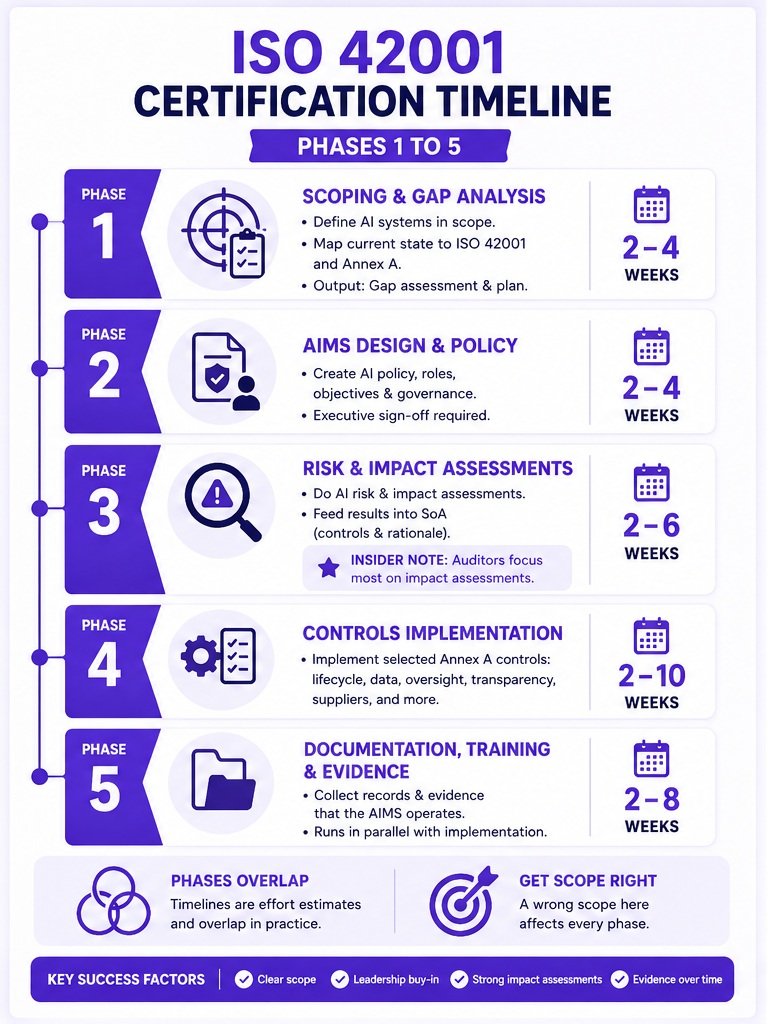
Phase 1: Scoping and Gap Analysis (2–4 Weeks)
Everything starts with two questions: which AI systems are in scope, and how far is your current governance from what the standard requires? The gap analysis maps your existing policies and controls against the standard’s clauses and Annex A controls, and produces the project plan for everything that follows. Get the scope wrong here and every later phase inherits the mistake.
Phase 2: AIMS Design, Leadership, and AI Policy Development (2–4 Weeks)
This phase establishes the skeleton of the management system: the AI policy, governance roles, objectives, and the leadership commitments the standard requires. Executive sign-off is the gating item. The documents are not hard to write. Getting senior leadership to formally own AI governance is where programs stall.
Phase 3: AI Risk and Impact Assessments (2–6 Weeks)
ISO 42001 requires both AI risk assessments and AI impact assessments, and the distinction matters. Risk assessments look at what could go wrong for the organization. Impact assessments look at consequences for individuals and society, which is a newer discipline for most teams. This phase takes longer when you have many AI systems, high-risk use cases, or no prior methodology to adapt. The output feeds directly into your Statement of Applicability (SoA), the document that maps which Annex A controls you have selected and why.
Insider Note: Impact assessments are where auditors probe hardest, because they are the most distinctive part of ISO 42001 compared with ISO 27001. A recycled security risk register with “AI” pasted into it will get picked apart in Stage 2. Build the impact assessment methodology properly the first time.
Phase 4: Controls Implementation (2–10 Weeks)
The longest phase. Here you implement the Annex A controls selected in your SoA: AI system lifecycle documentation, data governance for training data, human oversight mechanisms, transparency measures, supplier management for third-party AI, and so on. Duration depends almost entirely on the gap analysis results. Organizations with mature engineering practices often find they already do much of this and just need to document it. Organizations without formal AI development processes are building from zero.
Phase 5: Documentation, Training, and Evidence Collection (2–8 Weeks)
Certification requires proof that the system operates, not just that it exists on paper. That means records: training completion logs, risk assessment outputs, review meeting minutes, monitoring reports. This phase runs partly in parallel with implementation, but it cannot be compressed below a certain floor because auditors want to see evidence generated over time, not a folder of documents all created the week before Stage 1.
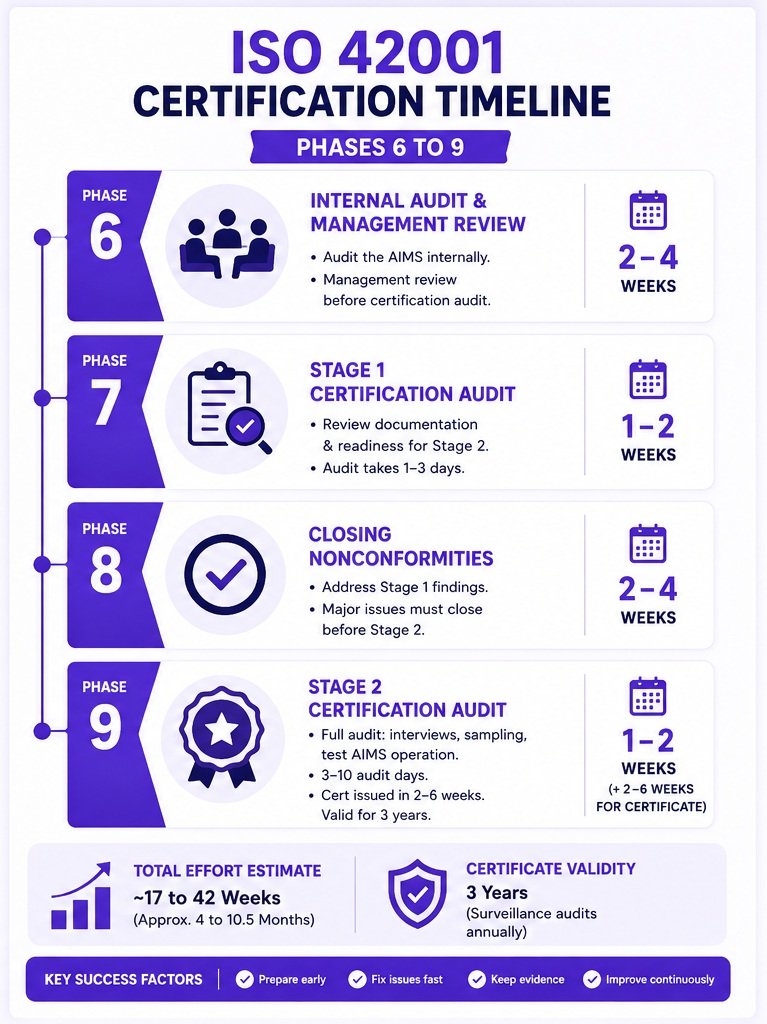
Phase 6: Internal Audit and Management Review (2–4 Weeks)
The standard requires an internal audit of the AIMS and a formal management review before the certification audit. This is your dress rehearsal. A good internal audit surfaces nonconformities while they are still cheap to fix. Skipping or rushing it is a false economy that shows up later as Stage 2 findings.
Phase 7: Stage 1 Certification Audit (1–2 Weeks)
The certification body reviews your documentation and assesses readiness for Stage 2. The audit itself takes 1 to 3 days for most organizations. The auditor examines your scope statement, AI policy, risk and impact assessment methodology, SoA, and internal audit results, then issues findings. The 1–2 week window covers the audit plus the report.
Phase 8: Closing Nonconformities (2–4 Weeks)
Almost every Stage 1 produces findings. Minor ones can carry into Stage 2 with a corrective action plan. Major nonconformities must be closed before Stage 2 can proceed, and this is where timelines tend to slip without anyone noticing: a major finding in your risk methodology can mean redoing assessments across your whole AI inventory.
Phase 9: Stage 2 Certification Audit (1–2 Weeks)
The full audit. Auditors interview staff, sample records, and test whether the AIMS operates as documented. Expect 3 to 10 audit days depending on organization size. After Stage 2, the certification body’s independent reviewer makes the certification decision, and the certificate typically arrives 2 to 6 weeks later. The certificate is valid for three years.
Let Axipro help you build a business continuity plan that's practical, compliant, and audit-ready.
Schedule Your Free Assessment Today
Factors That Speed Up ISO 42001 Certification
Existing ISO 27001 or ISO 9001 Certification
This is the single biggest accelerator. ISO 42001 shares the harmonized clause structure with ISO 27001 and ISO 9001, so your document control, internal audit program, management review cadence, and corrective action process carry over directly. Organizations with a mature ISO 27001 program routinely compress the timeline by 30 to 50 percent, because they are extending a working system rather than building one.
Mature AI Governance and Documentation
If you already maintain an AI inventory, run model reviews, and document training data provenance, much of the implementation phase becomes a formalization exercise. The fastest publicized certifications, completed in a matter of weeks, all involved organizations whose AI governance was substantially in place before the project started.
Dedicated Internal Resources or a Compliance Platform
A named project owner with real allocated time beats a committee every time. Compliance automation platforms help most with evidence collection and control monitoring, the mechanical work that otherwise eats weeks.
Well-Defined Scope of the AI Management System
A tight scope means fewer systems to assess, fewer controls to implement, and fewer audit days. Many organizations certify a defined product line or business unit first, then expand scope at a surveillance audit.
Early Engagement with a Certification Body
Accredited ISO 42001 auditors are still scarce. ISO/IEC 42006:2025 sets the requirements certification bodies must meet, and accreditation bodies like ANAB in the US and UKAS in the UK have only been issuing ISO 42001 accreditations since late 2024 and early 2026 respectively. Book your certification body at the start of the project, not the end. Lead times of 2 to 3 months for audit slots are common.
Pro Tip: Ask the Certification Body Two Questions
Ask the certification body two questions before signing: which accreditation body recognizes their ISO 42001 scope, and who specifically will be on your audit team. Auditor availability, not your internal readiness, is often the real critical path in the final stretch.
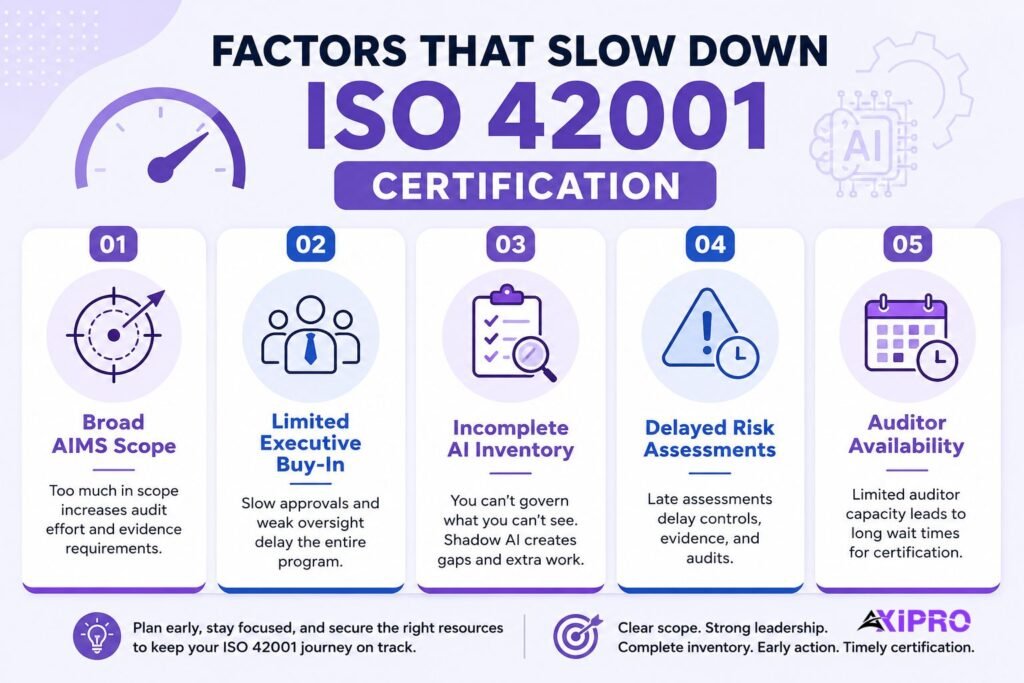
Factors That Slow Down ISO 42001 Certification
Broad or Undefined AIMS Scope
“All AI at the company” sounds thorough and audits terribly. Undefined scope inflates the risk assessment workload, multiplies evidence requirements, and invites Stage 1 findings about boundary ambiguity.
Limited Executive Buy-In
ISO 42001 puts explicit obligations on top management. When leadership treats the program as an IT project, policy approvals stall, resource requests queue, and the management review becomes a formality that auditors see through.
Incomplete AI System Inventory
You cannot govern what you have not cataloged. Shadow AI, meaning tools and models adopted by teams without central approval, surfaces during gap analysis and adds unplanned assessment work. Enterprises regularly discover their real AI footprint is two or three times what they assumed.
Delayed Risk and Impact Assessments
Everything downstream depends on these. Late assessments push controls implementation, which pushes evidence collection, which pushes the internal audit. A three-week slip here becomes a two-month slip at the end.
Auditor Availability and Scheduling Gaps
The pool of accredited certification bodies is growing but still small compared with ISO 27001. If you finish preparation and then start shopping for an auditor, expect to wait a quarter for a slot.
How Long Is the Gap Between Stage 1 and Stage 2 Audits?
Typically 2 weeks to 2 months. The gap exists so you can close Stage 1 findings, and its length depends on what those findings are. Organizations that sail through Stage 1 sometimes book Stage 2 within a fortnight. If Stage 1 surfaces major nonconformities, the certification body may recommend delaying Stage 2 until the fixes have generated evidence. Leaving the gap too long carries its own risk: most certification bodies expect Stage 2 within six months of Stage 1, or Stage 1 has to be repeated.
Can You Get ISO 42001 Certified in Under 3 Months?
Yes, but only under specific conditions. The organizations that have done it share a profile: existing ISO 27001 certification, a genuinely operating AI governance program before the project started, a narrow scope, and a pre-booked certification body. For them, the project is formalizing what exists, not building anything new.
For everyone else, 3 months is not realistic, and no amount of effort changes that. Auditors need evidence that your AIMS operates over time. You cannot backfill three months of monitoring records, training logs, and review minutes in three weeks, and an experienced auditor spots manufactured evidence quickly.
Timeline for ISO 42001 Recertification and Surveillance Audits
Annual Surveillance Audit Timing
Your certificate is valid for three years, but the certification body returns annually. Surveillance audits happen in years one and two after certification, typically scheduled around the anniversary of your certification date. They are shorter than the initial audit, usually 1 to 3 days, and focus on changes to your AI systems, closure of prior findings, and continued operation of core processes like risk assessment and internal audit.
Three-Year Recertification Cycle
At the end of year three, a full recertification audit renews the certificate for another three-year cycle. It resembles Stage 2 in depth but usually takes fewer days, around 60 to 70 percent of the original audit effort. Plan it 2 to 3 months before certificate expiry so any corrective actions can close before the certificate lapses. An expired certificate means starting over with a new Stage 1 and Stage 2.
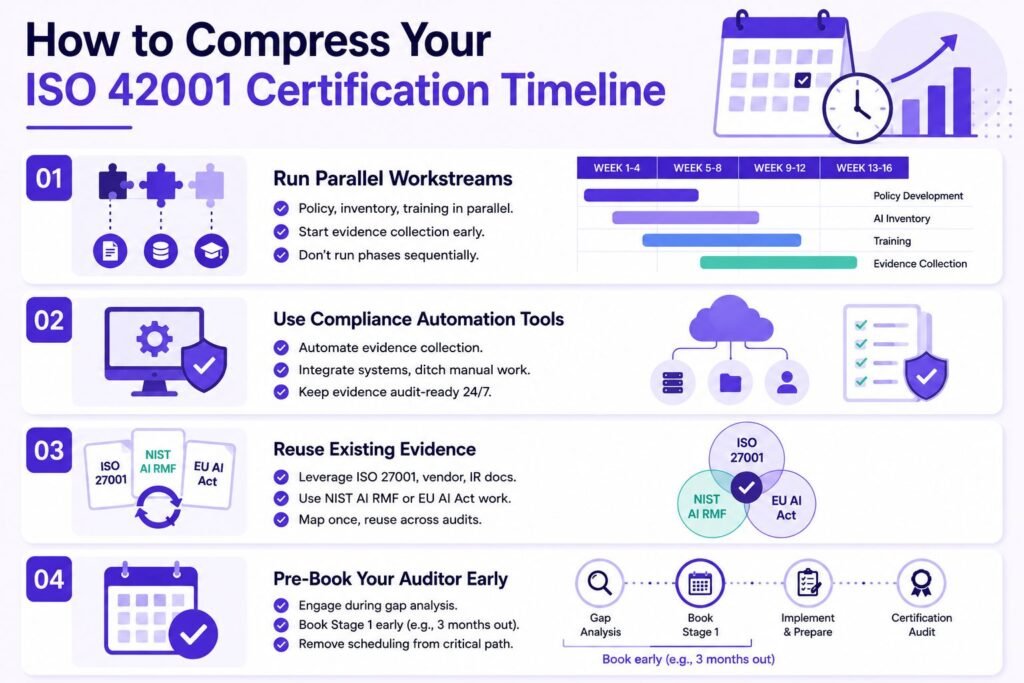
How to Compress Your ISO 42001 Certification Timeline
Run Parallel Workstreams
Nothing in the standard forces you to run the phases one after another. Policy development can run alongside the AI inventory. Training can start before every control is implemented. Evidence collection should begin the day each control goes live rather than waiting until all of them do. Programs that treat the phases as strictly sequential add a month or two for no reason.
Use Compliance Automation Tools
Automation platforms cut the most time in evidence collection and continuous monitoring. Integrations that pull records automatically from your infrastructure replace the spreadsheet-and-screenshot routine that consumes analyst weeks. They also keep evidence audit-ready year-round, which pays off again at every surveillance audit.
Reuse Evidence from Existing Frameworks
Your ISO 27001 access control records, vendor assessments, and incident response documentation satisfy overlapping ISO 42001 requirements. The same applies to work done for the NIST AI Risk Management Framework or EU AI Act preparation. Map your controls across frameworks once and every subsequent audit gets cheaper. An AI impact assessment built for EU AI Act readiness covers most of what ISO 42001 asks for.
Pre-Book Your Certification Body Early
Contact certification bodies during your gap analysis, not after implementation. Booking Stage 1 three months out creates a real deadline for the internal team and removes the scheduling queue from your critical path.
Let Axipro help you build a business continuity plan that's practical, compliant, and audit-ready.
Schedule Your Free Assessment Today
Common Mistakes That Extend the ISO 42001 Timeline
The same failure patterns show up across programs.
- Teams write policies before completing the AI inventory, then rewrite them when shadow AI surfaces.
- They treat the impact assessment as a copy of the security risk assessment and get sent back at Stage 1.
- They generate all their evidence in the final month, which auditors recognize immediately.
- They schedule the internal audit as a checkbox exercise days before Stage 1, leaving no time to fix what it finds.
- And they wait until they feel ready before contacting a certification body, then discover the next audit slot is ten weeks away.
- Each mistake individually costs weeks.
Together they routinely turn a six-month program into a ten-month one.
ISO 42001 certification is a 4 to 9 month project for most organizations, driven by preparation rather than the audit itself. Your starting point matters more than your ambition: existing certifications, mature AI governance, and a tight scope compress the timeline, while vague scope and late auditor booking stretch it. With most EU AI Act obligations now applying from August 2026, the organizations starting today are the ones that will have certificates in hand when customers and regulators start asking.
Frequently Asked Questions
How long does ISO 42001 certification take from scratch?
Plan for 6 to 9 months if you have no existing management system. Small companies with narrow scope can do it in 4 to 6. The long pole is operating the AIMS long enough to generate audit evidence, not writing the documentation.
How much faster is ISO 42001 if we already have ISO 27001?
Expect a 30 to 50 percent reduction. Shared clause structure means your document control, internal audit, and management review processes carry over, and controls implementation roughly halves. Most ISO 27001 certified organizations finish in 3 to 6 months.
How long does an individual ISO 42001 Lead Auditor or Lead Implementer certification take?
These are personal credentials rather than organizational certification, so the timeline is short. A Lead Implementer or Lead Auditor course typically runs 4 to 5 days of training followed by an exam, so most professionals complete the credential within 2 to 4 weeks including preparation.
What takes the longest in an ISO 42001 program?
Controls implementation, at 6 to 12 weeks for most organizations. Close behind is evidence collection, which has a hard floor because records must accumulate over real operating time.
How long is an ISO 42001 certificate valid?
Three years, subject to passing annual surveillance audits in years one and two. Recertification before the three-year mark starts a new cycle.
Can a startup realistically get ISO 42001 certified in a quarter?
Only with existing ISO 27001 certification, working AI governance, a narrow scope, and a certification body booked from day one. Without those, a quarter is marketing fiction. Four to six months is the honest startup answer.
How long does the initial gap assessment take?
Two to four weeks for most organizations. Small companies with few AI systems can finish in one week. The output is worth the time: it becomes the project plan for the entire certification effort.