
Table of Contents

Reach SOC 2 Compliance in 6 Weeks or Less.

  / ,

  / SOC 2 Compliance Checklist: A Step-by-Step Guide

SOC 2 Compliance Checklist: A Step-by-Step Guide

SOC 2 compliance can sometimes feel like a needlessly complex Pandora’s box of documentation. But it shouldn’t be. That’s why today, we’ll show you how to easily become compliant with our 12-step SOC 2 compliance checklist.
In its simplest form, all the SOC 2 sections point to the same question: 


Can you prove your controls work?


This SOC 2 Compliance Checklist guides you through the process from scoping through audit completion for both SOC 2 Type 1 and Type 2. It is practical, auditor-aligned, and written for teams that want clarity rather than theory.

If you want the short version: SOC 2 is not about tools or paperwork. It is about repeatable processes, clear ownership, and evidence that stands up to scrutiny.

Reach SOC 2 Compliance in 6 Weeks or Less

Schedule Your Free SOC 2 Assessment Today

What is a SOC 2 compliance checklist?


A SOC 2 compliance checklist is a structured roadmap that maps your internal controls to the AICPA Trust Services Criteria and prepares your organization for a Type 1 or Type 2 audit. 

For a full breakdown of SOC 2 requirements, read our detailed SOC 2 guide.

How to Use This SOC 2 Compliance Checklist

Think of this checklist as a living roadmap, not a one-time document. You should revisit it at four points: before scoping, during readiness, throughout evidence collection, and after the audit for continuous compliance.

Type 1 vs. Type 2: Which Checklist Items Change?

The core checklist does not change dramatically between Type 1 and Type 2. What changes is time and proof.

Type 1 evaluates whether controls are designed correctly at a specific point in time. Type 2 evaluates whether those same controls operated effectively over an observation period, usually 3, 6, or 12 months.

This means evidence for Type 2 must show consistency, such as quarterly access reviews, repeated vulnerability scans, and incident response tests that actually occurred.

Who Owns Each Workstream

SOC 2 is cross-functional by design. Security may lead, but it cannot succeed alone.

Engineering typically owns secure SDLC, change management, and logging. IT owns IAM, endpoints, and device management. Legal and HR contribute policies, onboarding controls, and training. GRC or compliance coordinates risk assessment, evidence, and auditor communication.

The fastest SOC 2 projects have named control owners with deadlines, not shared responsibility.

What “Audit-Ready” Really Means

Being audit-ready does not mean “we think we are secure.” It means you can produce clear, dated, and traceable evidence that maps directly to the Trust Services Criteria.

Auditors test design, then operation. They expect policies, tickets, screenshots, logs, and approvals. They also expect alignment. If your policy says quarterly, your evidence cannot show annual.

The AICPA provides the underlying standard, supported by SSAE 18 and AT-C 205.

Pre-Checklist: Confirm You Actually Need SOC 2

Not every company needs SOC 2 immediately. If your customers are SMBs, you may see lighter requirements. If you sell to enterprises, SOC 2 often becomes non-negotiable.

Security questionnaires are the strongest signal. When prospects ask about penetration testing, access reviews, and incident response evidence, SOC 2 is usually the cleanest way to respond at scale.

Alternatives like ISO 27001, PCI DSS, or HIPAA can be valid. But SOC 2 is uniquely customer-facing, especially in North America. ISO 27001 is excellent for global alignment, while SOC 2 maps directly to buyer trust.

The 12-Step Checklist
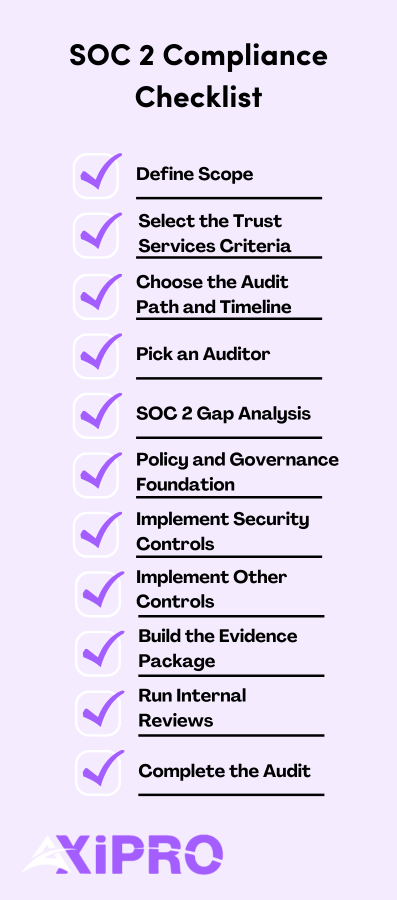
SOC 2 checklist Compliance

Step 1- Define Scope 

Scoping mistakes cause more SOC 2 delays than any missing control.

Your scope must clearly define the services you provide, the systems that support them, and the access controls. Over-scoping increases cost and complexity. Under-scoping leads to auditor pushback.

In-scope systems usually include production cloud environments, CI/CD pipelines, support tooling, and identity providers. In-scope people include employees and contractors with access to customer data. Third parties are addressed as Subservice organization, using either the Carve-out method or Inclusive method.

Data classification and flows must identify PII, PHI, or payment data, and how it moves through systems.

Action Plan for Scoping

  1. Define the Service Commitment
  2. List In-Scope Systems
  3. Identify In-Scope People
  4. Document Third Parties
  5. Map Data Flows
  6. Validate Scope with Leadership

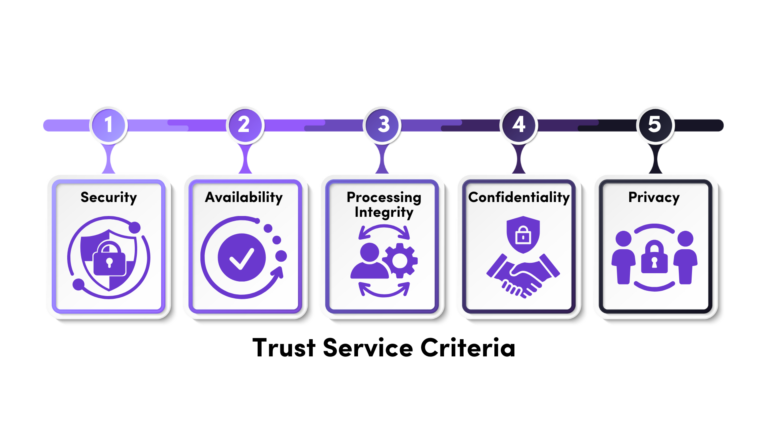
Step 2- Select the Trust Services Criteria

All SOC 2 reports include Security (Common Criteria). The others are optional but must be justified.

Availability focuses on uptime and disaster recovery. Confidentiality focuses on sensitive data protection. Processing Integrity focuses on system accuracy. Privacy applies when personal data obligations are central.

Your report must document why each criterion is included or excluded. Auditors look closely at this rationale.

Trust Service Criteria Action Plan

  1. Confirm Security (Mandatory)
  2. Assess Optional Criteria
  3. Document Inclusion Rationale
  4. Obtain Executive Sign-Off

Step 3- Choose the Audit Path and Timeline

Most teams benefit from a readiness assessment before audit. This is often referred to as a Readiness assessment or Gap analysis.

Type 1 audits can be completed in weeks once controls are ready. Type 2 timelines depend on the observation period. Six months is the most common balance between speed and credibility.

Define control owners early and create an evidence calendar. Late evidence is the enemy of clean audits.

Audit Path and Timeline Action Plan

  1. Conduct Readiness or Gap Assessment
  2. Choose Audit Type
  3. Set Observation Period (Type 2)
  4. Assign Control Owners
  5. Build Evidence Calendar

Step 4- Pick an Auditor and Define the Engagement

Choose a CPA firm with real SOC 2 experience in your industry. Responsiveness matters more than brand name.

Confirm standards, testing approach, sampling expectations, and how subservice organizations are treated. The engagement letter should clearly state scope, period, and deliverables. A clear PBC list process avoids confusion later.

Action plan for finding an auditor.

  1. Shortlist CPA Firms
  2. Review Testing Approach
  3. Clarify Subservice Treatment
  4. Finalize Engagement Letter
  5. Request Preliminary PBC List

Step 5- Perform a SOC 2 Gap Analysis

Map existing controls to the Trust Services Criteria. Missing policies, undocumented processes, and inconsistent evidence usually surface here.

Prioritize high-risk gaps first. Document known exceptions and compensating controls honestly. Auditors prefer transparency over perfection.

Gap Analysis Action Plan:

  1. Map Controls to Criteria
  2. Identify Missing Controls
  3. Prioritize by Risk
  4. Document Compensating Controls

Step 6- Build the Policy and Governance Foundation

Policies should reflect reality. Information security, access control, change management, incident response, vendor risk management, and BCDR must all exist, be approved, and be followed.

If Privacy is in scope, privacy notices, data handling, and retention policies must align with actual practices.

Governance Action Plan

  1. Draft Core Policies
  2. Align Policy to Reality
  3. Obtain Formal Approval
  4. Train Staff

Step 7- Implement Security (Common Criteria) Controls

This is where most effort goes. IAM, MFA, SSO, and RBAC must be enforced, not optional. Logging, monitoring, vulnerability scanning, and patch management must be operational.

Auditors expect encryption in transit and at rest, typically supported by KMS. Secure SDLC, change management, incident response, risk assessment, vendor reviews, and physical security all fall under this umbrella.

Common Control Implementation Action Plan

  1. Enforce Identity Controls
  2. Enable Monitoring
  3. Implement Vulnerability Management
  4. Encrypt Data
  5. Operationalize Secure SDLC
  6. Run Risk Assessment
trust service criteria

Step 8- Availability, Confidentiality, Processing Integrity, Privacy

Only implement what is in scope. Availability requires uptime definitions, monitoring, and tested disaster recovery. Confidentiality focuses on data handling and disposal. Processing Integrity requires evidence that systems do what you promise customers. Privacy requires DSAR handling, consent, and cross-border controls.

Availability

  1. Define uptime commitments.
  2. Document monitoring thresholds.
  3. Test BCDR annually.
  4. Record test results and improvements.

Confidentiality

  1. Classify confidential data.
  2. Restrict access via RBAC.
  3. Define disposal procedures.
  4. Validate encryption controls.

Processing Integrity

  1. Document system processing controls.
  2. Define input validation mechanisms.
  3. Monitor output accuracy.
  4. Track customer issue resolution.

Privacy

  1. Publish privacy notice aligned with practice.
  2. Implement DSAR handling process.
  3. Define data retention schedule.
  4. Control cross-border transfers.

Step 9- Build the Evidence Package

Auditors test evidence, not intent. They expect a clear System description, control narratives, access reviews, change tickets, incident records, vulnerability scans, vendor SOC reports, training logs, and BCDR test results.

Evidence must be complete, dated, and traceable.

Evidence Package Action Plan

  1. Draft System Description
  2. Collect Control Evidence
  3. Ensure Traceability

Step 10 — Run Internal Reviews

Before the auditor looks, you should. Control owners should sign off. Exceptions should be documented with root cause and corrective action. Management review is not optional.

Internal Review Action Plan

  1. Control Owner Sign-Off
  2. Document Exceptions
  3. Management Review


Step 11 — Complete the Audit

Expect walkthroughs, sampling, and follow-up questions. Review the draft report carefully, especially scope language and subservice organization descriptions.

Audit Action Plan

  1. Prepare for Walkthroughs
  2. Respond to Sampling Requests Quickly
  3. Review Draft Report Carefully

Step 12 — Maintain Continuous SOC 2 Compliance

SOC 2 is not annual busywork. Continuous monitoring, periodic access reviews, quarterly vulnerability scans, annual risk assessments, and vendor re-reviews keep you audit-ready.

Teams that treat SOC 2 as a one-time project struggle with every renewal.

Maintaining Compliance Action Plan

  1. Schedule Recurring Reviews
  2. Monitor Vendor Changes
  3. Automate Evidence Collection
  4. Track Metrics
  5. Embed Compliance into Operations

Ready to Use This Checklist in Practice?

If you want to turn this SOC 2 compliance checklist into a clear plan with owners, timelines, and auditor-ready evidence, Axipro can help.

Our Achievement Plan guides teams from scope to SOC 2 readiness in as little as six weeks, combining human expertise with the right automation tools. Whether you need a readiness assessment, a full Type 1 or Type 2 audit, or help maintaining compliance, we simplify the process so your team can focus on growth.

Book a SOC 2 readiness call or request a checklist walkthrough today, and move from “working on compliance” to confidently audit-ready.

Reach SOC 2 Compliance in 6 Weeks or Less

Schedule Your Free SOC 2 Assessment Today

Is this SOC 2 compliance checklist enough to pass an audit?

The checklist is designed to align with the AICPA Trust Services Criteria and reflects what auditors test in both Type 1 and Type 2 engagements. However, a checklist alone does not guarantee a clean report. Success depends on Accurate scoping, Clear control ownership, Proper documentation, Consistent evidence over time, and Management oversight. The checklist provides structure. Execution determines the outcome.

This checklist should function as a project management framework rather than a static document. Organizations should assign ownership for each step, define deadlines, and maintain an evidence tracker alongside the checklist. During readiness, it should be reviewed regularly to monitor progress and identify blockers. After certification, it should evolve into a quarterly governance tool to maintain continuous compliance rather than being archived as a completed project.

Scoping is the most frequently underestimated step. Poor scope definition can result in expanded audit testing, increased costs, and delays due to auditor pushback. Another commonly overlooked area is evidence preparation. Many organizations implement controls but fail to collect clear, dated, and traceable documentation. Even well-designed controls can create audit friction if evidence is incomplete or inconsistent.

Yes, but exclusions must be intentional and justified. Security, also known as the Common Criteria, is mandatory in every SOC 2 report. The inclusion of Availability, Confidentiality, Processing Integrity, or Privacy depends on customer commitments, regulatory requirements, contractual obligations, and data sensitivity. Auditors expect a documented rationale explaining why each optional criterion was included or excluded. Simply omitting criteria without explanation can raise concerns during review.

SOC 2 is inherently cross-functional. While security or GRC teams often coordinate the effort, engineering, IT, HR, legal, and executive leadership all play essential roles. The checklist works most effectively when each control area has a clearly defined owner with accountability for implementation, documentation, and ongoing monitoring. Shared responsibility without defined ownership frequently leads to gaps and delays.

You are audit-ready when every control has a designated owner, policies are formally approved and consistently followed, evidence is complete and traceable, and your system description accurately reflects your environment. Management should have reviewed and signed off on the program before the auditor begins testing. If your team can confidently walk an auditor through each checklist step with supporting documentation, you are prepared for a structured and efficient audit experience.

Axipro Author

Picture of Pedro Dias

Pedro Dias

Pedro has been writing online for over 10 years. With experience in all things programming, cyber security, and compliance, he is our editor-in-chief at Axipro.

Blog Highlights

Explore More Articles

SOC 2 compliance is a critical trust signal for organizations handling sensitive data. Unlike ISO standards, SOC 2 reports are private attestations issued by licensed CPA firms, making verification essential.  To verify a SOC 2 report, you need to review the auditor’s opinion, audit period, report type, scope, and any control exceptions, then confirm the auditor’s AICPA registration and request a bridge letter if the report is outdated. In today’s cybersecurity-driven business environment, SOC 2 compliance has become one of the most recognized trust signals in the industry. Whether you are a SaaS provider handling customer data or an enterprise evaluating third-party vendors, a SOC 2 report plays a central role in proving that security controls are properly designed and operating effectively. Verifying a SOC 2 report, however, is not as simple as checking a public registry. Unlike ISO 27001, SOC 2 is not a public certification. Despite being regulated by the AICPA, there is no central database or government portal where you can confirm a company’s compliance status. Instead, SOC 2 is a private attestation report, issued by an independent CPA firm. That makes verification a matter of careful review and disciplined due diligence. If you want to understand how SOC 2 stacks up against other frameworks, our breakdown of ISO 27001 vs SOC 2 is a good place to start. This guide explains how to properly verify a SOC 2 report, what to watch for, and how expert partners like Axipro help organizations achieve and maintain SOC 2 compliance so their reports hold up to real scrutiny. Why Verifying a SOC 2 Report Matters SOC 2 reports are widely used across vendor risk management, enterprise procurement decisions, security questionnaires, and customer trust and sales cycles. Because SOC 2 reports are private and shareable only under NDA, verification responsibility falls entirely on the recipient. Accepting an outdated, poorly scoped, or improperly audited SOC 2 report can expose your organization to serious security and compliance risks. According to IBM’s Cost of a Data Breach Report, the average cost of a data breach continues to climb year over year, and third-party vendor relationships remain one of the most common attack vectors. Treating SOC 2 verification as a formality is not just sloppy governance; it is a liability. Knowing how to verify a SOC 2 report, and working with the right compliance experts, is not optional. It is essential. Step 1: Thoroughly Review the SOC 2 Report Key Sections Once a company provides its SOC 2 report (typically under a Non-Disclosure Agreement), your first step is a structured internal review. There are five areas you must examine closely. The Auditor’s Opinion is the single most critical section of the report. The opinion should be Unqualified (also called Unmodified). A Qualified, Adverse, or Disclaimer opinion is a major red flag and should immediately prompt further questions. An unqualified opinion means the auditor found no material issues with how controls were designed or operated during the audit period. The Report Period and Date tell you whether the report is still relevant. SOC 2 reports are generally considered valid for 12 months. Confirm the exact audit period, for example, October 1, 2024 to September 30, 2025, and flag anything older than that as potentially unreliable without additional assurance documentation. The Report Type is equally important. A SOC 2 Type I assesses whether controls were properly designed at a single point in time. A SOC 2 Type II evaluates whether those controls actually operated effectively over a defined period, typically six to twelve months. For most enterprise customers, SOC 2 Type II is the expected standard, and anything less should be treated with appropriate skepticism. The Scope of Services, found in the System Description section, must explicitly include the product or service you are evaluating. A SOC 2 report that does not cover the relevant system offers limited assurance, regardless of how clean the auditor’s opinion is. Exceptions and Control Failures in the testing results section deserve careful attention. Look for exceptions, failed controls, or deviations from expected behavior. Not all exceptions are disqualifying, but you need to assess whether they represent a material risk to your data or operations. If the report contains a significant number of exceptions or a pattern of failures in critical areas, that is a conversation worth having with the vendor before proceeding. If you want a structured checklist to guide this review process internally, we have put one together here. Step 2: Verify the Auditor’s Credibility A SOC 2 report is only as trustworthy as the CPA firm that issued it. This step is non-negotiable. The auditor must be a licensed CPA firm authorized to perform SOC engagements under the standards set by the American Institute of Certified Public Accountants (AICPA). The AICPA is the governing body for SOC reporting, and any firm issuing these reports must be formally registered with them. Beyond registration, AICPA requires CPA firms to undergo periodic peer reviews to ensure quality and professional standards are maintained. You can check a firm’s peer review standing directly through the AICPA peer review database or verify their status through the relevant state board of accountancy. This is a free, publicly accessible check that takes minutes, and skipping it is a mistake. An unlicensed or non-peer-reviewed firm issuing a SOC 2 report is not just a compliance risk, it is a sign the report may not be worth the paper it is written on. Axipro works closely with reputable, AICPA-registered audit firms, helping clients select the right auditor and ensuring the engagement meets all professional and regulatory expectations from the start. Step 3: Request a Bridge Letter When There Is a Coverage Gap SOC 2 reports cover a defined period. If the most recent report ended several months ago and the next audit is still in progress, you are operating in a coverage gap, a window of time where you have no formal attestation of current control effectiveness. In this situation, you should request a Bridge Letter, sometimes

Axipro, the cybersecurity and compliance consulting firm, and Kertos, the European compliance automation platform, and  have entered a strategic partnership that combines software automation with hands-on implementation support for organisations navigating Europe’s expanding regulatory regime. The agreement, effective April 1, 2026, names Axipro as an implementation partner for Kertos. Customers can now buy the Kertos platform through Axipro alongside consulting, implementation support, and broader compliance service packages spanning frameworks including GDPR, NIS2, DORA, the EU AI Act, ISO 27001, and SOC 2. The partnership lands as European companies face mounting regulatory pressure. The NIS2 Directive pulled around 28,700 additional companies into scope when it replaced its predecessor in October 2024. DORA became fully applicable in January 2025, binding around 22,000 EU financial entities to a single ICT risk management framework with penalties of up to 2% of global turnover. The EU AI Act adds another layer, with compliance costs for SMEs running between €50,000 and €500,000 per organisation depending on use case. What the partnership delivers Under the agreement, Axipro sells, implements, and operates Kertos for customers as part of integrated service packages. The same partner that scopes the gap assessment, defines the control framework, and runs the implementation also configures and operates the platform that holds the evidence. Engagements no longer hand off between separate vendors. For Kertos, the deal gives the platform deeper exposure to how compliance programmes run inside operating businesses, feeding back into product development. For Axipro, which already supports companies across more than 20 frameworks with services spanning penetration testing, internal audit, and end-to-end certification support, Kertos extends its offering with continuous evidence collection, control management, vendor management, and automated audit preparation. “Our ambition at Kertos is to build the leading compliance automation platform in the market, one that doesn’t just simplify compliance but fundamentally redefines how companies achieve and maintain it,” said Dr. Kilian Schmidt, CEO of Kertos. “Strategic partnerships like the one with Axipro are a key part of that journey. By working closely with experienced compliance experts, we gain invaluable real-world insights that directly shape and accelerate our product development.” Free migration to Kertos through Axipro As part of the partnership, Axipro is offering free migration to Kertos for companies currently using another compliance or GRC platform. The migration covers transferring existing controls, evidence, policies, and vendor records into Kertos, with Axipro consultants handling the rebuild of framework mappings for ISO 27001, SOC 2, GDPR, NIS2, and other applicable standards. The aim is to remove the cost and disruption that typically deters companies from switching platforms mid-program, even when their existing tooling no longer fits their regulatory scope.   DACH region as the starting point Germany consistently leads European GRC adoption and accounts for the largest share of the region’s GRC platform market. It is also where regulatory pressure is sharpest right now, with the Federal Office for Information Security actively building out supervisory capacity ahead of the April 2026 NIS2 registration deadline for essential and important entities. “Compliance is only as strong as the tools and partners behind it,” said Ali Hayat, CEO of Axipro. “Our partnership with Kertos gives our clients in the DACH region access to a powerful data privacy and compliance platform, backed by Axipro’s hands-on expertise. Together, we make achieving and maintaining compliance seamless, faster, and more predictable for the businesses that need it most.” Both companies framed the agreement as a foundation for deeper collaboration as customer needs and regulatory requirements continue to evolve. About Axipro Axipro is a cybersecurity and compliance consulting firm helping high-growth companies achieve and maintain regulatory certifications across more than 20 frameworks including SOC 2, ISO 27001, GDPR, and NIST. Services span penetration testing, internal audit, and end-to-end support for companies pursuing first-time certification or maintaining existing ones. Axipro has offices in the UK, the USA, and Bahrain. About Kertos Kertos is a compliance automation platform that helps companies operating in Europe meet and maintain compliance requirements for frameworks including ISO 27001, SOC 2, GDPR, and NIS2. By automating evidence collection, control management, vendor management, and audit preparation, Kertos enables organisations to build and maintain robust information security and data protection programmes without the manual overhead of traditional approaches. Read the full press release here

ISO 14001:2026 was published on 15 April 2026. Over 600,000 organizations in more than 180 countries are currently certified to the previous edition, and all of them have until approximately May 2029 to transition. The revision is not a rebuild, but it is not cosmetic either. It sharpens several requirements that were inconsistently applied under the 2015 standard, introduces a formally new clause on change management, and embeds climate change, biodiversity, and lifecycle thinking more directly into the Environmental Management System (EMS) framework. This article explains what has changed, what has not, and what certified organizations need to do next. What Is ISO 14001 and Why Is It Being Updated? A Brief Overview of ISO 14001 ISO 14001 is the internationally recognized standard for Environmental Management Systems (EMS). Published by the International Organization for Standardization (ISO), it gives organizations a structured framework for managing environmental impacts, meeting legal obligations, and pursuing continual improvement in environmental performance. The standard applies to organizations of any size, in any sector, anywhere in the world, and more than one million sites globally are currently certified against it. Its value lies not in prescribing specific environmental outcomes, but in building the management system infrastructure that makes consistent, improving performance possible. Whether an organization is a manufacturer managing chemical discharge or a logistics provider tracking fuel consumption, ISO 14001 provides the same underlying framework for setting objectives, measuring performance, and driving improvement. Why ISO 14001:2015 Is Being Revised The 2015 version replaced ISO 14001:2004 and introduced several significant advances: risk-based thinking, a stronger link to organizational strategy, and the Harmonized Structure that aligned ISO 14001 with ISO 9001 and ISO 45001. It was a substantial step forward. But the environment it was designed for has changed. Climate change is now a core business risk, not a future projection. Biodiversity loss is accelerating. ESG reporting obligations have multiplied. Investors and regulators expect documented evidence of environmental performance, not just policy statements. The 2015 edition left too much room for organizations to treat climate and biodiversity as optional considerations within context analysis. The 2026 revision corrects that deliberately.   ISO 14001:2015 vs ISO 14001:2026: Overview of Key Differences What Has Changed and What Has Stayed the Same The core architecture of ISO 14001 is unchanged. The standard still follows the Plan-Do-Check-Act (PDCA) cycle and retains the Harmonized Structure it shares with ISO 9001, ISO 45001, ISO 50001, and other major management system standards. The ten-clause framework remains intact. What has changed is the specificity and accountability required within that framework. Environmental conditions must now be explicitly identified and named in context analysis. Change management is now a formal, auditable requirement rather than an implied expectation. Supply chain thinking is more directly embedded into operational controls. Internal audits must now have defined objectives, not just scope and criteria. The table below summarizes the most significant differences between the two editions. Area ISO 14001:2015 ISO 14001:2026 Climate change Not explicitly required (added via 2024 amendment) Formally integrated; required across multiple clauses Biodiversity Implied; not named Explicitly required in context analysis Change management No standalone clause New standalone Clause 6.3 Risks and opportunities Within Clause 6.1 New standalone Clause 6.1.4 Supply chain scope “Outsourced processes” “Externally provided processes, products and services” Internal audit Defined scope and criteria Defined scope, criteria, and objectives Clause 10.1 Standalone continual improvement clause Integrated into Clauses 10.2 and 10.3 What the ISO 14001:2026 Revision Is, and Is Not ISO 14001:2026 is not a new standard. It does not introduce a fundamentally different approach to environmental management. Organizations with a mature, well-run ISO 14001:2015 EMS will not be starting from scratch. What the revision is: a targeted update that addresses gaps and ambiguities that accumulated since 2015. It makes previously optional considerations mandatory, adds structural clarity where the 2015 edition was ambiguous, and aligns the standard more closely with how environmental management intersects with modern business risk, ESG reporting, and supply chain accountability. Organizations that applied the 2015 standard in a minimal or box-ticking way will face more substantial transition work. Organizations that ran a genuine, actively managed EMS will find most of what is required already in place, with focused updates needed in a handful of areas. Clause-by-Clause Comparison: ISO 14001:2015 vs ISO 14001:2026 Clause 4: Context of the Organization In ISO 14001:2015, Clause 4.1 required organizations to identify external and internal issues relevant to their EMS. Climate change was a possible consideration, but not a named one. The 2026 revision changes this directly. ISO 14001:2026 now explicitly names four categories of environmental condition that must be assessed when determining organizational context: climate change, pollution levels, biodiversity and ecosystem health, and the availability of natural resources. These are not suggestions, they place these issues squarely on the required agenda for every certified organization. The practical implication is significant. An organization that previously mapped its context by tracking energy use and waste generation now needs to demonstrate how it has assessed whether biodiversity loss, water scarcity, or local pollution levels are material to its operating environment. If they are, those factors must flow into objectives, risk registers, and operational controls. Clause 4.3, which covers the scope of the EMS, has also been strengthened. Organizations are now expected to define their scope with explicit reference to their authority and ability to exercise control and influence across the full life cycle of their activities, products, and services. The EMS boundary is no longer limited to the physical boundary of the facility. Clause 5: Leadership Top management responsibilities are expanded in the 2026 edition. The 2015 version focused on management roles. The 2026 revision makes clear that leadership must support environmental performance across all relevant functions, including non-management roles. The environmental policy itself has been updated. ISO 14001:2026 expects the policy to include commitment to conserving natural resources and protecting ecosystems, alongside the existing commitments to pollution prevention and continual improvement. This clause often receives less attention during gap analyses than the more structural changes in Clause 6. But