
Two controls decide whether your ISO 27001 business continuity plan survives an audit: Annex A 5.29 and Annex A 5.30. One keeps your security controls working while everything else is failing. The other gets your systems back online before the damage becomes permanent.
Plenty of teams write a continuity policy that satisfies neither in the way a certification auditor expects, and they discover the gap during the Stage 2 audit, when it is expensive to fix.
This article covers what ISO 27001:2022 actually requires for business continuity, the components an auditor will ask to see, the step-by-step build, and the mistakes that turn a continuity plan into a non-conformity.
What Is an ISO 27001 Business Continuity Plan?
An ISO 27001 business continuity plan is the documented set of procedures that keeps information security effective and critical ICT services available during a disruption. It is not a generic “keep the lights on” binder. Under ISO 27001, the plan protects the confidentiality, integrity, and availability of information when normal operations break down: a ransomware event, a cloud outage, a data center failure, or a supplier collapse.
The plan lives inside your Information Security Management System (ISMS). It draws on your risk assessment, your asset register, and your Business Impact Analysis (BIA), and it feeds your disaster recovery procedures. Scope is the part people get wrong. ISO 27001 cares about the information security aspects of continuity, not every operational hiccup a full business continuity program might cover.
Why You Need a Business Continuity Plan for ISO 27001 Compliance
Downtime is expensive, and the bill arrives fast. For most organizations, the question is not whether a disruption will happen, but how quickly they recover when it does.
There is also a hard compliance reason. You cannot certify to ISO 27001 while ignoring continuity. The standard requires you to maintain information security during disruption and to keep ICT able to support recovery, and an auditor will ask for the evidence. A continuity plan is where availability stops being a promise and becomes a tested capability.
Let Axipro help you build a business continuity plan that's practical, compliant, and audit-ready.
Strengthen Your Business Continuity Strategy
ISO 27001 Requirements Related to Business Continuity Planning
ISO/IEC 27001:2022 carries 93 Annex A controls across four categories: organizational, people, physical, and technological. Continuity sits in the organizational set, and two controls do the heavy lifting, supported by two more on the technical side.
Annex A 5.29 – Information Security During Disruption
A.5.29 requires you to maintain information security at an appropriate level when a disruption hits. The point is that security controls have a habit of degrading under pressure. People disable multi-factor authentication to “speed things up,” logging stops on a failover system, or access controls loosen while everyone scrambles. A.5.29 says the confidentiality and integrity of your information must be maintained even while availability is under threat. It is classed as both a preventive and a corrective control, meaning it should reduce the chance of an incident and also help resolve one already underway.
Annex A 5.30 – ICT Readiness for Business Continuity
A.5.30 is the technical engine. It requires that your ICT readiness is planned, implemented, maintained, and tested against business continuity objectives and ICT continuity requirements. In plain terms, your servers, networks, applications, and cloud services need a defined recovery path, each with a Recovery Time Objective (RTO) and Recovery Point Objective (RPO), and you need to prove the path works. This control is entirely new in the 2022 revision. It has no precedent in ISO 27001:2013, which is exactly why teams migrating from the older version so often have a gap here.
Important: A.5.30 did not exist in ISO 27001:2013. If your continuity documentation was written against the old Annex A 17 cluster and never updated, you are missing a control the auditor will specifically test. Treat ICT readiness as a fresh requirement, not a relabel.
Two technological controls back these up.
- Annex A 8.13 (Information Backup) requires backups to be taken and tested in line with an agreed policy, and
- Annex A 8.14 (Redundancy of Information Processing Facilities) covers the failover and redundancy that let critical systems keep running when a component dies.
Relationship Between ISO 27001 and ISO 22301
This is where confusion is common. ISO 27001 requires the information security aspects of continuity. ISO 22301 is the dedicated standard for a full Business Continuity Management System (BCMS), covering people, facilities, supply chain, and operations far beyond information security. An ISO 27001 certificate does not certify your wider continuity program.
The good news: both standards share the Annex SL high-level structure, so risk assessment, internal audit, management review, and document control carry across. Teams that already run ISO 27001 can layer ISO 22301 on top with far less effort than starting from scratch.
Key Components of an ISO 27001 Business Continuity Plan
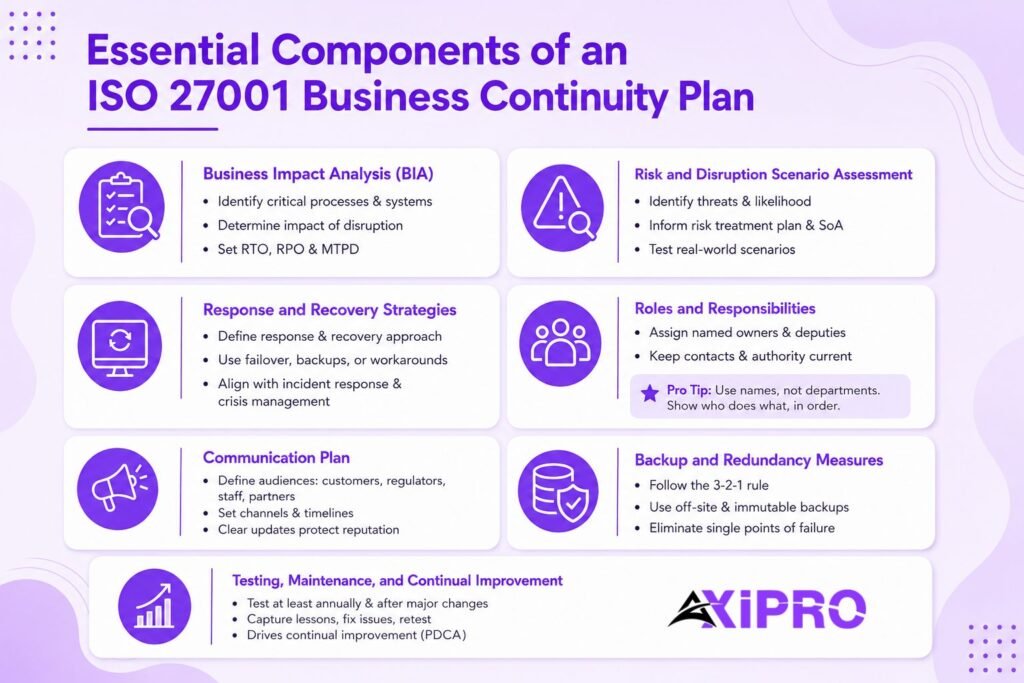
Business Impact Analysis (BIA)
The BIA is the foundation. It identifies your critical business processes, the ICT systems they depend on, and the cost of losing each one over time. It is where your recovery objectives come from, not from a vendor datasheet. A BIA also sets the Maximum Tolerable Period of Disruption (MTPD): the point beyond which an activity’s failure causes unacceptable damage.
Risk and Disruption Scenario Assessment
Your risk assessment identifies what could cause a disruption and how likely it is, feeding the Risk Treatment Plan and the Statement of Applicability (SoA) that records which controls apply. Continuity planning then runs concrete scenarios: ransomware, a regional outage, a key supplier failure, the loss of a data center.
Response and Recovery Strategies
For each critical system, you define how you will respond and recover: failover to a secondary site, restore from backup, or switch to a manual workaround. This links incident response to crisis management, the executive-level decision-making that kicks in when an incident escalates beyond a routine fix.
Roles and Responsibilities
Name real people, not departments. “IT will handle it” is the single most common reason a plan fails under pressure. Every critical system and recovery step needs a named owner and a named deputy, with current contact details and the authority to act.
Pro Tip: Replace every instance of "IT" or "the business" in your plan
Replace every instance of "IT" or "the business" in your plan with a person's name and a backup name. Auditors increasingly check whether the primary responder for a critical system can actually describe their role. A swim-lane diagram showing who does what, in order, is worth more than ten pages of policy prose.
Communication Plan
Decide in advance who tells customers, regulators, staff, and partners, through which channels, and on what timeline. Many disruptions become reputational events not because recovery was slow but because the silence was loud.
Backup and Redundancy Measures
This is Annex A 8.13 and 8.14 in practice. The widely used benchmark is the 3-2-1 rule: three copies of data, on two media types, with one off-site and ideally immutable. The U.S. Cybersecurity and Infrastructure Security Agency still recommends this baseline, with an additional offline or immutable copy as ransomware defense. Redundancy means no single point of failure can take down a critical service on its own.
Testing, Maintenance, and Continual Improvement
A plan that has never been tested is a hypothesis. ISO 27001 expects testing at planned intervals, typically at least annually and after any significant change. This is the Continual Improvement half of the PDCA cycle: test, capture what failed, fix it, retest. Our guide to Testing Maintenance and Continual Improvement covers the cadence in detail.
How to Create an ISO 27001 Business Continuity Plan: Step-by-Step
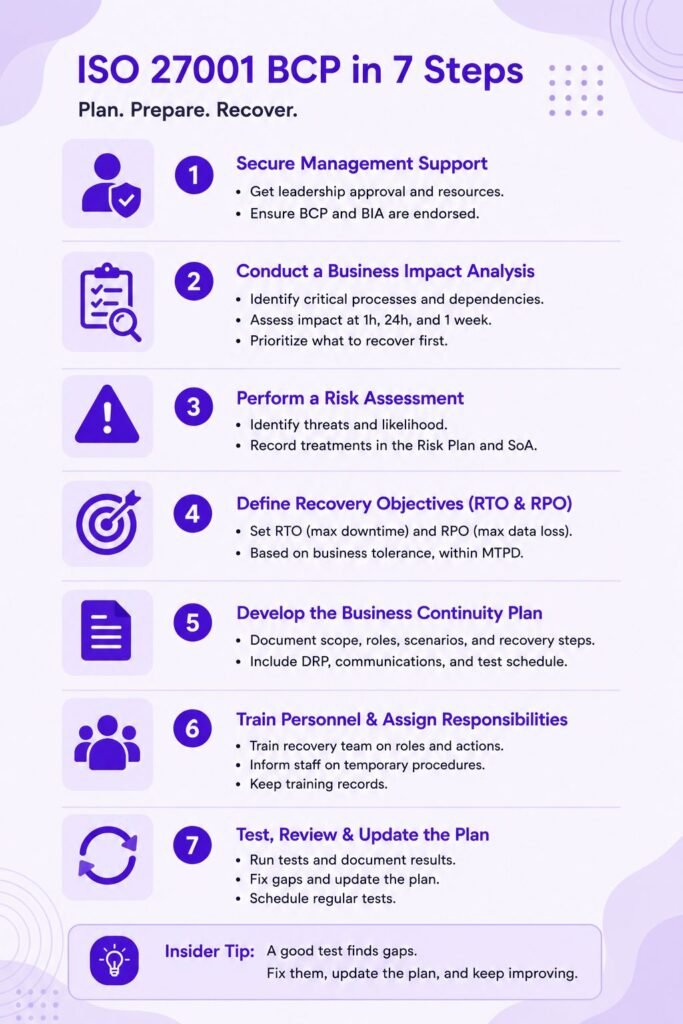
Step 1: Secure Management Support
Continuity planning needs budget and authority. Get senior management to own the objectives, because A.5.30 plans must be approved at that level and the BIA needs sign-off to carry weight in an audit.
Step 2: Conduct a Business Impact Analysis
Map every critical process to its supporting systems, suppliers, and data. Quantify the impact of losing each one at intervals such as 1 hour, 24 hours, and one week, and use that to rank what gets recovered first.
Step 3: Perform a Risk Assessment
Identify the threats that could cause those impacts, assess likelihood, and record your treatment decisions in the Risk Treatment Plan and the SoA. The risk assessment and the BIA together justify where you spend on resilience.
Step 4: Define Recovery Objectives (RTO and RPO)
Set an RTO and RPO for every critical system, derived from the BIA. RTO is the maximum time to restore a service. RPO is the maximum data loss you can absorb, measured in time. Both must fit inside the MTPD.
Insider Note: The most common RTO mistake is setting it based on what your technology can deliver, then calling that the target. Auditors and regulators expect the opposite: business tolerance sets the number, and the architecture is built to meet it. The NIST guidance in SP 800-34 is explicit that RTO must sit below the maximum tolerable downtime, with a safety margin. A stale or wishful RTO is worse than none, because it creates false confidence.
Step 5: Develop the Business Continuity Plan Document
Write the plan: scope, roles, scenarios, recovery procedures, a Disaster Recovery Plan (DRP) for ICT, communication protocols, and the testing schedule. Keep procedures specific enough to follow at 2 a.m. with half the team unreachable.
Step 6: Train Personnel and Assign Responsibilities
Brief the recovery team on their roles and give general staff awareness of the temporary procedures that apply during a disruption. Training records are audit evidence, so keep them.
Step 7: Test, Review, and Update the Plan
Run a tabletop exercise or a live failover test, document the results, log every gap in a corrective action tracker, and feed the fixes back into the plan. Then schedule the next test. A test that produces no findings usually means the test was too easy.
ISO 27001 Business Continuity Plan Template (What to Include)
A workable plan template covers, at minimum: scope and objectives; a register of critical processes and their ICT dependencies; the BIA results with MTPD, RTO, and RPO per system; named roles and deputies; disruption scenarios and recovery strategies; the DRP and backup arrangements; the communication plan; and the test schedule with a log of past exercises and their outcomes. The NIST contingency planning guide and ISO/TS 22317 both offer BIA templates worth borrowing from if you are starting cold rather than reinventing the structure.
We’ve created an editable template for your use, click the link below to view it.
How to Evaluate Information Security Continuity
Evaluation is not a one-off. ISO 27001 expects you to verify, through testing and review, that information security controls and ICT recovery still work as intended. That means checking after each test that recovery met the documented RTO and RPO, that security controls such as logging, encryption, and multi-factor authentication stayed active during failover, and that the lessons from the last exercise were actually implemented. Internal audit and management review are the formal mechanisms that close this loop and give the auditor a paper trail to follow.
Common Mistakes to Avoid When Building Your Plan
The recurring failures are predictable. Writing the plan in IT isolation with no buy-in from the rest of the business. Setting RTO and RPO from technology capability rather than business need. Leaving ownership as a job title instead of a person. Never testing, or testing once and filing the report. Disabling security controls during recovery to move faster, which directly breaches A.5.29. And treating A.5.30 as a relabel of the old Annex A 17, when it is a genuinely new requirement with its own evidence demands.
Worth Knowing: Don't Sacrifice Security During Recovery
Worth Knowing: Auditors treat the suppression of a security control during recovery as a non-conformity, not a pragmatic shortcut. If you turn off MFA or firewall inspection to speed a restore, that decision has to be a documented, risk-assessed waiver, not an undocumented field call. A failover that quietly drops your logging is a finding waiting to happen.
What Auditors Look for in an ISO 27001 Business Continuity Plan
A certification auditor wants living proof, not shelf-ware. Expect them to ask for a BIA reviewed and signed off by management within the last 12 months, a register of critical ICT assets with RTO and RPO attached, the DRP and its technical recovery procedures, evidence of backup integrity, and a schedule of tests with results from previous exercises. They will look for after-action reports and a tracked corrective action plan showing that failures from the last test were remediated. They will check training records for the recovery team. And they will probe whether a named responder can actually describe their role. The theme throughout: evidence that continuity is operationally real, not a policy PDF filed away after last year’s audit.
If you want help building or auditing this against ISO 27001:2022, Axipro’s ISO 27001 implementation support covers the BIA, control mapping, and evidence preparation end to end.
Let Axipro help you build a business continuity plan that's practical, compliant, and audit-ready.
Strengthen Your Business Continuity Strategy
Conclusion
An ISO 27001 business continuity plan succeeds or fails on two things: whether your information security holds during a disruption, and whether your ICT can recover within the targets the business actually needs. A.5.29 and A.5.30 make both measurable and auditable. Build the plan from a real BIA, set recovery objectives from business tolerance, name owners, test the plan, and fix what breaks. Do that, and certification becomes the byproduct of genuine resilience rather than a paperwork exercise.
ISO 27001 BCP Frequently Asked Questions
Is a business continuity plan mandatory for ISO 27001 certification?
You cannot ignore continuity. ISO 27001:2022 includes A.5.29 and A.5.30 as Annex A controls, and unless you can justify their exclusion in the Statement of Applicability, you must implement them. In practice this means documented, tested continuity arrangements for information security and ICT, even if you do not pursue a full ISO 22301 BCMS.
What is the difference between ISO 27001 and ISO 22301 business continuity?
ISO 27001 covers the information security aspects of continuity: keeping data confidential, intact, and available during disruption. ISO 22301 is a standalone Business Continuity Management System standard covering the whole organization, including people, facilities, and supply chain. An ISO 27001 certificate does not prove you have a complete BCMS; ISO 22301 does.
How often should an ISO 27001 business continuity plan be tested?
At planned intervals, which in practice means at least once a year and after any significant change, such as a major system migration, an acquisition, or a real incident that exposed a gap. The BIA should be reviewed on the same cadence so the recovery objectives stay accurate.
Who is responsible for the ISO 27001 business continuity plan?
Senior management owns the objectives and approves the plan, but day-to-day responsibility is distributed across process owners, an ICT recovery team, and named individuals for each critical system and recovery step. The plan should name people and deputies, not departments.
What is the difference between a business continuity plan and a disaster recovery plan in ISO 27001?
The business continuity plan is the umbrella, covering how the organization keeps critical functions running during disruption. The Disaster Recovery Plan is a subset focused specifically on restoring IT and technology infrastructure. Under ISO 27001, the DRP supports A.5.30, while the broader continuity plan supports A.5.29 and ties the technical recovery to business priorities.