
Table of Contents

Reach SOC 2 Compliance in 6 Weeks or Less.

  /

  / SOC 2 Penetration Testing Requirements: What Auditors Demand

SOC 2 Penetration Testing Requirements: What Auditors Demand

The AICPA never wrote the words penetration test required into SOC 2. Yet a service organization that walks into a Type II audit without one is almost guaranteed to leave with findings, follow-up questions, or a delayed report. That gap, between what the standard technically demands and what auditors operationally expect, is where most companies trip.

This article breaks down the real SOC 2 penetration testing requirements: where they sit in the Trust Services Criteria, what auditors look for during Type I and Type II engagements, how often you should test, and what a good pen test report needs to contain to satisfy your auditor without inflating your budget.
Understanding SOC 2 and Its Security Expectations

What Is SOC 2?

SOC 2 is an attestation framework developed by the American Institute of Certified Public Accountants (AICPA) for service organizations that handle customer data. Unlike a certification, SOC 2 is an opinion: a licensed CPA firm reviews your security controls and issues a report stating whether those controls are designed (Type I) or operating (Type II) effectively. SOC 2 reports are read by enterprise procurement teams, security reviewers, and risk officers. Most B2B SaaS contracts in 2026 require one before signing.

What Controls Does SOC 2 Require?

Rather than dictating specific technologies, SOC 2 requires that you design and operate controls that demonstrably meet each criterion under the Trust Services Criteria (TSC). That gives you flexibility, and it also gives auditors latitude to ask hard questions.

Reach SOC 2 Compliance in 6 Weeks or Less

Schedule Your Free SOC 2 Assessment Today

Does SOC 2 Require Penetration Testing?

The Official SOC 2 Position on Penetration Testing

The phrase penetration test appears in the AICPA’s 2017 Trust Services Criteria publication (with 2022 revisions) inside a single Point of Focus under CC7.1, the Common Criterion that requires entities to use detection and monitoring procedures to identify changes to configurations that introduce new vulnerabilities and susceptibilities to newly discovered vulnerabilities. The Point of Focus suggests management uses a variety of ongoing and separate risk and control evaluations to determine whether controls function. Penetration testing is named as one option.

That is the entire textual basis. There is no clause that mandates an annual external pentest, no specification of scope, no required methodology.

Short Answer: There Are No Mandatory SOC 2 Pen Test Requirements

You can technically obtain a SOC 2 report without a penetration test, provided you can show your auditor that you use alternative evaluations to satisfy CC4.1 (ongoing monitoring) and CC7.1 (vulnerability identification). In practice, almost nobody does this successfully.

Long Answer: You Still Need SOC 2 Penetration Testing

Auditors view penetration testing as the strongest available evidence that your controls work against a determined adversary, not just on paper. CC4.1 asks the entity to perform ongoing monitoring to ascertain whether internal controls are present and functioning; a pen test is the most direct way to evaluate that. CC6.1 asks whether logical access controls can be bypassed; a pen test answers that question directly. CC7.1 ties this together by requiring you to detect newly introduced vulnerabilities.

If you skip pen testing, you carry the burden of proving your alternative evidence is at least as good. That is a steeper hill than most organizations realize.

What Auditors Expect During Type I and Type II Engagements

A SOC 2 Type I report assesses control design at a single point in time. A Type II report assesses operating effectiveness over a defined audit period, typically six to twelve months. Both increasingly assume a recent penetration test exists. For Type II especially, auditors expect the test to fall within the audit window, with documented remediation of any critical or high findings before the period closes.

Auditors rarely refuse a Type II report over a missing pentest outright, but they will issue a finding or qualified opinion if they cannot validate CC4.1 evidence. That qualification will be read by every customer reviewing your report. Most CISOs would rather budget $15,000 for a pentest than try to explain a qualified opinion to a procurement team.

What Are the Actual SOC 2 Penetration Testing Requirements?

Alignment with Trust Services Criteria

A pen test that supports a SOC 2 audit must map its findings to specific criteria. Most reputable pentest firms now produce a Trust Services Criteria mapping appendix that ties identified vulnerabilities back to CC4.1, CC6.1, CC7.1, and where relevant CC7.2 through CC7.4. Without that mapping, your auditor has to do the interpretive work themselves, which typically means a follow-up request and a slower report.

Scope Definition Requirements

Scope should match your SOC 2 system boundary, not your entire infrastructure. If your audit covers a single SaaS product, its API, and its AWS account, that is what should be tested. Auditors look for evidence that the pen test scope was derived from the system description in your SOC 2 report. A mismatch between the two is one of the most common causes of fieldwork delays.

Testing Frequency and Timing Requirements

SOC 2 does not specify a frequency. Annual testing has become the de facto standard, with additional testing after material changes to architecture, authentication, or hosting. For organizations on continuous deployment, some auditors now accept a combination of annual deep-dive testing and continuous automated assessment as sufficient coverage, but this should be confirmed with your auditor before you rely on it.

Remediation Evidence Requirements

Findings without remediation are findings against you. Auditors expect documented remediation plans for every critical and high-severity issue, with closed tickets, retest results, or compensating controls recorded before the audit period ends. A finding sitting open in a backlog at audit time is treated almost identically to a finding that was never addressed.

Reach SOC 2 Compliance in 6 Weeks or Less

Schedule Your Free SOC 2 Assessment Today

Penetration Testing vs. Vulnerability Scans for SOC 2

Both belong in your control set, but they answer fundamentally different questions. Vulnerability scanning is automated and broad, it identifies known CVEs and misconfigurations across your environment quickly and consistently. Penetration testing is manual and adversarial, it simulates what a real attacker would do with the access and information they can obtain. CC7.1 explicitly references both, and your auditor will want to see evidence of each.

Why Automated Scans Are Not Sufficient for SOC 2 Compliance

Scanners cannot reason about business logic. They will not find a privilege escalation chain through a multi-tenant API, an authorization flaw that lets one customer view another customer’s data, or an authentication bypass via a forgotten admin endpoint. SOC 2 cares about whether your controls actually protect customer data, and those classes of failure only surface under manual penetration testing. Submitting scanner output as your primary evidence under CC4.1 is one of the fastest ways to generate a finding.

When to Use Vulnerability Scanning vs. Penetration Testing

Use scanning continuously as ongoing evidence of monitoring. Use penetration testing periodically as deep validation. They are complements, not substitutes, and your SOC 2 control narrative should describe them as such.

Required Types of Penetration Testing for SOC 2

In-scope assets generally fall into five categories, each requiring a distinct testing approach. External network testing simulates an attacker on the public internet probing your perimeter, open ports, exposed services, and edge device vulnerabilities. Internal network testing assumes a foothold has already been gained and evaluates lateral movement paths, network segmentation, and privilege escalation opportunities. Web application testing typically follows the OWASP Web Security Testing Guide and targets injection, authentication, and session management flaws. API testing has become its own discipline as most SaaS products now expose core business logic through REST and GraphQL endpoints, making it a critical surface area for SOC 2 evidence. Cloud infrastructure testing for AWS, Azure, and GCP focuses on misconfigured IAM policies, exposed storage buckets, and overly permissive network controls, the most common source of material findings in modern SaaS environments.

What Makes a Good SOC 2 Penetration Test?

A good test pursues specific goals tied to your actual threat model: Can a customer access another customer’s data? Can an unauthenticated user reach administrative endpoints? Can an attacker pivot from a compromised application tier to the underlying cloud account? Generic test-everything engagements rarely produce findings that map cleanly to TSC controls, and they are harder for auditors to evaluate. Specificity is an asset, not a limitation.

The test must also match your SOC 2 audit scope precisely. If your system description names three products and the pentest covered only one, your auditor will issue a finding. Results must be actionable, CVSS scores alone are not enough. Each finding should include reproduction steps, business impact, and prioritized remediation guidance. Anything less wastes engineering time and adds friction at audit fieldwork.

Pro Tip: Avoiding Failed Audits

Auditors will reject a pentest report that consists only of automated scanner output rebadged as a penetration test. This pattern has become common with low-cost pentest-as-a-service providers, and major audit firms have started calling it out as insufficient evidence for CC4.1.

When Should You Perform Penetration Tests for SOC 2 Compliance?

Four scenarios drive timing decisions. The first is the audit deadline itself, a pentest performed too early in the audit window leaves stale findings; too late, and there is no time to remediate before the period closes. The second is a trigger event, such as a security incident or a newly disclosed CVE affecting your stack. The third is a material architecture change, a major deployment, a new authentication system, or a cloud migration that changes your attack surface significantly. The fourth is the basic annual cadence that maintains posture between audits regardless of whether anything has changed.

Worth Knowing: Scheduling a Pentest

Schedule your pentest 90 to 120 days before your audit period closes. That gives engineering time to remediate critical findings, your testing firm time to retest, and your auditor time to validate evidence before the report is drafted. Anything tighter is a recipe for a qualified opinion or a delayed close.

How to Prepare for and Perform Effective SOC 2 Penetration Testing

Preparation starts with scope definition aligned to your SOC 2 system boundary. Document every in-scope application, API, and cloud account. Confirm authentication paths and provision tester accounts before the engagement starts. Brief your testing firm on your threat model and share prior findings so they are not duplicating work.

Choose a testing team with explicit SOC 2 experience. Certifications worth verifying include OSCP, OSWE, CREST, and CISSP. Ask specifically whether the firm produces TSC-mapped reports and whether retests are included in scope, both are non-negotiable for audit-quality evidence. For a full walkthrough of what to look for, the SOC 2 guide covers vendor selection in detail.

Remediate every critical and high finding before the audit period closes. Document medium and low findings with risk acceptance memos or remediation timelines. Then present everything to your auditor as a structured package: pentest report, remediation evidence, retest results, and a control-mapping summary. Auditors appreciate a clean folder, it signals operational maturity.

SOC 2 Penetration Testing Checklist for 2026

Use the SOC 2 checklist as your master reference, and layer in the following for penetration testing specifically. Confirm scope matches your system description. Schedule the engagement 90 to 120 days before the audit window closes. Require Trust Services Criteria mapping in the final report. Ensure manual testing of authorization flows and business logic, not just infrastructure. Remediate all criticals and highs before the period ends. Retain retest evidence alongside the original findings. Store the complete package, report, remediation tickets, retest results, and control mapping, in a single audit folder before fieldwork begins.

What Are the Benefits of SOC 2 Penetration Testing?

Beyond audit evidence, a properly scoped pentest delivers compounding value. It reduces breach risk by surfacing exploitable vulnerabilities before an attacker does. It validates your engineering investment in security controls, giving your team actionable signal rather than theoretical risk scores. It supplies ready-made evidence for customer security reviews and third-party questionnaires that would otherwise require custom responses. And it provides a legally defensible position if a breach later occurs, demonstrating reasonable due diligence is increasingly relevant in regulatory and litigation contexts.

How Much Does a SOC 2 Penetration Test Cost?

For a standard SaaS scope covering one product, its API, and one cloud account, expect to budget $1,000 to $20,000 in 2026. Scope size is the largest cost driver, additional applications, multiple cloud environments, complex authentication flows, and Active Directory all push costs higher. Boutique specialist firms typically deliver better evidence-to-cost ratios than large consultancies, which often charge two to three times the boutique rate for comparable depth of work.

The hidden cost is retesting. Many providers quote a low headline price that excludes retest fees. A finding without retest evidence does not satisfy your auditor, so retests are not optional, they are part of the deliverable. Ask explicitly whether retesting is included before signing an engagement letter.

Reach SOC 2 Compliance in 6 Weeks or Less

Schedule Your Free SOC 2 Assessment Today

Closing Note

SOC 2 will not technically fail you for skipping a penetration test. But the operational reality of modern audits, enterprise procurement requirements, and customer security reviews makes one effectively mandatory. Treat the pentest as the most efficient piece of evidence you can produce for CC4.1, CC6.1, and CC7.1, scope it tightly to your system boundary, remediate findings before the audit window closes, and make sure the report can be read by an auditor without translation. Done well, it is the lightest-weight way to satisfy three of the most scrutinized criteria in SOC 2, and one of the few security investments that pays dividends both inside and outside the audit room.

Frequently Asked Questions About SOC 2 Penetration Testing Requirements

Is penetration testing required for SOC 2 Type I?

Not strictly, but most auditors expect one as evidence of control design. A Type I report without a recent pentest is harder to defend and more likely to generate follow-up requests during fieldwork.

Same answer, more emphatically. Type II tests operating effectiveness over time, and a pentest is the strongest available evidence that controls operate as designed across the audit period.

Annually at minimum, plus additional tests after material changes to architecture, authentication systems, or cloud infrastructure. Some high-velocity engineering organizations supplement annual testing with continuous automated assessment, though this should be discussed with your auditor before relying on it as a substitute.

An executive summary, defined scope and methodology, severity-rated findings with reproduction steps, CVSS scores, Trust Services Criteria control mapping, and prioritized remediation guidance. Retest evidence should be appended or submitted as a follow-on document before the audit period closes.

No. Vulnerability scans support CC7.1 as evidence of ongoing monitoring but do not substitute for the manual evaluation evidence auditors expect under CC4.1 and CC6.1. The two serve different evidentiary purposes and both should appear in your control set.

Any qualified third-party firm with a documented testing methodology and credentialed testers. SOC 2 does not specify required accreditations, but auditors look for evidence of tester independence, a recognized methodology, often referencing NIST SP 800-115, and verifiable tester qualifications such as OSCP or CREST membership.
Axipro Author

Picture of Pedro Dias

Pedro Dias

Pedro has been writing online for over 10 years. With experience in all things programming, cyber security, and compliance, he is our editor-in-chief at Axipro.

Blog Highlights

Explore More Articles

Legacy threat modeling frameworks such as STRIDE were designed for software that behaves the same way over and over again. Agentic AI does no such thing. It can rewrite its own plan mid-task, call external tools, negotiate with other agents, and produce a different output from identical input. MAESTRO exists because none of the legacy threat modeling frameworks were built to handle that. MAESTRO stands for Multi-Agent Environment, Security, Threat, Risk, and Outcome. It is a seven-layer threat modeling framework created specifically for agentic AI systems, and it has become the closest thing the industry has to a standard method for reasoning about agent security. Understanding MAESTRO in the Context of Agentic AI What MAESTRO Stands For Each word in the acronym carries meaning. Multi-Agent Environment signals that the framework models entire ecosystems of interacting agents, not a single model behind an API. Security, Threat, Risk covers the core discipline: identifying attack surfaces, cataloging threats, and assessing likelihood and impact. Outcome is the part most frameworks skip. MAESTRO asks what an attack actually produces in the real world, because an autonomous agent with tool access turns a compromised prompt into a compromised action. The Origin of MAESTRO (Cloud Security Alliance) The Cloud Security Alliance published MAESTRO in February 2025. Its creator is Ken Huang, Co-Chair of the CSA AI Safety Working Groups and CEO of DistributedApps.ai. The CSA has since applied the framework publicly to real systems, including OpenAI’s Responses API and Google’s A2A protocol, which gives practitioners worked examples rather than just theory. The framework is openly published, and the CSA maintains an official companion tool, the MAESTRO Threat Analyzer, on GitHub. SOC 2, ISO 27001 and HIPAA done for you. Fixed fee, 100% audit pass rate. Audit-ready in 6 weeks. Not 6 months. Schedule Free Assessment Why Traditional Frameworks Fall Short for Agentic AI STRIDE, PASTA, LINDDUN, and OCTAVE all share a founding assumption: the system under analysis follows predictable logic with clearly defined boundaries. You draw the data flow diagram, mark the trust boundaries, and enumerate threats against components that behave deterministically. Agentic AI breaks every part of that assumption. Unique Security Challenges of Autonomous Agents Agents introduce three properties that legacy models cannot express. Non-determinism means the same input can produce different behavior, so you cannot enumerate execution paths in advance. Autonomy means the agent makes decisions and takes actions without a human approving each step, which collapses the usual assumption that a person sits between intent and execution. And in multi-agent systems there is often no stable trust boundary: agents delegate to other agents, consume tool outputs from external servers via protocols like the Model Context Protocol (MCP), and update their own memory and goals at runtime. The Gap Between Legacy Frameworks and Agent-Based Systems The practical consequence is coverage gaps. STRIDE has no category for goal manipulation, where an attacker gradually steers what an agent is trying to achieve. PASTA assumes attacker objectives and data flows are fixed, which fails for systems that learn and adapt during operation. LINDDUN addresses privacy but says nothing about agent collusion or memory poisoning. A threat model built purely on these frameworks will pass review and still miss the attacks that matter most in an agentic deployment. How MAESTRO Addresses Agentic-Specific Risks MAESTRO does not discard the older frameworks. It extends them with a layered reference architecture, an AI-specific threat catalog for each layer, and, critically, explicit analysis of how threats propagate between layers. That cross-layer lens is the framework’s real contribution, because most serious agentic incidents are chains: poisoned data influences a model, the model misleads an agent, and the agent takes an unauthorized action three layers away from where the attack started. The Seven Layers of the MAESTRO Framework MAESTRO decomposes any agentic system into seven layers, each with its own threat landscape. Layer 1: Foundation Models The core LLMs or other models the agents reason with. Threats here include adversarial examples, model extraction, backdoored weights, and jailbreaks that bypass safety training. If the model is a third-party API, supply chain risk lives at this layer too. Layer 2: Data Operations Everything the agent ingests, stores, and retrieves: training data, RAG pipelines, vector databases, and agent memory. Data poisoning and memory tampering are the signature threats at this layer, and they are especially dangerous because a poisoned memory persists across sessions and keeps shaping future decisions long after the initial attack. Layer 3: Agent Frameworks The orchestration software that turns a model into an agent: LangChain, CrewAI, AutoGen, custom planners, and tool-calling logic. Threats include prompt injection through tool outputs, insecure tool definitions, and manipulation of the planning loop itself. Layer 4: Deployment Infrastructure The servers, containers, and cloud services the agents run on. The CSA’s threat catalog here reads like traditional cloud security with an agentic twist: compromised container images carrying malicious agent code, Kubernetes orchestration attacks, denial of service against agent runtimes, and tampering with Infrastructure-as-Code templates that provision agent resources. Layer 5: Evaluation and Observability The systems that monitor, evaluate, and debug agent behavior. This layer is often forgotten, and attackers know it. The CSA specifically flags poisoning observability data: manipulating the telemetry fed to monitoring systems so that incidents stay hidden from security teams while malicious activity continues. Layer 6: Security and Compliance MAESTRO treats this as a vertical layer that cuts across all others: identity and access management, guardrails, policy enforcement, and compliance controls. Threats include permission escalation, guardrail bypass, and compromise of the security agents themselves in architectures where AI enforces policy on other AI. Layer 7: Agent Ecosystem The environment where agents interact with users, other agents, and marketplaces. This is where the genuinely novel threats live: agent impersonation, misleading agent capability cards, tool squatting, and collusion between agents to achieve outcomes no single agent was authorized to pursue. Insider Note: In real assessments, Layers 5 and 6 expose the maturity gap fastest. Most teams’ shipping agents can describe their model and their orchestration framework in detail, then

EU AI Act Hiring Map

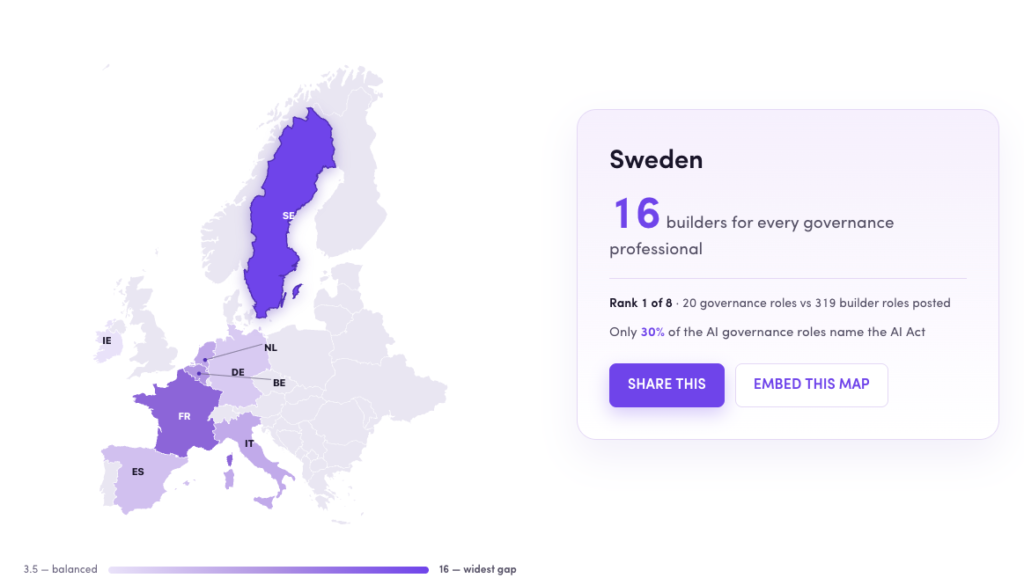
AXIPRO STUDY New Study: Europe is hiring AI builders faster than AI governance professionals Axipro analyzed 3,519 AI-related job postings across eight EU countries. For every professional hired to keep AI lawful, safe and accountable, nearly seven were hired to build more of it, and the gap is widest exactly where you’d least expect. Take EU AI ACT READINESS QUIZZ 16 AI Builders : 1 AI Governors Sweden — Europe’s widest AI governance gap 3,519 Job Postings Analyzed 8 EU Countries 2 Role Categories: Builders vs Governors July 2026 Date of Job Postings Analyzed The findings Finding 1: Sweden hires 16 AI builders for every 1 person to govern them Throughout our data-set we found the same pattern across all eight countries: the more a nation hires to build AI, the less it hires to govern it. France runs eleven builders to every governor. Even Ireland, the most balanced in Europe, looks responsible mainly because the US tech giants headquartered there import global-governance discipline under overlapping DORA and AI Act pressure.  3.5→16 builders hired per governor, Europe’s most balanced country to its least. Ireland 3.5 Germany 5.7 Spain 6.0 Italy 7.1 Netherlands 7.2 Belgium 7.9 France 11.4 Sweden 16:1 0 4 8 12 16 Builders hired per AI governor Source: Axipro, 2026 Sweden has one of the strongest engineering cultures in Europe. It also carries the widest governance gap we measured: sixteen AI builders hired for every person hired to govern them. France sits close behind at eleven to one. The most balanced country, Ireland at 3.5 to one, looks responsible for a reason that has little to do with virtue. The US tech giants headquartered in Dublin import global governance discipline, and they do it under the combined weight of the AI Act and DORA, the EU financial-sector resilience regime in force since January 2025. Engineering strength does nothing to close a governance gap, and it may widen it. A country that ships AI faster produces more systems that fall under the Act’s scope and, on this evidence, fewer people positioned to document, monitor, and defend them. Being good at building AI offers no protection against governing it badly. The countries most confident in their technical talent are running the largest deficit against the law. Explore AI governance hiring by country Click any country to see how many AI builders it hires for every governance professional, and where it ranks against the rest of Europe. Germany — 5.7 builders per governorDE France — 11.4 builders per governorFR Spain — 6.0 builders per governorES Italy — 7.1 builders per governorIT Netherlands — 7.2 builders per governorNL Belgium — 7.9 builders per governorBE Ireland — 3.5 builders per governorIE Sweden — 16 builders per governorSE 3.5 — balanced 16 — widest gap Source: Axipro, 2026 Sweden 16builders for every governance professional Rank 1 of 8 · 20 governance roles vs 319 builder roles posted Only 30% of the AI governance roles name the AI Act Share this Embed this map Copy & paste — links back to Axipro Copy embed code Branded, one paste, backlink included. × Share this country insight Share this AI governance gap X / Twitter LinkedIn Facebook WhatsApp Bluesky Email Copy link Choose a platform or copy the link. A view of the same country-level dataset behind the interactive map: governance roles, builder roles, builder-to-governance ratio, and the share of governance postings that name the EU AI Act. AI governance jobs Europe statistics by country: governance roles, builder roles, builder-to-governance ratio and AI Act mention percentage. Country Governance roles Builder roles Builder-to-governance ratio AI Act mention % Sweden 20 319 16.0:1 30.0% France 39 443 11.4:1 38.5% Belgium 38 299 7.9:1 39.5% Netherlands 61 439 7.2:1 31.1% Italy 40 284 7.1:1 45.0% Spain 64 384 6.0:1 28.1% Germany 88 501 5.7:1 27.3% Ireland 96 335 3.5:1 14.6% Source: Axipro analysis of AI builder, governance and compliance job postings across eight European countries. “AI Act mention %” is the share of governance postings that explicitly name the EU AI Act. We analyzed thousands of AI-related job postings across eight EU countries and split them into two camps: the people hired to build AI systems, and the people hired to govern them. The ratio between those two groups tells you how seriously a country, a sector, or a company is treating the law that now governs both. Three numbers stood out.  Finding 2: Europe is hiring for a law it won’t say out loud Europe spent years drafting the AI Act. It cleared the European Parliament, survived the Digital Omnibus revisions, and now carries penalties that reach €35 million or 7% of global turnover for the most serious breaches, a ceiling that makes GDPR fines look modest. Yet fewer than three in ten of the governance roles created to handle it actually name the law in the job description. Among builder roles, the figure collapses to one in twenty-five. More than 7 in 10 Governance job descriptions do not mention the EU AI Act. This number rises to 9 in 10 for all AI job descriptions. Despite hiring for governance, risk, privacy, and compliance roles, most employers are not yet translating the EU AI Act into explicit job requirements. That disconnect should stop you. The people being hired to make Europe compliant are, for the most part, not being hired against the Act by name. They are titled around adjacent ideas: risk, ethics, model validation, data protection. Some of that work will map onto the Act’s requirements. Much of it will not, because a role written without the regulation in view rarely produces the conformity assessments, technical documentation, and human-oversight structures the Act specifically demands. Readiness is even thinner than the headcount suggests. Simply counting governance hires overstates how many people are actually working the law. What job descriptions actually name The EU AI Act is visible in governance roles — but still absent from most job ads. Across the laws and frameworks most relevant to AI governance

AI Agents and Compliance

78% of organizations have no formal policies for creating or removing AI agent identities, according to a 2026 report from the Cloud Security Alliance and Oasis Security. The same research found that 92% are not confident that their legacy identity and access management tools can handle the risks agents introduce. Those two numbers describe the problem in full: enterprises are deploying autonomous software that reads email, queries databases, and triggers actions across production systems, and most of them cannot say who authorized it, what it can touch, or how they would prove any of that to an auditor. This is not a future problem. Agents are already operating inside regulated environments governed by the GDPR, HIPAA, SOX, and the EU AI Act. Every access decision an agent makes is a compliance event, whether or not anyone is logging it. This article covers what regulators actually expect, where traditional IAM falls short, and how to build an access framework for AI agents that survives an audit. Understanding the Compliance Landscape for AI Agents Key Regulations Impacting AI Agent Access No regulation says “AI agent” and then hands you a checklist. Instead, agents inherit obligations from every framework that governs the data and systems they touch. Under the GDPR, an agent processing personal data triggers the full set of principles in Article 5: lawfulness, purpose limitation, data minimization, and accountability. If an agent makes decisions that produce legal or similarly significant effects on individuals, Article 22 restrictions on automated decision-making apply as well. HIPAA requires covered entities to implement access controls, audit controls, and integrity protections for electronic protected health information under the Security Rule, and an agent with access to ePHI is subject to the same technical safeguards as a human workforce member. SOX demands that access to financial reporting systems be controlled, segregated, and reviewable, which becomes genuinely difficult when an autonomous agent can touch the general ledger. The EU AI Act adds an AI-specific layer, and its timeline is widely misunderstood. Following the Digital Omnibus agreement, obligations for standalone high-risk systems under Annex III were deferred to December 2, 2027. But the Article 50 transparency obligations still apply from August 2, 2026, meaning agents that interact with people in the EU must disclose their artificial nature on the original schedule. Treating the Omnibus as a blanket delay is one of the most common compliance mistakes being made right now. Important: The Digital Omnibus deferred the high-risk regime, not the whole Act. If an AI agent interacts with users in the EU, the August 2, 2026, transparency requirements were not moved, and the AI Office’s enforcement powers go live on the same date. Do not stand down 2026 workstreams based on headlines about the 2027 deferral. How AI Agents Create New Compliance Risks Agents break the assumptions most compliance programs are built on. A human user requests access, receives a role, and behaves within a predictable envelope. An agent reasons about its own goals, chains tool calls across systems, and can attempt actions its designers never anticipated. It operates at machine speed and machine volume, so a misconfigured permission produces thousands of non-compliant data touches before anyone notices. And because agents frequently run on shared service accounts or borrowed OAuth tokens, attribution collapses: the audit log says the CRM was queried, but not by whom, for what purpose, or under whose authority. The Gap Between Traditional IAM Compliance and Agentic AI Traditional IAM assumes identities are stable, access needs are predictable, and behavior maps to a job description. None of that holds for agents. A 2026 Cloud Security Alliance survey found that 68% of organizations cannot reliably distinguish AI agent activity from human activity in their logs. For a compliance function, that is disqualifying. If you cannot separate agent actions from human actions, you cannot certify access, demonstrate segregation of duties, or respond to a data subject access request with confidence. Core Compliance Requirements for AI Agent Access Auditability and Traceability of Agent Actions Every major framework converges on the same demand: show your work. For agents, a login timestamp is not enough. A defensible audit trail captures the full chain of custody for each action: which agent acted, which human or process delegated the authority, which tool or API was invoked, which data was accessed, and what the outcome was. Gartner’s 2026 Market Guide for what it calls “guardian agents” describes exactly this pattern of recording agent-to-tool-to-target chains for compliance reporting and incident response. Data Protection and Privacy Obligations Agents must operate inside the same data protection perimeter as everything else. That means Data Loss Prevention (DLP) controls apply to agent outputs, not just human uploads. It means an agent’s access to personal data needs a lawful basis, documented before deployment, not reverse-engineered after. And it means retention rules follow the data into whatever context window, vector store, or scratchpad the agent moves it into. Separation of Duties in Autonomous Systems Separation of duties exists so that no single actor can both commit and conceal an error or a fraud. A single agent granted permissions across procurement, approval, and payment reconstitutes exactly the toxic combination SOX controls were designed to prevent, except now it executes at machine speed. The control translates directly: no agent should hold permission sets that a human in the same process would be prohibited from combining, and multi-agent workflows need the same conflict analysis as human role assignments. Consent, Purpose Limitation, and Data Minimization Purpose limitation is the principle that agents most naturally violate. An agent given broad access “to be helpful” will use data collected for one purpose to accomplish another, because nothing in its architecture knows the difference. Compliance-ready agent access means scoping data access to the declared purpose of the task and enforcing that scope technically rather than hoping the system prompt holds. Insider Note: In practice, the purpose limitation failures we see are rarely dramatic. They look like a support agent enriching a ticket with data pulled from the sales