

Table of Contents

Reach SOC 2 Compliance in 6 Weeks or Less.

  / Automated vs. Manual Penetration Testing: Which One Does Your Business Need?

Automated vs. Manual Penetration Testing: Which One Does Your Business Need?

As cyber threats grow in volume and sophistication, penetration testing has emerged as a critical tool to identify and address vulnerabilities before malicious actors can exploit them. But when it comes to running these tests, businesses often face a pivotal decision: should they opt for automated penetration testing or manual penetration testing?

Each approach has its strengths and blind spots, and understanding which one aligns with your needs is key to building a security strategy that actually holds up. This article breaks down the differences, the pros and cons of each, and how to figure out the best fit for your organization.
Automated vs. Manual Penetration Testing

What is Penetration Testing?

Penetration testing—often shortened to pen testing—is a simulated cyberattack on your systems, applications, or network designed to uncover vulnerabilities that real attackers could exploit. Think of it as hiring someone to break into your house so you can find the unlocked windows before a burglar does.

It’s an essential part of any proactive cybersecurity strategy. According to IBM’s Cost of a Data Breach Report, the global average cost of a breach has climbed steadily year over year, which makes finding weak points before they’re exploited more valuable than ever. By identifying these gaps early, businesses can take corrective action and meaningfully improve their security posture. If you want to see what a professional engagement looks like, our penetration testing services cover the full spectrum.
Understanding Automated Penetration Testing

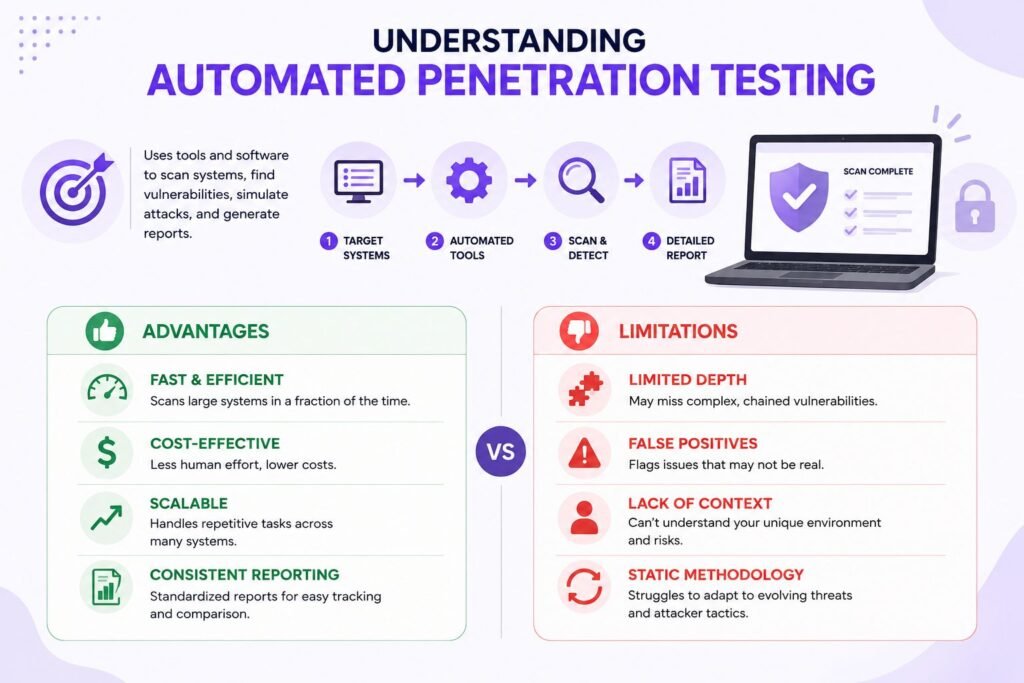
Automated penetration testing uses specialized tools and software to scan and identify vulnerabilities across your systems. These tools rely on predefined scripts and algorithms to simulate attacks and then spit out detailed reports on what they found.

Advantages of Automated Penetration Testing

Speed and efficiency are the headline benefits. Automated tools can scan sprawling networks in a fraction of the time it would take a human, making them ideal for large organizations with complex infrastructures. They’re also far more cost-effective, since they require less human intervention, and they scale effortlessly—handling repetitive tasks across a wide range of systems simultaneously.

There’s also the matter of consistent reporting. Automated tools generate standardized outputs, which means you get the same reliable format every time and can track common vulnerabilities without wondering whether the methodology shifted between scans.

Limitations of Automated Penetration Testing

The trade-off is limited depth. Automated tools tend to miss the complex, chained vulnerabilities that require human intuition and creativity to uncover. They’re also prone to false positives, flagging issues that turn out to be nothing—which means someone still has to manually validate the results.

On top of that, these tools lack context. They can’t understand what makes your business unique, so real risks specific to your environment can slip through. And because they follow a static methodology, they struggle to adapt to the dynamic, evolving threats that clever attackers throw at them.
Understanding Manual Penetration Testing

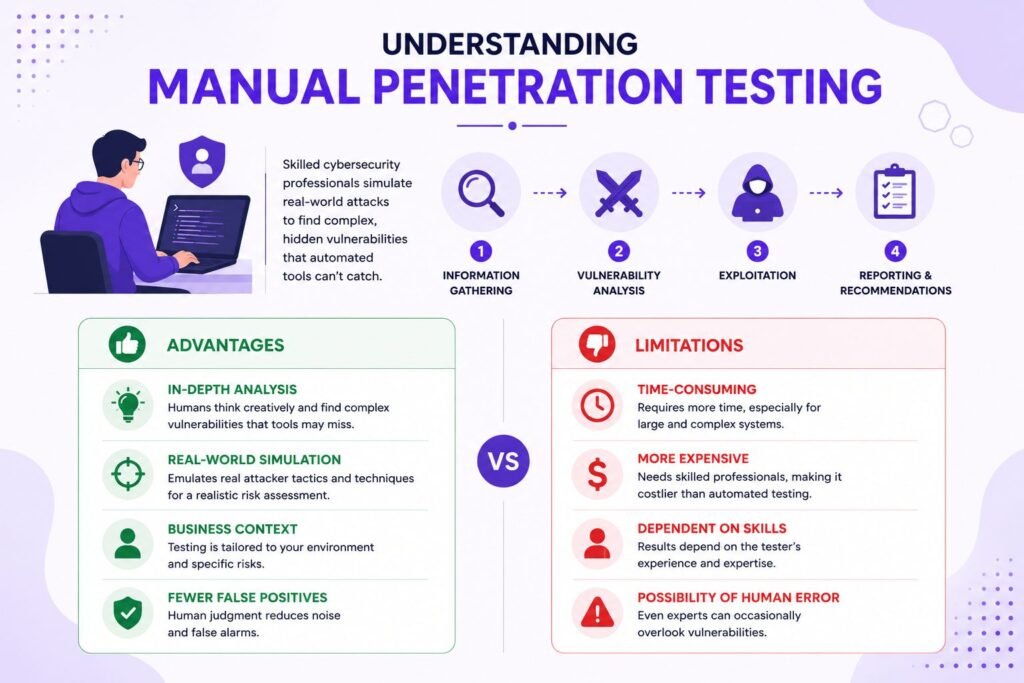
Manual penetration testing puts skilled cybersecurity professionals in the driver’s seat, simulating real-world attack scenarios to root out vulnerabilities. Unlike automated testing, it leans on human expertise to find the complex, hidden weaknesses that scripts simply can’t anticipate.

Advantages of Manual Penetration Testing

The biggest win is in-depth analysis. Human testers think creatively, spot sophisticated vulnerabilities, and exploit chains of weaknesses that automated tools breeze right past. Their work is also customized to your business context, ensuring a genuinely thorough assessment of your unique risks.

Manual testing delivers real-world simulation, too. Testers emulate the actual tactics, techniques, and procedures (TTPs) used by attackers—many of which are catalogued in the MITRE ATT&CK framework—giving you a realistic picture of how your defenses would hold up. And because skilled professionals can tell the difference between a genuine threat and a false alarm, you get fewer false positives and less wasted time.

Limitations of Manual Penetration Testing

All that expertise comes at a price. Manual testing is time-consuming, especially for large-scale systems, and the specialized skills involved make it more expensive than automated alternatives. There’s also the ever-present possibility of human error—even the best testers can occasionally overlook something.

SOC 2, ISO 27001 and HIPAA done for you. Fixed fee, 100% audit pass rate.

Audit-ready in 6 weeks. Not 6 months.

Key Differences Between Automated and Manual Penetration Testing

The clearest way to think about it: automated testing is about breadth and speed, while manual testing is about depth and nuance. Automated tools excel at covering large environments quickly and cheaply, catching well-documented vulnerabilities at scale. Manual testing, by contrast, digs into the complex, context-specific weaknesses that require a human to reason through—the kind of creative problem-solving no script can replicate.

Automated scans produce consistent, standardized reports but generate more noise in the form of false positives. Manual engagements produce tailored findings with far fewer false alarms, but they take longer and cost more. A thorough VAPT report often reflects both perspectives, combining the wide net of automation with the precision of human analysis.
Choosing the Right Approach for Your Business

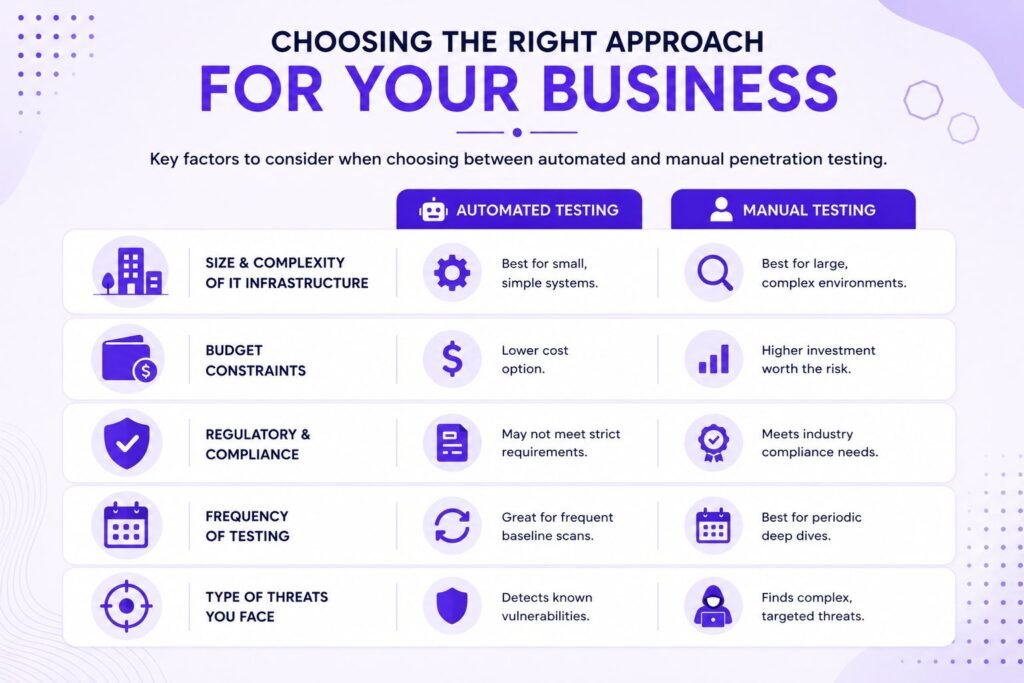
Selecting between automated and manual penetration testing comes down to a handful of factors: your organization’s size, budget, and security objectives. Here’s how to weigh them.

  • Size and complexity of your IT infrastructure. Small businesses with straightforward systems may find automated testing sufficient for catching common vulnerabilities. Larger organizations with sprawling, complex environments usually need the depth and customization that only manual testing provides.
  • Budget constraints. Automated testing is the cost-effective choice when funds are tight. That said, critical systems and sensitive data often justify the higher investment of manual testing—a breach in those areas would cost far more than the assessment itself.
  • Regulatory and compliance requirements. Industries like finance and healthcare face strict compliance mandates. Standards such as PCI DSS and frameworks aligned with ISO/IEC 27001 frequently call for rigorous, manual-driven risk assessments to satisfy auditors.
  • Frequency of testing. Automated testing shines for frequent scans that maintain a baseline level of security. Manual testing is better reserved for annual or biannual deep dives, or after significant system changes.
  • Type of threats your business faces. If your main concern is well-known vulnerabilities, automated tools have you covered. If you’re worried about sophisticated, targeted attacks, manual testing is the way to go.

Hybrid Approach: The Best of Both Worlds

Here’s the not-so-secret truth: many businesses don’t choose one over the other at all. Instead, they adopt a hybrid approach that marries the speed and scalability of automated tools with the depth and expertise of manual testing.

In practice, this means using automated penetration testing for regular scans and to catch the low-hanging fruit, then following up with manual assessments to uncover the deeper, more complex vulnerabilities that scanners miss. Integrating both methods gives you comprehensive coverage without blowing your budget. Our service plans are built around exactly this kind of balanced, layered testing.

Recommended Tools for Automated Penetration Testing

If you’re building out an automated testing capability, a few tools dominate the field.

  • Nessus is known for its extensive vulnerability scanning, while
  • Burp Suite is the go-to for web application security testing. On the open-source side,
  • OpenVAS handles network and system scans, and
  • Qualys offers a cloud-based platform for automated vulnerability management.


Manual Penetration Testing Frameworks

For manual work, professionals lean on established frameworks and platforms.

  • Metasploit is the widely-used standard for developing and executing exploit code.
  • The OWASP Testing Guide serves as the definitive reference for assessing web application security, and
  • Cobalt Strike is a favorite for adversary simulation and red team operations.

Conclusion

Both automated and manual penetration testing play crucial roles in defending your organization. Automated testing brings speed, scalability, and cost-efficiency, while manual testing delivers depth, creativity, and true real-world simulation. Understanding your unique needs—and, in most cases, blending the two—is how you build a security posture that genuinely protects your digital assets.

At Axipro, we specialize in helping businesses cut through the complexity of cybersecurity. Whether you need automated testing, manual assessments, or a hybrid solution, our team of experts is ready to guide you every step of the way.

Explore our plans to find the right fit for your organization.

Frequently Asked Questions

What is the primary difference between automated and manual penetration testing?

Automated testing relies on tools and software to identify vulnerabilities quickly, while manual testing uses human expertise to uncover complex, context-specific weaknesses.

For small businesses with simple IT systems, automated testing may suffice—but periodic manual testing provides valuable extra assurance.

At least annually, or after any significant changes to your systems. Automated scans can and should be run more frequently.

If performed incorrectly, penetration testing can cause system disruptions. Always work with certified professionals to minimize the risk.

Absolutely. A hybrid approach offers the best coverage, balancing efficiency with depth.

Axipro Author

Picture of Pedro Dias

Pedro Dias

Pedro has been writing online for over 10 years. With experience in all things programming, cyber security, and compliance, he is our editor-in-chief at Axipro.

Blog Highlights

Explore More Articles

Two compromised versions of LiteLLM sat on PyPI for roughly 40 minutes on the morning of March 24, 2026. That window was enough to capture secrets from around 434,000 CI/CD pipeline runs across nearly 2,500 organizations, including AWS, Samsung, Cisco, Salesforce, Siemens, and Deloitte. In August, researchers at CloudSEK and Hudson Rock confirmed they had obtained the raw exfiltrated data: a 153GB archive containing 433,909 files of environment variables, cloud keys, Kubernetes secrets, and API tokens harvested live from running pipelines, as covered by Help Net Security’s reporting on the credential archive. If LiteLLM runs anywhere in your stack, or you touch any AI proxy infrastructure at all, you need answers to three things: whether you were exposed, what to rotate first, and whether the rotation you did back in March actually held. That last one matters more than it sounds, because “we rotated everything” has already burned at least one very large company. How the Breach Happened The attack didn’t start with LiteLLM. On March 19, 2026, a threat group called TeamPCP compromised the build pipeline of Trivy, a vulnerability scanner half the industry runs, and pushed a poisoned release. LiteLLM’s own CI pipeline ran Trivy, so the poisoned scanner had legitimate read access to the project’s runner environment. The attackers used that to steal LiteLLM’s PyPI publishing tokens and ship two malicious releases of their own: versions 1.82.7 and 1.82.8. KICS and the Telnyx Python SDK got hit in the same campaign. The payload design is the part worth studying. The malicious package dropped a .pth startup hook into site-packages, so the code ran the moment any Python interpreter started on the machine, whether or not anything imported LiteLLM. From there it harvested environment variables, read local credential files like .aws/credentials and .kube/config, tried to move laterally across Kubernetes clusters, and installed a systemd backdoor dressed up as a generic telemetry service. InfoQ’s coverage of the PyPI compromise put downloads of the compromised release above 40,000. For scale, LiteLLM normally gets downloaded around 3 million times a day. The exfiltration had a nasty fallback, too. According to CloudSEK, stolen data was encrypted and sent to a typosquatted domain, and when that failed, the malware created a public repository inside the victim’s own GitHub account and uploaded the loot as a release asset. Some companies were publishing their own secrets to the open internet and had no idea. Worth Knowing: The malicious code only existed in the PyPI artifacts. The GitHub source repository stayed clean the whole time, so a developer reviewing the code on GitHub saw nothing wrong. Source review isn’t artifact verification. If you don’t check that what the registry serves matches the upstream source, this class of attack is invisible to you. How to Check If You Were Exposed Three checks, from quickest to most involved. 1. Confirm whether the compromised versions ever ran The malicious versions went live on PyPI at 10:39 UTC on March 24, 2026 and got quarantined about 40 minutes later. The project’s advice: treat any install from that day before 16:00 UTC as suspect. Search your lockfiles, pip caches, SBOMs, and container image histories for 1.82.7 and 1.82.8. And check your internal artifact mirrors. An Artifactory or Nexus proxy that cached the bad release in March can keep serving it internally long after PyPI pulled it. Keep the .pth mechanism in mind when you scope this. The question isn’t “which applications import LiteLLM,” it’s “which machines had the package installed at all,” because every Python process on an infected machine triggered the payload. 2. Hunt for persistence Rotation is pointless if the attacker still has a foothold. Check developer machines, CI runners, and containers for unauthorized .pth files in site-packages and for suspicious systemd units, especially anything posing as a system telemetry service. And review activity from March 24 onward, not just the 40-minute window. Persistence is there so the access outlives the infection. Pro Tip: Don’t limit the persistence hunt to live machines. Base container images rebuilt in late March may have baked the payload into every image derived from them since. Scan your image registry for the affected LiteLLM versions and for unexpected .pth files, then trace which running workloads came from flagged images. 3. Check whether your secrets are in the dump Hudson Rock has published a domain lookup tool and is running ethical disclosures for affected organizations, and CloudSEK maintains a high-confidence victim list. Use them, but know their limits. Attribution in this dataset is genuinely hard. One dump with a siriusxm.com committer email actually traced, through its self-hosted GitLab endpoints, to AdsWizz, a SiriusXM subsidiary. And a large share of the dumps are generic pipeline configurations with no identifying domain, email, or server name at all. Absence from a victim list is not evidence of absence. If your pipelines ran the compromised versions, assume exposure no matter what a lookup tool tells you. What to Rotate, in What Order The guidance from both research teams is blunt: treat every secret the LiteLLM environment could reach as compromised. That covers secrets on disk, in memory, injected into CI jobs, and anything retrievable through instance metadata services. Work down by blast radius: Priority Credential type Why it comes first 1 Cloud IAM keys (AWS, GCP, Azure) Direct control of infrastructure, data stores, and billing. This is where attackers monetize fastest. 2 GitHub and GitLab PATs, package publishing tokens These let an attacker poison your releases and turn your company into the next link in the supply chain. 3 Kubernetes service account tokens and kubeconfigs Lateral movement across clusters was built into the payload, not a theoretical risk. 4 Database passwords and third-party API keys Dumped in plain text in the archive, often with no attribution, so nobody will warn you they leaked. 5 AI provider API keys Billing abuse, quota theft, and access to whatever data flows through your LLM routing layer. One word matters more than the rest of this article: revoke, don’t just rotate. That

The EU AI Act names recruitment AI as high-risk. Annex III explicitly lists AI systems used for recruitment, candidate selection, and employment decisions, which pulls CV screeners, video interview platforms, and assessment tools into the most demanding compliance regime the Act contains. The original compliance date for these systems was August 2, 2026. In June 2026, the EU’s Digital Omnibus moved the deadline to December 2, 2027, a 16-month extension that has led many HR and talent teams to shelve the topic entirely. That’s a mistake, for two reasons. First, one rule that directly affects recruitment technology is already in force: the ban on emotion recognition in the workplace has applied since February 2, 2025, and it catches features still shipping in some video interview products today. Second, the deferred obligations didn’t shrink. Conformity assessments, human oversight design, bias monitoring, and documentation all still arrive in full, and the practical work of auditing a recruitment stack, renegotiating vendor contracts, and training hiring teams routinely takes a year or more. Here’s what the EU AI Act actually requires of employers and vendors using recruitment tools, on the timeline that now applies. Why Recruitment Tools Are Classified as High-Risk Under the EU AI Act​ Definition of High-Risk AI Systems in Hiring​ The Act takes a list-based approach. Annex III, point 4, designates as high-risk any AI system intended for the recruitment or selection of natural persons, including placing targeted job advertisements, analyzing and filtering applications, and evaluating candidates. The same point covers AI used for decisions on promotion, termination, task allocation, and monitoring of workers, so the classification follows the tool through the entire employment lifecycle, not just the hiring funnel. The reasoning is straightforward: hiring decisions shape access to livelihoods, and algorithmic discrimination in hiring is well documented. The European Commission’s regulatory framework for AI treats employment as one of the areas where an AI error or bias causes serious harm to fundamental rights. That’s the test for the high-risk tier. Types of Recruitment Tools Affected In practice, the high-risk classification captures most of the modern recruitment stack: CV and resume screeners that rank or filter applicants, video interview platforms that score responses or delivery, psychometric and skills assessment tools that produce scores feeding a hiring decision, sourcing and matching algorithms that decide which candidates a recruiter sees, and programmatic job ad targeting systems that determine who sees a vacancy at all. If the system’s output materially influences who advances and who does not, assume high-risk until proven otherwise. Important: Emotion recognition is not high-risk in the workplace. It is prohibited. Article 5 bans AI systems that infer emotions of people in the workplace (outside narrow medical and safety cases), and that ban has applied since February 2025 with the Act’s top penalty tier attached. If your video interview vendor markets “engagement scoring” or “sentiment analysis” of candidates, that feature needs to be switched off for EU hiring now, not in 2027. Recruitment Tools That May Fall Outside High-Risk Classification Not everything in the HR stack qualifies. The Act carves out systems performing narrow procedural tasks that do not materially influence decision outcomes. An applicant tracking system that stores applications, schedules interviews, and sends templated emails is a database with a workflow, not a high-risk AI system. The same goes for tools that transcribe interviews without scoring them, deduplicate candidate records, or generate first drafts of job descriptions for a human to edit. The line is decision influence: the moment a tool ranks, scores, filters, or recommends candidates, it crosses into Annex III territory. Deployers who rely on an exemption must be able to document that assessment, so “we decided it doesn’t count” needs to exist on paper. Extraterritorial Scope: Which Employers Are Covered The Act applies to providers placing AI systems on the EU market and to deployers established in the EU, but it also reaches further: it covers providers and deployers located outside the EU where the output of the system is used in the EU. For recruitment, the consequence is blunt. A US or UK company with no EU entity that uses an AI screener to filter applicants for roles based in Berlin or Dublin, or that screens candidates located in the EU, is using the system’s output in the Union. Brexit doesn’t move UK employers out of scope when they hire into or from the EU. Providers vs. Deployers of Recruitment AI Tools The Act splits obligations between the provider (the vendor that develops the tool and places it on the market) and the deployer (the employer using it). Most employers are deployers, and deployer obligations are lighter but real. One common trap: an employer that substantially modifies a high-risk system, or puts its own name on it, can be reclassified as a provider and inherit the full provider stack. Heavy customization of a screening model, or fine-tuning it on your own hiring data, can be enough to trigger this. Key Obligations for Employers Using AI Recruitment Tools Human Oversight in Automated Hiring Decisions Deployers must assign oversight of the system to people with the competence, training, and authority to intervene. That last word matters. A recruiter who rubber-stamps whatever the ranking algorithm produces, because nobody has time to review 800 rejected CVs, doesn’t count as oversight. Regulators and courts will look at whether the human could genuinely override the system and whether they ever did. Designing review checkpoints where a person can meaningfully change the outcome, and logging when they do, is the core of compliant deployment. Transparency Requirements Toward Candidates Employers must inform workers and their representatives before putting a high-risk AI system into use at work, and candidates subjected to such a system must be told it is being used. In countries with works councils, such as Germany, this obligation lands on top of existing co-determination rights, so employee representatives may need to be consulted before the tool goes live rather than just told afterward. Burying an AI disclosure in a privacy policy paragraph is unlikely to survive scrutiny.

A green dashboard is not an audit opinion. Compliance automation platforms like Vanta, Drata, Secureframe, and Hyperproof have made SOC 2 readiness faster and cheaper, but every audit cycle produces the same pattern: controls that sat at “passing” for months come back from the auditor with exceptions or requests for re-testing. The four controls below account for a disproportionate share of those rejections, and they all fail for the same underlying reason. The tool confirmed that evidence exists. The auditor tested whether the control actually operated. This article walks through each of the four: what auditors reject, why, and how to fix the evidence before fieldwork starts. Why Compliance Tools Show “Passing” But Auditors Still Reject Controls​ The Gap Between Automated Checks and Auditor Judgment Compliance platforms run continuous control monitoring: API calls that check whether a configuration exists, a document is uploaded, or a task is marked done. That’s real value. It catches drift, keeps evidence in one place, and saves weeks of screenshot collection. An audit is a different exercise. A SOC 2 examination is an attestation performed by a CPA firm under AICPA standards, and the auditor’s job is to form an independent opinion on whether your controls met the Trust Services Criteria. That opinion rests on professional judgment, not on whether an API integration returned a 200 response. What “Passing” Actually Means in Your Compliance Dashboard​ When a control shows “passing,” the platform is telling you one narrow thing: at the moment of the last scan, an automated test found the artifact or setting it was programmed to look for: MFA enforced in the identity provider, a policy document uploaded, a training campaign sitting at 100%. The test says nothing about whether the underlying process ran the way your control narrative claims it did, or whether it ran that way across the whole audit period. How Auditors Evaluate Controls Beyond the Checkbox Auditors test two dimensions. Design effectiveness asks whether the control, as described, would meet the criterion if it worked as intended. Operating effectiveness, the core of a SOC 2 Type 2 report, asks whether it actually did throughout the audit period. To answer that, the auditor pulls a population (every access review, every change, every new hire in the period), selects a sample, and inspects the evidence item by item. A dashboard status feeds into that process. It doesn’t replace it. Insider Note: Auditors increasingly ask for evidence outside the compliance platform precisely because they know what the platform auto-collects. If every artifact you produce comes from the same tool export, expect the auditor to independently pull the population from the source system and compare. Discrepancies between the two are one of the fastest routes to an exception. Control #1: Access Reviews That Automation Marks Complete but Auditors Reject Why Auditors Reject Automated Access Review Evidence​ User access reviews sit under the logical access criteria (CC6.1 through CC6.3), and they are the single most common source of audit exceptions we see. The typical failure: the platform generated a user list, someone clicked “complete,” and the dashboard turned green. The auditor then asks a simple question the evidence can’t answer: what did the reviewer actually decide? The Missing Element: Documented Reviewer Judgment​ An access review is a judgment control. Someone with knowledge of the system must look at each account and confirm the access is still appropriate for the person’s role. A timestamped task closure proves the task was closed. It doesn’t prove anyone assessed anything, and an “approve all” review completed in ninety seconds gets exactly the skepticism it deserves. What Auditors Actually Want to See in Access Review Evidence Auditors look for four things: The full population of accounts at the time of review (including service accounts and admin roles), Evidence of who reviewed it and when, explicit dispositions per account or group (retain, modify, revoke), and Proof that flagged access was actually removed. That last item, the deprovisioning ticket showing revocation within a defined window, is the piece most companies can’t produce. How to Fix Your Access Review Control Before the Audit​ Assign a named control owner per in-scope system, run reviews quarterly, and require reviewers to record a disposition for every line, not a blanket approval. When access is revoked, link the removal ticket to the review record. If a quarter was missed, don’t backfill it. Document it honestly and show the remediation, because auditors treat fabricated retroactive evidence far more severely than a disclosed gap. Control #2: Change Management Approvals That Pass Automated Scans​ Why Ticket Closure Isn’t Proof of Approval​ Change management (CC8.1) automation typically verifies that production changes link to a ticket and the ticket is closed. Auditors test something stricter: that each sampled change was approved by an authorized person before deployment. An approval added after the merge, or a ticket closed by the same engineer who wrote the code, fails that test even though every automated check came back green. The Segregation of Duties Problem Automation Misses Segregation of duties is the requirement that no single person can develop, approve, and deploy the same change. NIST’s SP 800-53 control catalog treats it as a foundational access control principle, and SOC 2 auditors apply the same logic. Small engineering teams trip on this constantly. Self-approved pull requests, admins who can bypass branch protection, direct pushes to main: a scanner sees “changes with tickets” while an auditor sees SoD violations. Emergency Changes and Retroactive Approvals: Common Rejection Triggers​ Every audit period contains hotfixes. Auditors don’t reject emergency changes. They reject emergency changes with no documented post-hoc review. If your policy says urgent changes get retroactive approval within two business days, the auditor will sample your emergency changes and check exactly that. No policy, or a policy nobody followed, produces an exception. Rebuilding Change Management Evidence Auditors Will Accept​ Enforce the control technically: branch protection requiring at least one independent reviewer, no admin bypass, and deploy pipelines that only run from protected branches. Then write the emergency change procedure down and generate the review artifact every time it fires.