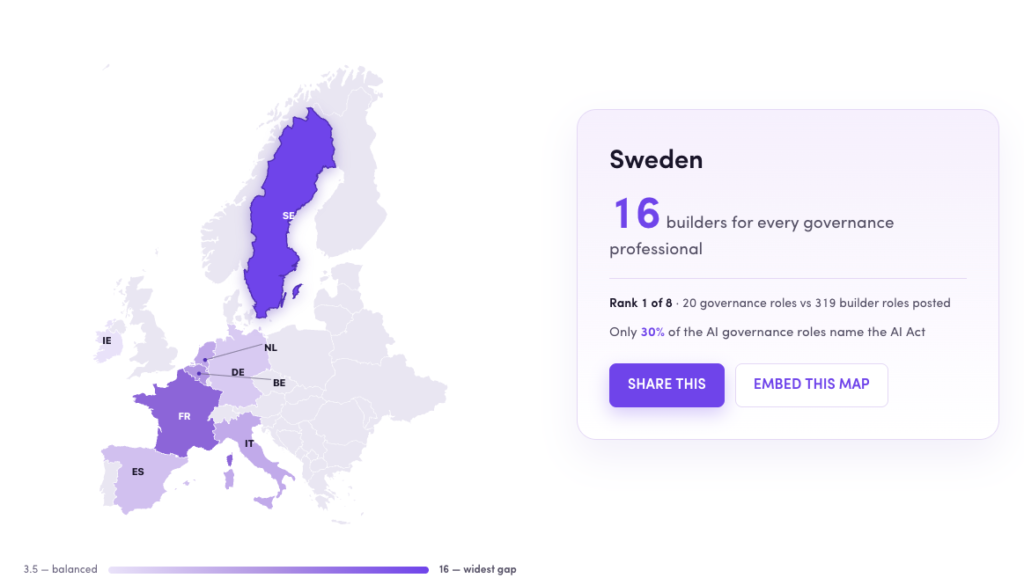
AXIPRO STUDY New Study: Europe is hiring AI builders faster than AI governance professionals Axipro analyzed 3,519 AI-related job postings across eight EU countries. For every professional hired to keep AI lawful, safe and accountable, nearly seven were hired to build more of it, and the gap is widest exactly where you’d least expect. Take EU AI ACT READINESS QUIZZ 16 AI Builders : 1 AI Governors Sweden — Europe’s widest AI governance gap 3,519 Job Postings Analyzed 8 EU Countries 2 Role Categories: Builders vs Governors July 2026 Date of Job Postings Analyzed The findings Finding 1: Sweden hires 16 AI builders for every 1 person to govern them Throughout our data-set we found the same pattern across all eight countries: the more a nation hires to build AI, the less it hires to govern it. France runs eleven builders to every governor. Even Ireland, the most balanced in Europe, looks responsible mainly because the US tech giants headquartered there import global-governance discipline under overlapping DORA and AI Act pressure. 3.5→16 builders hired per governor, Europe’s most balanced country to its least. Ireland 3.5 Germany 5.7 Spain 6.0 Italy 7.1 Netherlands 7.2 Belgium 7.9 France 11.4 Sweden 16:1 0 4 8 12 16 Builders hired per AI governor Source: Axipro, 2026 Sweden has one of the strongest engineering cultures in Europe. It also carries the widest governance gap we measured: sixteen AI builders hired for every person hired to govern them. France sits close behind at eleven to one. The most balanced country, Ireland at 3.5 to one, looks responsible for a reason that has little to do with virtue. The US tech giants headquartered in Dublin import global governance discipline, and they do it under the combined weight of the AI Act and DORA, the EU financial-sector resilience regime in force since January 2025. Engineering strength does nothing to close a governance gap, and it may widen it. A country that ships AI faster produces more systems that fall under the Act’s scope and, on this evidence, fewer people positioned to document, monitor, and defend them. Being good at building AI offers no protection against governing it badly. The countries most confident in their technical talent are running the largest deficit against the law. Explore AI governance hiring by country Click any country to see how many AI builders it hires for every governance professional, and where it ranks against the rest of Europe. Germany — 5.7 builders per governorDE France — 11.4 builders per governorFR Spain — 6.0 builders per governorES Italy — 7.1 builders per governorIT Netherlands — 7.2 builders per governorNL Belgium — 7.9 builders per governorBE Ireland — 3.5 builders per governorIE Sweden — 16 builders per governorSE 3.5 — balanced 16 — widest gap Source: Axipro, 2026 Sweden 16builders for every governance professional Rank 1 of 8 · 20 governance roles vs 319 builder roles posted Only 30% of the AI governance roles name the AI Act Share this Embed this map Copy & paste — links back to Axipro Copy embed code Branded, one paste, backlink included. × Share this country insight Share this AI governance gap X / Twitter LinkedIn Facebook WhatsApp Bluesky Email Copy link Choose a platform or copy the link. A view of the same country-level dataset behind the interactive map: governance roles, builder roles, builder-to-governance ratio, and the share of governance postings that name the EU AI Act. AI governance jobs Europe statistics by country: governance roles, builder roles, builder-to-governance ratio and AI Act mention percentage. Country Governance roles Builder roles Builder-to-governance ratio AI Act mention % Sweden 20 319 16.0:1 30.0% France 39 443 11.4:1 38.5% Belgium 38 299 7.9:1 39.5% Netherlands 61 439 7.2:1 31.1% Italy 40 284 7.1:1 45.0% Spain 64 384 6.0:1 28.1% Germany 88 501 5.7:1 27.3% Ireland 96 335 3.5:1 14.6% Source: Axipro analysis of AI builder, governance and compliance job postings across eight European countries. “AI Act mention %” is the share of governance postings that explicitly name the EU AI Act. We analyzed thousands of AI-related job postings across eight EU countries and split them into two camps: the people hired to build AI systems, and the people hired to govern them. The ratio between those two groups tells you how seriously a country, a sector, or a company is treating the law that now governs both. Three numbers stood out. Finding 2: Europe is hiring for a law it won’t say out loud Europe spent years drafting the AI Act. It cleared the European Parliament, survived the Digital Omnibus revisions, and now carries penalties that reach €35 million or 7% of global turnover for the most serious breaches, a ceiling that makes GDPR fines look modest. Yet fewer than three in ten of the governance roles created to handle it actually name the law in the job description. Among builder roles, the figure collapses to one in twenty-five. More than 7 in 10 Governance job descriptions do not mention the EU AI Act. This number rises to 9 in 10 for all AI job descriptions. Despite hiring for governance, risk, privacy, and compliance roles, most employers are not yet translating the EU AI Act into explicit job requirements. That disconnect should stop you. The people being hired to make Europe compliant are, for the most part, not being hired against the Act by name. They are titled around adjacent ideas: risk, ethics, model validation, data protection. Some of that work will map onto the Act’s requirements. Much of it will not, because a role written without the regulation in view rarely produces the conformity assessments, technical documentation, and human-oversight structures the Act specifically demands. Readiness is even thinner than the headcount suggests. Simply counting governance hires overstates how many people are actually working the law. What job descriptions actually name The EU AI Act is visible in governance roles — but still absent from most job ads. Across the laws and frameworks most relevant to AI governance

WhatsApp us