
Vanta automates the process. Axipro makes sure you pass.
We’re a Vanta implementation partner that gets SaaS, fintech, and cloud companies SOC 2, ISO 27001, and HIPAA certified in 6 weeks, with a 100% audit pass rate.
- Vanta Partner
- CREST Certified
- ISO 27001 Certified
Trusted by 200+ companies










How the Axipro × Vanta Accelerator Works
Vanta gives you the platform. Axipro gives you the team that runs it. Together, you go from no compliance program to audit-ready in six weeks — with one project plan, one point of contact, and one guaranteed outcome.
1- Scope & gap analysis
We map your business against your target framework (SOC 2, ISO 27001, HIPAA, GDPR) and identify exactly what’s missing
2- Set up Vanta
Policies, controls, integrations, and evidence collection — all configured inside your Vanta workspace.
3- Implement Controls
150+ controls implemented across people, processes, and technology, with hands-on guidance from a dedicated GRC PM and security analyst.
4- Internal audit & remediation
We run the internal audit ourselves, find the gaps before the external auditor does, and close them.
5- External audit coordination
We manage the external auditor relationship end-to-end. You pass. Guaranteed.
Our Services
G2 Clients Trust AxiPro
Trusted by clients on G2, Axipro stands out for real support, clear communication, and fast results. Our clients’ stories show how we simplify compliance and build lasting trust through genuine partnerships.
How to Actually Get a Discount on Vanta
Looking for a Vanta discount code? Here’s the honest truth: Unfortunately, Vanta doesn’t offer public promo codes or coupon codes. Any site promising one is wasting your time.
But there is a real way to pay less for Vanta: through a Vanta partner.
How partner pricing works
As a Vanta implementation partner, Axipro can get you up to 20–30% off your Vanta subscription — pricing that isn’t available if you buy directly. You get the same platform, same features, same support from Vanta. The only difference is what you pay.
Why Vanta does this
Vanta knows that companies who work with an implementation partner get certified faster and stick around longer. Partner pricing is their way of encouraging it. For you, it means the discount on your Vanta subscription can offset a meaningful part of the implementation cost — in some cases, the savings over a multi-year subscription cover most of our fee.
What you get beyond the discount
A discount code saves you money once. A partner saves you the 200+ engineering hours it takes to run compliance yourself:
- Vanta workspace configured by people who do this every week
- 150+ controls implemented with a dedicated GRC PM
- Internal audit run before the external auditor shows up
- A 100% audit pass rate, guaranteed
How to claim it
No code to enter. Book a free 30-minute scoping call, and we’ll quote your Vanta subscription with partner pricing included — alongside a fixed-fee implementation plan and a 6-week timeline to audit-ready.
Compliance Without the Headache.
Not sure if you need a partner? Book a free 30-minute scoping call.
Pricing Plans
Choose the perfect plan
Transparent pricing for every stage of your compliance journey.
Compliance Accelerator Plan (CAP)
DIY Starter
Try our compliance services free for 30 days.
- Onboarding and Assessment
- Policies and procedures
- Gap analysis
- System description / statement of applicability
- Tabletop exercise
Achievement Plan (AP)
End-to-end implementation with guaranteed certification.
Less than 50 employees, excluding audit fee
More than 50 employees, excluding audit fee
- Timeline: 6 weeks
- Guaranteed
- End to End Implementation
- Dedicated Project Manager
- Facilitating External Audits
- 100% Guaranteed Certification
- Virtual Information Security Team
- Post-Certification Support
Trust Assurance Plan - (TAP)
Ongoing Compliance Maintenance and Support.
Monthly subscription
- Cancel anytime
- Works with your existing GRC platform
- Monthly compliance maintenance
- Trust center updates
- Policy creation & refinement
- External audit coordination
- vCISO services
- No headache compliance maintenance
- Human-supervised automated processes
- Ten's of hours per week saved
Axipro was instrumental in helping us reach our compliance goals. They simplified the entire process and made it far easier for us to stay organized and confident. They are responsive, knowledgeable, and make compliance feel manageable.
– CEO, Noon AI
Compliance Without the Headache.
Not sure if you need a partner? Book a free 30-minute scoping call.
Do You Need Just Vanta, or Vanta Plus a Partner?
When you can run it yourself
- You have an in-house lead who has run SOC 2 or ISO 27001 before.
- Your environment is straightforward and your team is small.
- You have 5+ months before your deadline.
- It's a renewal, not a first-time certification.
- You are familiar with Vanta, or are willing to invest in staff training.
When a partner pays for itself
- Your engineers can't afford to lose 200+ hours to compliance work.
- It's your first certification and a mistake costs more than the fee.
- A customer deal is blocked and you need to move in weeks.
- You're running multiple frameworks at once.
- Your environment is complex: multi-cloud, regulated, or a large team.
OUR FRAMEWORKS
Frameworks We Implement with Vanta
SOC 2 Type I & II · ISO 27001 · HIPAA · GDPR · PCI DSS · NIST CSF · CMMC · DORA
SOC 2
The most-requested security certification in the US market. SOC 2 evaluates how service organizations protect customer data across five Trust Services Criteria: Security, Availability, Processing Integrity, Confidentiality, and Privacy. Available as Type I (point-in-time) or Type II (over a period), with Type II preferred for enterprise deals.
ISO 27001
The global gold standard for information security. ISO 27001 demonstrates that your organization systematically protects sensitive data through a comprehensive Information Security Management System (ISMS). Required by enterprise customers worldwide and the foundation for most other security frameworks.
ISO 42001
The world's first international standard for artificial intelligence management systems. ISO 42001 helps organizations develop, deploy, and use AI responsibly through structured governance, risk management, and ethical considerations. Increasingly important as AI regulations like the EU AI Act take effect globally.
ISO 27017
A specialized extension of ISO 27001 designed specifically for cloud service providers and cloud customers. ISO 27017 addresses unique cloud security challenges including shared responsibility, multi-tenancy, virtualization, and cloud-specific access controls. Essential for proving cloud security to enterprise buyers.
HIPAA
The Health Insurance Portability and Accountability Act establishes mandatory privacy and security standards for protected health information (PHI) in the United States. HIPAA applies to healthcare providers, health plans, healthcare clearinghouses, and any business associates handling PHI on their behalf.
ISO 27701
An extension of ISO 27001 specifically focused on privacy management. ISO 27701 helps organizations implement a Privacy Information Management System (PIMS) that demonstrates compliance with global privacy regulations like GDPR, CCPA, and others. Certification proves systematic, ongoing privacy management.
PCI DSS
The mandatory security standard for any organization that processes, stores, or transmits credit card data. PCI DSS establishes 12 core requirements covering network security, data protection, vulnerability management, and access controls. Non-compliance can result in heavy fines, increased transaction fees, and loss of card processing privileges.
GDPR
The world's most comprehensive data protection law, governing how organizations collect, process, store, and transfer personal data of EU residents. GDPR applies regardless of where your company is based—if you serve EU customers, you must comply. Violations can result in fines up to €20 million or 4% of global revenue.
ISO 9001
The world's most widely adopted quality management standard. ISO 9001 helps organizations demonstrate their ability to consistently deliver products and services that meet customer and regulatory requirements. Often required for government contracts, enterprise procurement, and international expansion.
Latest Case Studies
Serving Clients Globally
Axipro delivers Vanta implementation services to companies across the US, UK, Europe, GCC and APAC.
For UK and EU-based organizations, we bring specific expertise in ISO 27001 and GDPR requirements alongside SOC 2 readiness, ensuring your compliance program meets both international and regional standards.
Contact Us
Prefer to talk directly?
Schedule a quick call with one of our compliance experts to discuss your requirements and next steps.
USA
18121 E Hampden Ave, Unit C #1320 Aurora CO 80013
Bahrain
Block 115, Road 1527, Building 2004, Flat 2229, Hidd Kingdom of Bahrain
UK
Office 13422 182-184 High Street North East Ham, London, United Kingdom, E6 2JA
Portugal
Rua Luis Pinto Moitinho, 7, 1170-201, Lisbon
Compliance Without the Headache.
Ready to start? Get a quote in less than 24 hours.
Latest from the Blog
One in five organizations has already suffered a breach traced back to shadow AI. Meanwhile, 63% of breached organizations either have no AI governance policy at all or are still drafting one. Below is a complete, copy-ready shadow AI policy template with twelve sections, plus guidance on adapting it for your company size, your industry, and the regulatory frameworks you answer to. The template assumes one hard truth up front: your employees are already using unapproved AI tools. A policy that pretends adoption hasn’t started yet fails on day one, so this one starts from the assumption that it has. What Is a Shadow AI Policy? A shadow AI policy is a formal document that defines how your organization discovers, evaluates, approves, and governs AI tools that employees adopt outside official IT channels. The term borrows from shadow IT, the older problem of unsanctioned software and hardware, but the AI version carries sharper risks: data pasted into a public model may be retained, used for training, or exposed in ways the organization can’t reverse. The policy does three jobs: it separates approved use from unapproved use, gives employees a fast and visible way to request new tools so the sanctioned route beats the workaround, and spells out what happens when someone crosses the line, including how the organization detects it and responds. Shadow AI Policy vs. General AI Acceptable Use Policy Many organizations already have an AI acceptable use policy (AUP) and assume it covers shadow AI. It usually doesn’t. An AUP tells employees how to behave inside approved tools. A shadow AI policy governs the tools themselves: which ones exist in your environment, which ones are allowed, and what happens with the rest. You need both. The AUP handles conduct; the shadow AI policy handles inventory and control. If you only have room for one document, fold the AUP’s data-handling rules into Section 6 of the template below. Let Axipro help you build a business continuity plan that’s practical, compliant, and audit-ready. Strengthen Your Business Continuity Strategy Schedule A Consultation The Shadow AI Policy Template (Download Link and Copy-Ready Sections) We’ve created a compliance safe template for Shadow AI Policy, use the link below to create a copy and customize for your company: Download The Shadow AI Policy Template → Copy the sections below into your policy management system and replace the bracketed placeholders. The language is plain on purpose. Legalese gets skimmed. Section 1: Purpose and Scope This policy governs the acquisition, approval, and use of artificial intelligence tools, features, and services at [Company]. It applies to all employees, contractors, interns, and third parties with access to [Company] systems or data. It covers standalone AI applications, AI features embedded in existing software, browser extensions, AI agents, APIs, and personal AI accounts used for work purposes, on both corporate and personal devices. The purpose of this policy is to enable productive AI use while protecting [Company] data, customers, and legal obligations. This policy does not prohibit AI. It prohibits ungoverned AI. That last sentence matters. Employees read the purpose statement first, and it decides whether they see the policy as an enabler or a blocker. Section 2: Definitions and Terminology Shadow AI: any AI tool, feature, agent, or service used for work purposes without formal approval under this policy. Approved AI Tool: an AI tool listed in the Approved AI Tools Registry (Section 4) and used under a [Company]-managed account. Personal AI Account: an account on any AI service registered to a personal email address or paid for personally. AI Feature: AI functionality embedded within otherwise approved software (e.g., an AI assistant added to a project management tool), which requires separate evaluation. Sensitive Data: data classified as [Confidential] or [Restricted] under [Company]‘s data classification policy, including the prohibited data classes in Section 6. Define “AI feature” explicitly. Vendors now ship AI additions into already-approved SaaS products every month, and without this definition, those features inherit approval they never earned. Section 3: Roles and Responsibilities The CISO (or designated security lead) owns this policy, maintains the Approved AI Tools Registry, and runs the approval workflow. Department heads ensure their teams know the policy and surface tool requests rather than suppressing them. Legal and Compliance review tools that touch regulated data or fall under the EU AI Act, GDPR, HIPAA, or client contractual restrictions. IT operates detection and monitoring controls (Section 9). Every employee is responsible for using only approved tools for work, reporting unapproved AI use they discover, and requesting new tools through the workflow in Section 7 rather than adopting them directly. Insider Note: In organizations under roughly 200 people, the “CISO” in this section is often the same overworked IT lead who manages laptops. Name a real person, not a title that doesn’t exist yet. A policy that assigns duties to a phantom role is unenforceable, and auditors notice. Section 4: Approved AI Tools Registry [Company] maintains a registry of approved AI tools at [location/URL]. For each tool, the registry records: tool name and vendor, approved use cases, prohibited use cases, permitted data classes, account type (enterprise/team/individual), data retention and training settings, risk tier (Section 5), approval date, and next review date. Only tools listed in the registry may be used for work. Tools not listed are unapproved by default. The registry is reviewed [quarterly]. Keep the registry somewhere employees actually look, such as your intranet homepage or IT help center, not buried in a GRC platform they can’t access. An invisible registry recreates the problem the policy exists to fix. Section 5: Risk Tier Classification (Low, Medium, High) Each tool in the registry is assigned a risk tier. Low: the tool processes only public or internal non-sensitive data, runs under an enterprise agreement with training opt-out, and produces output that a human reviews before use. Approval by IT Security alone. Medium: the tool processes internal business data or connects to [Company] systems via API or integration. Approval by IT Security plus the data owner. High: the
Legacy threat modeling frameworks such as STRIDE were designed for software that behaves the same way over and over again. Agentic AI does no such thing. It can rewrite its own plan mid-task, call external tools, negotiate with other agents, and produce a different output from identical input. MAESTRO exists because none of the legacy threat modeling frameworks were built to handle that. MAESTRO stands for Multi-Agent Environment, Security, Threat, Risk, and Outcome. It is a seven-layer threat modeling framework created specifically for agentic AI systems, and it has become the closest thing the industry has to a standard method for reasoning about agent security. Understanding MAESTRO in the Context of Agentic AI What MAESTRO Stands For Each word in the acronym carries meaning. Multi-Agent Environment signals that the framework models entire ecosystems of interacting agents, not a single model behind an API. Security, Threat, Risk covers the core discipline: identifying attack surfaces, cataloging threats, and assessing likelihood and impact. Outcome is the part most frameworks skip. MAESTRO asks what an attack actually produces in the real world, because an autonomous agent with tool access turns a compromised prompt into a compromised action. The Origin of MAESTRO (Cloud Security Alliance) The Cloud Security Alliance published MAESTRO in February 2025. Its creator is Ken Huang, Co-Chair of the CSA AI Safety Working Groups and CEO of DistributedApps.ai. The CSA has since applied the framework publicly to real systems, including OpenAI’s Responses API and Google’s A2A protocol, which gives practitioners worked examples rather than just theory. The framework is openly published, and the CSA maintains an official companion tool, the MAESTRO Threat Analyzer, on GitHub. SOC 2, ISO 27001 and HIPAA done for you. Fixed fee, 100% audit pass rate. Audit-ready in 6 weeks. Not 6 months. Schedule Free Assessment Why Traditional Frameworks Fall Short for Agentic AI STRIDE, PASTA, LINDDUN, and OCTAVE all share a founding assumption: the system under analysis follows predictable logic with clearly defined boundaries. You draw the data flow diagram, mark the trust boundaries, and enumerate threats against components that behave deterministically. Agentic AI breaks every part of that assumption. Unique Security Challenges of Autonomous Agents Agents introduce three properties that legacy models cannot express. Non-determinism means the same input can produce different behavior, so you cannot enumerate execution paths in advance. Autonomy means the agent makes decisions and takes actions without a human approving each step, which collapses the usual assumption that a person sits between intent and execution. And in multi-agent systems there is often no stable trust boundary: agents delegate to other agents, consume tool outputs from external servers via protocols like the Model Context Protocol (MCP), and update their own memory and goals at runtime. The Gap Between Legacy Frameworks and Agent-Based Systems The practical consequence is coverage gaps. STRIDE has no category for goal manipulation, where an attacker gradually steers what an agent is trying to achieve. PASTA assumes attacker objectives and data flows are fixed, which fails for systems that learn and adapt during operation. LINDDUN addresses privacy but says nothing about agent collusion or memory poisoning. A threat model built purely on these frameworks will pass review and still miss the attacks that matter most in an agentic deployment. How MAESTRO Addresses Agentic-Specific Risks MAESTRO does not discard the older frameworks. It extends them with a layered reference architecture, an AI-specific threat catalog for each layer, and, critically, explicit analysis of how threats propagate between layers. That cross-layer lens is the framework’s real contribution, because most serious agentic incidents are chains: poisoned data influences a model, the model misleads an agent, and the agent takes an unauthorized action three layers away from where the attack started. The Seven Layers of the MAESTRO Framework MAESTRO decomposes any agentic system into seven layers, each with its own threat landscape. Layer 1: Foundation Models The core LLMs or other models the agents reason with. Threats here include adversarial examples, model extraction, backdoored weights, and jailbreaks that bypass safety training. If the model is a third-party API, supply chain risk lives at this layer too. Layer 2: Data Operations Everything the agent ingests, stores, and retrieves: training data, RAG pipelines, vector databases, and agent memory. Data poisoning and memory tampering are the signature threats at this layer, and they are especially dangerous because a poisoned memory persists across sessions and keeps shaping future decisions long after the initial attack. Layer 3: Agent Frameworks The orchestration software that turns a model into an agent: LangChain, CrewAI, AutoGen, custom planners, and tool-calling logic. Threats include prompt injection through tool outputs, insecure tool definitions, and manipulation of the planning loop itself. Layer 4: Deployment Infrastructure The servers, containers, and cloud services the agents run on. The CSA’s threat catalog here reads like traditional cloud security with an agentic twist: compromised container images carrying malicious agent code, Kubernetes orchestration attacks, denial of service against agent runtimes, and tampering with Infrastructure-as-Code templates that provision agent resources. Layer 5: Evaluation and Observability The systems that monitor, evaluate, and debug agent behavior. This layer is often forgotten, and attackers know it. The CSA specifically flags poisoning observability data: manipulating the telemetry fed to monitoring systems so that incidents stay hidden from security teams while malicious activity continues. Layer 6: Security and Compliance MAESTRO treats this as a vertical layer that cuts across all others: identity and access management, guardrails, policy enforcement, and compliance controls. Threats include permission escalation, guardrail bypass, and compromise of the security agents themselves in architectures where AI enforces policy on other AI. Layer 7: Agent Ecosystem The environment where agents interact with users, other agents, and marketplaces. This is where the genuinely novel threats live: agent impersonation, misleading agent capability cards, tool squatting, and collusion between agents to achieve outcomes no single agent was authorized to pursue. Insider Note: In real assessments, Layers 5 and 6 expose the maturity gap fastest. Most teams’ shipping agents can describe their model and their orchestration framework in detail, then
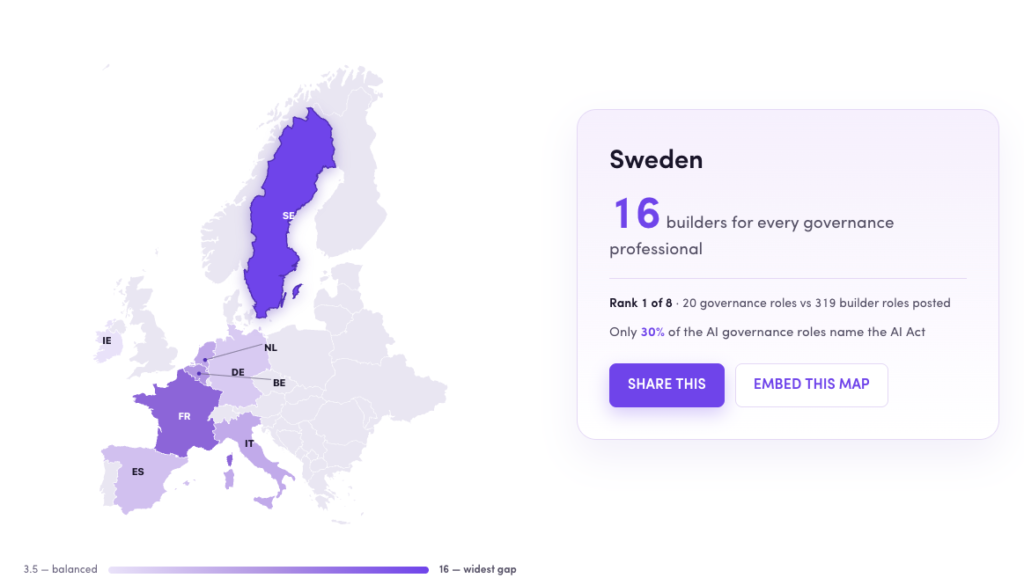
AXIPRO STUDY New Study: Europe is hiring AI builders faster than AI governance professionals Axipro analyzed 3,519 AI-related job postings across eight EU countries. For every professional hired to keep AI lawful, safe and accountable, nearly seven were hired to build more of it, and the gap is widest exactly where you’d least expect. Take EU AI ACT READINESS QUIZZ 16 AI Builders : 1 AI Governors Sweden — Europe’s widest AI governance gap 3,519 Job Postings Analyzed 8 EU Countries 2 Role Categories: Builders vs Governors July 2026 Date of Job Postings Analyzed The findings Finding 1: Sweden hires 16 AI builders for every 1 person to govern them Throughout our data-set we found the same pattern across all eight countries: the more a nation hires to build AI, the less it hires to govern it. France runs eleven builders to every governor. Even Ireland, the most balanced in Europe, looks responsible mainly because the US tech giants headquartered there import global-governance discipline under overlapping DORA and AI Act pressure. 3.5→16 builders hired per governor, Europe’s most balanced country to its least. Ireland 3.5 Germany 5.7 Spain 6.0 Italy 7.1 Netherlands 7.2 Belgium 7.9 France 11.4 Sweden 16:1 0 4 8 12 16 Builders hired per AI governor Source: Axipro, 2026 Sweden has one of the strongest engineering cultures in Europe. It also carries the widest governance gap we measured: sixteen AI builders hired for every person hired to govern them. France sits close behind at eleven to one. The most balanced country, Ireland at 3.5 to one, looks responsible for a reason that has little to do with virtue. The US tech giants headquartered in Dublin import global governance discipline, and they do it under the combined weight of the AI Act and DORA, the EU financial-sector resilience regime in force since January 2025. Engineering strength does nothing to close a governance gap, and it may widen it. A country that ships AI faster produces more systems that fall under the Act’s scope and, on this evidence, fewer people positioned to document, monitor, and defend them. Being good at building AI offers no protection against governing it badly. The countries most confident in their technical talent are running the largest deficit against the law. Explore AI governance hiring by country Click any country to see how many AI builders it hires for every governance professional, and where it ranks against the rest of Europe. Germany — 5.7 builders per governorDE France — 11.4 builders per governorFR Spain — 6.0 builders per governorES Italy — 7.1 builders per governorIT Netherlands — 7.2 builders per governorNL Belgium — 7.9 builders per governorBE Ireland — 3.5 builders per governorIE Sweden — 16 builders per governorSE 3.5 — balanced 16 — widest gap Source: Axipro, 2026 Sweden 16builders for every governance professional Rank 1 of 8 · 20 governance roles vs 319 builder roles posted Only 30% of the AI governance roles name the AI Act Share this Embed this map Copy & paste — links back to Axipro Copy embed code Branded, one paste, backlink included. × Share this country insight Share this AI governance gap X / Twitter LinkedIn Facebook WhatsApp Bluesky Email Copy link Choose a platform or copy the link. A view of the same country-level dataset behind the interactive map: governance roles, builder roles, builder-to-governance ratio, and the share of governance postings that name the EU AI Act. AI governance jobs Europe statistics by country: governance roles, builder roles, builder-to-governance ratio and AI Act mention percentage. Country Governance roles Builder roles Builder-to-governance ratio AI Act mention % Sweden 20 319 16.0:1 30.0% France 39 443 11.4:1 38.5% Belgium 38 299 7.9:1 39.5% Netherlands 61 439 7.2:1 31.1% Italy 40 284 7.1:1 45.0% Spain 64 384 6.0:1 28.1% Germany 88 501 5.7:1 27.3% Ireland 96 335 3.5:1 14.6% Source: Axipro analysis of AI builder, governance and compliance job postings across eight European countries. “AI Act mention %” is the share of governance postings that explicitly name the EU AI Act. Finding 2: The law nobody names. Most AI governance jobs still do not mention the EU AI Act Europe spent years drafting the AI Act. It cleared the European Parliament, survived the Digital Omnibus revisions, and now carries penalties that reach €35 million or 7% of global turnover for the most serious breaches, a ceiling that makes GDPR fines look modest. Yet fewer than three in ten of the governance roles created to handle it actually name the law in the job description. Among builder roles, the figure collapses to one in twenty-five. More than 7 in 10 Governance job descriptions do not mention the EU AI Act. This number rises to 9 in 10 for all AI job descriptions. Despite hiring for governance, risk, privacy, and compliance roles, most employers are not yet translating the EU AI Act into explicit job requirements. That disconnect should stop you. The people being hired to make Europe compliant are, for the most part, not being hired against the Act by name. They are titled around adjacent ideas: risk, ethics, model validation, data protection. Some of that work will map onto the Act’s requirements. Much of it will not, because a role written without the regulation in view rarely produces the conformity assessments, technical documentation, and human-oversight structures the Act specifically demands. Readiness is even thinner than the headcount suggests. Simply counting governance hires overstates how many people are actually working the law. What job descriptions actually name The EU AI Act is visible in governance roles — but still absent from most job ads. Across the laws and frameworks most relevant to AI governance hiring, the EU AI Act appears in fewer than three in ten governance postings, and only 4% of builder postings. Law or framework Governance roles naming it Builder roles naming it All roles naming it Governance mentions EU AI Act 28.5% 4.0% 7.6% 127 GDPR 26.9% 5.7% 9.6% 120 ISO 27001 11.4% 1.3% 2.8% 51
78% of organizations have no formal policies for creating or removing AI agent identities, according to a 2026 report from the Cloud Security Alliance and Oasis Security. The same research found that 92% are not confident that their legacy identity and access management tools can handle the risks agents introduce. Those two numbers describe the problem in full: enterprises are deploying autonomous software that reads email, queries databases, and triggers actions across production systems, and most of them cannot say who authorized it, what it can touch, or how they would prove any of that to an auditor. This is not a future problem. Agents are already operating inside regulated environments governed by the GDPR, HIPAA, SOX, and the EU AI Act. Every access decision an agent makes is a compliance event, whether or not anyone is logging it. This article covers what regulators actually expect, where traditional IAM falls short, and how to build an access framework for AI agents that survives an audit. Understanding the Compliance Landscape for AI Agents Key Regulations Impacting AI Agent Access No regulation says “AI agent” and then hands you a checklist. Instead, agents inherit obligations from every framework that governs the data and systems they touch. Under the GDPR, an agent processing personal data triggers the full set of principles in Article 5: lawfulness, purpose limitation, data minimization, and accountability. If an agent makes decisions that produce legal or similarly significant effects on individuals, Article 22 restrictions on automated decision-making apply as well. HIPAA requires covered entities to implement access controls, audit controls, and integrity protections for electronic protected health information under the Security Rule, and an agent with access to ePHI is subject to the same technical safeguards as a human workforce member. SOX demands that access to financial reporting systems be controlled, segregated, and reviewable, which becomes genuinely difficult when an autonomous agent can touch the general ledger. The EU AI Act adds an AI-specific layer, and its timeline is widely misunderstood. Following the Digital Omnibus agreement, obligations for standalone high-risk systems under Annex III were deferred to December 2, 2027. But the Article 50 transparency obligations still apply from August 2, 2026, meaning agents that interact with people in the EU must disclose their artificial nature on the original schedule. Treating the Omnibus as a blanket delay is one of the most common compliance mistakes being made right now. Important: The Digital Omnibus deferred the high-risk regime, not the whole Act. If an AI agent interacts with users in the EU, the August 2, 2026, transparency requirements were not moved, and the AI Office’s enforcement powers go live on the same date. Do not stand down 2026 workstreams based on headlines about the 2027 deferral. How AI Agents Create New Compliance Risks Agents break the assumptions most compliance programs are built on. A human user requests access, receives a role, and behaves within a predictable envelope. An agent reasons about its own goals, chains tool calls across systems, and can attempt actions its designers never anticipated. It operates at machine speed and machine volume, so a misconfigured permission produces thousands of non-compliant data touches before anyone notices. And because agents frequently run on shared service accounts or borrowed OAuth tokens, attribution collapses: the audit log says the CRM was queried, but not by whom, for what purpose, or under whose authority. The Gap Between Traditional IAM Compliance and Agentic AI Traditional IAM assumes identities are stable, access needs are predictable, and behavior maps to a job description. None of that holds for agents. A 2026 Cloud Security Alliance survey found that 68% of organizations cannot reliably distinguish AI agent activity from human activity in their logs. For a compliance function, that is disqualifying. If you cannot separate agent actions from human actions, you cannot certify access, demonstrate segregation of duties, or respond to a data subject access request with confidence. Core Compliance Requirements for AI Agent Access Auditability and Traceability of Agent Actions Every major framework converges on the same demand: show your work. For agents, a login timestamp is not enough. A defensible audit trail captures the full chain of custody for each action: which agent acted, which human or process delegated the authority, which tool or API was invoked, which data was accessed, and what the outcome was. Gartner’s 2026 Market Guide for what it calls “guardian agents” describes exactly this pattern of recording agent-to-tool-to-target chains for compliance reporting and incident response. Data Protection and Privacy Obligations Agents must operate inside the same data protection perimeter as everything else. That means Data Loss Prevention (DLP) controls apply to agent outputs, not just human uploads. It means an agent’s access to personal data needs a lawful basis, documented before deployment, not reverse-engineered after. And it means retention rules follow the data into whatever context window, vector store, or scratchpad the agent moves it into. Separation of Duties in Autonomous Systems Separation of duties exists so that no single actor can both commit and conceal an error or a fraud. A single agent granted permissions across procurement, approval, and payment reconstitutes exactly the toxic combination SOX controls were designed to prevent, except now it executes at machine speed. The control translates directly: no agent should hold permission sets that a human in the same process would be prohibited from combining, and multi-agent workflows need the same conflict analysis as human role assignments. Consent, Purpose Limitation, and Data Minimization Purpose limitation is the principle that agents most naturally violate. An agent given broad access “to be helpful” will use data collected for one purpose to accomplish another, because nothing in its architecture knows the difference. Compliance-ready agent access means scoping data access to the declared purpose of the task and enforcing that scope technically rather than hoping the system prompt holds. Insider Note: In practice, the purpose limitation failures we see are rarely dramatic. They look like a support agent enriching a ticket with data pulled from the sales
SOC 2 is not a certification, and no auditor will ever hand you a SOC 2 certificate. What you receive at the end of the audit is an attestation report: a detailed document, often 60 to 100 pages long, in which a licensed CPA firm expresses a professional opinion on your controls. That distinction sounds like pedantry until a prospect’s security team asks to see your “certificate” and you have nothing that looks like one. This article explains exactly what a SOC 2 report is, what it contains, how it differs from an ISO 27001 certificate, and how to talk about your SOC 2 status without misrepresenting it. Is SOC 2 a Certification or a Report? The Common Misconception About “SOC 2 Certification” Search volume tells the story: far more people look for “SOC 2 certification” than for “SOC 2 attestation,” and sales teams, procurement questionnaires, and even some auditors use the certification shorthand daily. The misconception is understandable. Every other major framework in the compliance stack, from ISO 27001 to PCI DSS, ends in something that looks like a pass. SOC 2 does not work that way, and treating it as if it does leads to awkward conversations during vendor due diligence. Why SOC 2 Is Technically an Attestation, Not a Certification A certification is a binary judgment issued by an accredited body: you meet the standard, or you do not. SOC 2 sits under the AICPA’s attestation standards, primarily SSAE 18 and its later amendments (SSAE 21 updated the relevant examination sections), specifically AT-C section 105 and AT-C section 205. Under those standards, an independent service auditor examines your controls and reports an opinion on them. Nobody “passes.” The auditor attests to what they found, in writing, with evidence. The output is a report, and the report is the entire deliverable. Understanding the SOC 2 Attestation Model What Is an Attestation Engagement? An attestation engagement is a formal examination in which a practitioner evaluates subject matter prepared by another party against defined criteria, then issues a written conclusion. In SOC 2, the subject matter is your system and its controls, the criteria are the AICPA’s Trust Services Criteria (Security, Availability, Processing Integrity, Confidentiality, and Privacy), and the party preparing the subject matter is you, the service organization. Security is the only mandatory category; the other four are scoped in based on your service commitments. The Role of the AICPA and Licensed CPA Firms The AICPA (American Institute of Certified Public Accountants) owns the SOC framework and the attestation standards behind it, but it does not perform audits and does not issue anything to your company. Only a licensed CPA firm can conduct a SOC 2 examination and sign the resulting opinion. That licensing requirement is the quality mechanism: the firm’s professional liability, independence rules, and peer review obligations stand behind the report. In practice, this means the assurance you get is only as strong as the auditor’s reputation and independence posture, which is why enterprise buyers often look at who signed the report almost as carefully as they look at what it says. How Attestation Differs from Certification and Accreditation The three terms describe different assurance models. Certification means an accredited certification body confirms conformity with a standard and issues a certificate, as happens with ISO 27001. Accreditation is one level up: it is the process by which national bodies, such as those coordinated through the International Accreditation Forum, authorize those certification bodies to certify in the first place. Attestation involves no certificate and no accreditation chain. A CPA firm examines evidence and expresses an opinion under professional standards. The credibility comes from the auditor’s license and independence, not from a badge. What You Actually Receive After a SOC 2 Audit The SOC 2 Attestation Report Explained The deliverable is a confidential, restricted-use document addressed to your management and intended for your customers, their auditors, and other informed parties. It is dense by design. A prospect’s risk team reads it to understand what your system does, which controls you operate, how the auditor tested them, and what the auditor found. It replaces a certificate with something far more useful: evidence. Key Components of the Final Report Independent service auditor’s opinion. The first section, usually two to three pages, states the auditor’s formal conclusion on whether your system description is fairly presented and whether your controls were suitably designed (and, for Type 2, operating effectively). This is the section report readers check first. Management’s assertion. A signed statement in which your leadership formally asserts that the system description is accurate and that controls meet the applicable criteria. SSAE 18 made this management assertion a mandatory element, which means responsibility for the description sits with you, not the auditor. System description. The longest narrative section was prepared by management against the AICPA’s SOC 2 description criteria. It covers the services provided, infrastructure, software, people, data, processes, subservice organizations, and complementary user entity controls. Trust Services Criteria and controls tested. A mapping of each in-scope criterion to the specific controls you operate. This is where scoping decisions become visible: a report covering Security only looks very different from one covering all five categories. Results of testing. For Type 2 reports, a control-by-control table showing the tests the auditor performed and the results, including any exceptions. Sophisticated readers spend most of their time here, because exceptions and the auditor’s response to them reveal more than the opinion page does. What a SOC 2 Report Is NOT (No Certificate, No Logo, No Pass/Fail Badge) There is no official SOC 2 certificate, no numbered credential, and no register of “certified” companies you can be listed in. The AICPA licenses a standard SOC logo that service organizations may display for a limited time after report issuance, but the logo confirms only that an examination took place. It says nothing about the opinion inside. Anyone selling you a “SOC 2 certificate” as a standalone artifact is selling something the framework does not produce. Important: If
The full SIG content library contains 1,936 questions. SIG Lite asks 128 of them. That difference is the entire point: most vendor relationships do not justify a multi-week questionnaire exchange, and SIG Lite exists so risk teams can run standardized due diligence on lower-risk vendors without burning analyst hours or vendor goodwill. What Is SIG Lite? SIG Lite is the streamlined version of the Standardized Information Gathering (SIG) questionnaire, the most widely used third-party risk assessment instrument in the industry. It condenses the full SIG question set into a short, high-level assessment of a vendor’s information security, privacy, and resilience controls. It is a self-assessment, not an audit: the vendor answers, the assessor evaluates, and the completed questionnaire becomes evidence of due diligence in a third-party risk management (TPRM) program. Purpose of the SIG Lite Questionnaire The purpose is speed with consistency. SIG Lite gives an outsourcing organization a broad understanding of a third party’s internal control environment using a standardized question set, so answers are comparable across an entire vendor portfolio. It works either as a complete assessment for low-risk vendors or as a preliminary screen that decides whether a deeper review is warranted. Because every vendor answers the same questions, risk teams can rank, tier, and triage instead of interpreting fifty differently formatted responses. Who Created and Maintains SIG Lite? SIG Lite is owned and maintained by Shared Assessments, a member-driven standards organization formed in 2005 when the Big Four accounting firms and six global banks set out to fix the inefficiency of every company writing its own vendor questionnaire. The SIG is developed through a formal governance process that draws on practitioner feedback and tracks evolving regulations and standards, which is a large part of why it has held its position as the de facto industry template. SOC 2, ISO 27001 and HIPAA done for you. Fixed fee, 100% audit pass rate. Audit-ready in 6 weeks. Not 6 months. Schedule Free Assessment What’s Included in the SIG Lite Questionnaire? Number of Questions and Structure The 2025 release of SIG Lite contains 128 questions. The exact count shifts slightly with each annual update (recent versions have ranged from roughly 126 to 133), so always confirm the version you are working with. Questions are predominantly yes/no with room for comments and references to supporting evidence, and each question maps back to the SIG content library and to external frameworks. SIG Lite ships as a single-worksheet questionnaire, which keeps completion and review manageable. Risk Domains Covered in SIG Lite SIG Lite draws its questions from the same 21 risk domains that structure the entire SIG, grouped into four control areas: Governance and Risk Management, Information Protection, IT Operations and Business Resilience, and Security Incident and Threat Management. In practice, that means high-level coverage of access control, information security policy, data privacy, cloud security, business continuity, incident response, supply chain risk, human resources security, compliance management, and ESG, among others. The breadth is the same as SIG Core; the depth per domain is what gets trimmed. Format and Delivery (Spreadsheet and Toolkit) Historically, the SIG has been delivered as an Excel workbook generated by the SIG Manager, the macro-driven engine inside the SIG Questionnaire Toolkit that lets assessors scope, generate, store, and compare questionnaires. That is changing. In March 2026, Shared Assessments launched SIG EV (Evolution), a browser-based platform that moves questionnaire creation, distribution, comparison, and grading to the cloud while preserving the same content and methodology. Vendors can still respond in Excel, and assessors can upload completed files, so the transition does not break existing workflows. Worth Knowing: SIG Questions & Permissions SIG questions cannot be edited without written permission from Shared Assessments, but assessors can add up to 100 custom questions to a scoped questionnaire. That is usually enough headroom to cover industry-specific requirements without abandoning the standard. When Should You Use SIG Lite? Ideal Vendor Risk Scenarios SIG Lite fits three situations well. First, vendors with no access to sensitive data or critical systems, where a full assessment would be disproportionate. Second, large vendor portfolios, where sending 600-plus questions to every supplier would stall onboarding across the board. Third, early-stage evaluation, where you need enough signal to decide whether a relationship is worth deeper diligence. Low-Risk vs. High-Risk Vendor Assessments The dividing line is data and criticality. A marketing tool that touches no customer records, a facilities contractor, or a niche SaaS product with read-only access to public data can all be assessed adequately with SIG Lite. A payroll processor, a cloud provider hosting production data, or any vendor storing regulated information under HIPAA, PCI DSS, GDPR, or GLBA should get SIG Core. Using Lite on a high-risk vendor is a documented gap waiting to be found in your next audit. Initial vs. In-Depth Risk Screening Many mature programs use SIG Lite as a gate rather than a destination. The Lite response feeds an initial risk score; vendors that trip defined thresholds (a missing incident response plan, no encryption at rest, no independent certification) graduate to SIG Core or a targeted domain-level assessment. This two-stage pattern keeps effort proportional to risk and gives vendors a lighter first touch. SIG Lite vs. SIG Core: Key Differences Both questionnaires come from the same content library and cover the same 21 risk domains. The differences are scope, depth, and effort. Question Count and Scope SIG Lite’s 128 questions sit at the top of the control hierarchy: does a policy exist, is a program in place, and is there independent validation? SIG Core’s 627 questions descend into how each control actually operates. Beyond both sits the full SIG Detail library of 1,936 questions, which assessors use to build custom scopes by regulation, domain, or control family. Depth of Assessment A SIG Lite answer tells you a vendor has an access control program. A SIG Core response tells you how privileged accounts are reviewed, how quickly access is revoked at termination, and how authentication is enforced across environments. If your obligation is
FAQ
Frequently Asked Questions
Do I need to already have Drata before working with Axipro?
No. If you’re already on Drata, we’ll work within your existing setup. If you haven’t chosen a platform yet, we can help you evaluate whether Drata is the right fit, handle onboarding, and configure it alongside your compliance program from day one. We also work with teams using other platforms, though our deepest expertise is with Drata.
How long does it take to get audit-ready?
A typical SOC 2 engagement takes around 6 weeks from kickoff to audit-ready. The exact timeline depends on your current security posture, the framework(s) you’re pursuing, and how quickly your team can action items on their side. During the free readiness assessment, we’ll give you a realistic timeline based on where you actually stand — not a generic estimate.
What frameworks does Axipro support?
We implement and manage compliance programs across SOC 2 Type I and II, ISO 27001, HIPAA, GDPR, PCI DSS, NIST CSF, CMMC, DORA, ISO 9001, ISO 13485, ISO 14001, ISO 22000, ISO 45001, R2, and SOX. If you need multiple frameworks, we build a unified program so you’re not duplicating effort across certifications.
What happens after we get certified?
Certification isn’t the finish line — it’s the beginning of an ongoing compliance obligation. Axipro offers continuous compliance management so your controls stay effective, your evidence stays current, and renewals don’t turn into fire drills. We can manage your program on an ongoing basis or support you only at renewal time, whichever fits your team.
What does Axipro actually do that Drata doesn't?
Drata automates evidence collection, control monitoring, and audit workflows, and it does that very well. What it doesn’t do is tell you whether your scope is right, whether your controls are appropriate for your business, or whether your evidence will survive auditor scrutiny. Axipro handles the judgment calls: scoping, control design, readiness validation, audit coordination, and remediation. Think of it as Drata runs the engine, Axipro makes sure you’re driving in the right direction.
Do we need to be in the same location?
Engagements are delivered however works best for you. Most clients work with us fully remotely, but we can accommodate hybrid or on-site arrangements depending on your needs and preferences.
Is there a minimum company size?
No. We work with pre-revenue startups preparing for their first SOC 2, mid-market companies adding ISO 27001 for enterprise sales, and established businesses managing multiple frameworks. The engagement is scoped to your size and complexity, not a one-size-fits-all package.
What does the free readiness assessment include?
It’s a 30-minute session where we review your current compliance posture, identify your biggest gaps, and give you a realistic timeline and scope estimate for certification. You’ll walk away with a clear picture of what’s needed — whether you work with us or not. No commitment, no sales pressure.