
Table of Contents

Reach SOC 2 Compliance in 6 Weeks or Less.

  /

  / SIG Lite Explained: Coverage, Uses, and Gaps

SIG Lite Explained: Coverage, Uses, and Gaps

The full SIG content library contains 1,936 questions. SIG Lite asks 128 of them. That difference is the entire point: most vendor relationships do not justify a multi-week questionnaire exchange, and SIG Lite exists so risk teams can run standardized due diligence on lower-risk vendors without burning analyst hours or vendor goodwill.
SIG Lite What It Covers, When to Use It, and Where It Falls Short

What Is SIG Lite?

SIG Lite is the streamlined version of the Standardized Information Gathering (SIG) questionnaire, the most widely used third-party risk assessment instrument in the industry. It condenses the full SIG question set into a short, high-level assessment of a vendor’s information security, privacy, and resilience controls. It is a self-assessment, not an audit: the vendor answers, the assessor evaluates, and the completed questionnaire becomes evidence of due diligence in a third-party risk management (TPRM) program.

Purpose of the SIG Lite Questionnaire

The purpose is speed with consistency. SIG Lite gives an outsourcing organization a broad understanding of a third party’s internal control environment using a standardized question set, so answers are comparable across an entire vendor portfolio. It works either as a complete assessment for low-risk vendors or as a preliminary screen that decides whether a deeper review is warranted. Because every vendor answers the same questions, risk teams can rank, tier, and triage instead of interpreting fifty differently formatted responses.

Who Created and Maintains SIG Lite?

SIG Lite is owned and maintained by Shared Assessments, a member-driven standards organization formed in 2005 when the Big Four accounting firms and six global banks set out to fix the inefficiency of every company writing its own vendor questionnaire. The SIG is developed through a formal governance process that draws on practitioner feedback and tracks evolving regulations and standards, which is a large part of why it has held its position as the de facto industry template.

SOC 2, ISO 27001 and HIPAA done for you. Fixed fee, 100% audit pass rate.

Audit-ready in 6 weeks. Not 6 months.

What’s Included in the SIG Lite Questionnaire?

Number of Questions and Structure

The 2025 release of SIG Lite contains 128 questions. The exact count shifts slightly with each annual update (recent versions have ranged from roughly 126 to 133), so always confirm the version you are working with. Questions are predominantly yes/no with room for comments and references to supporting evidence, and each question maps back to the SIG content library and to external frameworks. SIG Lite ships as a single-worksheet questionnaire, which keeps completion and review manageable.

Risk Domains Covered in SIG Lite

SIG Lite draws its questions from the same 21 risk domains that structure the entire SIG, grouped into four control areas: Governance and Risk Management, Information Protection, IT Operations and Business Resilience, and Security Incident and Threat Management. In practice, that means high-level coverage of access control, information security policy, data privacy, cloud security, business continuity, incident response, supply chain risk, human resources security, compliance management, and ESG, among others. The breadth is the same as SIG Core; the depth per domain is what gets trimmed.

Format and Delivery (Spreadsheet and Toolkit)

Historically, the SIG has been delivered as an Excel workbook generated by the SIG Manager, the macro-driven engine inside the SIG Questionnaire Toolkit that lets assessors scope, generate, store, and compare questionnaires. That is changing. In March 2026, Shared Assessments launched SIG EV (Evolution), a browser-based platform that moves questionnaire creation, distribution, comparison, and grading to the cloud while preserving the same content and methodology. Vendors can still respond in Excel, and assessors can upload completed files, so the transition does not break existing workflows.

Worth Knowing: SIG Questions & Permissions

SIG questions cannot be edited without written permission from Shared Assessments, but assessors can add up to 100 custom questions to a scoped questionnaire. That is usually enough headroom to cover industry-specific requirements without abandoning the standard.

When Should You Use SIG Lite?

Ideal Vendor Risk Scenarios

SIG Lite fits three situations well.

  • First, vendors with no access to sensitive data or critical systems, where a full assessment would be disproportionate.
  • Second, large vendor portfolios, where sending 600-plus questions to every supplier would stall onboarding across the board.
  • Third, early-stage evaluation, where you need enough signal to decide whether a relationship is worth deeper diligence.

Low-Risk vs. High-Risk Vendor Assessments

The dividing line is data and criticality. A marketing tool that touches no customer records, a facilities contractor, or a niche SaaS product with read-only access to public data can all be assessed adequately with SIG Lite. A payroll processor, a cloud provider hosting production data, or any vendor storing regulated information under HIPAA, PCI DSS, GDPR, or GLBA should get SIG Core. Using Lite on a high-risk vendor is a documented gap waiting to be found in your next audit.

Initial vs. In-Depth Risk Screening

Many mature programs use SIG Lite as a gate rather than a destination. The Lite response feeds an initial risk score; vendors that trip defined thresholds (a missing incident response plan, no encryption at rest, no independent certification) graduate to SIG Core or a targeted domain-level assessment. This two-stage pattern keeps effort proportional to risk and gives vendors a lighter first touch.
SIG Lite vs SIG Core

SIG Lite vs. SIG Core: Key Differences

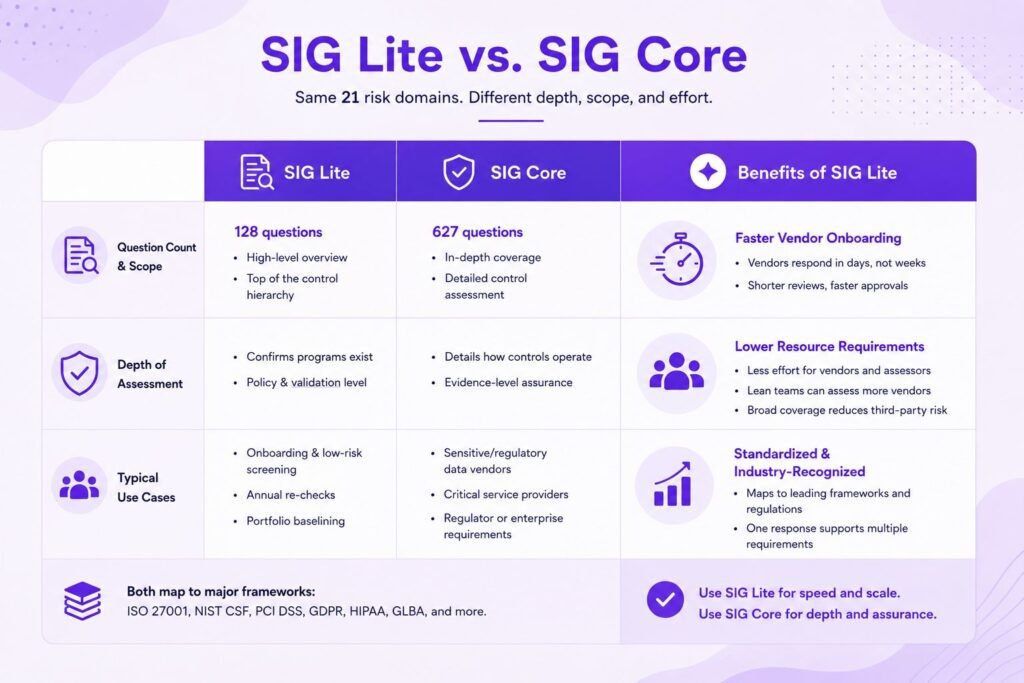
Both questionnaires come from the same content library and cover the same 21 risk domains. The differences are scope, depth, and effort.

Question Count and Scope

SIG Lite’s 128 questions sit at the top of the control hierarchy: does a policy exist, is a program in place, and is there independent validation? SIG Core’s 627 questions descend into how each control actually operates. Beyond both sits the full SIG Detail library of 1,936 questions, which assessors use to build custom scopes by regulation, domain, or control family.

Depth of Assessment

A SIG Lite answer tells you a vendor has an access control program. A SIG Core response tells you how privileged accounts are reviewed, how quickly access is revoked at termination, and how authentication is enforced across environments. If your obligation is to demonstrate that a vendor’s controls are designed and operating effectively, Lite alone will not carry that weight.

Typical Use Cases for Each

Use SIG Lite for onboarding screens, low-risk tiers, annual re-checks of stable low-risk vendors, and portfolio-wide baselining. Use SIG Core for vendors that store or process sensitive or regulated data, critical service providers, and any relationship where a regulator or enterprise customer expects evidence-level diligence.

Benefits of Using SIG Lite

Faster Vendor Onboarding

A prepared vendor can turn around a SIG Lite in days rather than the weeks a Core response takes, because 128 high-level questions can usually be answered by one or two people rather than a cross-functional committee. For the assessor, shorter responses mean faster review cycles and fewer stalled deals waiting on security sign-off.

Lower Resource Requirements

Both sides save effort. Vendors avoid mobilizing IT, legal, HR, and compliance for every prospect. Assessors reduce review time per vendor, which matters enormously when a lean risk team is responsible for hundreds of third parties. Verizon’s Data Breach Investigations Report has linked a substantial share of breaches to third-party access, so the pressure to assess everyone is real; SIG Lite makes broad coverage feasible.

Standardized, Industry-Recognized Framework

SIG questions map to widely adopted frameworks and regulations, including ISO 27001, the NIST Cybersecurity Framework, PCI DSS, GDPR, HIPAA, and GLBA. That mapping means a single well-maintained SIG response can evidence posture across multiple frameworks at once, and it puts SIG Lite in the same standardized category as instruments like the Cloud Security Alliance’s CAIQ, but with broader, industry-agnostic coverage.
Complete SIG Lite Questionnaire

How to Complete a SIG Lite Questionnaire

Preparing Documentation and Evidence

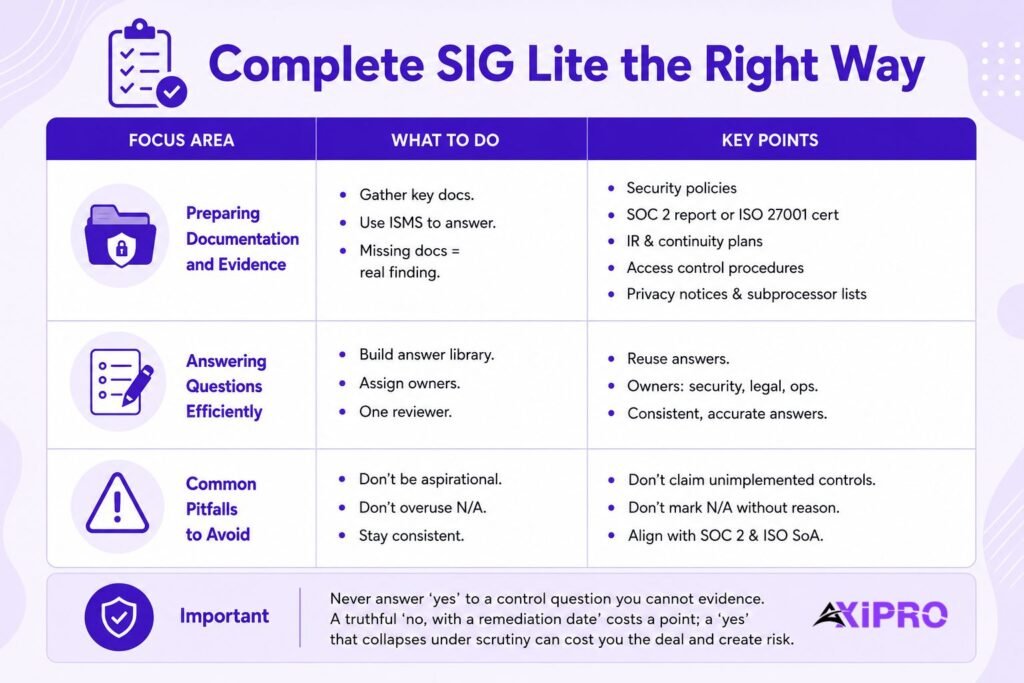
Before answering a single question, gather the artifacts the questions will point to: information security policies, your SOC 2 report or ISO 27001 certificate, incident response and business continuity plans, access control procedures, privacy notices, and subprocessor lists. Most SIG Lite questions can be answered directly from a reasonably mature ISMS. If the documentation does not exist, that is your real finding, and it is better discovered internally than by a prospect.

Answering Questions Efficiently

Build an answer library. The SIG’s standardization is an asset for responders too: an answer written once, kept current, and mapped to the SIG question serial numbers can be reused across every SIG Lite you receive. Assign domains to named owners (security answers access control, legal answers privacy, operations answers continuity) and have a single reviewer check the assembled response for consistency of voice and fact before it leaves the building.

Common Pitfalls to Avoid

Three mistakes recur constantly.

  • Aspirational answers: claiming controls that are planned but not implemented, which unravel the moment an assessor asks for evidence.
  • N/A abuse: marking questions not applicable without justification, which reads as evasion and triggers follow-up.
  • And inconsistency: SIG answers that contradict your SOC 2 report exceptions or your ISO Statement of Applicability, which damages credibility across the entire response.

Important: Never answer ‘yes’ to a control question you cannot evidence on request. A truthful ‘no, with a remediation date’ costs you a scoring point; a ‘yes’ that collapses under scrutiny can cost you the deal and, in regulated relationships, create contractual misrepresentation risk.


How to Send and Evaluate a SIG Lite Questionnaire as an Assessor

Distributing the Questionnaire to Vendors

Scope and generate the questionnaire from the SIG Manager or SIG EV, set a clear deadline (two to three weeks is reasonable for a Lite), and tell the vendor what evidence, if any, you expect alongside answers. Include your escalation criteria up front so vendors understand that certain answers will trigger a deeper assessment rather than a rejection. SIG EV supports secure one-time links for vendor access; TPRM platforms can automate the same distribution at portfolio scale.

Scoring and Interpreting Responses

Score against a rubric, not a gut feeling. Binary or weighted scoring per question, rolled up by risk domain, produces a comparable rating across vendors. Weight the domains that matter most for the specific relationship: data privacy and access control for a data processor, business continuity for an operationally critical supplier. Read comments as carefully as answers; hedged language around encryption, subprocessors, or incident notification usually marks the exact spot to probe.

Follow-Up and Remediation Steps

Every gap needs a disposition: accept the risk with documented rationale, require remediation with a deadline, escalate to a SIG Core or targeted assessment, or decline the vendor. Track remediation commitments to closure rather than filing them, and feed the results back into the vendor’s risk tier so the next review cycle reflects reality.

Pro Tip: Cross-check SIG Lite Answers

Cross-check SIG Lite answers against the exceptions section of the vendor's SOC 2 Type II report before scoring. Vendors rarely lie outright, but a clean SIG answer sitting next to a related audit exception tells you exactly where the optimistic self-assessment is.

SIG Lite Update Cycle

How Often SIG Lite Is Updated

Shared Assessments updates the entire SIG annually, adding, retiring, and renumbering questions to track new regulations, threats, and standards. Question counts move accordingly, which is why quoting ‘the’ SIG Lite count without a year is a minor sin among TPRM practitioners. Always request responses on the current release; accepting a version more than a year or two old undermines comparability across your portfolio.

Recent Changes in the Latest Release

The 2026 SIG release added no new risk domains but made three substantive moves: comprehensive mapping to ISO 42001, the AI management system standard, bringing third-party AI governance into standard due diligence; enhanced mapping to NIST SP 800-171 for organizations handling Controlled Unclassified Information; and alignment with the Business Resilience Council’s Operational Resilience Framework, shifting continuity questions from recovery planning toward evidence of sustained operations. Mappings were also refreshed for the restructured ISO 27001:2022 Annex A controls. Alongside the content update, the launch of SIG EV in March 2026 marks the first delivery-model change in the SIG’s history.

Insider Note: The ISO 42001 mapping is the sleeper change in the 2026 release. Once AI governance questions exist in the standard questionnaire, not asking them starts to look like an oversight gap. Expect enterprise assessors to treat vendor AI due diligence as table stakes within a couple of assessment cycles, well ahead of any regulatory mandate forcing the issue.

SOC 2, ISO 27001 and HIPAA done for you. Fixed fee, 100% audit pass rate.

Audit-ready in 6 weeks. Not 6 months.

Best Practices for SIG Lite Assessments

Segmenting Vendors by Risk Tier

Tier vendors before choosing a questionnaire, not after. A simple three-tier model based on data sensitivity, system access, and operational criticality lets you assign SIG Lite to the low tier, SIG Core to the high tier, and a scoped custom SIG to the middle. Document the tiering criteria; auditors and enterprise customers increasingly ask why a given vendor got the light-touch treatment.

Automating Distribution and Scoring

Manual SIG handling does not scale past a few dozen vendors. Automate the mechanical layer: distribution, reminders, response collection, first-pass scoring, and flagging of answers that breach thresholds. Keep humans on interpretation, follow-up questioning, and risk acceptance decisions. That division preserves judgment where it matters while removing the spreadsheet-wrangling that consumes most TPRM analyst time.

Integrating SIG Lite With Your TPRM Program

A SIG Lite response should not live in a folder. Feed scores into vendor risk registers, tie remediation items to contract renewals, and pair point-in-time questionnaire data with continuous monitoring signals such as security ratings and breach intelligence. The questionnaire tells you what a vendor says about its controls; monitoring tells you whether the outside world agrees.


Challenges of SIG Lite (and How to Solve Them)

SIG Lite is not free: it requires a Shared Assessments subscription or membership, which smaller assessors sometimes balk at, though the cost is modest against the analyst hours a standardized instrument saves. It is shallow by design, so treat escalation paths as part of the methodology rather than a failure of it. It is a point-in-time self-assessment, which is why pairing it with continuous monitoring matters. Vendors suffer questionnaire fatigue, which an answer library and a willingness to accept a vendor’s proactively shared SIG response both ease. And version drift across a portfolio erodes comparability year by year; standardize on the current release each year and migrate stored responses forward using the SIG’s built-in tools.


Tools and Automation for SIG Lite

The tooling landscape has three layers. Shared Assessments’ own stack, the SIG Manager workbook, and now SIG EV, handles creation, comparison, and grading. TPRM and VRM platforms embed licensed SIG content and automate the full assessment lifecycle, from distribution through remediation tracking, with SIG answers mapped automatically to frameworks like ISO 27001 and NIST. And on the vendor side, security questionnaire automation tools draft SIG responses from an organization’s existing documentation and prior answers, cutting response time from days to hours. Whichever layer you invest in, the standard itself stays the same, which is precisely what makes the automation reliable.

SIG Lite earns its place by matching assessment effort to actual risk: 128 standardized questions, 21 risk domains, annual updates, and an ecosystem of tooling that both sides of the assessment already understand. Use it as the broad, fast layer of a tiered TPRM program, escalate to SIG Core when data sensitivity demands it, and keep responses current with each annual release.

Frequently Asked Questions

How many questions are in SIG Lite?

The 2025 release contains 128 questions. The count changes slightly with each annual update, so check the version year before quoting a number.

No. The SIG, including SIG Lite, is a licensed product available through a Shared Assessments subscription or membership. Vendors responding to a SIG Lite sent by a customer do not need their own license to complete it.

A vendor with a mature answer library and current documentation can complete one in a day or two. A first-time responder assembling evidence from scratch should budget one to two weeks. SIG Core, by comparison, routinely takes several weeks of cross-functional effort.

Yes, on both sides. Small assessors get an industry-recognized framework without building one, and small vendors benefit because a completed SIG Lite is far less burdensome to produce than a Core, while still satisfying many customers’ due diligence requirements.

They embed licensed SIG content, automate distribution and reminders, collect responses, apply scoring rubrics, flag threshold breaches, and map answers to compliance frameworks. This removes most of the manual overhead and makes portfolio-wide SIG Lite assessment practical for lean teams.

Yes. The annual update cycle folds new frameworks into the standard question set and mappings; the 2026 release added ISO 42001 for AI governance and deepened NIST SP 800-171 coverage. Assessors can also append up to 100 custom questions to address requirements the standard set does not yet cover.

No. SIG Lite is a self-assessment questionnaire, not independent verification. It documents what a vendor claims about its controls; a SOC 2 report or ISO 27001 certification independently validates those claims. Mature programs use both the SIG for standardized information gathering and the audit report as supporting evidence.
Axipro Author

Picture of Pedro Dias

Pedro Dias

Pedro has been writing online for over 10 years. With experience in all things programming, cyber security, and compliance, he is our editor-in-chief at Axipro.

Blog Highlights

Explore More Articles

One in five organizations has already suffered a breach traced back to shadow AI. Meanwhile, 63% of breached organizations either have no AI governance policy at all or are still drafting one. Below is a complete, copy-ready shadow AI policy template with twelve sections, plus guidance on adapting it for your company size, your industry, and the regulatory frameworks you answer to. The template assumes one hard truth up front: your employees are already using unapproved AI tools. A policy that pretends adoption hasn’t started yet fails on day one, so this one starts from the assumption that it has. What Is a Shadow AI Policy? A shadow AI policy is a formal document that defines how your organization discovers, evaluates, approves, and governs AI tools that employees adopt outside official IT channels. The term borrows from shadow IT, the older problem of unsanctioned software and hardware, but the AI version carries sharper risks: data pasted into a public model may be retained, used for training, or exposed in ways the organization can’t reverse. The policy does three jobs: it separates approved use from unapproved use, gives employees a fast and visible way to request new tools so the sanctioned route beats the workaround, and spells out what happens when someone crosses the line, including how the organization detects it and responds. Shadow AI Policy vs. General AI Acceptable Use Policy Many organizations already have an AI acceptable use policy (AUP) and assume it covers shadow AI. It usually doesn’t. An AUP tells employees how to behave inside approved tools. A shadow AI policy governs the tools themselves: which ones exist in your environment, which ones are allowed, and what happens with the rest. You need both. The AUP handles conduct; the shadow AI policy handles inventory and control. If you only have room for one document, fold the AUP’s data-handling rules into Section 6 of the template below. Let Axipro help you build a business continuity plan that’s practical, compliant, and audit-ready. Strengthen Your Business Continuity Strategy​ Schedule A Consultation The Shadow AI Policy Template (Download Link and Copy-Ready Sections) We’ve created a compliance safe template for Shadow AI Policy, use the link below to create a copy and customize for your company: Download The Shadow AI Policy Template → Copy the sections below into your policy management system and replace the bracketed placeholders. The language is plain on purpose. Legalese gets skimmed. Section 1: Purpose and Scope This policy governs the acquisition, approval, and use of artificial intelligence tools, features, and services at [Company]. It applies to all employees, contractors, interns, and third parties with access to [Company] systems or data. It covers standalone AI applications, AI features embedded in existing software, browser extensions, AI agents, APIs, and personal AI accounts used for work purposes, on both corporate and personal devices. The purpose of this policy is to enable productive AI use while protecting [Company] data, customers, and legal obligations. This policy does not prohibit AI. It prohibits ungoverned AI. That last sentence matters. Employees read the purpose statement first, and it decides whether they see the policy as an enabler or a blocker. Section 2: Definitions and Terminology Shadow AI: any AI tool, feature, agent, or service used for work purposes without formal approval under this policy. Approved AI Tool: an AI tool listed in the Approved AI Tools Registry (Section 4) and used under a [Company]-managed account. Personal AI Account: an account on any AI service registered to a personal email address or paid for personally. AI Feature: AI functionality embedded within otherwise approved software (e.g., an AI assistant added to a project management tool), which requires separate evaluation. Sensitive Data: data classified as [Confidential] or [Restricted] under [Company]‘s data classification policy, including the prohibited data classes in Section 6. Define “AI feature” explicitly. Vendors now ship AI additions into already-approved SaaS products every month, and without this definition, those features inherit approval they never earned. Section 3: Roles and Responsibilities The CISO (or designated security lead) owns this policy, maintains the Approved AI Tools Registry, and runs the approval workflow. Department heads ensure their teams know the policy and surface tool requests rather than suppressing them. Legal and Compliance review tools that touch regulated data or fall under the EU AI Act, GDPR, HIPAA, or client contractual restrictions. IT operates detection and monitoring controls (Section 9). Every employee is responsible for using only approved tools for work, reporting unapproved AI use they discover, and requesting new tools through the workflow in Section 7 rather than adopting them directly. Insider Note: In organizations under roughly 200 people, the “CISO” in this section is often the same overworked IT lead who manages laptops. Name a real person, not a title that doesn’t exist yet. A policy that assigns duties to a phantom role is unenforceable, and auditors notice. Section 4: Approved AI Tools Registry [Company] maintains a registry of approved AI tools at [location/URL]. For each tool, the registry records: tool name and vendor, approved use cases, prohibited use cases, permitted data classes, account type (enterprise/team/individual), data retention and training settings, risk tier (Section 5), approval date, and next review date. Only tools listed in the registry may be used for work. Tools not listed are unapproved by default. The registry is reviewed [quarterly]. Keep the registry somewhere employees actually look, such as your intranet homepage or IT help center, not buried in a GRC platform they can’t access. An invisible registry recreates the problem the policy exists to fix. Section 5: Risk Tier Classification (Low, Medium, High) Each tool in the registry is assigned a risk tier. Low: the tool processes only public or internal non-sensitive data, runs under an enterprise agreement with training opt-out, and produces output that a human reviews before use. Approval by IT Security alone. Medium: the tool processes internal business data or connects to [Company] systems via API or integration. Approval by IT Security plus the data owner. High: the

Legacy threat modeling frameworks such as STRIDE were designed for software that behaves the same way over and over again. Agentic AI does no such thing. It can rewrite its own plan mid-task, call external tools, negotiate with other agents, and produce a different output from identical input. MAESTRO exists because none of the legacy threat modeling frameworks were built to handle that. MAESTRO stands for Multi-Agent Environment, Security, Threat, Risk, and Outcome. It is a seven-layer threat modeling framework created specifically for agentic AI systems, and it has become the closest thing the industry has to a standard method for reasoning about agent security. Understanding MAESTRO in the Context of Agentic AI What MAESTRO Stands For Each word in the acronym carries meaning. Multi-Agent Environment signals that the framework models entire ecosystems of interacting agents, not a single model behind an API. Security, Threat, Risk covers the core discipline: identifying attack surfaces, cataloging threats, and assessing likelihood and impact. Outcome is the part most frameworks skip. MAESTRO asks what an attack actually produces in the real world, because an autonomous agent with tool access turns a compromised prompt into a compromised action. The Origin of MAESTRO (Cloud Security Alliance) The Cloud Security Alliance published MAESTRO in February 2025. Its creator is Ken Huang, Co-Chair of the CSA AI Safety Working Groups and CEO of DistributedApps.ai. The CSA has since applied the framework publicly to real systems, including OpenAI’s Responses API and Google’s A2A protocol, which gives practitioners worked examples rather than just theory. The framework is openly published, and the CSA maintains an official companion tool, the MAESTRO Threat Analyzer, on GitHub. SOC 2, ISO 27001 and HIPAA done for you. Fixed fee, 100% audit pass rate. Audit-ready in 6 weeks. Not 6 months. Schedule Free Assessment Why Traditional Frameworks Fall Short for Agentic AI STRIDE, PASTA, LINDDUN, and OCTAVE all share a founding assumption: the system under analysis follows predictable logic with clearly defined boundaries. You draw the data flow diagram, mark the trust boundaries, and enumerate threats against components that behave deterministically. Agentic AI breaks every part of that assumption. Unique Security Challenges of Autonomous Agents Agents introduce three properties that legacy models cannot express. Non-determinism means the same input can produce different behavior, so you cannot enumerate execution paths in advance. Autonomy means the agent makes decisions and takes actions without a human approving each step, which collapses the usual assumption that a person sits between intent and execution. And in multi-agent systems there is often no stable trust boundary: agents delegate to other agents, consume tool outputs from external servers via protocols like the Model Context Protocol (MCP), and update their own memory and goals at runtime. The Gap Between Legacy Frameworks and Agent-Based Systems The practical consequence is coverage gaps. STRIDE has no category for goal manipulation, where an attacker gradually steers what an agent is trying to achieve. PASTA assumes attacker objectives and data flows are fixed, which fails for systems that learn and adapt during operation. LINDDUN addresses privacy but says nothing about agent collusion or memory poisoning. A threat model built purely on these frameworks will pass review and still miss the attacks that matter most in an agentic deployment. How MAESTRO Addresses Agentic-Specific Risks MAESTRO does not discard the older frameworks. It extends them with a layered reference architecture, an AI-specific threat catalog for each layer, and, critically, explicit analysis of how threats propagate between layers. That cross-layer lens is the framework’s real contribution, because most serious agentic incidents are chains: poisoned data influences a model, the model misleads an agent, and the agent takes an unauthorized action three layers away from where the attack started. The Seven Layers of the MAESTRO Framework MAESTRO decomposes any agentic system into seven layers, each with its own threat landscape. Layer 1: Foundation Models The core LLMs or other models the agents reason with. Threats here include adversarial examples, model extraction, backdoored weights, and jailbreaks that bypass safety training. If the model is a third-party API, supply chain risk lives at this layer too. Layer 2: Data Operations Everything the agent ingests, stores, and retrieves: training data, RAG pipelines, vector databases, and agent memory. Data poisoning and memory tampering are the signature threats at this layer, and they are especially dangerous because a poisoned memory persists across sessions and keeps shaping future decisions long after the initial attack. Layer 3: Agent Frameworks The orchestration software that turns a model into an agent: LangChain, CrewAI, AutoGen, custom planners, and tool-calling logic. Threats include prompt injection through tool outputs, insecure tool definitions, and manipulation of the planning loop itself. Layer 4: Deployment Infrastructure The servers, containers, and cloud services the agents run on. The CSA’s threat catalog here reads like traditional cloud security with an agentic twist: compromised container images carrying malicious agent code, Kubernetes orchestration attacks, denial of service against agent runtimes, and tampering with Infrastructure-as-Code templates that provision agent resources. Layer 5: Evaluation and Observability The systems that monitor, evaluate, and debug agent behavior. This layer is often forgotten, and attackers know it. The CSA specifically flags poisoning observability data: manipulating the telemetry fed to monitoring systems so that incidents stay hidden from security teams while malicious activity continues. Layer 6: Security and Compliance MAESTRO treats this as a vertical layer that cuts across all others: identity and access management, guardrails, policy enforcement, and compliance controls. Threats include permission escalation, guardrail bypass, and compromise of the security agents themselves in architectures where AI enforces policy on other AI. Layer 7: Agent Ecosystem The environment where agents interact with users, other agents, and marketplaces. This is where the genuinely novel threats live: agent impersonation, misleading agent capability cards, tool squatting, and collusion between agents to achieve outcomes no single agent was authorized to pursue. Insider Note: In real assessments, Layers 5 and 6 expose the maturity gap fastest. Most teams’ shipping agents can describe their model and their orchestration framework in detail, then

EU AI Act Hiring Map

AXIPRO STUDY New Study: Europe is hiring AI builders faster than AI governance professionals Axipro analyzed 3,519 AI-related job postings across eight EU countries. For every professional hired to keep AI lawful, safe and accountable, nearly seven were hired to build more of it, and the gap is widest exactly where you’d least expect. Take EU AI ACT READINESS QUIZZ 16 AI Builders : 1 AI Governors Sweden — Europe’s widest AI governance gap 3,519 Job Postings Analyzed 8 EU Countries 2 Role Categories: Builders vs Governors July 2026 Date of Job Postings Analyzed The findings Finding 1: Sweden hires 16 AI builders for every 1 person to govern them Throughout our data-set we found the same pattern across all eight countries: the more a nation hires to build AI, the less it hires to govern it. France runs eleven builders to every governor. Even Ireland, the most balanced in Europe, looks responsible mainly because the US tech giants headquartered there import global-governance discipline under overlapping DORA and AI Act pressure.  3.5→16 builders hired per governor, Europe’s most balanced country to its least. Ireland 3.5 Germany 5.7 Spain 6.0 Italy 7.1 Netherlands 7.2 Belgium 7.9 France 11.4 Sweden 16:1 0 4 8 12 16 Builders hired per AI governor Source: Axipro, 2026 Sweden has one of the strongest engineering cultures in Europe. It also carries the widest governance gap we measured: sixteen AI builders hired for every person hired to govern them. France sits close behind at eleven to one. The most balanced country, Ireland at 3.5 to one, looks responsible for a reason that has little to do with virtue. The US tech giants headquartered in Dublin import global governance discipline, and they do it under the combined weight of the AI Act and DORA, the EU financial-sector resilience regime in force since January 2025. Engineering strength does nothing to close a governance gap, and it may widen it. A country that ships AI faster produces more systems that fall under the Act’s scope and, on this evidence, fewer people positioned to document, monitor, and defend them. Being good at building AI offers no protection against governing it badly. The countries most confident in their technical talent are running the largest deficit against the law. Explore AI governance hiring by country Click any country to see how many AI builders it hires for every governance professional, and where it ranks against the rest of Europe. Germany — 5.7 builders per governorDE France — 11.4 builders per governorFR Spain — 6.0 builders per governorES Italy — 7.1 builders per governorIT Netherlands — 7.2 builders per governorNL Belgium — 7.9 builders per governorBE Ireland — 3.5 builders per governorIE Sweden — 16 builders per governorSE 3.5 — balanced 16 — widest gap Source: Axipro, 2026 Sweden 16builders for every governance professional Rank 1 of 8 · 20 governance roles vs 319 builder roles posted Only 30% of the AI governance roles name the AI Act Share this Embed this map Copy & paste — links back to Axipro Copy embed code Branded, one paste, backlink included. × Share this country insight Share this AI governance gap X / Twitter LinkedIn Facebook WhatsApp Bluesky Email Copy link Choose a platform or copy the link. A view of the same country-level dataset behind the interactive map: governance roles, builder roles, builder-to-governance ratio, and the share of governance postings that name the EU AI Act. AI governance jobs Europe statistics by country: governance roles, builder roles, builder-to-governance ratio and AI Act mention percentage. Country Governance roles Builder roles Builder-to-governance ratio AI Act mention % Sweden 20 319 16.0:1 30.0% France 39 443 11.4:1 38.5% Belgium 38 299 7.9:1 39.5% Netherlands 61 439 7.2:1 31.1% Italy 40 284 7.1:1 45.0% Spain 64 384 6.0:1 28.1% Germany 88 501 5.7:1 27.3% Ireland 96 335 3.5:1 14.6% Source: Axipro analysis of AI builder, governance and compliance job postings across eight European countries. “AI Act mention %” is the share of governance postings that explicitly name the EU AI Act. Finding 2: The law nobody names. Most AI governance jobs still do not mention the EU AI Act Europe spent years drafting the AI Act. It cleared the European Parliament, survived the Digital Omnibus revisions, and now carries penalties that reach €35 million or 7% of global turnover for the most serious breaches, a ceiling that makes GDPR fines look modest. Yet fewer than three in ten of the governance roles created to handle it actually name the law in the job description. Among builder roles, the figure collapses to one in twenty-five. More than 7 in 10 Governance job descriptions do not mention the EU AI Act. This number rises to 9 in 10 for all AI job descriptions. Despite hiring for governance, risk, privacy, and compliance roles, most employers are not yet translating the EU AI Act into explicit job requirements. That disconnect should stop you. The people being hired to make Europe compliant are, for the most part, not being hired against the Act by name. They are titled around adjacent ideas: risk, ethics, model validation, data protection. Some of that work will map onto the Act’s requirements. Much of it will not, because a role written without the regulation in view rarely produces the conformity assessments, technical documentation, and human-oversight structures the Act specifically demands. Readiness is even thinner than the headcount suggests. Simply counting governance hires overstates how many people are actually working the law. What job descriptions actually name The EU AI Act is visible in governance roles — but still absent from most job ads. Across the laws and frameworks most relevant to AI governance hiring, the EU AI Act appears in fewer than three in ten governance postings, and only 4% of builder postings. Law or framework Governance roles naming it Builder roles naming it All roles naming it Governance mentions EU AI Act 28.5% 4.0% 7.6% 127 GDPR 26.9% 5.7% 9.6% 120 ISO 27001 11.4% 1.3% 2.8% 51