
Hardly any startup starts a compliance program because it wants one. It usually starts the week an enterprise buyer sends over a 200-question security questionnaire, the deal stalls, and it turns out nobody on a team of 20 engineers knows what a Statement of Applicability is. Managed cybersecurity compliance means handing that problem to an outside team. They scope the framework, put the controls in place, write the policies, run the GRC platform, and deal with the auditor until you have a report or certificate in hand.
Below: what a managed service should include, how it’s different from buying software or hiring an MSSP, what it costs, how long it takes, and how to tell a good provider from a bad one.
What Is Managed Cybersecurity Compliance?
Managed cybersecurity compliance is an outsourced service in which a provider designs, implements, and maintains your compliance program against one or more frameworks, such as SOC 2, ISO 27001, HIPAA, or GDPR. You stay accountable for your own security, but the provider does the work that gets you audit-ready and keeps you there. You’ll also see it sold as Compliance as a Service.
Managed Compliance vs. Compliance Automation Software Alone
A GRC platform automates evidence collection and monitors your cloud accounts, identity provider, and devices for control failures. It doesn’t decide your audit scope, write a risk assessment that reflects your business, fix the failing controls, or answer the auditor’s follow-up questions. Somebody still has to own all of that, and in most startups it lands on the CTO by default. With a managed service, it lands on the provider.
Managed Compliance vs. Managed Security Services (MSSP)
An MSSP runs security operations: monitoring, detection, incident response, often through a Security Operations Center. A managed compliance provider runs the governance side: controls, policies, evidence, audits. There’s overlap, since every framework asks for monitoring and incident response. But an MSSP contract won’t get you a SOC 2 report, and a compliance engagement won’t watch your logs at 3 a.m. unless the scope says so.
Where a vCISO or CISO-as-a-Service Fits In
A virtual CISO is part-time security leadership. They set direction, make the risk calls, and take the awkward calls with a customer’s security team. Many managed services add a vCISO after certification, because somebody has to chair management reviews and sign off on risk treatment once the project team has gone. If a provider’s offer ends the day the certificate arrives, ask who plays that role in year two.
| GRC platform alone | MSSP | Managed compliance | |
|---|---|---|---|
| Primary output | Dashboards and automated evidence | Threat monitoring and response | Audit report or certification |
| Who implements controls | Your team | Your team (security tooling only) | Provider, with your engineers |
| Policies and risk assessment | Templates | Not included | Written for your business |
| Auditor coordination | Not included | Not included | Included |
| Internal time required | High | Medium | Low |
Let Axipro help you build a business continuity plan that's practical, compliant, and audit-ready.
Schedule Your Free Assessment Today
Why Startups Outsource Cybersecurity Compliance
No In-House Security or GRC Headcount
Most startups don’t hire a security person until somewhere around 50 to 75 employees, and a GRC specialist comes later than that. Bigger companies have the same problem. The 2025 ISC2 Cybersecurity Workforce Study found that 59% of security teams report critical or significant skills gaps, up from 44% a year earlier, and a third of respondents said their organizations can’t afford to staff security adequately. A Series A company is competing for the same people with a smaller budget.
Enterprise Deals Blocked by Security Questionnaires
Revenue is the usual trigger. A prospect’s procurement team asks for a SOC 2 Type II report or an ISO 27001 certificate, and the deal sits there until you produce one. Every week you spend working out compliance from scratch is another week the contract stays unsigned.
Investor and Due Diligence Expectations
Security now comes up in most due diligence processes, especially for companies that hold customer data, health data, or payments. A current report or certificate answers most of those questions in a single document, which a half-finished controls spreadsheet won’t.
The Hidden Cost of Engineer-Led, DIY Compliance
DIY compliance looks cheap because the cost is buried in engineering time. A senior engineer who spends a quarter configuring a GRC platform and chasing screenshots isn’t shipping product that quarter. The work also tends to stall around 70%. By then the easy integrations are connected, and what’s left is a pile of judgment calls nobody on the team has made before.
Insider Note: The controls startups fail most often are rarely technical. They’re process controls that need a paper trail. Think quarterly access reviews that never happened, a former contractor who still has repository access, or vendor reviews that exist only as a sentence in a policy. A platform will flag all of these, but someone still has to go and do them.
What a Managed Compliance Service Includes
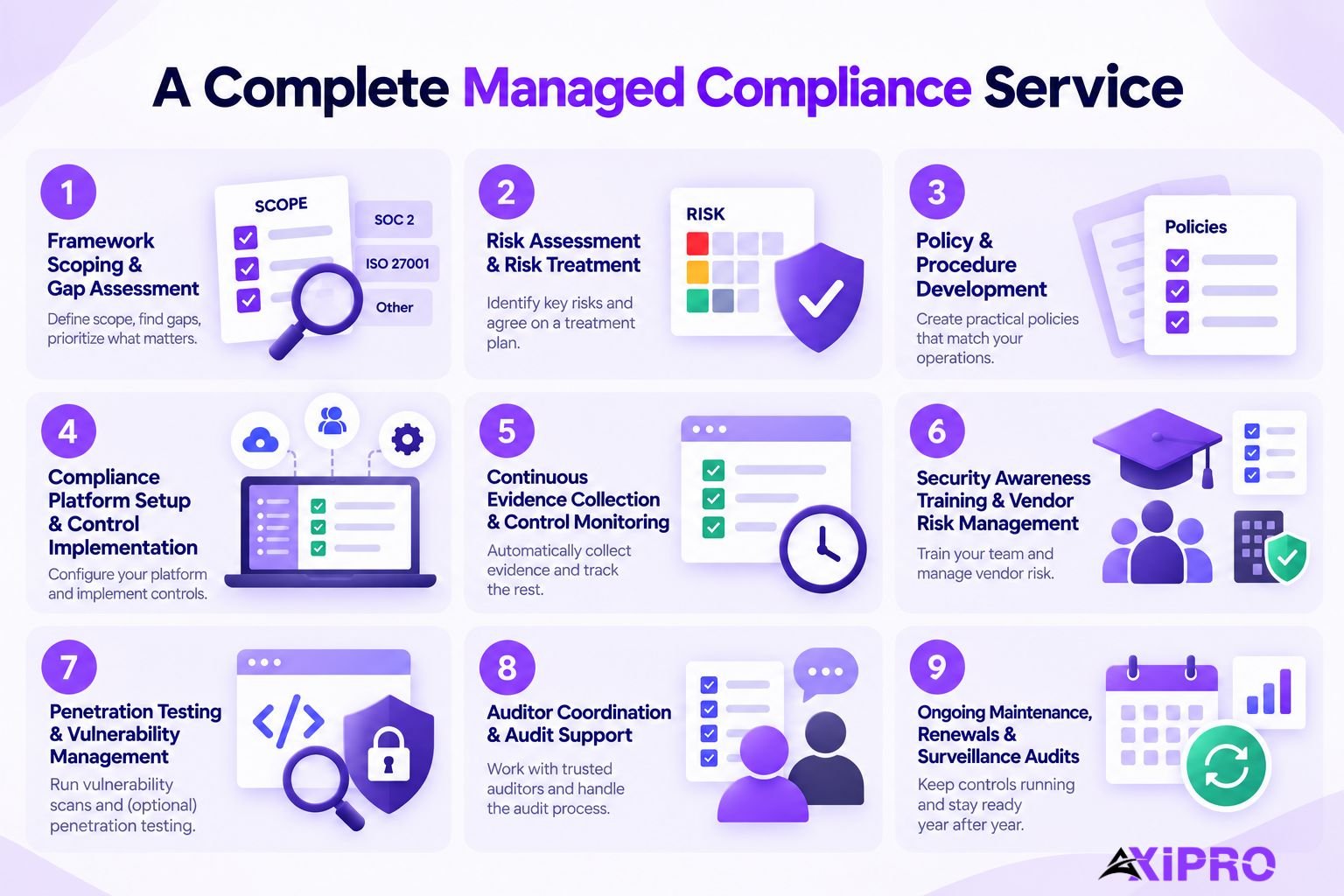
Scope varies a lot between providers, so compare offers line by line. A complete service covers everything below.
Framework Scoping and Gap Assessment
The provider confirms which framework you need, what is in scope (products, environments, teams, locations), and where you stand against the requirements today. Most of the savings in a compliance project come from good scoping. A narrow scope you can defend to an auditor means fewer controls to run and a smaller audit fee.
Risk Assessment and Risk Treatment
Both SOC 2 and ISO 27001 require a documented risk assessment. The provider runs it with your leadership, writes down the risks that matter to your business, and agrees a treatment plan with you. For ISO 27001 this feeds the Statement of Applicability, which is the first document an auditor reads.
Policy and Procedure Development
Expect a set of 15 to 25 policies covering access control, change management, incident response, vendor management, business continuity, and acceptable use. What matters is whether the policies describe what your company really does. Auditors check practice against policy, so a template promising weekly vulnerability scans you don’t run will turn into a finding.
Compliance Platform Setup and Control Implementation
The provider configures the GRC platform, connects your cloud, identity, HR, and device management systems, and works through failing checks with your engineers: MFA enforcement, encryption settings, logging, endpoint protection, branch protection. This is where most of the hands-on hours go.
Continuous Evidence Collection and Control Monitoring
Automated tests cover much of the evidence. The rest is manual: meeting minutes, access review records, tabletop exercise notes, training completion. A managed provider keeps a calendar of these tasks and runs them with you, so there are no holes in the evidence when the audit window opens.
Security Awareness Training and Vendor Risk Management
Every major framework expects your staff to complete security training and expects you to assess the vendors that touch your data. The provider sets up the training program, tracks completion, and builds a vendor inventory with risk ratings and review records.
Penetration Testing and Vulnerability Management
SOC 2 doesn’t strictly mandate a penetration test, but most auditors and nearly all enterprise customers expect one. ISO 27001 requires technical vulnerability management. Many managed services bundle vulnerability scanning and offer a penetration test as an add-on. Check that the test is manual and scoped to your application. Auditors and customers can tell a real test from an automated scan with a cover page.
Auditor Coordination and Audit Support
The provider introduces vetted audit firms, prepares the evidence package, sits in on walkthroughs, and handles auditor requests. One rule to know: the firm that builds your controls can’t be the firm that audits them. Licensed CPA firms issue SOC 2 reports under the AICPA’s Trust Services Criteria, and accredited certification bodies issue ISO 27001 certificates.
Ongoing Maintenance, Renewals, and Surveillance Audits
SOC 2 Type II reports are renewed every year. ISO 27001 runs on a three-year cycle with annual surveillance audits. The controls have to keep running in between. Ongoing plans usually bundle continuous monitoring, policy updates, internal audits, and vCISO support for a monthly fee.
Which Compliance Frameworks Do Startups Need Managed?
Pick the framework your buyers ask for. It sounds obvious, yet plenty of startups chase the wrong one first because a competitor has it on their website.
SOC 2 for Selling to US Customers
SOC 2 is the default request from US enterprise buyers of SaaS. Technically it’s an attestation report rather than a certificate, and it comes in two forms. Type I assesses control design at a point in time. Type II assesses whether controls operated effectively over a period, usually three to twelve months. Axipro has a separate guide to SOC 2 compliance for startups that covers the process in detail.
ISO 27001 for International and Enterprise Buyers
ISO/IEC 27001 is the international standard for an information security management system (ISMS) and the usual requirement in the UK, Europe, the Middle East, and Asia-Pacific. The certificate runs on a three-year cycle. For costs and sequencing, see the ISO 27001 guide for startups.
GDPR and Data Privacy Obligations
GDPR is a law, so there’s no certificate to hang on the wall. If you process personal data of people in the EU or UK, it applies to you at any company size. Managed providers typically handle records of processing, data processing agreements, DPIAs, and, where required, an outsourced Data Protection Officer.
HIPAA for Healthtech Startups
Any startup handling protected health information for US healthcare customers must meet the HIPAA Security Rule and will be asked to sign Business Associate Agreements. There is no official HIPAA certification, so buyers usually accept a third-party assessment or a SOC 2 report with HIPAA mapping.
PCI DSS for Fintech and Payments
PCI DSS applies if you store, process, or transmit cardholder data. Most startups shrink their scope by using a payment processor and never touching card numbers, which turns a full assessment into a self-assessment questionnaire.
ISO 42001 and the EU AI Act for AI Startups
AI startups now get questionnaires about model governance and training data on top of the usual security questions. ISO 42001 is the certifiable management system standard for AI, and it shares its structure with ISO 27001, which makes the two efficient to run together. The EU AI Act adds legal obligations that scale with the risk category of the system.
Managing Multiple Frameworks Through Control Mapping
The frameworks overlap a lot. Access control, encryption, incident response, and vendor management show up in all of them. A competent provider sets up each control once and maps it to every framework you hold, so the second framework costs a fraction of the first. If no customer is asking for anything yet, you can start with the free NIST Cybersecurity Framework 2.0 Small Business Quick-Start Guide as a baseline.
Managed Compliance by Funding Stage
Pre-Seed and Seed: Building the Foundations
A full audit is usually premature here. The priority is basic hygiene that makes certification cheap later: single sign-on with MFA, a device management tool, a password manager, infrastructure as code, and a handful of core policies. If a design partner requires a report, a SOC 2 Type I is the fastest credible answer.
Series A: First Certification and Enterprise Readiness
This is where managed compliance pays for itself. Enterprise deals are in the pipeline, there’s still no security hire, and the founders can’t give up a quarter to audit prep. Most startups complete their first SOC 2 Type II or ISO 27001 certification here.
Series B and Beyond: Multi-Framework and Continuous Compliance
Growth brings a second and third framework, new regions, and customers who negotiate their own audit rights. The job changes from getting certified to staying certified across several frameworks at once. Many companies hire their first internal security lead at this stage and keep the managed provider for execution.
Managed Service vs. In-House vs. DIY with a Platform
| Managed service | In-house hire | DIY with a platform | |
|---|---|---|---|
| Upfront cost | Fixed project fee | Six-figure salary plus recruiting | Platform subscription only |
| Time to audit readiness | 4 to 8 weeks | 4 to 9 months, including hiring | 3 to 9 months |
| Internal workload | A few hours per week | One full-time role plus engineering support | Heavy on CTO and senior engineers |
| Expertise | Team that has run many audits | Depends on one person | Learned on the job |
| Main risk | Provider quality varies | Single point of failure | Stalls, or fails the first audit |
Cost Comparison
In-house is the most expensive route for a company under 100 people. One salary comes to more than most startups spend on a managed service, platform, and audit put together. DIY is cheapest on paper and hardest to cost honestly, because the real expense is engineering time nobody tracks.
Time to Audit Readiness
A managed team has run the same project dozens or hundreds of times, and that’s most of the reason it’s faster. They know which evidence an auditor will reject and which scoping decisions cause trouble later.
Internal Workload on Founders and Engineers
No provider can get your involvement down to zero. Your engineers still make configuration changes, and leadership still makes risk decisions. A reasonable expectation is two to four hours per week from a technical lead and an operations owner during implementation.
When It Makes Sense to Bring Compliance In-House
Bring it in-house once compliance is a permanent, multi-framework function with regulators or customer audits involved. For most companies that’s somewhere past 150 employees. Even then, many companies keep a provider for internal audits, since ISO 27001 requires the internal auditor to be independent of the work being audited.
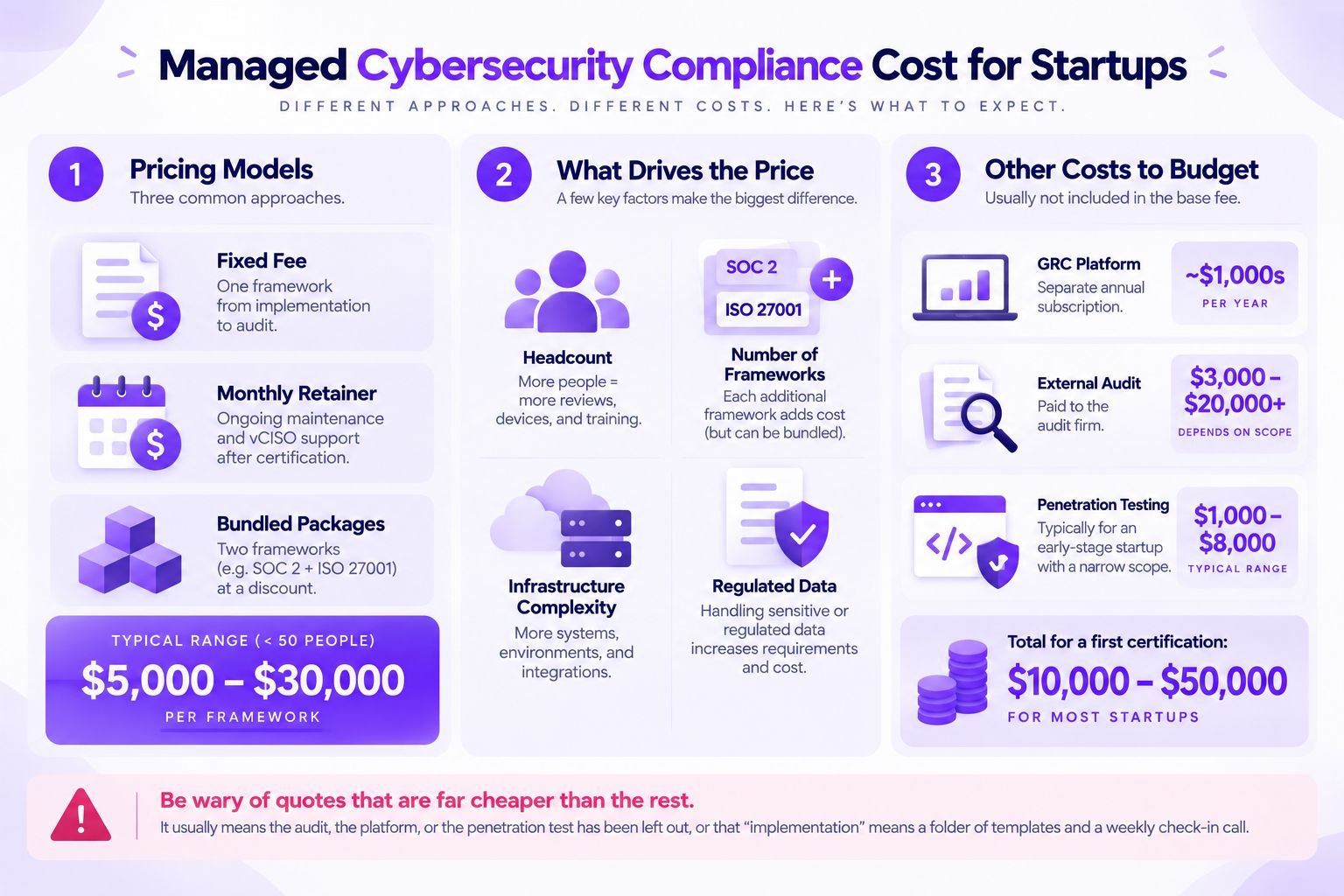
How Much Does Managed Cybersecurity Compliance Cost for Startups?
Pricing Models: Fixed Fee, Retainer, and Bundled Packages
You’ll run into three models. Fixed-fee projects cover implementation of one framework through to audit. Monthly retainers cover ongoing maintenance and vCISO support after certification. Bundles combine two frameworks, commonly SOC 2 and ISO 27001, at a discount because of control overlap. For a company under 50 people, fixed fees for a single framework generally land between the mid four figures and the low five figures.
What Drives the Price: Scope, Frameworks, and Headcount
Headcount is the usual pricing axis because it drives the volume of access reviews, devices, and training. After that comes the number of frameworks, the complexity of your infrastructure, and whether you handle regulated data. A single-product SaaS company on one cloud provider sits at the bottom of any range.
Platform, Audit, and Penetration Testing Fees to Budget Separately
Ask every provider what’s not in the quote. The GRC platform subscription is usually a separate annual cost in the thousands of dollars. The external audit is always a separate fee paid to the audit firm, from a few thousand dollars for a small SOC 2 Type I to well over $20,000 for larger scopes. A penetration test for an early-stage startup with a narrow scope typically runs $1,000 to $8,000. All in, most startups spend between $10,000 and $50,000 on a first certification, a range covered in more detail in Axipro’s ISO 27001 cost breakdown linked above.
Important: Be wary of a quote that’s far cheaper than the rest. Usually it means the audit, the platform, or the penetration test has been left out, or that “implementation” means a folder of templates and a weekly check-in call.
How to Choose a Managed Compliance Provider
Green Flags to Look For
Look for fixed, published pricing and a named team instead of a rotating pool. The provider should have worked with companies at your stage, and should be able to tell you how many clients they’ve taken through audit and how many passed. Ask about guarantees too, and read the conditions attached.
Red Flags to Watch Out For
Walk away from anyone promising SOC 2 Type II “in two weeks.” The observation period alone makes that impossible. Be careful with providers who also issue the audit report, because that’s an independence problem. Uncapped hourly billing is another bad sign, and so is a provider with no answer for what happens after certification.
Questions to Ask Before Signing
- Who will do the work, and what are their qualifications?
- What exactly is included, and what’s billed separately?
- How much of my team’s time will you need each week?
- Which audit firms do you work with, and can I choose my own?
- What happens if we fail the audit?
- What does year two cost?
Why Platform Partnerships and Auditor Relationships Matter
A provider with top-tier partner status on the major GRC platforms knows the tooling well, gets faster support escalations, and can often pass on a subscription discount. Established relationships with audit firms mean the evidence is prepared in the format that auditor expects, which shortens fieldwork. If you are still choosing tooling, this comparison of the main compliance automation platforms is a reasonable place to start.
How Long Does It Take to Get Compliant with a Managed Provider?
Typical Timeline from Kickoff to Audit Readiness
With a managed provider and a responsive internal team, SOC 2 readiness takes around four weeks and ISO 27001 certification readiness around six to eight. Readiness isn’t the end of it, though. A SOC 2 Type I audit can follow immediately, while a Type II requires an observation period of at least three months before the auditor can issue the report. ISO 27001 involves a Stage 1 documentation review and a Stage 2 audit, usually a few weeks apart.
What Your Team Still Needs to Do
Your engineers apply the configuration changes. Your leadership attends the risk assessment and management review. Every employee completes training and accepts the policies. Someone inside the company has to own the relationship and unblock requests. The projects that run late are nearly always the ones without that person.
Pro Tip: Tell prospects where you are in the process.
Tell prospects where you are in the process. Many enterprise buyers will sign with a SOC 2 Type I report plus a letter from your auditor confirming that the Type II observation period is underway. That can close a deal months before the final report lands.
Common Mistakes Startups Make When Outsourcing Compliance
Treating Compliance as a One-Time Project
The certificate expires, and the controls have to keep running until it’s renewed. Startups that drop everything after the first audit tend to find out eleven months later, with a renewal due and no evidence collected.
Buying a Platform Without Implementation Support
Buying a platform feels like progress. If nobody is there to fix the controls behind the dashboard, what you’ve bought is an expensive list of failing tests.
Choosing the Wrong Framework First
A startup selling to German manufacturers doesn’t need SOC 2 first, and one selling to US fintechs probably doesn’t need ISO 27001 first. Ask your five biggest prospects what they require before you decide.
Confusing Compliance with Security
An audit confirms that a defined set of controls exists and operates. It doesn’t prove you’re secure against every threat. Treat the framework as the floor of your security program, and check that your provider is improving your real security while they produce the paperwork.
Let Axipro help you build a business continuity plan that's practical, compliant, and audit-ready.
Schedule Your Free Assessment Today
How Axipro Manages Cybersecurity Compliance for Startups
Axipro is a compliance automation and cybersecurity consultancy founded in 2023, with teams in the US, UK, and Bahrain. It has served more than 200 clients and holds a 100% audit success rate across them. Its main service, the Achievement Plan, is a fixed-fee managed engagement that runs from gap analysis to the external audit. It covers the risk assessment, policies, control work on your GRC platform, an internal audit, and vulnerability scanning. A dedicated information security team does the work and is reachable on Slack.
SOC 2 readiness takes around four weeks, ISO 27001 readiness as little as six, and the Achievement Plan comes with guaranteed certification.
Axipro is a Drata Elite Partner and also partners with Vanta, Sensiba, and Insight Assurance, so clients are not tied to a single platform or audit firm. If you’d like to try the approach first, there’s the free 30-day Compliance Accelerator Plan, which gets you a gap analysis, a first set of policies, and a tabletop exercise. After certification, the Trust Assurance Plan covers ongoing monitoring, surveillance audit preparation, and vCISO support.
Is Managed Compliance Right for Your Startup?
Managed cybersecurity compliance fits startups that need a credible report or certificate soon, have no security staff, and can’t pull engineers off the roadmap to get one. It costs more than DIY on paper and much less than a full-time hire, and it’s usually the quickest way to get a stalled enterprise deal moving. Start from the framework your buyers ask for. Get the scope in writing, budget for the platform and the audit separately, and choose a provider who’ll still be around in year two.
Frequently Asked Questions
Is managed compliance worth it for an early-stage startup?
Yes, once a deal, an investor, or a regulation requires proof of security. Before that point, focus on basic hygiene such as SSO, MFA, and device management, which makes certification cheaper later. When the requirement arrives, a managed service is usually the fastest and lowest-risk way to meet it without a security hire.
Can a startup outsource compliance entirely?
You can outsource the work, but the accountability stays with you. The provider can implement controls, write policies, and manage the audit, but your leadership must approve risk decisions and your team must follow the policies. Expect a few hours per week of internal involvement during implementation.
Do we still need a GRC platform if we use a managed service?
In most cases, yes. The platform automates evidence collection and continuous monitoring, and most audit firms now expect to work inside one. The managed provider configures and operates it for you, and some can secure a discount on the subscription.
What is the difference between a managed compliance provider and an auditor?
The provider gets you ready for the audit, and the auditor examines you independently. Independence rules prevent the same firm from doing both for the same client. A good provider will introduce you to several audit firms and manage the relationship through fieldwork.
What happens after we pass the audit?
The controls keep running and the evidence keeps accumulating. SOC 2 Type II is renewed annually, and ISO 27001 requires surveillance audits in years two and three before recertification. Most startups move to a monthly maintenance plan that covers monitoring, policy updates, internal audits, and vCISO support.