
Table of Contents

Reach SOC 2 Compliance in 6 Weeks or Less.

  /

  / SOC 2 Report vs. Certification: What You Actually Get After the Audit

SOC 2 Report vs. Certification: What You Actually Get After the Audit

SOC 2 is not a certification, and no auditor will ever hand you a SOC 2 certificate. What you receive at the end of the audit is an attestation report: a detailed document, often 60 to 100 pages long, in which a licensed CPA firm expresses a professional opinion on your controls. That distinction sounds like pedantry until a prospect’s security team asks to see your “certificate” and you have nothing that looks like one. This article explains exactly what a SOC 2 report is, what it contains, how it differs from an ISO 27001 certificate, and how to talk about your SOC 2 status without misrepresenting it.
SOC 2 Report vs. Certification

Is SOC 2 a Certification or a Report?

The Common Misconception About “SOC 2 Certification”

Search volume tells the story: far more people look for “SOC 2 certification” than for “SOC 2 attestation,” and sales teams, procurement questionnaires, and even some auditors use the certification shorthand daily. The misconception is understandable. Every other major framework in the compliance stack, from ISO 27001 to PCI DSS, ends in something that looks like a pass. SOC 2 does not work that way, and treating it as if it does leads to awkward conversations during vendor due diligence.

Why SOC 2 Is Technically an Attestation, Not a Certification

A certification is a binary judgment issued by an accredited body: you meet the standard, or you do not. SOC 2 sits under the AICPA’s attestation standards, primarily SSAE 18 and its later amendments (SSAE 21 updated the relevant examination sections), specifically AT-C section 105 and AT-C section 205. Under those standards, an independent service auditor examines your controls and reports an opinion on them. Nobody “passes.” The auditor attests to what they found, in writing, with evidence. The output is a report, and the report is the entire deliverable.

Reach SOC 2 Compliance in 6 Weeks or Less

Schedule Your Free SOC 2 Assessment Today

Understanding the SOC 2 Attestation Model

What Is an Attestation Engagement?

An attestation engagement is a formal examination in which a practitioner evaluates subject matter prepared by another party against defined criteria, then issues a written conclusion. In SOC 2, the subject matter is your system and its controls, the criteria are the AICPA’s Trust Services Criteria (Security, Availability, Processing Integrity, Confidentiality, and Privacy), and the party preparing the subject matter is you, the service organization. Security is the only mandatory category; the other four are scoped in based on your service commitments.

The Role of the AICPA and Licensed CPA Firms

The AICPA (American Institute of Certified Public Accountants) owns the SOC framework and the attestation standards behind it, but it does not perform audits and does not issue anything to your company. Only a licensed CPA firm can conduct a SOC 2 examination and sign the resulting opinion. That licensing requirement is the quality mechanism: the firm’s professional liability, independence rules, and peer review obligations stand behind the report. In practice, this means the assurance you get is only as strong as the auditor’s reputation and independence posture, which is why enterprise buyers often look at who signed the report almost as carefully as they look at what it says.

How Attestation Differs from Certification and Accreditation

The three terms describe different assurance models.

  • Certification means an accredited certification body confirms conformity with a standard and issues a certificate, as happens with ISO 27001.
  • Accreditation is one level up: it is the process by which national bodies, such as those coordinated through the International Accreditation Forum, authorize those certification bodies to certify in the first place.
  • Attestation involves no certificate and no accreditation chain. A CPA firm examines evidence and expresses an opinion under professional standards. The credibility comes from the auditor’s license and independence, not from a badge.
What you really get after SOC 2 Audit

What You Actually Receive After a SOC 2 Audit

The SOC 2 Attestation Report Explained

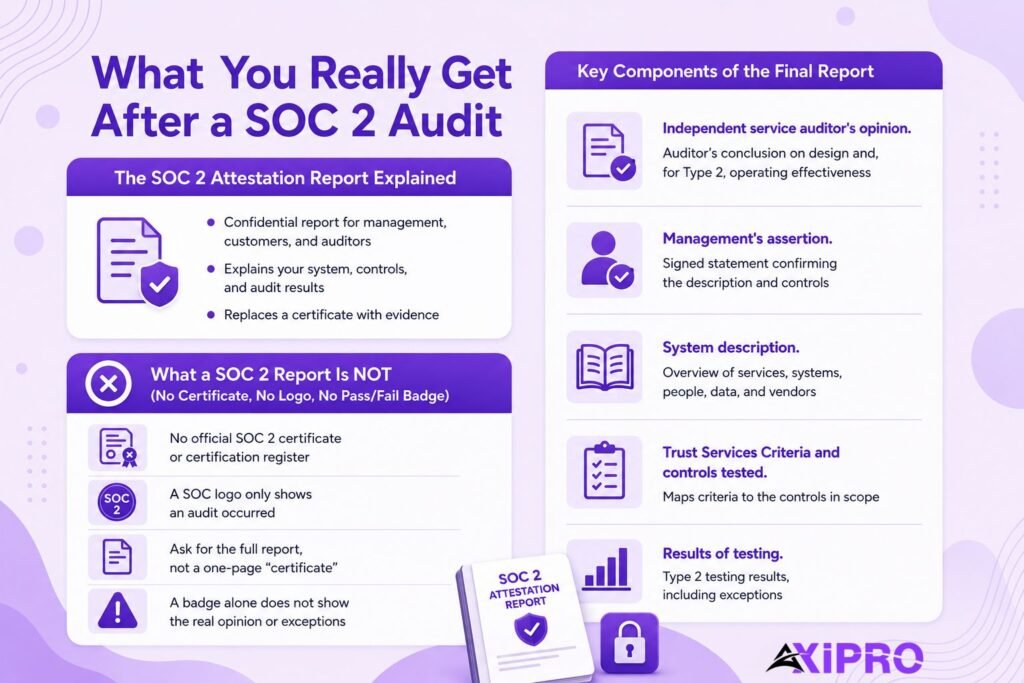
The deliverable is a confidential, restricted-use document addressed to your management and intended for your customers, their auditors, and other informed parties. It is dense by design. A prospect’s risk team reads it to understand what your system does, which controls you operate, how the auditor tested them, and what the auditor found. It replaces a certificate with something far more useful: evidence.

Key Components of the Final Report

Independent service auditor’s opinion. The first section, usually two to three pages, states the auditor’s formal conclusion on whether your system description is fairly presented and whether your controls were suitably designed (and, for Type 2, operating effectively). This is the section report readers check first.

Management’s assertion. A signed statement in which your leadership formally asserts that the system description is accurate and that controls meet the applicable criteria. SSAE 18 made this management assertion a mandatory element, which means responsibility for the description sits with you, not the auditor.

System description. The longest narrative section was prepared by management against the AICPA’s SOC 2 description criteria. It covers the services provided, infrastructure, software, people, data, processes, subservice organizations, and complementary user entity controls.

Trust Services Criteria and controls tested. A mapping of each in-scope criterion to the specific controls you operate. This is where scoping decisions become visible: a report covering Security only looks very different from one covering all five categories.

Results of testing. For Type 2 reports, a control-by-control table showing the tests the auditor performed and the results, including any exceptions. Sophisticated readers spend most of their time here, because exceptions and the auditor’s response to them reveal more than the opinion page does.

What a SOC 2 Report Is NOT (No Certificate, No Logo, No Pass/Fail Badge)

There is no official SOC 2 certificate, no numbered credential, and no register of “certified” companies you can be listed in. The AICPA licenses a standard SOC logo that service organizations may display for a limited time after report issuance, but the logo confirms only that an examination took place. It says nothing about the opinion inside. Anyone selling you a “SOC 2 certificate” as a standalone artifact is selling something the framework does not produce.

Important: If a vendor shows you a one-page SOC 2 “certificate” during due diligence, treat it as a red flag, not a shortcut. Ask for the full report under NDA and read the opinion and the exceptions table. A certificate-style summary with no underlying report is meaningless, and a real report reduced to a badge may be hiding a qualified opinion.
SOC 2 Report vs. ISO 27001 Certificate: A Side-by-Side Comparison

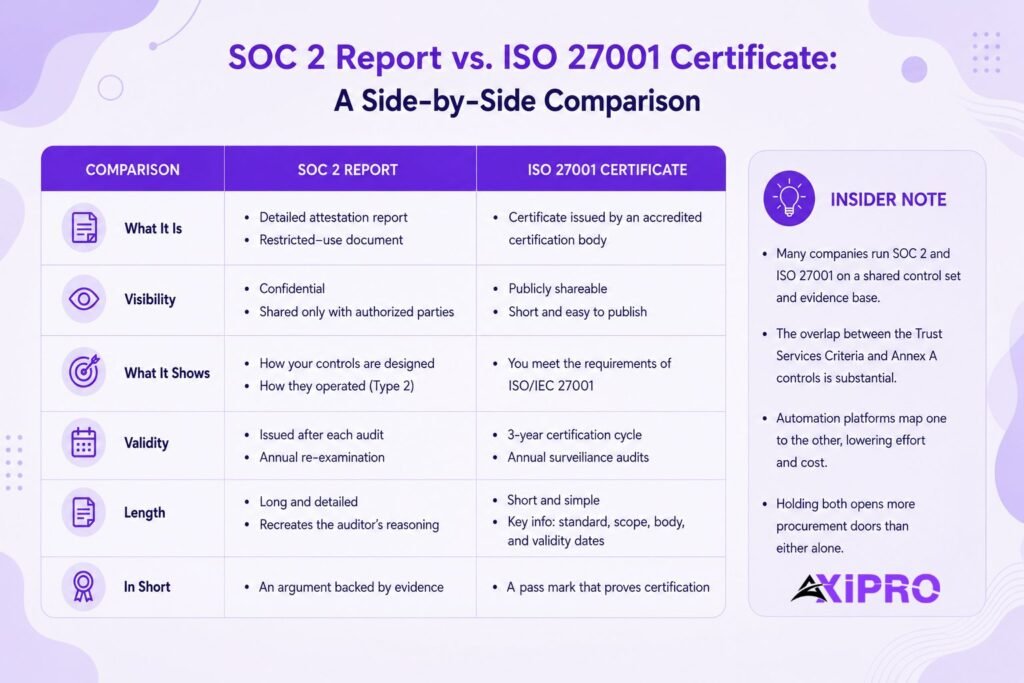
The confusion between attestation and certification usually resolves the moment you place the two deliverables side by side. ISO/IEC 27001 produces a certificate issued by an accredited certification body on a three-year cycle with annual surveillance audits. SOC 2 produces a detailed, restricted report that is reissued following a fresh examination every year. The ISO 27001 certificate is a short public document that names the standard, the scope, the certification body, and the validity dates; the SOC 2 report is a long confidential document that lets a reader recreate the auditor’s reasoning. One is a pass mark; the other is an argument.

Insider Note: Companies selling into both the US and EMEA increasingly run the two programs on a shared control set and evidence base. The overlap between the Trust Services Criteria and Annex A controls is substantial, and compliance automation platforms map one to the other. The marginal cost of the second framework is far lower than the first, and holding both closes more procurement doors than either alone.

Types of SOC 2 Reports You Can Receive

SOC 2 Type 1 Report: Point-in-Time Deliverable

A Type 1 report evaluates whether your controls were suitably designed as of a single specified date. It answers “were the right controls in place on that day,” not “did they work overtime.” Type 1 is typically a first-audit stepping stone that satisfies early customer requests while you accumulate the operating history that a Type 2 requires.

SOC 2 Type 2 Report: Period-of-Time Deliverable

A Type 2 report adds operating effectiveness: the auditor tests whether controls actually functioned throughout a defined review period, commonly three to twelve months. This is the report enterprise buyers mean when they ask for “your SOC 2.” A first Type 2 often covers a shorter window (three or six months) so the report exists sooner, with subsequent examinations settling into an annual twelve-month rhythm.
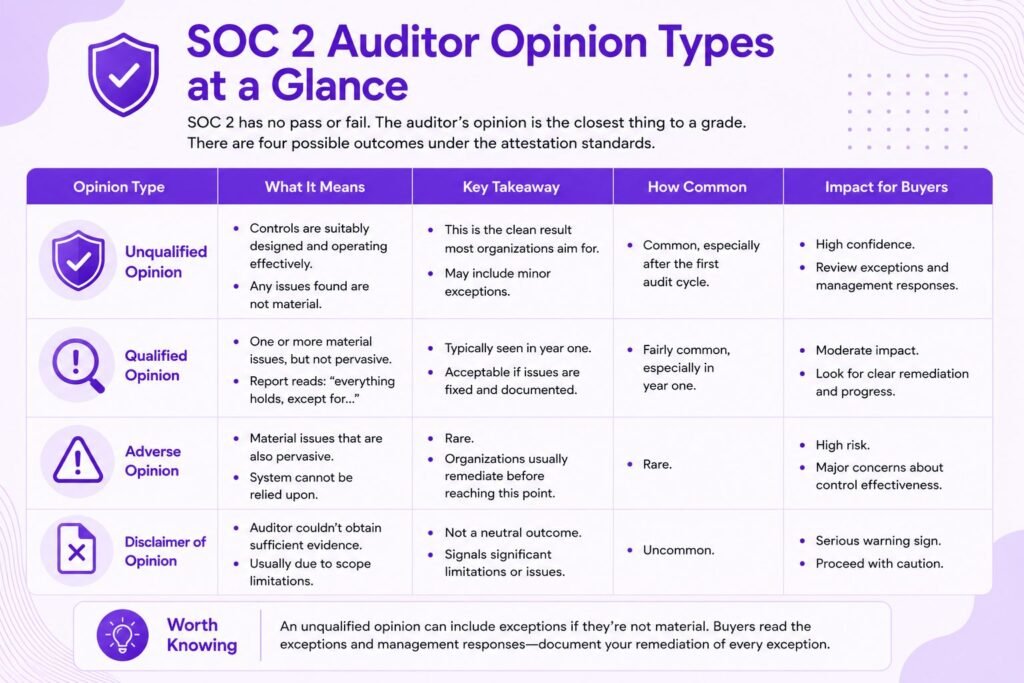
Types of Auditor Opinions in Your SOC 2 Report

Because SOC 2 has no pass or fail, the auditor’s opinion is the closest thing to a grade, and there are four possible outcomes defined under the attestation standards.

Unqualified Opinion

The clean result, and the one every service organization wants. The auditor concludes that the description is fairly presented and that controls were suitably designed and operating effectively. An unqualified opinion can still contain individual test exceptions; the auditor simply judged them immaterial to the overall conclusion, often because compensating controls held.

Qualified Opinion

The auditor found one or more material problems, but they were not pervasive. The report reads as “everything holds, except for the following.” Qualified opinions are more common than most first-timers expect, particularly in year one, and a well-remediated qualification is survivable in sales conversations if you can show what you fixed.

Adverse Opinion

Material problems that are also pervasive. The auditor is telling report readers that they cannot rely on the system as described. Adverse opinions are rare in practice because organizations heading toward one usually pause the engagement and remediate rather than take the report.

Disclaimer of Opinion

The auditor could not obtain sufficient evidence to form any opinion at all, usually because of scope limitations imposed by the organization. A disclaimer is not neutral; experienced report readers treat it as a serious warning sign.

Worth Knowing: An Unqualified Opinion

An unqualified opinion with disclosed exceptions is normal and defensible. Under the attestation standards, an exception only forces a qualification when the auditor judges the resulting misstatement material, and it only becomes adverse when material and pervasive. Savvy buyers read the exceptions table and management's responses, not just the opinion page, so document your remediation of every exception in the report itself where possible.

How to Use Your SOC 2 Report After the Audit

Sharing the Report with Customers and Prospects

The report is your primary trust asset in enterprise sales. Most organizations distribute it through a trust center or a controlled request process, gate it behind an NDA, and log who received which version. Proactively offering the report during security review shortens procurement cycles far more than any badge does.

NDA Requirements and Distribution Restrictions

SOC 2 is a restricted-use report. It contains your system architecture, control inventory, and test results, which are precisely the information you do not want circulating freely. Standard practice is to share it only under a non-disclosure agreement, either a standing mutual NDA or a click-through acknowledgment in a trust portal, and to watermark distributed copies. Given the volume of third-party breach reporting in the Verizon Data Breach Investigations Report and similar studies, treating the report as sensitive intellectual property is not paranoia; it is the same care your customers apply to yours.

Using SOC 2 Reports in Vendor Due Diligence

On the receiving side, the report is a working document for vendor risk management. Reviewers map the vendor’s in-scope criteria to their own risk requirements, check the opinion, read the exceptions, and verify the complementary user entity controls, the items the vendor’s assurance depends on you performing. A clean opinion with unimplemented user entity controls on your side still leaves you exposed.

Leveraging a SOC 3 Report for Public Marketing

If you want something you can publish, that is what SOC 3 exists for. A SOC 3 is a general-use summary derived from the same SOC 2 Type 2 examination, containing management’s assertion and the auditor’s opinion but stripped of the detailed system description and test results. You can post it on your website without an NDA, which makes it the legitimate public-facing counterpart to the restricted SOC 2 report.

How Long Your SOC 2 Report Remains Valid

The 12-Month Reporting Period

Strictly speaking, a SOC 2 report never expires; nothing in the attestation standards stamps a validity date on it. The market imposes one anyway. Buyers and their auditors treat a report as current for roughly twelve months from the end of the review period, after which they ask for a fresh one, and the AICPA limits use of its SOC logo to a defined window after issuance. The practical consequence is an annual audit cycle.

Bridge Letters Between Audit Cycles

A bridge letter (or gap letter) covers the interval between the end of your last report period and the issuance of the next report. Management, not the auditor, signs it, asserting that no material changes to the control environment occurred during the gap. Bridge letters conventionally cover no more than about three months and carry no independent assurance, so they buy time between reports rather than replacing one.

Pro Tip: Bridge Letter Template

Draft your bridge letter template before you need it, and time your review period so it ends a quarter before your customers' most common fiscal year-end. Most gap-letter fire drills happen because the report period was chosen for the auditor's convenience rather than the customers' audit calendars, and a badly timed period guarantees a bridge letter request every single year.

Why the “Certification” Language Persists in the Market

The shorthand survives because it is useful. “We are SOC 2 certified” fits on a slide; “we received an unqualified SOC 2 Type 2 attestation report” does not. Compliance vendors also optimize their content for what people actually search, which reinforces the loop. And since ISO 27001, PCI DSS, and most other frameworks genuinely are certifications, buyers pattern-match SOC 2 into the same mental category. The terminology is technically wrong but commercially sticky, and it is not going away.


How to Communicate SOC 2 Status Accurately to Stakeholders

Accurate phrasing is simple once you have it. Say your organization completed a SOC 2 Type 2 examination or received an unqualified SOC 2 Type 2 report, and name the trust services categories in scope. Avoid “certified,” “accredited,” and any invented badge. In contracts and security questionnaires, precision matters more: misdescribing an attestation as a certification in a signed document can create representations you cannot support, and general counsel teams increasingly flag this in redlines.


The Bottom Line

SOC 2 delivers a report, not a certificate: an independent CPA firm’s written opinion on your system description and controls, backed by documented testing. Understanding the attestation model tells you what to expect after the audit (an opinion, an assertion, a system description, and test results), how it differs from an ISO 27001 certificate, how long the market will treat it as current, and how to share it safely. Get the language right, and the deliverable becomes exactly what it was designed to be: the most detailed trust document your company produces.

Frequently Asked Questions

Can I say my company is "SOC 2 certified"?

You should not, strictly speaking. SOC 2 is an attestation, so the accurate phrasing is that you completed a SOC 2 examination and received a report. The shorthand is widespread and rarely challenged in casual conversation, but avoid it in contracts, questionnaires, and anything legally binding.

No certificate exists. The AICPA offers a standard logo that service organizations can display for a limited period after an examination, but it confirms only that an examination occurred, not what opinion resulted.

A licensed CPA firm acting as the independent service auditor. The AICPA sets the standards but issues nothing to individual companies.

Annually, by market convention. Reports have no formal expiry, but customers treat them as stale roughly twelve months after the end of the review period, so most organizations run a continuous yearly examination cycle.

Not in the pass/fail sense. You always receive a report; the variable is the opinion inside it. A qualified, adverse, or disclaimer opinion signals problems of increasing severity, and an unqualified opinion is the outcome buyers expect.

No. It is a restricted-use document shared under NDA with customers, prospects, and their auditors. If you need a publicly distributable version, obtain a SOC 3 report from the same examination.

The report is the full deliverable with the opinion, system description, and test results. An attestation or bridge letter is a short management-signed summary, often used to cover the gap between audit cycles, and it carries no independent auditor assurance.
Axipro Author

Picture of Pedro Dias

Pedro Dias

Pedro has been writing online for over 10 years. With experience in all things programming, cyber security, and compliance, he is our editor-in-chief at Axipro.

Blog Highlights

Explore More Articles

SOC 2 Report vs. Certification

SOC 2 is not a certification, and no auditor will ever hand you a SOC 2 certificate. What you receive at the end of the audit is an attestation report: a detailed document, often 60 to 100 pages long, in which a licensed CPA firm expresses a professional opinion on your controls. That distinction sounds like pedantry until a prospect’s security team asks to see your “certificate” and you have nothing that looks like one. This article explains exactly what a SOC 2 report is, what it contains, how it differs from an ISO 27001 certificate, and how to talk about your SOC 2 status without misrepresenting it. Is SOC 2 a Certification or a Report? The Common Misconception About “SOC 2 Certification” Search volume tells the story: far more people look for “SOC 2 certification” than for “SOC 2 attestation,” and sales teams, procurement questionnaires, and even some auditors use the certification shorthand daily. The misconception is understandable. Every other major framework in the compliance stack, from ISO 27001 to PCI DSS, ends in something that looks like a pass. SOC 2 does not work that way, and treating it as if it does leads to awkward conversations during vendor due diligence. Why SOC 2 Is Technically an Attestation, Not a Certification A certification is a binary judgment issued by an accredited body: you meet the standard, or you do not. SOC 2 sits under the AICPA’s attestation standards, primarily SSAE 18 and its later amendments (SSAE 21 updated the relevant examination sections), specifically AT-C section 105 and AT-C section 205. Under those standards, an independent service auditor examines your controls and reports an opinion on them. Nobody “passes.” The auditor attests to what they found, in writing, with evidence. The output is a report, and the report is the entire deliverable. Understanding the SOC 2 Attestation Model What Is an Attestation Engagement? An attestation engagement is a formal examination in which a practitioner evaluates subject matter prepared by another party against defined criteria, then issues a written conclusion. In SOC 2, the subject matter is your system and its controls, the criteria are the AICPA’s Trust Services Criteria (Security, Availability, Processing Integrity, Confidentiality, and Privacy), and the party preparing the subject matter is you, the service organization. Security is the only mandatory category; the other four are scoped in based on your service commitments. The Role of the AICPA and Licensed CPA Firms The AICPA (American Institute of Certified Public Accountants) owns the SOC framework and the attestation standards behind it, but it does not perform audits and does not issue anything to your company. Only a licensed CPA firm can conduct a SOC 2 examination and sign the resulting opinion. That licensing requirement is the quality mechanism: the firm’s professional liability, independence rules, and peer review obligations stand behind the report. In practice, this means the assurance you get is only as strong as the auditor’s reputation and independence posture, which is why enterprise buyers often look at who signed the report almost as carefully as they look at what it says. How Attestation Differs from Certification and Accreditation The three terms describe different assurance models. Certification means an accredited certification body confirms conformity with a standard and issues a certificate, as happens with ISO 27001. Accreditation is one level up: it is the process by which national bodies, such as those coordinated through the International Accreditation Forum, authorize those certification bodies to certify in the first place. Attestation involves no certificate and no accreditation chain. A CPA firm examines evidence and expresses an opinion under professional standards. The credibility comes from the auditor’s license and independence, not from a badge. What You Actually Receive After a SOC 2 Audit The SOC 2 Attestation Report Explained The deliverable is a confidential, restricted-use document addressed to your management and intended for your customers, their auditors, and other informed parties. It is dense by design. A prospect’s risk team reads it to understand what your system does, which controls you operate, how the auditor tested them, and what the auditor found. It replaces a certificate with something far more useful: evidence. Key Components of the Final Report Independent service auditor’s opinion. The first section, usually two to three pages, states the auditor’s formal conclusion on whether your system description is fairly presented and whether your controls were suitably designed (and, for Type 2, operating effectively). This is the section report readers check first. Management’s assertion. A signed statement in which your leadership formally asserts that the system description is accurate and that controls meet the applicable criteria. SSAE 18 made this management assertion a mandatory element, which means responsibility for the description sits with you, not the auditor. System description. The longest narrative section was prepared by management against the AICPA’s SOC 2 description criteria. It covers the services provided, infrastructure, software, people, data, processes, subservice organizations, and complementary user entity controls. Trust Services Criteria and controls tested. A mapping of each in-scope criterion to the specific controls you operate. This is where scoping decisions become visible: a report covering Security only looks very different from one covering all five categories. Results of testing. For Type 2 reports, a control-by-control table showing the tests the auditor performed and the results, including any exceptions. Sophisticated readers spend most of their time here, because exceptions and the auditor’s response to them reveal more than the opinion page does. What a SOC 2 Report Is NOT (No Certificate, No Logo, No Pass/Fail Badge) There is no official SOC 2 certificate, no numbered credential, and no register of “certified” companies you can be listed in. The AICPA licenses a standard SOC logo that service organizations may display for a limited time after report issuance, but the logo confirms only that an examination took place. It says nothing about the opinion inside. Anyone selling you a “SOC 2 certificate” as a standalone artifact is selling something the framework does not produce. Important: If

SIG Lite What It Covers, When to Use It, and Where It Falls Short

The full SIG content library contains 1,936 questions. SIG Lite asks 128 of them. That difference is the entire point: most vendor relationships do not justify a multi-week questionnaire exchange, and SIG Lite exists so risk teams can run standardized due diligence on lower-risk vendors without burning analyst hours or vendor goodwill. What Is SIG Lite? SIG Lite is the streamlined version of the Standardized Information Gathering (SIG) questionnaire, the most widely used third-party risk assessment instrument in the industry. It condenses the full SIG question set into a short, high-level assessment of a vendor’s information security, privacy, and resilience controls. It is a self-assessment, not an audit: the vendor answers, the assessor evaluates, and the completed questionnaire becomes evidence of due diligence in a third-party risk management (TPRM) program. Purpose of the SIG Lite Questionnaire The purpose is speed with consistency. SIG Lite gives an outsourcing organization a broad understanding of a third party’s internal control environment using a standardized question set, so answers are comparable across an entire vendor portfolio. It works either as a complete assessment for low-risk vendors or as a preliminary screen that decides whether a deeper review is warranted. Because every vendor answers the same questions, risk teams can rank, tier, and triage instead of interpreting fifty differently formatted responses. Who Created and Maintains SIG Lite? SIG Lite is owned and maintained by Shared Assessments, a member-driven standards organization formed in 2005 when the Big Four accounting firms and six global banks set out to fix the inefficiency of every company writing its own vendor questionnaire. The SIG is developed through a formal governance process that draws on practitioner feedback and tracks evolving regulations and standards, which is a large part of why it has held its position as the de facto industry template. SOC 2, ISO 27001 and HIPAA done for you. Fixed fee, 100% audit pass rate. Audit-ready in 6 weeks. Not 6 months. Schedule Free Assessment What’s Included in the SIG Lite Questionnaire? Number of Questions and Structure The 2025 release of SIG Lite contains 128 questions. The exact count shifts slightly with each annual update (recent versions have ranged from roughly 126 to 133), so always confirm the version you are working with. Questions are predominantly yes/no with room for comments and references to supporting evidence, and each question maps back to the SIG content library and to external frameworks. SIG Lite ships as a single-worksheet questionnaire, which keeps completion and review manageable. Risk Domains Covered in SIG Lite SIG Lite draws its questions from the same 21 risk domains that structure the entire SIG, grouped into four control areas: Governance and Risk Management, Information Protection, IT Operations and Business Resilience, and Security Incident and Threat Management. In practice, that means high-level coverage of access control, information security policy, data privacy, cloud security, business continuity, incident response, supply chain risk, human resources security, compliance management, and ESG, among others. The breadth is the same as SIG Core; the depth per domain is what gets trimmed. Format and Delivery (Spreadsheet and Toolkit) Historically, the SIG has been delivered as an Excel workbook generated by the SIG Manager, the macro-driven engine inside the SIG Questionnaire Toolkit that lets assessors scope, generate, store, and compare questionnaires. That is changing. In March 2026, Shared Assessments launched SIG EV (Evolution), a browser-based platform that moves questionnaire creation, distribution, comparison, and grading to the cloud while preserving the same content and methodology. Vendors can still respond in Excel, and assessors can upload completed files, so the transition does not break existing workflows. Worth Knowing: SIG Questions & Permissions SIG questions cannot be edited without written permission from Shared Assessments, but assessors can add up to 100 custom questions to a scoped questionnaire. That is usually enough headroom to cover industry-specific requirements without abandoning the standard. When Should You Use SIG Lite? Ideal Vendor Risk Scenarios SIG Lite fits three situations well. First, vendors with no access to sensitive data or critical systems, where a full assessment would be disproportionate. Second, large vendor portfolios, where sending 600-plus questions to every supplier would stall onboarding across the board. Third, early-stage evaluation, where you need enough signal to decide whether a relationship is worth deeper diligence. Low-Risk vs. High-Risk Vendor Assessments The dividing line is data and criticality. A marketing tool that touches no customer records, a facilities contractor, or a niche SaaS product with read-only access to public data can all be assessed adequately with SIG Lite. A payroll processor, a cloud provider hosting production data, or any vendor storing regulated information under HIPAA, PCI DSS, GDPR, or GLBA should get SIG Core. Using Lite on a high-risk vendor is a documented gap waiting to be found in your next audit. Initial vs. In-Depth Risk Screening Many mature programs use SIG Lite as a gate rather than a destination. The Lite response feeds an initial risk score; vendors that trip defined thresholds (a missing incident response plan, no encryption at rest, no independent certification) graduate to SIG Core or a targeted domain-level assessment. This two-stage pattern keeps effort proportional to risk and gives vendors a lighter first touch. SIG Lite vs. SIG Core: Key Differences Both questionnaires come from the same content library and cover the same 21 risk domains. The differences are scope, depth, and effort. Question Count and Scope SIG Lite’s 128 questions sit at the top of the control hierarchy: does a policy exist, is a program in place, and is there independent validation? SIG Core’s 627 questions descend into how each control actually operates. Beyond both sits the full SIG Detail library of 1,936 questions, which assessors use to build custom scopes by regulation, domain, or control family. Depth of Assessment A SIG Lite answer tells you a vendor has an access control program. A SIG Core response tells you how privileged accounts are reviewed, how quickly access is revoked at termination, and how authentication is enforced across environments. If your obligation is

The PDPA Compliance Singapore Checklist

In 2018, a cyberattack on SingHealth exposed the records of 1.5 million patients, including the Prime Minister. The Personal Data Protection Commission (PDPC) handed down S$1 million in combined penalties, and that decision still sits on its public enforcement page today. The Personal Data Protection Act (PDPA) has sharper teeth than it did a few years ago. Since October 2022, the PDPC can impose financial penalties of up to 10% of an organisation’s annual turnover in Singapore, or S$1 million, whichever is higher. Breach notification is now mandatory. And a hard deadline is approaching: from 1 January 2027, using NRIC numbers for authentication becomes an enforcement target. A checklist is how you turn all of that into something you can actually execute against, rather than a legal document you skim once and forget. What Is the PDPA Compliance Checklist? A PDPA compliance checklist translates the law’s 11 data protection obligations into concrete, verifiable actions. The obligations themselves are principles: Consent, Purpose Limitation, Notification, Access and Correction, Accuracy, Protection, Retention Limitation, Transfer Limitation, Data Breach Notification, Accountability, and Data Portability (legislated in 2020 but not yet in force). A principle tells you what good looks like. A checklist tells you whether you have done it. The distinction matters because the PDPC does not accept good intentions as a defense. When it investigates, it looks for documented policies, a named Data Protection Officer (DPO), evidence of consent, and a breach plan that existed before the breach. The checklist is what produces that evidence trail. SOC 2, ISO 27001 and HIPAA done for you. Fixed fee, 100% audit pass rate. Audit-ready in 6 weeks. Not 6 months. Schedule Free Assessment Who Needs to Follow the PDPA Compliance Checklist in Singapore Every private sector organisation that collects, uses, or discloses personal data in Singapore falls under the PDPA. That covers sole proprietorships, partnerships, companies, and foreign entities with Singapore operations. Headcount is irrelevant. A five-person startup carries the same obligations as a multinational, and the PDPC has shown it will penalize small and mid-sized businesses, not only household names. Physical presence is not the trigger either. If your processing touches individuals in Singapore, the Act can reach you even without a local office. Public sector agencies sit under separate legislation, but the private sector rules administered by the PDPC, which operates under the Info-communications Media Development Authority (IMDA), apply broadly. One useful carve-out: business contact information used purely for business purposes is largely exempt from the consent rules. Worth Knowing: PDPA Roles Explained The PDPA distinguishes an organisation from a data intermediary, a party that processes data on another’s behalf. Intermediaries carry a narrower but real set of duties, mainly protection and retention. If you outsource payroll, hosting, or email marketing, you are the organisation and your vendor is the intermediary, and the contract between you needs to say so explicitly. PDPA Compliance Checklist: Step-by-Step Guide The 15 steps below move roughly in the order you should tackle them, from governance foundations through operational controls to ongoing assurance. Treat them as a sequence, not a menu. Step 1: Appoint a Data Protection Officer (DPO) The PDPA requires every organisation to designate at least one individual responsible for compliance, and to make that person’s business contact details available to the public. You do not have to hire a specialist. In smaller firms, an existing employee can hold the DPO role alongside other duties. What matters is that the role is named, resourced, and reachable, because the DPO is who the PDPC and affected individuals contact first. Publish the contact details on your website and inside your privacy notice. Step 2: Map and Inventory Personal Data You cannot protect data you cannot see. Build a data inventory that records what personal data you hold, where it lives, which systems and people can access it, why you collected it, and how long you keep it. This map is the single most useful artifact in your entire program. It feeds your privacy notice, your retention schedule, your breach assessments, and your vendor reviews. Most compliance failures trace back to a blind spot, a spreadsheet of customer records nobody remembered, or a legacy database still holding data long past its purpose. Step 3: Establish Lawful Basis and Obtain Valid Consent Under the Consent Obligation, you generally need an individual’s consent before you collect, use, or disclose their personal data, and that consent must be tied to a specific, notified purpose. The 2020 amendments added flexibility: deemed consent covers scenarios like contractual necessity, and the legitimate interests exception lets you process data where the benefit outweighs any adverse effect, provided you document the assessment. You cannot make consent to unrelated data uses a condition of providing a service. Important: Bundled consent is a common enforcement trigger. A single checkbox that forces a customer to agree to marketing in order to complete a purchase is not valid consent for the marketing. Separate the purposes, and let people say yes to one without being forced into the other. Step 4: Draft and Publish a Compliant Privacy Notice Your privacy notice is the public expression of how you handle personal data. It should state what you collect, the purposes you collect it for, who you share it with, how long you retain it, and how individuals can contact your DPO or exercise their access and correction rights. Write it in plain language. A notice dense enough to deter reading does not satisfy the spirit of the Notification Obligation, and regulators notice the difference. Step 5: Implement the Notification of Purpose Requirement The Notification Obligation and the Purpose Limitation Obligation work as a pair. You must inform individuals of the purpose before or at the point of collection, and you must then confine your use of the data to that purpose. Practically, that means a clear notice at every collection point: sign-up forms, website pop-ups, contact forms, event registrations. Selling a customer list you gathered for order fulfillment is precisely the kind of