
EORs are often the leaders in data security compliance. As the responsible party for payroll and HR data, the burden of SOC 2 compliance is greater for them than for other companies. But SOC 2 compliance doesn’t have to be complicated. In this article, we’ll guide EOR firms through the process with an easy, step-by-step approach.
What Is SOC 2 Compliance and Why Does It Matter for EOR Providers?
Understanding SOC 2 and Its Role in Employer of Record Services
An Employer of Record processes payroll data, national identification numbers, bank account details, tax filings, and employment records for workers across dozens of countries. In a single month, a mid-sized EOR platform may handle more sensitive personal data than many healthcare organisations. That concentration of risk is precisely why SOC 2 compliance has moved from a nice-to-have to a procurement prerequisite for clients who take data security seriously.
SOC 2 is a security auditing framework developed by the American Institute of Certified Public Accountants (AICPA). It evaluates service organisations against a set of Trust Services Criteria covering security, availability, processing integrity, confidentiality, and privacy. Unlike prescriptive frameworks such as PCI DSS, SOC 2 does not mandate a specific list of controls. Instead, it requires organisations to demonstrate that the controls they have designed and implemented actually work.
For EOR providers, this flexibility is both useful and demanding. Useful because it allows controls to be tailored to the specific realities of multi-country payroll operations. Demanding because evidence of effective control operation must be documented and sustained continuously — not assembled in the weeks before an audit.
Why EOR Providers Are High-Value Targets for Data Security Risks
EOR platforms sit at a uniquely dangerous intersection of data sensitivity, operational scale, and third-party dependency. They act as the legal employer in multiple jurisdictions, which means they hold the kind of data that attracts two distinct threats: financially motivated attackers looking for payroll and banking credentials, and regulatory enforcement bodies scrutinising how personal data crosses borders.
The attack surface is broad. EOR providers connect client company HR systems to local payroll engines, tax authorities, benefits administrators, and banking rails. Each integration is a potential entry point. A misconfigured API between an EOR platform and a client HRIS can expose employee records without any external attacker involved at all.
The regulatory exposure compounds the security risk. Under the GDPR alone, penalties for serious data breaches can reach €20 million or 4% of global annual turnover, whichever is higher. For an EOR operating in Europe, Southeast Asia, and Latin America simultaneously, the regulatory surface is enormous.
The Business Case for SOC 2 Compliance in the EOR Industry
Enterprise clients and their procurement teams increasingly require SOC 2 Type II certification before signing EOR contracts. A successful audit signals that an EOR provider has implemented and sustained effective security controls over time — not just designed them on paper. That distinction matters enormously in a market where a single data breach can destroy client relationships overnight.
SOC 2 compliance also de-risks the EOR provider itself. Organisations that have gone through the audit process typically discover and remediate control gaps they did not know existed. The internal discipline required to sustain a Type II audit programme produces a more operationally mature organisation, regardless of what any individual client requires.
Pro Tip: Type 1 vs Type 2
In the EOR market, SOC 2 Type II has become the de facto security signal that enterprise procurement teams look for when vetting providers. Type I is no longer sufficient for most Fortune 1000 clients. If an EOR is starting the compliance journey today, the goal should be Type II from the outset.
Which Trust Services Criteria Apply to EOR Providers?
Security (Common Criteria)
Security is the only mandatory Trust Services Criterion in a SOC 2 audit. It covers nine areas of control (CC1 through CC9) grounded in the COSO framework, spanning governance, risk management, access controls, system operations, change management, and incident response. For EOR providers, the security criterion is the foundation on which everything else sits.
Access control is particularly critical. EOR platforms grant dozens or hundreds of internal staff access to employee PII and payroll data, often differentiated by country and client. Multi-factor authentication, role-based access, and rigorous user provisioning and deprovisioning processes are baseline expectations for any SOC 2 auditor.
Availability
Availability assesses whether systems perform as expected and are accessible to users when required. For EOR providers, payroll processing is time-critical. A system outage on a payroll run date does not just affect internal operations — it directly impacts employees’ ability to receive pay on time, which creates legal exposure in many jurisdictions.
Availability controls for EOR providers should address capacity planning, disaster recovery, and system resilience. Demonstrable recovery time objectives and tested business continuity plans are the evidence auditors will want to see.
Confidentiality
Confidentiality applies to any information designated as confidential within the system, including client business information, employment contracts, salary benchmarking data, and any other data the EOR has committed to protect beyond basic legal requirements. It requires both clear data classification processes and active controls to prevent unauthorised disclosure.
EOR providers often hold confidential commercial information on behalf of multiple clients who may be competitors of one another. Logical segregation of client data is therefore not only a security best practice but a direct requirement under the confidentiality criterion.
Processing Integrity
Processing integrity evaluates whether systems process data completely, accurately, in a timely fashion, and without unauthorised modification. This criterion is particularly relevant to payroll operations, where a calculation error can result in incorrect tax remittances, underpaid employees, or regulatory violations.
Input validation controls, reconciliation procedures, and audit trails that confirm payroll data moved accurately from source to payment are the core of a processing integrity programme for EOR platforms.
Privacy
Privacy goes beyond confidentiality to address how personal data is collected, stored, used, retained, and disclosed in line with the AICPA’s Generally Accepted Privacy Principles. It applies when an organisation collects and processes PII — which every EOR provider does by definition.
For EOR providers operating globally, the privacy criterion intersects directly with GDPR, the CCPA, and a growing number of regional data protection regimes. A SOC 2 audit covering Privacy does not substitute for GDPR compliance, but the controls required to meet the privacy criterion are largely the same ones needed to demonstrate regulatory compliance.
Pro Tip: AICPA Trust Service Criteria
The AICPA updated its Trust Services Criteria points of focus in 2022 to reflect evolving cybersecurity threats and technology environments. The underlying five criteria remain unchanged, but the 2022 revision added specific focus areas around vendor risk, software supply chain security, and breach response, areas that are especially relevant to EOR platforms with complex third-party integration ecosystems.
SOC 2 Type I vs. SOC 2 Type II: What EOR Providers Need to Know
SOC 2 Type I: Point-in-Time Design Assessment
A Type I report evaluates whether the controls an organisation has designed are appropriate and in place as of a specific date. It does not assess whether those controls have been operating effectively over time. The auditor is confirming that the controls are correctly designed and that they existed on the date of the assessment.
Type I is faster and less expensive to obtain. For an EOR provider building a compliance programme from scratch, Type I can serve as a milestone that confirms the foundation is solid before moving to the sustained operational evidence required for Type II. It can also be a useful signal to early-stage clients who want assurance that a formal security programme exists.
SOC 2 Type II: Ongoing Operational Effectiveness
A Type II report covers a defined observation period, typically six to twelve months. Auditors assess not just whether controls exist and are well-designed, but whether they operated effectively throughout that period. This requires continuous evidence: access review logs, training completion records, incident response tests, vendor assessments, and so on.
Type II is the standard that enterprise buyers expect. It is a fundamentally different kind of commitment from Type I, requiring that the organisation maintain audit-ready evidence on an ongoing basis rather than preparing for a single point-in-time assessment. For a deeper look at building and sustaining that readiness, see what to expect from a SOC 2 compliance solution.
Which SOC 2 Report Type Should EOR Providers Pursue First?
EOR providers with no existing compliance programme should plan for Type II from the start, treating a Type I as a waypoint rather than a destination. The disciplines required to sustain a Type II audit, including continuous monitoring for SOC 2, systematic evidence collection, and regular control testing, take time to establish. Starting that clock earlier reduces the total time to a mature Type II report.
Providers that already have strong security controls in place but lack a formal audit trail are typically better positioned to move directly toward a Type II observation period, using a gap analysis to identify what evidence collection needs to be formalised before the observation window opens.
SOC 2 Compliance Checklist for EOR Providers
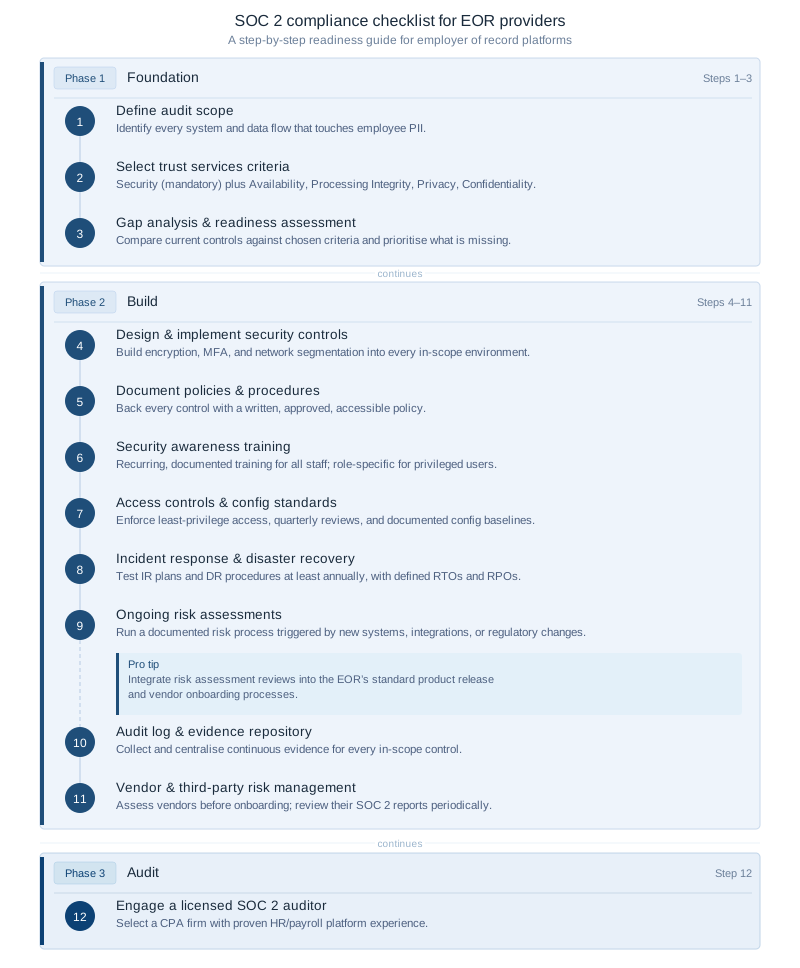
The following steps represent the full operational journey from programme initiation to audit-ready posture. This SOC 2 compliance checklist is designed specifically for EOR providers navigating the complexity of multi-country data operations.
Step 1: Define Your Audit Scope
Scope definition is the most consequential decision in the SOC 2 process. The scope determines which systems, processes, and data flows are included in the audit, and therefore which controls must be evidenced. For an EOR provider, this typically includes the core payroll platform, client onboarding systems, HR data integrations, and any systems that store or transmit employee PII.
Resist the instinct to scope narrowly to reduce cost. Auditors and clients will notice if material systems or data flows have been excluded, and a narrow scope undermines the trust the audit is meant to build.
Step 2: Select Your Trust Services Criteria
Security is mandatory. Given the nature of EOR services, most providers should also include Availability, Processing Integrity, and Privacy. Confidentiality is appropriate for providers that have contractual confidentiality commitments to clients regarding business information beyond standard data protection requirements. See the full breakdown of the Trust Services Criteria to determine the right scope for your organisation.
Step 3: Conduct a Gap Analysis and Readiness Assessment
A readiness assessment and gap analysis compares current controls against the requirements of the selected Trust Services Criteria and identifies what is missing, underdocumented, or not operating as intended. For most EOR providers, gaps surface in vendor risk management, formal access review processes, and evidence collection practices rather than in the underlying security controls themselves.
Step 4: Design and Implement Required Security Controls
Controls must be designed to address the specific risks identified in the gap analysis. For EOR providers, this includes encryption of data in transit and at rest across all environments where employee PII is stored, multi-factor authentication across all in-scope systems, and network segmentation to limit lateral movement in the event of a breach.
Step 5: Develop and Document Policies and Procedures
Every control must be backed by a documented policy that explains what the control does, who is responsible for it, and how compliance is verified. An auditor who cannot locate the policy for a control they are testing will treat it as a gap, regardless of whether the control is functioning correctly in practice. Required documentation includes an information security policy, an access control policy, a change management policy, a data retention and disposal policy, and a vendor management policy.
Step 6: Implement Employee Security Awareness Training
SOC 2 requires documented, recurring security awareness training for all staff, with role-specific training for employees with elevated access or security responsibilities. Training records must include dates, participants, and topics covered. These records will be requested during the audit, and incomplete records are one of the most common findings in first-time SOC 2 engagements.
Step 7: Establish Access Controls and System Configuration Standards
Access to in-scope systems should be granted on a least-privilege basis, reviewed at regular intervals, quarterly is the most common expectation, and immediately revoked upon employee departure. Configuration baselines for all in-scope systems should be documented and enforced, with any deviations logged and reviewed.
Step 8: Set Up Incident Response and Disaster Recovery Procedures
An incident response plan should cover detection, containment, eradication, recovery, and post-incident review, and must be tested at least annually. Disaster recovery procedures should include defined recovery time objectives and recovery point objectives, tested through tabletop exercises or simulations. For EOR providers, GDPR’s 72-hour breach notification requirement makes a well-rehearsed incident response plan not just an audit requirement but a legal one.
Step 9: Perform Ongoing Risk Assessments
SOC 2 requires a documented, repeatable risk assessment process. The assessment should inventory all systems and data flows in scope, identify threats and their likelihood and impact, and document the controls in place to mitigate each risk. For EOR providers, country-specific regulatory changes and new third-party integrations should trigger a risk assessment update.
Pro Tip: Integrate risk assessment reviews into the EOR’s standard product release and vendor onboarding processes. This ensures that new systems and integrations are evaluated before they go live, rather than discovered as gaps during audit evidence collection.
Step 10: Build and Maintain an Audit Log and Evidence Repository
Continuous evidence collection is the operational backbone of a Type II programme. Audit logs should capture access events, configuration changes, and security incidents across all in-scope systems. Evidence of control operation, completed access reviews, training records, vendor assessments, should be organised in a central repository accessible to the audit team. Disorganised evidence is one of the common SOC 2 compliance mistakes that delays audits and inflates costs.
Step 11: Implement a Vendor and Third-Party Risk Management Process
EOR providers rely heavily on third parties: local payroll processors, benefits administrators, banking partners, and HR technology integrations. A formal vendor risk management programme should assess vendors before engagement, review their security posture periodically, including reviewing their own SOC 2 reports where available, and document the outcomes. This is an area where EOR providers are disproportionately exposed relative to non-EOR technology companies.
Step 12: Engage a Licensed SOC 2 Audit Firm
SOC 2 audits must be performed by a licensed CPA firm. An auditor with experience in HR and payroll technology platforms will better understand the specific risks and control requirements relevant to EOR operations, ask more targeted questions, and complete the audit more efficiently than a generalist firm encountering payroll infrastructure for the first time.
Key Documentation Required for SOC 2 Compliance as an EOR Provider
Control Policies and Procedures Documentation
Every in-scope control must be supported by a written policy. Policies must be current, approved by management, and accessible to employees. Auditors distinguish clearly between a policy that exists and a policy that is actively maintained, version histories, approval dates, and evidence of annual reviews all support the latter.
Employee Training Records
Training records must document who was trained, when, on what topics, and with what outcome. For EOR providers, role-specific training for payroll staff, HR administrators, and engineers with privileged access is an additional requirement beyond general security awareness training. General awareness training records and role-specific records should be maintained separately and be producible on request.
System Configurations and Access Controls
Auditors will request evidence of system configuration baselines, access control lists, and user access review records. For EOR platforms operating across multiple environments, maintaining consistent, documented configuration standards is a significant operational effort that must begin well before the audit window opens, not in the weeks preceding it.
Incident Response Plans
A documented, tested incident response plan is a core audit requirement. The plan must define roles and responsibilities, escalation procedures, notification timelines, particularly relevant for GDPR breach notification obligations, which require notification within 72 hours, and post-incident review processes. Evidence of annual testing is required; a plan that has never been tested provides much weaker assurance than one with documented tabletop exercise outcomes.
Monitoring and Logging Mechanisms
Evidence that monitoring and logging are operational, not merely configured, is a standard audit request. Log retention periods, alerting thresholds, and the results of periodic log reviews should all be documented and producible on request. Auditors will look for evidence of actual review activity, not just system configuration screenshots.
Vendor and Subprocessor Management Records
Records of vendor due diligence, including the basis for approving each vendor, the results of periodic reviews, and any corrective actions taken, form a critical part of the audit evidence package. For EOR providers with global operations, this list can be extensive and requires systematic management rather than ad hoc documentation.
EOR-Specific Security Controls to Prioritise
Protecting Employee Personally Identifiable Information (PII) Across Borders
EOR platforms hold some of the most sensitive PII imaginable: national identification numbers, passport details, bank account information, and tax identifiers for employees in dozens of countries. Controls must ensure that this data is encrypted at rest and in transit, that access is restricted to personnel with a legitimate need, and that data is retained only for as long as legally required.
Cross-border data transfers add further complexity. The GDPR restricts transfers of personal data to countries not deemed to provide adequate data protection. China’s data protection framework imposes localisation requirements that prevent certain categories of data from leaving Chinese jurisdiction. These requirements must be mapped into the EOR’s access control and data residency architecture before the audit scope is finalised.
Payroll Data Integrity and Processing Controls
Payroll errors have direct legal consequences. A failure to process correct tax deductions can trigger audits and penalties from tax authorities, potentially implicating both the EOR and the client company. Processing integrity controls, input validation, reconciliation procedures, and exception reporting, should be documented and tested as part of the SOC 2 programme, with evidence of regular reconciliation runs available for auditor review.
Multi-Country Data Residency and Access Management
Many EOR platforms use cloud infrastructure to serve global operations, which creates default data flows that may not comply with local data residency requirements. Role-based and geography-based access controls, enforced at the data layer rather than just the application layer, are a meaningful differentiator. A support engineer in one jurisdiction should not have default access to employee data held in another, and demonstrating that this restriction is actively enforced is a strong audit signal.
Third-Party Integrations and Client System Access Controls
EOR providers often have privileged access to client HR and finance systems. The controls governing this access, how credentials are stored, how access is granted and revoked, and how activity is logged, are high-priority audit considerations. Any client system access not governed by a formal access management process represents both a security risk and an audit finding waiting to happen.
Pro Tip: Multi-country EORs
Multi-country EOR operations present a complication that non-specialist auditors may underestimate. The Privacy criterion in a SOC 2 audit does not substitute for GDPR, CCPA, or any other jurisdiction-specific data protection regulation. An EOR provider can pass a SOC 2 audit and still be non-compliant with GDPR if cross-border data transfer mechanisms are not properly implemented. These are parallel requirements, not alternatives.
Preparing for the SOC 2 Audit: Practical Steps for EOR Providers
Conduct a Mock Audit or Internal Readiness Review
A readiness review performed six to eight weeks before the audit begins is the single most effective way to reduce audit surprises. It should test whether evidence can be produced for each in-scope control, identify any controls that have lapsed, and confirm that the audit evidence repository is organised and complete. Think of it as a rehearsal where fixing mistakes still costs nothing.
Resolve Control Gaps Before the Audit Begins
Gaps identified in the readiness review should be remediated before the audit starts, not during it. Remediating a gap after the auditor has identified it results in a qualified or adverse finding in the report. Remediating it beforehand means it simply does not appear as a gap. This requires enough lead time to implement and evidence the corrective control before the audit window closes, which is another reason why preparation timelines of six months or more are not conservative but realistic.
Maintain Continuous Monitoring to Sustain Audit Readiness
For a Type II audit, the observation period is the audit. Evidence collected during that period must demonstrate consistent control operation, not a burst of activity in the weeks before the assessment. Continuous monitoring for SOC 2, whether through purpose-built compliance platforms or security information and event management systems, is a practical necessity for organisations managing large evidence volumes across complex, multi-country environments.
SOC 2 and Related Frameworks: What EOR Providers Should Know
SOC 2 is not the only framework EOR providers will encounter. Understanding how it relates to other standards helps organisations make smarter decisions about where to invest compliance resources. ISO 27001 vs SOC 2 is one of the most common comparisons, and for good reason: both address information security management, but they differ significantly in scope, evidence requirements, and market recognition across geographies.
ISO 27001 is an international standard that requires organisations to establish, implement, maintain, and continually improve an information security management system. It is more widely recognised outside North America and is often the preferred certification for EOR providers operating primarily in European or Asia-Pacific markets. SOC 2, by contrast, is deeply embedded in the North American enterprise procurement process. Many mature EOR providers pursue both, using the overlapping control requirements to build a single evidence base that serves multiple audit programmes simultaneously.
For organisations considering ISO 27001 alongside SOC 2, a structured gap analysis covering both frameworks can identify where controls satisfy requirements for one standard but fall short for the other, and where a single well-designed control can serve both.
Can EOR providers use compliance automation software for SOC 2?
Compliance automation platforms can meaningfully reduce the effort required to collect and organise audit evidence, monitor controls continuously, and manage the evidence repository. They are particularly useful for EOR providers managing high evidence volumes across multiple systems and geographies. These tools do not replace the need for an accredited SOC 2 auditor, but they can substantially reduce preparation costs and ongoing compliance burden.
How does SOC 2 compliance relate to GDPR and other data privacy regulations for EOR providers
SOC 2 and GDPR compliance are parallel requirements that overlap significantly in practice but are not substitutes for one another. Achieving SOC 2 compliance, including the Privacy criterion, demonstrates that robust data protection controls are in place. However, a SOC 2 report does not provide a GDPR compliance certification, and GDPR requirements around data subject rights, cross-border transfer mechanisms, and data processor agreements must be addressed separately. EOR providers should treat both frameworks as independently necessary and jointly beneficial.
Which Trust Services Criteria are most important for EOR providers?
Security is mandatory for all SOC 2 audits. For EOR providers specifically, Availability is critical because of payroll processing deadlines, Processing Integrity is essential given the legal consequences of payroll errors, and Privacy is required because EOR platforms collect and process substantial volumes of employee PII. Most EOR providers pursuing a full SOC 2 programme should address all five criteria.