
SOC 2 compliance can sometimes feel like a needlessly complex Pandora’s box of documentation. But it shouldn’t be. That’s why today, we’ll show you how to easily become compliant with our 12-step SOC 2 compliance checklist.In its simplest form, all the SOC 2 sections point to the same question: Can you prove your controls work? This SOC 2 Compliance Checklist guides you through the process from scoping through audit completion for both SOC 2 Type 1 and Type 2. It is practical, auditor-aligned, and written for teams that want clarity rather than theory. If you want the short version: SOC 2 is not about tools or paperwork. It is about repeatable processes, clear ownership, and evidence that stands up to scrutiny. What is a SOC 2 compliance checklist? A SOC 2 compliance checklist is a structured roadmap that maps your internal controls to the AICPA Trust Services Criteria and prepares your organization for a Type 1 or Type 2 audit. For a full breakdown of SOC 2 requirements, read our detailed SOC 2 guide. How to Use This SOC 2 Compliance Checklist Think of this checklist as a living roadmap, not a one-time document. You should revisit it at four points: before scoping, during readiness, throughout evidence collection, and after the audit for continuous compliance. Type 1 vs. Type 2: Which Checklist Items Change? The core checklist does not change dramatically between Type 1 and Type 2. What changes is time and proof. Type 1 evaluates whether controls are designed correctly at a specific point in time. Type 2 evaluates whether those same controls operated effectively over an observation period, usually 3, 6, or 12 months. This means evidence for Type 2 must show consistency, such as quarterly access reviews, repeated vulnerability scans, and incident response tests that actually occurred. Who Owns Each Workstream SOC 2 is cross-functional by design. Security may lead, but it cannot succeed alone. Engineering typically owns secure SDLC, change management, and logging. IT owns IAM, endpoints, and device management. Legal and HR contribute policies, onboarding controls, and training. GRC or compliance coordinates risk assessment, evidence, and auditor communication. The fastest SOC 2 projects have named control owners with deadlines, not shared responsibility. What “Audit-Ready” Really Means Being audit-ready does not mean “we think we are secure.” It means you can produce clear, dated, and traceable evidence that maps directly to the Trust Services Criteria. Auditors test design, then operation. They expect policies, tickets, screenshots, logs, and approvals. They also expect alignment. If your policy says quarterly, your evidence cannot show annual. The AICPA provides the underlying standard, supported by SSAE 18 and AT-C 205. Pre-Checklist: Confirm You Actually Need SOC 2 Not every company needs SOC 2 immediately. If your customers are SMBs, you may see lighter requirements. If you sell to enterprises, SOC 2 often becomes non-negotiable. Security questionnaires are the strongest signal. When prospects ask about penetration testing, access reviews, and incident response evidence, SOC 2 is usually the cleanest way to respond at scale. Alternatives like ISO 27001, PCI DSS, or HIPAA can be valid. But SOC 2 is uniquely customer-facing, especially in North America. ISO 27001 is excellent for global alignment, while SOC 2 maps directly to buyer trust. The 12-Step Checklist Step 1- Define Scope Scoping mistakes cause more SOC 2 delays than any missing control. Your scope must clearly define the services you provide, the systems that support them, and the access controls. Over-scoping increases cost and complexity. Under-scoping leads to auditor pushback. In-scope systems usually include production cloud environments, CI/CD pipelines, support tooling, and identity providers. In-scope people include employees and contractors with access to customer data. Third parties are addressed as Subservice organization, using either the Carve-out method or Inclusive method. Data classification and flows must identify PII, PHI, or payment data, and how it moves through systems. Action Plan for Scoping Define the Service Commitment List In-Scope Systems Identify In-Scope People Document Third Parties Map Data Flows Validate Scope with Leadership Step 2- Select the Trust Services Criteria All SOC 2 reports include Security (Common Criteria). The others are optional but must be justified. Availability focuses on uptime and disaster recovery. Confidentiality focuses on sensitive data protection. Processing Integrity focuses on system accuracy. Privacy applies when personal data obligations are central. Your report must document why each criterion is included or excluded. Auditors look closely at this rationale. Trust Service Criteria Action Plan Confirm Security (Mandatory) Assess Optional Criteria Document Inclusion Rationale Obtain Executive Sign-Off Step 3- Choose the Audit Path and Timeline Most teams benefit from a readiness assessment before audit. This is often referred to as a Readiness assessment or Gap analysis. Type 1 audits can be completed in weeks once controls are ready. Type 2 timelines depend on the observation period. Six months is the most common balance between speed and credibility. Define control owners early and create an evidence calendar. Late evidence is the enemy of clean audits. Audit Path and Timeline Action Plan Conduct Readiness or Gap Assessment Choose Audit Type Set Observation Period (Type 2) Assign Control Owners Build Evidence Calendar Step 4- Pick an Auditor and Define the Engagement Choose a CPA firm with real SOC 2 experience in your industry. Responsiveness matters more than brand name. Confirm standards, testing approach, sampling expectations, and how subservice organizations are treated. The engagement letter should clearly state scope, period, and deliverables. A clear PBC list process avoids confusion later. Action plan for finding an auditor. Shortlist CPA Firms Review Testing Approach Clarify Subservice Treatment Finalize Engagement Letter Request Preliminary PBC List Step 5- Perform a SOC 2 Gap Analysis Map existing controls to the Trust Services Criteria. Missing policies, undocumented processes, and inconsistent evidence usually surface here. Prioritize high-risk gaps first. Document known exceptions and compensating controls honestly. Auditors prefer transparency over perfection. Gap Analysis Action Plan: Map Controls to Criteria Identify Missing Controls Prioritize by Risk Document Compensating Controls Step 6- Build the Policy and Governance
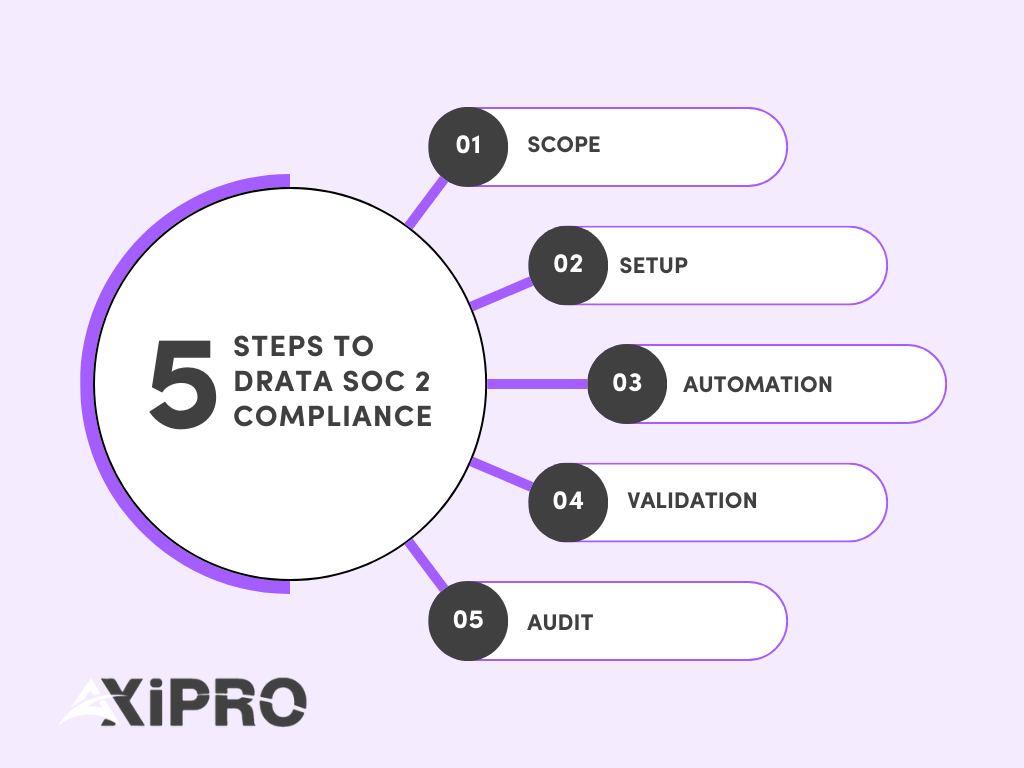
Drata is a powerful tool. It can transform a slow, resource-draining activity into a value-added automated task. But in order for it to work, it needs to be set up properly. This guide explains how SOC 2 actually works inside Drata, what you need before you begin, and how to avoid the most common mistakes that slow teams down. It is written for founders, CISOs, compliance leads, and non-technical executives who want a semi-automated approach to compliance. Drata does not replace your SOC 2 program. It operationalizes it. The platform helps you manage controls, evidence, and monitoring, but decisions, ownership, and execution still matter. A successful Drata SOC 2 project follows a predictable flow: scoping, setup, automation, validation, and audit. Before You Start: What You Need to Run a SOC 2 Project in Drata Before logging into Drata, your organization needs to be aligned. 1- Decide your SOC 2 target: Type 1 vs. Type 2 and realistic timelines SOC 2 comes in two formats defined by the AICPA. SOC 2 Type I evaluates whether controls are designed correctly at a point in time.SOC 2 Type II evaluates whether those controls operate effectively over a period, usually three to twelve months. Report Type What It Evaluates Timeframe SOC 2 Type I Whether controls are designed appropriately Point in time SOC 2 Type II Whether controls operate effectively 3–12 months With Drata, many of our clients reach Type I readiness in 6 to 8 weeks if controls already exist. Type II timelines depend on the observation period, which can range from 3 months to up to a year. If you’re pursuing SOC 2 compliance due to a client’s request, he will till you which type he requires. If you’re proactively seeking SOC 2 compliance, then we recommend going for type 2 compliance. This allows you to cast a wider net of clients. A successful SOC 2 program follows a predictable lifecycle. While tools and timelines vary, the underlying phases are consistent across most organizations. Scoping: Define the system being audited, select Trust Services Criteria, set the audit period, and confirm the auditor. Good scoping reduces downstream complexity dramatically. Setup: Configure Drata, connect integrations, publish policies, and assign control ownership. This phase turns abstract requirements into operational structure. Automation: Enable continuous evidence collection across identity, infrastructure, code, ticketing, and endpoints. Automation replaces manual tracking, but only when integrations reflect reality. Validation: Run a readiness review. Confirm that controls are operating as described, evidence is complete, and timing aligns with the audit window. This is where most hidden risks surface. Audit: Auditors independently test controls and evidence. Clarifications and minor findings are normal. Clear responses and preparation determine how fast this phase moves. Continuous compliance: After the report is issued, controls continue operating. Monitoring, reviews, and periodic reassessment prevent drift and reduce effort in future audit cycles. 2- Select your Trust Services Criteria Every SOC 2 must include the Common Criteria for Security. Additional criteria are optional and must be justified. These include Availability, Confidentiality, Processing Integrity, and Privacy. The choice of additional criteria is driven by the service agreement with the customer, which may require specific criteria, or by the type of business pursuing SOC 2. If you’re a SaaS that handles a large amount of private financial data, it makes sense to pursue the confidentiality criteria, for example. Availability makes sense if you sell uptime guarantees or SLAs. Privacy should only be selected if you are prepared to meet the additional criteria around notice, consent, and data subject rights. 3- Gather prerequisites: Systems, Owners, and Access Drata works best when you already know what is in scope. This includes cloud infrastructure, identity providers, repositories, ticketing tools, and endpoints. You also need named control owners. Automation cannot replace accountability. 4- Choose or confirm an auditor early An external CPA firm ultimately issues the SOC 2 report. Confirm your auditor before proceeding with deep configuration to avoid mismatches in expectations, evidence formats, or control interpretations. Where Axipro Fits in a Drata-Led SOC 2 Program Drata is excellent at operationalizing SOC 2. It centralizes controls, automates evidence collection, and enforces timelines that matter to auditors. What it does not do is make judgment calls, resolve ambiguity, or design controls in context. That work still belongs to the experts. This is where Axipro fits. In practice, Axipro supports Drata-led SOC 2 programs in four critical areas: Scoping discipline Before configuration begins, Axipro helps validate system boundaries, Trust Services Criteria selection, and audit periods. This prevents over-scoping, which is one of the most common reasons SOC 2 projects slow down or fail testing later. Control ownership and execution clarity Drata can track controls, but it cannot assign accountability. Axipro works with teams to ensure every in-scope control has a clear owner, a realistic execution process, and an evidence strategy that will stand up to auditor scrutiny. Readiness validation before auditor access Many SOC 2 delays happen after auditors are invited. Axipro performs structured readiness reviews to catch weak evidence, misaligned controls, and timing gaps before fieldwork begins. This reduces follow-ups, exceptions, and rework. Audit navigation and exception handling During the audit, Axipro helps teams respond to auditor questions, document compensating controls, and resolve findings clearly. This keeps the audit moving and avoids creating long-term issues that resurface in future cycles. Drata provides the operating system. Axipro helps ensure the program running on top of it is coherent, defensible, and sustainable. Step 1: Scope Your SOC 2 Program in Drata Once your prep work is done, it’s time to open Drata and start the real implementation work. Scoping is the first and most important step. It defines what the auditor will test and, just as importantly, what they will ignore. Create the audit container In Drata, scope becomes “real” the moment you create the audit. Navigate to Audit Hub, then select Create Audit. Choose SOC 2 as the framework and define the audit period. This date range matters more than most teams realize. Drata

If your company sells software, handles customer data, or operates in the cloud, chances are you have already been asked for a SOC 2 report. Sometimes by a prospect, sometimes by a procurement team, sometimes by a very persistent security questionnaire that refuses to go away. And if you are early in your compliance journey, that request can feel confusing, intimidating, or even slightly unfair. What exactly is a SOC 2 report? What does it include? How does the process actually work? And do you really need one right now? This article answers those questions clearly, without legal jargon or unnecessary complexity. Whether you are a startup selling internationally or a SaaS company expanding into enterprise deals, this guide will give you the full picture on SOC 2 compliance. What does SOC 2 stand for? SOC 2 stands for System and Organization Controls 2. It is part of a broader family of SOC reports created to help organisations demonstrate how they manage and protect information. In a nutshell, its a voluntary framework that proves that a company stores and manages data in a safe way. The “2” matters because it distinguishes this report from others in the SOC framework: Report Type Primary Focus Typical Audience SOC 1 Controls relevant to financial reporting Auditors, finance teams, regulators SOC 2 Controls related to security, availability, processing integrity, confidentiality, and privacy Customers, partners, procurement teams SOC 3 High-level public summary of SOC 2 controls General public, marketing, prospects When customers ask for “SOC 2,” they are seeking evidence that your internal systems and processes are designed to protect their data consistently and measurably. And this can be evaluated through a SOC 2 report. SOC 2 vs SOC 1 vs SOC 3: what’s the difference? SOC reports serve different purposes, and choosing the wrong one can create unnecessary work. SOC 1 focuses exclusively on controls related to financial reporting. It is primarily relevant for service providers whose systems impact a customer’s financial statements, such as payroll processors or financial platforms. SOC 2 evaluates controls related to security, availability, processing integrity, confidentiality, and privacy. It is the most commonly requested report for SaaS companies, cloud providers, and B2B service organisations because it directly addresses data protection and operational risk. SOC 3 is a high-level, public summary of a SOC 2 report. It contains far less detail and is typically used for marketing or high-level assurance, not for procurement or vendor risk assessments. If customers, partners, or regulators need detailed evidence of how you protect data, SOC 2 is almost always the correct choice. https://www.youtube.com/watch?si=_Qmle4yusN2cMOJT&v=dueT49f5wNA&feature=youtu.be Benefits of SOC 2 Compliance- Why do Companies Pursue Compliance? Companies invest in SOC 2 compliance for the commercial and operational advantages it delivers. But besides that, being able to produce a SOC 2 report will allow to cast a wider net and work with customers that you would otherwise not be able to work with. Some examples: Cloud service providers, SaaS companies, and Data Centers looking to win big enterprise contracts: These businesses are often required to do Vendor Risk Assessment due to regulations such as GDPR, HIPAA, PCI DSS, SOX, and NYDFS. Companies in tightly regulated industries: Finance, healthcare, and technology are typically regulated by norms that required SOC 2 reports and Vendor Risk Assessment. Companies bidding for government contracts: While not always required, some government bodies will ask for an SOC 2 report or ISO 27001 certification to accept bids. SOC 2 reports are becoming widespread since they cascade down: Most SOC 2 compliant businesses will require vendors to produce a SOC 2 report, and not having an SOC 2 report will often make you lose a compliant client. Besides that, the most immediate benefit is trust. A SOC 2 report reduces friction during sales cycles by answering security questions upfront, rather than repeatedly through bespoke questionnaires. So even when its not strictly required, having a SOC 2 report will be beneficial. It also improves internal discipline. Preparing for SOC 2 forces teams to formalise access controls, incident response, change management, and monitoring processes that often exist informally. Finally, SOC 2 can be a growth enabler. Many enterprise buyers will not progress without it. Having a current report keeps deals moving and prevents compliance from becoming a last-minute blocker. A 2023 procurement study published by Wired noted that vendor security reviews are now standard even for contracts under six figures, reflecting how deeply embedded assurance expectations have become. Who typically needs SOC 2 compliance? SOC 2 is most often pursued by organisations that handle customer data on behalf of others, especially where trust and security influence buying decisions. This commonly includes: SaaS and cloud-based software companies Managed service providers, IT, and security firms Data platforms, infrastructure providers, and APIs Companies selling into regulated or enterprise markets Beyond industry, SOC 2 is often triggered by stage and scale. Startups moving upmarket, companies entering enterprise sales cycles, or vendors undergoing formal vendor risk assessments are frequently asked for a SOC 2 report before deals can progress. Even when not explicitly required, SOC 2 often becomes a commercial necessity. Customers increasingly expect structured, independent assurance that security controls are not improvised, but designed, documented, and consistently followed. What is a SOC 2 report? A SOC 2 report is an independent assurance report that evaluates how well an organisation protects customer data. It is issued by a licensed CPA firm and is based on the Trust Services Criteria (TSC) developed by the American Institute of Certified Public Accountants (AICPA). In simple terms, a SOC 2 report answers one core question: Can this company be trusted to handle sensitive information securely and responsibly? Unlike ISO standards, SOC 2 is not a “certification” in the traditional sense. There is no pass or fail badge. Instead, the report documents: Your control environment How controls are designed How they operate over time Any exceptions or gaps identified by the auditor The result is a detailed report that customers and partners use to assess your
Digital trust now determines whether businesses win customers, partnerships, and long-term contracts. Data breaches, service outages, and regulatory failures erode confidence faster than pricing or competition. Many leaders understand these risks but struggle with technical security frameworks. An SOC 2 compliance solution solves this problem by translating security expectations into business-relevant trust principles. The five Trust Service Criteria define how organizations protect systems, ensure reliability, and respect customer data. These criteria are not technical checklists. They represent outcomes that stakeholders expect from responsible companies. This guide explains each criterion in simple terms for non-technical leaders. It focuses on why each one matters and how it supports business objectives. Executives carry responsibility for brand reputation, customer confidence, and operational continuity. However, cybersecurity discussions often feel complex and detached from daily decision-making. This gap creates unseen exposure until an audit failure or incident occurs. SOC 2 connects security controls to business risk. Instead of focusing on tools, the SOC 2 compliance solution emphasizes trust, accountability, and consistency. It helps leaders understand whether systems are secure, services remain available, and data is handled responsibly. Knowing the Trust Service Criteria enables leadership teams to guide strategy, allocate resources wisely, and communicate confidence to customers. Before exploring each criterion, a summary simplifies the essentials. https://www.youtube.com/watch?v=MZfF999HyRE&pp=2AbABA%3D%3D TL;DR • SOC 2 focuses on building customer and stakeholder trust• Five criteria define how systems stay secure and reliable• Security is mandatory for every SOC 2 report• Other criteria depend on business operations and data usage• Leadership involvement strengthens audit outcomes and credibility Understanding The Trust Service Criteria Framework The Trust Service Criteria form the foundation of SOC 2 reporting. Each criterion addresses a different dimension of trust and operational discipline. Organizations select applicable criteria based on how systems are used and what customer data they handle. The five criteria include Security, Availability, Processing Integrity, Confidentiality, and Privacy. Together, they create a comprehensive view of organizational reliability. Therefore, leaders do not need technical depth to understand their intent. What matters is recognizing how these principles protect business continuity and customer confidence. Security: Protecting Systems from Unauthorized Access Security is the core of SOC 2 and applies to every engagement. It focuses on preventing unauthorized access, misuse, or compromise of systems. From a leadership perspective, security represents governance and accountability. It answers whether the organization understands its threats and applies safeguards appropriately. Controls typically include access restrictions, monitoring systems, incident response processes, and employee training. Security failures often lead to reputational damage and regulatory scrutiny. Strong controls demonstrate that the organization actively protects its assets and customer data. For non-technical leaders, security success means fewer surprises and faster responses during incidents. Availability: Keeping Systems Reliable And Accessible Availability evaluates whether systems operate as expected and remain accessible during normal and adverse conditions. It directly impacts customer satisfaction and revenue continuity. Business leaders should associate availability with service reliability. This criterion assesses disaster recovery planning, system capacity, performance monitoring, and backup processes. Downtime can disrupt operations, damage trust, and violate service commitments. Effective availability controls show that the organization plans for disruptions instead of reacting to them. Customers value vendors who deliver consistent performance, especially during unexpected events. Ensure system reliability supports your growth strategy by aligning availability controls with real business expectations. BOOK A CALL Processing Integrity: Delivering Accurate & Complete Results Processing integrity focuses on whether systems process data correctly, completely, and on time. This criterion matters for organizations handling transactions, calculations, or automated decisions. Leaders often overlook processing integrity until errors affect customers or reporting accuracy. A professional SOC 2 compliance solution ensures systems follow defined workflows, validation checks, and error handling procedures. It reduces the risk of incorrect outputs that harm trust. When processing integrity is strong, customers receive consistent results. Leaders gain confidence that operational data supports informed decisions. This criterion reinforces reliability across digital processes. Confidentiality: Restricting Access to Sensitive Information Confidentiality addresses how organizations protect sensitive, restricted, or proprietary information. This includes business data, intellectual property, and customer records not classified as personal data. From a strategic angle, confidentiality safeguards competitive advantage. SOC 2 generally evaluates encryption practices, data classification, access controls, and secure disposal procedures. It ensures information is only accessed by authorized individuals. Customers and partners prefer businesses that respect contractual and confidentiality obligations. Strong confidentiality controls help prevent data leaks and trust erosion. Privacy: Managing Personal Data Responsibly Privacy focuses on the collection, use, retention, and disposal of personal information. It applies when businesses process data connected to identifiable individuals. Leaders should view privacy as reputation protection. SOC 2 evaluates consent management, data minimization, transparency, and regulatory alignment. Improper handling of personal data leads to legal penalties and public scrutiny. Privacy controls demonstrate ethical responsibility and regulatory awareness. Customers increasingly choose companies that respect personal data rights. Choosing The Right Trust Service Criteria Not every organization needs all five criteria. Selection depends on business model, services offered, and data types handled. Leadership involvement ensures the scope aligns with actual risks. Overcommitting increases complexity, while under-scoping weakens assurance value. A thoughtful selection balances compliance efficiency with stakeholder expectations. Hence, visit Axipro. Clarify your SOC 2 scope early to align trust objectives with operational realities. BOOK A CALL How the Five Trust Service Criteria Fit Into a SOC 2 Report A SOC 2 report is structured around the Trust Service Criteria, but not every report includes all five. The criteria you choose shape the scope of the audit, the controls tested, and how customers interpret your assurance posture. At its core, Security is mandatory. Every SOC 2 report includes it. The other four criteria are optional and selected based on how your product operates, what data you handle, and what your customers expect. A SOC 2 report tells a story. It explains your system, defines the boundaries of responsibility, and then evaluates how well your controls support the selected criteria over time. The criteria are not separate silos. They overlap by design. A single control, such as access management, often supports
In a world where data drives every business operation, maintaining security and trust is more critical than ever. For service organizations that manage client information, SOC 2 compliance is not just a badge of credibility—it’s a foundation of accountability. However, compliance is not achieved once and forgotten. It’s a continuous process that requires vigilance, adaptation, and proactive management. This is where continuous monitoring plays a pivotal role. It ensures that every control implemented under your SOC 2 compliance solution remains effective, up to date, and capable of defending against emerging risks. Continuous monitoring transforms compliance from a one-time event into a sustainable business practice. https://www.youtube.com/watch?v=MZfF999HyRE&pp=2AbABA%3D%3D By integrating automation, analytics, and consistent reporting, businesses can prevent control failures, improve transparency, and demonstrate long-term commitment to security. In this guide, you’ll learn why continuous monitoring is essential for maintaining SOC 2 compliance, how it strengthens your organization’s defense, and how a reliable SOC 2 monitoring framework supports this process every step of the way. At Axipro, we help organizations simplify compliance management with automated tools, expert guidance, and tailored monitoring strategies that keep your SOC 2 framework strong and audit-ready all year round. TL;DR • Continuous monitoring is essential for maintaining ongoing SOC 2 compliance.• It ensures real-time detection of control failures, system vulnerabilities, and security threats.• Automated SOC 2 compliance solutions make tracking, documentation, and reporting easier.• Continuous oversight improves audit readiness and strengthens customer trust.• Axipro helps businesses design and implement monitoring systems that keep SOC 2 compliance reliable, effective, and compliant. What Is Continuous Monitoring and Why It Matters for SOC 2 Continuous monitoring refers to the systematic observation, evaluation, and analysis of your organization’s systems and controls. It ensures that your compliance posture remains consistent long after the audit is completed. For businesses that have implemented a SOC 2 compliance solution, continuous monitoring serves as the foundation for long-term success. SOC 2 Type II certification, for example, assesses control effectiveness over a period of time. Without ongoing monitoring, it’s impossible to provide accurate, up-to-date evidence of operational consistency. Continuous monitoring also aligns perfectly with the five Trust Service Criteria—security, availability, processing integrity, confidentiality, and privacy. By continuously validating these controls, businesses can detect issues before they escalate into serious breaches or compliance failures. You can read the full criteria here. A strong SOC 2 monitoring framework integrates continuous monitoring tools that automatically track system activity, record control performance, and generate compliance reports. This not only improves visibility but also minimizes the manual effort required to stay audit-ready. Why Businesses Should Implement Continuous Monitoring for SOC 2 While achieving SOC 2 certification is an important milestone, maintaining it requires ongoing effort. Many organizations focus heavily on audit preparation but fail to sustain compliance afterward. Continuous monitoring bridges this gap, ensuring your organization remains compliant and secure throughout the year. With an effective SOC 2 compliance solution, businesses can: Identify control weaknesses early – Continuous data tracking highlights risks before they affect operations. Stay audit-ready – Real-time evidence collection ensures that documentation is always current. Improve accountability – Assigning monitoring responsibilities builds a culture of ownership and compliance. Enhance transparency – Automated reports provide clear visibility for stakeholders and auditors alike. Build resilience – Proactive monitoring prepares your systems to adapt to new threats and evolving compliance requirements. Organizations that adopt continuous monitoring not only simplify future audits but also strengthen trust with clients, investors, and regulators. Stay audit-ready all year long. Axipro’s SOC 2 compliance solution helps you monitor controls effortlessly and maintain compliance with confidence. BOOK A CALL What Needs to Be Continuously Monitored for SOC 2 Continuous monitoring under SOC 2 is not about blanket oversight. It is about proving that key controls operate consistently, securely, and as designed over time. Auditors expect organizations to demonstrate that control effectiveness is maintained daily, not just during audit preparation. Below are the core control areas that require ongoing monitoring to support SOC 2 Trust Service Criteria. Access Control Access control is one of the most scrutinized areas in a SOC 2 audit. Organizations must continuously monitor how users are granted, modified, and removed from systems. This includes tracking new user provisioning, role changes, privileged access usage, and timely offboarding. Any unauthorized access attempts or policy violations must be detected and addressed quickly. SOC 2 monitoring tools help ensure access reviews remain current and evidence is automatically recorded throughout the audit period. Incident Response SOC 2 requires organizations to not only have an incident response plan but to prove it works in practice. Continuous monitoring ensures security events are detected, escalated, investigated, and resolved according to defined procedures. Monitoring incident response activities provides clear evidence of response timelines, root cause analysis, and corrective actions. SOC 2 evidence tools capture this activity automatically, helping demonstrate operational readiness during audits. Change Management Change management controls validate that system and infrastructure changes are reviewed, approved, tested, and documented before deployment. Continuous monitoring tracks code releases, configuration changes, and infrastructure updates in real time. This ensures unauthorized or unapproved changes are identified immediately and that approved changes maintain an auditable trail. SOC 2 audit tools rely heavily on this evidence to confirm system integrity and processing reliability. Vendor Risk Third-party service providers can introduce significant compliance risk. Continuous monitoring of vendor risk ensures that critical suppliers maintain appropriate security and availability standards. This includes tracking vendor onboarding, security reviews, contract obligations, and periodic reassessments. A structured SOC 2 monitoring framework helps organizations maintain visibility into vendor dependencies and demonstrate ongoing due diligence. Vendor Risk Third-party service providers can introduce significant compliance risk. Continuous monitoring of vendor risk ensures that critical suppliers maintain appropriate security and availability standards. This includes tracking vendor onboarding, security reviews, contract obligations, and periodic reassessments. A structured SOC 2 monitoring framework helps organizations maintain visibility into vendor dependencies and demonstrate ongoing due diligence. Logs and Evidence Collection SOC 2 audits are evidence-driven. Logs, system records, alerts, and approvals must be complete, time-stamped, and tamper-resistant. Continuous monitoring ensures logs are
Quality management is crucial for any business aiming for sustainable growth. Therefore, achieving ISO 9001 certification ensures credibility and consistency. This globally recognized standard focuses on improving operational efficiency, boosting customer satisfaction, and meeting regulatory requirements. For businesses seeking to enhance quality assurance, understanding ISO 9001 certification requirements is essential. This comprehensive guide explores the requirements of ISO 9001 certification. We’ll break it down into actionable steps, clarify common concerns, and provide tips for success. So, whether you’re new to ISO standards or refreshing your knowledge, this blog simplifies complex concepts. By the end, you’ll be ready to confidently navigate the ISO 9001 certification process. Let’s embark on this journey together and uncover how ISO 9001 can transform your business practices. What Is the ISO 9001 Certification? The ISO 9001 certification is a global benchmark for quality management systems. It proves a company’s commitment to consistent quality. But what does that mean for your business? Simply put, it is a way to show customers, stakeholders, and regulatory bodies that you take quality seriously. This standard is part of the ISO 9000 family and focuses on meeting customer and regulatory requirements. Certification demonstrates a business’s ability to consistently deliver products or services that satisfy stakeholders. And the best part? It’s universally applicable. Whether you’re a small startup or a multinational corporation. To achieve certification, organizations must fulfill specific requirements outlined in ISO 9001. These requirements in the ISO 9001 certification process aim to create a robust framework for continuous improvement. Imagine having a roadmap that not only improves your current processes but also positions you as an industry leader. Why Are ISO 9001 Certification Requirements Important? Achieving ISO 9001 certification offers numerous benefits. It enhances credibility, increases customer trust, and also improves operational efficiency. So, let’s unpack these benefits further: Global Recognition: ISO 9001 is internationally recognized, helping your business stand out in competitive markets. Think of it as a badge of honor recognized by customers worldwide. Customer Satisfaction: The standard ensures your processes meet customer expectations, fostering long-term loyalty. Ultimately, happy customers mean a thriving business. Process Improvement: It identifies inefficiencies and encourages continuous operational enhancements. Who wouldn’t want smoother workflows? Regulatory Compliance: ISO 9001 aligns your business with industry-specific and legal quality requirements. Consequently, compliance becomes less of a headache. Market Opportunities: Many contracts require certification, opening doors to larger markets and partnerships. It’s like a golden ticket to new opportunities. Therefore, by aligning your practices with ISO 9001, you build trust, reduce risks, and enhance your reputation. It could be a win-win situation. What ISO 9001 Requires (Clause by Clause) The requirements of ISO 9001 are structured around how an organization understands its business, leads its people, plans for risk, delivers products or services, measures performance, and improves over time. While the clauses are distinct, auditors assess them as an integrated management system rather than isolated checkboxes. Context of the Organization (Clause 4) ISO 9001 begins by requiring organizations to clearly understand their context. This means taking a structured view of both internal and external factors that can influence quality outcomes, such as market conditions, regulatory obligations, organizational culture, and operational complexity. Equally important is identifying interested parties. Customers, regulators, suppliers, and partners all have expectations that must be understood and reflected within the Quality Management System (QMS). From this understanding, the organization must define the scope of its QMS and determine its core processes, including how those processes interact. Auditors typically focus here on whether the business has realistic process mapping and whether those processes clearly support strategic and quality objectives. ISO provides further guidance on this clause directly through its official overview of the standard: https://www.iso.org/standard/62085.html Leadership and Commitment (Clause 5) Leadership involvement is a foundational requirement of ISO 9001. Top management must take accountability for the effectiveness of the QMS, rather than delegating responsibility solely to a quality manager or consultant. This includes establishing a quality policy, setting measurable quality objectives, assigning clear roles and responsibilities, and ensuring that customer focus is embedded across the organization. Auditors expect to see evidence that leadership is actively engaged, particularly through decision-making, resourcing, and participation in management reviews. ISO 9001 is explicit on this point. A QMS without leadership ownership is, by design, ineffective. Planning (Clause 6) Clause 6 introduces risk-based thinking as a core principle of ISO 9001. Organizations are required to identify risks and opportunities that could affect product or service quality, customer satisfaction, or the integrity of the QMS. These risks must be proportionate to the organization’s context and complexity. Formal risk registers are acceptable but not mandatory if risk is demonstrably addressed through planning and controls. In addition to risk, organizations must define measurable quality objectives aligned with business goals. Planning also extends to how changes to the QMS are managed, ensuring that updates do not introduce unintended consequences. This approach replaced the older “preventive action” model and is explained in ISO’s official risk-based thinking guidance. Support (Clause 7) Support requirements focus on ensuring the organization has what it needs to operate its QMS effectively. This includes competent personnel, appropriate training, and awareness of quality responsibilities at all relevant levels. Infrastructure, work environment, and supporting resources must be adequate for the consistent delivery of products or services. Documentation control is a critical part of this clause. While ISO 9001 no longer mandates specific documented procedures, auditors expect documentation and records to be controlled, up to date, accessible, and appropriate to the organization’s operations. Operation (Clause 8) Clause 8 is where planned processes are put into action. Organizations must define how they deliver products or services, from understanding customer requirements through to final acceptance. Where applicable, this includes controls over design and development, supplier management, and outsourced processes. Auditors spend significant time in this clause assessing whether operations align with documented processes and whether customer requirements are consistently met. A recurring audit theme is simple but decisive: does the organization do what it says it does, and can it prove it with evidence? Performance
Trust and reputation are critical organizational assets in today’s fiercely competitive business environment. As stakeholders increasingly expect transparency, accountability, and quality, ISO certification has emerged as a potent means of affirming these hallmarks. By meeting ISO certification requirements, businesses not only demonstrate compliance but also gain potential strategic advantages that enhance their credibility and operational efficiency. What is ISO Certification? ISO (International Organization for Standardization) certification means an organization meets ISO’s strict standards. These standards provide a baseline of consistency, quality, and efficiency across industries and processes. Businesses have pan-industry standards, such as the ISO 9001 for quality management systems and ISO 14001 for environmental management, to which they can certify to achieve global alignment. Individual ISO certification is also becoming increasingly popular, offering professionals the opportunity to receive recognized credentials that demonstrate their knowledge and proficiency in ISO standards and practices. ISO certification underlines a pledge to excellence, whether for individuals or organizations. The Advantages of ISO Certification A Shared Language of Trust One of the most powerful benefits of ISO certification is also one of the least obvious. ISO creates a shared international language for quality, security, and reliability. When a customer sees an ISO certificate, especially for well-known standards like ISO 9001 or ISO 27001, they do not need to guess how your organization operates. They already understand the framework behind it. This matters more than many leaders realize. According to ISO’s own data, ISO 9001 is used by over one million organizations worldwide, making it the most widely adopted quality standard globally. That level of adoption creates familiarity. Familiarity builds confidence. Confidence reduces friction in buying decisions. Operational Discipline Without the Bureaucracy A common misconception is that ISO certification forces companies into rigid, inflexible processes. In reality, modern ISO standards are intentionally non-prescriptive. They do not tell you how to run your business. They ask you to clearly define how you already run it and then prove that it works. The real benefit here is operational discipline. ISO-certified organizations tend to understand their processes better, spot inefficiencies faster, and fix recurring problems instead of repeatedly firefighting them. A study published in the Journal of Operations Management found that companies adopting ISO 9001 experienced measurable improvements in operational performance and defect reduction over time. That improvement does not come from paperwork. It comes from clarity. When roles, responsibilities, inputs, outputs, and controls are clearly defined, work becomes smoother and less dependent on tribal knowledge or individual heroics. Better Decision-Making, Backed by Evidence ISO standards emphasize measurement and review. This requirement often feels uncomfortable at first, especially for fast-growing or founder-led organizations that rely heavily on instinct. But over time, it becomes one of the most valuable aspects of certification. Internal audits, management reviews, and performance metrics force leadership teams to step back and ask structured questions. What is working? What is not? Where are risks increasing? Where are customers dissatisfied? This is not theoretical. Research summarized by the Harvard Business Review found that organizations implementing formal management systems like ISO tend to make more consistent, data-informed decisions and outperform peers in stability and long-term growth. ISO does not replace intuition. It sharpens it. Market Access and Competitive Advantage ISO certification opens doors. Sometimes literally. Many government contracts, enterprise procurement processes, and international partnerships require ISO certification as a minimum qualification. Without it, an otherwise capable organization may be excluded before the conversation even starts. But even when ISO is not mandatory, it can be a differentiator. In competitive markets where products and pricing look similar, certification becomes a visible signal of professionalism and reliability. It gives sales teams a concrete, third-party-backed answer to the question, “Why should we trust you?” Reduced Risk and Fewer Costly Surprises Risk management is embedded into modern ISO standards. Whether it is quality risks, operational risks, or information security risks, certification requires organizations to identify what could go wrong and take proportionate action before it does. This proactive approach has measurable financial benefits. The British Standards Institution has published research showing that organizations with certified management systems experience fewer major incidents and lower costs related to rework, recalls, and compliance failures. In other words, ISO helps organizations fail less expensively by preventing small issues from becoming large, reputation-damaging events. Stronger Customer Confidence and Retention Customers rarely ask for ISO certification out of curiosity. They ask for it because it reduces their risk. Certification signals that your organization has controls in place to deliver consistent outcomes, manage issues when they arise, and improve over time. In regulated or B2B-heavy industries, ISO certification is often a baseline requirement just to participate in tenders. In less regulated sectors, it still plays a powerful psychological role. A survey referenced by Quality Progress magazine showed that ISO-certified organizations report higher customer satisfaction scores and improved retention rates compared to non-certified peers. In simple terms, customers feel safer doing business with organizations that can demonstrate maturity and structure, even if they never read a single ISO clause. Cultural Benefits You Don’t See on the Certificate One of the most underestimated benefits of ISO certification is its impact on internal culture. When implemented properly, ISO clarifies expectations, empowers employees, and reduces ambiguity. People generally perform better when they understand what “good” looks like. ISO provides that definition without micromanagement. It encourages ownership, accountability, and continuous improvement at all levels of the organization. Compliance with Regulatory Standards At last, by complying with ISO certification requirements, companies can ensure that they are meeting both national and international regulations and thus reduce the risk of non-compliance and penalties. ISO Certification for Individuals ISO certifications aid professionals in achieving a competitive advantage in the job market. Certifications, whether ISO 9001:2015 for quality management or ISO 27001 for information security, help in validating expertise and thus provide wider career opportunities. These credentials denote a firm grasp of global best practices, making individuals more valuable to employers across sectors. From strategy to certification, Axipro delivers the Benefits of ISO Certification that elevate your credibility
Sensitive data protection has become critical in today’s digital-first environment. Organizations need skilled professionals to ensure robust security measures. ISO 27001 certification in Lead Auditor training is a critical step in establishing yourself as a trusted information security expert. So, whether you’re an aspiring auditor or a seasoned IT professional, this certification can elevate your career. Let’s explore how this training can transform your professional journey and make you indispensable in information security. What Is ISO 27001 Certification in Lead Auditor Training? ISO 27001 Lead Auditor training focuses on equipping professionals with the knowledge and skills to audit information security management systems. It’s designed to help you assess organizational compliance with ISO 27001 standards. This training ensures you’re well-versed in risk assessment, mitigation strategies, and continuous improvement techniques. The ultimate goal? To help organizations maintain data confidentiality, integrity, and availability effectively. Therefore, by earning this certification, you gain a deep understanding of information security frameworks, internal auditing techniques, and report documentation. Moreover, you’ll learn how to lead audits, identify security vulnerabilities, and recommend actionable improvements. Ultimately, this expertise can position you as a trusted authority in information security. Why Pursue ISO 27001 Lead Auditor Training? Become A High-Demand Professional Cybersecurity threats are evolving rapidly, creating a pressing need for qualified auditors. Businesses value professionals who can ensure compliance and mitigate risks effectively. ISO 27001 certification in Lead Auditor training sets you apart as an expert in this high-demand field. Build Transferable Skills The training provides comprehensive knowledge in risk management, policy creation, and audit execution. Hence, these skills are highly transferable across industries, from finance to healthcare. Boost Your Earning Potential With increased demand comes higher earning opportunities. ISO 27001-certified auditors often command competitive salaries and greater career advancement prospects. Contribute to Organizational Success By ensuring organizations adhere to ISO 27001 standards, you help protect critical information. Thus, it maintains customer trust and upholds the industry’s reputation. At Axipro, our experts deliver ISO 27001 certification in Lead Auditor training that transforms your compliance strategy into a competitive advantage. BOOK A CALL What Does The Training Involve? Comprehensive Curriculum The ISO 27001 Lead Auditor training covers essential topics like information security principles, audit preparation, and execution. You’ll gain a thorough understanding of the ISO 27001 framework and learn to conduct audits effectively. Hands-On Exercises Interactive exercises simulate real-world scenarios, thus, allowing you to apply theoretical knowledge practically. These exercises build confidence and practical skills crucial for your auditing role. Certification Exam After completing the training, you must pass a rigorous exam to earn your certification. The exam tests your understanding of the ISO 27001 standards and auditing techniques. Expert Guidance Training sessions are led by experienced professionals who provide valuable insights and real-world examples. Their guidance enhances your learning experience and equips you with actionable knowledge. How to Get Started with ISO 27001 Training Choose The Right Training Provider Selecting a reputable training provider is crucial. Look for accredited institutions with experienced trainers and comprehensive course materials. Meet The Prerequisites While no formal prerequisites exist, prior knowledge of ISO 27001 or experience in information security is beneficial. It ensures a smoother learning process. Commit to Continuous Learning Information security is a dynamic field. Hence, staying updated on evolving standards and threats ensures you remain relevant and effective in your role. Career Opportunities after Certification ISO 27001 Lead Auditor certification opens doors to diverse roles. Here are some career paths you can explore: Information Security Auditor: Assess and improve organizations’ security frameworks. Risk Manager: Identify, analyze, and mitigate security risks. Compliance Officer: Ensure organizations meet regulatory and security standards. Consultant: Advise businesses on implementing robust security measures. These roles often come with significant responsibilities and rewarding career prospects. Tips for Success in ISO 27001 Lead Auditor Training Stay Organized Effective time management is crucial. Allocate time for study, practical exercises, and review sessions to maximize learning outcomes. Leverage Networking Opportunities Connect with fellow participants and trainers. Networking can provide insights, support, and also potential job opportunities in the future. Practice Mock Audits Hands-on practice is essential for mastering audit techniques. Simulate real-life scenarios to refine your skills and build confidence. Stay Updated ISO standards evolve. Keep yourself informed about updates and new developments to maintain your expertise. Final Thoughts ISO 27001 certification in Lead Auditor training is more than a certification; it is a gateway to a rewarding career in information security. By equipping yourself with this qualification, you not only enhance your professional value but also contribute meaningfully to protecting organizational data. Hence, start your journey today with Axipro, and make your mark in the ever-growing field of cybersecurity. The world needs more professionals like you—ready to safeguard its digital future! At Axipro, we help professionals master ISO 27001 certification in Lead Auditor training to unlock elite cybersecurity and compliance careers. BOOK A DEMO
Cyber threats are no longer theoretical. They are automated, persistent, and increasingly aimed at organisations that believe they are “too small to be a target”. Whether you are a SaaS startup, a regulated enterprise, or a growing organisation preparing for ISO 27001 or SOC 2, penetration testing is no longer optional. It is a core security and compliance requirement. At Axipro, penetration testing is designed to do more than find weaknesses. It helps organisations understand their real-world risk, validate security controls, and prioritise remediation in a way that supports audits, certifications, and long-term growth. Main Objectives of Penetration Testing The Axipro penetration testing framework is built around four primary objectives: Identify vulnerabilities across applications, infrastructure, and exposed services before attackers do. Improve security posture by understanding how systems behave under real attack conditions, not just theoretical assessments. Prioritise remediation so teams focus on the vulnerabilities that pose genuine business risk, rather than chasing low-impact findings. Validate security controls to ensure that policies, configurations, and safeguards actually work in practice. Penetration testing is not about producing long reports. It is about producing clarity. Introduction & Methodology Penetration testing at Axipro follows a structured, repeatable methodology that aligns with modern security standards and compliance frameworks. The methodology is designed to simulate real-world attacks while remaining controlled, auditable, and business-focused. This ensures findings are both technically accurate and compliance-ready. The process balances automation with deep manual testing, recognising that tools alone cannot uncover logic flaws, chained vulnerabilities, or contextual risk. Project Map The project map illustrated above provides a clear, end-to-end view of how an Axipro penetration testing engagement is delivered . Rather than treating testing as a single activity, Axipro approaches it as a sequence of interconnected phases, each building on the last. Kick Off The engagement begins with a structured kick-off. This phase defines: Project stakeholders Scope boundaries Timeline and milestones Terminology and testing methodology Type of testing to be performed This step is critical. Clear scoping ensures the test reflects real business risk and avoids both blind spots and unnecessary noise. Initial Scanning Initial scanning focuses on information gathering and attack surface discovery. Axipro collects intelligence on the target environment using scanning tools and publicly available sources. This mirrors how real attackers begin their reconnaissance. The goal is not exploitation, but understanding what is visible, reachable, and potentially misconfigured. Assessment & Analysis This is the core analytical phase of the engagement. During assessment and analysis, Axipro: Scans for known vulnerabilities and misconfigurations Performs automated and manual testing Conducts targeted manual penetration attempts Analyses authentication flows, access controls, and exposed APIs Evaluates real exploitability rather than theoretical risk This phase separates generic vulnerability scanning from true penetration testing. Exploitation In the exploitation phase, Axipro safely attempts to exploit validated vulnerabilities. This step answers the most important question for leadership: What could an attacker actually do with this weakness? Exploitation is controlled, non-destructive, and focused on demonstrating impact rather than causing disruption. Reporting The final phase is reporting and closeout. Axipro delivers a structured penetration testing report that: Documents all findings Rates vulnerabilities by severity Explains business impact in clear language Provides actionable remediation recommendations The report is designed to support engineering teams, leadership, and auditors alike. Tools Used Axipro uses a broad range of industry-standard tools, supported by expert-led manual testing . These include vulnerability scanners, network analysis tools, application testing platforms, API testing tools, and custom scripts. However, tools are only part of the equation. Automation finds volume. Expertise finds risk. Manual testing techniques such as code review, API analysis, SQL injection testing, and custom exploitation scripts are critical to uncovering vulnerabilities that scanners routinely miss. Black Box Testing Black box testing is performed with no prior knowledge of the internal workings of the system. Testers approach the application from an external attacker’s perspective, relying on publicly accessible interfaces and behaviour. Advantages Black box testing provides a realistic simulation of external attacks, helping organisations: Identify externally exposed weaknesses Improve overall security posture Support compliance requirements Prioritise risk based on real-world attack paths Disadvantages Because internal code and architecture are not visible, some deep or logic-based vulnerabilities may remain undetected. White Box Testing White box testing provides testers with full knowledge of the internal code, architecture, and design. Axipro’s security team uses this visibility to examine internal logic, security mechanisms, and code quality. Advantages White box testing enables: Comprehensive testing coverage Identification of complex vulnerabilities Accurate risk assessment Early detection during development Validation of security controls Disadvantages White box testing can be time-consuming, more costly, and dependent on internal access. It may also create a false sense of security if not paired with external testing. Grey Box Testing Grey box testing combines elements of both black box and white box testing. Testers have partial knowledge of the internal system, such as architecture diagrams or limited access credentials. Advantages This approach provides a balanced perspective, allowing: Realistic attack simulation In-depth evaluation Efficient vulnerability identification Practical risk prioritisation Disadvantages Grey box testing may still have scope limitations and incomplete coverage, particularly in complex or legacy environments. Penetration Testing Timeline While timelines vary based on scope and complexity, a standard engagement includes: Kick-off and planning, followed by initial scanning, assessment and analysis, exploitation, and reporting. In most cases, penetration testing is completed within one to two weeks, providing fast, actionable insight without disrupting operations. Penetration Testing Plans Axipro offers scalable penetration testing plans aligned with organisational size, growth stage, and compliance needs. The Basic plan is suitable for smaller organisations or single-framework requirements, including one round of retesting. The Scale plan supports growing organisations that require multiple retesting cycles and deeper coverage. The Growth plan is designed for organisations with frequent testing needs and evolving attack surfaces. Each plan integrates seamlessly with Axipro’s broader compliance services, including ISO 27001, SOC 2, internal audits, and compliance as a service. Basic 1 Round of Retesting Talk with us
In an era where businesses are increasingly focused on quality and data privacy, two key standards often emerge in discussions: ISO 9001 vs GDPR. While ISO 9001 ensures quality management systems, GDPR governs data privacy and security. But do these frameworks intersect, and how can organizations leverage their overlap? This blog delves into the nuances of ISO 9001 certification and GDPR compliance, shedding light on their business implications. What is ISO 9001 Certification? ISO 9001 is an internationally recognized Quality Management Systems (QMS) standard. Published by the International Organization for Standardization (ISO), it sets out criteria for ensuring consistent quality in products and services, emphasizing customer satisfaction and continuous improvement. Key Principles of ISO 9001 Customer Focus: Meeting and exceeding customer expectations. Leadership: Strong leadership to establish unity and direction. Engagement of People: Maximizing employee potential. Process Approach: Streamlining processes for efficiency. Improvement: Fostering innovation and continuous development. Evidence-Based Decision Making: Making informed decisions based on data. Relationship Management: Maintaining beneficial relationships with stakeholders. What is GDPR? The General Data Protection Regulation (GDPR) is a legal framework established by the European Union to protect personal data. Effective May 2018, it mandates organizations to handle personal data responsibly, giving individuals greater control over their information. Key Requirements of GDPR Lawful Processing: Processing personal data only for legitimate purposes. Data Subject Rights: Rights to access, rectify, delete, and restrict data. Data Minimization: Collecting only necessary data. Security Measures: Protecting data with appropriate security protocols. Accountability: Demonstrating compliance through documentation. Breach Notification: Reporting data breaches within 72 hours. ISO 9001 vs. GDPR: A Comparative Overview Though ISO 9001 vs GDPR serve different purposes, they share common ground in fostering trust, transparency, and accountability. Below is a side-by-side comparison: Aspect ISO 9001 GDPR Focus Quality Management Data Privacy and Security Scope Products, services, and processes Personal data of EU citizens Mandatory? Voluntary, but often a business requirement Legally binding for organizations handling EU data Core Principles Customer satisfaction, continuous improvement Data protection, individual rights Documentation Quality Manual, procedures, records Data Protection Impact Assessments (DPIA), policies Auditing Internal and external audits Regular audits and Data Protection Officer (DPO) oversight Turn ISO 9001 vs GDPR into a competitive edge with Axipro’s expert compliance planning that protects your business and strengthens client trust. BOOK A CALL Where ISO 9001 and GDPR Overlap Understanding the synergy between ISO 9001 and GDPR allows organizations to align their compliance strategies effectively. By identifying shared objectives, businesses can streamline operations and reduce duplication of effort. Below are the primary areas where these two frameworks intersect: Risk Management ISO 9001: Advocates for risk-based thinking to identify, assess, and mitigate risks affecting quality management systems. GDPR: Requires organizations to conduct Data Protection Impact Assessments (DPIAs) and implement safeguards to address data security risks. Overlap: Both frameworks emphasize a proactive approach to risk management, enabling businesses to anticipate and mitigate potential issues before they escalate. Documentation and Record-Keeping ISO 9001: Mandates proper documentation of processes, procedures, and performance metrics to ensure consistency in quality management. GDPR: Requires detailed records of personal data processing activities, consent tracking, and compliance measures to demonstrate accountability. Overlap: Both standards rely heavily on accurate and organized documentation to prove adherence to regulatory and quality requirements. Accountability and Leadership ISO 9001: Places responsibility on leadership to uphold the organization’s commitment to quality and oversee effective implementation of quality management systems. GDPR: Holds organizations accountable for protecting personal data, often requiring the appointment of a Data Protection Officer (DPO) to ensure compliance. Overlap: Both frameworks call for leadership accountability to drive organizational commitment and ensure compliance. Continuous Improvement ISO 9001: Encourages a culture of ongoing improvement to refine processes, enhance efficiency, and elevate product or service quality. GDPR: Mandates regular review and improvement of data protection measures to stay ahead of emerging risks and evolving regulations. Overlap: Continuous improvement is a cornerstone of both frameworks, fostering an adaptive approach to meet dynamic business and regulatory needs. Implications for Businesses Achieving ISO 9001 certification while adhering to GDPR requirements brings a range of benefits that go beyond compliance. The alignment of these two frameworks has strategic and operational implications for businesses: Building Trust ISO 9001 demonstrates a commitment to delivering high-quality products or services, while GDPR ensures respect for data privacy. Together, these certifications position businesses as trustworthy entities, enhancing stakeholder confidence and loyalty. Competitive Advantage Compliance with both standards differentiates businesses in the market. Customers and partners are more likely to engage with organizations that demonstrate strong values in both quality and data protection. Streamlined Processes By aligning ISO 9001’s quality processes with GDPR’s data protection mandates, businesses can integrate overlapping requirements and eliminate redundancies, saving time and resources. Legal and Regulatory Compliance While GDPR compliance is a legal necessity, ISO 9001’s structured approach provides a framework that supports regulatory adherence, helping organizations manage compliance systematically. How to Align ISO 9001 Certification with GDPR Compliance Conduct a Gap Analysis Evaluate existing ISO 9001 practices against GDPR requirements to identify areas of overlap and gaps. Focus on aspects like documentation practices, risk assessments, and employee awareness. Implement Integrated Policies Develop policies that address both quality and data protection requirements. For instance, a single policy on data handling can ensure data accuracy (ISO 9001) and safeguard privacy (GDPR). Train Employees Educate employees on their roles and responsibilities under both frameworks. Regular training fosters awareness, ensuring alignment across departments. Leverage Technology Adopt tools to streamline documentation, automate processes, and monitor compliance. Technology can reduce manual efforts and enhance consistency in both quality management and data protection. Monitor and Audit Conduct regular audits to evaluate the effectiveness of integrated practices. ISO 9001’s focus on continuous improvement complements GDPR’s emphasis on periodic reviews, enabling organizations to stay compliant and efficient. Common Challenges and Solutions While aligning ISO 9001 with GDPR offers significant benefits, organizations may face certain challenges. Here’s how to overcome them: Challenge: Understanding the Technicalities The complexity of ISO 9001 and GDPR requirements can be overwhelming. Solution: Partner with experts or consultants specializing
WhatsApp us