
Table of Contents

Reach SOC 2 Compliance in 6 Weeks or Less.

  / ISO 27001 Internal Audit Explained: Key Steps and Best Practices

ISO 27001 Internal Audit Explained: Key Steps and Best Practices

Achieving ISO 27001 certification signifies excellence in information security management, demonstrating your organization’s dedication to protecting sensitive data. However, this process involves careful steps, with one of the most important being the internal audit. This crucial phase verifies that your Information Security Management System (ISMS) meets ISO 27001 standards and is strong enough to reduce risks.

Watch the Loom Video for a detailed explanation of our internal audit services, check out our Loom video, where our Principal Consultant Ali Hayat breaks down the process step-by-step and shares tips for seamless ISO 27001 compliance. Click here to watch the Loom video.
ISO 27001 Internal Audit

What is an ISO 27001 Internal Audit?


An ISO 27001 internal audit is a structured review of your ISMS to check its compliance with the standard’s requirements. Unlike external audits done by certification bodies, internal audits are performed by the organization itself or by a third-party auditor to find gaps, evaluate risks, and ensure readiness for certification.

The main goal of an internal audit is to ensure that your ISMS meets ISO 27001 requirements and effectively reduces risks. It also offers a chance to find areas for improvement and strengthen your organization’s security efforts. By conducting a thorough gap analysis during this stage, you help set your organization up for success in the certification process.

ISO 27001 Internal Audit Requirements: Understanding Clause 9.2


Clause 9.2 of ISO 27001:2022 establishes the specific requirements for internal audits, forming the backbone of audit governance. This section mandates that organizations establish and implement audit programs to evaluate the effectiveness of their ISMS at planned intervals.

The standard specifies several critical requirements within Clause 9.2:

Clause 9.2.1 – Audit Program Requirements: Organizations must define audit objectives, scope, frequency, and methodologies. Your audit program should establish criteria against which the ISMS will be evaluated, ensuring that all relevant information security controls are systematically reviewed over a defined period.

Clause 9.2.2 – Auditor Competence and Objectivity: This is perhaps the most critical requirement. Auditors must be objective, impartial, and free from conflict of interest. The standard explicitly prohibits auditors from evaluating areas for which they hold direct responsibility, as this compromises independence and undermines audit credibility.

To meet Clause 9.2.2, auditors should possess documented competence in ISO 27001 standards and audit methodologies. Many organizations require auditors to hold certifications such as Certified Information Systems Auditor (CISA) or ISO 27001 Lead Auditor. Reference to ISO 19011 – Guidelines for auditing management systems – provides additional guidance on selecting, evaluating, and managing auditors.

Who Can Perform an ISO 27001 Internal Audit?

Internal audits can be carried out by your organization’s own internal audit team or outsourced to a third-party auditor or an ISO 27001 consulting firm. Unlike external certification audits, you can choose the most suitable approach for your organization. However, it’s crucial to follow Clause 9.2(e) of the ISO 27001 standard, which stresses the importance of selecting an internal auditor who is objective and impartial. This means avoiding any potential conflicts of interest—specifically, the auditor should not have been involved in developing the ISMS or in operating or monitoring any of the controls under review. The reason for this requirement is simple: reviewing your own work can undermine objectivity and hinder a thorough evaluation.

Essential Auditor Qualifications

When selecting an auditor, ensure they meet the following criteria:

In-Depth ISO 27001 Knowledge: Auditors must understand the standard’s requirements, Annex A controls, and how they apply to your organization’s context.

Audit Methodology Expertise: Knowledge of audit planning, sampling techniques, evidence collection, and report writing.

Relevant Certifications: ISO 27001 Lead Auditor (IRCA or equivalent), CISA, or similar credentials demonstrate formal competence.

Industry Experience: Understanding of your sector’s specific security challenges and regulatory landscape adds significant value.

If internal expertise is limited, hiring an experienced third-party auditor or consulting firm can provide a fresh, unbiased perspective and valuable insights tailored to your organization’s unique environment.

Internal Audit vs External Certification Audit: Key Differences

Understanding the distinction between internal and external audits is crucial for effective compliance strategy. While both serve important roles, they differ significantly in purpose, scope, and outcome.

Aspect

Internal Audit

External Certification Audit

Conducted By

Organization (internal or contracted third party)

Accredited certification body

Primary Purpose

Identify gaps and prepare for certification

Verify compliance and issue certificate

Focus

Detailed improvement; addresses specific findings

Overall conformance; verifies readiness

Flexibility

High – customize scope and approach

Low – standardized audit procedures


Internal audits serve as your organization’s opportunity to address vulnerabilities proactively before the certification audit. They foster a culture of continuous improvement and ensure that any gaps are remediated well in advance. This strategic advantage makes internal audits invaluable in the certification journey.

How to Conduct an ISO 27001 Internal Audit: Key Phases

Conducting an ISO 27001 internal audit involves a series of well-defined steps to ensure that your Information Security Management System (ISMS) is thoroughly evaluated. Below is a detailed breakdown of the process:

Phase 1: Determine the Scope of the Audit

The first step is to clearly outline the audit’s scope, specifying the systems, functions, people, and processes that will be assessed. This scope ensures the audit comprehensively covers all necessary areas to meet compliance objectives. Defining the boundaries early on helps the auditor focus on the most relevant elements of the ISMS, particularly considering your organization’s specific ISMS scope boundaries and the applicability of controls.

Phase 2: Documentation Review

Before proceeding with on-site evaluations, the internal auditor will review all key ISMS documents to verify that they align with ISO 27001 requirements. An effective ISMS requires a well-defined scope, a comprehensive Statement of Applicability (SoA), a robust Information Security Policy, a thorough risk assessment and treatment plan, and clear definitions of responsibilities. Additionally, identifying individuals responsible for implementing and operating controls, and documenting evidence of control implementation, provides valuable context for the field review.

Phase 3: Management Review and Approval

The audit plan must be reviewed and approved by senior management. Regular meetings should be scheduled to set expectations, discuss timelines, and maintain open communication. Management also plays a critical role in reviewing the internal audit findings, collaborating with the auditor to assess the organization’s readiness for an external certification audit, and ensuring that all significant issues are addressed beforehand.

Phase 4: Pre-Audit Preparation

Preparation is critical for a successful audit. This phase includes developing detailed audit checklists, identifying key personnel for interviews, scheduling on-site activities, and gathering necessary documentation. A well-prepared audit checklist aligned with ISO 27001 requirements and your organization’s context ensures comprehensive coverage and consistency.

Phase 5: Conducting the Field Review

The field review is the core of the internal audit process. During this phase, the auditor evaluates the ISMS through multiple evaluation methods, gathering evidence to support findings and determine the effectiveness of controls.

Audit Tests: Assessing controls to ensure they are effectively implemented and functioning as intended. This involves testing a sample of control activities to verify control effectiveness.

Audit Evidence Collection: Reviewing documented information and audit trails to confirm compliance and identify gaps. Evidence should support all audit conclusions.

Staff Interviews: Engaging with employees to gauge their understanding of and adherence to ISMS policies. These interviews provide crucial insight into whether controls function as designed in practice.

Observations and Documentation: Recording findings, highlighting areas of non-conformity, and identifying strengths. Clear documentation enables transparent reporting and actionable recommendations.

This comprehensive review enables the auditor to pinpoint what’s working well and what needs improvement, providing a clear roadmap for corrective actions.

ISO 27001 Internal Audit Checklist: Essential Items

A well-designed audit checklist is fundamental to conducting a thorough and consistent internal audit. The checklist should cover all ISO 27001 requirements and be tailored to your organization’s context. Below are the essential categories and items to include:

Organizational Context (Clauses 4.1-4.3): Verify that the organization understands its internal and external context, interested parties, and scope of the ISMS.

Leadership and Governance (Clauses 5-6): Confirm management commitment, information security policy, allocation of roles and responsibilities, and evidence of management review.

Planning (Clause 6): Assess risk assessment methodology, risk treatment plans, and management of information security objectives.

Support and Operation (Clauses 7-8): Check resource availability, competence assessments, awareness and training programs, and operational control implementation.

Performance Evaluation (Clause 9): Review monitoring and measurement of controls, incident management procedures, and evidence that internal audit has been appropriately planned and conducted.

Improvement (Clause 10): Evaluate management of non-conformities, corrective action effectiveness, and documented information control.

Incorporating Annex A controls into your checklist ensures that all 114 control objectives are evaluated within the scope of your ISMS. Many organizations create control-specific evaluation criteria linked to this comprehensive checklist.

Addressing Non-Conformities


Non-conformities can range from minor documentation gaps to critical security flaws. Identifying and addressing these issues promptly is essential to maintain the integrity of your ISMS. By developing comprehensive corrective action plans and monitoring their implementation, organizations can ensure continuous improvement and long-term compliance with ISO 27001 standards.


Common ISO 27001 Internal Audit Findings

Understanding typical non-conformities helps organizations proactively address vulnerabilities. Here are the most frequently encountered findings:

Documentation Gaps: Missing, incomplete, or outdated policies, procedures, or records. For example, risk assessment documentation that doesn’t clearly link to implemented controls.

Access Control Deficiencies: Inadequate user access reviews, orphaned accounts, lack of segregation of duties, or insufficient multi-factor authentication implementation.

Incident Management Issues: Incomplete incident logs, lack of timely incident classification, or insufficient root cause analysis documentation.

Training and Awareness Gaps: Insufficient security awareness training records, lack of role-specific training, or no evidence of competency assessment.

Change Management Failures: Changes implemented without proper authorization, risk assessment, or documented approvals.

Backup and Recovery Defects: Untested backup procedures, unclear recovery objectives, or lack of documented restoration testing records.

The Corrective Action Process

Addressing non-conformities requires a structured, documented approach. The standard corrective action process includes:

Classification: Categorize each finding as Major (major risk or complete absence of a control) or Minor (temporary deviation or incomplete implementation that doesn’t significantly impact security).

Root Cause Analysis: Investigate why the non-conformity occurred—whether due to lack of awareness, insufficient resources, or inadequate procedures.

Corrective Action Plan: Develop specific, measurable actions with defined timelines and responsible parties. Plans should address root causes, not just symptoms.

Implementation Monitoring: Track progress toward completion and verify that actions are implemented as planned.

Effectiveness Verification: Re-audit completed actions to confirm they have resolved the non-conformity and prevented recurrence.

Major non-conformities must be resolved before certification, while minor findings require documented action plans with appropriate timelines. Organizations should also review common mistakes during ISO 27001 implementation to avoid repeating the same errors across multiple audits.

Timeline of Internal Audits

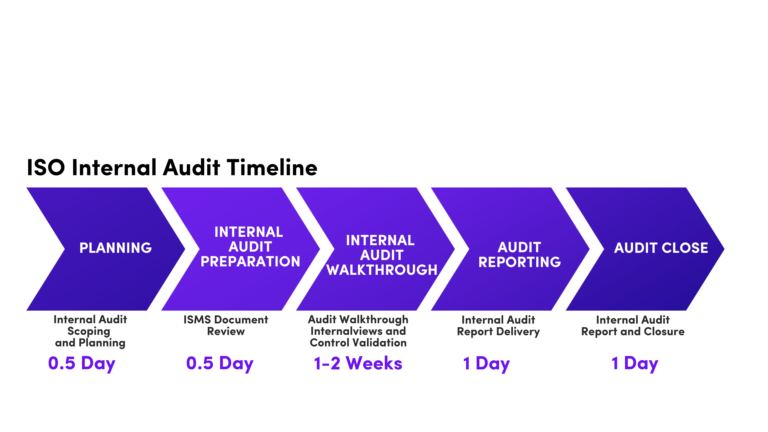
A successful ISO 27001 internal audit requires careful planning and execution. Here’s a detailed breakdown of the key phases and estimated time required for each, though actual duration depends on organization size, ISMS complexity, and control maturity.

Planning (0.5 days): Define the audit scope, objectives, and methodology. Develop an audit plan, including the schedule and resource allocation. This phase establishes the foundation for all subsequent work.

Preparation (0.5 days): Review relevant documentation, develop audit checklists, and identify key personnel to be interviewed. Preparation ensures efficiency during field activities.

Audit Execution (1-2 weeks): Conduct interviews, document reviews, and observations. Verify the implementation of controls and procedures. Identify non-conformities and opportunities for improvement. This phase is the most time-intensive and involves active on-site engagement.

Reporting (1 day): Prepare a detailed audit report, including findings, recommendations, and corrective action requirements. Review the report with management to ensure accuracy and completeness.

Closure (1 day): Finalize the audit report and distribute it to relevant stakeholders. Monitor the implementation of corrective actions. Schedule follow-up audits to verify the effectiveness of corrective actions and ensure sustainable improvement.

The audit execution timeline varies significantly based on organization size. A small organization with a well-defined scope might complete field activities in 3-5 days, while a larger enterprise with multiple business units could require 2-3 weeks. The complexity of your ISMS and the maturity of your existing controls also play significant roles in determining realistic timelines.
ISO 27001 Internal Audit Timeline

Benefits of a Well-Executed Internal Audit

Conducting a comprehensive internal audit provides key benefits for organizations aiming for ISO 27001 certification:

Certification Readiness: Identifying and fixing gaps before the certification audit greatly boosts the chances of passing on the first attempt and minimizes the need for re-audits.

Enhanced Security: Internal audits reinforce your ISMS by verifying control effectiveness, reducing weaknesses, and increasing your organization’s resilience to security risks.

Operational Efficiency: The process reveals inefficiencies and overlaps, helping you streamline workflows and better allocate resources for security efforts.

Stakeholder Trust: Showcasing strong, documented security practices through internal audits builds confidence with clients, partners, regulators, and other stakeholders. This often provides a competitive edge and supports business growth.

Culture of Improvement: Regular audits foster a mindset of continuous enhancement, motivating ongoing review and improvement of security measures beyond mere compliance.

Understanding Your Path to Certification with Axipro


Axipro’s internal audit services are designed to simplify the ISO 27001 compliance process. Our team of experienced auditors conducts thorough assessments, identifying gaps and providing actionable insights to strengthen your ISMS.

We tailor our approach to your organization’s unique needs, offering guidance from planning to corrective actions. With Axipro, you can streamline your internal audit process, reduce complexity, and achieve ISO 27001 certification confidently.

Conclusion


An ISO 27001 internal audit is a cornerstone of effective information security management. It ensures compliance, enhances security practices, and prepares your organization for certification success. By following a structured approach and leveraging expert support, you can make the audit process smooth and impactful.

Frequently Asked Questions

What is the purpose of an ISO 27001 internal audit?

The primary purpose is to verify that your ISMS aligns with ISO 27001 standards, identify gaps and non-conformities before external certification, ensure controls are effectively operating, and prepare the organization for successful certification audit.

Internal audits can be conducted by your organization’s internal audit team or outsourced to qualified third-party auditors or consulting firms. However, auditors must be objective, impartial, and free from conflicts of interest as required by Clause 9.2.

After completion, the audit report is distributed to management. Non-conformities are categorized and corrective action plans are developed. Organizations then implement and monitor these corrections. Follow-up audits verify the effectiveness of corrective actions. Once major non-conformities are resolved, the organization proceeds to schedule the external certification audit.

ISO 27001 requires audits at planned intervals, typically at least annually for certified organizations. Pre-certification organizations should conduct audits multiple times (3-6 months before certification). Focused audits can be conducted quarterly or as-needed after significant changes.

Simplify your ISO 27001 compliance journey with Axipro’s expert internal audit services.
Axipro Author

Picture of Abeera Zainab

Abeera Zainab

Blog Highlights

Explore More Articles

Roughly 60% of data breaches still trace back to a person rather than a system, according to Verizon’s 2025 Data Breach Investigations Report. Earlier editions of the same report put the figure as high as 74%. That single statistic is why every framework Drata supports — from SOC 2 to HIPAA — treats Drata security awareness training as a required control rather than a nice-to-have. Drata gives you three ways to run that training: automatic tracking across your personnel and recurring resets that keep evidence current for auditors. This guide covers how each piece works, how to configure it, and the quiet mistakes that break compliance. What Is Security Awareness Training in Drata? Security awareness training in Drata is the annual cybersecurity education your workforce completes to satisfy personnel-related controls across frameworks. The control language is consistent across audits: security awareness training is provided to all employees on an annual basis. Drata’s job is to deliver or track that training, then hold the completion evidence in one place so you can show an auditor that every current employee and contractor met the requirement for the current cycle. The discipline itself is well established. The broad concept of security awareness maps to the Protect function (PR.AT) of the NIST Cybersecurity Framework, which treats workforce education as a foundational layer of organizational defense. Inside Drata, training settings live on the Internal Security page, and completion surfaces on the Personnel page and in each person’s My Drata onboarding. Training Methods Available in Drata Drata supports three approaches, and you choose one on the Internal Security page. They differ mainly in who delivers the content and who supplies the completion evidence. Drata Embedded Security Awareness Training (Default) Drata built its own training course that personnel complete directly inside the platform. During onboarding, the employee opens the Complete Security Awareness Training task, clicks Begin Training, and works through the module. On completion, the task flips to completed automatically, and the Personnel page reflects it. No file uploads, no chasing screenshots. This is the simplest route to compliance and the default for most accounts. Connected Training Provider If you already run a training platform, you can connect it so completion data flows into Drata automatically. Drata integrates with providers including KnowBe4, Huntress, and Curricula. Once connected, Drata recognizes that provider as your default training source and pulls completion status for the campaigns you select. For each person, Drata combines campaign selection, enrollment, and completion status to decide whether they are compliant. Insider Note: Drata only syncs training for individuals who are not yet compliant. Once someone is marked compliant, Drata stops pulling their status from the connected provider, so a later change in that tool won’t accidentally overwrite a green check. The practical consequence: if you need to re-run someone, reset them in Drata first, then let the sync pick them back up. External Training (Evidence Upload) The third option covers training done entirely outside Drata. Here, evidence is uploaded manually — either by the employee through My Drata, or by an admin on their behalf, depending on configuration. Compliance is determined by the presence of valid evidence — a certificate, screenshot, or other file — for each current person. How to Configure Security Awareness Training in Drata Where to Find Security Awareness Training Settings All training configuration lives in one place. Select your account from the bottom-left navigation, open Settings, then Internal Security. Only account administrators can access this section. The Security Awareness Training section is where you choose your method. If HIPAA or an AI-related framework is enabled on your account, additional training sections appear below it. Setting Up Security Awareness Training for All Personnel Under the Security Awareness Training section, select the radio button for your chosen method — embedded, a connected provider, or external upload — then save. That setting applies to all personnel going forward, and new hires see the corresponding task in their onboarding automatically. Assigning Training to Individual Personnel Most configuration is account-wide, but you manage individuals from the Personnel page. Select a person to open their detail drawer, where you can view their training status and, for the external method, view or upload evidence on their behalf. This is also where you handle one-off resets, covered further below. HIPAA Training in Drata (If Enabled) What Is Annual HIPAA Training in Drata? The HIPAA Security Rule requires covered entities to implement a security awareness and training program for their entire workforce — a standard codified at 45 CFR 164.308(a)(5). If you have purchased the HIPAA framework in Drata, a dedicated HIPAA Training section appears on the Internal Security page so you can track this separately from general security awareness. Personnel complete it annually to address the associated control. How to Configure HIPAA Training With HIPAA enabled, the HIPAA Training section offers four options: Drata’s embedded HIPAA training, a connected provider, external training with manual evidence upload by an admin or information security lead, or opting out if HIPAA training is not required for your personnel. Select one and save. If you opt out, Drata removes all references to HIPAA training from the interface. Compliance is based on valid evidence existing for each current employee or contractor.   AI Awareness Training in Drata What Is AI Awareness Training? AI awareness training covers responsible and secure use of AI tools, and it maps to newer governance frameworks. Personnel should complete it annually to satisfy requirements in frameworks such as the NIST AI Risk Management Framework and ISO 42001. The setting only appears on your Internal Security page when a related framework is enabled on your account. How to Configure AI Awareness Training The AI Awareness Training section offers four options that mirror the others: Drata’s embedded AI training, a connected provider, external training with manual upload, or a URL that links personnel straight to an external course from My Drata. With the embedded option, Drata generates a certificate of completion as a PDF and uploads it automatically, viewable from the

The identity and access management market will pass $25 billion in 2026, and it is crowded with vendors that all make the same promise: the right people get the right access to the right resources at the right time. The hard part of any IAM solutions comparison is not finding capable products. It is that the leading platforms were each built to solve a different problem first, then expanded outward. Okta started with access. SailPoint started with governance. CyberArk started with privilege. Choose by brand reputation alone, and you risk buying a governance tool to solve an access problem, or paying enterprise prices for capabilities a mid-market team will never switch on. This guide compares the major providers by what they are actually good at, then walks through how to match one to your environment. What Is an IAM Solution? An IAM solution is the set of technologies that manages digital identities and controls what each identity can access. NIST frames the goal simply: ensure the right people and things have the right access to the right resources at the right time. In practice, that breaks into a few core functions: authenticating users (proving they are who they claim), authorizing them (deciding what they may do), and administering the account lifecycle as people join, move, and leave. The category splits into recognizable disciplines. Access management (AM) handles authentication and single sign-on. Identity governance and administration (IGA) handles who should have access and proves it to auditors. Privileged access management (PAM) protects the high-value accounts that can change infrastructure or read sensitive data. Most vendors now sell across these lines, but few are equally strong in all of them. That gap is the whole reason a comparison is worth doing. Why Comparing IAM Solutions Matters in 2026 Identity is now the primary attack surface. Stolen credentials and phishing remain among the top routes attackers use to get inside, which is why identity spending keeps climbing even when other security budgets flatten. The IAM market reached roughly $22 billion in 2025 and is on track for about $25 billion in 2026, growing near 15 percent a year, according to Fortune Business Insights. Two shifts make the comparison harder than it was a few years ago. First, the workforce went hybrid and cloud-first, so identity has to span on-prem systems, SaaS, and multi-cloud at once. Second, machine identities exploded. Your choice of platform now locks in how well you can govern not just employees but the service accounts, tokens, and AI agents multiplying across your environment. Gartner has reported that roughly 48 percent of organizations still lack a written IAM strategy — a serious problem, because a comparison is worth little if it is not anchored to documented requirements. Vendor demos are designed to make every product look like the obvious answer. Key Criteria for Comparing IAM Solutions A useful comparison rests on a consistent scorecard rather than the feature checklists vendors supply. The criteria below are the ones that tend to decide satisfaction two years after purchase. Core Identity and Access Capabilities Start with the fundamentals: single sign-on, multi-factor authentication, lifecycle provisioning and deprovisioning, and access certification. The differentiator in 2026 is adaptive, risk-based authentication that weighs device, location, and behavior before granting access, alongside phishing-resistant methods such as passkeys. A tool that only does password-plus-OTP is already behind. Deployment Options: Cloud-Native, Hybrid, and On-Premises Deployment model shapes cost, speed, and control. Cloud-native SaaS platforms deploy fastest and shift maintenance to the vendor. On-prem suits organizations with strict data-residency rules or deep legacy systems. Hybrid is the common reality, and the question to ask is how gracefully a platform bridges old and new — not whether it claims to. Integration Capabilities with Existing Infrastructure An IAM platform is only as good as its connectors. Look for prebuilt integrations with your core systems, directory services, HR platforms, and major SaaS apps, plus open standards support: SAML, OIDC, SCIM, and increasingly standards for continuous authorization. A thin connector catalog means custom engineering, which is where budgets quietly disappear. Scalability for Enterprise vs. Mid-Market Organizations Scale is not only user count. It is the number of applications, directories, and identity types a platform can govern without performance or administrative strain. Enterprise suites assume a dedicated identity team. Mid-market tools assume a stretched IT generalist. Buying the wrong tier means either paying for unused complexity or hitting a ceiling within two years. Pricing Models and Total Cost of Ownership Headline per-user pricing rarely reflects real cost. Implementation, professional services, connector licensing, premium support, and the internal staff time to run the platform often exceed the subscription itself. Compliance and Audit Support For regulated industries, audit support is a core feature, not a bonus. Strong platforms run access certification campaigns, segregation-of-duties checks, and audit-ready reports aligned with frameworks such as SOX, HIPAA, ISO 27001, and PCI DSS. The NIST Digital Identity Guidelines (SP 800-63, revised in 2025) are a useful reference for the assurance levels your authentication should meet. Vendor Support, Stability, and Roadmap You are buying a multi-year relationship. Financial stability, support quality, and a credible roadmap matter as much as today’s feature set, especially as the market consolidates and converges. A vendor that gets acquired or pivots can leave you maintaining a product on a slow decline. Pro Tip: Comparing Quotes When you compare quotes, normalize them to a three-year total cost of ownership that includes implementation and at least one major version upgrade. Vendors that look cheap per seat sometimes carry the heaviest services bill, and the gap usually shows up in year one, not at signing. IAM Solutions Compared: The Leading Providers The vendors below dominate enterprise shortlists. Each entry notes the problem the platform solves best — which is the most reliable way to read past the marketing. Okta Workforce Identity Cloud Okta is the largest independent identity vendor and was named a Leader in the 2025 Gartner Magic Quadrant for Access Management for the ninth straight year. Its strength is breadth of

Researchers who buy second-hand drives off online marketplaces keep finding the same thing: live data.  A widely cited study by Blancco Technology Group found that 42% of used drives sold on eBay still held recoverable information, including financial records and personal data the previous owners assumed was long gone. The drives were not hacked; they were thrown away by organizations that treated deleting a file as the same thing as destroying it. Secure data disposal is where many compliance programs fail. ISO 27001, SOC 2, and GDPR all demand it, but they describe it in different languages, enforce it through different mechanisms, and punish failure in very different ways.  This article sets out what each framework requires, where the requirements overlap, and how to run a single disposal program that satisfies all three at once. Why Secure Data Disposal Matters Across Compliance Frameworks Disposal is the last link in the data lifecycle, and the easiest one to skip. An organization can run flawless access controls, encryption, and monitoring for years and still cause a reportable breach the moment one unwiped laptop leaves the building. A recoverable drive in a recycling skip is functionally identical to an open database on the internet, and auditors and regulators know it. Most disposal failures are unforced errors: a control that was already written into policy but never carried through to the actual hardware. The gap between having a disposal policy and proving this specific drive was destroyed is exactly where audits and breach investigations live. Defining Secure Data Disposal: Key Terms and Concepts What Is Secure Data Disposal? Secure data disposal is the end-to-end process of removing data and the equipment that holds it from active use, in a way that prevents its recovery. It covers the full lifecycle end: deletion of data while a system is still live, sanitisation of media that will be reused, physical destruction of media that will not, and the safe handling of equipment that is recycled, returned to a lessor, or sold. Disposal is the goal. The methods are how you get there. What Is Secure Data Destruction? Secure data destruction is the subset of disposal that renders media permanently unusable or its contents mathematically irretrievable. Shredding a drive, pulverising it, incinerating it, or destroying the encryption keys that make an encrypted disk readable are all forms of destruction. Destruction is one route to disposal, and it is the right route when the data is highly sensitive, or the media will never be reused. Secure Data Disposal vs. Secure Data Destruction: What Is the Difference? The distinction matters more than it looks. Disposal is the outcome you owe to every framework: data gone, unrecoverable, equipment handled appropriately. Destruction is just one of the methods. You can dispose of data without destroying the hardware by sanitising a drive thoroughly enough to reuse it. Confusing the two leads to two classic mistakes: destroying assets that could have been securely wiped and reused, and assuming a quick deletion counts as disposal when it does not. Important: Emptying the recycle bin, formatting a drive, or hitting delete does not dispose of data under any of these frameworks. Standard deletion only removes the pointer to the data; the bits remain until they are overwritten. Every framework discussed here expects the data to be unrecoverable, which is a far higher bar than not visible. What ISO 27001 Requires for Secure Data Disposal ISO/IEC 27001 handles disposal through a small cluster of Annex A controls that auditors read as a single process rather than in isolation. The two controls that do most of the work are 7.14 and 8.10. For a deeper look at how these controls fit into a broader compliance program, see our ISO 27001 implementation guide. ISO 27001 Annex A 7.14: Secure Disposal or Re-Use of Equipment Annex A 7.14 is a physical control. Before any equipment is disposed of or reused, the organisation must check whether it holds information assets or licensed software and ensure those are permanently erased or the media physically destroyed. It applies to servers, laptops, desktops, mobile devices, printers, network gear, and any storage media: if it ever processed information, it is in scope. The control replaces the older 2013 clause 11.2.7 and adds explicit expectations around removing identifying markings and handling end-of-occupancy scenarios. ISO 27001 Control 8.10: Information Deletion Annex A 8.10 is a technological control, and it focuses on the data rather than the box. It requires information stored in systems, devices, or media to be deleted when it is no longer required, and rendered unrecoverable. The cleanest way to keep these straight: 8.10 governs the data while it is in use or reaches its retention limit; 7.14 governs the hardware at end of life. Most retention-driven deletion sits under 8.10; most decommissioning sits under 7.14. ISO 27001 Control 8.12: Data Leakage Prevention and Its Role in Disposal Control 8.12 is rarely filed under disposal, but improperly discarded media is one of the oldest data leakage channels there is. A drive that leaves your control with recoverable data on it is a leak, regardless of how it left. Treating disposal as part of your leakage prevention posture forces the right question at the right time: what could walk out the door on this device, and has it actually been removed? Physical Destruction and Irretrievable Erasure Under ISO 27001 ISO 27001 offers two broad routes: physically destroy media that holds information, or erase and overwrite it so retrieval by a malicious party is precluded. The standard cross-references ISO/IEC 27040 for detailed sanitisation methods. The unifying requirement is that recovery should be impractical, not merely inconvenient. Deletion alone never satisfies this. Overwriting, Full-Disk Encryption, and Other Approved Methods Overwriting user-accessible storage with multiple passes is acceptable for many sensitivity levels. Full-disk encryption changes the economics of disposal entirely: if a device is encrypted from day one and the keys are properly managed, secure disposal can be as simple as destroying the keys, a technique known as