
Table of Contents

Reach SOC 2 Compliance in 6 Weeks or Less.

  /

  / SIG Lite Explained: Coverage, Uses, and Gaps

SIG Lite Explained: Coverage, Uses, and Gaps

The full SIG content library contains 1,936 questions. SIG Lite asks 128 of them. That difference is the entire point: most vendor relationships do not justify a multi-week questionnaire exchange, and SIG Lite exists so risk teams can run standardized due diligence on lower-risk vendors without burning analyst hours or vendor goodwill.
SIG Lite What It Covers, When to Use It, and Where It Falls Short

What Is SIG Lite?

SIG Lite is the streamlined version of the Standardized Information Gathering (SIG) questionnaire, the most widely used third-party risk assessment instrument in the industry. It condenses the full SIG question set into a short, high-level assessment of a vendor’s information security, privacy, and resilience controls. It is a self-assessment, not an audit: the vendor answers, the assessor evaluates, and the completed questionnaire becomes evidence of due diligence in a third-party risk management (TPRM) program.

Purpose of the SIG Lite Questionnaire

The purpose is speed with consistency. SIG Lite gives an outsourcing organization a broad understanding of a third party’s internal control environment using a standardized question set, so answers are comparable across an entire vendor portfolio. It works either as a complete assessment for low-risk vendors or as a preliminary screen that decides whether a deeper review is warranted. Because every vendor answers the same questions, risk teams can rank, tier, and triage instead of interpreting fifty differently formatted responses.

Who Created and Maintains SIG Lite?

SIG Lite is owned and maintained by Shared Assessments, a member-driven standards organization formed in 2005 when the Big Four accounting firms and six global banks set out to fix the inefficiency of every company writing its own vendor questionnaire. The SIG is developed through a formal governance process that draws on practitioner feedback and tracks evolving regulations and standards, which is a large part of why it has held its position as the de facto industry template.

SOC 2, ISO 27001 and HIPAA done for you. Fixed fee, 100% audit pass rate.

Audit-ready in 6 weeks. Not 6 months.

What’s Included in the SIG Lite Questionnaire?

Number of Questions and Structure

The 2025 release of SIG Lite contains 128 questions. The exact count shifts slightly with each annual update (recent versions have ranged from roughly 126 to 133), so always confirm the version you are working with. Questions are predominantly yes/no with room for comments and references to supporting evidence, and each question maps back to the SIG content library and to external frameworks. SIG Lite ships as a single-worksheet questionnaire, which keeps completion and review manageable.

Risk Domains Covered in SIG Lite

SIG Lite draws its questions from the same 21 risk domains that structure the entire SIG, grouped into four control areas: Governance and Risk Management, Information Protection, IT Operations and Business Resilience, and Security Incident and Threat Management. In practice, that means high-level coverage of access control, information security policy, data privacy, cloud security, business continuity, incident response, supply chain risk, human resources security, compliance management, and ESG, among others. The breadth is the same as SIG Core; the depth per domain is what gets trimmed.

Format and Delivery (Spreadsheet and Toolkit)

Historically, the SIG has been delivered as an Excel workbook generated by the SIG Manager, the macro-driven engine inside the SIG Questionnaire Toolkit that lets assessors scope, generate, store, and compare questionnaires. That is changing. In March 2026, Shared Assessments launched SIG EV (Evolution), a browser-based platform that moves questionnaire creation, distribution, comparison, and grading to the cloud while preserving the same content and methodology. Vendors can still respond in Excel, and assessors can upload completed files, so the transition does not break existing workflows.

Worth Knowing: SIG Questions & Permissions

SIG questions cannot be edited without written permission from Shared Assessments, but assessors can add up to 100 custom questions to a scoped questionnaire. That is usually enough headroom to cover industry-specific requirements without abandoning the standard.

When Should You Use SIG Lite?

Ideal Vendor Risk Scenarios

SIG Lite fits three situations well.

  • First, vendors with no access to sensitive data or critical systems, where a full assessment would be disproportionate.
  • Second, large vendor portfolios, where sending 600-plus questions to every supplier would stall onboarding across the board.
  • Third, early-stage evaluation, where you need enough signal to decide whether a relationship is worth deeper diligence.

Low-Risk vs. High-Risk Vendor Assessments

The dividing line is data and criticality. A marketing tool that touches no customer records, a facilities contractor, or a niche SaaS product with read-only access to public data can all be assessed adequately with SIG Lite. A payroll processor, a cloud provider hosting production data, or any vendor storing regulated information under HIPAA, PCI DSS, GDPR, or GLBA should get SIG Core. Using Lite on a high-risk vendor is a documented gap waiting to be found in your next audit.

Initial vs. In-Depth Risk Screening

Many mature programs use SIG Lite as a gate rather than a destination. The Lite response feeds an initial risk score; vendors that trip defined thresholds (a missing incident response plan, no encryption at rest, no independent certification) graduate to SIG Core or a targeted domain-level assessment. This two-stage pattern keeps effort proportional to risk and gives vendors a lighter first touch.
SIG Lite vs SIG Core

SIG Lite vs. SIG Core: Key Differences

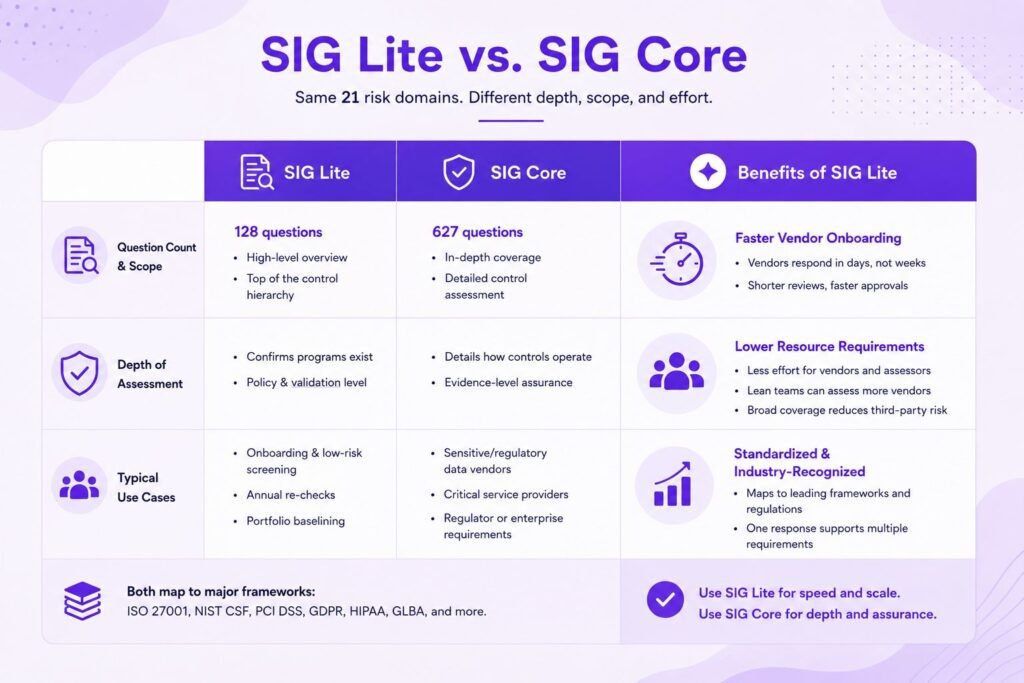
Both questionnaires come from the same content library and cover the same 21 risk domains. The differences are scope, depth, and effort.

Question Count and Scope

SIG Lite’s 128 questions sit at the top of the control hierarchy: does a policy exist, is a program in place, and is there independent validation? SIG Core’s 627 questions descend into how each control actually operates. Beyond both sits the full SIG Detail library of 1,936 questions, which assessors use to build custom scopes by regulation, domain, or control family.

Depth of Assessment

A SIG Lite answer tells you a vendor has an access control program. A SIG Core response tells you how privileged accounts are reviewed, how quickly access is revoked at termination, and how authentication is enforced across environments. If your obligation is to demonstrate that a vendor’s controls are designed and operating effectively, Lite alone will not carry that weight.

Typical Use Cases for Each

Use SIG Lite for onboarding screens, low-risk tiers, annual re-checks of stable low-risk vendors, and portfolio-wide baselining. Use SIG Core for vendors that store or process sensitive or regulated data, critical service providers, and any relationship where a regulator or enterprise customer expects evidence-level diligence.

Benefits of Using SIG Lite

Faster Vendor Onboarding

A prepared vendor can turn around a SIG Lite in days rather than the weeks a Core response takes, because 128 high-level questions can usually be answered by one or two people rather than a cross-functional committee. For the assessor, shorter responses mean faster review cycles and fewer stalled deals waiting on security sign-off.

Lower Resource Requirements

Both sides save effort. Vendors avoid mobilizing IT, legal, HR, and compliance for every prospect. Assessors reduce review time per vendor, which matters enormously when a lean risk team is responsible for hundreds of third parties. Verizon’s Data Breach Investigations Report has linked a substantial share of breaches to third-party access, so the pressure to assess everyone is real; SIG Lite makes broad coverage feasible.

Standardized, Industry-Recognized Framework

SIG questions map to widely adopted frameworks and regulations, including ISO 27001, the NIST Cybersecurity Framework, PCI DSS, GDPR, HIPAA, and GLBA. That mapping means a single well-maintained SIG response can evidence posture across multiple frameworks at once, and it puts SIG Lite in the same standardized category as instruments like the Cloud Security Alliance’s CAIQ, but with broader, industry-agnostic coverage.
Complete SIG Lite Questionnaire

How to Complete a SIG Lite Questionnaire

Preparing Documentation and Evidence

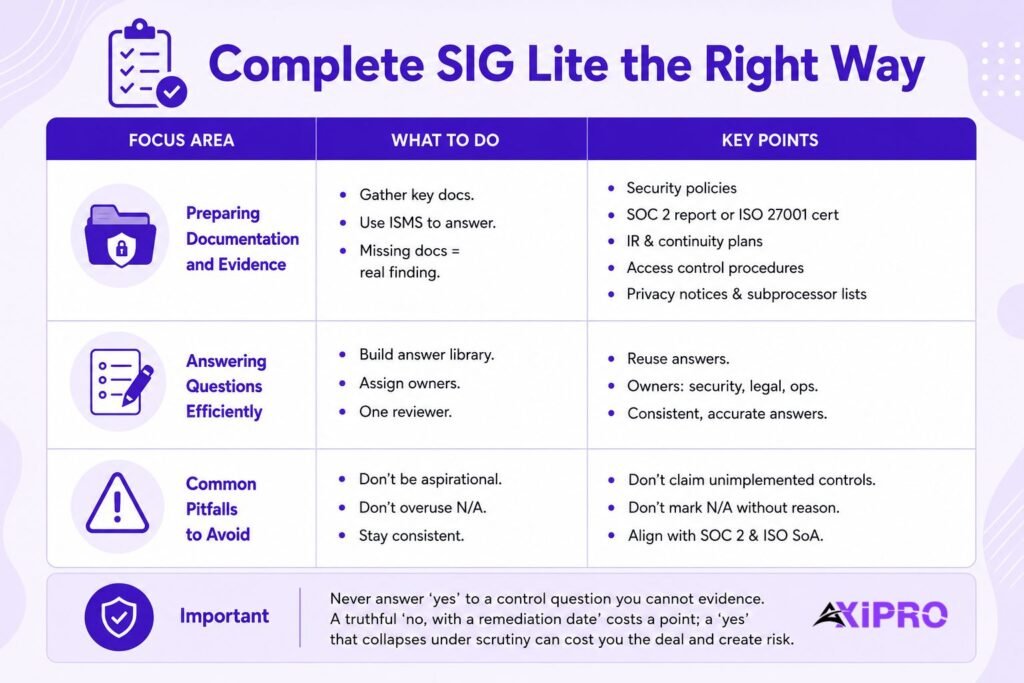
Before answering a single question, gather the artifacts the questions will point to: information security policies, your SOC 2 report or ISO 27001 certificate, incident response and business continuity plans, access control procedures, privacy notices, and subprocessor lists. Most SIG Lite questions can be answered directly from a reasonably mature ISMS. If the documentation does not exist, that is your real finding, and it is better discovered internally than by a prospect.

Answering Questions Efficiently

Build an answer library. The SIG’s standardization is an asset for responders too: an answer written once, kept current, and mapped to the SIG question serial numbers can be reused across every SIG Lite you receive. Assign domains to named owners (security answers access control, legal answers privacy, operations answers continuity) and have a single reviewer check the assembled response for consistency of voice and fact before it leaves the building.

Common Pitfalls to Avoid

Three mistakes recur constantly.

  • Aspirational answers: claiming controls that are planned but not implemented, which unravel the moment an assessor asks for evidence.
  • N/A abuse: marking questions not applicable without justification, which reads as evasion and triggers follow-up.
  • And inconsistency: SIG answers that contradict your SOC 2 report exceptions or your ISO Statement of Applicability, which damages credibility across the entire response.

Important: Never answer ‘yes’ to a control question you cannot evidence on request. A truthful ‘no, with a remediation date’ costs you a scoring point; a ‘yes’ that collapses under scrutiny can cost you the deal and, in regulated relationships, create contractual misrepresentation risk.


How to Send and Evaluate a SIG Lite Questionnaire as an Assessor

Distributing the Questionnaire to Vendors

Scope and generate the questionnaire from the SIG Manager or SIG EV, set a clear deadline (two to three weeks is reasonable for a Lite), and tell the vendor what evidence, if any, you expect alongside answers. Include your escalation criteria up front so vendors understand that certain answers will trigger a deeper assessment rather than a rejection. SIG EV supports secure one-time links for vendor access; TPRM platforms can automate the same distribution at portfolio scale.

Scoring and Interpreting Responses

Score against a rubric, not a gut feeling. Binary or weighted scoring per question, rolled up by risk domain, produces a comparable rating across vendors. Weight the domains that matter most for the specific relationship: data privacy and access control for a data processor, business continuity for an operationally critical supplier. Read comments as carefully as answers; hedged language around encryption, subprocessors, or incident notification usually marks the exact spot to probe.

Follow-Up and Remediation Steps

Every gap needs a disposition: accept the risk with documented rationale, require remediation with a deadline, escalate to a SIG Core or targeted assessment, or decline the vendor. Track remediation commitments to closure rather than filing them, and feed the results back into the vendor’s risk tier so the next review cycle reflects reality.

Pro Tip: Cross-check SIG Lite Answers

Cross-check SIG Lite answers against the exceptions section of the vendor's SOC 2 Type II report before scoring. Vendors rarely lie outright, but a clean SIG answer sitting next to a related audit exception tells you exactly where the optimistic self-assessment is.

SIG Lite Update Cycle

How Often SIG Lite Is Updated

Shared Assessments updates the entire SIG annually, adding, retiring, and renumbering questions to track new regulations, threats, and standards. Question counts move accordingly, which is why quoting ‘the’ SIG Lite count without a year is a minor sin among TPRM practitioners. Always request responses on the current release; accepting a version more than a year or two old undermines comparability across your portfolio.

Recent Changes in the Latest Release

The 2026 SIG release added no new risk domains but made three substantive moves: comprehensive mapping to ISO 42001, the AI management system standard, bringing third-party AI governance into standard due diligence; enhanced mapping to NIST SP 800-171 for organizations handling Controlled Unclassified Information; and alignment with the Business Resilience Council’s Operational Resilience Framework, shifting continuity questions from recovery planning toward evidence of sustained operations. Mappings were also refreshed for the restructured ISO 27001:2022 Annex A controls. Alongside the content update, the launch of SIG EV in March 2026 marks the first delivery-model change in the SIG’s history.

Insider Note: The ISO 42001 mapping is the sleeper change in the 2026 release. Once AI governance questions exist in the standard questionnaire, not asking them starts to look like an oversight gap. Expect enterprise assessors to treat vendor AI due diligence as table stakes within a couple of assessment cycles, well ahead of any regulatory mandate forcing the issue.

SOC 2, ISO 27001 and HIPAA done for you. Fixed fee, 100% audit pass rate.

Audit-ready in 6 weeks. Not 6 months.

Best Practices for SIG Lite Assessments

Segmenting Vendors by Risk Tier

Tier vendors before choosing a questionnaire, not after. A simple three-tier model based on data sensitivity, system access, and operational criticality lets you assign SIG Lite to the low tier, SIG Core to the high tier, and a scoped custom SIG to the middle. Document the tiering criteria; auditors and enterprise customers increasingly ask why a given vendor got the light-touch treatment.

Automating Distribution and Scoring

Manual SIG handling does not scale past a few dozen vendors. Automate the mechanical layer: distribution, reminders, response collection, first-pass scoring, and flagging of answers that breach thresholds. Keep humans on interpretation, follow-up questioning, and risk acceptance decisions. That division preserves judgment where it matters while removing the spreadsheet-wrangling that consumes most TPRM analyst time.

Integrating SIG Lite With Your TPRM Program

A SIG Lite response should not live in a folder. Feed scores into vendor risk registers, tie remediation items to contract renewals, and pair point-in-time questionnaire data with continuous monitoring signals such as security ratings and breach intelligence. The questionnaire tells you what a vendor says about its controls; monitoring tells you whether the outside world agrees.


Challenges of SIG Lite (and How to Solve Them)

SIG Lite is not free: it requires a Shared Assessments subscription or membership, which smaller assessors sometimes balk at, though the cost is modest against the analyst hours a standardized instrument saves. It is shallow by design, so treat escalation paths as part of the methodology rather than a failure of it. It is a point-in-time self-assessment, which is why pairing it with continuous monitoring matters. Vendors suffer questionnaire fatigue, which an answer library and a willingness to accept a vendor’s proactively shared SIG response both ease. And version drift across a portfolio erodes comparability year by year; standardize on the current release each year and migrate stored responses forward using the SIG’s built-in tools.


Tools and Automation for SIG Lite

The tooling landscape has three layers. Shared Assessments’ own stack, the SIG Manager workbook, and now SIG EV, handles creation, comparison, and grading. TPRM and VRM platforms embed licensed SIG content and automate the full assessment lifecycle, from distribution through remediation tracking, with SIG answers mapped automatically to frameworks like ISO 27001 and NIST. And on the vendor side, security questionnaire automation tools draft SIG responses from an organization’s existing documentation and prior answers, cutting response time from days to hours. Whichever layer you invest in, the standard itself stays the same, which is precisely what makes the automation reliable.

SIG Lite earns its place by matching assessment effort to actual risk: 128 standardized questions, 21 risk domains, annual updates, and an ecosystem of tooling that both sides of the assessment already understand. Use it as the broad, fast layer of a tiered TPRM program, escalate to SIG Core when data sensitivity demands it, and keep responses current with each annual release.

Frequently Asked Questions

How many questions are in SIG Lite?

The 2025 release contains 128 questions. The count changes slightly with each annual update, so check the version year before quoting a number.

No. The SIG, including SIG Lite, is a licensed product available through a Shared Assessments subscription or membership. Vendors responding to a SIG Lite sent by a customer do not need their own license to complete it.

A vendor with a mature answer library and current documentation can complete one in a day or two. A first-time responder assembling evidence from scratch should budget one to two weeks. SIG Core, by comparison, routinely takes several weeks of cross-functional effort.

Yes, on both sides. Small assessors get an industry-recognized framework without building one, and small vendors benefit because a completed SIG Lite is far less burdensome to produce than a Core, while still satisfying many customers’ due diligence requirements.

They embed licensed SIG content, automate distribution and reminders, collect responses, apply scoring rubrics, flag threshold breaches, and map answers to compliance frameworks. This removes most of the manual overhead and makes portfolio-wide SIG Lite assessment practical for lean teams.

Yes. The annual update cycle folds new frameworks into the standard question set and mappings; the 2026 release added ISO 42001 for AI governance and deepened NIST SP 800-171 coverage. Assessors can also append up to 100 custom questions to address requirements the standard set does not yet cover.

No. SIG Lite is a self-assessment questionnaire, not independent verification. It documents what a vendor claims about its controls; a SOC 2 report or ISO 27001 certification independently validates those claims. Mature programs use both the SIG for standardized information gathering and the audit report as supporting evidence.
Axipro Author

Picture of Pedro Dias

Pedro Dias

Pedro has been writing online for over 10 years. With experience in all things programming, cyber security, and compliance, he is our editor-in-chief at Axipro.

Blog Highlights

Explore More Articles

SIG Lite What It Covers, When to Use It, and Where It Falls Short

The full SIG content library contains 1,936 questions. SIG Lite asks 128 of them. That difference is the entire point: most vendor relationships do not justify a multi-week questionnaire exchange, and SIG Lite exists so risk teams can run standardized due diligence on lower-risk vendors without burning analyst hours or vendor goodwill. What Is SIG Lite? SIG Lite is the streamlined version of the Standardized Information Gathering (SIG) questionnaire, the most widely used third-party risk assessment instrument in the industry. It condenses the full SIG question set into a short, high-level assessment of a vendor’s information security, privacy, and resilience controls. It is a self-assessment, not an audit: the vendor answers, the assessor evaluates, and the completed questionnaire becomes evidence of due diligence in a third-party risk management (TPRM) program. Purpose of the SIG Lite Questionnaire The purpose is speed with consistency. SIG Lite gives an outsourcing organization a broad understanding of a third party’s internal control environment using a standardized question set, so answers are comparable across an entire vendor portfolio. It works either as a complete assessment for low-risk vendors or as a preliminary screen that decides whether a deeper review is warranted. Because every vendor answers the same questions, risk teams can rank, tier, and triage instead of interpreting fifty differently formatted responses. Who Created and Maintains SIG Lite? SIG Lite is owned and maintained by Shared Assessments, a member-driven standards organization formed in 2005 when the Big Four accounting firms and six global banks set out to fix the inefficiency of every company writing its own vendor questionnaire. The SIG is developed through a formal governance process that draws on practitioner feedback and tracks evolving regulations and standards, which is a large part of why it has held its position as the de facto industry template. SOC 2, ISO 27001 and HIPAA done for you. Fixed fee, 100% audit pass rate. Audit-ready in 6 weeks. Not 6 months. Schedule Free Assessment What’s Included in the SIG Lite Questionnaire? Number of Questions and Structure The 2025 release of SIG Lite contains 128 questions. The exact count shifts slightly with each annual update (recent versions have ranged from roughly 126 to 133), so always confirm the version you are working with. Questions are predominantly yes/no with room for comments and references to supporting evidence, and each question maps back to the SIG content library and to external frameworks. SIG Lite ships as a single-worksheet questionnaire, which keeps completion and review manageable. Risk Domains Covered in SIG Lite SIG Lite draws its questions from the same 21 risk domains that structure the entire SIG, grouped into four control areas: Governance and Risk Management, Information Protection, IT Operations and Business Resilience, and Security Incident and Threat Management. In practice, that means high-level coverage of access control, information security policy, data privacy, cloud security, business continuity, incident response, supply chain risk, human resources security, compliance management, and ESG, among others. The breadth is the same as SIG Core; the depth per domain is what gets trimmed. Format and Delivery (Spreadsheet and Toolkit) Historically, the SIG has been delivered as an Excel workbook generated by the SIG Manager, the macro-driven engine inside the SIG Questionnaire Toolkit that lets assessors scope, generate, store, and compare questionnaires. That is changing. In March 2026, Shared Assessments launched SIG EV (Evolution), a browser-based platform that moves questionnaire creation, distribution, comparison, and grading to the cloud while preserving the same content and methodology. Vendors can still respond in Excel, and assessors can upload completed files, so the transition does not break existing workflows. Worth Knowing: SIG Questions & Permissions SIG questions cannot be edited without written permission from Shared Assessments, but assessors can add up to 100 custom questions to a scoped questionnaire. That is usually enough headroom to cover industry-specific requirements without abandoning the standard. When Should You Use SIG Lite? Ideal Vendor Risk Scenarios SIG Lite fits three situations well. First, vendors with no access to sensitive data or critical systems, where a full assessment would be disproportionate. Second, large vendor portfolios, where sending 600-plus questions to every supplier would stall onboarding across the board. Third, early-stage evaluation, where you need enough signal to decide whether a relationship is worth deeper diligence. Low-Risk vs. High-Risk Vendor Assessments The dividing line is data and criticality. A marketing tool that touches no customer records, a facilities contractor, or a niche SaaS product with read-only access to public data can all be assessed adequately with SIG Lite. A payroll processor, a cloud provider hosting production data, or any vendor storing regulated information under HIPAA, PCI DSS, GDPR, or GLBA should get SIG Core. Using Lite on a high-risk vendor is a documented gap waiting to be found in your next audit. Initial vs. In-Depth Risk Screening Many mature programs use SIG Lite as a gate rather than a destination. The Lite response feeds an initial risk score; vendors that trip defined thresholds (a missing incident response plan, no encryption at rest, no independent certification) graduate to SIG Core or a targeted domain-level assessment. This two-stage pattern keeps effort proportional to risk and gives vendors a lighter first touch. SIG Lite vs. SIG Core: Key Differences Both questionnaires come from the same content library and cover the same 21 risk domains. The differences are scope, depth, and effort. Question Count and Scope SIG Lite’s 128 questions sit at the top of the control hierarchy: does a policy exist, is a program in place, and is there independent validation? SIG Core’s 627 questions descend into how each control actually operates. Beyond both sits the full SIG Detail library of 1,936 questions, which assessors use to build custom scopes by regulation, domain, or control family. Depth of Assessment A SIG Lite answer tells you a vendor has an access control program. A SIG Core response tells you how privileged accounts are reviewed, how quickly access is revoked at termination, and how authentication is enforced across environments. If your obligation is

The PDPA Compliance Singapore Checklist

In 2018, a cyberattack on SingHealth exposed the records of 1.5 million patients, including the Prime Minister. The Personal Data Protection Commission (PDPC) handed down S$1 million in combined penalties, and that decision still sits on its public enforcement page today. The Personal Data Protection Act (PDPA) has sharper teeth than it did a few years ago. Since October 2022, the PDPC can impose financial penalties of up to 10% of an organisation’s annual turnover in Singapore, or S$1 million, whichever is higher. Breach notification is now mandatory. And a hard deadline is approaching: from 1 January 2027, using NRIC numbers for authentication becomes an enforcement target. A checklist is how you turn all of that into something you can actually execute against, rather than a legal document you skim once and forget. What Is the PDPA Compliance Checklist? A PDPA compliance checklist translates the law’s 11 data protection obligations into concrete, verifiable actions. The obligations themselves are principles: Consent, Purpose Limitation, Notification, Access and Correction, Accuracy, Protection, Retention Limitation, Transfer Limitation, Data Breach Notification, Accountability, and Data Portability (legislated in 2020 but not yet in force). A principle tells you what good looks like. A checklist tells you whether you have done it. The distinction matters because the PDPC does not accept good intentions as a defense. When it investigates, it looks for documented policies, a named Data Protection Officer (DPO), evidence of consent, and a breach plan that existed before the breach. The checklist is what produces that evidence trail. SOC 2, ISO 27001 and HIPAA done for you. Fixed fee, 100% audit pass rate. Audit-ready in 6 weeks. Not 6 months. Schedule Free Assessment Who Needs to Follow the PDPA Compliance Checklist in Singapore Every private sector organisation that collects, uses, or discloses personal data in Singapore falls under the PDPA. That covers sole proprietorships, partnerships, companies, and foreign entities with Singapore operations. Headcount is irrelevant. A five-person startup carries the same obligations as a multinational, and the PDPC has shown it will penalize small and mid-sized businesses, not only household names. Physical presence is not the trigger either. If your processing touches individuals in Singapore, the Act can reach you even without a local office. Public sector agencies sit under separate legislation, but the private sector rules administered by the PDPC, which operates under the Info-communications Media Development Authority (IMDA), apply broadly. One useful carve-out: business contact information used purely for business purposes is largely exempt from the consent rules. Worth Knowing: PDPA Roles Explained The PDPA distinguishes an organisation from a data intermediary, a party that processes data on another’s behalf. Intermediaries carry a narrower but real set of duties, mainly protection and retention. If you outsource payroll, hosting, or email marketing, you are the organisation and your vendor is the intermediary, and the contract between you needs to say so explicitly. PDPA Compliance Checklist: Step-by-Step Guide The 15 steps below move roughly in the order you should tackle them, from governance foundations through operational controls to ongoing assurance. Treat them as a sequence, not a menu. Step 1: Appoint a Data Protection Officer (DPO) The PDPA requires every organisation to designate at least one individual responsible for compliance, and to make that person’s business contact details available to the public. You do not have to hire a specialist. In smaller firms, an existing employee can hold the DPO role alongside other duties. What matters is that the role is named, resourced, and reachable, because the DPO is who the PDPC and affected individuals contact first. Publish the contact details on your website and inside your privacy notice. Step 2: Map and Inventory Personal Data You cannot protect data you cannot see. Build a data inventory that records what personal data you hold, where it lives, which systems and people can access it, why you collected it, and how long you keep it. This map is the single most useful artifact in your entire program. It feeds your privacy notice, your retention schedule, your breach assessments, and your vendor reviews. Most compliance failures trace back to a blind spot, a spreadsheet of customer records nobody remembered, or a legacy database still holding data long past its purpose. Step 3: Establish Lawful Basis and Obtain Valid Consent Under the Consent Obligation, you generally need an individual’s consent before you collect, use, or disclose their personal data, and that consent must be tied to a specific, notified purpose. The 2020 amendments added flexibility: deemed consent covers scenarios like contractual necessity, and the legitimate interests exception lets you process data where the benefit outweighs any adverse effect, provided you document the assessment. You cannot make consent to unrelated data uses a condition of providing a service. Important: Bundled consent is a common enforcement trigger. A single checkbox that forces a customer to agree to marketing in order to complete a purchase is not valid consent for the marketing. Separate the purposes, and let people say yes to one without being forced into the other. Step 4: Draft and Publish a Compliant Privacy Notice Your privacy notice is the public expression of how you handle personal data. It should state what you collect, the purposes you collect it for, who you share it with, how long you retain it, and how individuals can contact your DPO or exercise their access and correction rights. Write it in plain language. A notice dense enough to deter reading does not satisfy the spirit of the Notification Obligation, and regulators notice the difference. Step 5: Implement the Notification of Purpose Requirement The Notification Obligation and the Purpose Limitation Obligation work as a pair. You must inform individuals of the purpose before or at the point of collection, and you must then confine your use of the data to that purpose. Practically, that means a clear notice at every collection point: sign-up forms, website pop-ups, contact forms, event registrations. Selling a customer list you gathered for order fulfillment is precisely the kind of

ISO 42001 is the first international standard an organization can be certified against for how it builds, provides, and runs artificial intelligence. It was published in December 2023 by ISO and IEC, and it defines an AI Management System (AIMS) that an accredited auditor can actually inspect. That single fact reshaped the compliance conversation for anyone shipping AI products. A SOC 2 report tells a buyer your data handling is sound. It says nothing about whether your models are governed, your training data is documented, or your automated decisions can be explained. Enterprise procurement teams figured this out fast. AI-specific questionnaires now show up in deals that used to close on a SOC 2 report alone, and buyers increasingly want a recognized certification behind the answers. ISO 42001 is becoming that certification, and Vanta is the platform many AI companies reach for to get there without building a governance program from nothing. What Is ISO 42001 and Why It Matters for AI Companies ISO 42001 at a glance: the first AI management system standard ISO/IEC 42001:2023 specifies the requirements for establishing, maintaining, and continually improving an AIMS. It follows the same Harmonized Structure as ISO 27001 and ISO 9001, so the backbone is familiar: context, leadership, planning, support, operation, performance evaluation, and improvement. The difference sits in the annexes. Annex A defines roughly 38 AI-specific controls across nine areas, covering AI policy, internal roles, resources, impact assessments, lifecycle processes, data management, information for interested parties, use of AI systems, and third-party relationships. Annex B gives implementation guidance, and Annex C lists organizational objectives and risk sources. What makes the standard distinct is that it addresses problems that generic management systems never had to. Model outputs are probabilistic. Training data governance is messy. Automated decisions are hard to explain. Risk does not sit still; it shifts every time a model is retrained or a vendor pushes an update. Who in the AI ecosystem needs ISO 42001 The standard applies across the AI value chain. Providers that build and sell AI systems, developers that create models or components, and deployers that integrate AI into their own products or operations all fall within scope. A Series B startup shipping a generative feature, an enterprise embedding AI in hiring workflows, and a public agency using AI for citizen services can each build an AIMS against the same clauses. For AI-native companies, the pull is commercial before it is regulatory. Certification is turning into a procurement filter. When a large customer’s security review asks how you govern model risk, “we have SOC 2” is no longer a complete answer. How ISO 42001 fits alongside SOC 2, ISO 27001, and the EU AI Act These frameworks are not competitors. They stack. ISO 27001 secures your information. SOC 2 proves your controls to customers. The EU AI Act is binding law with penalties. NIST AI RMF is voluntary guidance. ISO 42001 is the connective tissue that puts an auditable management system around AI specifically. Insider Note: The reason ISO 42001 sells itself in enterprise deals is that it fills a gap SOC 2 was never designed to cover. SOC 2 examines security, availability, and confidentiality. It does not ask whether you ran an AI impact assessment, whether a human reviews high-stakes model outputs, or whether you track which third-party models touch customer data. Buyers now write those exact questions into vendor questionnaires, and a 42001 certificate answers most of them before the call even starts. Need help implementing ISO 42001 in Vanta? Axipro can guide you from setup to certification readiness. Schedule Free Assessment The Unique AI Compliance Challenges Vanta Solves Managing AI-specific risks across models, data, and vendors Traditional GRC tooling was built for static controls. AI risk is not static. A model that passed review at launch can drift, a new data source can introduce bias, and a fine-tune can reclassify your legal obligations overnight. Vanta’s value for AI companies is treating these as continuous, monitored controls rather than one-time checkboxes, spanning the models you build, the data that feeds them, and the vendors whose models you embed. Keeping pace with evolving global AI regulations The regulatory floor keeps moving. The EU AI Act phases in over several years, US agencies are issuing guidance, and standards bodies are revising their work. Tracking this by hand across eight jurisdictions is not realistic for a lean team. A compliance platform that maps a single control set to multiple frameworks turns that sprawl into something maintainable. Proving trust to enterprise buyers procuring AI products The end goal of most of this work is a shorter sales cycle. Enterprise buyers procuring AI want evidence, not assurances. A live, shareable view of your AI compliance posture answers the questionnaire before it becomes a bottleneck, which is exactly what a Trust Center is built to do. How Vanta Supports ISO 42001 Certification for AI Companies Automated evidence collection mapped to ISO 42001 controls The heaviest part of any certification is evidence. Vanta connects to your cloud, identity, and development stack and pulls control evidence automatically, then maps it to the relevant ISO 42001 clauses and Annex A controls. Instead of screenshotting configurations the week before an audit, you accumulate evidence continuously. That shifts the audit from a scramble into a review. Pre-built policy templates for AI governance ISO 42001 expects documented policies for AI use, roles, and risk management. Building these from a blank page is slow and error-prone. Pre-built AI governance policy templates give teams a defensible starting point they can adapt to their actual operations, which matters when an auditor asks not just whether a policy exists but whether it reflects what you really do. Continuous control monitoring for AI systems Certification is a snapshot. An AIMS is supposed to be alive. Continuous monitoring is where the platform earns its keep, flagging when a control drifts out of compliance so you can fix it before it becomes an audit finding or, worse, a real incident. Cross-mapping ISO 42001