
The CMMC program turned from advisory framework to binding contract requirement on November 10, 2025, when the DoD’s Title 48 acquisition rule took effect.
That single date changed the market for CMMC advisory services overnight, and the Cyber AB Registered Practitioner credential moved from a useful business card to a genuine signal of competence.
Over 80,000 companies in the Defense Industrial Base now need help interpreting the rule, and the RP is the formal entry-level role in the ecosystem authorized to provide it.
This guide explains what a CMMC Registered Practitioner is, how the role fits alongside CCPs, CCAs, RPOs, and C3PAOs, what it takes to earn the designation, and how Organizations Seeking Certification (OSCs) should think about engaging one.
What Is a CMMC Registered Practitioner (RP)?
A CMMC Registered Practitioner is an individual authorized by the Cyber AB, the official accreditation body for the CMMC ecosystem, to provide non-certified advisory and consulting services to Organizations Seeking Certification.
RPs help defense contractors interpret the CMMC model, scope their environments, build documentation, remediate gaps against NIST SP 800-171, and prepare for the formal assessment they will eventually undergo.
The credential exists because the CMMC framework is genuinely dense. CMMC Level 2 maps to all 110 controls in NIST SP 800-171, and Level 3 layers on 24 selected requirements from NIST SP 800-172. Most contractors do not have the in-house expertise to implement these controls cleanly, and the Cyber AB needed a way to identify advisors who had at least demonstrated baseline knowledge of the program.
An RP does not perform official assessments. That work is reserved for Certified CMMC Assessors (CCAs) operating under a C3PAO. The RP role is strictly advisory, and the Code of Professional Conduct that every RP must sign makes the boundary explicit.
How RPs Fit Into the Broader CMMC Ecosystem
The Cyber AB structures the ecosystem into two distinct lanes: consulting and implementation on one side, assessment and certification on the other. RPs sit on the consulting side. CCPs, CCAs, and C3PAOs sit on the assessment side.
The two are kept deliberately separate so that no firm can audit work it helped configure, a separation that preserves the integrity of the certification process.
Registered Practitioners vs. Certified CMMC Professionals (CCPs)
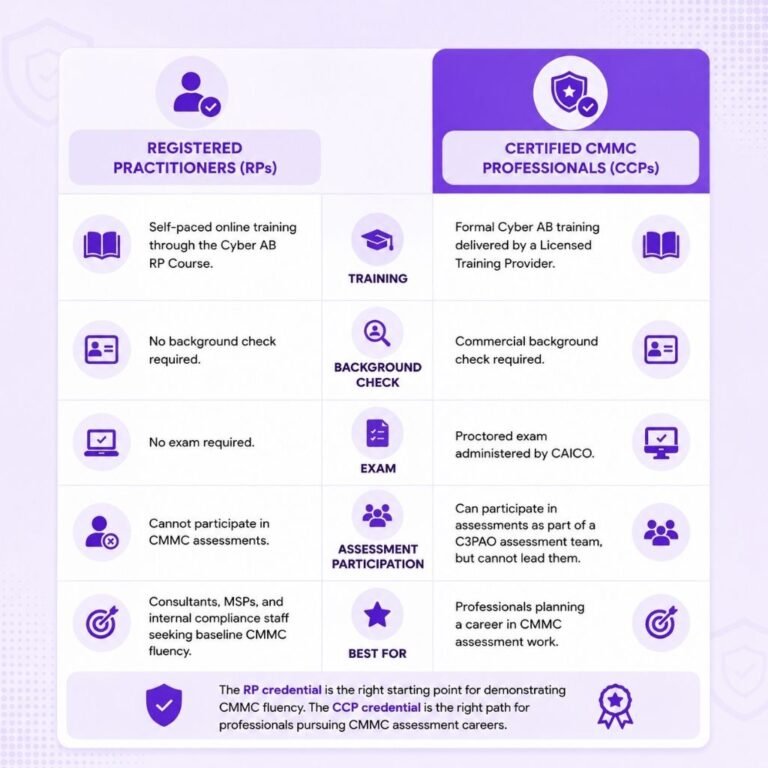
The CCP is a more rigorous credential. CCP candidates must complete formal Cyber AB training delivered by a Licensed Training Provider, pass a commercial background check, and sit a proctored exam administered by CAICO. CCPs can participate in actual assessments as part of a C3PAO assessment team, though they cannot lead them. RPs cannot participate in assessments at all.
In practical terms, the RP credential is the right starting point for consultants, MSPs, and internal compliance staff who want to demonstrate baseline CMMC fluency. The CCP is the right credential for professionals planning a career in CMMC assessment work.
Registered Practitioners vs. C3PAOs
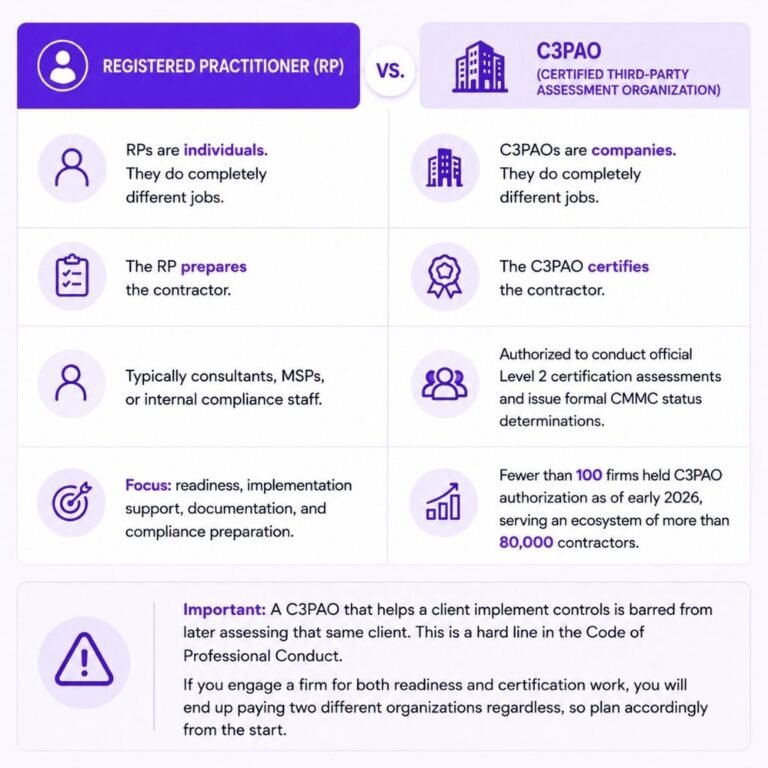
A C3PAO (Certified Third-Party Assessment Organization) is the entity authorized to conduct official Level 2 certification assessments and issue formal CMMC status determinations. Fewer than 100 firms held C3PAO authorization as of early 2026, serving an ecosystem of more than 80,000 contractors. C3PAOs are companies. RPs are individuals. They do completely different jobs: the RP prepares the contractor, the C3PAO certifies them.
Important: A C3PAO that helps a client implement controls is barred from later assessing that same client. This is a hard line in the Code of Professional Conduct. If you engage a firm for both readiness and certification work, you will end up paying two different organizations regardless, so plan accordingly from the start.
What Does a CMMC Registered Practitioner Do?
The work of an RP is the work of getting an organization to the starting line of a formal assessment without surprises. That includes interpreting which CMMC level applies to a given contract, scoping the CUI and FCI environments, identifying gaps against NIST SP 800-171, drafting the System Security Plan (SSP) and Plan of Action and Milestones (POA&M), advising on technical remediation, and coaching the OSC through mock assessments before the real one.
Who Can a CMMC RP Help?
RPs serve any organization in the Defense Industrial Base that needs to achieve a CMMC status. That includes prime contractors, subcontractors at any tier, MSPs, and MSSPs that handle CUI on behalf of defense clients, manufacturers, research universities, and civilian agency contractors whose departments have adopted CMMC-aligned clauses. The flow-down requirements in 32 CFR §170.23 mean that even small subcontractors who process Federal Contract Information (FCI) must hit Level 1, which keeps RP work relevant well past the first wave of large primes.
What Services Does a CMMC RP Provide?
The core service menu looks consistent across the market: gap assessments against NIST SP 800-171, scope definition, SSP and POA&M drafting, policy and procedure development, technical advisory on encryption, access control and incident response, and pre-assessment readiness reviews. Strong RPs also help clients interpret recent guidance changes, manage their SPRS score, and prepare evidence packages that will survive scrutiny from a C3PAO assessment team.
Pro Tip: Evaluating a Registered Practitioner
When evaluating an RP, ask whether they have walked a client through a full C3PAO assessment cycle, not just a gap assessment. There is a significant difference between consultants who write SSPs and consultants who have watched assessors actually challenge one.
How to Become a CMMC Registered Practitioner
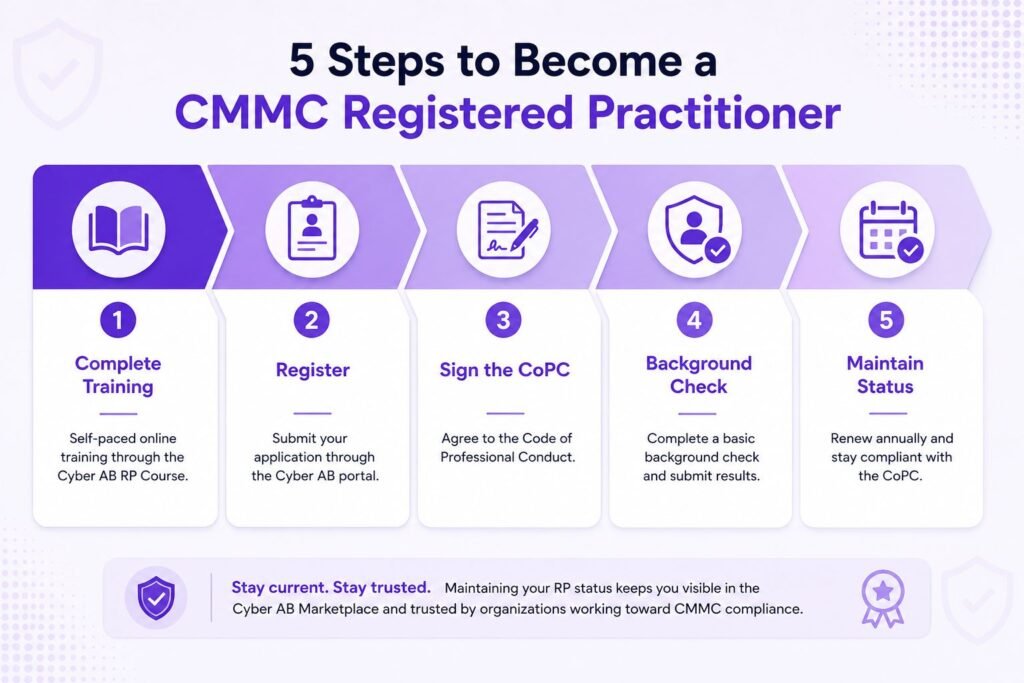
The path is straightforward but not trivial. The Cyber AB controls the registration process end-to-end, and every step must be completed in order.
Step 1: Complete the Required CMMC Registered Practitioner Training
The RP training is delivered online through the Cyber AB’s learning management system. It covers the CMMC model document, the structure of the ecosystem, scoping methodology, FCI and CUI definitions, prime and subcontractor information flow, the assessment process, and the relationship between CMMC and existing DFARS clauses.
The course typically takes around eight hours. Candidates should plan for roughly $500 to $600 in combined training and annual registration costs.
Step 2: Register with the Cyber AB
After training, candidates submit a formal application through the Cyber AB portal. The application captures professional background, contact details, and the candidate’s intended affiliation with an RPO, if applicable.
Step 3: Sign the Code of Professional Conduct (CoPC)
Every RP must sign the Code of Professional Conduct, which governs ethical behaviour, conflict of interest, confidentiality, advertising, and, critically, the boundary between advisory and assessment work.
The CoPC is enforceable, and the Cyber AB can and does revoke credentials for material breaches.
Step 4: Complete Identity and Background Checks
RPs must clear a basic background check focused on felony convictions. The candidate runs the check on themselves through an approved provider and submits the result to the Cyber AB. The cost is modest, in the region of $35.
Step 5: Maintain Active Status
The RP designation is valid for one year. Renewal requires payment of the annual registration fee and continued compliance with the CoPC.
RPs whose status lapses are removed from the Cyber AB Marketplace listing, the public-facing directory OSCs use to find advisors, so staying current is a basic business hygiene issue, not just an administrative one.
What Is Covered in the CMMC Registered Practitioner Training?
The training is broader than it is deep. It walks candidates through the structure of 32 CFR Part 170, the roles in the ecosystem, the three CMMC levels, the assessment process, scoping rules, and the appeals path. It introduces the CMMC Assessment Process (CAP), explains how SPRS scoring works, and covers the documentation expectations OSCs must satisfy.
What the training does not do is go deep at the implementation level. It points at the NIST documents and the CMMC model rather than walking through every control in detail. Practitioners who want real depth need to bring prior cybersecurity and compliance experience to the table, or pursue the Registered Practitioner Advanced (RPA) credential.
The course is fully online, self-paced within a window, and delivered through the Cyber AB LMS. Most candidates with an IT or compliance background complete it in six to ten hours.
Why Become a CMMC Registered Practitioner?
The market signal is the main value. The Cyber AB Marketplace lists every active RP and RPO, and OSCs increasingly start their consultant search there. Being listed gives consultants credibility that no LinkedIn title can replicate.
For internal employees at defense contractors, the RP credential also signals to leadership that the person responsible for CMMC has at least met the published baseline.
The other value is the path it opens. RPs can pursue the Registered Practitioner Advanced (RPA) designation, which requires demonstrated experience implementing CMMC Level 2 controls and a more rigorous exam. From there, the path continues to CCP and CCA for those who want to move into formal assessment work.
Worth Knowing: RP Credential Not Required for CMMC Consulting
The RP credential is not legally required to provide CMMC consulting services. An OSC can hire any qualified cybersecurity consultant, employee, or MSP without the credential. The RP designation is a market signal, not a regulatory gate, and that distinction matters when comparing it to the CCA, which is required to participate in assessments.
What Is a Registered Practitioner Organization (RPO)?
An RPO is the company-level equivalent of the RP credential. A Registered Practitioner Organization is a firm authorized by the Cyber AB to deliver CMMC consulting services, listed in the Cyber AB Marketplace, and permitted to market using official RPO branding.
Becoming an RPO requires employing or contracting at least one active Registered Practitioner, signing the RPO agreement and the Code of Professional Conduct, passing an organizational background check, and paying the annual registration fee.
Public sources put the RPO registration fee at around $6,000, though this should be verified directly with the Cyber AB before budgeting.
The distinction between RP and RPO matters when an OSC is choosing who to contract with. An individual RP may be highly skilled, but an RPO brings organizational accountability, institutional continuity if a key practitioner leaves, and the ability to field a broader team across a complex engagement. For larger or longer-horizon CMMC programs, the RPO structure is generally the more stable choice.
Should You Hire a CMMC Registered Practitioner for Your Compliance Journey?
For most OSCs, the answer is yes, and the earlier the better. The implementation curve for Level 2 is steep. Realistic first-year costs for a fifty-person contractor pursuing Level 2 sit in the range of $70,000 to $350,000 once gap analysis, remediation, documentation, and assessment fees are factored in. Hiring an experienced RP early in that process tends to compress the timeline and cut the total spend, mostly by avoiding the false starts that consume budget on poorly scoped enclaves.
When Should an OSC Engage a CMMC Registered Practitioner?
Engage an RP at the point you know CMMC will appear in a contract you intend to bid on, not after the RFP lands. Most contractors who scramble at the last minute fail their first assessment, and a failed assessment carries both direct remediation cost and a multi-month delay before retest eligibility. According to GAO reporting on DoD cybersecurity readiness, implementation gaps are consistently identified as a leading cause of contractor compliance failures. Front-loading the advisory work is significantly cheaper than fixing it under time pressure.
How to Choose the Right CMMC Registered Practitioner
The Marketplace listing is the floor, not the ceiling. Beyond verifying credentials, OSCs should look for hands-on experience implementing controls in environments similar to their own, fluency in the specific cloud or on-premise stack they use, and a track record of clients who have completed C3PAO certification assessments cleanly.
Verify their CMMC experience.
Ask how many OSCs they have advised to a successful certification, and how many they have walked through a full C3PAO assessment, not just a gap assessment.
Check their knowledge depth.
A strong RP can explain not just what the controls require but why, and can reference the relevant section of NIST SP 800-171 or 32 CFR Part 170 without hesitation.
Understand their service scope.
Some RPs do scoping and documentation only. Others handle technical remediation and managed compliance. Match the offering to your actual gap. And always ask for references and case studies; a practitioner with real experience can produce both.
Insider Note: The most common reason OSCs fail their first assessment is scope creep, not technical gaps. They define the CUI environment too broadly, and then cannot defend every device and identity in that scope under assessor scrutiny. A good RP spends as much time narrowing the assessment boundary as expanding the controls inside it.
Conclusion
The Registered Practitioner credential is the formal entry point for anyone who wants to advise on CMMC compliance, and the most efficient way for an OSC to identify someone who has at least passed the Cyber AB’s baseline vetting.
It is not a substitute for hands-on cybersecurity experience, and it does not authorize assessment work. But in a market where over 80,000 contractors are working out what compliance actually looks like under the final rule, an RP who knows the model, the ecosystem, and the assessment process is a genuinely useful person to have on the project.
Pick carefully, engage early, and treat the credential as a starting filter rather than a guarantee.
Frequently Asked Questions About CMMC Registered Practitioners
What is a CMMC Registered Practitioner (RP)?
An individual authorized by the Cyber AB to provide non-certified CMMC consulting and advisory services to Organizations Seeking Certification.
What are the requirements to become a CMMC Registered Practitioner?
Complete the Cyber AB RP training, pass a basic background check, sign the Code of Professional Conduct, and pay the annual registration fee.
How long does it take to become a CMMC Registered Practitioner?
Most candidates complete the process in two to four weeks, depending on background check turnaround. The training itself takes six to ten hours.
What is the difference between a CMMC RP and a Certified CMMC Professional (CCP)?
The RP is advisory only. The CCP is a higher credential, requires a proctored exam and commercial background check, and can participate in C3PAO-led assessments.
Do I need a CMMC Registered Practitioner to achieve CMMC compliance?
No. OSCs can use internal staff or any qualified consultant. The RP credential is a market signal, not a legal requirement.
How do I find a verified CMMC Registered Practitioner?
The Cyber AB Marketplace is the authoritative directory of active RPs, RPAs, RPOs, and C3PAOs.
What is the Cyber AB and what role does it play for Registered Practitioners?
The Cyber AB is the sole accreditation body authorized by the DoD to manage CMMC training, credentialing, and ecosystem oversight.
What advertising rules apply to CMMC Registered Practitioners?
The Code of Professional Conduct restricts how RPs and RPOs can describe their authorization, prohibits misrepresenting the scope of services they are allowed to provide, and bars any claim that suggests an RP can issue or influence formal certification decisions.