

Table of Contents

Reach SOC 2 Compliance in 6 Weeks or Less.

  /

  / How to Become a CMMC Registered Practitioner

How to Become a CMMC Registered Practitioner

The CMMC program turned from advisory framework to binding contract requirement on November 10, 2025, when the DoD’s Title 48 acquisition rule took effect. 

That single date changed the market for CMMC advisory services overnight, and the Cyber AB Registered Practitioner credential moved from a useful business card to a genuine signal of competence. 

Over 80,000 companies in the Defense Industrial Base now need help interpreting the rule, and the RP is the formal entry-level role in the ecosystem authorized to provide it.

This guide explains what a CMMC Registered Practitioner is, how the role fits alongside CCPs, CCAs, RPOs, and C3PAOs, what it takes to earn the designation, and how Organizations Seeking Certification (OSCs) should think about engaging one.

CMMC Registered Practitioner

What Is a CMMC Registered Practitioner (RP)?

A CMMC Registered Practitioner is an individual authorized by the Cyber AB, the official accreditation body for the CMMC ecosystem, to provide non-certified advisory and consulting services to Organizations Seeking Certification. 

RPs help defense contractors interpret the CMMC model, scope their environments, build documentation, remediate gaps against NIST SP 800-171, and prepare for the formal assessment they will eventually undergo.

The credential exists because the CMMC framework is genuinely dense. CMMC Level 2 maps to all 110 controls in NIST SP 800-171, and Level 3 layers on 24 selected requirements from NIST SP 800-172. Most contractors do not have the in-house expertise to implement these controls cleanly, and the Cyber AB needed a way to identify advisors who had at least demonstrated baseline knowledge of the program.

An RP does not perform official assessments. That work is reserved for Certified CMMC Assessors (CCAs) operating under a C3PAO. The RP role is strictly advisory, and the Code of Professional Conduct that every RP must sign makes the boundary explicit.

Reach SOC 2 Compliance in 6 Weeks or Less

Schedule Your Free SOC 2 Assessment Today

How RPs Fit Into the Broader CMMC Ecosystem

The Cyber AB structures the ecosystem into two distinct lanes: consulting and implementation on one side, assessment and certification on the other. RPs sit on the consulting side. CCPs, CCAs, and C3PAOs sit on the assessment side.

The two are kept deliberately separate so that no firm can audit work it helped configure, a separation that preserves the integrity of the certification process.

Registered Practitioners vs. Certified CMMC Professionals (CCPs)
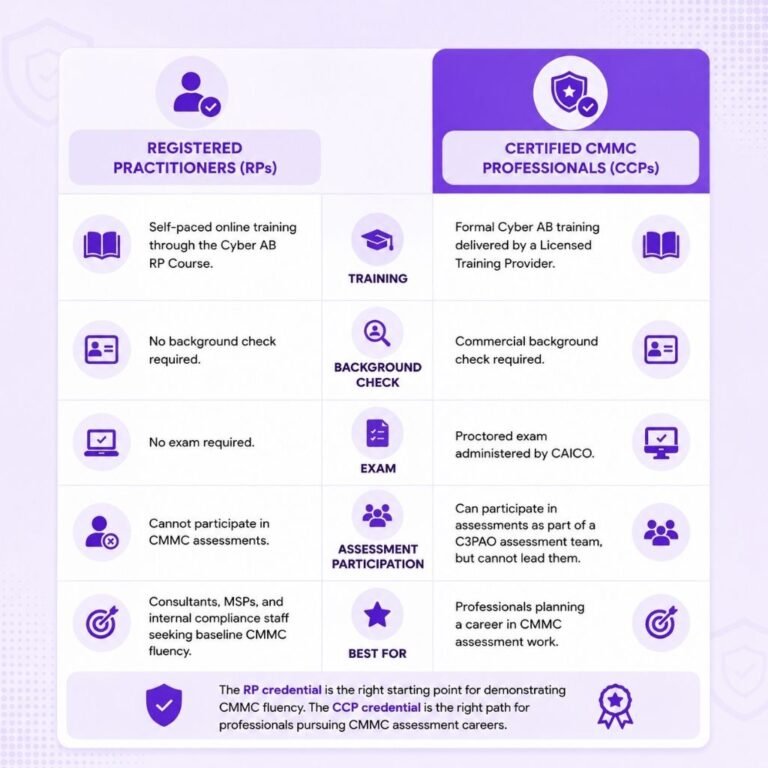
The CCP is a more rigorous credential. CCP candidates must complete formal Cyber AB training delivered by a Licensed Training Provider, pass a commercial background check, and sit a proctored exam administered by CAICO. CCPs can participate in actual assessments as part of a C3PAO assessment team, though they cannot lead them. RPs cannot participate in assessments at all.

In practical terms, the RP credential is the right starting point for consultants, MSPs, and internal compliance staff who want to demonstrate baseline CMMC fluency. The CCP is the right credential for professionals planning a career in CMMC assessment work.

Registered Practitioners vs. C3PAOs
Registered Practitioners vs. C3PAOs

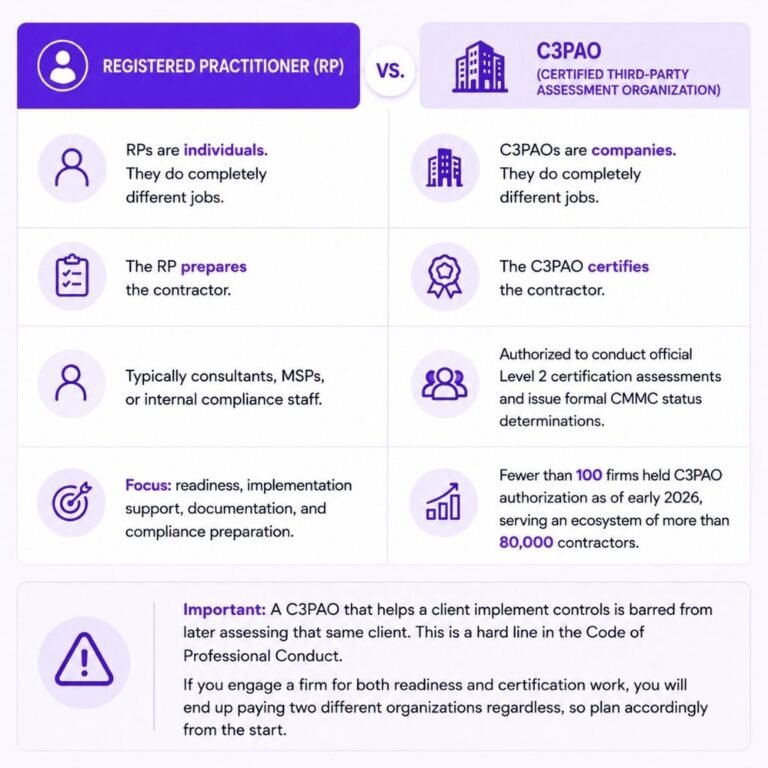
A C3PAO (Certified Third-Party Assessment Organization) is the entity authorized to conduct official Level 2 certification assessments and issue formal CMMC status determinations. Fewer than 100 firms held C3PAO authorization as of early 2026, serving an ecosystem of more than 80,000 contractors. C3PAOs are companies. RPs are individuals. They do completely different jobs: the RP prepares the contractor, the C3PAO certifies them.

Important: A C3PAO that helps a client implement controls is barred from later assessing that same client. This is a hard line in the Code of Professional Conduct. If you engage a firm for both readiness and certification work, you will end up paying two different organizations regardless, so plan accordingly from the start.

Reach SOC 2 Compliance in 6 Weeks or Less

Schedule Your Free SOC 2 Assessment Today

What Does a CMMC Registered Practitioner Do?

The work of an RP is the work of getting an organization to the starting line of a formal assessment without surprises. That includes interpreting which CMMC level applies to a given contract, scoping the CUI and FCI environments, identifying gaps against NIST SP 800-171, drafting the System Security Plan (SSP) and Plan of Action and Milestones (POA&M), advising on technical remediation, and coaching the OSC through mock assessments before the real one.

Who Can a CMMC RP Help?

RPs serve any organization in the Defense Industrial Base that needs to achieve a CMMC status. That includes prime contractors, subcontractors at any tier, MSPs, and MSSPs that handle CUI on behalf of defense clients, manufacturers, research universities, and civilian agency contractors whose departments have adopted CMMC-aligned clauses. The flow-down requirements in 32 CFR §170.23 mean that even small subcontractors who process Federal Contract Information (FCI) must hit Level 1, which keeps RP work relevant well past the first wave of large primes.

What Services Does a CMMC RP Provide?

The core service menu looks consistent across the market: gap assessments against NIST SP 800-171, scope definition, SSP and POA&M drafting, policy and procedure development, technical advisory on encryption, access control and incident response, and pre-assessment readiness reviews. Strong RPs also help clients interpret recent guidance changes, manage their SPRS score, and prepare evidence packages that will survive scrutiny from a C3PAO assessment team.

Pro Tip: Evaluating a Registered Practitioner

When evaluating an RP, ask whether they have walked a client through a full C3PAO assessment cycle, not just a gap assessment. There is a significant difference between consultants who write SSPs and consultants who have watched assessors actually challenge one.
How to Become a CMMC Registered Practitioner

How to Become a CMMC Registered Practitioner

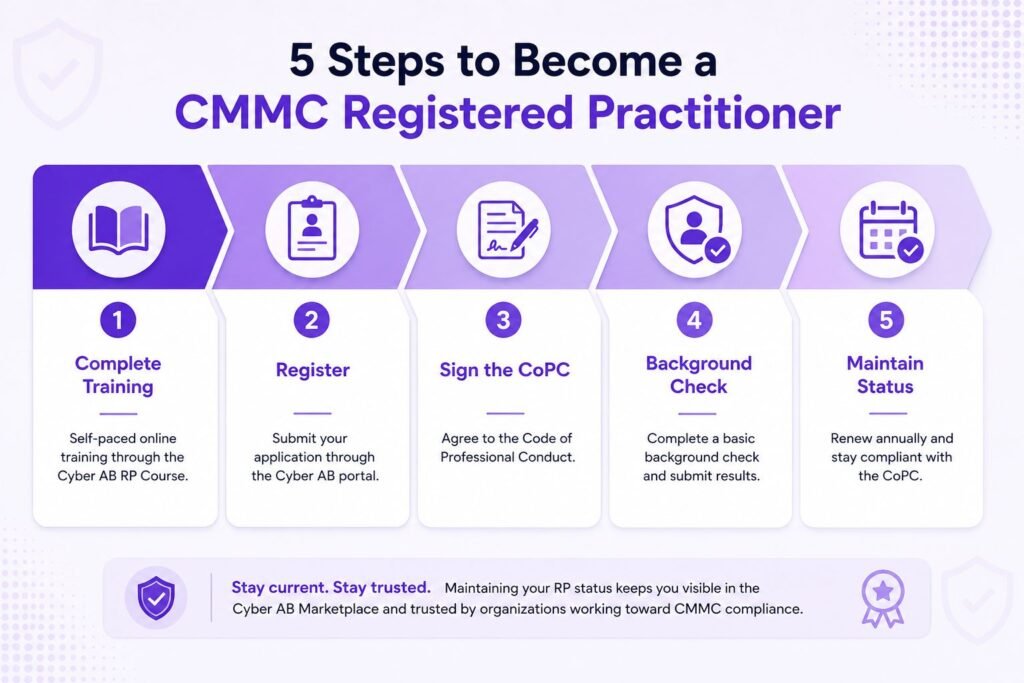
The path is straightforward but not trivial. The Cyber AB controls the registration process end-to-end, and every step must be completed in order.

Step 1: Complete the Required CMMC Registered Practitioner Training

The RP training is delivered online through the Cyber AB’s learning management system. It covers the CMMC model document, the structure of the ecosystem, scoping methodology, FCI and CUI definitions, prime and subcontractor information flow, the assessment process, and the relationship between CMMC and existing DFARS clauses.

The course typically takes around eight hours. Candidates should plan for roughly $500 to $600 in combined training and annual registration costs.

Step 2: Register with the Cyber AB

After training, candidates submit a formal application through the Cyber AB portal. The application captures professional background, contact details, and the candidate’s intended affiliation with an RPO, if applicable.

Step 3: Sign the Code of Professional Conduct (CoPC)

Every RP must sign the Code of Professional Conduct, which governs ethical behaviour, conflict of interest, confidentiality, advertising, and, critically, the boundary between advisory and assessment work.

The CoPC is enforceable, and the Cyber AB can and does revoke credentials for material breaches.

Step 4: Complete Identity and Background Checks

RPs must clear a basic background check focused on felony convictions. The candidate runs the check on themselves through an approved provider and submits the result to the Cyber AB. The cost is modest, in the region of $35.

Step 5: Maintain Active Status

The RP designation is valid for one year. Renewal requires payment of the annual registration fee and continued compliance with the CoPC.

RPs whose status lapses are removed from the Cyber AB Marketplace listing, the public-facing directory OSCs use to find advisors, so staying current is a basic business hygiene issue, not just an administrative one.


What Is Covered in the CMMC Registered Practitioner Training?

The training is broader than it is deep. It walks candidates through the structure of 32 CFR Part 170, the roles in the ecosystem, the three CMMC levels, the assessment process, scoping rules, and the appeals path. It introduces the CMMC Assessment Process (CAP), explains how SPRS scoring works, and covers the documentation expectations OSCs must satisfy.

What the training does not do is go deep at the implementation level. It points at the NIST documents and the CMMC model rather than walking through every control in detail. Practitioners who want real depth need to bring prior cybersecurity and compliance experience to the table, or pursue the Registered Practitioner Advanced (RPA) credential.

The course is fully online, self-paced within a window, and delivered through the Cyber AB LMS. Most candidates with an IT or compliance background complete it in six to ten hours.


Why Become a CMMC Registered Practitioner?

The market signal is the main value. The Cyber AB Marketplace lists every active RP and RPO, and OSCs increasingly start their consultant search there. Being listed gives consultants credibility that no LinkedIn title can replicate.

For internal employees at defense contractors, the RP credential also signals to leadership that the person responsible for CMMC has at least met the published baseline.

The other value is the path it opens. RPs can pursue the Registered Practitioner Advanced (RPA) designation, which requires demonstrated experience implementing CMMC Level 2 controls and a more rigorous exam. From there, the path continues to CCP and CCA for those who want to move into formal assessment work.

Worth Knowing: RP Credential Not Required for CMMC Consulting

The RP credential is not legally required to provide CMMC consulting services. An OSC can hire any qualified cybersecurity consultant, employee, or MSP without the credential. The RP designation is a market signal, not a regulatory gate, and that distinction matters when comparing it to the CCA, which is required to participate in assessments.

What Is a Registered Practitioner Organization (RPO)?

An RPO is the company-level equivalent of the RP credential. A Registered Practitioner Organization is a firm authorized by the Cyber AB to deliver CMMC consulting services, listed in the Cyber AB Marketplace, and permitted to market using official RPO branding.

Becoming an RPO requires employing or contracting at least one active Registered Practitioner, signing the RPO agreement and the Code of Professional Conduct, passing an organizational background check, and paying the annual registration fee.

Public sources put the RPO registration fee at around $6,000, though this should be verified directly with the Cyber AB before budgeting.

The distinction between RP and RPO matters when an OSC is choosing who to contract with. An individual RP may be highly skilled, but an RPO brings organizational accountability, institutional continuity if a key practitioner leaves, and the ability to field a broader team across a complex engagement. For larger or longer-horizon CMMC programs, the RPO structure is generally the more stable choice.


Should You Hire a CMMC Registered Practitioner for Your Compliance Journey?

For most OSCs, the answer is yes, and the earlier the better. The implementation curve for Level 2 is steep. Realistic first-year costs for a fifty-person contractor pursuing Level 2 sit in the range of $70,000 to $350,000 once gap analysis, remediation, documentation, and assessment fees are factored in. Hiring an experienced RP early in that process tends to compress the timeline and cut the total spend, mostly by avoiding the false starts that consume budget on poorly scoped enclaves.

When Should an OSC Engage a CMMC Registered Practitioner?

Engage an RP at the point you know CMMC will appear in a contract you intend to bid on, not after the RFP lands. Most contractors who scramble at the last minute fail their first assessment, and a failed assessment carries both direct remediation cost and a multi-month delay before retest eligibility. According to GAO reporting on DoD cybersecurity readiness, implementation gaps are consistently identified as a leading cause of contractor compliance failures. Front-loading the advisory work is significantly cheaper than fixing it under time pressure.

Reach SOC 2 Compliance in 6 Weeks or Less

Schedule Your Free SOC 2 Assessment Today

How to Choose the Right CMMC Registered Practitioner

The Marketplace listing is the floor, not the ceiling. Beyond verifying credentials, OSCs should look for hands-on experience implementing controls in environments similar to their own, fluency in the specific cloud or on-premise stack they use, and a track record of clients who have completed C3PAO certification assessments cleanly.

Verify their CMMC experience.

Ask how many OSCs they have advised to a successful certification, and how many they have walked through a full C3PAO assessment, not just a gap assessment.

Check their knowledge depth.

A strong RP can explain not just what the controls require but why, and can reference the relevant section of NIST SP 800-171 or 32 CFR Part 170 without hesitation.

Understand their service scope.

Some RPs do scoping and documentation only. Others handle technical remediation and managed compliance. Match the offering to your actual gap. And always ask for references and case studies; a practitioner with real experience can produce both.

Insider Note: The most common reason OSCs fail their first assessment is scope creep, not technical gaps. They define the CUI environment too broadly, and then cannot defend every device and identity in that scope under assessor scrutiny. A good RP spends as much time narrowing the assessment boundary as expanding the controls inside it.

Conclusion

The Registered Practitioner credential is the formal entry point for anyone who wants to advise on CMMC compliance, and the most efficient way for an OSC to identify someone who has at least passed the Cyber AB’s baseline vetting.

It is not a substitute for hands-on cybersecurity experience, and it does not authorize assessment work. But in a market where over 80,000 contractors are working out what compliance actually looks like under the final rule, an RP who knows the model, the ecosystem, and the assessment process is a genuinely useful person to have on the project.

Pick carefully, engage early, and treat the credential as a starting filter rather than a guarantee.

Frequently Asked Questions About CMMC Registered Practitioners

What is a CMMC Registered Practitioner (RP)?

An individual authorized by the Cyber AB to provide non-certified CMMC consulting and advisory services to Organizations Seeking Certification.

Complete the Cyber AB RP training, pass a basic background check, sign the Code of Professional Conduct, and pay the annual registration fee.

Most candidates complete the process in two to four weeks, depending on background check turnaround. The training itself takes six to ten hours.

The RP is advisory only. The CCP is a higher credential, requires a proctored exam and commercial background check, and can participate in C3PAO-led assessments.

No. OSCs can use internal staff or any qualified consultant. The RP credential is a market signal, not a legal requirement.

The Cyber AB Marketplace is the authoritative directory of active RPs, RPAs, RPOs, and C3PAOs.

The Cyber AB is the sole accreditation body authorized by the DoD to manage CMMC training, credentialing, and ecosystem oversight.

The Code of Professional Conduct restricts how RPs and RPOs can describe their authorization, prohibits misrepresenting the scope of services they are allowed to provide, and bars any claim that suggests an RP can issue or influence formal certification decisions.

Axipro Author

Picture of Pedro Dias

Pedro Dias

Pedro has been writing online for over 10 years. With experience in all things programming, cyber security, and compliance, he is our editor-in-chief at Axipro.

Blog Highlights

Explore More Articles

The CMMC program turned from advisory framework to binding contract requirement on November 10, 2025, when the DoD’s Title 48 acquisition rule took effect.  That single date changed the market for CMMC advisory services overnight, and the Cyber AB Registered Practitioner credential moved from a useful business card to a genuine signal of competence.  Over 80,000 companies in the Defense Industrial Base now need help interpreting the rule, and the RP is the formal entry-level role in the ecosystem authorized to provide it. This guide explains what a CMMC Registered Practitioner is, how the role fits alongside CCPs, CCAs, RPOs, and C3PAOs, what it takes to earn the designation, and how Organizations Seeking Certification (OSCs) should think about engaging one. What Is a CMMC Registered Practitioner (RP)? A CMMC Registered Practitioner is an individual authorized by the Cyber AB, the official accreditation body for the CMMC ecosystem, to provide non-certified advisory and consulting services to Organizations Seeking Certification.  RPs help defense contractors interpret the CMMC model, scope their environments, build documentation, remediate gaps against NIST SP 800-171, and prepare for the formal assessment they will eventually undergo. The credential exists because the CMMC framework is genuinely dense. CMMC Level 2 maps to all 110 controls in NIST SP 800-171, and Level 3 layers on 24 selected requirements from NIST SP 800-172. Most contractors do not have the in-house expertise to implement these controls cleanly, and the Cyber AB needed a way to identify advisors who had at least demonstrated baseline knowledge of the program. An RP does not perform official assessments. That work is reserved for Certified CMMC Assessors (CCAs) operating under a C3PAO. The RP role is strictly advisory, and the Code of Professional Conduct that every RP must sign makes the boundary explicit. How RPs Fit Into the Broader CMMC Ecosystem The Cyber AB structures the ecosystem into two distinct lanes: consulting and implementation on one side, assessment and certification on the other. RPs sit on the consulting side. CCPs, CCAs, and C3PAOs sit on the assessment side. The two are kept deliberately separate so that no firm can audit work it helped configure, a separation that preserves the integrity of the certification process. Registered Practitioners vs. Certified CMMC Professionals (CCPs) The CCP is a more rigorous credential. CCP candidates must complete formal Cyber AB training delivered by a Licensed Training Provider, pass a commercial background check, and sit a proctored exam administered by CAICO. CCPs can participate in actual assessments as part of a C3PAO assessment team, though they cannot lead them. RPs cannot participate in assessments at all. In practical terms, the RP credential is the right starting point for consultants, MSPs, and internal compliance staff who want to demonstrate baseline CMMC fluency. The CCP is the right credential for professionals planning a career in CMMC assessment work. Registered Practitioners vs. C3PAOs A C3PAO (Certified Third-Party Assessment Organization) is the entity authorized to conduct official Level 2 certification assessments and issue formal CMMC status determinations. Fewer than 100 firms held C3PAO authorization as of early 2026, serving an ecosystem of more than 80,000 contractors. C3PAOs are companies. RPs are individuals. They do completely different jobs: the RP prepares the contractor, the C3PAO certifies them. Important: A C3PAO that helps a client implement controls is barred from later assessing that same client. This is a hard line in the Code of Professional Conduct. If you engage a firm for both readiness and certification work, you will end up paying two different organizations regardless, so plan accordingly from the start. What Does a CMMC Registered Practitioner Do? The work of an RP is the work of getting an organization to the starting line of a formal assessment without surprises. That includes interpreting which CMMC level applies to a given contract, scoping the CUI and FCI environments, identifying gaps against NIST SP 800-171, drafting the System Security Plan (SSP) and Plan of Action and Milestones (POA&M), advising on technical remediation, and coaching the OSC through mock assessments before the real one. Who Can a CMMC RP Help? RPs serve any organization in the Defense Industrial Base that needs to achieve a CMMC status. That includes prime contractors, subcontractors at any tier, MSPs, and MSSPs that handle CUI on behalf of defense clients, manufacturers, research universities, and civilian agency contractors whose departments have adopted CMMC-aligned clauses. The flow-down requirements in 32 CFR §170.23 mean that even small subcontractors who process Federal Contract Information (FCI) must hit Level 1, which keeps RP work relevant well past the first wave of large primes. What Services Does a CMMC RP Provide? The core service menu looks consistent across the market: gap assessments against NIST SP 800-171, scope definition, SSP and POA&M drafting, policy and procedure development, technical advisory on encryption, access control and incident response, and pre-assessment readiness reviews. Strong RPs also help clients interpret recent guidance changes, manage their SPRS score, and prepare evidence packages that will survive scrutiny from a C3PAO assessment team. Pro Tip: Evaluating a Registered Practitioner When evaluating an RP, ask whether they have walked a client through a full C3PAO assessment cycle, not just a gap assessment. There is a significant difference between consultants who write SSPs and consultants who have watched assessors actually challenge one. How to Become a CMMC Registered Practitioner The path is straightforward but not trivial. The Cyber AB controls the registration process end-to-end, and every step must be completed in order. Step 1: Complete the Required CMMC Registered Practitioner Training The RP training is delivered online through the Cyber AB’s learning management system. It covers the CMMC model document, the structure of the ecosystem, scoping methodology, FCI and CUI definitions, prime and subcontractor information flow, the assessment process, and the relationship between CMMC and existing DFARS clauses. The course typically takes around eight hours. Candidates should plan for roughly $500 to $600 in combined training and annual registration costs. Step 2: Register with the Cyber AB After training, candidates submit a

A single VS Code extension installed by a single GitHub employee has cost the world’s largest code host roughly 3,800 of its internal repositories. GitHub confirmed the breach in a five-post thread on X on May 20, 2026, attributing the compromise to a poisoned extension that ran on the employee’s machine and gave attackers a foothold inside Microsoft’s flagship developer platform. The threat group TeamPCP, already infamous for a string of supply chain attacks across npm, PyPI, and PHP packages earlier this year, has claimed responsibility on underground forums and is reportedly asking more than $50,000 for the stolen dataset. GitHub’s own assessment is that the attacker’s claim of around 3,800 exfiltrated repositories is directionally consistent with what investigators have found so far. The company says no customer data was touched. What GitHub Disclosed GitHub broke the news in a numbered thread of five short posts on X, with no entry on the official github.blog or githubstatus.com at the time of disclosure. The company said it detected the compromise of an employee device the previous day, removed the malicious extension version from the marketplace, isolated the affected endpoint, and rotated critical secrets overnight, prioritizing the highest-impact credentials first. “Our current assessment is that the activity involved exfiltration of GitHub-internal repositories only,” GitHub wrote, adding that it would continue to monitor logs for follow-on activity and publish a fuller report once the investigation is complete. The phrasing is careful. Saying GitHub-internal repositories only rules out customer repos, enterprise tenants, and organization data hosted on the public platform, but it leaves open what was inside those 3,800 repos: deployment scripts, infrastructure configuration, API documentation, staging credentials, and the architectural blueprints of GitHub itself. Important Note “No customer data” does not mean “no customer risk.” Internal repositories at a platform like GitHub typically contain deployment topology, secret rotation logic, CI workflows, and references to third-party integrations. Even if no customer secrets are inside, the architectural knowledge alone meaningfully reduces the cost of attacking customers downstream. The Attack: A Trojanized Extension Inside a Trusted Marketplace GitHub has not yet named the specific extension. Security researchers tracking TeamPCP’s tradecraft note that the group has spent 2026 weaponizing exactly this surface, planting trojanized code in package registries and development tools that developers trust by default. The mechanism is brutally simple. A developer browses the VS Code Marketplace, installs an extension that looks legitimate, and grants it the same execution privileges as any other process running under their account. From there, the malware can read source files, exfiltrate Git credentials, harvest tokens from ~/.aws, ~/.kube, and password managers, and clone every repository the developer has access to. There is no permission model meaningfully limiting what an extension can do once it executes. A theme can do anything a debugger can do. Browser extensions get treated as a security boundary. IDE extensions, which see your source code, your credentials, and your terminal, do not. That asymmetry is the single largest unaddressed risk in the modern developer toolchain, and the GitHub incident is the most expensive demonstration of it to date. What GitHub Has Done, and What Comes Next The containment steps GitHub described are textbook: detect, isolate, rotate, monitor. The company says it removed the malicious extension version, took the developer’s machine off the network, and rotated the credentials most likely to provide further pivots. The investigation continues, and GitHub has committed to publishing a fuller report later. Where the response is less defensible is in disclosure. Announcing a breach of this scale exclusively on X, a platform that requires a login to view most posts, drew sharp criticism. As of publication, there is no entry on the GitHub Blog and no advisory on the official status page. Customers governed by frameworks such as DORA or NIS2, both of which have hard supplier-incident notification timelines, will be looking for something more substantive than a Twitter thread. Pro Tip: IDE plugins and Cyber Security Treat any IDE plugin like a piece of production software. Pin to specific versions, disable auto-updates on critical machines, restrict the allowed publisher list (in VS Code via the extensions.allowed setting), and ensure that any project containing credentials cannot be opened by an editor that auto-runs .vscode/tasks.json without confirmation. If you maintain CI/CD secrets, assume that any developer machine with both source access and an unverified extension installed is already in the threat model. For organizations downstream of GitHub itself, the immediate hygiene items are clear. Rotate any GitHub personal access tokens or OIDC credentials that were used in conjunction with packages from the TanStack, UiPath, Mistral AI, OpenSearch, or Guardrails AI namespaces during the early May window. Audit .vscode/ and .claude/ directories for files such as router_runtime.js or setup.mjs. Search for the gh-token-monitor daemon, which acts as a dead-man switch and triggers a destructive rm -rf on token revocation if not removed first. An Incident or a Pattern? GitHub has had a rough quarter on availability, with multiple outages drawing public complaints. A confirmed source-code breach by the most prolific supply chain threat actor of 2026 lands at the worst possible moment for that narrative. Independent agencies such as the Cybersecurity and Infrastructure Security Agency and NIST, through its Secure Software Development Framework, have been warning for years that developer tooling and build pipelines are the soft underbelly of every modern company, and the Wikipedia entry for supply chain attack now reads like a chronological list of escalating incidents. The deeper lesson from the GitHub breach is not that one employee made a mistake. It is that the security model of the modern developer workstation has not kept pace with the value of what sits on it. Until IDE extensions are sandboxed with explicit capability grants, until source code repositories are treated as sensitive assets rather than collaboration surfaces, and until the disclosure norms for breaches at platform-level vendors are tightened, the Mini Shai-Hulud playbook will continue to work. GitHub will not be the last victim of this campaign. It is simply, for

Plenty of companies treat an ISO 27001 certificate as proof of GDPR compliance. It is not. The two frameworks overlap heavily, but they answer different questions, and the gap between them is exactly where regulators tend to look. ISO 27001 tells you how to build a defensible security program. GDPR tells you what the law expects when that program touches personal data. Run one without understanding the other, and you will either over-engineer security you do not strictly need, or miss privacy obligations that carry real financial exposure. This article maps where ISO 27001 and GDPR meet, where they part ways, and how to run them as a single coordinated effort rather than two competing projects. What Is ISO 27001? ISO/IEC 27001 is the international standard for an Information Security Management System, or ISMS. The current edition is ISO 27001:2022. It is not a checklist of technical fixes. It is a management framework: a structured, repeatable way to identify information security risks, decide how to treat them, document those decisions, and improve over time. Clauses 4 to 10 of the standard define the mandatory ISMS requirements, covering leadership, risk assessment, internal audit, and management review. Annex A then lists 93 controls grouped into four themes: organisational, people, physical, and technological. You do not implement all 93 by default. You select the controls that address your assessed risks and justify your choices in a document called the Statement of Applicability. Certification against ISO 27001 is voluntary and is granted by an accredited third-party body after an audit. What Is GDPR? The General Data Protection Regulation is European Union law. It has been applied since 25 May 2018, and it applies to any organisation that processes the personal data of people in the EU, wherever that organisation is based. GDPR is fundamentally about the rights of individuals, not just the security of data. It grants people rights over their personal data, including access, correction, erasure and portability. It places obligations on the organisations that decide how data is used (controllers) and those that process it on their behalf (processors). It requires a lawful basis for every processing activity, mandates breach notification, and demands transparency about what happens to people’s information. You do not implement GDPR and receive a certificate. You obey it, and a regulator decides whether you have. Key Differences Between ISO 27001 and GDPR Scope and Purpose ISO 27001 protects all information assets an organisation holds: intellectual property, financial records, operational data, source code and, yes, personal data. Its purpose is the confidentiality, integrity and availability of information in general. GDPR is narrower in one sense and broader in another. It covers only personal data of individuals in the EU, but it protects the person behind the data, not merely the data itself. A system can be flawlessly secure and still violate GDPR. Legal Obligation vs. Voluntary Certification This is the difference that catches people out. GDPR is binding law. If you process EU personal data, compliance is not optional, and there is no opting out. ISO 27001 is a voluntary standard. Organisations pursue it for assurance, for competitive advantage, and because customers increasingly demand it. Crucially, there is no such thing as a GDPR certificate. Regulators assess compliance through investigation and enforcement, not through a badge you can display. Penalties for Non-Compliance GDPR fines run on two tiers under Article 83. Less severe infringements — such as failures around records of processing or breach notification — can reach €10 million or 2% of global annual turnover, whichever is higher. The more serious tier, covering breaches of the core processing principles and data subject rights, can reach €20 million or 4% of global annual turnover. Failing an ISO 27001 audit carries no legal fine at all. The consequence is commercial: you do not get the certificate, or you lose it, and that can cost you contracts. How ISO 27001 and GDPR Align Despite their different purposes, the two frameworks were built on compatible logic, which is why running them together works. Both treat information security as central. GDPR Article 32 requires “appropriate technical and organisational measures” to secure personal data. That phrasing is almost a direct description of what an ISO 27001 ISMS produces. The controls an organisation selects for confidentiality and access already serve the regulation’s security expectations. Both are risk-based. ISO 27001 starts every control decision from a risk assessment. GDPR expects the same proportionality: the measures you apply should match the sensitivity of the data and the likelihood and severity of harm. One risk methodology can serve both, provided you assess personal data processing risks alongside broader security risks. Both demand incident response. ISO 27001’s incident management controls require organisations to detect, assess and respond to security events. GDPR Article 33 requires notifying the supervisory authority of a personal data breach within 72 hours of becoming aware of it. The ISO process is the engine that makes the GDPR deadline achievable. How ISO 27001 Can Help You Comply With GDPR Four areas of an ISMS do direct, practical work toward GDPR compliance. Asset management. ISO 27001 requires an inventory of information and associated assets, with owners assigned. You cannot protect personal data, respond to access requests, or maintain records of processing if you do not know where that data lives. The asset inventory is the foundation for both frameworks. Access control. Identity management, privileged access controls and the principle of least privilege limit who can see personal data. That directly supports the GDPR requirement to ensure confidentiality and to prevent unauthorised access. Operational security. Logging, malware protection, backup and secure configuration keep personal data accurate, available and resistant to compromise. These map cleanly onto the integrity and availability expectations in Article 32. Techniques such as data masking for GDPR and ISO 27001 also sit within this space, reducing exposure without sacrificing operational utility. Incident management. A defined process for detecting and handling security events gives you the evidence trail and the response capability you need to