
For any SaaS company, securing customer data is the foundation of building trust and winning new business. SOC 2 compliance has become the gold standard for data security, proving to clients and prospects that your organization takes the protection of sensitive information seriously.
Getting there takes preparation, accurate documentation, and continuous effort. It can feel overwhelming for first-timers, but with the right guidance, it’s entirely manageable and well worth it.
Here’s the key thing to understand up front: SOC 2 isn’t just about passing an audit. It’s about embedding a culture of security into your organization. In this guide, we’ll walk through actionable tips to help SaaS companies achieve and sustain SOC 2 certification, prepare effectively, avoid common pitfalls, and turn compliance into a genuine competitive advantage.
What Is SOC 2 Compliance?
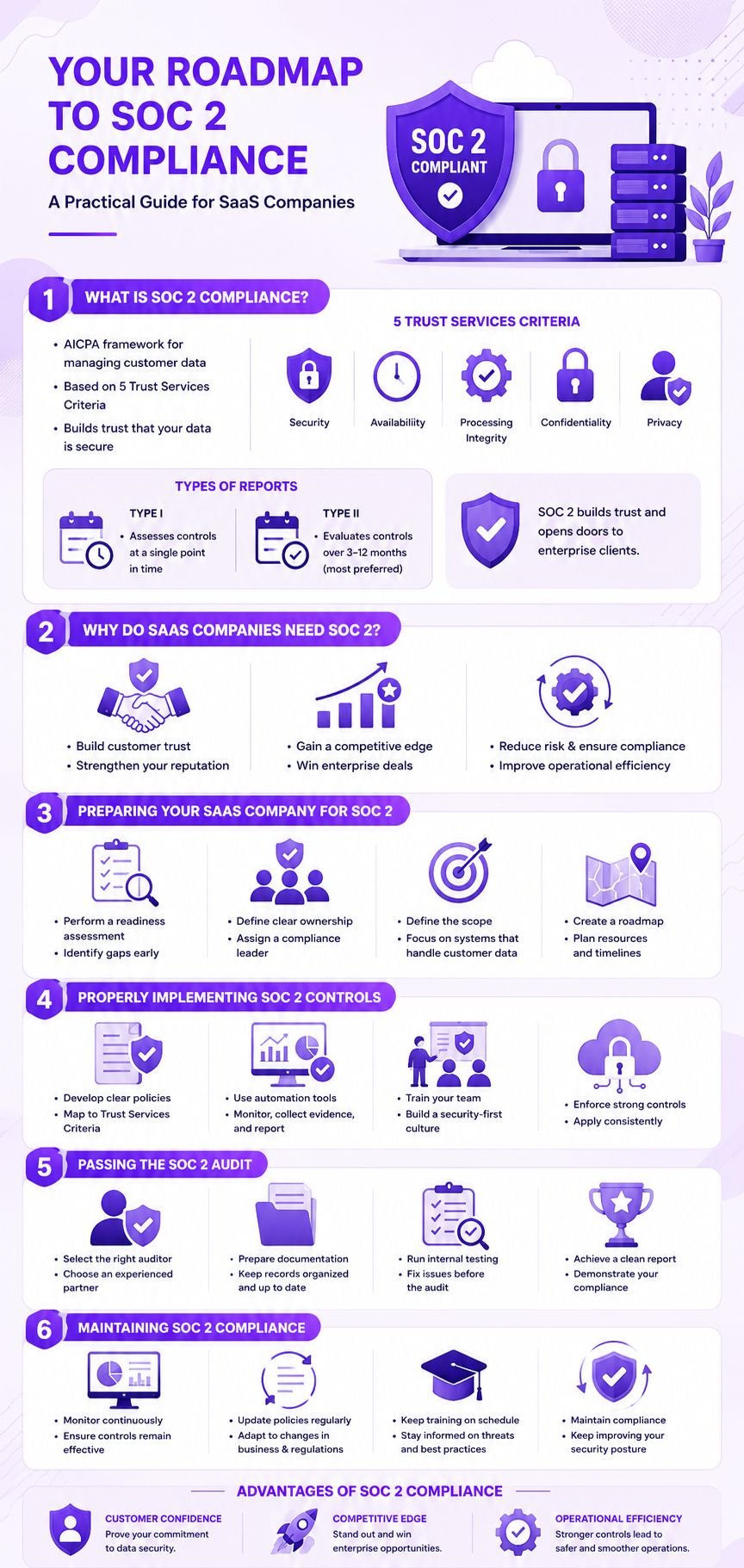
Let’s start with the basics. SOC 2 (short for Service Organization Control 2) is a framework developed by the American Institute of Certified Public Accountants (AICPA). It evaluates how organizations manage customer data based on five Trust Services Criteria: Security, Availability, Processing Integrity, Confidentiality, and Privacy.
Compliance means demonstrating that your systems, policies, and processes meet the standard required to protect data. For SaaS companies specifically, SOC 2 gives customers confidence that their sensitive information is in safe hands.
It’s worth noting that there are two types of SOC 2 reports. A Type I report assesses your controls at a single point in time, while a Type II report evaluates how effectively those controls operate over a period (typically three to twelve months). Enterprise clients almost always want to see a Type II report, so keep that in mind as you plan.
Why Do SaaS Companies Need SOC 2?
SaaS businesses operate in a fiercely competitive landscape where trust is one of the biggest differentiators. Achieving SOC 2 certification satisfies customer demands and signals your commitment to data security, enhancing your reputation and instilling confidence in potential clients.
Beyond reputation, SOC 2 simplifies internal operations by introducing structured policies and standardized processes. This reduces the risk of data breaches, operational failures, and non-compliance, while improving overall system reliability. The strong controls you build to meet the criteria tend to make your entire organization run more smoothly.
Perhaps most importantly, SOC 2 opens the door to enterprise clients, who typically require very high compliance standards from their vendors. A clean report is often the difference between getting shortlisted and getting ignored, making it a powerful tool for closing high-value deals.
Preparing Your SaaS Company for SOC 2
Perform a readiness assessment.
Before diving into the compliance process, evaluate where you stand. A readiness assessment surfaces the gaps in your existing controls, policies, and systems. Bring in an experienced auditor or consultant to review your current state and recommend the improvements you’ll need to make. Skipping this step is one of the most common reasons companies stumble later.
Define clear ownership.
SOC 2 compliance is a team effort, but assigning ownership ensures accountability. Designate a compliance leader to coordinate activities, manage timelines, and communicate progress. This role keeps everyone aligned and ensures no detail slips through the cracks.
Define the scope.
Clearly outline the scope of your audit, concentrating on the critical systems and processes that touch customer data. A well-defined scope helps you prioritize your efforts and avoid unnecessary complexity that can inflate both timeline and cost.
Properly Implementing SOC 2 Controls
Develop detailed policies.
Create and implement policies covering data security, access management, incident response, and risk assessment. Each policy should map directly to the relevant SOC 2 Trust Services Criteria, ensuring a clear, auditable link between what you say and what you do.
Use automation tools.
Compliance automation platforms make the process dramatically easier by reducing manual effort and improving accuracy. These tools handle continuous monitoring, evidence collection, logging, and incident reporting. Popular solutions include Vanta and Drata, both of which can significantly shorten your time to certification. That said, the tool is only as good as the processes behind it, so don’t treat automation as a substitute for genuine security practices.
Train your team.
The success of any compliance program depends on a security-first culture. Regularly train employees on best practices, policy adherence, and their individual role in protecting information. Human error remains one of the leading causes of security incidents, so this step matters more than many companies realize.
Passing the SOC 2 Audit
Select the right auditor.
Choose a seasoned, reputable SOC 2 auditor who understands your industry and how SaaS businesses actually operate. The right partner will make the process far less painful, and Axipro can help guide your company through it from start to finish.
Prepare thorough documentation.
Auditors require extensive documentation of your policies, controls, and processes. Keep your records current and organized throughout the year rather than scrambling to assemble them at the last minute, this is where a lot of companies lose time.
Run internal testing.
Before the formal audit, conduct internal tests to verify the effectiveness of your controls. Proactively identifying and fixing issues ensures a far smoother audit and reduces the risk of unexpected findings.
Maintaining SOC 2 Compliance
Monitor continuously.
SOC 2 is not a once-and-done event, especially for a Type II report that measures performance over time. Continuously monitor your systems for vulnerabilities and confirm that your controls remain effective month after month.
Update policies regularly.
As your business operations evolve, so do your compliance needs. Review and update your policies to reflect changes in regulations, technology, and organizational structure.
Keep training on schedule.
Ongoing employee training ensures your team stays current on compliance changes, emerging security threats, and evolving best practices. A single annual session isn’t enough, treat this as a recurring commitment.
Advantages of SOC 2 Compliance for SaaS Companies
Customer confidence.
A SOC 2 report gives clients concrete assurance that your company takes data security seriously, building lasting trust and credibility.
Competitive edge.
Compliance puts your SaaS company ahead in the market and makes you a viable option for enterprise customers who won’t even consider vendors without it.
Operational efficiency.
The disciplined processes and controls you build along the way translate into fewer risks and a more efficient organization overall.
Final Thoughts
SOC 2 compliance is a strategic investment, one that builds trust, wins enterprise deals, and strengthens your data security posture. The tips above should give you the confidence to pursue and sustain certification.
Just remember: compliance isn’t a destination; it’s an ongoing journey of monitoring, updating, and training your team to stay ahead of evolving threats.
Frequently Asked Questions
Why is SOC 2 compliance important for SaaS companies?
SOC 2 ensures SaaS companies adhere to rigorous data security standards, building trust with customers while minimizing operational and reputational risk.
How long does it take to achieve SOC 2 compliance?
It depends on your company’s size and readiness, but the process generally takes anywhere from three to twelve months.
What are the Trust Services Criteria for SOC 2?
The five criteria are Security, Availability, Processing Integrity, Confidentiality, and Privacy. Security (the “common criteria”) is mandatory; the others apply based on your scope.
Are automation tools a must-have for SOC 2 compliance?
Not strictly, but tools like Vanta and Drata make compliance significantly easier, improving both efficiency and the accuracy of your controls.
What should you do after achieving certification?
Focus on continuous monitoring, regular policy updates, and ongoing employee training to sustain your compliance over time.