

Table of Contents

Reach SOC 2 Compliance in 6 Weeks or Less.

  / Mastering Gap Analysis: The Key to Strategic Improvement and Compliance Excellence

Mastering Gap Analysis: The Key to Strategic Improvement and Compliance Excellence

Mastering Gap Analysis

In today’s dynamic business landscape, organizations face an ever-growing need to align their operations, security, and compliance practices with industry standards and regulatory requirements. Whether you’re aiming for ISO 27001, SOC 2, PCI DSS, GDPR or simply striving for operational efficiency, one critical tool can guide your journey: Gap Analysis.

Gap Analysis is more than just a compliance requirement it’s a strategic approach that helps organizations identify discrepancies between their current practices and desired goals. By understanding where gaps exist, businesses can prioritize improvements, mitigate risks, and enhance overall performance.

Let’s explore what Gap Analysis is, why it’s essential, and how Axipro empowers organizations to leverage this powerful tool for strategic success.

What is Gap Analysis?

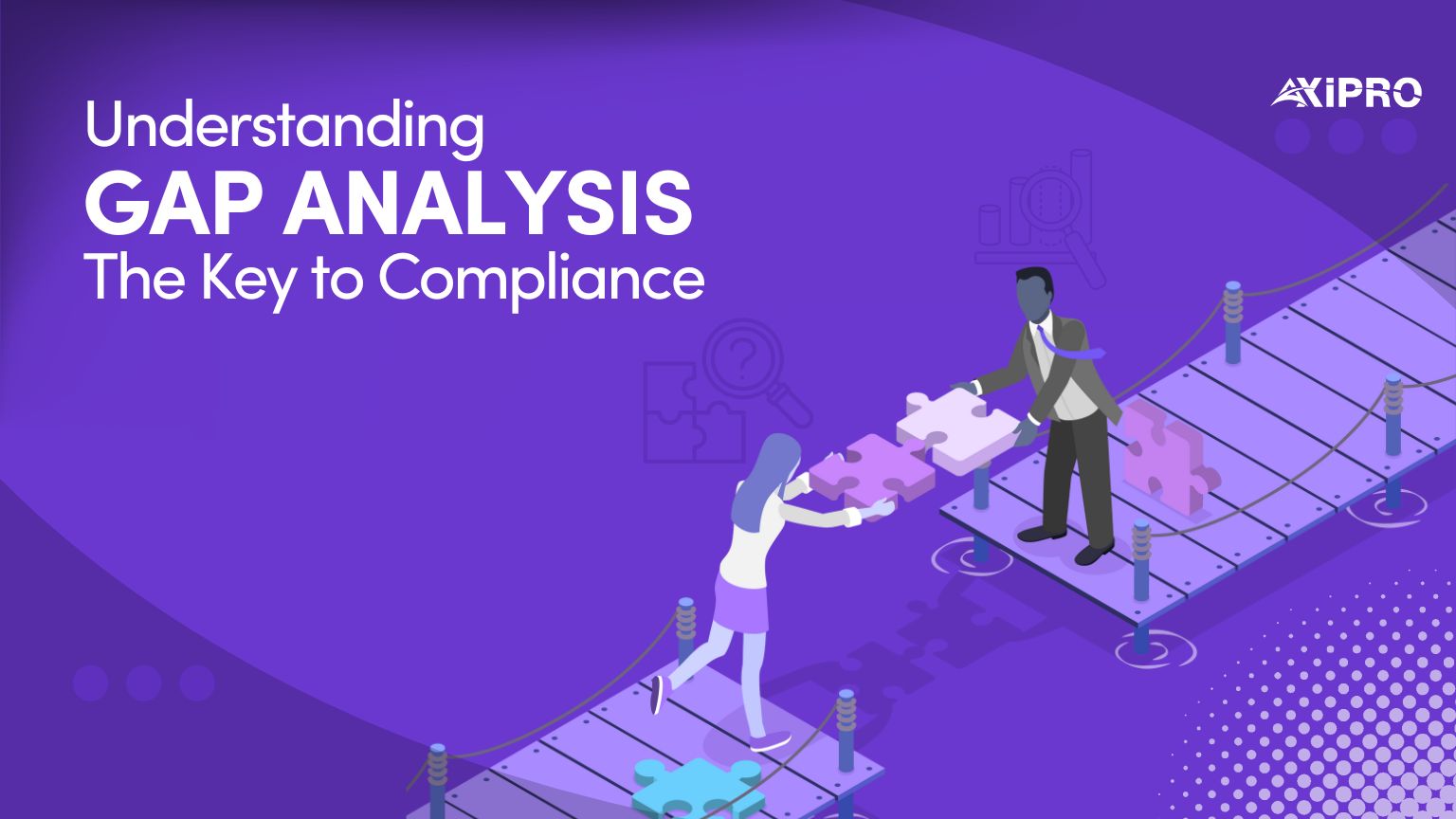
Gap Analysis is a systematic evaluation process that compares an organization’s current state against desired benchmarks, standards, or best practices. The goal is to identify gaps, inefficiencies, and risks that hinder optimal performance or compliance.

This analysis is widely used across various domains, including:

    • Compliance and Risk Management: Ensuring adherence to standards like ISO 27001, SOC 2, PCI DSS, HIPAA, GDPR, NIST CSF, and more.
    • Operational Efficiency: Identifying bottlenecks, redundancies, and productivity gaps in business processes.
    • Performance Improvement: Aligning business strategies with organizational goals for sustained growth.
    • Security Posture Evaluation: Identifying vulnerabilities and strengthening cybersecurity controls.

Why is Gap Analysis Important?


Gap Analysis is an invaluable tool that provides actionable insights to drive strategic improvements. Here’s why it’s crucial:

  • Identifies Compliance Shortcomings: Uncovers areas where current practices fall short of regulatory requirements or industry standards.
  • Mitigates Risks: Detects vulnerabilities and gaps in controls, reducing the likelihood of security breaches and compliance penalties.
  • Enhances Operational Efficiency: Highlights inefficiencies, enabling organizations to optimize resources and improve productivity.
  • Guides Strategic Decision-Making: Offers data-driven insights that inform strategic initiatives and risk management.
  • Streamlines Certification Processes: Simplifies the journey to certification by providing a clear roadmap for closing compliance gaps.

Axipro’s Approach to Gap Analysis


At Axipro, we understand that no two organizations are alike. Every business has unique challenges, industry requirements, and strategic goals. That’s why our Gap Analysis Service is designed to provide a comprehensive and tailored assessment that aligns with your specific needs.


  1. Customized Assessments

We believe that a one-size-fits-all approach doesn’t work when it comes to Gap Analysis. Our consultants work closely with your organization to customize the assessment according to your industry, compliance requirements, and business objectives. Whether you’re pursuing ISO 27001, SOC 2, PCI DSS, HIPAA, GDPR, or operational excellence, our assessments are tailored to meet your goals.

       2. Thorough Evaluation

Our team of experts conducts a detailed evaluation of your existing processes, policies, and practices.
This includes:

  • Reviewing documentation, workflows, and security controls.
  • Analysing Key Performance Indicators (KPIs) to establish a clear baseline.
  • Assessing your risk management framework to identify potential threats and vulnerabilities.
    This thorough evaluation provides a holistic view of your organization’s current state.
  1. Identification of Gaps and Risks

Through meticulous analysis, we identify:

  • Compliance Shortcomings: Areas where existing practices do not meet regulatory requirements or industry standards.
  • Operational Inefficiencies: Redundancies, bottlenecks, or productivity gaps in business processes.
  • Security Vulnerabilities: Weaknesses in security controls that may expose your organization to threats.
  1. Collaborative Approach

At Axipro, we value collaboration and transparency. Our team works closely with your stakeholders throughout the Gap Analysis process to:

  • Ensure that findings are contextualized and relevant to your strategic objectives.
  • Empower your team with knowledge and tools needed to take ownership of the remediation process.
  • Deliver practical and actionable recommendations for seamless implementation.
  1. Prioritized Action Plan

Once gaps are identified, we provide a detailed action plan that:

  • Prioritizes areas requiring immediate attention based on risk severity and business impact.
  • Outlines a step-by-step roadmap for addressing identified gaps.
  • Ensures a structured and efficient improvement process tailored to your objectives.
  1. Strategic Recommendations

Our service goes beyond identifying gaps by providing strategic recommendations that are:

  • Actionable and Measurable: Clear steps for remediation with key performance indicators for tracking progress.
  • Aligned with Organizational Goals: Ensuring that improvement initiatives support your strategic vision.
  • Focused on Long-Term Success: Enabling your organization to achieve and maintain compliance, operational efficiency, and security resilience.

Why Choose Axipro for Gap Analysis?


With Axipro, you get more than just a checklist approach to Gap Analysis. We offer:

  • Expertise Across Multiple Standards: Our consultants have extensive experience in ISO 27001, SOC 2, PCI DSS, HIPAA, GDPR, NIST CSF, and other frameworks.
  • Tailored Solutions: Customized assessments that align with your industry-specific needs and strategic goals.
  • End-to-End Support: From Gap Analysis to remediation, certification, and continuous improvement, we support your entire journey.
  • Proven Success: Our Compliance Acceleration Program (CAP) powered by Drata helps organizations achieve compliance faster and maintain it efficiently.

Bridge the Gaps and Drive Strategic Success


A well-executed Gap Analysis is the foundation for compliance excellence, operational efficiency, and strategic growth. Whether you’re aiming for ISO 27001 certification, SOC 2 readiness, PCI DSS compliance, or simply enhancing your business performance, Axipro’s tailored Gap Analysis services provide the actionable insights you need to succeed.

Axipro Author

Picture of Abeera Zainab

Abeera Zainab

Blog Highlights

Explore More Articles

The AICPA never wrote the words penetration test required into SOC 2. Yet a service organization that walks into a Type II audit without one is almost guaranteed to leave with findings, follow-up questions, or a delayed report. That gap, between what the standard technically demands and what auditors operationally expect, is where most companies trip. This article breaks down the real SOC 2 penetration testing requirements: where they sit in the Trust Services Criteria, what auditors look for during Type I and Type II engagements, how often you should test, and what a good pen test report needs to contain to satisfy your auditor without inflating your budget. Understanding SOC 2 and Its Security Expectations What Is SOC 2? SOC 2 is an attestation framework developed by the American Institute of Certified Public Accountants (AICPA) for service organizations that handle customer data. Unlike a certification, SOC 2 is an opinion: a licensed CPA firm reviews your security controls and issues a report stating whether those controls are designed (Type I) or operating (Type II) effectively. SOC 2 reports are read by enterprise procurement teams, security reviewers, and risk officers. Most B2B SaaS contracts in 2026 require one before signing. What Controls Does SOC 2 Require? Rather than dictating specific technologies, SOC 2 requires that you design and operate controls that demonstrably meet each criterion under the Trust Services Criteria (TSC). That gives you flexibility, and it also gives auditors latitude to ask hard questions. Does SOC 2 Require Penetration Testing? The Official SOC 2 Position on Penetration Testing The phrase penetration test appears in the AICPA’s 2017 Trust Services Criteria publication (with 2022 revisions) inside a single Point of Focus under CC7.1, the Common Criterion that requires entities to use detection and monitoring procedures to identify changes to configurations that introduce new vulnerabilities and susceptibilities to newly discovered vulnerabilities. The Point of Focus suggests management uses a variety of ongoing and separate risk and control evaluations to determine whether controls function. Penetration testing is named as one option. That is the entire textual basis. There is no clause that mandates an annual external pentest, no specification of scope, no required methodology. Short Answer: There Are No Mandatory SOC 2 Pen Test Requirements You can technically obtain a SOC 2 report without a penetration test, provided you can show your auditor that you use alternative evaluations to satisfy CC4.1 (ongoing monitoring) and CC7.1 (vulnerability identification). In practice, almost nobody does this successfully. Long Answer: You Still Need SOC 2 Penetration Testing Auditors view penetration testing as the strongest available evidence that your controls work against a determined adversary, not just on paper. CC4.1 asks the entity to perform ongoing monitoring to ascertain whether internal controls are present and functioning; a pen test is the most direct way to evaluate that. CC6.1 asks whether logical access controls can be bypassed; a pen test answers that question directly. CC7.1 ties this together by requiring you to detect newly introduced vulnerabilities. If you skip pen testing, you carry the burden of proving your alternative evidence is at least as good. That is a steeper hill than most organizations realize. What Auditors Expect During Type I and Type II Engagements A SOC 2 Type I report assesses control design at a single point in time. A Type II report assesses operating effectiveness over a defined audit period, typically six to twelve months. Both increasingly assume a recent penetration test exists. For Type II especially, auditors expect the test to fall within the audit window, with documented remediation of any critical or high findings before the period closes. Auditors rarely refuse a Type II report over a missing pentest outright, but they will issue a finding or qualified opinion if they cannot validate CC4.1 evidence. That qualification will be read by every customer reviewing your report. Most CISOs would rather budget $15,000 for a pentest than try to explain a qualified opinion to a procurement team. What Are the Actual SOC 2 Penetration Testing Requirements? Alignment with Trust Services Criteria A pen test that supports a SOC 2 audit must map its findings to specific criteria. Most reputable pentest firms now produce a Trust Services Criteria mapping appendix that ties identified vulnerabilities back to CC4.1, CC6.1, CC7.1, and where relevant CC7.2 through CC7.4. Without that mapping, your auditor has to do the interpretive work themselves, which typically means a follow-up request and a slower report. Scope Definition Requirements Scope should match your SOC 2 system boundary, not your entire infrastructure. If your audit covers a single SaaS product, its API, and its AWS account, that is what should be tested. Auditors look for evidence that the pen test scope was derived from the system description in your SOC 2 report. A mismatch between the two is one of the most common causes of fieldwork delays. Testing Frequency and Timing Requirements SOC 2 does not specify a frequency. Annual testing has become the de facto standard, with additional testing after material changes to architecture, authentication, or hosting. For organizations on continuous deployment, some auditors now accept a combination of annual deep-dive testing and continuous automated assessment as sufficient coverage, but this should be confirmed with your auditor before you rely on it. Remediation Evidence Requirements Findings without remediation are findings against you. Auditors expect documented remediation plans for every critical and high-severity issue, with closed tickets, retest results, or compensating controls recorded before the audit period ends. A finding sitting open in a backlog at audit time is treated almost identically to a finding that was never addressed. Penetration Testing vs. Vulnerability Scans for SOC 2 Both belong in your control set, but they answer fundamentally different questions. Vulnerability scanning is automated and broad, it identifies known CVEs and misconfigurations across your environment quickly and consistently. Penetration testing is manual and adversarial, it simulates what a real attacker would do with the access and information they can obtain. CC7.1 explicitly references both, and your auditor

The CMMC program turned from advisory framework to binding contract requirement on November 10, 2025, when the DoD’s Title 48 acquisition rule took effect.  That single date changed the market for CMMC advisory services overnight, and the Cyber AB Registered Practitioner credential moved from a useful business card to a genuine signal of competence.  Over 80,000 companies in the Defense Industrial Base now need help interpreting the rule, and the RP is the formal entry-level role in the ecosystem authorized to provide it. This guide explains what a CMMC Registered Practitioner is, how the role fits alongside CCPs, CCAs, RPOs, and C3PAOs, what it takes to earn the designation, and how Organizations Seeking Certification (OSCs) should think about engaging one. What Is a CMMC Registered Practitioner (RP)? A CMMC Registered Practitioner is an individual authorized by the Cyber AB, the official accreditation body for the CMMC ecosystem, to provide non-certified advisory and consulting services to Organizations Seeking Certification.  RPs help defense contractors interpret the CMMC model, scope their environments, build documentation, remediate gaps against NIST SP 800-171, and prepare for the formal assessment they will eventually undergo. The credential exists because the CMMC framework is genuinely dense. CMMC Level 2 maps to all 110 controls in NIST SP 800-171, and Level 3 layers on 24 selected requirements from NIST SP 800-172. Most contractors do not have the in-house expertise to implement these controls cleanly, and the Cyber AB needed a way to identify advisors who had at least demonstrated baseline knowledge of the program. An RP does not perform official assessments. That work is reserved for Certified CMMC Assessors (CCAs) operating under a C3PAO. The RP role is strictly advisory, and the Code of Professional Conduct that every RP must sign makes the boundary explicit. How RPs Fit Into the Broader CMMC Ecosystem The Cyber AB structures the ecosystem into two distinct lanes: consulting and implementation on one side, assessment and certification on the other. RPs sit on the consulting side. CCPs, CCAs, and C3PAOs sit on the assessment side. The two are kept deliberately separate so that no firm can audit work it helped configure, a separation that preserves the integrity of the certification process. Registered Practitioners vs. Certified CMMC Professionals (CCPs) The CCP is a more rigorous credential. CCP candidates must complete formal Cyber AB training delivered by a Licensed Training Provider, pass a commercial background check, and sit a proctored exam administered by CAICO. CCPs can participate in actual assessments as part of a C3PAO assessment team, though they cannot lead them. RPs cannot participate in assessments at all. In practical terms, the RP credential is the right starting point for consultants, MSPs, and internal compliance staff who want to demonstrate baseline CMMC fluency. The CCP is the right credential for professionals planning a career in CMMC assessment work. Registered Practitioners vs. C3PAOs A C3PAO (Certified Third-Party Assessment Organization) is the entity authorized to conduct official Level 2 certification assessments and issue formal CMMC status determinations. Fewer than 100 firms held C3PAO authorization as of early 2026, serving an ecosystem of more than 80,000 contractors. C3PAOs are companies. RPs are individuals. They do completely different jobs: the RP prepares the contractor, the C3PAO certifies them. Important: A C3PAO that helps a client implement controls is barred from later assessing that same client. This is a hard line in the Code of Professional Conduct. If you engage a firm for both readiness and certification work, you will end up paying two different organizations regardless, so plan accordingly from the start. What Does a CMMC Registered Practitioner Do? The work of an RP is the work of getting an organization to the starting line of a formal assessment without surprises. That includes interpreting which CMMC level applies to a given contract, scoping the CUI and FCI environments, identifying gaps against NIST SP 800-171, drafting the System Security Plan (SSP) and Plan of Action and Milestones (POA&M), advising on technical remediation, and coaching the OSC through mock assessments before the real one. Who Can a CMMC RP Help? RPs serve any organization in the Defense Industrial Base that needs to achieve a CMMC status. That includes prime contractors, subcontractors at any tier, MSPs, and MSSPs that handle CUI on behalf of defense clients, manufacturers, research universities, and civilian agency contractors whose departments have adopted CMMC-aligned clauses. The flow-down requirements in 32 CFR §170.23 mean that even small subcontractors who process Federal Contract Information (FCI) must hit Level 1, which keeps RP work relevant well past the first wave of large primes. What Services Does a CMMC RP Provide? The core service menu looks consistent across the market: gap assessments against NIST SP 800-171, scope definition, SSP and POA&M drafting, policy and procedure development, technical advisory on encryption, access control and incident response, and pre-assessment readiness reviews. Strong RPs also help clients interpret recent guidance changes, manage their SPRS score, and prepare evidence packages that will survive scrutiny from a C3PAO assessment team. Pro Tip: Evaluating a Registered Practitioner When evaluating an RP, ask whether they have walked a client through a full C3PAO assessment cycle, not just a gap assessment. There is a significant difference between consultants who write SSPs and consultants who have watched assessors actually challenge one. How to Become a CMMC Registered Practitioner The path is straightforward but not trivial. The Cyber AB controls the registration process end-to-end, and every step must be completed in order. Step 1: Complete the Required CMMC Registered Practitioner Training The RP training is delivered online through the Cyber AB’s learning management system. It covers the CMMC model document, the structure of the ecosystem, scoping methodology, FCI and CUI definitions, prime and subcontractor information flow, the assessment process, and the relationship between CMMC and existing DFARS clauses. The course typically takes around eight hours. Candidates should plan for roughly $500 to $600 in combined training and annual registration costs. Step 2: Register with the Cyber AB After training, candidates submit a

A single VS Code extension installed by a single GitHub employee has cost the world’s largest code host roughly 3,800 of its internal repositories. GitHub confirmed the breach in a five-post thread on X on May 20, 2026, attributing the compromise to a poisoned extension that ran on the employee’s machine and gave attackers a foothold inside Microsoft’s flagship developer platform. The threat group TeamPCP, already infamous for a string of supply chain attacks across npm, PyPI, and PHP packages earlier this year, has claimed responsibility on underground forums and is reportedly asking more than $50,000 for the stolen dataset. GitHub’s own assessment is that the attacker’s claim of around 3,800 exfiltrated repositories is directionally consistent with what investigators have found so far. The company says no customer data was touched. What GitHub Disclosed GitHub broke the news in a numbered thread of five short posts on X, with no entry on the official github.blog or githubstatus.com at the time of disclosure. The company said it detected the compromise of an employee device the previous day, removed the malicious extension version from the marketplace, isolated the affected endpoint, and rotated critical secrets overnight, prioritizing the highest-impact credentials first. “Our current assessment is that the activity involved exfiltration of GitHub-internal repositories only,” GitHub wrote, adding that it would continue to monitor logs for follow-on activity and publish a fuller report once the investigation is complete. The phrasing is careful. Saying GitHub-internal repositories only rules out customer repos, enterprise tenants, and organization data hosted on the public platform, but it leaves open what was inside those 3,800 repos: deployment scripts, infrastructure configuration, API documentation, staging credentials, and the architectural blueprints of GitHub itself. Important Note “No customer data” does not mean “no customer risk.” Internal repositories at a platform like GitHub typically contain deployment topology, secret rotation logic, CI workflows, and references to third-party integrations. Even if no customer secrets are inside, the architectural knowledge alone meaningfully reduces the cost of attacking customers downstream. The Attack: A Trojanized Extension Inside a Trusted Marketplace GitHub has not yet named the specific extension. Security researchers tracking TeamPCP’s tradecraft note that the group has spent 2026 weaponizing exactly this surface, planting trojanized code in package registries and development tools that developers trust by default. The mechanism is brutally simple. A developer browses the VS Code Marketplace, installs an extension that looks legitimate, and grants it the same execution privileges as any other process running under their account. From there, the malware can read source files, exfiltrate Git credentials, harvest tokens from ~/.aws, ~/.kube, and password managers, and clone every repository the developer has access to. There is no permission model meaningfully limiting what an extension can do once it executes. A theme can do anything a debugger can do. Browser extensions get treated as a security boundary. IDE extensions, which see your source code, your credentials, and your terminal, do not. That asymmetry is the single largest unaddressed risk in the modern developer toolchain, and the GitHub incident is the most expensive demonstration of it to date. What GitHub Has Done, and What Comes Next The containment steps GitHub described are textbook: detect, isolate, rotate, monitor. The company says it removed the malicious extension version, took the developer’s machine off the network, and rotated the credentials most likely to provide further pivots. The investigation continues, and GitHub has committed to publishing a fuller report later. Where the response is less defensible is in disclosure. Announcing a breach of this scale exclusively on X, a platform that requires a login to view most posts, drew sharp criticism. As of publication, there is no entry on the GitHub Blog and no advisory on the official status page. Customers governed by frameworks such as DORA or NIS2, both of which have hard supplier-incident notification timelines, will be looking for something more substantive than a Twitter thread. Pro Tip: IDE plugins and Cyber Security Treat any IDE plugin like a piece of production software. Pin to specific versions, disable auto-updates on critical machines, restrict the allowed publisher list (in VS Code via the extensions.allowed setting), and ensure that any project containing credentials cannot be opened by an editor that auto-runs .vscode/tasks.json without confirmation. If you maintain CI/CD secrets, assume that any developer machine with both source access and an unverified extension installed is already in the threat model. For organizations downstream of GitHub itself, the immediate hygiene items are clear. Rotate any GitHub personal access tokens or OIDC credentials that were used in conjunction with packages from the TanStack, UiPath, Mistral AI, OpenSearch, or Guardrails AI namespaces during the early May window. Audit .vscode/ and .claude/ directories for files such as router_runtime.js or setup.mjs. Search for the gh-token-monitor daemon, which acts as a dead-man switch and triggers a destructive rm -rf on token revocation if not removed first. An Incident or a Pattern? GitHub has had a rough quarter on availability, with multiple outages drawing public complaints. A confirmed source-code breach by the most prolific supply chain threat actor of 2026 lands at the worst possible moment for that narrative. Independent agencies such as the Cybersecurity and Infrastructure Security Agency and NIST, through its Secure Software Development Framework, have been warning for years that developer tooling and build pipelines are the soft underbelly of every modern company, and the Wikipedia entry for supply chain attack now reads like a chronological list of escalating incidents. The deeper lesson from the GitHub breach is not that one employee made a mistake. It is that the security model of the modern developer workstation has not kept pace with the value of what sits on it. Until IDE extensions are sandboxed with explicit capability grants, until source code repositories are treated as sensitive assets rather than collaboration surfaces, and until the disclosure norms for breaches at platform-level vendors are tightened, the Mini Shai-Hulud playbook will continue to work. GitHub will not be the last victim of this campaign. It is simply, for