
Enforcement of the EU AI Act’s core rules started on 2 August 2026, and ISO/IEC 42001:2023 is the standard companies reach for when they need to prove their AI governance actually holds up. It’s the first certifiable standard for an Artificial Intelligence Management System (AIMS), and consultancies package help with it in two ways. A gap analysis tells you how far you are from the standard. Full implementation support builds the management system with you until you’re ready for certification.
The two engagements differ enormously in cost, duration, and how much of the work the consultant carries, so picking the wrong one is expensive in both directions. Buy implementation when you only needed a roadmap and you pay for work your team could have done themselves. Buy a gap analysis when you have nobody to close the gaps and the report sits in a drawer while your certification deadline slips past. This article covers what each service includes, what each costs, who should pick which, and how the two combine.
What Is an ISO 42001 Gap Analysis?
A gap analysis is a structured baseline assessment. A consultant reviews your current AI governance practices against the requirements of ISO 42001: the management system clauses (4 through 10) and the Annex A controls, of which there are 38 grouped under nine control objectives. You end up with a clear picture of what already satisfies the standard, what partially satisfies it, and what doesn’t exist at all.
The purpose is diagnostic, not corrective. Nobody writes your AI policy during a gap analysis. What you get is a gap report with maturity scoring against each clause and control, a prioritized remediation roadmap, an early view of your likely AIMS scope and Statement of Applicability (SoA), and an estimate of the effort certification will take.
Timeframes are short. A standalone ISO 42001 gap analysis usually takes one to three weeks, with a few days of consultant time and a modest internal commitment: stakeholder interviews, access to documentation, and someone who can describe how AI is actually used across the business. Standalone assessments on the market typically run in the low four figures. Axipro bundles one into its free 30-day Compliance Accelerator Plan, so in practice you can get the diagnostic without spending anything.
A gap analysis is the right entry point when you already have governance maturity to build on. Companies with an existing ISO 27001 ISMS often find heavy overlap in the management system clauses, since both standards follow the same Plan-Do-Check-Act (PDCA) structure. It also fits when you have internal compliance expertise to execute the roadmap, when budget needs phasing, or when you want an accurate scope before committing to a bigger project.
Insider Note: The step that consistently takes longer than anyone expects is the AI system inventory. Most companies walk into a gap analysis confident they know where AI is used, then discover marketing has been running LLM tools on customer data, and engineering has embedded a third-party model nobody scoped. Budget real time for discovery before the control review starts.
Let Axipro help you build a business continuity plan that's practical, compliant, and audit-ready.
Schedule Your Free Assessment Today
What Is ISO 42001 Full Implementation Support?
Full implementation support is an end-to-end engagement that takes you from your current state to certification readiness. The consultant identifies the gaps, then closes them with you, building the AIMS piece by piece and owning the project through to the external audit.
The deliverables list is long. A typical engagement covers the AI policy and governance framework, an AI risk assessment methodology, completed AI risk assessments and AI impact assessments for your in-scope systems, the Statement of Applicability, the applicable Annex A controls put in place (data governance, human oversight, transparency, and so on), the documentation and evidence set an auditor will ask for, staff training, an internal audit, a management review, and corrective action plans for whatever the internal audit surfaces. Most providers, Axipro included, also coordinate directly with the accredited certification body through the Stage 1 and Stage 2 audits.
Most organizations need roughly three to six months. It’s shorter where an ISO 27001 ISMS already exists to integrate with, longer for complex or high-risk AI portfolios. Consultant involvement is heavy and sustained, but your team doesn’t disappear from the project. Internal subject-matter experts still make the real decisions about AI use cases, data handling, and acceptable risk. On cost, consultant-led ISO 42001 implementations commonly run well into five figures. Axipro’s ISO 42001 readiness engagement costs $4,500, which is one of the reasons the honest comparison below matters: at that price, the “just buy the gap analysis to save money” logic gets a lot weaker.
Full implementation is the right call when you’re starting an AIMS from scratch, when nobody internal can carry the workload, when a certification deadline is fixed by an enterprise deal or regulatory exposure, or when your AI use cases are risky enough that getting the controls wrong has real consequences. The EU AI Act’s requirements for high-risk AI systems entered into application in August 2026, and companies in that category rarely get the luxury of a slow, self-paced build.
Key Differences Between the Two Services
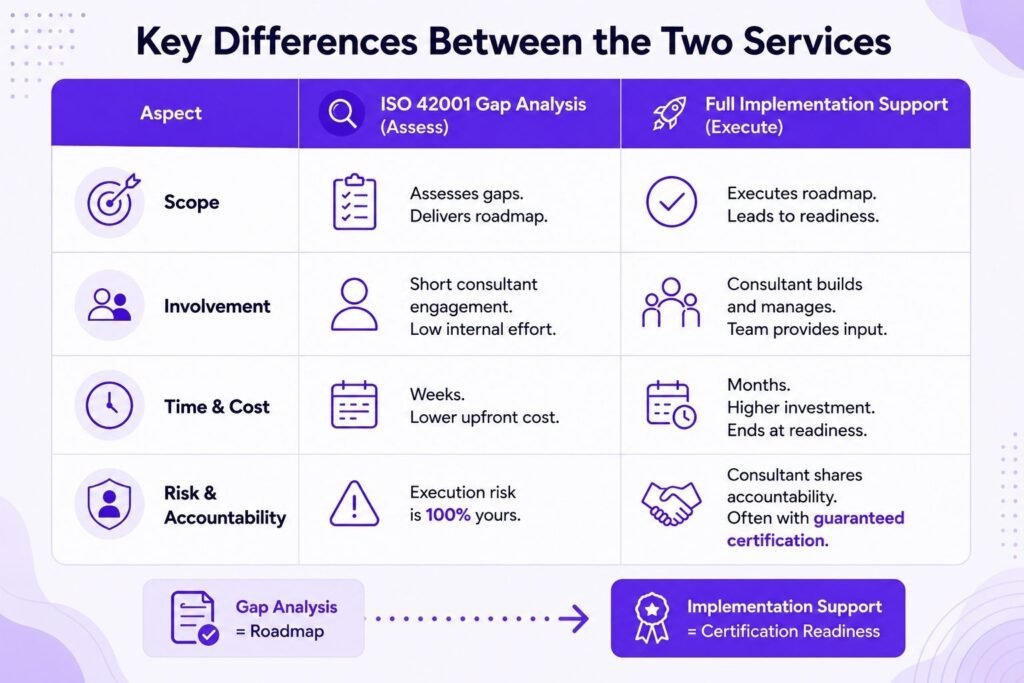
Scope and depth
A gap analysis assesses; implementation support executes. The gap analysis stops at the roadmap, no matter how detailed. Implementation carries every roadmap item through to a working, evidenced control. That distinction sounds obvious, but it’s the single most common source of buyer disappointment: a gap report doesn’t make you certifiable, and some companies find that out only after they’ve scheduled a Stage 1 audit.
Consultant involvement and internal effort
In a gap analysis, the consultant works in short, concentrated bursts and your team’s effort is measured in hours of interviews and document gathering. In full implementation, the consultant drafts, builds, and project-manages, yet your team still spends real time reviewing policies, making risk decisions, and generating evidence. Any provider promising certification with zero internal effort is describing a paper AIMS that won’t survive an audit or an incident.
Cost and time to readiness
A gap analysis finishes in weeks and costs less upfront. Implementation takes months, but it’s the only one of the two that ends at certification readiness. If you buy a gap analysis and then execute the roadmap internally, your total elapsed time is usually longer than a consultant-led implementation, because internal teams fit remediation around their day jobs.
Risk ownership and accountability
After a gap analysis, execution risk sits entirely with you. If the roadmap stalls, that’s an internal problem. Under implementation support, the consultant shares accountability for reaching readiness, and the commercial structure often reflects that: Axipro’s Achievement Plan, for example, comes with guaranteed certification.
Side-by-Side Comparison
| Factor | Gap Analysis | Full Implementation Support |
|---|---|---|
| Purpose | Diagnostic — measures distance from the standard | Corrective — builds the AIMS to certification readiness |
| Main deliverable | Gap report, maturity scoring, remediation roadmap | Working AIMS: policies, risk assessments, controls, evidence, internal audit |
| Duration | 1–3 weeks | 3–6 months |
| Consultant effort | Light, concentrated | Heavy, sustained |
| Internal effort | Interviews and document access | Ongoing reviews, risk decisions, evidence generation |
| Typical cost | Low four figures (free in Axipro’s CAP) | Well into five figures on the wider market ($4,500 at Axipro) |
| Ends at certification readiness? | No | Yes |
| Risk ownership | Entirely yours | Shared with the consultant |
When a Gap Analysis Is the Right Choice
- You already have AI governance maturity.
If you hold ISO 27001, run a functioning risk program, and have documented at least some AI-specific policies, a gap analysis may show you’re closer to 42001 than you think. The management clauses of the two standards align closely, and an integrated audit path cuts duplicated work. - Budget is the binding constraint.
A gap analysis turns an unknown, intimidating project into a scoped, priced one. Even if you later buy implementation support, you’ll buy it with accurate scope instead of a provider’s guess. - You have internal compliance expertise.
A capable GRC lead with roadmap in hand can execute much of the remediation. The consultant’s assessment de-risks their plan without displacing their role. - You’re preparing for a larger project.
Boards and buyers respond better to “we need six months and this specific list of controls” than to “we should probably do ISO 42001.” A gap analysis produces exactly that business case.
When Full Implementation Support Is the Right Choice
- You’re starting from scratch. No AI policy, no risk methodology, no inventory. Building an AIMS from zero involves dozens of interdependent artifacts, and sequencing them wrong wastes months.
- Nobody internally owns AI governance. This is the most common situation at SaaS scale-ups: the CTO or an ops lead holds compliance as a side responsibility. A roadmap handed to someone with no bandwidth is a roadmap that doesn’t get executed.
- The deadline isn’t yours to move. An enterprise customer requiring ISO 42001 in the next procurement cycle, or exposure to the EU AI Act’s high-risk requirements, removes the option of a leisurely internal build.
- Your AI use cases carry real risk. Systems making decisions about people, such as hiring, credit, or health, deserve expert judgment on risk treatment and human oversight design rather than a first attempt by a stretched internal team. France’s standards body AFNOR notes that certification auditors pay particular attention to data quality, governance, and the management of risks and impacts linked to algorithms, and that’s exactly where inexperienced implementations get picked apart.
Pro Tip: Accreditation for ISO 42001
Whichever route you take, ask early which certification bodies your consultant works with and whether those bodies hold accreditation for ISO 42001. Accreditation for this standard is still maturing, audit slots are limited, and Stage 1 scheduling alone can add weeks to an otherwise finished project.
Can You Combine Both Services?
Yes, and for most buyers the phased model is the honest recommendation. Start with a gap analysis, review the roadmap, then decide how much of it to execute internally versus with support. Reputable consultancies will credit the gap analysis into a subsequent implementation engagement, since the assessment work is the first stage of implementation anyway.
The phased approach turns one large, uncertain commitment into two smaller, well-scoped decisions, and it gives you a working test of the consultant before the bigger engagement. It also lets a resourced internal team take the cheap 80 percent of remediation while reserving consultant time for the hard 20 percent: risk methodology, impact assessments, and audit preparation. Axipro’s free Compliance Accelerator Plan runs on this exact logic, bundling a gap analysis and initial policies into a 30-day starting phase before any paid implementation begins.
Important: A gap analysis alone doesn’t make you certification-ready, no matter how thorough the report. Certification requires implemented controls, generated evidence, a completed internal audit, and a management review. Treat the gap report as the start line, not the finish line.
How to Decide: A Four-Question Framework
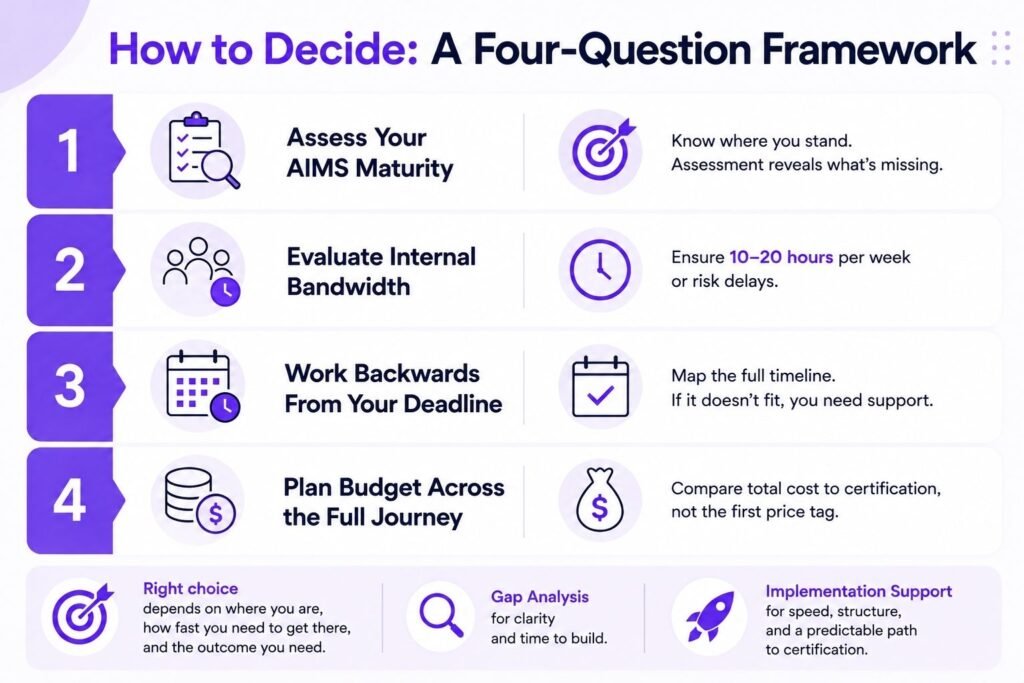
First, assess your current AIMS maturity honestly.
If you can’t produce an inventory of AI systems, a risk register, or any AI-specific policy, you’re at the start-from-scratch end and a gap analysis will mostly confirm what you already suspect. If you hold ISO 27001 and have partial AI governance maturity, an assessment adds real information.
Second, evaluate internal bandwidth, not just expertise.
The question isn’t whether someone on your team could set up ISO 42001, but whether they have 10 to 20 hours a week to spend on it for several months. Expertise without bandwidth produces stalled roadmaps.
Third, work backwards from your certification deadline.
Add up gap analysis time, remediation at your team’s realistic pace, the internal audit, and certification body scheduling. If the total lands after your deadline, implementation support stops being a preference and becomes arithmetic.
Fourth, plan budget across the full journey.
Compare the total cost to certification under each path, not the sticker price of the first engagement. A cheap gap analysis followed by six months of expensive internal drift can easily cost more than a $4,500 fixed-scope readiness engagement. Frameworks like the voluntary NIST AI RMF can structure interim governance work, but they don’t produce a certificate, so budget against the outcome you actually need.
Let Axipro help you build a business continuity plan that's practical, compliant, and audit-ready.
Schedule Your Free Assessment Today
What to Expect After Each Service
After a gap analysis, you own a prioritized roadmap and a decision. Execute internally, buy targeted support for specific workstreams, or move into full implementation. The worst outcome is deferring that decision. Gap reports age quickly as AI use inside the business changes.
After full implementation support, the path runs through the external audit.
- Stage 1 reviews your documentation and readiness,
- Stage 2 tests whether the AIMS operates in practice, and a pass means certification from an accredited body, typically valid for three years with annual surveillance audits.
The AIMS then needs ongoing operation: risk assessments as new AI systems ship, periodic internal audits, management reviews, and continuous improvement under the PDCA cycle. Ongoing maintenance, whether handled internally or through a provider like Axipro’s ISO 42001 implementation services, is what keeps the certificate alive after the project team disbands.
Conclusion
The choice between an ISO 42001 gap analysis and full implementation support comes down to four things: how mature your AI governance already is, how much internal bandwidth you can commit, how hard your deadline is, and how the budget spreads across the journey to certification. A gap analysis suits mature, resourced teams that need a map.
Full implementation suits teams that need the destination, on a date, with someone accountable for getting there. For most companies, the phased combination, assessment first and execution second, delivers the best ratio of certainty to spend.
Frequently Asked Questions
Is a gap analysis required before full implementation?
No. Every implementation engagement includes its own assessment phase, so a separate gap analysis isn’t a prerequisite. It’s worth buying standalone when you want a scoped view before committing budget, or when you plan to execute remediation internally.
Can a gap analysis alone prepare us for ISO 42001 certification?
No. Certification requires implemented controls, evidence of operation, an internal audit, and a management review, and a gap analysis delivers none of those. It prepares you to plan the work, not to pass the audit.
How much does full implementation cost compared to a gap analysis?
Standalone gap analyses typically run in the low four figures, while consultant-led implementations on the wider market often reach well into five figures. Axipro’s ISO 42001 readiness engagement costs $4,500, and its gap analysis comes free inside the 30-day Compliance Accelerator Plan. An existing ISO 27001 ISMS usually reduces the build on either path.
Can the same consultant deliver both services?
Yes, and it’s usually preferable. A consultant who ran the gap analysis starts implementation with full context, and most will credit the assessment into the larger engagement. The certification audit itself must come from an independent accredited certification body, though, not from the consultant who built your AIMS.
Which service better supports EU AI Act alignment?
Full implementation support, in most cases. ISO 42001 is widely used as a structured route toward AI Act obligations, and the Act’s high-risk requirements entered into application in August 2026. Meeting them requires operating controls, not a list of gaps. A gap analysis still helps by mapping where 42001 work and AI Act exposure overlap.