
You can get a SaaS company ready for a SOC 2 audit in six weeks, but you’ll feel every one of them. Most published timelines say three to six months. For a company with no project owner, no identity provider, and nothing written down, that’s about right. A cloud-native startup that already has the basics in place and can protect some time is a different story, and it can fit the work into six hard weeks.
This plan walks through that route one week at a time. Each week has an owner, an hour estimate, and a clear test for when it’s finished. The free Google Sheet version turns the plan into a tracker you can hand out to owners and update in your weekly standup.
Before you start, know what you’re signing up for. At the end of week 6 you’ll be audit-ready, which isn’t the same as holding a Type II report. Nobody can get you a Type II in six weeks. This is also the do-it-yourself route, and it takes a lot of hours. We’ll show you where those hours go and what the faster option looks like.
Is Six Weeks Realistic for Your Company?
Six weeks works when most of the plumbing already exists and your job is to formalize it, fill the gaps, and prove it all works. It falls apart when you’re building the foundations and documenting them at the same time.
Go through this table honestly before you promise a customer a date.
| Six weeks is realistic if… | Plan for 10 to 16 weeks if… |
|---|---|
| Your product runs on a major cloud provider | You host on-premise or across several data centers |
| You already use an identity provider with SSO | Every tool has its own login and password |
| You have fewer than about 50 employees | You have multiple offices, subsidiaries, or products in scope |
| One named person owns the project with 10 to 15 hours a week | Compliance is “everyone’s job,” so in practice nobody owns it |
| An engineer can give you 15 to 20 hours in weeks 3 and 4 | Engineering is fully committed to a launch |
| You only need the Security criteria | You need Availability, Confidentiality, or Privacy on day one |
Landing mostly in the right-hand column doesn’t mean you should throw the plan out. Give each week two weeks instead of one and follow the same order.
What “SOC 2 Ready” Means at the End of Week 6
SOC 2 doesn’t give you a certificate. An independent CPA firm examines your controls against the AICPA Trust Services Criteria and writes a report, and which of the two report types you go for decides what you can show a buyer after week 6.
A Type I report checks whether your controls are designed properly on a single date. Once you’re ready, a Type I audit can start almost right away. A Type II report checks whether those controls kept working over an observation period of at least three months, and usually six to twelve. Most enterprise procurement teams want Type II in the end.
Being “ready” at the end of this plan means your in-scope controls are in place, you can pull evidence for any of them on request, and your auditor is booked. From there you either start a Type I audit or open your Type II observation window. Plenty of buyers will sign with a Type I report plus a letter from your auditor saying the Type II period is underway.
Important: The Type II clock doesn’t start until your controls are running. If readiness slips by a week, your Type II report slips by a week too. Founders who tell a prospect “we’ll have SOC 2 in Q3” often forget this and end up renegotiating the deal.
Before Week 1: Four Decisions to Make First
Settle these before the clock starts. If you change any of them halfway through, you’ll redo work.
Scope. Decide which systems, teams, and data the report covers. For most SaaS companies that’s the production environment, the code repository, the identity provider, customer data stores, and any support tools that touch customer data. Corporate systems that never see customer data can usually stay out.
Trust Services Criteria. Security (also called the Common Criteria) is mandatory. Availability, Confidentiality, Processing Integrity, and Privacy are optional.
Report type. Pick Type I if a deal is blocked right now and the buyer will accept it. If there’s no deadline, go straight to Type II. You’ll need it eventually, and skipping Type I saves you an audit fee.
Owner and tooling. Name one person who’s accountable for the plan, and decide where your controls and evidence will live. The tooling choice gets its own section below.
Pro Tip: Adding Criteria
Only add optional criteria when a customer contract or security questionnaire asks for them. Each one brings more controls to set up and more evidence to collect, and you can widen the scope in next year’s audit.
Spreadsheet or Compliance Software: Choosing Your Tracking Tool
Every SOC 2 program needs a system of record, meaning one place where each control, its owner, its status, and its evidence live. You can run it yourself in a spreadsheet or a GRC platform, or have a consultant implement it for you. The right choice depends mostly on which report you’re after and how much of your team’s time you can spare.
A spreadsheet is free and familiar. It also makes you understand your own environment before you automate any of it. For a Type I, or for a small team with a tight scope, a well-built spreadsheet can take you all the way to the audit. Axipro’s free GRC workbook for SOC 2 and ISO 27001 covers all 33 SOC 2 Common Criteria plus the optional criteria, with evidence, risk, policy, and gap trackers built in. It has no macros and opens straight in Google Sheets or Excel.
A GRC platform connects to your cloud, identity provider, code repository, and HR system. It collects a lot of the evidence automatically and flags controls that drift out of compliance. That matters most once a Type II observation window opens and you have to show the same controls worked every month for up to a year. Platforms list at around $10,000 a year before any implementation work. Through Axipro’s partner pricing, clients can get up to 40% off the platform subscription.
| Spreadsheet | GRC platform (DIY) | Consultant implementation (Axipro) | |
|---|---|---|---|
| Cost | Free | Around $10,000 per year at list price | Fixed fee starting at $4,500, plus up to 40% off the platform through partner pricing |
| Setup time | Hours | Days to weeks, depending on integrations | Handled by Axipro, typically within the first week |
| Evidence collection | Manual screenshots and exports | Largely automated through integrations | Automated through the platform, configured and monitored by Axipro |
| Who does the work | Your team | Your team | Axipro, with a couple of hours from your team |
| Best fit | Type I, small team, single framework | Type II, multiple frameworks, many control owners | Teams that need a report fast without pulling engineers off the roadmap |
| Main risk | Version errors and stale evidence | Paying for automation before you understand your controls | Higher upfront spend than a spreadsheet, offset by time saved |
Knowing when to switch is easy: once collecting evidence becomes the bottleneck, the spreadsheet has done its job. That usually happens when a Type II window opens, when a second framework like ISO 27001 comes in, or when more than a handful of people own controls.
The GRC workbook and the six-week template do different jobs. The workbook tracks your controls, and the template tracks your plan, so you’ll want both.
The 6-Week Plan at a Glance
| Week | Focus | Lead owner | Owner hours | Engineering hours | Output |
|---|---|---|---|---|---|
| 1 | Scope and gap analysis | Project owner | 12 | 4 | Gap register with owners and dates |
| 2 | Policies, risk, governance | Project owner | 15 | 2 | Approved policy set and risk register |
| 3 | Access and identity | Engineering lead | 6 | 15 | SSO, MFA, offboarding, first access review |
| 4 | Engineering controls | Engineering lead | 5 | 20 | Change management, logging, scanning, backups |
| 5 | People, vendors, incidents | Project owner and HR | 12 | 4 | Training, vendor reviews, tabletop exercise |
| 6 | Evidence and mock audit | Project owner | 15 | 6 | Complete evidence set, fix list, auditor booked |
Add it up, and you get roughly 65 hours from the project owner and 50 from engineering over six weeks. That assumes nobody gets pulled onto an escalation halfway through.
Week 1: Scope the System and Run the Gap Analysis
Goal: know exactly what’s in scope and what’s missing.
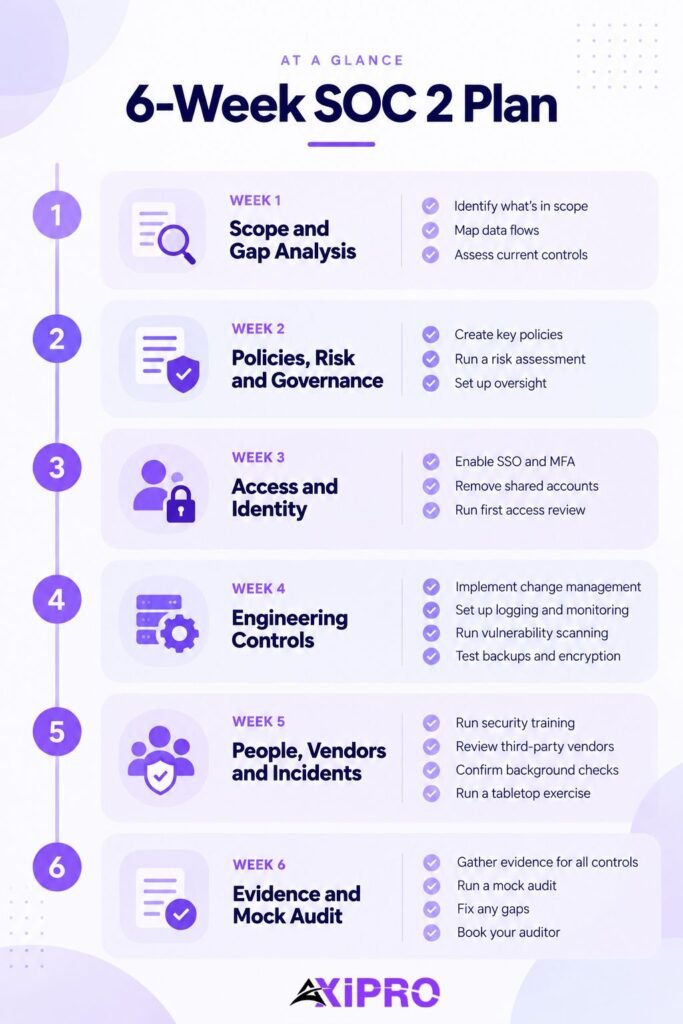
Start by listing every system inside the boundary you picked: cloud accounts, databases, code repositories, CI/CD pipelines, the identity provider, and any third-party tools that process customer data. Sketch how customer data moves between them. That sketch becomes the first draft of your system description, the narrative part of the SOC 2 report that tells the auditor what they’re looking at.
Next, check what you have against the criteria in scope. Mark each control as in place, partly in place, or missing, then give it an owner and a due date. If you want a structured starting point, our SOC 2 compliance checklist goes through the control areas auditors test.
You’re done when: every in-scope control has a status, an owner, and a due date inside the next five weeks.
Week 2: Policies, Risk Assessment, and Governance
Goal: write down how the company really runs and work out what could go wrong.
Most SaaS companies need around fifteen policies. They cover information security, access control, change management, incident response, vendor management, business continuity, data classification, and acceptable use. Write them to match what you do today, or what you’ll start doing this month. Auditors test whether practice matches policy, so a borrowed template that promises quarterly reviews you never run will turn into a finding.
Then run a formal risk assessment. List the threats to your systems, rate how likely and how damaging each one is, and note how you’ll handle it. NIST SP 800-30 is a good free reference for the method. Finally, set up oversight for criterion CC1.2. A formal board isn’t required, but you do need a documented group that reviews security. Our guide to the SOC 2 board charter explains what auditors look for.
You’re done when: management has signed off on the policies, every high risk in the register has a treatment, and the first oversight meeting is on the calendar.
Week 3: Access and Identity Controls
Goal: make sure only the right people can reach production and customer data, and be able to prove it.
This is when engineering starts carrying the load. Turn on SSO for every in-scope system that supports it and multi-factor authentication for the rest. CISA calls MFA one of the most effective ways to stop account takeovers. Get rid of shared accounts, limit production access to the people who need it, and write down how access gets requested and approved.
Then document your onboarding and offboarding steps and run your first access review. Pull the user list from each system and have a manager confirm every account on it.
Insider Note: Offboarding causes more audit exceptions than almost anything else we see. The identity provider gets updated on someone’s last day, but a contractor still has a working login to a support or analytics tool that was never connected to SSO. Your first access review will almost always turn up an account like this. It’s much cheaper to find it yourself than to have the auditor find it.
You’re done when: SSO and MFA are switched on, no shared accounts are left in scope, and the first access review is signed off with every exception closed.
Week 4: Engineering Controls
Goal: show that code changes, infrastructure, and data are under control and being watched.
Set up branch protection so nothing reaches production without a reviewed pull request, and apply that rule to admins as well. Check that logging covers production and that someone gets an alert when something important happens. Start vulnerability scanning, and decide whether a penetration test belongs in this audit cycle. Many customers will ask for one.
Test that your backups restore, and keep a record of the test. Confirm that data is encrypted at rest and in transit. Company laptops should have disk encryption, screen locks, and up-to-date operating systems, ideally enforced through device management software.
You’re done when: all of these controls are live and you can back each one up with a screenshot, a configuration export, or a log.
Week 5: People, Vendors, and Incident Response
Goal: cover the people side of security and the third parties you rely on.
Run security awareness training and keep the completion records. Have every employee sign off on the policies you approved in week 2. Confirm background checks for staff who can access customer data, and where a check isn’t possible in someone’s country, write down why.
Build a vendor inventory of every third party that touches customer data. Rate each one by risk and collect their SOC 2 report or security documentation. Finish your incident response plan (if you’re starting from zero, NIST SP 800-61 is a useful reference), then run a tabletop exercise. Walk the team through a realistic incident and write down what happened and what you’d change.
You’re done when: training and policy sign-offs are complete, every critical vendor has been reviewed, and the tabletop exercise is written up.
Week 6: Evidence Review and Mock Audit
Goal: prove you’d pass if the audit started tomorrow.
Go through every in-scope control and pull the evidence an auditor would ask for. File it by control so each one has a dated artifact sitting next to it. Then run a mock audit. Pick a sample of controls and have someone who didn’t set them up ask for the evidence, and time how long it takes to produce. If something takes more than a few minutes to find, or doesn’t quite match the policy, it goes on the fix list.
Work through the fix list, then confirm your auditor and your fieldwork dates.
You’re done when: you can produce evidence for every control on request, the fix list is empty, and your audit start date is confirmed.
Worth Knowing: Good audit firms book up weeks in advance.
Good audit firms book up weeks in advance. Reach out to two or three during week 1 so the audit can start as soon as you’re ready, instead of a month later.
Where Six-Week Plans Usually Slip
You can hit six weeks, but the plan is fragile, and it tends to break in the same places.
Engineering time goes first. Weeks 3 and 4 need real hours from your engineers, and the first production incident or launch deadline will pull them back to the roadmap. Get those hours protected in writing before you start. Next comes policy drift, where the policies you wrote in week 2 describe processes nobody is following by week 6, and the mock audit shows it.
Evidence is another weak spot. A control might be in place, but proving it means digging through three tools and a former employee’s Slack messages. And if one person owns the whole plan, the timeline stops the moment they get sick, get pulled into fundraising, or end up buried in a customer escalation.
These are ordinary problems. They’re what happens when a company runs a compliance project on top of everyone’s full-time job, and the DIY route asks you to do exactly that.
What the DIY Route Really Costs
Software is the cheap part. The real cost of doing this yourself is time, roughly 115 hours between the project owner and engineering over six weeks if everything goes well. For a founder or CTO, that’s about three full working weeks away from running the business. For your engineers, it’s a sprint and a half with no features shipped.
On top of that comes the audit fee, which varies a lot by firm, report type, and scope, so get at least three quotes. If you go with a GRC platform, add the annual subscription, which runs around $10,000 at list price or up to 40% less through a partner like Axipro. Then there’s the risk to the deal itself. A slipped timeline on a blocked enterprise contract is often worth more than the entire compliance budget.
The Faster Route: Four Weeks and a Couple of Hours of Your Time
The six-week plan shows what readiness looks like when your own team does all the work. You can also hand it off.
With Axipro’s managed approach, our infosec team runs the plan for you. We scope the system and write policies around how you operate. We set up the controls alongside your engineers, collect the evidence, run the internal audit, and coordinate the external auditor. Your team spends a couple of hours on decisions and approvals, and readiness usually lands in about four weeks.
| DIY with a spreadsheet | DIY with a GRC platform | Axipro managed delivery | |
|---|---|---|---|
| Time to readiness | 6 weeks at best, often 10 to 16 | 6 to 10 weeks | About 4 weeks |
| Your team’s time | 100+ hours | 80+ hours | A couple of hours |
| Who writes policies | You | You, from templates | Axipro |
| Who implements controls | Your engineers | Your engineers | Axipro, with your engineers |
| Who owns the audit outcome | You | You | Axipro, with guaranteed certification on the Achievement Plan |
A GRC platform automates evidence collection, but someone still has to design the controls, write the policies, and manage the audit. Axipro takes that work off your plate. If you’d like to try the approach first, the free 30-day Compliance Accelerator Plan gives you a gap analysis, a first set of policies, and a tabletop exercise at no cost. Our SOC 2 compliance services page explains how the full engagement works, and you can also read how managed compliance works for startups that don’t have security staff.
Conclusion
A six-week SOC 2 readiness plan is realistic if you’re a cloud-native SaaS company with SSO, a named owner, and engineering time you can protect. Order matters. Scope the system and find the gaps first, then write policies and assess risk, lock down access and engineering, cover people and vendors, and finish with a mock audit. Pick a spreadsheet if you’re going for a tight Type I, and move to a platform once Type II evidence starts slowing you down. Just go in knowing what it costs. Doing it yourself takes more than a hundred hours of your team’s time, while managed delivery gets you there in about four weeks for a couple of hours of theirs.
Frequently Asked Questions
How long does SOC 2 readiness take?
If you’re a cloud-native SaaS company with SSO, a dedicated owner, and engineering time available, you can get ready in six weeks on your own or in about four with managed support. Companies without those foundations should plan for three to four months. The audit comes after readiness, and a Type II adds an observation period of at least three months.
Can you get a SOC 2 report in six weeks?
You can be ready for a Type I audit in six weeks, and the Type I report follows shortly after fieldwork. A Type II report takes longer, because your controls have to run through an observation period of at least three months first. Many buyers will accept a Type I report plus a letter from your auditor confirming the Type II period has started.
Do I need compliance software for SOC 2?
No. A well-built spreadsheet is enough for a Type I audit or a small team with a tight scope. Software starts paying for itself when you enter a Type II observation period, add a second framework, or have lots of people owning controls, because collecting evidence by hand turns into a full-time job.
Should a startup get SOC 2 Type I or Type II first?
Get Type I first if a specific deal is blocked and the buyer will accept it, since it’s faster. With no urgent deadline, plan for Type II from the start. Most enterprise buyers will ask for it eventually, and skipping Type I saves you an audit.
What happens if you’re not ready when the auditor arrives?
The auditor records an exception for every control that’s missing or that you can’t back up with evidence, and those exceptions show up in the report your customers read. In serious cases you might have to push the audit back or restart a Type II observation period. That’s why a mock audit in the last week of readiness is worth the time.