
Table of Contents

Reach SOC 2 Compliance in 6 Weeks or Less.

  /

  / CMMC Certification Cost: Complete Pricing Breakdown 2026

CMMC Certification Cost: Complete Pricing Breakdown 2026

CMMC certification costs between $4,000 and $30,000 at Level 1, $30,000 to $300,000 or more at Level 2, and $100,000 to well over $1 million at Level 3. Most contractors expect the audit fee to be the big number. It isn’t. The formal assessment typically accounts for only 25% to 40% of total spend, with preparation, remediation, and technology upgrades consuming the rest.

The stakes changed in late 2025. The final 48 CFR acquisition rule took effect on November 10, 2025, which means CMMC requirements now appear directly in Department of Defense (DoD) solicitations and contracts. Starting in November 2026, Phase 2 of the rollout gives contracting officers the authority to require third-party certification for Level 2 work. If you handle Controlled Unclassified Information (CUI), certification is no longer optional, and the cost question becomes a budgeting exercise rather than a hypothetical.

This guide breaks down every major cost category, what moves your number up or down, and how to keep the total under control.
What Is CMMC Certification and Why Does Cost Vary?

The Cybersecurity Maturity Model Certification (CMMC) is the DoD’s framework for verifying that companies in the Defense Industrial Base (DIB) actually protect the sensitive information they handle. The program, codified in 32 CFR Part 170, builds on the security requirements of NIST SP 800-171 and, at the top tier, selected controls from NIST SP 800-172.

Costs vary so widely because you can’t buy CMMC off a shelf. Your environment has to reach a certain state and then stay there. A 15-person machine shop with one well-scoped CUI enclave faces a fundamentally different project than a 500-person prime contractor with CUI flowing through a dozen systems. Your starting security posture, the scope of your assessment boundary, and whether you build internally or hire help all move the total by six figures in either direction.

Let Axipro help you build a business continuity plan that's practical, compliant, and audit-ready.

Schedule Your Free Assessment Today

Average CMMC Certification Cost at a Glance

The DoD’s own published estimates are instructive. A triennial Level 2 certification assessment, including affirmations, is projected at roughly $105,000 for small entities and $118,000 for larger ones. Those figures cover only assessment and affirmation activities, though. The DoD excludes implementation costs from its estimates on the grounds that NIST SP 800-171 compliance has been contractually required under DFARS 252.204-7012 since 2017. Your real budget has to cover both.
CMMC Certification Cost

CMMC Certification Cost by Level

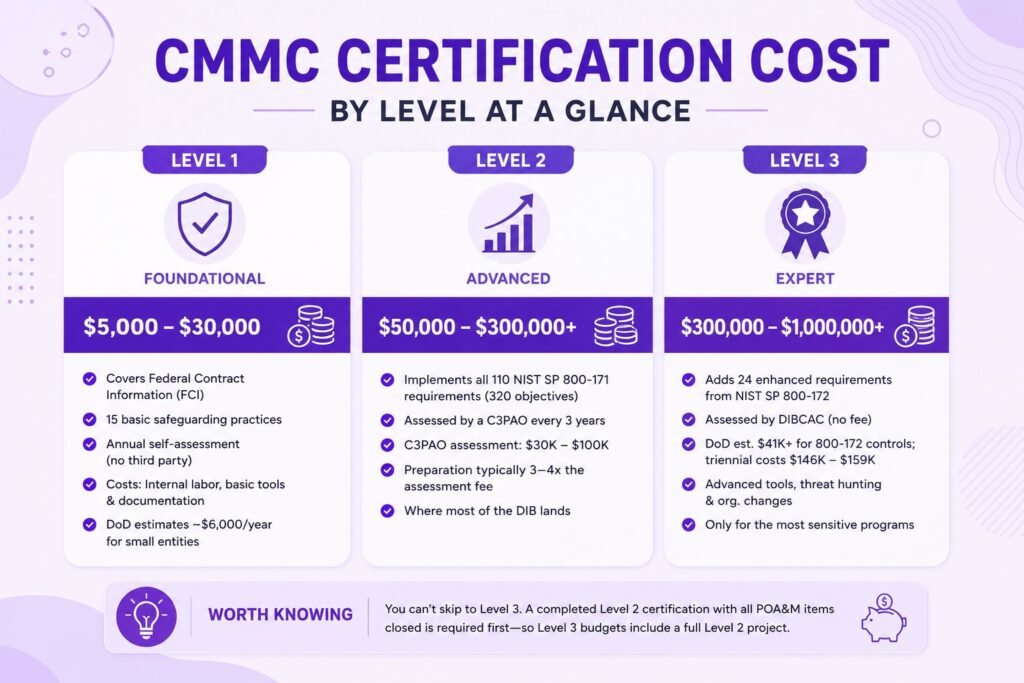
CMMC Level 1 (Foundational) Cost: $5,000 – $30,000

Level 1 covers Federal Contract Information (FCI) and requires 15 basic safeguarding practices drawn from FAR 52.204-21. Because Level 1 permits an annual self-assessment with no third-party auditor, the costs are internal labor, basic tooling, and documentation. Small contractors with reasonable IT hygiene often land near the bottom of the range. The DoD estimates annual Level 1 assessment and affirmation activity at around $6,000 for a small entity, with the remainder of the range driven by any remediation needed to attest honestly.

CMMC Level 2 (Advanced) Cost: $50,000 – $300,000+

Level 2 is where most of the DIB lands and where budgets get serious. It requires full implementation of all 110 security requirements in NIST SP 800-171, assessed across 320 individual objectives. For most contracts, a C3PAO (Certified Third-Party Assessor Organization) accredited by the Cyber AB has to conduct the assessment every three years.

Market data puts C3PAO assessment fees at $30,000 to $100,000 depending on scope, site count, and complexity. Preparation dwarfs that figure for most organizations. Companies starting from a low maturity baseline routinely spend three to four times the assessment fee on readiness work before an auditor ever shows up.

CMMC Level 3 (Expert) Cost: $300,000 – $1,000,000+

Level 3 adds 24 enhanced requirements from NIST SP 800-172 on top of a completed Level 2 certification, and the assessment is conducted by the government’s DIBCAC rather than a commercial C3PAO. DIBCAC charges no assessment fee, but don’t mistake free for cheap. The DoD estimated roughly $41,000 in additional implementation cost for the 800-172 controls alone, and total triennial assessment-related costs in the $146,000 to $159,000 range. Real-world totals run far higher once you account for the advanced tooling, threat hunting capability, and organizational changes Level 3 demands. Only contractors supporting the most sensitive programs need this tier.

Worth Knowing: You can't skip to Level 3.

You can't skip to Level 3. A final Level 2 certification with all POA&M items closed is a prerequisite for the same assessment scope, so Level 3 budgets always include a full Level 2 project first.

CMMC Certification Cost Breakdown by Expense Category

Gap Assessment and Readiness Planning Costs

A gap assessment maps your current environment against NIST SP 800-171 and typically costs $1,500 to $20,000 depending on depth and scope. This is the most valuable dollar you’ll spend in the entire project, because everything downstream is priced off what it finds.

Documentation and System Security Plan (SSP) Costs

The System Security Plan (SSP) is the cornerstone document of any assessment, mapping every control to your specific implementation. Professionally developed SSPs and supporting policies run $12,000 to $60,000. A weak SSP is one of the most common reasons assessments stall or fail, so this is a poor place to economize.

Remediation and Security Control Implementation Costs

Closing the gaps is usually the largest line item: $20,000 to $150,000 or more. Multi-factor authentication, logging and SIEM deployment, encryption, access control restructuring, and incident response capability all live here. Organizations with mature security postures spend far less than those starting from scratch.

Technology and Infrastructure Upgrade Costs

Many contractors move CUI into a dedicated enclave rather than securing their entire network. Enclave platforms typically cost $300 to $400 per user per month. Others upgrade endpoint protection, replace unsupported systems, or migrate to government-grade cloud environments, each with its own licensing and migration costs.

C3PAO Assessment and Audit Fees

The formal Level 2 assessment runs $30,000 to $100,000, driven by assessor-days, number of sites, and evidence quality. Well-organized evidence directly reduces assessor time and therefore your invoice.

Consulting and Advisory Fees

Specialist consultants, including Registered Practitioners (RPs) and Certified CMMC Professionals (CCPs), bill roughly $250 to $400 per hour. Engagements range from targeted advisory work to full program management. Many contractors instead retain a Managed Security Service Provider (MSSP), typically starting at $2,000 to $3,500 per month.

Staff Training and Awareness Program Costs

Security awareness training, role-based training for IT staff, and CUI handling training generally cost $2,000 to $10,000 per year. Assessors check for evidence of training, not just a policy saying it happens.

Internal Personnel and Labor Costs

The least visible cost is your own people’s time: evidence collection, interviews, remediation project management, and documentation review pull hours from billable work. Small contractors feel this hardest, with per-employee compliance costs of roughly $2,500 to $4,600 compared with $600 to $1,000 at enterprise scale.

Ongoing CMMC Costs After Certification

Annual Maintenance and Monitoring Costs

Budget $10,000 to $50,000 per year for continuous monitoring tools, vulnerability scanning, log retention, policy updates, and license renewals. Certification reflects a point in time. Your contractual obligation to stay compliant doesn’t expire between assessments.

Recertification Costs (Every 3 Years)

Level 2 certification lasts three years, after which the full C3PAO assessment repeats. Recertification is usually cheaper than the first cycle because the environment and evidence already exist, but plan for the assessment fee plus refreshed documentation and a pre-assessment review.

Continuous Compliance and Reporting Costs

Annual affirmations by a senior official must be filed in the Supplier Performance Risk System (SPRS), and your score has to stay current. False or careless affirmations carry real legal exposure under the False Claims Act, which is why many companies fund an annual internal review before signing.

Important: The affirmation requirement changes the risk calculus entirely. An executive personally attests to compliance every year, and the Department of Justice has actively pursued False Claims Act cases over cybersecurity misrepresentations. Treat annual affirmations as a compliance event with evidence behind them rather than a formality.
Key Factors That Influence Your CMMC Certification Cost

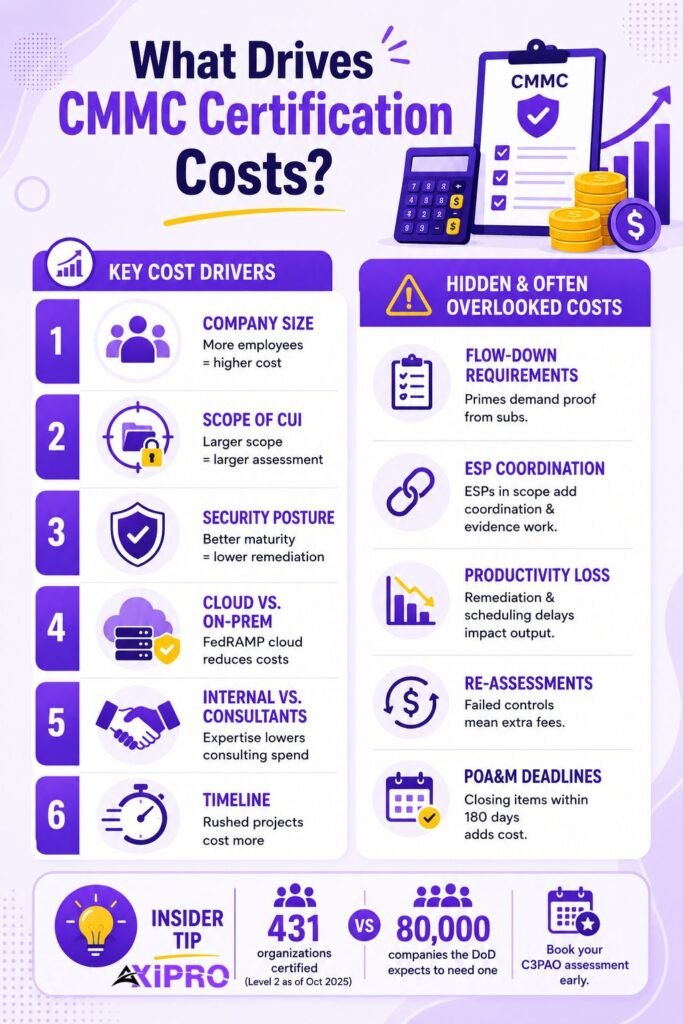
Company Size and Number of Employees

More users mean more endpoints, more accounts, more training seats, and more assessment hours. Costs scale with headcount, though per-employee cost falls as fixed expenses spread across more staff.

Scope of Controlled Unclassified Information (CUI)

Scope is the single biggest cost driver. CUI touching every system means every system is in scope. CUI confined to a tight enclave means the assessment boundary, and the bill, shrinks accordingly.

Existing Cybersecurity Maturity and Posture

A contractor already operating close to NIST SP 800-171, perhaps with SOC 2 or ISO 27001 in place, inherits significant control overlap and spends far less on remediation than one starting cold.

Cloud vs. On-Premise Environment

Cloud environments with strong compliance inheritance, particularly FedRAMP-authorized services, reduce the number of controls you need to build yourself. Legacy on-premise infrastructure often requires expensive upgrades or segmentation.

Internal Resources vs. Outsourced Support

In-house expertise converts consulting fees into salary you already pay. Most small and mid-size contractors blend the two: internal ownership of the program, external specialists for gap assessment, SSP development, and mock audits.

Timeline and Urgency

Compressed timelines cost more. Rushed remediation means premium consulting rates, expedited procurement, and less time to optimize scope. With C3PAO capacity tightening ahead of the November 2026 Phase 2 milestone, late movers will also face scheduling backlogs.


Hidden and Often Overlooked CMMC Costs

Several costs rarely appear in initial budgets.

  • Flow-down requirements mean prime contractors increasingly demand proof of compliance from subcontractors before the government does, sometimes on short notice.
  • External Service Providers (ESPs) that touch your CUI can fall within your assessment scope, adding coordination and evidence-gathering work. Productivity dips during remediation, assessment scheduling delays, and re-assessment fees for failed controls all add up.
  • So does the cost of closing POA&M (Plan of Action and Milestones) items within the mandated 180-day window after a conditional certification.

Insider Note: Only 431 organizations held a final Level 2 certification as of October 2025, against roughly 80,000 companies the DoD expects to need one. That mismatch between assessor capacity and demand is a cost factor in itself. Contractors who book C3PAO slots early are already negotiating from a stronger position than those who wait for a contract clause to force the issue.

Let Axipro help you build a business continuity plan that's practical, compliant, and audit-ready.

Schedule Your Free Assessment Today

CMMC Cost Estimates for Small vs. Mid-Size vs. Large Contractors

These are first-cycle figures including preparation. Contractors with strong existing postures can land below these ranges. Those discovering years of deferred IT investment can exceed them.
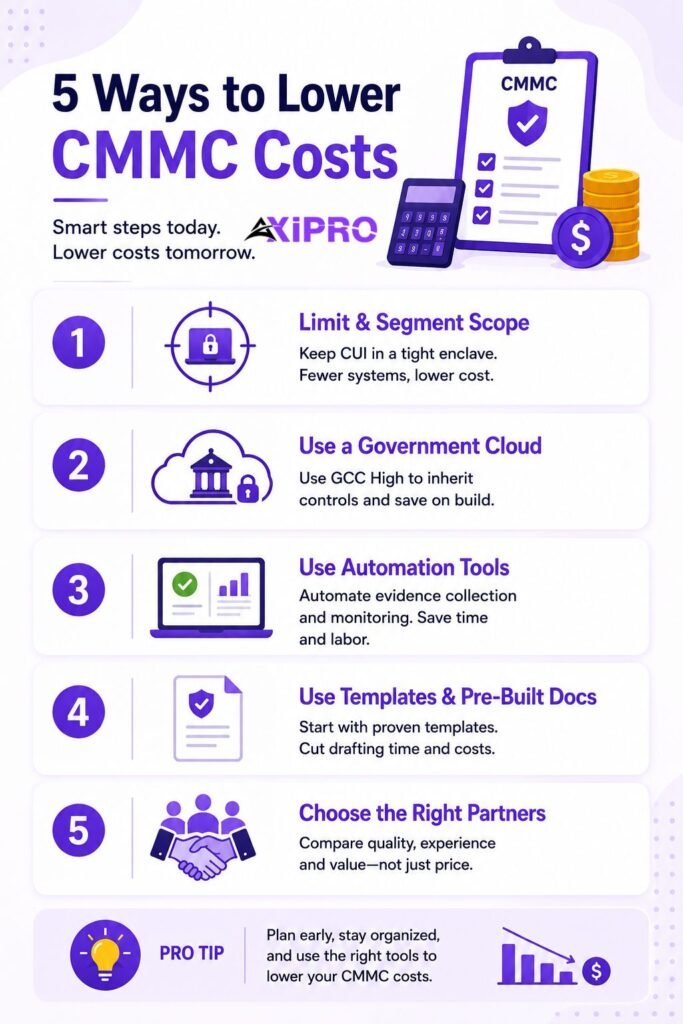
How to Reduce CMMC Certification Costs

Limit and Segment Your Compliance Scope

Isolate CUI into a defined enclave with strict boundaries. Every system you keep out of scope is a system you neither remediate nor pay an assessor to examine. Scoping decisions made before remediation begins are worth more than any discount negotiated afterward.

Use a Government Community Cloud (GCC High) Environment

Microsoft 365 GCC High and comparable government cloud environments are built for CUI and ITAR data, so you inherit controls instead of building them yourself. Licensing costs more than commercial tiers, but the inherited compliance typically outweighs the premium for CUI-heavy organizations.

Use Compliance Automation Tools

Governance platforms that automate evidence collection, control monitoring, and documentation reduce both consultant hours and internal labor, and they make the triennial re-assessment much cheaper by keeping evidence current year-round.

Use Pre-Built Policy Templates and Documentation

Starting policies and the SSP from proven templates instead of a blank page cuts documentation costs substantially. Templates still require tailoring, and assessors can tell when they haven’t been, but the drafting effort drops by half or more.

Choose the Right C3PAO and Consultants

Get quotes from multiple C3PAOs listed on the Cyber AB Marketplace and compare methodology, not just price. A cheap assessor who drags out the engagement or fails controls that a readiness review would have caught costs more in the end. The same logic applies to consultants: defense-sector experience matters more than hourly rate.

Pro Tip: Ask any Prospective C3PAO

Ask any prospective C3PAO for their assessment-day estimate in writing, broken down by control family, before signing. The spread between quotes usually comes from differing scope assumptions rather than differing rates, and surfacing those assumptions early prevents mid-engagement change orders.

How to Budget for CMMC Certification: A Step-by-Step Approach

Start by confirming which level your contracts actually require, then commission a gap assessment to establish your baseline. Price remediation from the gap findings, not from generic benchmarks, and phase the work so quick wins land first. Reserve the C3PAO engagement early, then hold 15% to 20% contingency for the findings every project surfaces. Finally, build the ongoing annual costs into your indirect rate structure so maintenance is funded before it’s needed rather than scrambled for afterward.

CMMC Certification Cost FAQs

How much does a CMMC Level 2 audit cost?

The C3PAO assessment itself typically costs $30,000 to $100,000, depending on scope, sites, and complexity. The DoD’s own estimate for the full triennial assessment and affirmation cycle is roughly $105,000 for small entities. Preparation and remediation sit on top of that figure.

Small businesses pursuing Level 2 typically spend $50,000 to $140,000 for a first certification cycle, including gap assessment, remediation, documentation, and the C3PAO fee. Level 1 self-assessment usually costs $5,000 to $30,000.

There’s no direct reimbursement program, but compliance costs are generally allowable indirect costs and can be built into your rates. Talk to your DCAA-savvy accountant about structuring them properly.

Level 2 and Level 3 certifications last three years, so the assessment cost recurs on a triennial cycle. Annual affirmations in SPRS and ongoing maintenance costs continue every year in between.

Only where your contract allows it. Level 1 always permits self-assessment, and a subset of Level 2 contracts accept a self-assessment filed in SPRS, at a fraction of C3PAO cost. Most Level 2 work involving sensitive CUI requires third-party certification, especially from Phase 2 onward.

Most Level 2 projects take 6 to 18 months from gap assessment to certificate. Longer timelines spread costs and allow cheaper, deliberate remediation. Compressed timelines inflate consulting fees and procurement costs, and assessor scheduling backlogs make last-minute certification increasingly expensive as the November 2026 milestone approaches.

Axipro Author

Picture of Pedro Dias

Pedro Dias

Pedro has been writing online for over 10 years. With experience in all things programming, cyber security, and compliance, he is our editor-in-chief at Axipro.

Blog Highlights

Explore More Articles

CMMC certification costs between $4,000 and $30,000 at Level 1, $30,000 to $300,000 or more at Level 2, and $100,000 to well over $1 million at Level 3. Most contractors expect the audit fee to be the big number. It isn’t. The formal assessment typically accounts for only 25% to 40% of total spend, with preparation, remediation, and technology upgrades consuming the rest. The stakes changed in late 2025. The final 48 CFR acquisition rule took effect on November 10, 2025, which means CMMC requirements now appear directly in Department of Defense (DoD) solicitations and contracts. Starting in November 2026, Phase 2 of the rollout gives contracting officers the authority to require third-party certification for Level 2 work. If you handle Controlled Unclassified Information (CUI), certification is no longer optional, and the cost question becomes a budgeting exercise rather than a hypothetical. This guide breaks down every major cost category, what moves your number up or down, and how to keep the total under control. What Is CMMC Certification and Why Does Cost Vary? The Cybersecurity Maturity Model Certification (CMMC) is the DoD’s framework for verifying that companies in the Defense Industrial Base (DIB) actually protect the sensitive information they handle. The program, codified in 32 CFR Part 170, builds on the security requirements of NIST SP 800-171 and, at the top tier, selected controls from NIST SP 800-172. Costs vary so widely because you can’t buy CMMC off a shelf. Your environment has to reach a certain state and then stay there. A 15-person machine shop with one well-scoped CUI enclave faces a fundamentally different project than a 500-person prime contractor with CUI flowing through a dozen systems. Your starting security posture, the scope of your assessment boundary, and whether you build internally or hire help all move the total by six figures in either direction. Average CMMC Certification Cost at a Glance The DoD’s own published estimates are instructive. A triennial Level 2 certification assessment, including affirmations, is projected at roughly $105,000 for small entities and $118,000 for larger ones. Those figures cover only assessment and affirmation activities, though. The DoD excludes implementation costs from its estimates on the grounds that NIST SP 800-171 compliance has been contractually required under DFARS 252.204-7012 since 2017. Your real budget has to cover both. CMMC Certification Cost by Level CMMC Level 1 (Foundational) Cost: $5,000 – $30,000 Level 1 covers Federal Contract Information (FCI) and requires 15 basic safeguarding practices drawn from FAR 52.204-21. Because Level 1 permits an annual self-assessment with no third-party auditor, the costs are internal labor, basic tooling, and documentation. Small contractors with reasonable IT hygiene often land near the bottom of the range. The DoD estimates annual Level 1 assessment and affirmation activity at around $6,000 for a small entity, with the remainder of the range driven by any remediation needed to attest honestly. CMMC Level 2 (Advanced) Cost: $50,000 – $300,000+ Level 2 is where most of the DIB lands and where budgets get serious. It requires full implementation of all 110 security requirements in NIST SP 800-171, assessed across 320 individual objectives. For most contracts, a C3PAO (Certified Third-Party Assessor Organization) accredited by the Cyber AB has to conduct the assessment every three years. Market data puts C3PAO assessment fees at $30,000 to $100,000 depending on scope, site count, and complexity. Preparation dwarfs that figure for most organizations. Companies starting from a low maturity baseline routinely spend three to four times the assessment fee on readiness work before an auditor ever shows up. CMMC Level 3 (Expert) Cost: $300,000 – $1,000,000+ Level 3 adds 24 enhanced requirements from NIST SP 800-172 on top of a completed Level 2 certification, and the assessment is conducted by the government’s DIBCAC rather than a commercial C3PAO. DIBCAC charges no assessment fee, but don’t mistake free for cheap. The DoD estimated roughly $41,000 in additional implementation cost for the 800-172 controls alone, and total triennial assessment-related costs in the $146,000 to $159,000 range. Real-world totals run far higher once you account for the advanced tooling, threat hunting capability, and organizational changes Level 3 demands. Only contractors supporting the most sensitive programs need this tier. Worth Knowing: You can’t skip to Level 3. You can’t skip to Level 3. A final Level 2 certification with all POA&M items closed is a prerequisite for the same assessment scope, so Level 3 budgets always include a full Level 2 project first. CMMC Certification Cost Breakdown by Expense Category Gap Assessment and Readiness Planning Costs A gap assessment maps your current environment against NIST SP 800-171 and typically costs $1,500 to $20,000 depending on depth and scope. This is the most valuable dollar you’ll spend in the entire project, because everything downstream is priced off what it finds. Documentation and System Security Plan (SSP) Costs The System Security Plan (SSP) is the cornerstone document of any assessment, mapping every control to your specific implementation. Professionally developed SSPs and supporting policies run $12,000 to $60,000. A weak SSP is one of the most common reasons assessments stall or fail, so this is a poor place to economize. Remediation and Security Control Implementation Costs Closing the gaps is usually the largest line item: $20,000 to $150,000 or more. Multi-factor authentication, logging and SIEM deployment, encryption, access control restructuring, and incident response capability all live here. Organizations with mature security postures spend far less than those starting from scratch. Technology and Infrastructure Upgrade Costs Many contractors move CUI into a dedicated enclave rather than securing their entire network. Enclave platforms typically cost $300 to $400 per user per month. Others upgrade endpoint protection, replace unsupported systems, or migrate to government-grade cloud environments, each with its own licensing and migration costs. C3PAO Assessment and Audit Fees The formal Level 2 assessment runs $30,000 to $100,000, driven by assessor-days, number of sites, and evidence quality. Well-organized evidence directly reduces assessor time and therefore your invoice. Consulting and Advisory Fees Specialist consultants, including Registered Practitioners (RPs) and

SOC 2 and ISO 27001 Engagement

After a SOC 2 and ISO 27001 engagement, there are two documents out of the whole pile that actually close deals: the SOC 2 attestation report and the ISO 27001 certificate. Everything else your engagement produces exists to create those two, support them, or keep them alive for another year. Companies routinely ask their auditor for a SOC 2 certificate, which doesn’t exist. They send a prospect their full ISMS documentation when a one-page certificate would have done. They pay for six months of readiness work and then can’t say what they’re holding at the end of it. So here’s the full list. What a SOC 2 engagement produces, what an ISO 27001 engagement produces, what a combined program produces, and who gets to see each one. Understanding SOC 2 and ISO 27001 Engagement Outputs The Core Difference: Report vs. Certificate SOC 2 is an attestation. A licensed CPA firm examines your controls against the Trust Services Criteria under standards set by the AICPA, then writes up what it found and signs an opinion. No certificate. No logo from the AICPA. No pass or fail stamp. What you get is the report, and it usually runs 60 to 120 pages. ISO 27001 is a certification. An accredited certification body audits your Information Security Management System (ISMS) against ISO/IEC 27001:2022, and if you conform, it issues a certificate of registration. The certificate itself is a page or two. All the detail lives behind it, in your ISMS documentation and the audit reports the certification body writes as it goes. SOC 2 Engagement Deliverables The SOC 2 Attestation Report The report is the engagement. The AICPA’s illustrative SOC 2 report lays out the standard structure: auditor’s report, management’s assertion, system description, the Trust Services Criteria in scope, and the controls tested with their results. A Type I covers control design at one point in time. A Type II covers whether those controls actually operated over a period, usually three to twelve months, and most enterprise buyers now won’t accept anything else. Independent Auditor’s Opinion Letter First section of the report, and the first thing anyone experienced turns to. It gives the scope, the examination period, and the auditor’s conclusion. An unqualified opinion means the description held up and the controls worked. A qualified opinion means the auditor found something material, and every serious reviewer will want to talk about it. Management Assertion Your leadership signs a written statement stating that the system description is accurate and that the controls were properly designed and are operating. It reads like a formality, and it isn’t. The auditor’s entire examination runs against what management asserts here, so overstating anything creates real exposure. System Description Usually the longest part of the report, and you write it, not the auditor. It covers the services in scope, your infrastructure, software, people, processes, how data moves, which subservice organizations you depend on, and the complementary user entity controls your customers have to run on their side for your controls to hold up. Trust Services Criteria Applied Security (the Common Criteria) is in every SOC 2. Availability, Processing Integrity, Confidentiality, and Privacy are optional, and the report names exactly which ones you picked. Whatever you decide during scoping ends up printed in a document your customers read for the next several years. Description of Tests of Controls and Results (Type II) The matrix: every control, what the auditor did to test it, and what came back, including exceptions. Reviewers spend most of their time here, because the exceptions tell them things the opinion letter won’t. Bridge Letter / Gap Letter Your report covers a fixed window, so one ending December 31 leaves a hole for a customer doing diligence in June. A bridge letter from your management, not the auditor, confirms that nothing material changed in the control environment between the report’s end date and today. You’ll write these often enough to keep a template. Management Letter and Observations Plenty of auditors also send an internal-only letter covering observations, minor exceptions, and suggestions that never reached the threshold of a qualified opinion. It’s the closest thing to free consulting you’ll get before next year’s audit starts. Insider Note: Ask early whether your auditor issues a management letter, and whether exceptions land in the report body or only in that letter. Firms handle this differently, and the answer decides what your customers see versus what stays behind your firewall. It rarely comes up in the proposal, but it changes how the finished report reads to a buyer. ISO 27001 Engagement Deliverables ISO 27001 Certificate of Registration The document everyone asks for. It names the certified legal entity, states the ISMS scope, identifies the certification body, carries an accreditation mark from a body recognized under the International Accreditation Forum such as UKAS or ANAB, and shows the validity dates. It’s good for three years as long as you pass annual surveillance audits. Read the scope statement carefully, on your own certificate as much as anyone else’s. A certificate covering one office or one product line says nothing about the rest of the business. Statement of Applicability (SoA) After the certificate, this is the document buyers request most. The Statement of Applicability runs through all 93 Annex A controls in ISO/IEC 27001:2022, says which apply to you, justifies the ones you excluded, and records where each stands. Auditors use it as the map of your control environment, and larger customers increasingly want to see it or a summary of it during diligence. Risk Assessment and Risk Treatment Plan Your methodology, the register it produced, and the Risk Treatment Plan showing what you decided to do about each significant risk: mitigate it with a control, transfer it, avoid it, or accept it. ISO 27001 is built around risk, so these documents are what justify every control decision recorded in the SoA. Information Security Management System (ISMS) Documentation The policy and procedure set, plus the operational records that prove any of it happens. Information

The EU AI Act’s transparency requirements take effect on 2 August 2026, and most of the companies they cover still think the rules are not their problem. Article 50 applies to any business that publishes AI-generated content or runs an AI system that talks to people in the EU. That includes the marketing team generating campaign images and the support team running a chatbot. It also covers the AI agents you’ve wired into customer email. Penalties reach €15 million or 3% of total worldwide annual turnover, whichever is higher, and you don’t need an office in Europe to be in scope. If your content or your chatbot reaches EU users, the obligations reach you. In a nutshell: if you publish AI-generated images or video, deploy chatbots or AI agents that interact with EU users, or publish AI-written text on matters of public interest, then yes, the EU AI Act applies, starting 2 August 2026. A quick word on the “AI Act delay” headlines. The Digital Omnibus package did push the high-risk system deadlines back, in some cases by more than a year, but it did not move the deployer obligations in Article 50. Companies that read those headlines and stood down their AI Act work made an expensive mistake, because the rules most likely to touch an ordinary business are the ones that stayed on the calendar. What Article 50 Actually Requires Article 50 of the AI Act sets out transparency obligations in four situations. In plain English: Tell people when they’re talking to AI. Systems designed to interact directly with people — chatbots, voice assistants, and AI agents — must make clear that the user is dealing with AI, unless that’s already obvious. Mark AI-generated content so machines can detect it. Providers of generative AI systems must mark outputs in a machine-readable format, typically through metadata and watermarking, so the content is detectable as artificially generated. Label deepfakes. Anyone deploying AI to generate or manipulate image, audio, or video content that resembles real people, places, objects, or events, and could falsely appear authentic, must disclose that the content is artificial. Label AI-generated text on matters of public interest. Text published to inform the public must carry a label if AI-generated or manipulated, unless a human reviewed it and a person or organization holds editorial responsibility for it. Article 50 also covers emotion recognition and biometric categorization systems, which carry their own disclosure duties. Far fewer businesses run into those, so this article sticks to the four above. The distinction running through all of this is provider vs deployer. The provider builds or supplies the AI system. The deployer uses it professionally. Most companies reading this are deployers. If You Use AI-Generated Images Realistic AI images sit closer to the deepfake rules than most marketing teams assume. The Act’s definition covers content depicting people, objects, places, and events that could falsely appear authentic to a viewer, which describes a large share of what image generators produce for campaigns, social posts, and landing pages. So what does “clearly and distinguishably labeled” mean? The threshold is best described by its failures: a tiny disclosure hidden in the website footer doesn’t qualify. Neither does a faint label on an image, a label that flashes for an instant in a video, or a disclosure buried in your terms and conditions. The label has to be visible right where someone sees the content, and it has to meet accessibility standards so people with disabilities can perceive it too. The Code of Practice proposes a standardized “AI” visual label, localized per language (“KI” in German, “IA” in French). It also draws a useful line between fully AI-generated content and AI-assisted content, with lighter requirements for the latter. A designer who used AI to extend a background is in a different position from a team publishing a fully synthetic image of a person who doesn’t exist. Important: The deepfake duty doesn’t care about intent. A flattering, harmless AI image of your CEO at an event that never happened is still a deepfake under the Act. Marketing teams generate this kind of content casually. From August, every one of those images needs a label. If You Deploy AI Agents or Chatbots The rule itself is simple: people must know they’re dealing with AI. The provider carries the design obligation, but as the deployer you’re the one putting the system in front of your customers, and you’re the one an EU regulator will contact if your branded assistant pretends to be human. The Act contains an exception for cases where it’s “obvious” the user is talking to AI, judged from the perspective of a reasonably well-informed and observant person. Don’t lean on it. What’s obvious to your product team isn’t obvious to every customer, and the human-sounding voice agents and email-writing AI agents rolling out right now are designed specifically to not feel like software. If an AI agent negotiates a renewal over email or handles a support ticket end to end, disclose it. Pro Tip: Put the Disclosure at the Start of the Interaction Put the disclosure at the start of the interaction, in the interface itself: “You’re chatting with an AI assistant.” A line in your privacy policy doesn’t meet the standard, and a disclosure that appears after the conversation ends is worthless. For voice agents, say it up front in the greeting. What Your AI Vendors Owe You The machine-readable marking obligation in Article 50(2) sits with providers — the companies supplying your generative AI tools. The final Code of Practice expects providers to apply at least two layers of marking where necessary, such as embedded metadata combined with watermarking, and to offer detection mechanisms so deployers, authorities, and researchers can verify whether a piece of content came from AI. One timing caveat: the Digital Omnibus gives generative AI systems already on the market before 2 August 2026 until 2 December 2026 to comply with the marking requirement. Every other Article 50 obligation stays on