

Table of Contents

Reach SOC 2 Compliance in 6 Weeks or Less.

  /

  / NIST AI RMF 1.0 Explained: The AI Governance Benchmark

NIST AI RMF 1.0 Explained: The AI Governance Benchmark

The NIST AI Risk Management Framework (AI RMF 1.0) is the most widely referenced standard for managing AI risk in the United States, and it is not a law, a regulation, or a certifiable standard. It is voluntary guidance. That combination explains both its rapid adoption and the confusion around it: regulators cite it, enterprise buyers ask about it in security questionnaires, and AI governance programs are built on it, yet no auditor will ever hand you an AI RMF certificate. This article explains what the framework actually contains, how its four core functions work, and where it fits alongside ISO/IEC 42001 and the EU AI Act.
NIST AI RMF 1.0

What Is the NIST AI RMF 1.0?

Background and Purpose of the Framework

The AI RMF is a structured approach for identifying, assessing, and managing the risks that AI systems create across their entire lifecycle, from design and data collection through deployment, monitoring, and decommissioning. Its stated goal is to help organizations build and use AI systems that are trustworthy: valid, reliable, safe, secure, accountable, transparent, explainable, privacy-enhanced, and fair. The framework treats AI as a socio-technical system, meaning risk does not come from models and data alone. It also comes from how people build, deploy, oversee, and interact with those systems. That framing is the single most important idea in the document, because it pushes risk management beyond model accuracy metrics and into governance, human oversight, and organizational culture.

Who Published It and When

The framework was published by the National Institute of Standards and Technology (NIST), an agency of the U.S. Department of Commerce, on January 26, 2023. The official document is NIST AI 100-1, developed over 18 months of public workshops, requests for information, and two public draft rounds. Congress directed NIST to create it through the National Artificial Intelligence Initiative Act of 2020, so the framework carries legislative backing even though compliance with it does not.

Voluntary Nature of the Framework

NIST describes the AI RMF as voluntary, rights-preserving, non-sector-specific, and use-case agnostic. There is no enforcement mechanism, no audit regime, and no certification. In practice, the word voluntary undersells its weight. U.S. regulators, including the FTC and sector agencies, reference NIST principles when assessing whether an organization exercised reasonable care; federal contractors face growing expectations to demonstrate NIST-aligned AI governance, and enterprise procurement teams increasingly ask vendors how they apply it. Voluntary frameworks have a habit of becoming de facto requirements, and the AI RMF is following that exact path.

Insider Note: In vendor risk assessments, “do you align with the NIST AI RMF” is becoming the AI equivalent of “do you have a SOC 2 report.” There is no certificate to show, so what buyers actually want is documented evidence: an AI inventory, a risk assessment methodology, and named accountability for AI decisions. Organizations that can produce those three artifacts pass most questionnaires.

Reach SOC 2 Compliance in 6 Weeks or Less

Schedule Your Free SOC 2 Assessment Today

Why the NIST AI RMF 1.0 Was Developed

Addressing Unique AI Risks

Traditional software risk frameworks assume deterministic systems: the same input produces the same output, and failures are traceable to specific defects. AI systems break those assumptions. Models drift as real-world data shifts; training data can embed historical bias at scale; outputs can be opaque even to their developers; and the same model can behave differently across deployment contexts. The AI RMF was built specifically for these properties. It treats risk as continuous rather than one-shot, requiring ongoing measurement and monitoring instead of a single pre-deployment review.

Building Trustworthy AI Systems

The second driver was the trust gap. By 2022, organizations were deploying AI faster than they could explain or govern it, and high-profile failures in hiring, lending, and facial recognition had made AI bias a mainstream concern. NIST’s answer was to define trustworthiness in operational terms rather than aspirational ones, breaking it into seven measurable characteristics that risk, security, and product teams could actually work against.

Key Drivers Behind Its Creation

Three forces converged. First, the congressional mandate in the National AI Initiative Act of 2020. Second, international momentum: the framework explicitly aligns with the OECD AI Principles, positioning U.S. guidance within a global consensus on responsible AI. Third, industry demand for a shared vocabulary. Before the AI RMF, every organization defined AI risk differently, which made procurement, audits, and cross-industry collaboration unnecessarily painful. The framework gave executives, engineers, auditors, and regulators a common language.
Core Concepts Behind the NIST AI RMF 1.0

Defining AI Risk

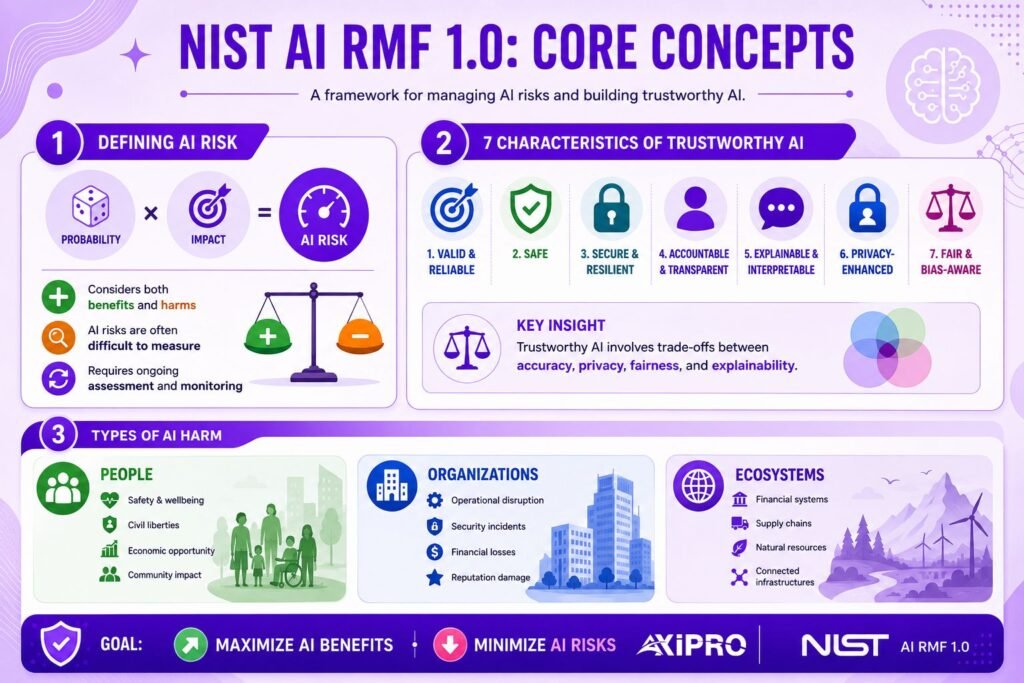
The framework defines risk as the composite measure of an event’s probability of occurring and the magnitude of its consequences. Two things distinguish the AI RMF’s treatment of risk from older frameworks. It explicitly considers positive impacts as well as harms, framing risk management as a way to maximize benefits, not just avoid downsides. And it acknowledges that AI risk is genuinely hard to measure: third-party models, emergent behavior, and a lack of agreed metrics mean organizations must often manage risks they cannot precisely quantify.

Characteristics of Trustworthy AI Systems

The AI RMF defines seven characteristics of trustworthy AI: valid and reliable; safe; secure and resilient; accountable and transparent; explainable and interpretable; privacy-enhanced; and fair with harmful bias managed. Validity and reliability is described as a necessary precondition for all the others, since an inaccurate system cannot be meaningfully safe or fair. The framework is candid that these characteristics involve trade-offs. Improving explainability can reduce accuracy, and strengthening privacy can limit the data available for bias testing. Managing those tensions is a governance decision, not a technical one.

Framing Risks: Harms to People, Organizations, and Ecosystems

The framework organizes potential harm into three groups. Harm to people covers individual civil liberties, physical and psychological safety, and economic opportunity, as well as harm to communities and society at large. Harm to organizations covers business disruption, security breaches, financial loss, and reputational damage. Harm to ecosystems covers damage to interconnected systems, including the global financial system, supply chains, and natural resources. This breadth is deliberate. It forces impact assessments to look beyond the deploying organization’s own balance sheet.

Structure of the NIST AI RMF 1.0

Part 1: Foundational Information

Part 1 sets the conceptual ground. It explains how AI risks differ from traditional software risks, defines the audience of AI actors — everyone who plays a role across the AI lifecycle, from data scientists to procurement teams to end users — describes the harm taxonomy above, and details the seven trustworthiness characteristics. It also addresses the practical challenges of risk measurement, risk tolerance, and prioritization, acknowledging that organizations cannot eliminate AI risk and should not try to treat every system as equally critical.

Part 2: Core and Profiles

Part 2 is the operational half. It presents the AI RMF Core: four functions broken into categories and subcategories that describe specific outcomes, plus the concept of Profiles for tailoring the framework to specific use cases and sectors. If Part 1 explains why AI risk management matters, Part 2 is the part teams actually implement.
The Four Core Functions of the NIST AI RMF 1.0 Explained

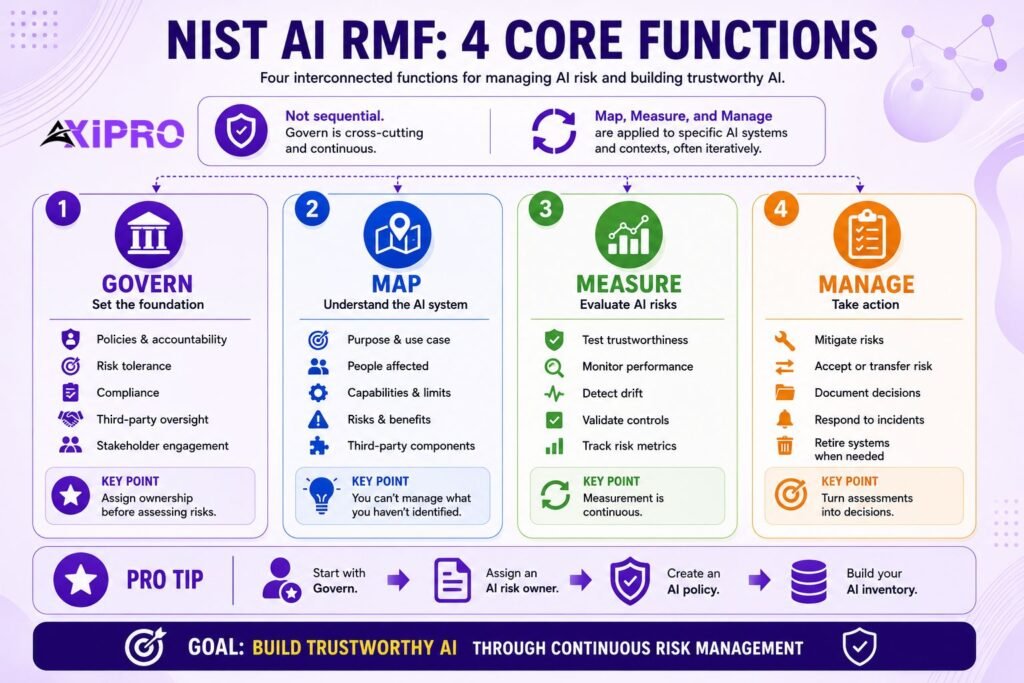
The Core organizes everything into four functions: Govern, Map, Measure, and Manage. They are not sequential steps. Govern is cross-cutting and continuous, while Map, Measure, and Manage are applied to specific AI systems and contexts, often iteratively.

Govern

Govern establishes the organizational foundation: policies, accountability structures, risk tolerance, and culture. It covers legal and regulatory compliance, workforce diversity and competence, third-party risk, and processes for engaging affected communities. NIST positions Govern as the function everything else depends on. Without named accountability and a defined risk appetite, mapping and measuring risks produces documentation that nobody acts on.

Map

Map establishes context. For each AI system, the organization documents its intended purpose, deployment setting, the people it affects, its capabilities and limitations, and the risks and benefits of each component, including third-party models and data. Mapping is where most organizations discover their first uncomfortable truth: they do not actually know how many AI systems they are running, especially once embedded AI features in SaaS tools are counted.

Measure

Measure analyzes and tracks the risks identified during mapping, using quantitative and qualitative methods. This includes testing systems against each trustworthiness characteristic, monitoring for drift in production, and evaluating the effectiveness of the measurement program itself. The framework leans heavily on test, evaluation, verification, and validation (TEVV) processes performed throughout the lifecycle rather than once before launch.

Manage

Manage allocates resources to treat the risks that mapping and measuring surfaced, based on the priorities Govern established. It covers risk response (mitigate, transfer, avoid, or accept), documentation of residual risk, incident response, and decommissioning. Manage closes the loop: it is where risk assessments turn into decisions, including the decision not to deploy a system at all.

Pro Tip: Do not start with Map

Do not start with Map, even though it looks like the natural first step. Start with two Govern outcomes: name a single accountable owner for AI risk and write a one-page AI use policy. Then build the system inventory. Teams that inventory first, without an owner, produce a spreadsheet that goes stale within a quarter.

AI RMF Profiles Explained

Profiles are implementations of the framework’s functions, categories, and subcategories tailored to a specific setting. The framework describes three kinds.

Use-Case Profiles

A use-case profile applies the framework to a particular application or sector, such as hiring, lending, or fraud detection. The most significant published example is the Generative AI Profile (NIST AI 600-1), released in July 2024, which identifies twelve risks unique to or amplified by generative AI — including confabulation, data privacy leakage, and harmful content generation — and maps suggested actions to the Core’s subcategories. In April 2026, NIST also released a concept note for a profile on trustworthy AI in critical infrastructure.

Cross-Sectoral Profiles

Cross-sectoral profiles address risks from activities or technologies that cut across industries, such as large language models or cloud-based AI services, rather than a single vertical application. They help organizations govern shared infrastructure consistently across many use cases.

Temporal Profiles

Temporal profiles describe state over time. A current profile documents how an organization manages AI risk today; a target profile describes the desired end state. The gap between the two becomes the AI governance roadmap — the same gap-analysis pattern familiar from the NIST Cybersecurity Framework and ISO 27001 implementations.


AI RMF Categories and Subcategories Overview

Beneath the four functions sit 19 categories and 72 subcategories. Govern is the largest function with six categories spanning policy, accountability, culture, and third-party oversight. Map contains five categories covering context, system categorization, capabilities, component risks, and impact characterization. Measure has four categories on metrics, trustworthiness evaluation, risk tracking, and feedback on measurement effectiveness. Manage has four categories on risk prioritization, treatment strategy, third-party risk management, and response and recovery. Each subcategory is an outcome statement, not a control. The framework tells you what good looks like and leaves the how to you, which is precisely where the Playbook comes in.


The AI RMF Playbook: Companion Resource Explained

The AI RMF Playbook is the framework’s practical companion, hosted in NIST’s Trustworthy and Responsible AI Resource Center. For every subcategory, it provides suggested actions, documentation guidance, and references. NIST is explicit that the Playbook is neither a checklist nor an ordered list of steps; organizations borrow what applies to their context. It is also updated more frequently than the framework itself, making it the best place to track NIST’s evolving thinking between formal revisions. For teams staring at 72 outcome statements and wondering where to begin, the Playbook is the difference between a framework and an implementation plan.
Key Benefits of the NIST AI RMF 1.0

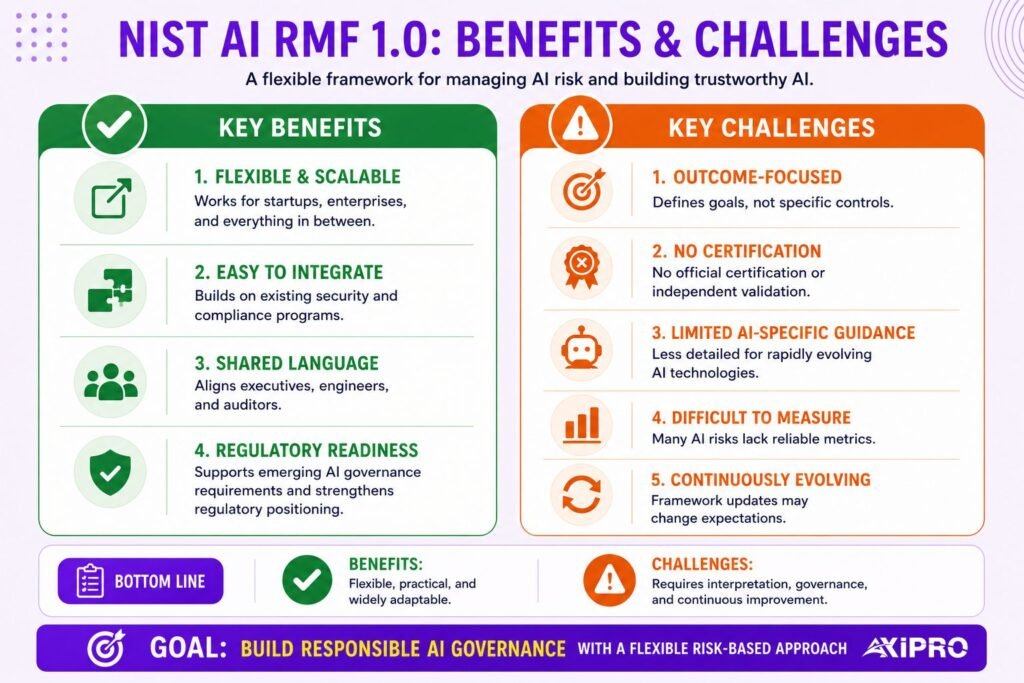
The framework’s flexibility is its biggest practical advantage. Because it is technology-neutral and scales to organization size, a 50-person SaaS company and a global bank can both use it without absurd overhead on one end or insufficient rigor on the other. Its structure also plugs neatly into existing governance: the function-category-subcategory model mirrors the NIST Cybersecurity Framework, so security and compliance teams can extend processes they already run rather than building a parallel program. It improves stakeholder communication by giving boards, engineers, and auditors a shared vocabulary. And alignment with it strengthens regulatory positioning: demonstrating AI RMF-based governance is increasingly treated as evidence of reasonable care, and it provides a head start on overlapping requirements in ISO/IEC 42001 and the EU AI Act.


Limitations of the NIST AI RMF 1.0

The flexibility cuts both ways. The framework specifies outcomes, not controls, so two organizations can both claim alignment while doing very different amounts of actual risk management. There is no certification, which means no independent verification and no simple artifact to hand a customer. It offers limited prescriptive guidance on emerging issues like agentic AI, and its risk measurement guidance acknowledges — honestly but unhelpfully — that reliable metrics for many AI risks do not yet exist. Finally, it is a living document: the AI RMF 1.0 is currently under revision, per NIST and the 2025 U.S. AI Action Plan, so organizations building programs on it today should design for change rather than treating the 2023 text as final.

Worth Knowing: NIST uses a Two-number Versioning System

NIST uses a two-number versioning system: major revisions increment the generation (1.0 to 2.0) and minor updates add a decimal (1.1). The pending revision will be the first test of how disruptive a framework update is in practice. Organizations that mapped their controls to subcategory IDs, rather than copying text into policies, will absorb the change with far less rework.

How the NIST AI RMF 1.0 Compares to Other Frameworks

NIST AI RMF vs. ISO/IEC 42001

ISO/IEC 42001, published in December 2023, is the international standard for AI management systems (AIMS), and the comparison with the AI RMF comes down to one word: certification. ISO/IEC 42001 is auditable and certifiable; the AI RMF is not. The two are complementary rather than competing. Many organizations use the AI RMF to structure their risk thinking and ISO/IEC 42001 to formalize and certify the resulting management system, much as the NIST Cybersecurity Framework and ISO 27001 coexist in security programs.

NIST AI RMF vs. EU AI Act

The EU AI Act is the comparison that matters most for any organization selling into Europe, and it is a category difference: the EU AI Act is binding law with penalties, while the AI RMF is guidance. The Act entered into force in August 2024 and applies in phases; prohibited practices took effect in February 2025 and obligations for general-purpose AI models in August 2025. In May 2026, EU lawmakers reached provisional agreement under the Digital Omnibus to defer the main high-risk system obligations to December 2027, a 16-month delay reflecting how unprepared the supporting standards ecosystem was. The frameworks are philosophically aligned on risk-based thinking, and AI RMF implementation builds much of the documentation, risk assessment, and human oversight machinery the Act requires. But alignment with the AI RMF does not constitute EU AI Act compliance, and treating it as such is a genuine legal exposure.

Important: A common and costly misconception: “we follow NIST, so we are covered for the EU AI Act.” The AI RMF has no concept of prohibited practices, conformity assessment, or CE marking. If you deploy high-risk systems in the EU, the AI RMF is a strong foundation, not a substitute. Run a separate gap analysis against the Act’s specific articles.

Reach SOC 2 Compliance in 6 Weeks or Less

Schedule Your Free SOC 2 Assessment Today

Conclusion

The NIST AI RMF 1.0 earned its position the hard way: by being useful. It gave organizations a shared definition of AI risk, a workable structure in Govern, Map, Measure, and Manage, and the flexibility to scale from a single chatbot deployment to an enterprise AI portfolio — all without licensing fees or audit gatekeeping. Its voluntary status is a feature and a limitation at once, which is why mature AI governance programs rarely use it alone, pairing it instead with ISO/IEC 42001 for assurance and EU AI Act mapping for legal compliance. For organizations starting their AI governance journey, it remains the most sensible first framework to adopt, with the official NIST AI RMF resources as the starting point.

Frequently Asked Questions

Is the NIST AI RMF 1.0 mandatory?

No. It is voluntary guidance with no certification or enforcement mechanism. In practice, U.S. regulators reference it as a benchmark for reasonable care, federal procurement increasingly expects alignment, and enterprise customers ask about it in vendor assessments — so for many organizations it is voluntary in name only.

Any organization that designs, develops, deploys, procures, or uses AI systems. The framework deliberately addresses all AI actors across the lifecycle, from data engineers to risk and compliance teams to executives. It scales to organization size, so it is as relevant to a startup embedding an LLM in its product as it is to a regulated enterprise.

NIST uses a two-number versioning system: major revisions change the generation number and minor updates are tracked as point releases. Version 1.0 was published in January 2023 and is currently being revised under the U.S. AI Action Plan. The companion AI RMF Playbook is updated more frequently than the framework itself.

Yes, through the Generative AI Profile (NIST AI 600-1), released in July 2024. It identifies twelve risks unique to or amplified by generative AI — including confabulation, information security weaknesses, and harmful content — and maps several hundred suggested actions back to the framework’s core subcategories.

There is no certification deadline, so adoption is a maturity curve rather than a project with an end date. Most organizations can stand up the essentials — a named owner, an AI use policy, a system inventory, and an initial risk assessment — within one to three months. Building out measurement, monitoring, and third-party risk processes across all four functions typically takes six to twelve months, and the framework itself frames risk management as a continuous activity thereafter.
Axipro Author

Picture of Pedro Dias

Pedro Dias

Pedro has been writing online for over 10 years. With experience in all things programming, cyber security, and compliance, he is our editor-in-chief at Axipro.

Blog Highlights

Explore More Articles

The NIST AI Risk Management Framework (AI RMF 1.0) is the most widely referenced standard for managing AI risk in the United States, and it is not a law, a regulation, or a certifiable standard. It is voluntary guidance. That combination explains both its rapid adoption and the confusion around it: regulators cite it, enterprise buyers ask about it in security questionnaires, and AI governance programs are built on it, yet no auditor will ever hand you an AI RMF certificate. This article explains what the framework actually contains, how its four core functions work, and where it fits alongside ISO/IEC 42001 and the EU AI Act. What Is the NIST AI RMF 1.0? Background and Purpose of the Framework The AI RMF is a structured approach for identifying, assessing, and managing the risks that AI systems create across their entire lifecycle, from design and data collection through deployment, monitoring, and decommissioning. Its stated goal is to help organizations build and use AI systems that are trustworthy: valid, reliable, safe, secure, accountable, transparent, explainable, privacy-enhanced, and fair. The framework treats AI as a socio-technical system, meaning risk does not come from models and data alone. It also comes from how people build, deploy, oversee, and interact with those systems. That framing is the single most important idea in the document, because it pushes risk management beyond model accuracy metrics and into governance, human oversight, and organizational culture. Who Published It and When The framework was published by the National Institute of Standards and Technology (NIST), an agency of the U.S. Department of Commerce, on January 26, 2023. The official document is NIST AI 100-1, developed over 18 months of public workshops, requests for information, and two public draft rounds. Congress directed NIST to create it through the National Artificial Intelligence Initiative Act of 2020, so the framework carries legislative backing even though compliance with it does not. Voluntary Nature of the Framework NIST describes the AI RMF as voluntary, rights-preserving, non-sector-specific, and use-case agnostic. There is no enforcement mechanism, no audit regime, and no certification. In practice, the word voluntary undersells its weight. U.S. regulators, including the FTC and sector agencies, reference NIST principles when assessing whether an organization exercised reasonable care; federal contractors face growing expectations to demonstrate NIST-aligned AI governance, and enterprise procurement teams increasingly ask vendors how they apply it. Voluntary frameworks have a habit of becoming de facto requirements, and the AI RMF is following that exact path. Insider Note: In vendor risk assessments, “do you align with the NIST AI RMF” is becoming the AI equivalent of “do you have a SOC 2 report.” There is no certificate to show, so what buyers actually want is documented evidence: an AI inventory, a risk assessment methodology, and named accountability for AI decisions. Organizations that can produce those three artifacts pass most questionnaires. Why the NIST AI RMF 1.0 Was Developed Addressing Unique AI Risks Traditional software risk frameworks assume deterministic systems: the same input produces the same output, and failures are traceable to specific defects. AI systems break those assumptions. Models drift as real-world data shifts; training data can embed historical bias at scale; outputs can be opaque even to their developers; and the same model can behave differently across deployment contexts. The AI RMF was built specifically for these properties. It treats risk as continuous rather than one-shot, requiring ongoing measurement and monitoring instead of a single pre-deployment review. Building Trustworthy AI Systems The second driver was the trust gap. By 2022, organizations were deploying AI faster than they could explain or govern it, and high-profile failures in hiring, lending, and facial recognition had made AI bias a mainstream concern. NIST’s answer was to define trustworthiness in operational terms rather than aspirational ones, breaking it into seven measurable characteristics that risk, security, and product teams could actually work against. Key Drivers Behind Its Creation Three forces converged. First, the congressional mandate in the National AI Initiative Act of 2020. Second, international momentum: the framework explicitly aligns with the OECD AI Principles, positioning U.S. guidance within a global consensus on responsible AI. Third, industry demand for a shared vocabulary. Before the AI RMF, every organization defined AI risk differently, which made procurement, audits, and cross-industry collaboration unnecessarily painful. The framework gave executives, engineers, auditors, and regulators a common language. Core Concepts Behind the NIST AI RMF 1.0 Defining AI Risk The framework defines risk as the composite measure of an event’s probability of occurring and the magnitude of its consequences. Two things distinguish the AI RMF’s treatment of risk from older frameworks. It explicitly considers positive impacts as well as harms, framing risk management as a way to maximize benefits, not just avoid downsides. And it acknowledges that AI risk is genuinely hard to measure: third-party models, emergent behavior, and a lack of agreed metrics mean organizations must often manage risks they cannot precisely quantify. Characteristics of Trustworthy AI Systems The AI RMF defines seven characteristics of trustworthy AI: valid and reliable; safe; secure and resilient; accountable and transparent; explainable and interpretable; privacy-enhanced; and fair with harmful bias managed. Validity and reliability is described as a necessary precondition for all the others, since an inaccurate system cannot be meaningfully safe or fair. The framework is candid that these characteristics involve trade-offs. Improving explainability can reduce accuracy, and strengthening privacy can limit the data available for bias testing. Managing those tensions is a governance decision, not a technical one. Framing Risks: Harms to People, Organizations, and Ecosystems The framework organizes potential harm into three groups. Harm to people covers individual civil liberties, physical and psychological safety, and economic opportunity, as well as harm to communities and society at large. Harm to organizations covers business disruption, security breaches, financial loss, and reputational damage. Harm to ecosystems covers damage to interconnected systems, including the global financial system, supply chains, and natural resources. This breadth is deliberate. It forces impact assessments to look beyond the deploying organization’s own balance

Every defense contractor that handles Controlled Unclassified Information (CUI) has a number attached to its CAGE code in a DoD database. That number ranges from -203 to a perfect 110 and most organizations that calculate it honestly for the first time land somewhere they would rather not advertise. This guide covers how CMMC scoring works: where the number comes from, what counts as a passing score at each CMMC level, how to calculate and submit a score in SPRS, and where Plans of Action and Milestones (POA&Ms) fit in. What Is CMMC Scoring? CMMC 2.0 is the Department of Defense program for verifying that companies in the Defense Industrial Base (DIB) actually protect Federal Contract Information (FCI) and CUI, rather than simply attesting that they do. The program rule, 32 CFR Part 170, took effect in December 2024, and the acquisition rule that inserts CMMC requirements into contracts via DFARS 252.204-7021 began phasing in from November 2025. Phase 2, which makes third-party certification the default for contracts involving CUI, arrives in November 2026. CMMC scoring is the quantitative layer underneath all of this. At Level 2, the score measures implementation of the 110 security requirements of NIST SP 800-171, the standard that has applied to contractors handling CUI since DFARS 252.204-7012 made it mandatory. CMMC did not invent new controls at Level 2; it created a verification and scoring regime around controls contractors were already obligated to implement. The score matters for three practical reasons. It determines contract eligibility, because solicitations now specify a required CMMC status and contracting officers check SPRS before award. It drives prime contractor flow-downs, since primes must verify subcontractor scores before passing CUI down the supply chain. And it creates legal exposure: a senior official affirms the score, and a knowingly inflated number is a False Claims Act problem, not a paperwork problem. Understanding the SPRS Scoring System The Supplier Performance Risk System (SPRS) is the DoD’s authoritative source for supplier risk information. For cybersecurity purposes, it stores the results of NIST SP 800-171 assessments and CMMC statuses against each contractor’s CAGE code. Contracting officers, programme offices, and DCMA personnel query it routinely; prime contractors can verify that a subcontractor has a current assessment on file. SPRS does not perform the assessment. It is a reporting database. Self-assessment scores are entered directly by the contractor through the Procurement Integrated Enterprise Environment (PIEE). Results of third-party certification assessments are entered by the C3PAO into the CMMC instance of eMASS, which then populates SPRS automatically. The relationship between an SPRS score and CMMC certification is straightforward: same methodology, different assessor. The self-assessment score is your own claim about your posture. A CMMC Level 2 certification is the same 110 requirements scored by a Certified Third-Party Assessment Organization (C3PAO), with the result carrying formal status under the programme rule. A contractor whose self-reported 110 collapses to 60 under C3PAO scrutiny has a credibility problem on the record. The CMMC Scoring Methodology Explained The methodology comes from the NIST SP 800-171 DoD Assessment Methodology, Version 1.2.1, now codified for CMMC in 32 CFR 170.24. Every organisation starts at the maximum of 110 points. For every requirement scored NOT MET, a weighted value of 1, 3, or 5 points is subtracted. The weighting reflects security impact. Five-point requirements are those whose absence exposes the network or CUI directly. Three-point requirements have a specific, meaningful effect on security. One-point requirements have a limited or indirect effect. Because total possible deductions add up to 313, the floor is -203. Negative scores are common on a first honest assessment, and they are not a clerical curiosity: a deeply negative number visible to a contracting officer signals an organisation years away from certification. There is no partial credit. A requirement that is 90 percent implemented deducts its full point value, exactly like one that was never started. The only two exceptions are multi-factor authentication (3.5.3), which deducts 3 points instead of 5 if MFA covers remote and privileged users but not all users, and FIPS-validated encryption (3.13.11), which deducts 3 points instead of 5 if encryption is in place but not FIPS-validated. Everything else is binary. One further prerequisite catches people out: a System Security Plan (3.12.4) must exist at the time of assessment. Without an SSP describing how each requirement is met, the assessment cannot be completed at all, and the absence is treated as non-compliance with DFARS 252.204-7012 rather than as a scoring deduction. CMMC Score Requirements by Level Scoring works differently at each of the three CMMC levels, and the term passing score means something different at each.  Level 1 Level 1 sits apart from both Level 2 and Level 3: it requires an annual self-assessment of just 15 basic safeguarding requirements, carries no numeric score, permits no POA&Ms, and requires only an annual affirmation. There is no minimum number to hit because the assessment is pass/fail on each individual requirement. Level 2 At Level 2, the 110-point methodology applies in full. A score of 110 earns Final Level 2 status. A score of at least 88, where every unmet requirement is POA&M-eligible under 32 CFR 170.21, earns Conditional Level 2 status — but only as a temporary bridge to the full 110. At  Level 3 Level 3, the bar rises further: organizations must first hold Final Level 2 status from a C3PAO assessment, then undergo a DIBCAC-led assessment against the 24 enhanced requirements drawn from NIST SP 800-172 requirements, each worth a single point. The Level 2 thresholds deserve emphasis because they are widely misread. A score of 88 does not mean you passed. It means you are eligible for Conditional Level 2 status, and only if every unmet requirement is one the rule allows on a POA&M. Conditional status starts a 180-day clock. Final Level 2 status requires the full 110, achieved either at the initial assessment or at the POA&M closeout assessment. How to Calculate Your CMMC Score The most reliable way to calculate your score is

Most companies pursuing ISO 27001 certification cost analysis for the first time will spend between $10,000 and $50,000 in year one, and far less than half of that goes to the auditor. A 50-person SaaS company typically pays $10,000 to $22,000 in certification body fees alone, then doubles or triples that figure in implementation work, tooling, and internal hours before the Stage 2 audit even begins. The wide range exists because ISO 27001 certification cost is not a price tag; it is the sum of a dozen separate decisions: your scope, your security maturity, your certification body, and whether you build the ISMS yourself, hire a consultant, or run it through a compliance automation platform. This article breaks down every one of those costs, stage by stage and region by region, including the ones that never appear in vendor quotes. What Determines ISO 27001 Certification Cost? Six variables drive almost all of the variance between a $10,000 certification and a $150,000 one. Company Size and Employee Count Headcount is the single biggest cost driver because certification bodies calculate audit days (mandays) primarily based on the number of people working within the scope of your Information Security Management System (ISMS). The calculation is not arbitrary: accredited bodies follow the audit time tables in ISO/IEC 27006, which means a 20-person company and a 200-person company will receive structurally different quotes no matter how hard they negotiate. More employees also means more interviews, more evidence sampling, and more Annex A controls applied across more people. Scope and Complexity of the ISMS Scope is the variable you actually control. Your Statement of Scope defines which business units, systems, products, and locations fall inside the ISMS. A scope limited to one product line and the engineering team that runs it costs dramatically less to implement and audit than a whole-of-company scope. Complexity compounds this: bespoke infrastructure, regulated data types, and heavy third-party dependency chains all add controls, evidence, and audit time. Number of Physical and Cloud Locations Each physical site within scope can require its own audit visit, with travel costs on top. Multi-site organisations can reduce this through sampling (more on the square root rule later), but every additional location still adds something. Cloud environments count too: multiple cloud providers, regions, and tenancy models expand the technical scope auditors must cover, even when no travel is involved. Existing Security Maturity A company that already runs access reviews, maintains an asset inventory, and documents its incident response process is buying a much shorter journey than one starting from a blank page. The gap analysis exists precisely to price this difference. Organisations already aligned to SOC 2, NIST CSF, or Cyber Essentials Plus typically reuse 50 to 70 percent of their existing controls and evidence, which translates directly into lower implementation cost. Choice of Certification Body Certification bodies are not interchangeable on price. Large international names like BSI, Bureau Veritas, LRQA, and DNV charge premium day rates, often 30 to 50 percent above smaller accredited bodies, and their brand carries weight with enterprise procurement teams. What matters most is accreditation: a certificate issued by a body accredited by UKAS, ANAB, or another IAF (International Accreditation Forum) member carries international recognition. An unaccredited certificate is cheaper and close to worthless in serious sales conversations. Internal vs. External Implementation Approach The final driver is who does the work. Internal teams cost salary hours. Consultants cost fees. Platforms cost subscriptions. Each approach lands at a very different total, which is why this article dedicates a full section to it below. Average ISO 27001 Certification Cost Ranges The ranges below cover total first-year cost: implementation, tooling, and certification audits combined. They assume an accredited certification body and a sensibly defined scope. Cost for Small Businesses and Startups (1–50 Employees) A focused startup with a single product, cloud-native infrastructure, and a tight scope can realistically certify for $10,000 to $35,000 all-in. Lean implementations using templates or an automation platform sit at the bottom of that range. UK micro-businesses can find UKAS-accredited audit fees starting around £6,250, with day rates near £1,250. Cost for Mid-Sized Organizations (50–250 Employees) This is where most certifications happen, and where costs spread widest. Expect 8 to 12 initial audit days, $30,000 to $80,000 in total first-year spend, and a six to nine month timeline. Multiple departments, more mature customer requirements, and the first real multi-team coordination overhead all show up in the budget. Cost for Large Enterprises (250+ Employees) Enterprise certifications routinely exceed $100,000 in year one once you include program management, multiple sites, and large-scale audits. The audit fee alone can pass $50,000 for complex, multi-site scopes. At this scale, the internal time investment, covered under hidden costs below, often outweighs every external invoice. ISO 27001 Cost Breakdown by Stage Here is where the money actually goes, in roughly the order you will spend it. Cost of Purchasing the ISO 27001 Standard The official ISO/IEC 27001:2022 document costs CHF 155 (roughly $170) from the ISO store. Most teams also buy ISO 27002, the implementation guidance for the Annex A controls, for a similar amount. Budget $300 to $400 for both. Do not skip this purchase: implementing against second-hand summaries of the standard is a common source of audit findings. Gap Analysis Costs A consultant-led gap analysis before committing to anything else runs $2,000 to $10,000 depending on scope, while platform-based readiness assessments are often bundled into the subscription. The output, a clear map of where you stand against every clause and control, is what makes the rest of the budget predictable. ISMS Implementation Costs This is the largest and most variable line item: building the risk assessment, the risk treatment plan, the Statement of Applicability (SoA), and operationalizing the controls you have selected. Done internally, it consumes 200 to 600 hours of staff time over four to eight months. Done with consultants, expect $10,000 to $50,000 in fees for a typical SMB. Documentation and Policy Development Costs ISO 27001 requires a defined set of documented