

The EU AI Act’s transparency requirements take effect on 2 August 2026, and most of the companies they cover still think the rules are not their problem. Article 50 applies to any business that publishes AI-generated content or runs an AI system that talks to people in the EU. That includes the marketing team generating campaign images and the support team running a chatbot. It also covers the AI agents you’ve wired into customer email. Penalties reach €15 million or 3% of total worldwide annual turnover, whichever is higher, and you don’t need an office in Europe to be in scope. If your content or your chatbot reaches EU users, the obligations reach you.
In a nutshell: if you publish AI-generated images or video, deploy chatbots or AI agents that interact with EU users, or publish AI-written text on matters of public interest, then yes, the EU AI Act applies, starting 2 August 2026.
A quick word on the “AI Act delay” headlines. The Digital Omnibus package did push the high-risk system deadlines back, in some cases by more than a year, but it did not move the deployer obligations in Article 50. Companies that read those headlines and stood down their AI Act work made an expensive mistake, because the rules most likely to touch an ordinary business are the ones that stayed on the calendar.

What Article 50 Actually Requires
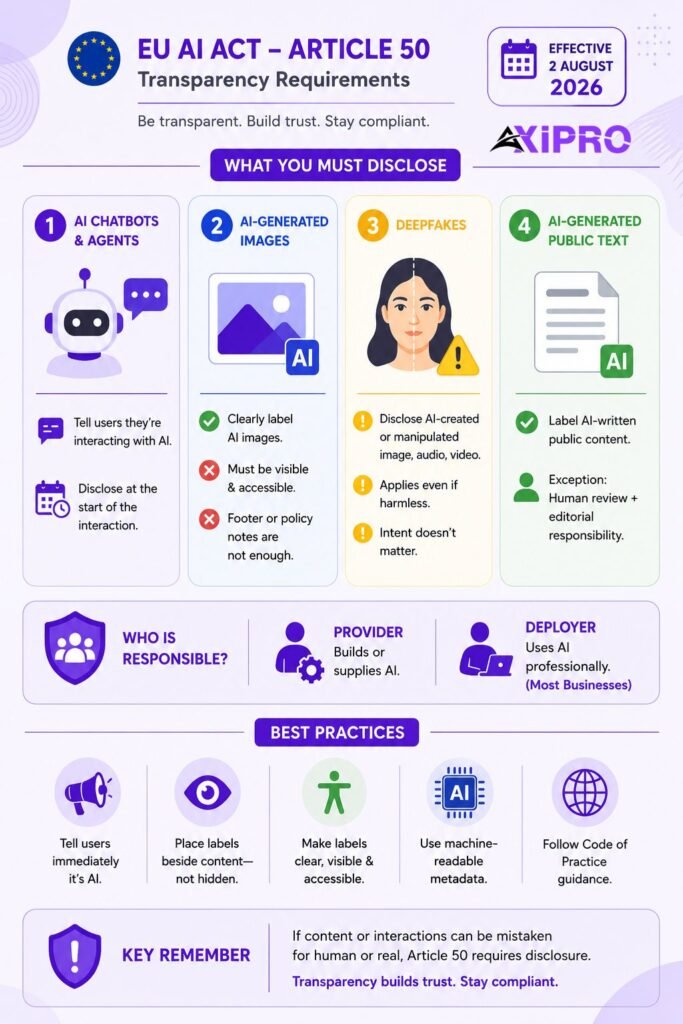
Article 50 of the AI Act sets out transparency obligations in four situations. In plain English:
- Tell people when they’re talking to AI. Systems designed to interact directly with people — chatbots, voice assistants, and AI agents — must make clear that the user is dealing with AI, unless that’s already obvious.
- Mark AI-generated content so machines can detect it. Providers of generative AI systems must mark outputs in a machine-readable format, typically through metadata and watermarking, so the content is detectable as artificially generated.
- Label deepfakes. Anyone deploying AI to generate or manipulate image, audio, or video content that resembles real people, places, objects, or events, and could falsely appear authentic, must disclose that the content is artificial.
- Label AI-generated text on matters of public interest. Text published to inform the public must carry a label if AI-generated or manipulated, unless a human reviewed it and a person or organization holds editorial responsibility for it.
Article 50 also covers emotion recognition and biometric categorization systems, which carry their own disclosure duties. Far fewer businesses run into those, so this article sticks to the four above.
The distinction running through all of this is provider vs deployer. The provider builds or supplies the AI system. The deployer uses it professionally. Most companies reading this are deployers.
Let Axipro help you build a business continuity plan that's practical, compliant, and audit-ready.
Schedule Your Free Assessment Today
If You Use AI-Generated Images
Realistic AI images sit closer to the deepfake rules than most marketing teams assume. The Act’s definition covers content depicting people, objects, places, and events that could falsely appear authentic to a viewer, which describes a large share of what image generators produce for campaigns, social posts, and landing pages.
So what does “clearly and distinguishably labeled” mean? The threshold is best described by its failures: a tiny disclosure hidden in the website footer doesn’t qualify. Neither does a faint label on an image, a label that flashes for an instant in a video, or a disclosure buried in your terms and conditions.
The label has to be visible right where someone sees the content, and it has to meet accessibility standards so people with disabilities can perceive it too.
The Code of Practice proposes a standardized “AI” visual label, localized per language (“KI” in German, “IA” in French). It also draws a useful line between fully AI-generated content and AI-assisted content, with lighter requirements for the latter. A designer who used AI to extend a background is in a different position from a team publishing a fully synthetic image of a person who doesn’t exist.
Important: The deepfake duty doesn’t care about intent. A flattering, harmless AI image of your CEO at an event that never happened is still a deepfake under the Act. Marketing teams generate this kind of content casually. From August, every one of those images needs a label.
If You Deploy AI Agents or Chatbots
The rule itself is simple: people must know they’re dealing with AI. The provider carries the design obligation, but as the deployer you’re the one putting the system in front of your customers, and you’re the one an EU regulator will contact if your branded assistant pretends to be human.
The Act contains an exception for cases where it’s “obvious” the user is talking to AI, judged from the perspective of a reasonably well-informed and observant person. Don’t lean on it. What’s obvious to your product team isn’t obvious to every customer, and the human-sounding voice agents and email-writing AI agents rolling out right now are designed specifically to not feel like software. If an AI agent negotiates a renewal over email or handles a support ticket end to end, disclose it.
Pro Tip: Put the Disclosure at the Start of the Interaction
Put the disclosure at the start of the interaction, in the interface itself: "You're chatting with an AI assistant." A line in your privacy policy doesn't meet the standard, and a disclosure that appears after the conversation ends is worthless. For voice agents, say it up front in the greeting.
What Your AI Vendors Owe You
The machine-readable marking obligation in Article 50(2) sits with providers — the companies supplying your generative AI tools. The final Code of Practice expects providers to apply at least two layers of marking where necessary, such as embedded metadata combined with watermarking, and to offer detection mechanisms so deployers, authorities, and researchers can verify whether a piece of content came from AI.
One timing caveat: the Digital Omnibus gives generative AI systems already on the market before 2 August 2026 until 2 December 2026 to comply with the marking requirement. Every other Article 50 obligation stays on the August date.
The practical consequence lands in your contracts. The hard part of Article 50 is deciding who is the provider and who is the deployer at each link in the supply chain, and your vendor agreements need to say which party holds each duty. Ask your generative AI vendors three things: what marking technology they apply, how you can access their detection tooling, and whether they’ve signed the Code of Practice.
Insider Note: The four-month marking grace period creates an awkward window. Between August and December 2026, some of the tools you use daily won’t watermark their output yet, while your deployer duties apply in full from day one. So don’t build your labeling process on the assumption that vendor watermarks have you covered. Label at your own layer, visibly, and treat vendor-side marking as reinforcement rather than the plan.
The Code of Practice: Voluntary, but the De Facto Standard
The European Commission published the final Code of Practice on marking and labelling of AI-generated content, drafted by independent experts with input from more than 180 stakeholders. It has two sections: one for providers, covering marking and detection, and one for deployers, covering the labeling of deepfakes and public-interest text.
Signing is voluntary. Ignoring it is unwise. The Code is the only official, concrete answer to “what does compliance actually look like,” and regulators will most likely use it as their reference point when they judge whether a company made a good-faith effort. The Commission has also prepared guidelines interpreting Article 50’s scope, definitions, and exceptions, with the final version expected around the application date.
Behind on This? A 7-Day Catch-Up Plan
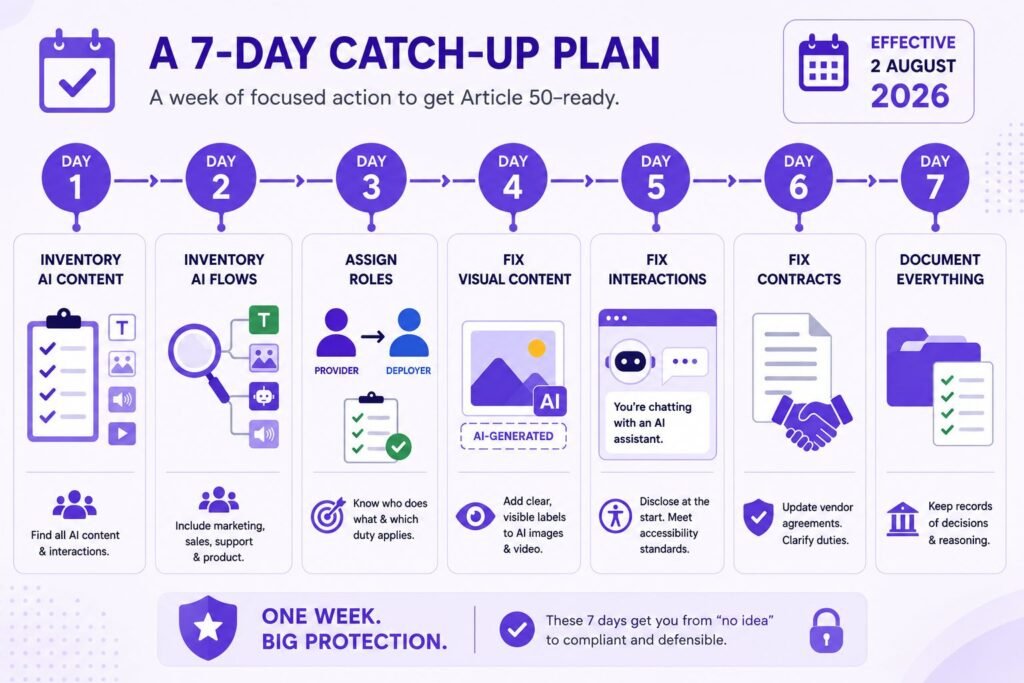
If today is the first time anyone in your company has looked hard at Article 50, a week of focused work covers most of the exposure.
Days 1 and 2 — Inventory your AI content flows.
List every place AI-generated text, images, audio, or video reaches an EU audience, plus every chatbot, voice assistant, or AI agent that interacts with EU users. Count what marketing, sales, and support produce with AI tools, alongside anything built into your product.
Day 3 — Assign roles.
For each tool and use case, decide whether you’re the provider or the deployer, and note which Article 50 duty attaches. This one exercise clears up most of the confusion.
Day 4 — Fix your visual content.
Add clear labels to realistic AI-generated images and video, and audible disclosures to synthetic audio, following the Code’s guidance on visible, persistent labels.
Day 5 — Fix your interactions.
Add disclosures to every chatbot, assistant, and agent at the start of the interaction, and check they meet accessibility requirements.
Day 6 — Fix your contracts.
Write to your generative AI vendors, request their marking and detection documentation, and update agreements to state who holds each duty.
Day 7 — Document everything.
Document everything — record what you inventoried, the roles you assigned, the labels you applied, and the reasoning behind each judgment call. If a regulator ever asks, this record is your first line of defense.
Let Axipro help you build a business continuity plan that's practical, compliant, and audit-ready.
Schedule Your Free Assessment Today
Where Article 50 Fits in Your AI Governance Program
Nothing in that checklist should live as a one-off project. An AI system inventory, assigned roles and responsibilities, transparency controls, vendor management, and documented decisions are all core requirements of ISO 42001, the international standard for AI management systems. Companies that already run an ISO 42001 program will find that Article 50 mostly falls out of controls they operate anyway. Companies scrambling this week are usually the ones without a governance structure to hang the work on.
That’s the real lesson of this deadline. The EU has more AI rules coming: the marking obligation lands in December, and the high-risk regime arrives later. Treating each deadline as a fire drill doesn’t scale. Axipro helps companies build ISO 42001-aligned AI governance programs that absorb requirements like Article 50 as routine control updates instead of emergencies. If the checklist above turned up gaps you can’t close on your own, that’s the work we do. Talk to us.
The short version: Article 50’s transparency requirements apply from 2 August 2026 to any business whose AI-generated content or AI systems reach EU users. Deployers must label deepfakes and public-interest AI text and make sure people know when they’re talking to AI. Providers must mark synthetic content, from December for tools already on the market. The final Code of Practice explains what good looks like.
Heavy AI use isn’t what puts a company at risk here. The risk comes from never writing down where that AI shows up.
Frequently Asked Questions
Does Article 50 apply to companies outside the EU?
Yes. The obligations follow the content and the users, not your headquarters. A US or GCC company publishing AI-generated campaigns to EU audiences, or running a chatbot that serves EU customers, is in scope.
Wasn't the AI Act delayed?
Partly. The Digital Omnibus moved the high-risk system deadlines back and gave providers of generative AI systems already on the market until 2 December 2026 for the machine-readable marking duty. The deployer obligations — deepfake labeling, public-interest text labeling, and chatbot disclosure — all apply from 2 August 2026 as originally scheduled.
Do we have to label every blog post drafted with AI?
No. The text-labeling duty covers AI-generated or AI-manipulated text published to inform the public on matters of public interest, and it includes a carve-out where a human reviewed the text and someone holds editorial responsibility for it. Ordinary marketing content that goes through human review generally doesn’t need a label. Realistic synthetic images and video face stricter treatment.
Is the Code of Practice mandatory?
No, it’s voluntary. But it’s the Commission-backed description of what compliance looks like in practice, and following it is the most defensible way to show good faith. Most companies should treat it as the standard.


