

CMMC certification costs between $4,000 and $30,000 at Level 1, $30,000 to $300,000 or more at Level 2, and $100,000 to well over $1 million at Level 3. Most contractors expect the audit fee to be the big number. It isn’t. The formal assessment typically accounts for only 25% to 40% of total spend, with preparation, remediation, and technology upgrades consuming the rest.
The stakes changed in late 2025. The final 48 CFR acquisition rule took effect on November 10, 2025, which means CMMC requirements now appear directly in Department of Defense (DoD) solicitations and contracts. Starting in November 2026, Phase 2 of the rollout gives contracting officers the authority to require third-party certification for Level 2 work. If you handle Controlled Unclassified Information (CUI), certification is no longer optional, and the cost question becomes a budgeting exercise rather than a hypothetical.
This guide breaks down every major cost category, what moves your number up or down, and how to keep the total under control.
What Is CMMC Certification and Why Does Cost Vary?
The Cybersecurity Maturity Model Certification (CMMC) is the DoD’s framework for verifying that companies in the Defense Industrial Base (DIB) actually protect the sensitive information they handle. The program, codified in 32 CFR Part 170, builds on the security requirements of NIST SP 800-171 and, at the top tier, selected controls from NIST SP 800-172.
Costs vary so widely because you can’t buy CMMC off a shelf. Your environment has to reach a certain state and then stay there. A 15-person machine shop with one well-scoped CUI enclave faces a fundamentally different project than a 500-person prime contractor with CUI flowing through a dozen systems. Your starting security posture, the scope of your assessment boundary, and whether you build internally or hire help all move the total by six figures in either direction.
Let Axipro help you build a business continuity plan that's practical, compliant, and audit-ready.
Schedule Your Free Assessment Today
Average CMMC Certification Cost at a Glance
The DoD’s own published estimates are instructive. A triennial Level 2 certification assessment, including affirmations, is projected at roughly $105,000 for small entities and $118,000 for larger ones. Those figures cover only assessment and affirmation activities, though. The DoD excludes implementation costs from its estimates on the grounds that NIST SP 800-171 compliance has been contractually required under DFARS 252.204-7012 since 2017. Your real budget has to cover both.
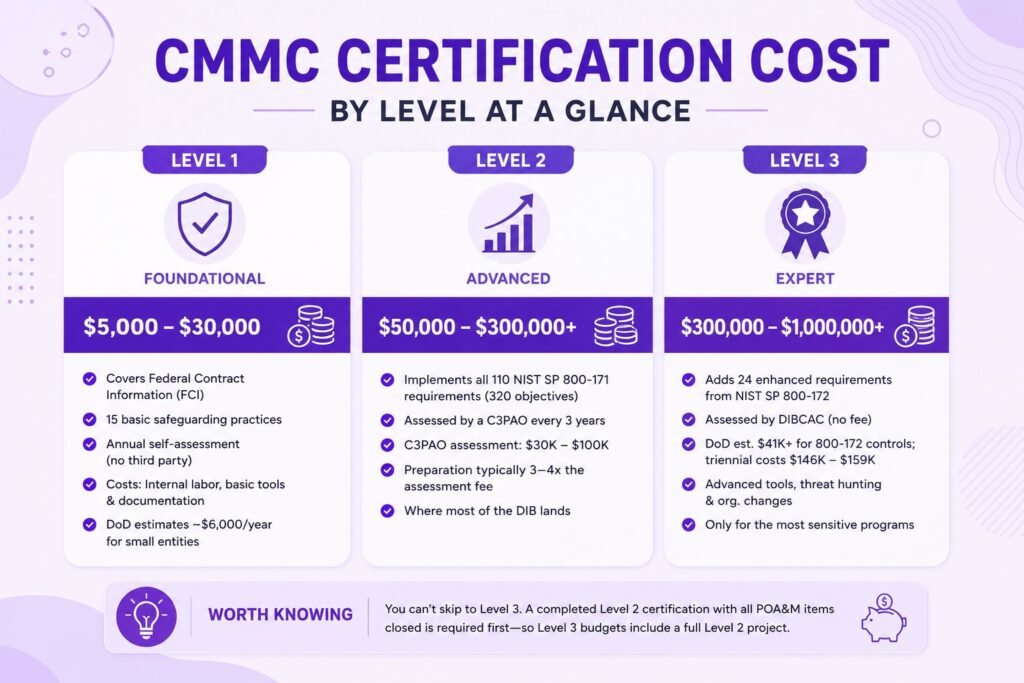
CMMC Certification Cost by Level
CMMC Level 1 (Foundational) Cost: $5,000 – $30,000
Level 1 covers Federal Contract Information (FCI) and requires 15 basic safeguarding practices drawn from FAR 52.204-21. Because Level 1 permits an annual self-assessment with no third-party auditor, the costs are internal labor, basic tooling, and documentation. Small contractors with reasonable IT hygiene often land near the bottom of the range. The DoD estimates annual Level 1 assessment and affirmation activity at around $6,000 for a small entity, with the remainder of the range driven by any remediation needed to attest honestly.
CMMC Level 2 (Advanced) Cost: $50,000 – $300,000+
Level 2 is where most of the DIB lands and where budgets get serious. It requires full implementation of all 110 security requirements in NIST SP 800-171, assessed across 320 individual objectives. For most contracts, a C3PAO (Certified Third-Party Assessor Organization) accredited by the Cyber AB has to conduct the assessment every three years.
Market data puts C3PAO assessment fees at $30,000 to $100,000 depending on scope, site count, and complexity. Preparation dwarfs that figure for most organizations. Companies starting from a low maturity baseline routinely spend three to four times the assessment fee on readiness work before an auditor ever shows up.
CMMC Level 3 (Expert) Cost: $300,000 – $1,000,000+
Level 3 adds 24 enhanced requirements from NIST SP 800-172 on top of a completed Level 2 certification, and the assessment is conducted by the government’s DIBCAC rather than a commercial C3PAO. DIBCAC charges no assessment fee, but don’t mistake free for cheap. The DoD estimated roughly $41,000 in additional implementation cost for the 800-172 controls alone, and total triennial assessment-related costs in the $146,000 to $159,000 range. Real-world totals run far higher once you account for the advanced tooling, threat hunting capability, and organizational changes Level 3 demands. Only contractors supporting the most sensitive programs need this tier.
Worth Knowing: You can't skip to Level 3.
You can't skip to Level 3. A final Level 2 certification with all POA&M items closed is a prerequisite for the same assessment scope, so Level 3 budgets always include a full Level 2 project first.
CMMC Certification Cost Breakdown by Expense Category
Gap Assessment and Readiness Planning Costs
A gap assessment maps your current environment against NIST SP 800-171 and typically costs $1,500 to $20,000 depending on depth and scope. This is the most valuable dollar you’ll spend in the entire project, because everything downstream is priced off what it finds.
Documentation and System Security Plan (SSP) Costs
The System Security Plan (SSP) is the cornerstone document of any assessment, mapping every control to your specific implementation. Professionally developed SSPs and supporting policies run $12,000 to $60,000. A weak SSP is one of the most common reasons assessments stall or fail, so this is a poor place to economize.
Remediation and Security Control Implementation Costs
Closing the gaps is usually the largest line item: $20,000 to $150,000 or more. Multi-factor authentication, logging and SIEM deployment, encryption, access control restructuring, and incident response capability all live here. Organizations with mature security postures spend far less than those starting from scratch.
Technology and Infrastructure Upgrade Costs
Many contractors move CUI into a dedicated enclave rather than securing their entire network. Enclave platforms typically cost $300 to $400 per user per month. Others upgrade endpoint protection, replace unsupported systems, or migrate to government-grade cloud environments, each with its own licensing and migration costs.
C3PAO Assessment and Audit Fees
The formal Level 2 assessment runs $30,000 to $100,000, driven by assessor-days, number of sites, and evidence quality. Well-organized evidence directly reduces assessor time and therefore your invoice.
Consulting and Advisory Fees
Specialist consultants, including Registered Practitioners (RPs) and Certified CMMC Professionals (CCPs), bill roughly $250 to $400 per hour. Engagements range from targeted advisory work to full program management. Many contractors instead retain a Managed Security Service Provider (MSSP), typically starting at $2,000 to $3,500 per month.
Staff Training and Awareness Program Costs
Security awareness training, role-based training for IT staff, and CUI handling training generally cost $2,000 to $10,000 per year. Assessors check for evidence of training, not just a policy saying it happens.
Internal Personnel and Labor Costs
The least visible cost is your own people’s time: evidence collection, interviews, remediation project management, and documentation review pull hours from billable work. Small contractors feel this hardest, with per-employee compliance costs of roughly $2,500 to $4,600 compared with $600 to $1,000 at enterprise scale.
Ongoing CMMC Costs After Certification
Annual Maintenance and Monitoring Costs
Budget $10,000 to $50,000 per year for continuous monitoring tools, vulnerability scanning, log retention, policy updates, and license renewals. Certification reflects a point in time. Your contractual obligation to stay compliant doesn’t expire between assessments.
Recertification Costs (Every 3 Years)
Level 2 certification lasts three years, after which the full C3PAO assessment repeats. Recertification is usually cheaper than the first cycle because the environment and evidence already exist, but plan for the assessment fee plus refreshed documentation and a pre-assessment review.
Continuous Compliance and Reporting Costs
Annual affirmations by a senior official must be filed in the Supplier Performance Risk System (SPRS), and your score has to stay current. False or careless affirmations carry real legal exposure under the False Claims Act, which is why many companies fund an annual internal review before signing.
Important: The affirmation requirement changes the risk calculus entirely. An executive personally attests to compliance every year, and the Department of Justice has actively pursued False Claims Act cases over cybersecurity misrepresentations. Treat annual affirmations as a compliance event with evidence behind them rather than a formality.
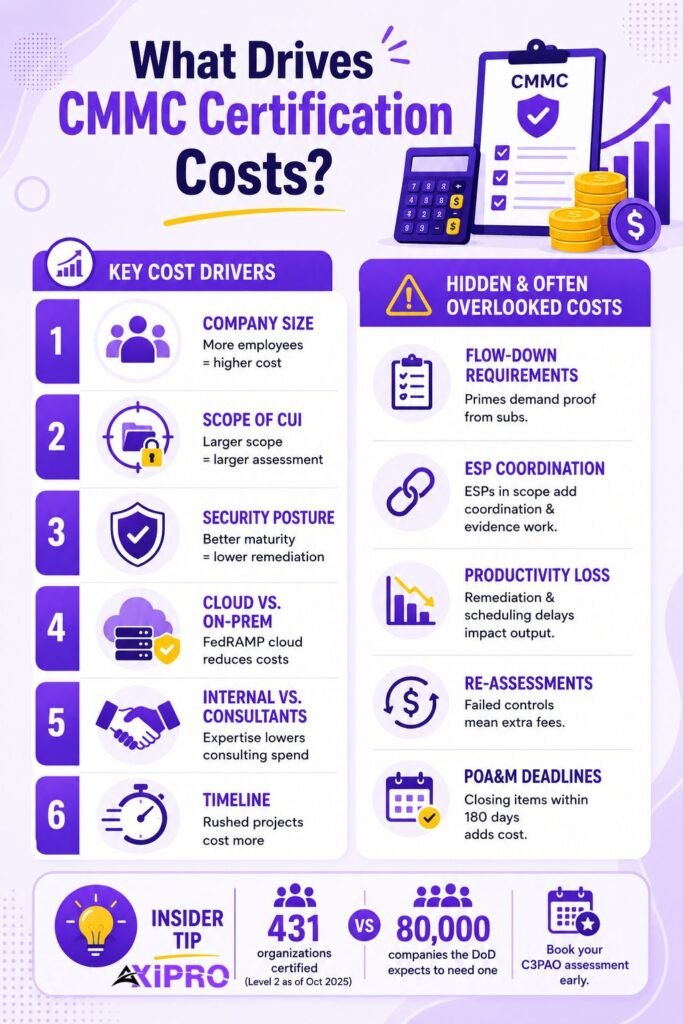
Key Factors That Influence Your CMMC Certification Cost
Company Size and Number of Employees
More users mean more endpoints, more accounts, more training seats, and more assessment hours. Costs scale with headcount, though per-employee cost falls as fixed expenses spread across more staff.
Scope of Controlled Unclassified Information (CUI)
Scope is the single biggest cost driver. CUI touching every system means every system is in scope. CUI confined to a tight enclave means the assessment boundary, and the bill, shrinks accordingly.
Existing Cybersecurity Maturity and Posture
A contractor already operating close to NIST SP 800-171, perhaps with SOC 2 or ISO 27001 in place, inherits significant control overlap and spends far less on remediation than one starting cold.
Cloud vs. On-Premise Environment
Cloud environments with strong compliance inheritance, particularly FedRAMP-authorized services, reduce the number of controls you need to build yourself. Legacy on-premise infrastructure often requires expensive upgrades or segmentation.
Internal Resources vs. Outsourced Support
In-house expertise converts consulting fees into salary you already pay. Most small and mid-size contractors blend the two: internal ownership of the program, external specialists for gap assessment, SSP development, and mock audits.
Timeline and Urgency
Compressed timelines cost more. Rushed remediation means premium consulting rates, expedited procurement, and less time to optimize scope. With C3PAO capacity tightening ahead of the November 2026 Phase 2 milestone, late movers will also face scheduling backlogs.
Hidden and Often Overlooked CMMC Costs
Several costs rarely appear in initial budgets.
- Flow-down requirements mean prime contractors increasingly demand proof of compliance from subcontractors before the government does, sometimes on short notice.
- External Service Providers (ESPs) that touch your CUI can fall within your assessment scope, adding coordination and evidence-gathering work. Productivity dips during remediation, assessment scheduling delays, and re-assessment fees for failed controls all add up.
- So does the cost of closing POA&M (Plan of Action and Milestones) items within the mandated 180-day window after a conditional certification.
Insider Note: Only 431 organizations held a final Level 2 certification as of October 2025, against roughly 80,000 companies the DoD expects to need one. That mismatch between assessor capacity and demand is a cost factor in itself. Contractors who book C3PAO slots early are already negotiating from a stronger position than those who wait for a contract clause to force the issue.
Let Axipro help you build a business continuity plan that's practical, compliant, and audit-ready.
Schedule Your Free Assessment Today
CMMC Cost Estimates for Small vs. Mid-Size vs. Large Contractors
These are first-cycle figures including preparation. Contractors with strong existing postures can land below these ranges. Those discovering years of deferred IT investment can exceed them.
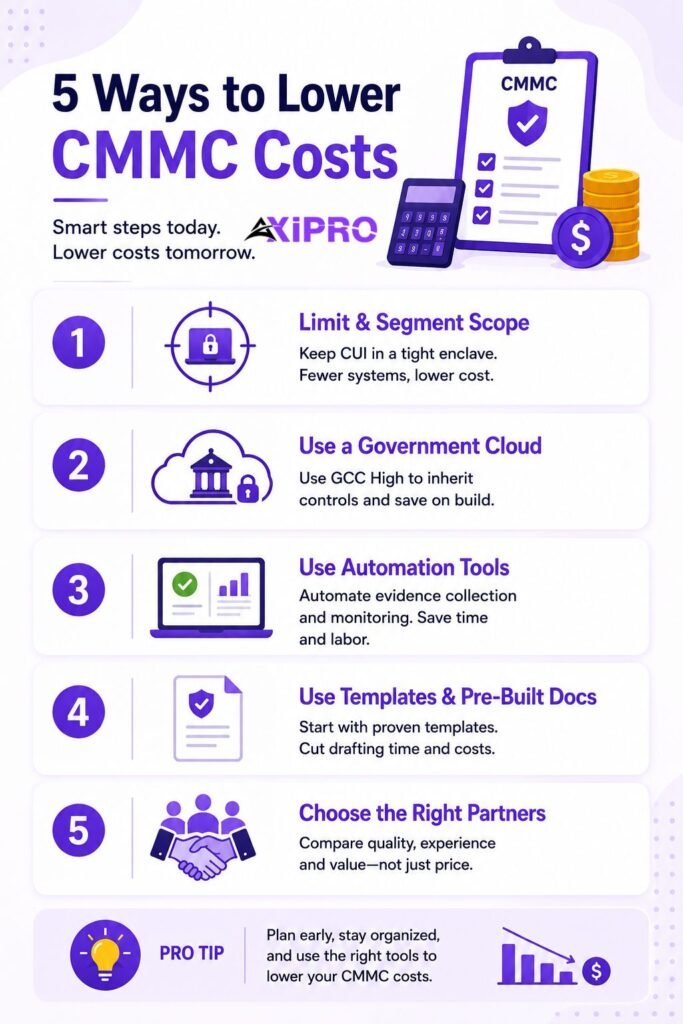
How to Reduce CMMC Certification Costs
Limit and Segment Your Compliance Scope
Isolate CUI into a defined enclave with strict boundaries. Every system you keep out of scope is a system you neither remediate nor pay an assessor to examine. Scoping decisions made before remediation begins are worth more than any discount negotiated afterward.
Use a Government Community Cloud (GCC High) Environment
Microsoft 365 GCC High and comparable government cloud environments are built for CUI and ITAR data, so you inherit controls instead of building them yourself. Licensing costs more than commercial tiers, but the inherited compliance typically outweighs the premium for CUI-heavy organizations.
Use Compliance Automation Tools
Governance platforms that automate evidence collection, control monitoring, and documentation reduce both consultant hours and internal labor, and they make the triennial re-assessment much cheaper by keeping evidence current year-round.
Use Pre-Built Policy Templates and Documentation
Starting policies and the SSP from proven templates instead of a blank page cuts documentation costs substantially. Templates still require tailoring, and assessors can tell when they haven’t been, but the drafting effort drops by half or more.
Choose the Right C3PAO and Consultants
Get quotes from multiple C3PAOs listed on the Cyber AB Marketplace and compare methodology, not just price. A cheap assessor who drags out the engagement or fails controls that a readiness review would have caught costs more in the end. The same logic applies to consultants: defense-sector experience matters more than hourly rate.
Pro Tip: Ask any Prospective C3PAO
Ask any prospective C3PAO for their assessment-day estimate in writing, broken down by control family, before signing. The spread between quotes usually comes from differing scope assumptions rather than differing rates, and surfacing those assumptions early prevents mid-engagement change orders.
How to Budget for CMMC Certification: A Step-by-Step Approach
Start by confirming which level your contracts actually require, then commission a gap assessment to establish your baseline. Price remediation from the gap findings, not from generic benchmarks, and phase the work so quick wins land first. Reserve the C3PAO engagement early, then hold 15% to 20% contingency for the findings every project surfaces. Finally, build the ongoing annual costs into your indirect rate structure so maintenance is funded before it’s needed rather than scrambled for afterward.
CMMC Certification Cost FAQs
How much does a CMMC Level 2 audit cost?
The C3PAO assessment itself typically costs $30,000 to $100,000, depending on scope, sites, and complexity. The DoD’s own estimate for the full triennial assessment and affirmation cycle is roughly $105,000 for small entities. Preparation and remediation sit on top of that figure.
How much does it cost a small business to get CMMC certified?
Small businesses pursuing Level 2 typically spend $50,000 to $140,000 for a first certification cycle, including gap assessment, remediation, documentation, and the C3PAO fee. Level 1 self-assessment usually costs $5,000 to $30,000.
Are CMMC certification costs reimbursable through DoD contracts?
There’s no direct reimbursement program, but compliance costs are generally allowable indirect costs and can be built into your rates. Talk to your DCAA-savvy accountant about structuring them properly.
How often do you need to pay for CMMC recertification?
Level 2 and Level 3 certifications last three years, so the assessment cost recurs on a triennial cycle. Annual affirmations in SPRS and ongoing maintenance costs continue every year in between.
Can I self-assess to save on CMMC costs?
Only where your contract allows it. Level 1 always permits self-assessment, and a subset of Level 2 contracts accept a self-assessment filed in SPRS, at a fraction of C3PAO cost. Most Level 2 work involving sensitive CUI requires third-party certification, especially from Phase 2 onward.
How long does CMMC certification take and how does that affect cost?
Most Level 2 projects take 6 to 18 months from gap assessment to certificate. Longer timelines spread costs and allow cheaper, deliberate remediation. Compressed timelines inflate consulting fees and procurement costs, and assessor scheduling backlogs make last-minute certification increasingly expensive as the November 2026 milestone approaches.


