
/

  / CMMC Scoring Explained: SPRS Scores & the 110-Point System

CMMC Scoring Explained: SPRS Scores & the 110-Point System

Every defense contractor that handles Controlled Unclassified Information (CUI) has a number attached to its CAGE code in a DoD database.

That number ranges from -203 to a perfect 110 and most organizations that calculate it honestly for the first time land somewhere they would rather not advertise.

This guide covers how CMMC scoring works: where the number comes from, what counts as a passing score at each CMMC level, how to calculate and submit a score in SPRS, and where Plans of Action and Milestones (POA&Ms) fit in.
CMMC Scoring Explained

What Is CMMC Scoring?

CMMC 2.0 is the Department of Defense program for verifying that companies in the Defense Industrial Base (DIB) actually protect Federal Contract Information (FCI) and CUI, rather than simply attesting that they do. The program rule, 32 CFR Part 170, took effect in December 2024, and the acquisition rule that inserts CMMC requirements into contracts via DFARS 252.204-7021 began phasing in from November 2025. Phase 2, which makes third-party certification the default for contracts involving CUI, arrives in November 2026.

CMMC scoring is the quantitative layer underneath all of this. At Level 2, the score measures implementation of the 110 security requirements of NIST SP 800-171, the standard that has applied to contractors handling CUI since DFARS 252.204-7012 made it mandatory. CMMC did not invent new controls at Level 2; it created a verification and scoring regime around controls contractors were already obligated to implement.

The score matters for three practical reasons. It determines contract eligibility, because solicitations now specify a required CMMC status and contracting officers check SPRS before award. It drives prime contractor flow-downs, since primes must verify subcontractor scores before passing CUI down the supply chain. And it creates legal exposure: a senior official affirms the score, and a knowingly inflated number is a False Claims Act problem, not a paperwork problem.

Reach SOC 2 Compliance in 6 Weeks or Less

Schedule Your Free SOC 2 Assessment Today

Understanding the SPRS Scoring System

The Supplier Performance Risk System (SPRS) is the DoD’s authoritative source for supplier risk information. For cybersecurity purposes, it stores the results of NIST SP 800-171 assessments and CMMC statuses against each contractor’s CAGE code. Contracting officers, programme offices, and DCMA personnel query it routinely; prime contractors can verify that a subcontractor has a current assessment on file.

SPRS does not perform the assessment. It is a reporting database. Self-assessment scores are entered directly by the contractor through the Procurement Integrated Enterprise Environment (PIEE). Results of third-party certification assessments are entered by the C3PAO into the CMMC instance of eMASS, which then populates SPRS automatically.

The relationship between an SPRS score and CMMC certification is straightforward: same methodology, different assessor. The self-assessment score is your own claim about your posture. A CMMC Level 2 certification is the same 110 requirements scored by a Certified Third-Party Assessment Organization (C3PAO), with the result carrying formal status under the programme rule. A contractor whose self-reported 110 collapses to 60 under C3PAO scrutiny has a credibility problem on the record.

The CMMC Scoring Methodology Explained

The methodology comes from the NIST SP 800-171 DoD Assessment Methodology, Version 1.2.1, now codified for CMMC in 32 CFR 170.24. Every organisation starts at the maximum of 110 points. For every requirement scored NOT MET, a weighted value of 1, 3, or 5 points is subtracted.

The weighting reflects security impact. Five-point requirements are those whose absence exposes the network or CUI directly. Three-point requirements have a specific, meaningful effect on security. One-point requirements have a limited or indirect effect. Because total possible deductions add up to 313, the floor is -203. Negative scores are common on a first honest assessment, and they are not a clerical curiosity: a deeply negative number visible to a contracting officer signals an organisation years away from certification.

There is no partial credit. A requirement that is 90 percent implemented deducts its full point value, exactly like one that was never started. The only two exceptions are multi-factor authentication (3.5.3), which deducts 3 points instead of 5 if MFA covers remote and privileged users but not all users, and FIPS-validated encryption (3.13.11), which deducts 3 points instead of 5 if encryption is in place but not FIPS-validated. Everything else is binary.

One further prerequisite catches people out: a System Security Plan (3.12.4) must exist at the time of assessment. Without an SSP describing how each requirement is met, the assessment cannot be completed at all, and the absence is treated as non-compliance with DFARS 252.204-7012 rather than as a scoring deduction.
CMMC Levels

CMMC Score Requirements by Level

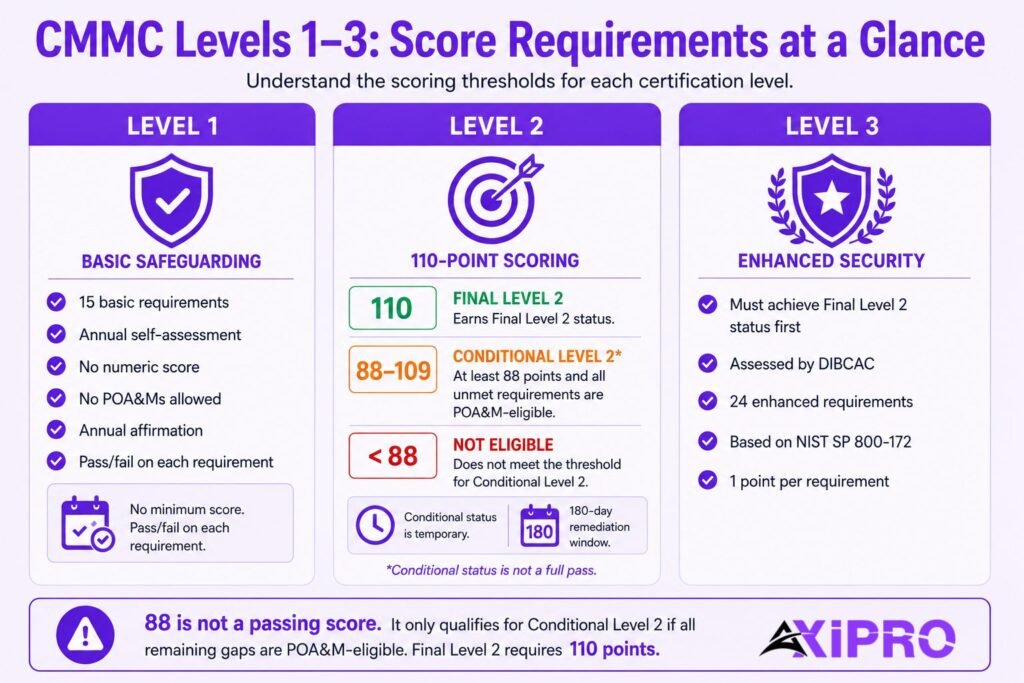
Scoring works differently at each of the three CMMC levels, and the term passing score means something different at each. 

Level 1

Level 1 sits apart from both Level 2 and Level 3: it requires an annual self-assessment of just 15 basic safeguarding requirements, carries no numeric score, permits no POA&Ms, and requires only an annual affirmation. There is no minimum number to hit because the assessment is pass/fail on each individual requirement.

Level 2

At Level 2, the 110-point methodology applies in full. A score of 110 earns Final Level 2 status. A score of at least 88, where every unmet requirement is POA&M-eligible under 32 CFR 170.21, earns Conditional Level 2 status — but only as a temporary bridge to the full 110. At 

Level 3

Level 3, the bar rises further: organizations must first hold Final Level 2 status from a C3PAO assessment, then undergo a DIBCAC-led assessment against the 24 enhanced requirements drawn from NIST SP 800-172 requirements, each worth a single point.

The Level 2 thresholds deserve emphasis because they are widely misread. A score of 88 does not mean you passed. It means you are eligible for Conditional Level 2 status, and only if every unmet requirement is one the rule allows on a POA&M.

Conditional status starts a 180-day clock. Final Level 2 status requires the full 110, achieved either at the initial assessment or at the POA&M closeout assessment.
How to Calculate Your CMMC Score

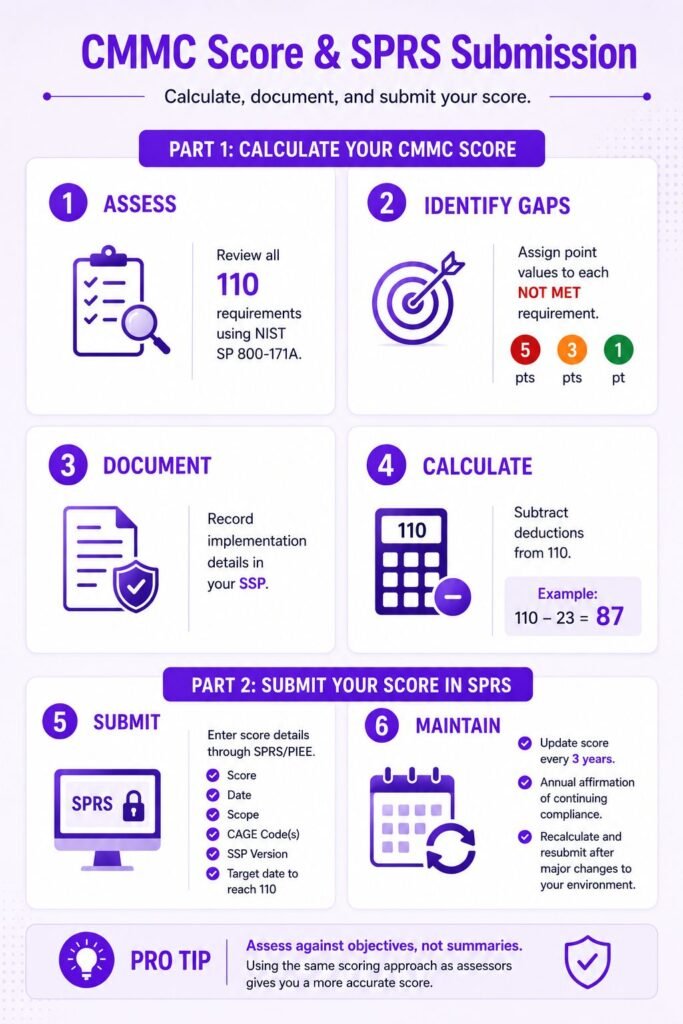
The most reliable way to calculate your score is to work through all 110 requirements at the assessment-objective level using NIST SP 800-171A, the companion publication assessors use. A single requirement can contain a dozen objectives, and one failed objective fails the requirement. Conducting a NIST SP 800-171 gap assessment at this level of granularity is what separates a defensible score from an optimistic one.

Once gaps are identified, map each NOT MET requirement to its point value using Annex A of the DoD Assessment Methodology. Tag every gap with its 1, 3, or 5 point weight, applying the two partial-scoring rules for 3.5.3 and 3.13.11 where relevant. Then document implementation status in the SSP: for each requirement, the SSP should state how it is implemented, where, and by what mechanism. Requirements that are technically enforced but undocumented are routinely scored NOT MET in third-party assessments, because the assessor scores what can be evidenced, not what exists in theory.

Finally, sum the deductions and subtract from 110. An organization missing two 5-point, three 3-point, and four 1-point requirements scores 110 minus 23, or 87, one point short of Conditional eligibility, which is exactly the kind of margin that makes the weighting worth understanding before an assessment rather than after.

Pro Tip: Score Yourself

Score yourself against the assessment objectives in NIST SP 800-171A, not the requirement text in 800-171. Self-assessments done at the requirement level run optimistic because a control that is "mostly there" feels met. Assessors work objective by objective, and the CMMC Level 2 Assessment Guide shows precisely how they will score you. Using the same lens removes the gap between your number and theirs.

How to Submit Your CMMC Score in SPRS

Submission runs through PIEE. Register an account, request the SPRS Cyber Vendor role for your CAGE code, and wait for your Contractor Administrator to approve it. Once inside SPRS, the NIST SP 800-171 assessment entry asks for a defined set of fields: the assessment date, the summary score, the scope (enterprise, enclave, or contract-specific), the CAGE codes covered, the SSP name and version the assessment was performed against, and a planned date by which a score below 110 will reach 110.

The supporting documentation does not get uploaded. The SSP, the assessment workpapers, and the POA&M stay with you, but they must exist and they must reconcile with the submitted number — because they are exactly what DIBCAC reviews if your score is ever checked under a medium or high assessment.

Keep the record current. A score must be refreshed at least every three years to remain valid, the senior official’s affirmation of continuing compliance recurs annually under 32 CFR 170.22, and a material change to the environment — such as a cloud migration or a new system handling CUI — means recalculating and resubmitting rather than waiting for the cycle.

Reach SOC 2 Compliance in 6 Weeks or Less

Schedule Your Free SOC 2 Assessment Today

The Role of POA&Ms in CMMC Scoring

A Plan of Action and Milestones is a time-bound remediation plan for requirements scored NOT MET: what the deficiency is, what will fix it, who owns it, and by when. Under CMMC, its use is far narrower than most contractors assume. 32 CFR 170.21 permits POA&Ms only to reach Conditional status, and only when all of the following hold: the assessment score is at least 88, every POA&M item is a 1-point requirement, and none of the specifically prohibited requirements appear on the plan.

The 180-day window is rigid. The clock starts on the Conditional status date, and every POA&M item must be closed and verified through a POA&M closeout assessment within it. For a certification assessment, the closeout is performed by a C3PAO. If items remain open at day 180, the Conditional status expires, the organisation becomes ineligible for awards requiring that status, and the entire assessment must be repeated.

Insider note: There is exactly one situation in which something heavier than a 1-point item can sit on a POA&M — FIPS-validated encryption (3.13.11), and only in its partial state. If encryption is deployed but not FIPS-validated, the 3-point deduction is POA&M-eligible. If no encryption is in place at all, the full 5-point deduction applies, and the requirement cannot be deferred. In practice, this makes cryptographic module validation the single most consequential procurement question in a Level 2 readiness project.
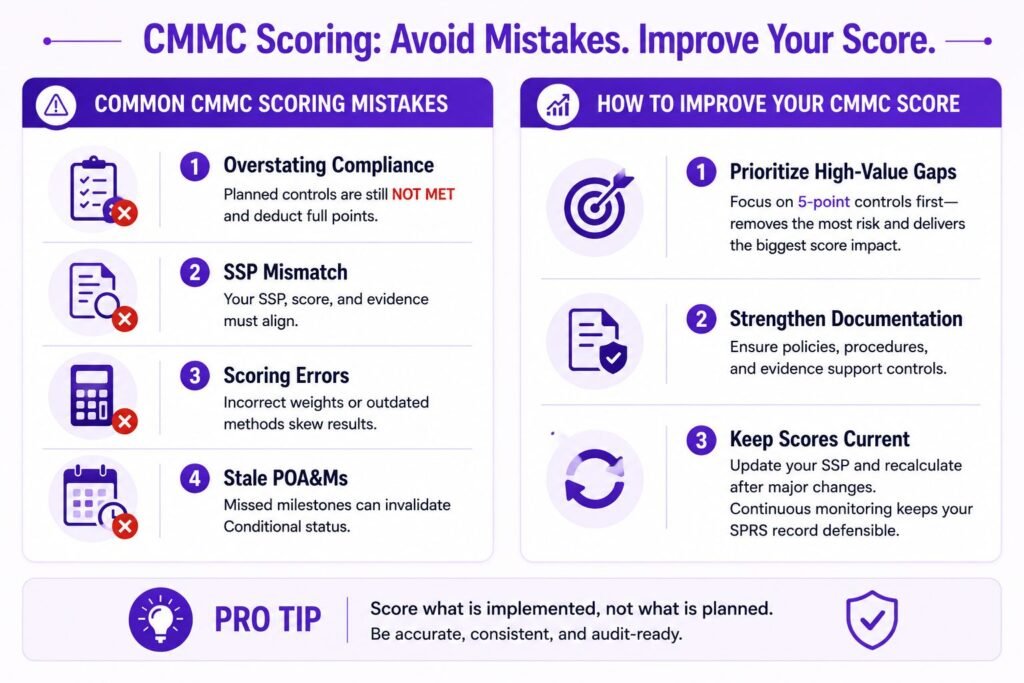
Common CMMC Scoring Mistakes to Avoid

Overstating the self-assessment. When DIBCAC has reviewed self-reported scores under medium and high assessments, independently verified numbers have frequently come in dramatically below what contractors submitted. The gap is rarely fraud; it is requirement-level scoring, charitable interpretation, and confusing planned with implemented. The POA&M trap sits here too: a requirement on a plan of action is still NOT MET and still deducts its full point value.

An SSP that does not match reality. Assessors triangulate the submitted score, the SSP, and observable evidence. When the SSP describes controls that interviews and technical testing cannot confirm, the requirement fails — and the credibility of every other claim in the document drops with it.

Arithmetic and weighting errors. Treating partially implemented requirements as met, missing the two partial-scoring exceptions, or working from an outdated copy of the methodology all produce a number that will not survive verification.

Letting the POA&M go stale. Milestones without owners and dates, or items that quietly slip past their completion dates, convert a Conditional status into an expired one. The 180-day closeout is not extendable.

Pro Tip: The annual affirmation under 32 CFR 170.22

The annual affirmation under 32 CFR 170.22 is signed by a named senior official, and the Department of Justice has pursued False Claims Act cases against contractors over misrepresented cybersecurity compliance through its Civil Cyber-Fraud Initiative. An optimistic score is no longer a private estimate; it is a federal representation with a signature on it.

How to Improve Your CMMC Score

Sequence remediation by weight, not by ease. Closing five 1-point documentation gaps moves the score five points; closing one 5-point technical control moves it the same distance and removes a requirement that can never sit on a POA&M. The 5-point population — which includes boundary protection, access control enforcement, flaw remediation, and audit logging — is where both the score and the actual security risk concentrate.

Next, close the documentation layer. A meaningful share of NOT MET findings in otherwise capable organisations are evidence failures: the control runs, but no policy requires it, no procedure describes it, and no artefact proves it. Fixing this is cheap relative to its scoring impact.

Finally, treat the score as a maintained asset. Configuration drift, expired FIPS certificates after patching, and new systems entering scope all erode a score between assessments. Continuous monitoring tied to the SSP, with the score recalculated whenever the environment changes materially, keeps the SPRS record defensible and avoids a scramble before the next triennial cycle.


Self-Assessment vs. Third-Party Assessment Scoring

The methodology is identical in both paths; what changes is who applies it, how evidence is tested, and what the result is worth contractually.

In a self-assessment, the contractor scores its own environment, enters the result in SPRS, and a senior official affirms it. This satisfies the requirement for contracts that specify only the basic DFARS 252.204-7012 reporting obligation or a CMMC Level 1 or Level 2 self-assessment status. The score is the contractor’s own claim, and it carries the legal weight of that affirmation.

In a third-party assessment, a Certified Third-Party Assessment Organization (C3PAO) applies the same 110-requirement methodology with independent evidence testing — document review, interviews, and technical observation — across the defined assessment scope. The result is entered into eMASS and flows to SPRS as a formal certification status rather than a self-reported number. For Level 3, the assessor is DIBCAC rather than a C3PAO, and the additional 24 requirements from NIST SP 800-172 are scored on top of a confirmed Final Level 2 foundation.

Level 1 sits apart from both: a simple annual self-assessment of 15 requirements with no numeric score, no POA&Ms, and an annual affirmation. Organisations that completed a Joint Surveillance Voluntary Assessment (JSVA) with DIBCAC before the rule took effect were able to convert a perfect result into early certification standing, which is why JSVA alumni dominate the first wave of certified companies.

CMMC scoring rewards organizations that measure themselves the way an assessor would: objective by objective, evidence first, weighted gaps prioritized, and a POA&M used as a short runway rather than a parking lot.

The contractors who struggle are almost never the ones with the worst security; they are the ones whose number was built on assumptions instead of assessment.

Frequently Asked Questions

What is the minimum SPRS score for CMMC Level 2?

Final Level 2 status requires 110. A score of at least 88 can earn Conditional Level 2 status, but only if every unmet requirement is POA&M-eligible under 32 CFR 170.21 and all items close within 180 days.

A score is valid for three years, but the senior official’s affirmation of continuing compliance is annual, and any material change to the assessed environment requires recalculating and resubmitting before the cycle ends.

Nothing automatic, but it is visible to contracting officers and primes as a clear signal of non-implementation, and it places Conditional eligibility (88) far out of reach. First honest assessments commonly land negative; the response is a weighted remediation plan, not a resubmission.

Where only the self-assessment reporting requirement applies, a current score of any value can satisfy the letter of the rule. Once a solicitation specifies a CMMC status under DFARS 252.204-7021, the required status is an eligibility condition, and a low score means no award.

Three years from the assessment date, subject to the annual affirmation and to resubmission if the environment changes materially.

The SPRS score is a self-reported number under the DoD Assessment Methodology. A CMMC Level 2 certification is a formal status — Conditional or Final — resulting from an assessment by a C3PAO at Level 2 or DIBCAC at Level 3, using the same scoring rules. The first is a claim; the second is a verified credential.

SPRS is not public. DoD personnel — including contracting officers, program offices, and DCMA/DIBCAC — can view it, and prime contractors can confirm whether a subcontractor holds a current assessment when verifying flow-down compliance.

Axipro Author

Picture of Pedro Dias

Pedro Dias

Pedro has been writing online for over 10 years. With experience in all things programming, cyber security, and compliance, he is our editor-in-chief at Axipro.

Blog Highlights

Explore More Articles

Compliance software collects the evidence. A consultant builds the system that evidence is meant to prove. That’s the real difference in the ISO 27001 consultant vs software decision, and most teams only figure it out after they’ve bought one and realized they still need the other. Below, we compare what each route covers, where it breaks down, and what it costs you in time, money, and your team’s hours. Short version: software on its own works for a small group of companies. For most SaaS and tech scale-ups trying to get an enterprise deal over the line, consultant-led implementation on a compliance platform is the faster and safer path to a certificate. Quick Answer: Consultant, Software, or Both? Software-only works if you already have an in-house security lead who’s taken a company through ISO/IEC 27001 before and has the time to own the project. Consultant-only still makes sense if you run mostly on-premise or legacy systems that platforms barely integrate with. For everyone else, which means most cloud-native companies under a few hundred people, a hybrid works best: a platform to handle evidence and monitoring, and a consultant to build the management system and stand behind it in front of an auditor. Here’s why. What an ISO 27001 Consultant Handles ISO/IEC 27001:2022 is a management system standard. Clauses 4 to 10 cover how you run information security, and Annex A lists 93 controls you pick from based on risk. Almost none of it is box-ticking. Most of it comes down to judgment calls about your business, and that’s what you’re paying a consultant for. Scoping, Gap Analysis and Risk Assessment Scope is the first decision you make, and the most expensive one to get wrong. Go too wide and you’ll spend months on controls for systems no customer asks about. Go too narrow and the certificate won’t get through the procurement review it was supposed to pass. A consultant scopes around the deals you’re trying to close, runs a gap analysis, and builds a risk assessment based on your real assets and threats. That’s the document auditors dig into hardest. ISMS Documentation and Policy Writing The standard asks for a specific set of documents: the ISMS scope, information security policy, risk assessment and treatment methodology, Statement of Applicability, risk treatment plan, and evidence of competence, monitoring, internal audit, and management review. A consultant writes these around how your company works day to day, instead of how a template imagines it works. Auditors check whether you follow your own procedures, so a mismatch shows up fast. Internal Audit and Certification Audit Support You need an internal audit before certification, and Clause 9.2 says the auditor has to be objective and impartial. In a small company, the people who built the ISMS can’t credibly audit it, so most teams outsource it through ISO 27001 internal audit services. A good consultant also gets your team ready for the Stage 1 and Stage 2 audits, joins the conversations that matter, and handles corrective actions if the auditor raises nonconformities.  What ISO 27001 Compliance Software Handles Compliance automation platforms, often called GRC platforms, have changed how cloud-native companies get certified. They’re very good at the repetitive, evidence-heavy side of the work. Automated Evidence Collection and Continuous Control Monitoring The platform plugs into your cloud provider, identity provider, code repos, HR system, and device management tools, then pulls evidence on its own. It’ll flag an unencrypted storage bucket, an ex-employee who still has access, or a laptop without disk encryption. For technical controls, that saves weeks of screenshots and spreadsheet tracking. Policy Templates and Annex A Control Mapping Most platforms come with a policy library and map each control to the ISO 27001 clauses and Annex A. You get a starting point and a clear view of which controls have evidence and which don’t. Auditor Access and Ongoing Compliance Tracking Auditors can log in and review evidence themselves, which cuts down fieldwork. After you’re certified, dashboards show when controls slip between surveillance audits, so you aren’t rebuilding evidence from scratch every year. Where Each Approach Falls Short Neither route covers everything by itself. The good news is that the ways each one fails are predictable, so you can plan around them. Limits of Compliance Automation Platforms A platform can tell you a control is failing. It can’t decide your scope, run your risk assessment, write a policy that matches your operations, convince your CTO to change the offboarding process, or explain to an auditor why you excluded a control from your Statement of Applicability. Templates can also make you feel further along than you are. A dashboard at 90% can hide an ISMS that won’t survive Stage 1, because the missing 10% is the management system itself. Insider Note: The Stage 1 problem we see most on software-only projects is a risk assessment copied straight from the platform’s default risk library. The risks are generic, the scores are almost identical, and nothing ties back to the company’s own assets. Auditors notice within minutes, and it weakens the Statement of Applicability that’s built on it. The other problem is ownership. Software assumes someone inside the company will drive the project. At most startups that’s a CTO or ops lead who already has a full-time job, and the subscription renews whether the work gets done or not. Limits of a Consultant-Only Approach A consultant working without automation spends billable days on things a platform does for free, like chasing screenshots, updating evidence trackers, and collecting the same proof again before every surveillance audit. You pay more and wait longer. You also end up with a program that’s only accurate on the day it’s handed over. Once the engagement ends, the evidence goes stale and year-two surveillance turns into a scramble. ISO 27001 Consultant vs Software: Side-by-Side Comparison Factor Consultant only Software only Hybrid (consultant + platform) Time to audit readiness 3 to 6+ months Highly variable; depends on internal expertise As little as 6 weeks for well-scoped

Uzbekistan regulates artificial intelligence through two documents. The first is Law ZRU-1115, signed on 21 January 2026. It amends existing legislation to define AI, stops anyone from basing decisions about people’s rights on AI output alone, and fines companies that process personal data unlawfully with AI. The second is the set of Ethical Rules approved by Order No. 3787, in force since 17 June 2026, which spell out what developers, implementers, and users actually have to do. Uzbekistan hasn’t passed a standalone AI act, and its rules don’t sort systems into risk tiers or require conformity assessments. The framework is short and blunt, and it’s already enforceable. Below we walk through what each document requires, who it applies to, how it stacks up against the EU AI Act, and what a company using AI in Uzbekistan should do next. Uzbekistan AI Regulation at a Glance (TL;DR) Instrument Date What it does Who it binds Law ZRU-1115 Signed 21 January 2026 Defines AI in law, sets general rules for AI-built information resources and systems, bans legally significant decisions based only on AI, adds fines for unlawful AI processing of personal data State bodies, organizations, website owners, anyone processing personal data with AI Order No. 3787 (Ethical Rules) Registered 14 March 2026, in force 17 June 2026 Sets eight mandatory ethical principles and lists rights and obligations for developers, implementers, and users Individuals and companies developing, implementing, or using AI in Uzbekistan Law No. 1125 (Personal Data amendments) Adopted 26 March 2026 Limits data localization to biometric, genetic, and local telecom user data, and allows cross-border transfers under conditions Personal data operators, including AI providers AI Strategy until 2030 (RP-358) 14 October 2024 Sets national targets for AI adoption, infrastructure, and skills Government bodies What Is Law ZRU-1115? The law’s official title is a mouthful: “On making additions and changes to certain legislative acts of the Republic of Uzbekistan in connection with the regulation of relations arising from the use of artificial intelligence.” Put simply, it’s an amending law. Instead of creating a new AI code, it writes AI into laws that were already on the books. When It Was Signed and When It Took Effect The Legislative Chamber of the Oliy Majlis adopted the bill on 12 August 2025, and the Senate approved it on 1 November 2025. President Shavkat Mirziyoyev signed it on 21 January 2026. You can read the official text in Lex.uz, Uzbekistan’s national legislation database. The law set out the principles and the penalties. The day-to-day detail arrived later with the Ethical Rules, which came into force on 17 June 2026. For compliance planning, treat mid-June 2026 as the point when the whole framework started applying. Why Uzbekistan Amended Existing Laws Instead of Passing a Standalone AI Act Uzbekistan wants more AI, not less. Its national strategy sets numeric targets for adoption, investment, and local computing capacity, and a heavy EU-style act would have worked against them. So lawmakers kept it light. They defined AI, drew two hard lines (human control over decisions that affect people’s rights, and protection of personal data), and left the Ministry of Digital Technologies to fill in the rest through secondary rules. Businesses get less legal certainty, and the government gets to move faster. Which Laws ZRU-1115 Changes For businesses, two amendments matter most. The Law “On Informatization” (ZRU-560-II, 2003) now contains a legal definition of AI, a new article on using AI in information resources and systems, duties for website owners, and updated powers for the ministry in charge. The Code on Administrative Liability now includes an offense for processing and spreading personal data unlawfully using AI. The Legal Definition of Artificial Intelligence in Uzbekistan Under the amended Law “On Informatization,” AI is a set of technological solutions that imitate human cognitive functions, including learning on their own and solving problems, and that produce results on specific tasks comparable to what a person could do. That’s deliberately broad. It covers generative AI, machine learning classifiers, recommendation engines, and most agentic systems. The Ethical Rules add a narrower term, the AI system: software built on AI that can find, collect, store, analyze, process, evaluate, and use data, and make decisions on its own based on that data. If your product makes a decision from data, or shapes one, assume it counts. Key Rules Introduced by Law ZRU-1115 General Principles for Using AI in Information Systems and Resources The new article in the Law “On Informatization” starts from harm. Information resources created with AI, and information systems running on AI, must not harm people’s life, health, freedom, honor, or dignity, or violate their other inalienable rights. The standard is short and open-ended. It gives regulators something to enforce against without saying in advance what counts as harm. Principle-based rules like this deserve to be taken seriously precisely because the edges are undefined. Human Oversight: No Decisions on Rights and Freedoms Based Solely on AI Most coverage leads with this provision, and it’s easy to see why. When someone makes a legally significant decision that affects human rights and freedoms, they can’t rely only on conclusions produced by AI systems or AI-built information resources. AI can feed into the decision, but a person has to make it. That applies to loan denials, benefit eligibility, hiring rejections, licensing outcomes, and disciplinary action. In each case, someone needs to look at the AI output and own the final call. Insider Note: In AI governance engagements, teams rarely struggle to show that a review step exists. What they struggle to show is that the reviewer could disagree, and sometimes did. If a human clicks “approve” on every AI recommendation and nobody ever records an override, auditors will see automation with a signature on top. Build the override path and log when people use it, starting on day one. Powers of the Authorized State Body (Ministry of Digital Technologies) ZRU-1115 makes the Ministry of Digital Technologies the authorized state body for AI. Among its new jobs, it’s

You can get a SaaS company ready for a SOC 2 audit in six weeks, but you’ll feel every one of them. Most published timelines say three to six months. For a company with no project owner, no identity provider, and nothing written down, that’s about right. A cloud-native startup that already has the basics in place and can protect some time is a different story, and it can fit the work into six hard weeks. This plan walks through that route one week at a time. Each week has an owner, an hour estimate, and a clear test for when it’s finished. The free Google Sheet version turns the plan into a tracker you can hand out to owners and update in your weekly standup. Before you start, know what you’re signing up for. At the end of week 6 you’ll be audit-ready, which isn’t the same as holding a Type II report. Nobody can get you a Type II in six weeks. This is also the do-it-yourself route, and it takes a lot of hours. We’ll show you where those hours go and what the faster option looks like. Is Six Weeks Realistic for Your Company? Six weeks works when most of the plumbing already exists and your job is to formalize it, fill the gaps, and prove it all works. It falls apart when you’re building the foundations and documenting them at the same time. Go through this table honestly before you promise a customer a date. Six weeks is realistic if… Plan for 10 to 16 weeks if… Your product runs on a major cloud provider You host on-premise or across several data centers You already use an identity provider with SSO Every tool has its own login and password You have fewer than about 50 employees You have multiple offices, subsidiaries, or products in scope One named person owns the project with 10 to 15 hours a week Compliance is “everyone’s job,” so in practice nobody owns it An engineer can give you 15 to 20 hours in weeks 3 and 4 Engineering is fully committed to a launch You only need the Security criteria You need Availability, Confidentiality, or Privacy on day one Landing mostly in the right-hand column doesn’t mean you should throw the plan out. Give each week two weeks instead of one and follow the same order. What “SOC 2 Ready” Means at the End of Week 6 SOC 2 doesn’t give you a certificate. An independent CPA firm examines your controls against the AICPA Trust Services Criteria and writes a report, and which of the two report types you go for decides what you can show a buyer after week 6. A Type I report checks whether your controls are designed properly on a single date. Once you’re ready, a Type I audit can start almost right away. A Type II report checks whether those controls kept working over an observation period of at least three months, and usually six to twelve. Most enterprise procurement teams want Type II in the end. Being “ready” at the end of this plan means your in-scope controls are in place, you can pull evidence for any of them on request, and your auditor is booked. From there you either start a Type I audit or open your Type II observation window. Plenty of buyers will sign with a Type I report plus a letter from your auditor saying the Type II period is underway. Important: The Type II clock doesn’t start until your controls are running. If readiness slips by a week, your Type II report slips by a week too. Founders who tell a prospect “we’ll have SOC 2 in Q3” often forget this and end up renegotiating the deal. Before Week 1: Four Decisions to Make First Settle these before the clock starts. If you change any of them halfway through, you’ll redo work. Scope. Decide which systems, teams, and data the report covers. For most SaaS companies that’s the production environment, the code repository, the identity provider, customer data stores, and any support tools that touch customer data. Corporate systems that never see customer data can usually stay out. Trust Services Criteria. Security (also called the Common Criteria) is mandatory. Availability, Confidentiality, Processing Integrity, and Privacy are optional. Report type. Pick Type I if a deal is blocked right now and the buyer will accept it. If there’s no deadline, go straight to Type II. You’ll need it eventually, and skipping Type I saves you an audit fee. Owner and tooling. Name one person who’s accountable for the plan, and decide where your controls and evidence will live. The tooling choice gets its own section below. Pro Tip: Adding Criteria Only add optional criteria when a customer contract or security questionnaire asks for them. Each one brings more controls to set up and more evidence to collect, and you can widen the scope in next year’s audit. Spreadsheet or Compliance Software: Choosing Your Tracking Tool Every SOC 2 program needs a system of record, meaning one place where each control, its owner, its status, and its evidence live. You can run it yourself in a spreadsheet or a GRC platform, or have a consultant implement it for you. The right choice depends mostly on which report you’re after and how much of your team’s time you can spare. A spreadsheet is free and familiar. It also makes you understand your own environment before you automate any of it. For a Type I, or for a small team with a tight scope, a well-built spreadsheet can take you all the way to the audit. Axipro’s free GRC workbook for SOC 2 and ISO 27001 covers all 33 SOC 2 Common Criteria plus the optional criteria, with evidence, risk, policy, and gap trackers built in. It has no macros and opens straight in Google Sheets or Excel. A GRC platform connects to your cloud, identity provider, code repository, and HR system.