
Vanta is worth it for most cloud-native companies chasing their first SOC 2 or ISO 27001. It’s a harder call if you run on-prem infrastructure, have unusual evidence requirements, or a budget that can’t absorb a renewal surprise. That’s the short answer. The longer one comes down to three things: how much of the platform’s automation applies to your stack, what the contract costs by year two, and how much compliance expertise you have in-house.
This review draws on Vanta’s 2026 product releases, third-party procurement data, review platforms, and our experience at Axipro as a Vanta partner implementing the platform for clients across SOC 2, ISO 27001, and ISO 42001 engagements. We work inside the tool every week. We also see exactly where it stops working, and a human has to pick up.
What Is Vanta? A Quick Overview
Vanta is a compliance automation platform that now calls itself an Agentic Trust Platform. It connects to your cloud infrastructure, identity provider, code repositories, HR system, and device fleet, then runs continuous automated tests against the controls your target framework requires. It collects evidence on its own, maps it to controls, and packages the whole thing for your auditor.
Vanta at a Glance
Founded in 2018, Vanta now serves more than 15,000 customers, from early-stage startups to names like Atlassian, Duolingo, and Icelandair. The platform supports 35+ frameworks, ships 400+ integrations (the deepest library in the category), and runs over 1,400 pre-built automated tests. In 2026, Forrester named Vanta a Leader in The Forrester Wave: Governance, Risk, and Compliance Platforms, Q2 2026, the first time it appeared in the evaluation.
Who Vanta Is Built For (Startups, Mid-Market, Enterprise)
Startups remain the core market: roughly 58% of Vanta’s G2 reviews come from small businesses, typically SaaS companies that need a SOC 2 report to close their first enterprise deals. Mid-market teams use it to run multiple frameworks off shared evidence. The enterprise push is newer. In March 2026, Vanta shipped an Organizations Center and adaptive business unit scoping, which lets larger companies segment compliance by product, region, or team inside a single workspace instead of duplicating controls across accounts.
Frameworks Vanta Supports
Coverage includes SOC 2 (Type I and Type II), ISO 27001, ISO 42001 for AI management systems, HIPAA, GDPR, HITRUST, FedRAMP, PCI DSS, and the NIST AI RMF, among 35+ total. The AI governance coverage matters more each quarter: ISO 42001 and NIST AI RMF requests now show up in security questionnaires that had never mentioned AI before 2025.
Let Axipro help you build a business continuity plan that's practical, compliant, and audit-ready.
Schedule Your Free Assessment Today
Vanta Key Features Reviewed
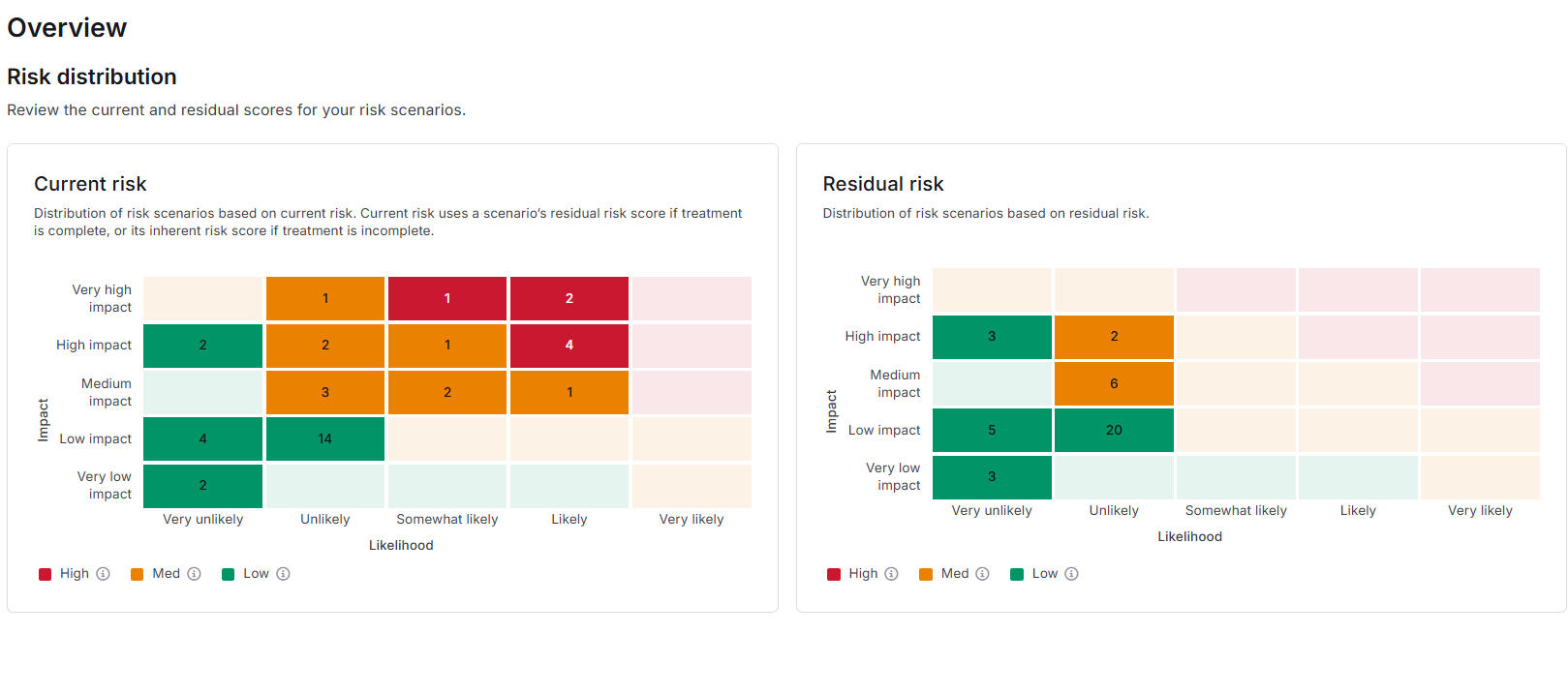
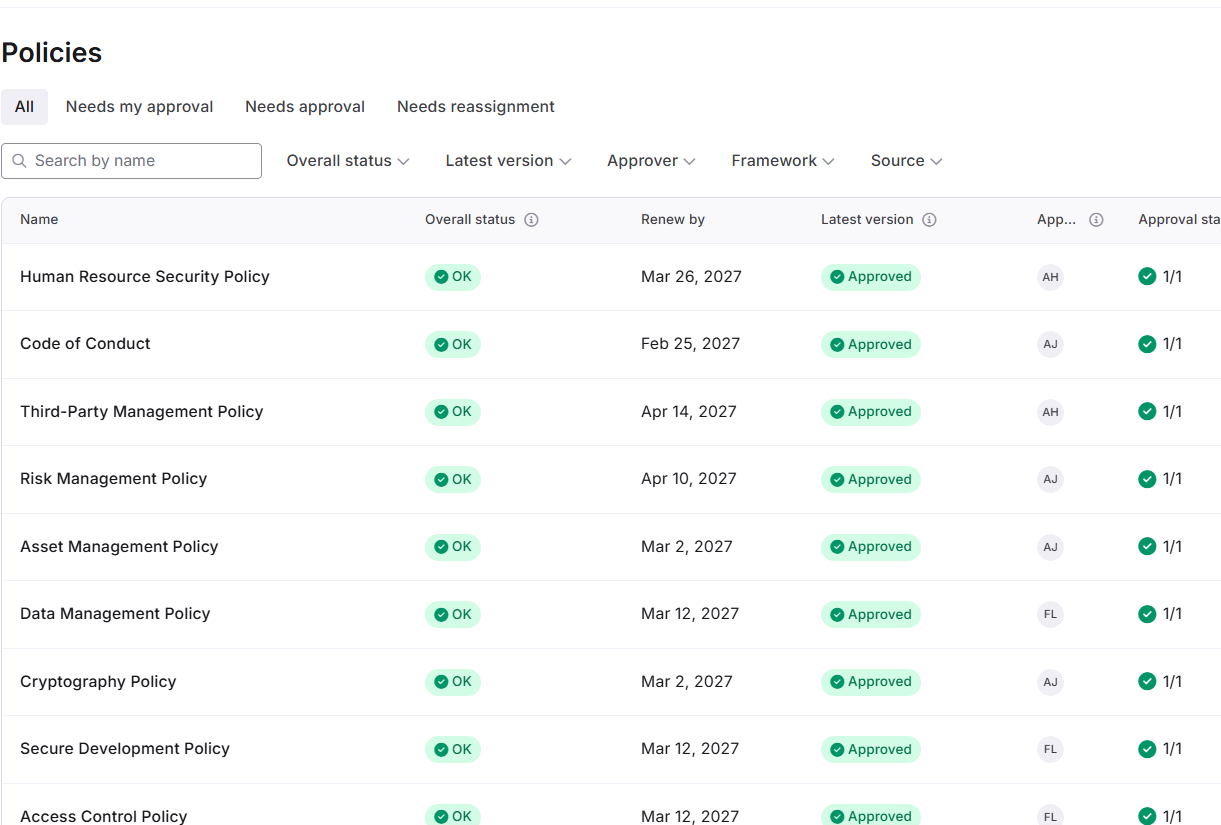
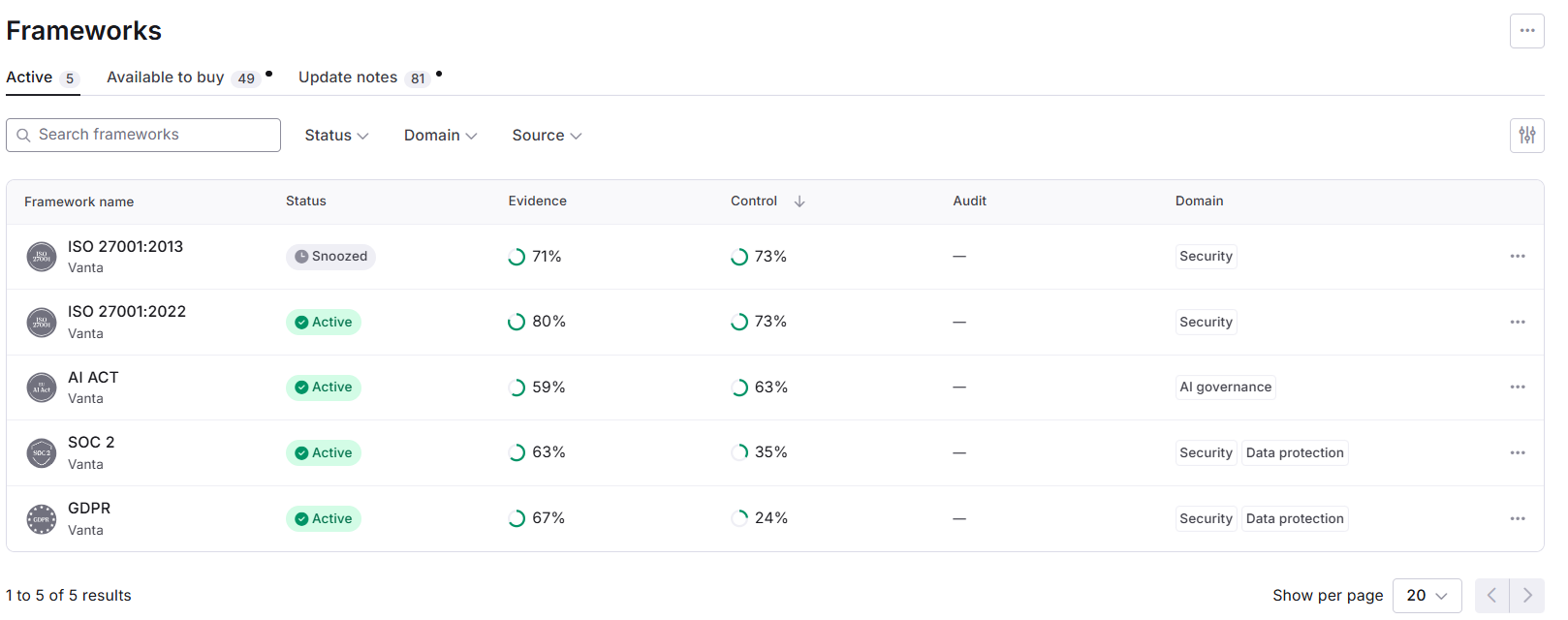
Overview of the Vanta platform and compliance management dashboard.
Continuous Controls Monitoring
This is the engine. Vanta’s 1,400+ tests run continuously against AWS, GCP, Azure, Okta, GitHub, and whatever else you’ve connected: are S3 buckets encrypted, is MFA enforced, are background checks done on time, does anyone hold access they shouldn’t? Failing controls get flagged with remediation guidance and SLA tracking, so compliance stops being an annual scramble and turns into something you maintain as you go.
Automated Evidence Collection
Instead of screenshots and spreadsheet exports, evidence flows in from your integrations and lands on the right controls. Cross-mapping is the underrated part: evidence you collect for SOC 2 gets reused for ISO 27001, HIPAA, or ISO 42001, which is why adding a second framework on Vanta takes weeks rather than months.
The Vanta AI Agent (2026 Update)
The AI Agent launched in mid-2025 and has moved fast since. In November 2025, Vanta rebuilt it as AI Agent 2.0, the core of the new Agentic Trust Platform, alongside a Risk Graph and Customer Commitments tracking. In March 2026, dedicated agents for compliance, third-party risk, and customer trust workflows. In June 2026, the Vanta Agent for Risk unified internal and vendor risk into one continuously updated view.
In practice, the agent scans your program for inconsistencies, drafts policy change summaries for annual reviews, suggests control mappings when you upload policies, validates evidence before audits, and flags questionnaire gaps before they slow a security review. Vanta pitches it as a 24/7 GRC engineer. That’s marketing, but not empty marketing: it takes real hours of tedious work off your plate. Every draft still needs a human review before adoption, and the agent does its best work when a question maps to evidence you already hold.
Insider Note: The AI Agent is only as good as its signal. If a large slice of your stack sits outside Vanta’s 400+ integrations, its suggestions shift from precise to generic. Test it against your actual environment during a trial, not a polished demo tenant.
Policy, Vendor Risk, and Training Modules
Policy templates cover the standard library, with AI-assisted drafting and version tracking. Vendor Risk Management (VRM) is a paid add-on that collects vendor evidence and generates AI risk summaries, feeding the broader third-party risk management picture. Security awareness training is built in, which removes one more standalone tool from the stack.
Trust Center and Questionnaire Automation
The Trust Center gives you a public page where prospects self-serve your security posture, and questionnaire automation drafts answers to inbound security reviews. Vanta reports automating over 80% of questionnaire responses with up to a 95% acceptance rate and 81% faster review completion. Those are vendor numbers, so apply a discount, but the direction matches what users report. Watch the caps: lower tiers limit automated questionnaires per year, and enterprise sales teams burn through those limits quickly.
Access Reviews
Access review campaigns pull directly from your identity provider, so quarterly reviews become a guided approval flow instead of a spreadsheet exercise. It’s a strong module; just know it sits in the Plus tier and above, not the entry plan.
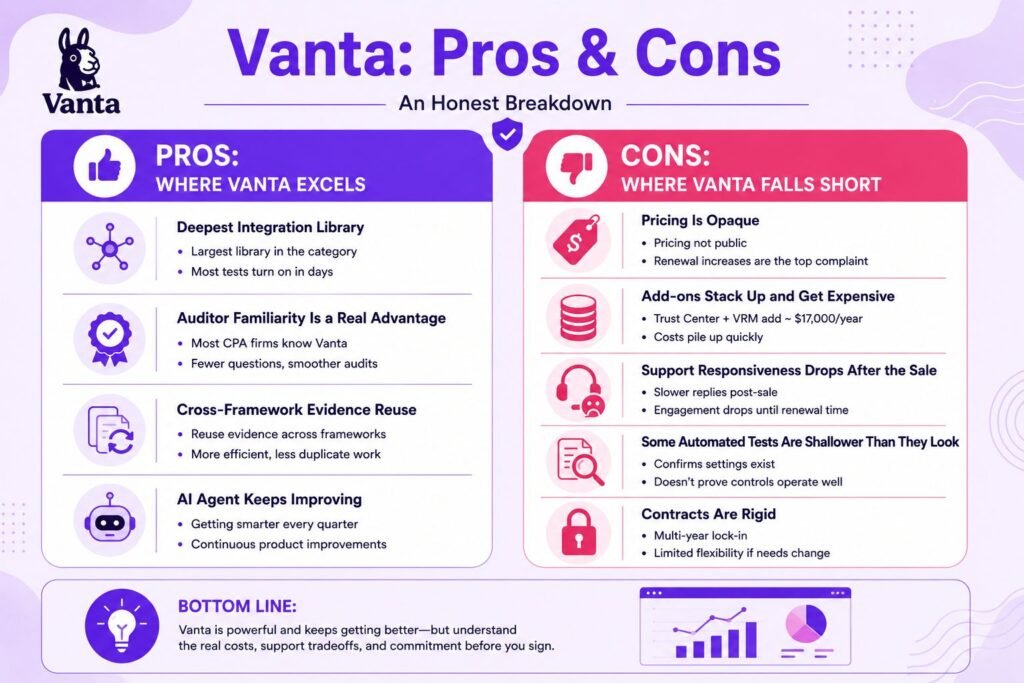
Vanta Pros and Cons (Honest Breakdown)
Pros: Where Vanta Excels
- The integration library is the deepest in the category, and it shows during onboarding: most tests light up within days for a standard cloud stack.
- Auditor familiarity is a real, compounding advantage, since most CPA firms know Vanta’s exports and ask fewer clarification questions.
- Cross-framework evidence reuse makes multi-framework programs efficient. And the AI Agent keeps improving quarter over quarter rather than sitting still.
Cons: Where Vanta Falls Short
- Pricing is opaque, and renewal increases are the single most consistent complaint across G2 and Reddit.
- Add-ons stack up: Trust Center and VRM together can add roughly $17,000 a year on top of base pricing.
- Support responsiveness reportedly drops after the sale, with customer success engagement thinning out until renewal season. Some automated tests are shallower than they look, confirming a setting exists rather than proving the control operates well. And contracts are rigid, with multi-year lock-in and limited flexibility if your circumstances change.
Let Axipro help you build a business continuity plan that's practical, compliant, and audit-ready.
Schedule Your Free Assessment Today
The Automation Gap: What Vanta Covers vs. What You Still Do Manually
Compliance automation platforms automate evidence, not judgment. Vanta handles the continuous monitoring, evidence collection, control mapping, and questionnaire drafting. What stays human is the work that requires context: defining your audit scope, deciding which risks to accept versus remediate, actually fixing broken controls, and preparing the narrative your auditor needs. The platform surfaces the problem; your team owns the decision and the fix.
Important: Vanta tells you a control is failing. It doesn’t fix the control. Budget internal engineering time for remediation, especially in the first six weeks. That’s where most audit timelines slip, and no platform tier changes it.
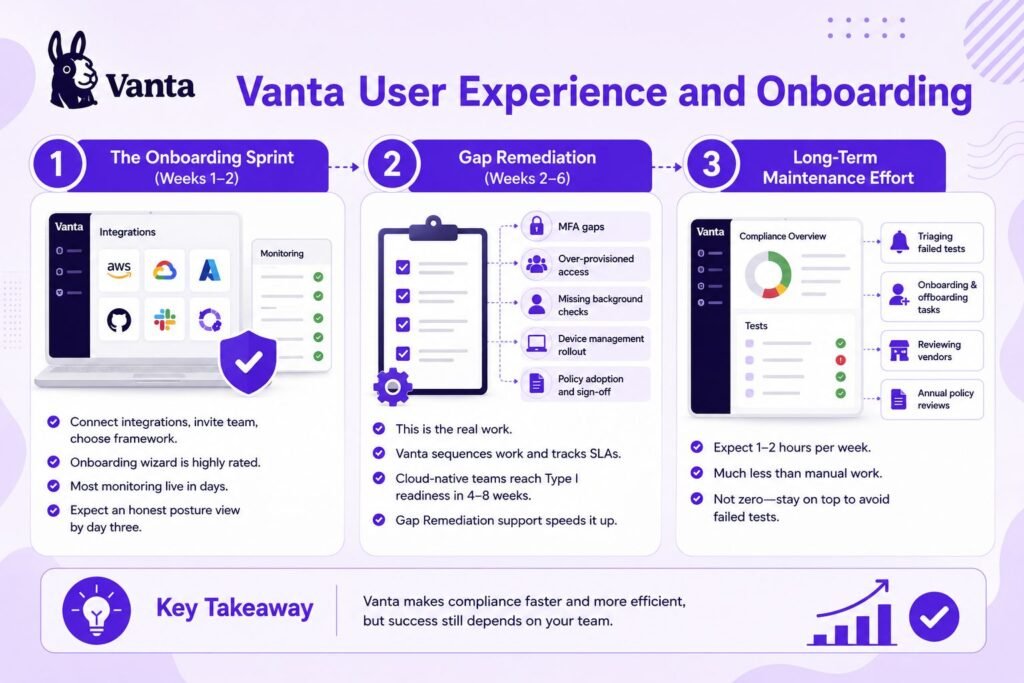
Vanta User Experience and Onboarding
The Onboarding Sprint (Weeks 1-2)
Connect your integrations, invite the team, pick your framework. The onboarding wizard is one of the most praised parts of the product on G2, and for a standard SaaS stack, most monitoring lights up within days. The first dashboard view is usually uncomfortable. That’s the point: you get an honest picture of your posture on day three instead of week ten of an audit.
Gap Remediation (Weeks 2-6)
This is the real work. MFA gaps, over-provisioned access, missing background checks, device management rollout, policy adoption and sign-off. Vanta sequences the work well and tracks SLAs, but the hours come from your engineers and your ops team. Cloud-native startups with a cooperative team typically reach Type I readiness in four to eight weeks, and structured Gap Remediation support can compress that further.
Long-Term Maintenance Effort
After the first audit, expect an hour or two a week: triaging failed tests, completing onboarding and offboarding tasks, reviewing vendors, and running annual policy reviews. That’s dramatically less than manual maintenance, but it’s not zero, and teams that treat the platform as fire-and-forget accumulate failed tests that make the next audit painful.
Worth Knowing: SOC 2 Type II Requirement
SOC 2 Type II requires an observation window, usually three to twelve months, during which your controls must operate. No platform shortens the window itself. What Vanta shortens is the preparation before it and the evidence assembly after it.
Budgeting for Vanta: The Short Version
Vanta publishes no prices. Every quote is custom, and the most credible independent benchmark, from procurement platform Vendr, puts observed annual contracts between roughly $7,500 and $57,000 with a median around $20,000. Headcount, framework count, and add-ons like Trust Center and Vendor Risk Management move the number, and the audit fee itself is always separate. Watch renewals: escalation clauses of 5 to 10% are standard, and buyers on Reddit and G2 repeatedly report sharper year-two increases when headcount grew or bundled features converted to paid add-ons.
We keep the full tier-by-tier breakdown, add-on costs, total cost of ownership math, and negotiation levers in our dedicated Vanta pricing guide, so this review stays focused on whether the platform earns the spend.
Pro Tip: Negotiate the Renewal
Negotiate the renewal before you sign the original contract. A multi-year price lock (24 to 36 months) typically earns 10 to 25% off list, and certified partners can often do better when frameworks and add-ons are bundled upfront. Bring a competing quote and buy at quarter-end. Those two levers move the price more than anything else.
Real User Sentiment on Vanta
G2 Reviews
Vanta holds 4.6 out of 5 across 2,300+ G2 reviews, with 58% coming from small businesses. The praise clusters around ease of use, fast onboarding, and having the whole GRC program in one place. Complaints center on price, spotty integration depth in places, and support quality.
Reddit Discussions
Threads in r/soc2 and r/cybersecurity tell a consistent story: the platform works, procurement stings. Renewal increases dominate the discussion, including one widely shared report of a 40% year-two jump paired with declining support responsiveness. The practical consensus from buyers who’ve been through it: lock pricing early and cap renewals in writing.
Trustpilot Feedback
Trustpilot volume is low and polarized, which is typical for B2B software. Positive reviews credit the automation with drastically reducing manual security work; negative ones describe generic support responses and slow resolution. Elsewhere, Capterra rates Vanta 4.3 and Gartner Peer Insights 4.4, both citing the same cost and support themes.
How Vanta Works With Your Auditor
Vanta isn’t an auditor. A SOC 2 attestation can only come from a licensed CPA firm, and an ISO 27001 certificate from an accredited certification body. Vanta maintains a network of partner audit firms you can engage directly through the platform, or you can bring your own. Either way, the auditor gets structured access to your evidence rather than a folder of screenshots. The familiarity advantage is real: most audit firms have worked with Vanta exports many times, which means fewer clarification cycles and, often, a lower audit quote.
Vanta Suitability Scorecard: Should You Pick Vanta?
Vanta is a strong fit if you run a cloud-native stack, need SOC 2 or ISO 27001 to close deals, and have someone internally who can own the program. It’s a weaker fit if your infrastructure is largely on-prem, your evidence needs are unusual, your budget can’t absorb a year-two renewal jump, or nobody on the team is accountable for compliance day to day.
Score yourself honestly on that last point. The most common failure we see has nothing to do with the platform. A team buys the automation, assumes it replaces ownership, and finds out at audit time that it doesn’t.
Final Verdict: Is Vanta the Right Choice?
For cloud-native companies that need SOC 2 or ISO 27001 to unblock revenue, Vanta is the strongest overall platform on the market in 2026: deepest integrations, broadest auditor familiarity, the most mature AI agent in the category, and a Forrester Leader placement to match. The things to watch are commercial rather than technical. Go in with a multi-year price lock, renewal caps in writing, and add-ons bundled at signing, and the value case holds. Go in on a handshake and year two will cost you.
Vanta automates evidence collection, monitoring, and a growing share of GRC busywork, while scoping decisions, remediation judgment, and risk acceptance stay human. Priced with discipline and paired with real ownership, internal or through a Vanta implementation partner like Axipro, it turns compliance from a quarterly fire drill into a maintained state. That’s the whole promise of the category, and Vanta currently delivers on it better than anyone else.
Frequently Asked Questions
How much does Vanta cost per year?
Most contracts land somewhere between $7,500 and $57,000 a year, with the median around $20,000. The audit is billed separately. Our Vanta pricing guide breaks down every tier and add-on.
Is Vanta worth it?
For a cloud-native company pursuing its first SOC 2 or ISO 27001, usually yes: the time savings and auditor familiarity outweigh the cost. It’s a weaker fit for on-prem environments, tight budgets, or teams with nobody to own the program.
What's new in Vanta in 2026?
The Agentic Trust Platform rollout: AI Agent 2.0 at the core, dedicated agents for compliance, third-party risk, and customer trust (March 2026), the Agent for Risk (June 2026), enterprise features like the Organizations Center, and a Leader placement in the Forrester Wave for GRC Platforms, Q2 2026.
Can Vanta replace a compliance consultant?
No. It replaces the evidence-gathering and monitoring work a consultant used to bill for, but scoping, risk decisions, remediation strategy, and audit preparation judgment still need a human. Many companies run both: the platform for automation, a consultant or vCISO for direction.
How long does it take to get audit-ready with Vanta?
Cloud-native teams typically reach SOC 2 Type I readiness in four to eight weeks. Type II adds an observation window of three to twelve months that no platform can compress.
Does Vanta guarantee audit success?
No platform can. The audit opinion belongs to an independent auditor. What Vanta does is make failure unlikely by surfacing every gap before the auditor does.