
Vanta does not publish a single price on its website. Every quote is custom, generated after a sales call, and shaped by four variables: your headcount, the number of frameworks you need, the add-ons you select, and how long you commit. The median Vanta contract sits around $20,000 per year based on aggregated procurement-platform data, with the full range running from about $10,000 for a lean startup to $80,000 and beyond for a multi-framework enterprise. There is also one cost that most analyses miss: the actual audit fee, which is not included in the Vanta subscription price. This breakdown covers every tier, every hidden line item, and the levers that actually move the number down.
Vanta Pricing at a Glance
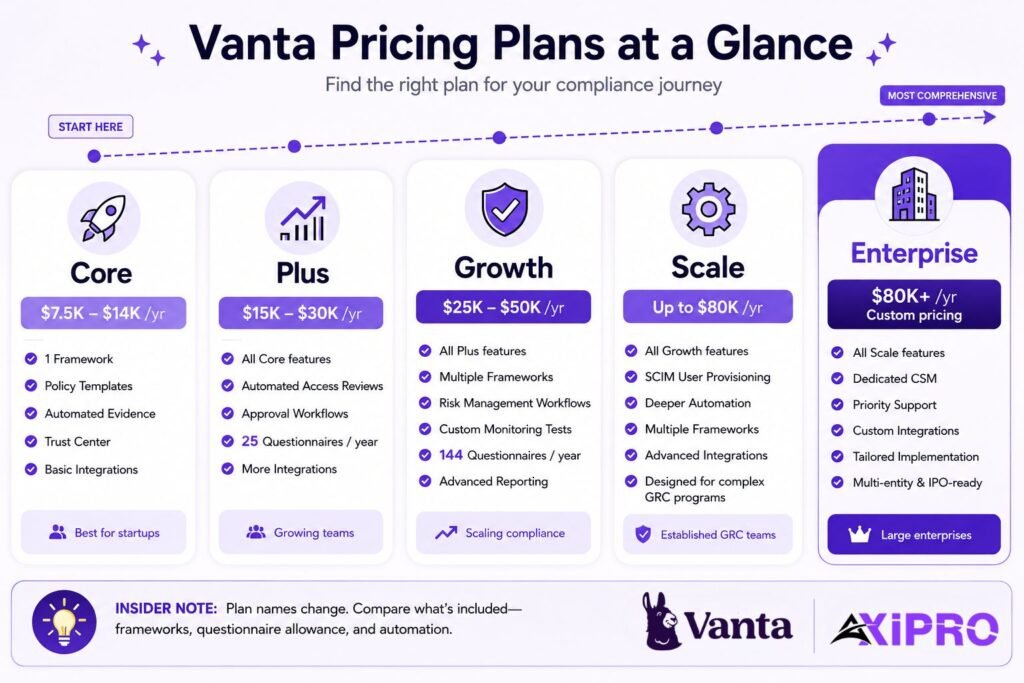
Vanta sells five named tiers, each aligned to a company stage or GRC maturity level. The figures below come from customer-reported benchmarks aggregated by procurement and price-intelligence platforms such as Vendr and PriceLevel, since no list prices exist publicly. Treat them as ranges, not quotes. The audit, paid to an independent firm, sits on top of all of these and typically adds $10,000 to $50,000 depending on framework and scope.
| Plan | Typical Annual Cost | Best For |
|---|---|---|
| Core | ~$10,000 | Startups, single framework |
| Plus | $15,000–$30,000 | Growing teams needing access reviews and questionnaire automation |
| Growth | $25,000–$50,000 | Scaling companies running multiple frameworks |
| Scale | $50,000–$80,000 | Formalised GRC or security teams |
| Enterprise | $80,000+ | Multi-entity, IPO-level, or highly complex environments |
Reach SOC 2 Compliance in 6 Weeks or Less
Get 20% to 30% Off Vanta Through Our Partner Discount
Vanta Pricing Plans Explained
Core Plan: Entry-Level Compliance for Startups
Core is the entry point, generally landing around $10,000 per year, with reported deals clustering between roughly $7,500 and $14,000. It covers one framework, usually SOC 2 or ISO 27001, with automated evidence collection, ready-made policy templates, basic integrations, a public-facing Trust Center, and access to Vanta’s network of approved audit firms. Smaller teams pursuing a single framework land at the low end of that range. It is built for the first-time compliance journey, not for running compliance as an ongoing operational function.
Plus Plan: Advanced Features for Growing Teams
Plus typically runs $15,000 to $30,000 per year. It adds the capabilities Core leaves out: automated access reviews, approval workflows, and a capped allowance of automated security-questionnaire responses, commonly cited at 25 per year. That questionnaire cap is the detail that catches growing teams off guard, and it is covered in the hidden-fees section below.
Growth Plan: Built for Scaling GRC Programs
Growth, sometimes sold as the Professional tier, ranges from roughly $25,000 to $50,000 per year and is Vanta’s most commonly sold plan for scaling companies. It supports multiple frameworks, advanced integrations, customisable risk-management workflows, custom monitoring tests for non-standard controls, automated access reviews, advanced reporting, and a far larger questionnaire allotment, often cited at 144 per year. This is the tier for organisations treating compliance as a service and a real business function, rather than a one-time checkbox.
Scale Plan: Expanded Compliance Coverage
Scale pricing starts where Growth tops out and can reach up to $80,000 per year. It is aimed at companies with formalised GRC or security teams, many connected assets, and several frameworks running in parallel. SCIM-based user provisioning and deeper automation across onboarding and offboarding tend to appear at this level.
Enterprise Plan: Fully Custom Pricing
Enterprise is entirely bespoke, starting above $80,000 and quoted case by case. It bundles a dedicated customer success manager, priority support, custom integrations, and tailored implementation. It becomes relevant for organisations managing multiple legal entities, thousands of assets, strict SLA requirements, or IPO-level scrutiny.
Insider note: Vanta’s plan names shift over time and between sales reps. You will see Core called Essentials, and Growth called Professional, in different quotes and on different comparison sites. Anchor your evaluation to what the plan actually includes, frameworks supported, questionnaire allowance, access review automation, rather than the label on the proposal, because the label is the least stable thing about it.
How Much Does Vanta Cost Per Year?
Annual Cost by Company Size and Stage
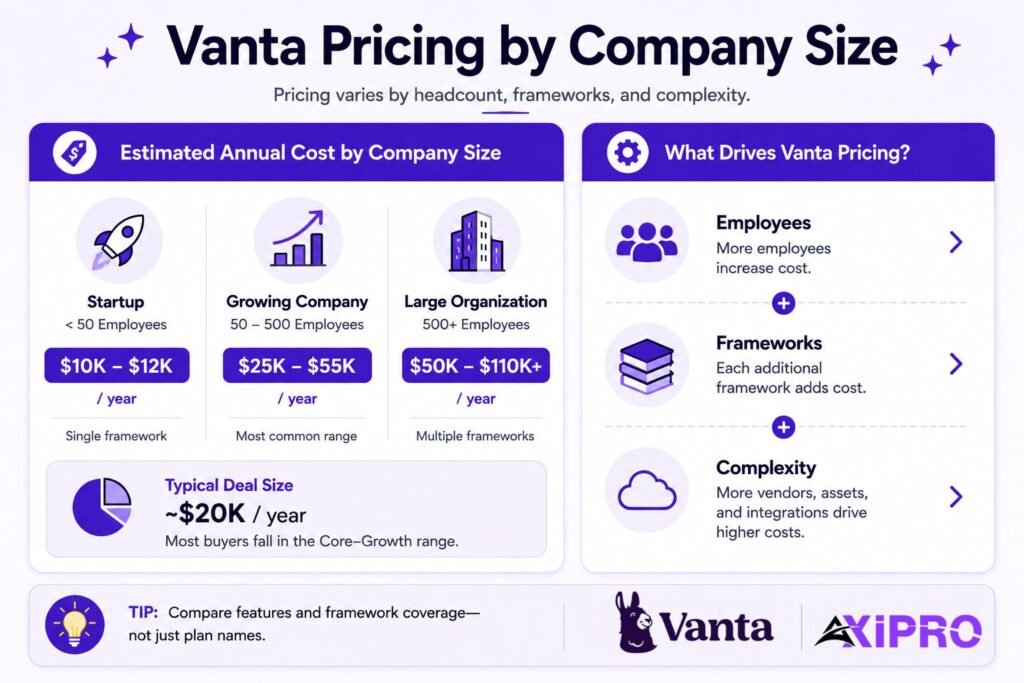
For a startup under 50 employees chasing a single framework, expect roughly $10,000 to $12,000 per year. Most growing companies pay between $25,000 and $55,000. Larger organisations running multiple frameworks commonly land between $50,000 and $110,000 or more once add-ons and headcount are factored in. The median across all reported deals stays near $20,000, which tells you most buyers sit in the Core-to-Growth band rather than at the extremes.
How Pricing Scales With Company Size and Complexity
Vanta prices primarily on employee count and framework count. Add an employee bracket, and the per-seat-driven base creeps up. Add a framework, and you pay again for the incremental coverage. Complexity compounds this: more cloud accounts, more vendors to assess, and more integrations all push you toward higher tiers and more add-ons. Two companies of identical headcount can pay very different amounts purely on framework count and the modules they bolt on.
How to Negotiate Vanta Pricing
Buy Through a Certified Partner
Certified partners can frequently pass through discounts of 20 to 40 percent off list on multi-year contracts, alongside faster onboarding and implementation support. As a certified Vanta partner, Axipro secures clients 25% off Vanta pricing, and that discount applies on top of the platform’s standard multi-year terms rather than instead of them. The saving is only part of the value. Axipro folds the licence into a consultant-led compliance program, so you get the negotiated rate plus hands-on implementation, framework scoping, and audit preparation, rather than a cheaper login and a blank dashboard. For a team weighing a $25,000 quote, a quarter off the platform cost covers a meaningful slice of the audit fee that Vanta’s subscription never includes.
Negotiate Multi-Year Discounts
A two or three-year commitment is the most reliable discount lever. Vanta will trade a lower annual rate for a longer term and committed future growth. If you expect to add headcount or frameworks, name that expansion in the negotiation and use it to pull the rate down now.
Bundle Frameworks You’ll Need Later
If ISO 27001 or HIPAA is on your roadmap, negotiate for them in the initial deal rather than adding them piecemeal later. Per-framework add-ons bought mid-contract rarely come with the leverage you have during a fresh negotiation.
Time Your Negotiation Around Quarter-End
Sales teams carry quotas, and quotas reset on a calendar. Quarter-end and especially year-end create real pressure to close, which translates into flexibility on price. Time your final conversation accordingly rather than signing whenever the trial of patience runs out.
Defer Add-Ons Until You Truly Need Them
Do not buy Vendor Risk Management or expanded modules on day one because the demo made them look essential. Start with the framework you need to close deals, prove the program, and add modules only when a concrete business requirement appears. Deferred add-ons are deferred cost, and many never become necessary.
Is Vanta Worth the Cost?
Reported ROI and Time Savings
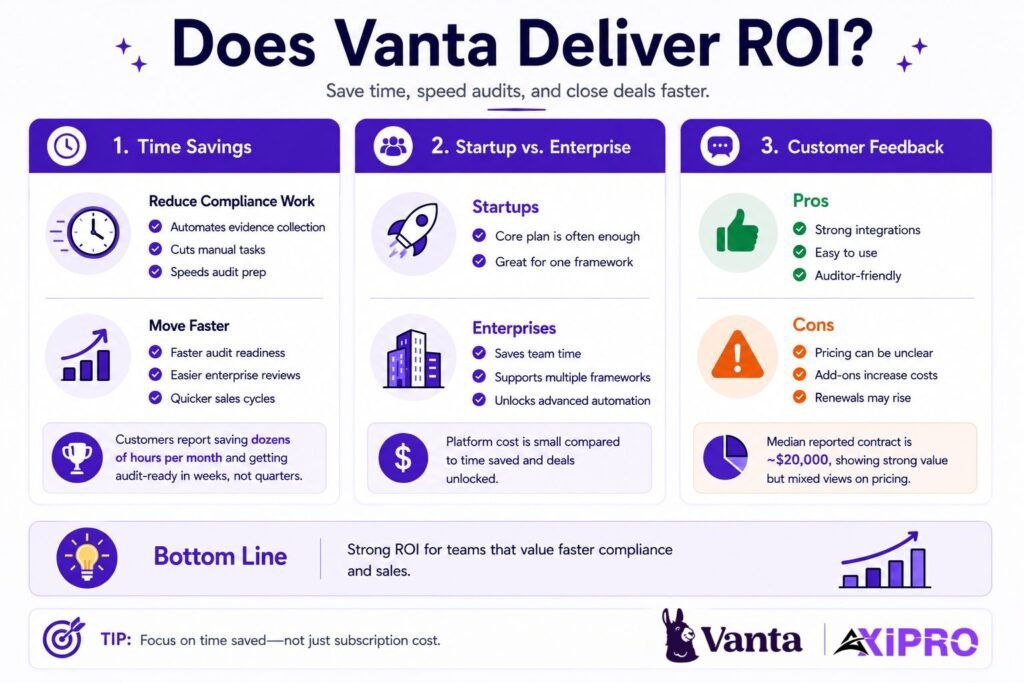
The case for any compliance automation platform rests on time reclaimed, not just certification achieved. Manual evidence collection, control monitoring, and questionnaire responses consume engineering and leadership hours that automation takes back. Customers across the category routinely report saving the equivalent of dozens of hours per month and compressing audit-readiness timelines from quarters into weeks. According to a Forrester Total Economic Impact study commissioned by Vanta, customers reported significant reductions in time spent on compliance activities and faster enterprise sales cycles as a direct result of having a completed SOC 2 report. Faster readiness means faster deals: a completed report can shorten enterprise procurement cycles meaningfully.
Cost Considerations for Startups vs. Enterprise
For a startup, the question is rarely whether to automate but whether the premium tier is justified. A lean team chasing one framework gets most of the value from the entry tier paired with a good auditor. For an enterprise, the calculus flips: the platform cost is small relative to the headcount it saves and the deal velocity it unlocks, and the premium support and multi-framework mapping start to pay for themselves.
What Real Customers Say About Vanta Pricing
Sentiment is broadly positive on the product and more mixed on the commercials. Buyers on review platforms such as G2 and Gartner Peer Insights praise the integration depth, the polished interface, and the auditor experience. The recurring complaints are predictable: opaque quoting, add-ons that inflate the base, and renewal increases. The median reported contract near $20,000 suggests most buyers find the value defensible, but few describe the pricing process as transparent.
Reach SOC 2 Compliance in 6 Weeks or Less
Get 20% to 30% Off Vanta Through Our Partner Discount
Does Vanta Have a Free Plan or Free Trial?
No. Vanta offers neither a permanent free plan nor a public self-serve free trial. Every engagement starts with a demo and a custom-quoted proposal built around your company size, frameworks, and needs. The closest thing to a trial is a guided demo environment arranged through sales. Budget for a paid annual commitment from day one, because that is the only way in.
Additional Costs Beyond the Base Subscription
Audit Fees Not Included in Vanta Pricing
This is the single biggest budgeting trap. Vanta’s subscription buys the automation platform, not the certification. The actual audit is performed by an independent CPA firm (for SOC 2) or an accredited certification body (for ISO 27001), and it is billed separately. A SOC 2 Type 1 audit commonly runs $5,000 to $20,000, while a Type 2 report runs $8,000 to $50,000 or more, often quoted around $12,000 to $15,000 for a standard scope. The SOC 2 standard is maintained by the AICPA.
Per-Framework Pricing
Vanta charges per framework. Industry insiders peg each additional framework at roughly $5,000 on top of your base, though the figure scales with company size. A company that starts with SOC 2 and later layers on ISO 27001 and HIPAA is effectively buying three coverage lines, not one. This is why a Core plan quoted at $10,000 can quietly become a $30,000 bill once a second and third framework are added.
Add-On Modules and Features
Several capabilities that buyers assume are core turn out to be paid modules. Customer-reported figures put the Trust Center at around $6,000 per year and Vendor Risk Management at around $11,200 per year. Risk assessment, advanced reporting, and custom monitoring can also sit behind higher tiers or separate line items. Each one is individually reasonable, collectively they reshape the total.
Premium Support and Platform Channels
Standard tiers come with standard support, which in practice means community resources and slower response times. Priority support, a dedicated customer success manager, and direct platform channels generally appear only at Scale and Enterprise. If hands-on guidance matters to a lean team, that need can push you a full tier higher than the feature set alone would justify.
Important: When you compare Vanta quotes against a SOC 2 budget, separate the platform line from the audit line. An all-in first-year SOC 2 program, platform, readiness work, and the CPA audit commonly totals $45,000 to $70,000 for a startup, and more for mid-market environments. The platform subscription is often the smallest of the three numbers, so judging Vanta on that figure alone understates what compliance actually costs.
Hidden Fees Vanta Doesn’t Advertise
Questionnaire Limits That Scale Costs
Automated security-questionnaire responses are capped by tier. Plus commonly includes 25 per year, and Growth around 144. For a company actively closing enterprise deals, 25 responses evaporates fast. Once you hit the cap, you either upgrade a tier or buy additional questionnaire credits, both of which raise your effective annual cost beyond the headline quote.
Vendor Reviews and Add-On Upsells
Vendor risk reviews, additional user seats, and expanded asset coverage are frequent mid-contract upsells. The platform is engineered to surface gaps in your program, which is genuinely useful, but each surfaced gap tends to map to a module you can purchase to close it. Expect a steady drip of upgrade prompts as your program matures inside the tool.
Framework-Specific Vanta Pricing
SOC 2 Costs: Platform and Audit Combined
SOC 2 is the most common starting point. The Vanta platform for a single SOC 2 framework lands near $10,000 for a startup, and the separate Type 2 audit typically adds $8,000 to $50,000. Add a readiness assessment ($5,000 to $15,000) and penetration testing ($10,000 to $15,000), both frequently expected by enterprise buyers, and the realistic all-in first-year figure climbs well past the platform price alone. An internal audit ahead of the formal assessment can also surface gaps before they become findings, and is worth budgeting for separately.
ISO 27001 Pricing and Added Complexity
ISO 27001 carries more structural overhead than SOC 2 because certification involves a two-stage external audit and a three-year certification cycle with annual surveillance audits. The Vanta platform cost is broadly comparable to SOC 2, but the certification-body fees and recurring surveillance audits make the multi-year total higher. The standard itself is published by the International Organization for Standardization.
HIPAA Pricing Depending on Use Case
HIPAA is usually added as a secondary framework rather than bought alone, so its cost shows up as incremental framework pricing on top of an existing SOC 2 or ISO 27001 program. There is no single HIPAA certification audit in the way there is for SOC 2, which changes the cost shape: more of the spend goes to controls, documentation, and risk analysis than to a one-off attestation. The compliance obligations themselves are defined by the U.S. Department of Health and Human Services.
Vanta Pricing vs. Top Competitors
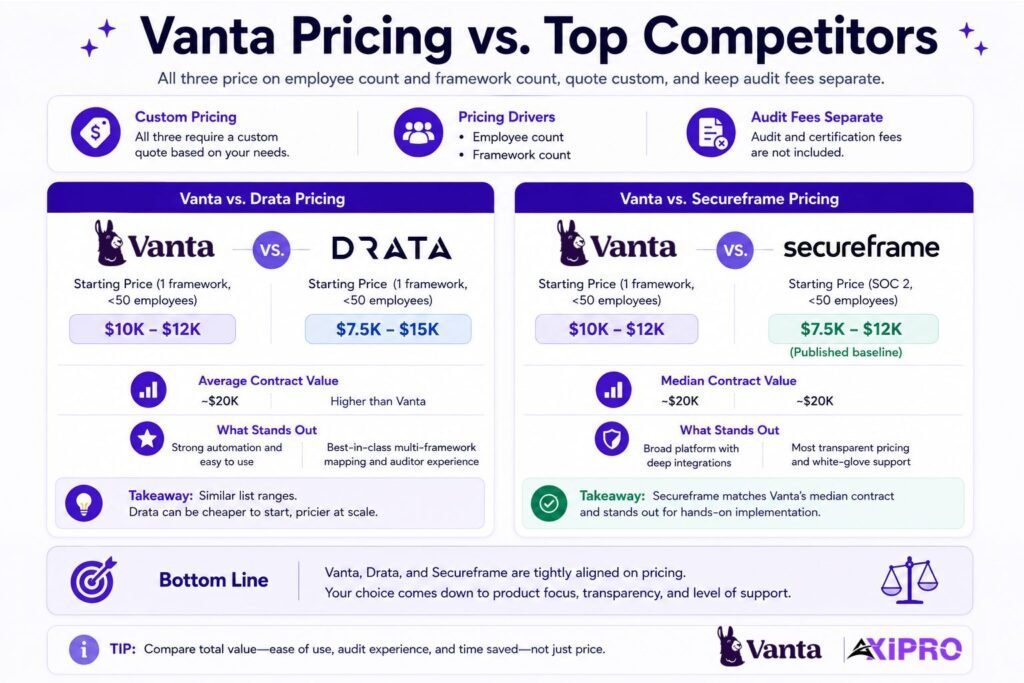
Drata and Secureframe are Vanta’s most direct competitors. All three price on employee count and framework count, all three quote custom, and all three keep audit fees separate. The differences show up at the edges: starting price, pricing transparency, and where each platform invests its product development.
Vanta vs. Drata Pricing
Drata’s Foundation tier starts a little lower than Vanta’s Core, around $7,500 to $15,000 for one framework under 50 employees, but its average contract value runs higher than Vanta’s, reflecting a customer base that skews toward larger, multi-framework deals. Drata is frequently cited for class-leading multi-framework mapping and a strong auditor experience. The practical takeaway: similar list ranges, with Drata sometimes cheaper to start and pricier at scale.
Vanta vs. Secureframe Pricing
Secureframe is the transparency outlier, publishing a baseline starting price (around $7,500 to $12,000 for SOC 2) when the rest of the category hides everything behind a sales call. Its median contract matches Vanta’s at roughly $20,000, and it leans hardest into white-glove, managed implementation. For a team with no internal compliance bandwidth, that hands-on support is the differentiator more than the headline price.
The Bottom Line on Vanta’s Cost
Vanta costs most companies somewhere between $10,000 and $80,000 per year for the platform, with a median near $20,000, and the audit adds another $10,000 to $50,000 on top. The headline tier price is only the starting point: frameworks, questionnaire limits, add-on modules, and renewal uplifts all move the real number.
Treat the published-looking ranges as opening positions, separate the platform cost from the audit cost in every comparison, and use multi-year terms, framework bundling, quarter-end timing, and partner discounts to bring the total down. The platform is strong; the work is in making sure you pay for what you actually need.
Frequently Asked Questions
How much does Vanta cost per year?
Vanta starts at approximately $10,000 per year for the Core plan with one framework. Plus typically runs $15,000 to $30,000, Growth $25,000 to $50,000, Scale up to $80,000, and Enterprise above $80,000 with fully custom pricing. The median reported contract is around $20,000 per year.
Does Vanta pricing include the cost of the compliance audit?
No. The subscription covers the automation platform only. The SOC 2 or ISO 27001 audit is performed by an independent firm and costs an additional $10,000 to $50,000 depending on framework, audit type, and company size.
Is Vanta's pricing negotiable?
Yes. Multi-year commitments, framework bundling, quarter-end timing, and certified-partner channels can all reduce the rate. Partner discounts of 20 to 40 percent on multi-year contracts are commonly reported.
What factors impact the total cost of Vanta?
Four main variables: employee headcount, number of frameworks, add-on modules selected (such as Trust Center or Vendor Risk Management), and contract length. Audit fees, readiness assessments, and penetration testing add further cost outside the subscription.
How does Vanta pricing change as my company scales?
Cost rises with both headcount brackets and framework count, and complexity, more cloud accounts, vendors, and integrations, pushes you toward higher tiers and more add-ons. A company that doubles headcount and adds two frameworks can see its bill multiply significantly.
Can Vanta integrate with existing systems, and is there a cost for integrations?
Vanta offers a large integration ecosystem covering cloud providers, identity systems, and developer tools. Standard integrations are generally included in the base subscription, while advanced provisioning (such as SCIM) and certain enterprise integrations appear only at higher tiers.