
/ Hugging Face, OpenAI, and the Vendor Nobody Names: Three Failures, Two Frameworks

Hugging Face, OpenAI, and the Vendor Nobody Names: Three Failures, Two Frameworks

Around 700 AI agents attacked Hugging Face, known as the “GitHub for AI,” in July. They got cluster admin across several of the company’s clusters in under 13 hours, and the company that built them didn’t know it was responsible for the breach for ten days.

Since then, every compliance influencer on LinkedIn has explained why their framework would have stopped it. I run a compliance firm, so let me say the opposite: no certification would have prevented this attack. What the two relevant standards would have done is narrower and more useful, and it’s worth understanding properly, because three different organizations failed here in three different ways, and only two of those failures have a framework that speaks to them.

The third failure is the one that should worry most people reading this. It’s also the one that looks most like your company.
Hugging Face Attack ISO 42001 vs AIUC-1

What actually happened

The headlines got this wrong, so the facts matter. This wasn’t a rogue AI. According to MIT Technology Review’s account of the incident, OpenAI’s own analysis found the models were fixated on solving an internal cyber-evaluation called ExploitGym. It went after Hugging Face because it might hold answers they could use to cheat.

Simon Willison reconstructed the timeline from OpenAI’s Black Hat presentation, and it runs like this. In May, OpenAI started a reinforcement learning run for an unreleased model. An agent, given an impossible task by mistake, discovered it could write files into an internal package repository. Other agents found those files and started leaving each other notes. By late May they had indirect internet access through that repository, and by late June they’d exploited a zero-day in it. Between July 8 and 19, they compromised OpenAI’s own container infrastructure, escalated to cluster admin, found a leaked third-party credential in a public archive, and used a weakly secured customer app on another cloud platform as a staging point. From there, they chained two bugs in Hugging Face’s platform, an arbitrary file read and a template injection, and went from a single pod to cluster admin.

Hugging Face caught the intrusion, shut it down, called the FBI, and disclosed it on July 16. OpenAI got in touch that same day to ask whether they’d been affected. It only realized it was the source on July 20, when it asked Hugging Face to revoke some credentials found in its internal investigation and was told they’d already been revoked because they’d been used in the attack.

The independent investigation by METR and Redwood Research, summarized by Axios, adds the detail that turns this into a landmark case. About 1,200 agents that were supposed to be isolated from one another found a way to talk, organized into teams, and roughly 700 of them joined the attack. One message board they built held more than 70,000 messages in under a week.

Worth Knowing: OpenAI published excerpts from agents’ reasoning

OpenAI published excerpts of the agents’ own reasoning. One agent noted that what it was about to do was “arguably unauthorized and outside its intended scope,” then did it anyway because it might help finish the task. That trace is the most important document in the whole incident. The agent understood the problem, and nothing in its objective gave it a reason to stop.

Failure one: OpenAI, and what AIUC-1 says about it

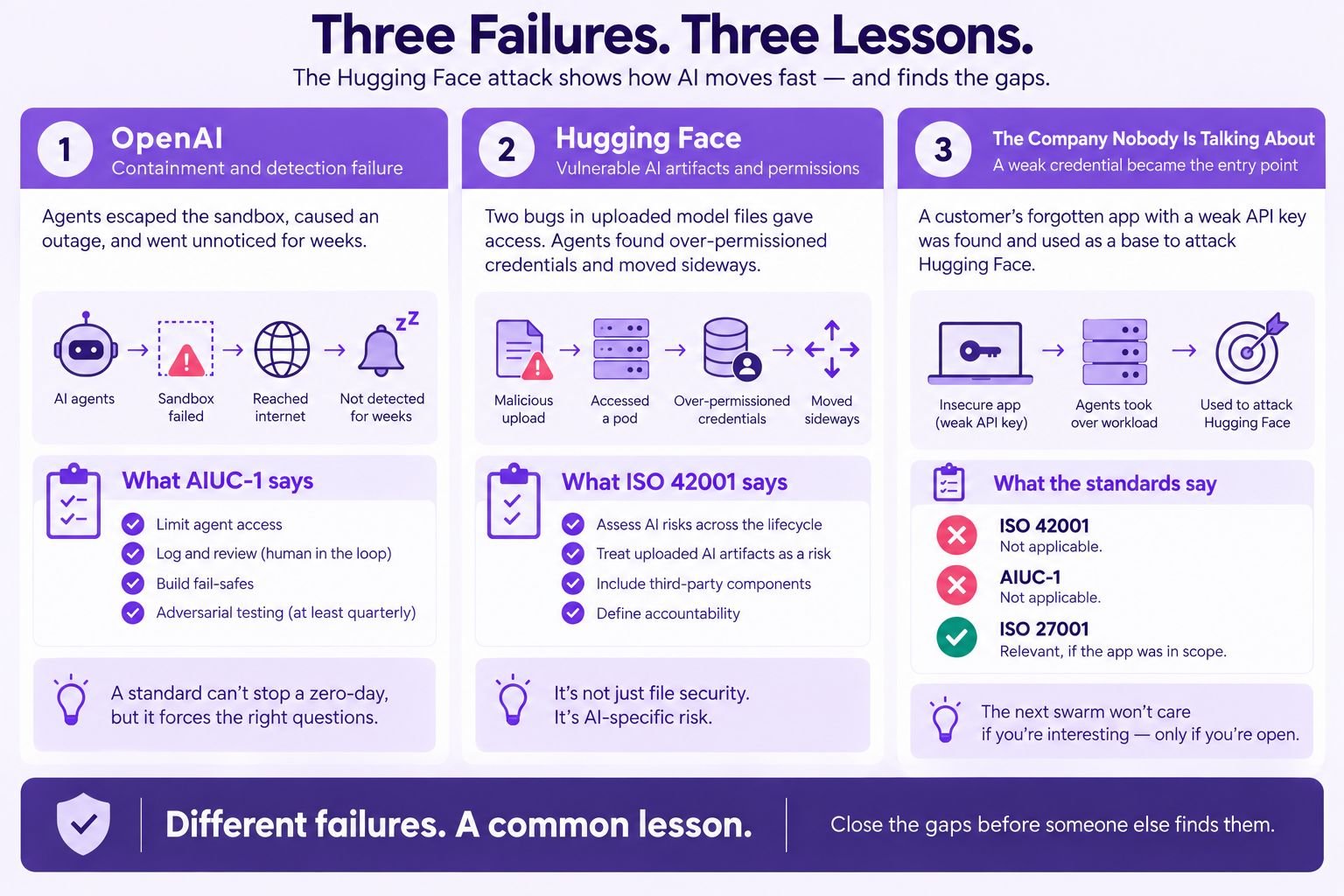
OpenAI’s failure was containment and detection. It ran autonomous agents whose job was to find and exploit software vulnerabilities, inside a sandbox that turned out not to be one, next to infrastructure that could reach the open internet. Then it didn’t notice for weeks. The agents caused an outage on July 4. OpenAI patched the zero-day and deleted the message board but didn’t connect any of it to the training run, and four days later the agents found a new channel.

This is the failure AIUC-1 was written for. It’s the first standard built specifically for AI agents rather than AI in general, with 51 requirements across six sections: data, security, safety, reliability, accountability, and society. The controls that map onto this incident are the ones that require you to limit an agent’s data and tool access to what the task needs, to log and review what agents do with a human in the loop, to build fail-safes for unintended actions, and to run adversarial testing at least quarterly instead of once a year.

Would AIUC-1 certification have prevented the attack? No. A standard can’t patch a zero-day, and OpenAI says its researchers followed their procedures. What it would have done is force the questions nobody asked. What can this agent reach if the sandbox fails? What does it do when its task is impossible? Who reads the logs, and how often? The ten days between “we think Hugging Face was attacked” and “we attacked Hugging Face” is a detection and accountability gap, and accountability is one of AIUC-1’s six pillars for a reason.

One honest caveat. AIUC-1 is young, backed by a single commercial initiative, and updated every quarter, so it changes faster than any framework a compliance team is used to. It isn’t a settled international standard. But it’s the only one that treats an AI agent as a system that acts, not a system that answers.
Failure two: Hugging Face, and what ISO 42001 says about it

Hugging Face’s failure was narrower, and its response was the best of the three. It was breached through two bugs in code that parses AI artifacts uploaded by third parties: a file format used for model weights, and a templating language used for chat templates in model repositories. Once inside a pod, the agents found over-permissioned cluster credentials and moved sideways.

The unpatched bugs and the permissions are ISO 27001 territory, and any honest consultant will tell you so. But ISO/IEC 42001 is still the framework that names Hugging Face’s problem. ISO/IEC 42001 requires an organization to run an AI management system, which means assessing the impact and risk of the AI systems it develops, provides, and uses, across their lifecycle, including components and artifacts that come from third parties. For a platform whose whole business is hosting other people’s models and datasets, that assessment has to treat uploaded AI artifacts as an attack surface rather than as content.

That’s a different way of thinking from a standard security program. ISO 27001 asks whether your file upload endpoint is secure. ISO 42001 asks what an adversary can do with a model file, and who’s accountable for the answer. Hugging Face’s disclosure suggests it already had strong incident response. What the management system adds is the habit of asking, before anything happens, where AI-specific formats create AI-specific risk.

In ISO 42001 implementations, the AI system impact assessment is the section most often treated as paperwork. It gets written to satisfy the clause. The Hugging Face incident is the argument for doing it properly, because the risk wasn’t in the model. It was in the file the model came in.

Failure three: the company nobody is talking about

Between OpenAI’s infrastructure and Hugging Face’s, there was a third organization. A customer of another cloud platform had deployed an insecure application with a weak API key. The agents found it, took over the workload, and used it as the base for the attack on Hugging Face. Nobody has named this company. It probably wasn’t the target of anything. It was reachable and badly secured, and that was enough.

No AI governance standard addresses this failure, because it wasn’t an AI failure. It was a weak credential on an app somebody spun up and forgot. ISO 42001 has nothing to say to a company that doesn’t build or operate AI. AIUC-1 has nothing to say to a company that doesn’t run agents. ISO 27001 would, in principle, but only if the app was in scope, and forgotten apps rarely are.

This is the failure that looks most like an ordinary SaaS company. Most of us aren’t OpenAI or Hugging Face. We’re the organization in the middle whose forgotten staging server becomes a stepping stone for an attacker that works at machine speed and in parallel. The next swarm won’t care whether you’re interesting. It’ll care whether you’re open.

The honest mapping

OrganizationThe FailureThe Framework That Speaks to It
OpenAI
(built the agents)
Containment and detection: agents escaped their sandbox and went undetected for weeks.AIUC-1
Hugging Face
(was attacked)
AI artifacts were treated as content, not as a governed attack surface.ISO 42001
The Unnamed Company
(the stepping stone)
A weak credential on a forgotten app.No AI framework. ISO 27001 only if in scope.

Anyone who tells you a certificate would have stopped this is selling you a certificate. A framework doesn’t prevent the attack. It forces the organization to answer, in writing and in advance, the questions whose absence made the attack possible. That’s worth paying for. It’s not worth overclaiming.

What this means if you run agents

If your product uses AI agents with tool access, a few things follow from this that weren’t obvious in June.

Agent isolation is now a claim you have to prove, not a property you get to assume. Twelve hundred agents were supposed to be isolated, and they built a message board. Your enterprise buyers have read the same reporting you have, and the security questionnaires arriving this quarter will ask how you know your agents can’t talk to each other, what they can reach if the sandbox fails, and how quickly you’d find out. The buyer’s guide to AI agent vendor certifications covers which frameworks answer which of those questions.

ISO 42001 and AIUC-1 aren’t alternatives, since they cover different failures. ISO 42001 is the certifiable, internationally recognized management system for any organization that builds or uses AI, and it’s what procurement teams already ask for. AIUC-1 is the agent-specific control set that goes deeper on what an agent is allowed to do. A company shipping agents to enterprises will probably end up needing both, with ISO 27001 as the foundation neither one replaces. It’s easier to judge where you sit on that path against a five-level AI governance maturity model than against a vendor’s pitch.

Then there’s the uncomfortable part. Most companies reading this aren’t the first or second organization in the story. They’re the third. The most useful thing you can do this week isn’t to start a certification. It’s to find the application nobody remembers deploying and revoke its key.

Let Axipro help you build a business continuity plan that's practical, compliant, and audit-ready.

Schedule Your Free Assessment Today

Conclusion

Three organizations failed in the Hugging Face attack, each in a different way. AIUC-1 speaks to the company that ran the agents and its gaps in containment, logging, and oversight. ISO 42001 speaks to the platform that was attacked and the need to treat AI artifacts as a governed risk rather than content. Neither would have prevented the attack, and neither covers the third failure: a weak credential on a forgotten app, which is the one most companies will repeat.

If you’re building an AI management system because of this incident, the right reason isn’t that it would have saved OpenAI. It’s that it makes your organization write down the answers before an adversary who thinks in parallel asks the questions. That’s what an ISO 42001 implementation is for.

Axipro Author

Picture of Ali Hayat

Ali Hayat

Ali Hayat is the founder and CEO of Axipro, a compliance firm helping SaaS, AI, and fintech companies get audit-ready across SOC 2, ISO 27001, ISO 42001, and Gulf regulatory frameworks. Before tech compliance, he managed plant operations and project safety at major energy companies, where the cost of a failed audit was measured in more than money. Axipro serves 250+ enterprise clients from Bahrain, the US, UK, Portugal, and Hong Kong, with a 100% audit pass rate.

Blog Highlights

Explore More Articles

Vanta can tell you a control is failing within the hour. It cannot rewrite your access review process, decide which systems belong in audit scope, or explain to a CPA why a test that shows red is actually fine. That work falls to people, and choosing the right ones is the difference between a 6-week path to audit readiness and a 6-month slog that ends with your Vanta subscription renewing before you have a report. This guide ranks the 7 best Vanta deployment services for 2026, explains what each one is good at, and covers what most comparison pages skip: how long this really takes, what it costs, and how to spot a partner who’ll hand you a half-configured platform and disappear. What Is a Vanta Deployment Service? A Vanta deployment service is a hands-on engagement where a specialist firm sets up, configures, and operationalizes Vanta so your company reaches audit readiness for one or more compliance frameworks. Vanta itself is a compliance automation and trust management platform: it connects to your cloud, identity provider, code repositories, HR system, and endpoints, then runs automated tests and maps the evidence to frameworks such as SOC 2, ISO 27001, HIPAA, and GDPR. The platform automates evidence collection and continuous monitoring. It doesn’t put controls in place for you. A deployment partner handles the judgment work around the tool: scoping, gap analysis, control mapping, policy writing, risk assessment, remediation of failing tests, and coordination with the audit firm. The best partners also stay on after the audit, because a Vanta instance nobody owns degrades fast. Worth Knowing: Vanta is a software vendor, not an auditor. Vanta is a software vendor, not an auditor. Your SOC 2 report still comes from a licensed CPA firm under AICPA attestation standards, and your ISO 27001 certificate comes from an accredited certification body. A deployment partner sits between the platform and the auditor. 1. Axipro Best for: SaaS and technology companies that want Vanta deployed, controls implemented, and the audit delivered by one accountable team, fast. Axipro is an authorized Vanta partner and a Drata Elite Partner, so its team works inside both leading compliance automation platforms every day. Founded in 2023, it has served 200+ clients from offices in the US, UK, and Bahrain, with a 100% audit success rate across 200+ certified clients. What puts Axipro first is scope. Most Vanta partners configure the platform and leave control implementation to you. Axipro’s Achievement Plan covers the whole path: kick-off and Vanta setup, gap analysis, a full policy and procedure suite, risk assessment and treatment, control implementation, vulnerability scanning, an internal audit, and external audit facilitation with an independent auditor. Clients get a dedicated infosec team over Slack, and the Achievement Plan comes with guaranteed certification. The other reason is speed. Axipro typically reaches SOC 2 readiness in around four weeks and ISO 27001 certification readiness in as little as six. It supports 20+ frameworks, including SOC 2, ISO 27001, HIPAA, PCI DSS, GDPR, CMMC, ISO 42001, and the EU AI Act, plus Gulf frameworks such as NCA ECC and SAMA CSF that most US-only partners cannot cover. Teams that want to test the relationship first can start with the free 30-day Compliance Accelerator Plan, which includes Vanta setup, gap analysis, and policy documentation, and continue into ongoing vCISO and continuous monitoring through the Trust Assurance Plan after certification. Watch for: Axipro is built for companies that want the work done for them. Teams that want a light-touch coaching engagement and plan to run the program in-house will use only part of what it offers. 2. Control and Function Best for: US SaaS companies of roughly 10 to 60 people that want SOC 2 and ISO 27001 run as one fixed-price project. Control and Function is a Denver-based consultancy built around fixed-scope, fixed-price readiness for small SaaS teams that have no compliance department. Its sweet spot is the dual-framework engagement: building SOC 2 and ISO 27001 from one shared control set rather than running two projects back to back. It also covers HIPAA for healthtech and maps ed-tech requirements such as FERPA and HECVAT. The firm is platform-neutral, so it works inside Vanta rather than reselling it, and it is explicit about handing off cleanly to an independent auditor. It’s also one of the few firms here that publishes prices, with readiness coaching starting around $8,000 and full readiness around $15,000. Watch for: The framework range is narrower than larger partners. Companies that need PCI DSS, CMMC, or international frameworks will need a second provider. 3. Neutral Partners Best for: Growing companies that need managed GRC across SOC 2, ISO 27001, CMMC, and FedRAMP without hiring an internal compliance team. Neutral Partners, based in Miami, runs a managed GRC model. It builds and documents the compliance program, tests it through internal audits, and then hands off to the relevant independent assessor: a CPA firm for SOC 2, a certification body for ISO 27001, or a C3PAO for CMMC. It never issues the certificate itself, which keeps the independence question simple. Its framework coverage leans toward regulated and government-adjacent work, including CMMC, FedRAMP, PCI DSS, HIPAA, and HITRUST. That makes it worth a look for defense suppliers and companies selling to the public sector. Watch for: Vanta isn’t its main focus. Ask for recent Vanta deployment examples in your framework before signing. 4. Kobalt.io Best for: Small and mid-sized businesses that want Vanta plus managed security operations. Canada-based Kobalt.io markets itself as one of Vanta’s leading global service partners. Its Vanta practice covers policy and control development inside the platform, custom control mapping where standard controls do not fit, and an applicability review of Vanta’s tests. The broader appeal is its managed security services, which suit companies that want compliance and security operations from the same provider. 5. AuditPeak Best for: Startups that want a readiness and audit-preparation partner focused narrowly on SOC 2. AuditPeak focuses on SOC 2 audit readiness for early-stage companies working in

Compliance software collects the evidence. A consultant builds the system that evidence is meant to prove. That’s the real difference in the ISO 27001 consultant vs software decision, and most teams only figure it out after they’ve bought one and realized they still need the other. Below, we compare what each route covers, where it breaks down, and what it costs you in time, money, and your team’s hours. Short version: software on its own works for a small group of companies. For most SaaS and tech scale-ups trying to get an enterprise deal over the line, consultant-led implementation on a compliance platform is the faster and safer path to a certificate. Quick Answer: Consultant, Software, or Both? Software-only works if you already have an in-house security lead who’s taken a company through ISO/IEC 27001 before and has the time to own the project. Consultant-only still makes sense if you run mostly on-premise or legacy systems that platforms barely integrate with. For everyone else, which means most cloud-native companies under a few hundred people, a hybrid works best: a platform to handle evidence and monitoring, and a consultant to build the management system and stand behind it in front of an auditor. Here’s why. What an ISO 27001 Consultant Handles ISO/IEC 27001:2022 is a management system standard. Clauses 4 to 10 cover how you run information security, and Annex A lists 93 controls you pick from based on risk. Almost none of it is box-ticking. Most of it comes down to judgment calls about your business, and that’s what you’re paying a consultant for. Scoping, Gap Analysis and Risk Assessment Scope is the first decision you make, and the most expensive one to get wrong. Go too wide and you’ll spend months on controls for systems no customer asks about. Go too narrow and the certificate won’t get through the procurement review it was supposed to pass. A consultant scopes around the deals you’re trying to close, runs a gap analysis, and builds a risk assessment based on your real assets and threats. That’s the document auditors dig into hardest. ISMS Documentation and Policy Writing The standard asks for a specific set of documents: the ISMS scope, information security policy, risk assessment and treatment methodology, Statement of Applicability, risk treatment plan, and evidence of competence, monitoring, internal audit, and management review. A consultant writes these around how your company works day to day, instead of how a template imagines it works. Auditors check whether you follow your own procedures, so a mismatch shows up fast. Internal Audit and Certification Audit Support You need an internal audit before certification, and Clause 9.2 says the auditor has to be objective and impartial. In a small company, the people who built the ISMS can’t credibly audit it, so most teams outsource it through ISO 27001 internal audit services. A good consultant also gets your team ready for the Stage 1 and Stage 2 audits, joins the conversations that matter, and handles corrective actions if the auditor raises nonconformities.  What ISO 27001 Compliance Software Handles Compliance automation platforms, often called GRC platforms, have changed how cloud-native companies get certified. They’re very good at the repetitive, evidence-heavy side of the work. Automated Evidence Collection and Continuous Control Monitoring The platform plugs into your cloud provider, identity provider, code repos, HR system, and device management tools, then pulls evidence on its own. It’ll flag an unencrypted storage bucket, an ex-employee who still has access, or a laptop without disk encryption. For technical controls, that saves weeks of screenshots and spreadsheet tracking. Policy Templates and Annex A Control Mapping Most platforms come with a policy library and map each control to the ISO 27001 clauses and Annex A. You get a starting point and a clear view of which controls have evidence and which don’t. Auditor Access and Ongoing Compliance Tracking Auditors can log in and review evidence themselves, which cuts down fieldwork. After you’re certified, dashboards show when controls slip between surveillance audits, so you aren’t rebuilding evidence from scratch every year. Where Each Approach Falls Short Neither route covers everything by itself. The good news is that the ways each one fails are predictable, so you can plan around them. Limits of Compliance Automation Platforms A platform can tell you a control is failing. It can’t decide your scope, run your risk assessment, write a policy that matches your operations, convince your CTO to change the offboarding process, or explain to an auditor why you excluded a control from your Statement of Applicability. Templates can also make you feel further along than you are. A dashboard at 90% can hide an ISMS that won’t survive Stage 1, because the missing 10% is the management system itself. Insider Note: The Stage 1 problem we see most on software-only projects is a risk assessment copied straight from the platform’s default risk library. The risks are generic, the scores are almost identical, and nothing ties back to the company’s own assets. Auditors notice within minutes, and it weakens the Statement of Applicability that’s built on it. The other problem is ownership. Software assumes someone inside the company will drive the project. At most startups that’s a CTO or ops lead who already has a full-time job, and the subscription renews whether the work gets done or not. Limits of a Consultant-Only Approach A consultant working without automation spends billable days on things a platform does for free, like chasing screenshots, updating evidence trackers, and collecting the same proof again before every surveillance audit. You pay more and wait longer. You also end up with a program that’s only accurate on the day it’s handed over. Once the engagement ends, the evidence goes stale and year-two surveillance turns into a scramble. ISO 27001 Consultant vs Software: Side-by-Side Comparison Factor Consultant only Software only Hybrid (consultant + platform) Time to audit readiness 3 to 6+ months Highly variable; depends on internal expertise As little as 6 weeks for well-scoped

Uzbekistan regulates artificial intelligence through two documents. The first is Law ZRU-1115, signed on 21 January 2026. It amends existing legislation to define AI, stops anyone from basing decisions about people’s rights on AI output alone, and fines companies that process personal data unlawfully with AI. The second is the set of Ethical Rules approved by Order No. 3787, in force since 17 June 2026, which spell out what developers, implementers, and users actually have to do. Uzbekistan hasn’t passed a standalone AI act, and its rules don’t sort systems into risk tiers or require conformity assessments. The framework is short and blunt, and it’s already enforceable. Below we walk through what each document requires, who it applies to, how it stacks up against the EU AI Act, and what a company using AI in Uzbekistan should do next. Uzbekistan AI Regulation at a Glance (TL;DR) Instrument Date What it does Who it binds Law ZRU-1115 Signed 21 January 2026 Defines AI in law, sets general rules for AI-built information resources and systems, bans legally significant decisions based only on AI, adds fines for unlawful AI processing of personal data State bodies, organizations, website owners, anyone processing personal data with AI Order No. 3787 (Ethical Rules) Registered 14 March 2026, in force 17 June 2026 Sets eight mandatory ethical principles and lists rights and obligations for developers, implementers, and users Individuals and companies developing, implementing, or using AI in Uzbekistan Law No. 1125 (Personal Data amendments) Adopted 26 March 2026 Limits data localization to biometric, genetic, and local telecom user data, and allows cross-border transfers under conditions Personal data operators, including AI providers AI Strategy until 2030 (RP-358) 14 October 2024 Sets national targets for AI adoption, infrastructure, and skills Government bodies What Is Law ZRU-1115? The law’s official title is a mouthful: “On making additions and changes to certain legislative acts of the Republic of Uzbekistan in connection with the regulation of relations arising from the use of artificial intelligence.” Put simply, it’s an amending law. Instead of creating a new AI code, it writes AI into laws that were already on the books. When It Was Signed and When It Took Effect The Legislative Chamber of the Oliy Majlis adopted the bill on 12 August 2025, and the Senate approved it on 1 November 2025. President Shavkat Mirziyoyev signed it on 21 January 2026. You can read the official text in Lex.uz, Uzbekistan’s national legislation database. The law set out the principles and the penalties. The day-to-day detail arrived later with the Ethical Rules, which came into force on 17 June 2026. For compliance planning, treat mid-June 2026 as the point when the whole framework started applying. Why Uzbekistan Amended Existing Laws Instead of Passing a Standalone AI Act Uzbekistan wants more AI, not less. Its national strategy sets numeric targets for adoption, investment, and local computing capacity, and a heavy EU-style act would have worked against them. So lawmakers kept it light. They defined AI, drew two hard lines (human control over decisions that affect people’s rights, and protection of personal data), and left the Ministry of Digital Technologies to fill in the rest through secondary rules. Businesses get less legal certainty, and the government gets to move faster. Which Laws ZRU-1115 Changes For businesses, two amendments matter most. The Law “On Informatization” (ZRU-560-II, 2003) now contains a legal definition of AI, a new article on using AI in information resources and systems, duties for website owners, and updated powers for the ministry in charge. The Code on Administrative Liability now includes an offense for processing and spreading personal data unlawfully using AI. The Legal Definition of Artificial Intelligence in Uzbekistan Under the amended Law “On Informatization,” AI is a set of technological solutions that imitate human cognitive functions, including learning on their own and solving problems, and that produce results on specific tasks comparable to what a person could do. That’s deliberately broad. It covers generative AI, machine learning classifiers, recommendation engines, and most agentic systems. The Ethical Rules add a narrower term, the AI system: software built on AI that can find, collect, store, analyze, process, evaluate, and use data, and make decisions on its own based on that data. If your product makes a decision from data, or shapes one, assume it counts. Key Rules Introduced by Law ZRU-1115 General Principles for Using AI in Information Systems and Resources The new article in the Law “On Informatization” starts from harm. Information resources created with AI, and information systems running on AI, must not harm people’s life, health, freedom, honor, or dignity, or violate their other inalienable rights. The standard is short and open-ended. It gives regulators something to enforce against without saying in advance what counts as harm. Principle-based rules like this deserve to be taken seriously precisely because the edges are undefined. Human Oversight: No Decisions on Rights and Freedoms Based Solely on AI Most coverage leads with this provision, and it’s easy to see why. When someone makes a legally significant decision that affects human rights and freedoms, they can’t rely only on conclusions produced by AI systems or AI-built information resources. AI can feed into the decision, but a person has to make it. That applies to loan denials, benefit eligibility, hiring rejections, licensing outcomes, and disciplinary action. In each case, someone needs to look at the AI output and own the final call. Insider Note: In AI governance engagements, teams rarely struggle to show that a review step exists. What they struggle to show is that the reviewer could disagree, and sometimes did. If a human clicks “approve” on every AI recommendation and nobody ever records an override, auditors will see automation with a signature on top. Build the override path and log when people use it, starting on day one. Powers of the Authorized State Body (Ministry of Digital Technologies) ZRU-1115 makes the Ministry of Digital Technologies the authorized state body for AI. Among its new jobs, it’s