

Table of Contents

Reach SOC 2 Compliance in 6 Weeks or Less.

  /

  / DPIA vs Risk Assessment Under GDPR

DPIA vs Risk Assessment Under GDPR

The CNIL‘s screening rule sounds simple: hit two of the nine high-risk criteria, and you owe a full Data Protection Impact Assessment (DPIA). The trouble starts when you hit one or none, because the GDPR never says that skipping the DPIA means skipping assessment altogether.

Plenty of processing falls outside the CNIL’s screening rules: operations below the two-criteria threshold, activities on the CNIL’s exemption list, processing already covered by an earlier DPIA, and controllers who answer to a different supervisory authority altogether. In every one of those cases, the Article 35 GDPR DPIA obligation may fall away while the risk assessment obligations under Articles 24 and 32 stay exactly where they were. This article maps the scenarios where CNIL criteria don’t apply and what a defensible assessment strategy looks like when they don’t.
DPIA vs Risk Assessment Under GDPR

DPIA vs General Risk Assessment: Core Distinctions Under GDPR

These two assessments get conflated constantly, and the mix-up has real consequences. They rest on different legal bases, serve different purposes, and trigger under different conditions.

Article 35 GDPR requires a DPIA where processing is “likely to result in a high risk” to people’s rights and freedoms, and it requires the assessment before processing begins. The DPIA looks outward. It evaluates the necessity and proportionality of the processing and the risks it creates for data subjects: discrimination, identity theft, financial loss, reputational damage, loss of control over personal data. The measuring stick throughout is harm to people.

Article 32 GDPR requires controllers and processors to put in place technical and organizational measures (TOMs) appropriate to the risk of the processing. You can’t know what’s appropriate without assessing that risk first, so Article 32 carries an implicit risk assessment duty for every processing operation you run, high risk or not. Its focus is security: the confidentiality, integrity, availability, and resilience of the systems handling personal data.

Article 24 completes the picture by making the controller responsible for implementing measures proportionate to risk and able to demonstrate compliance. That’s the accountability principle at work.

So risk assessment is universal, and the DPIA is the escalated version you reserve for processing that crosses the high-risk line. The real question is which assessment to run and how deep to go.

You don't need a six-figure budget to be GDPR compliant. You need a clear plan and someone to do the work.

Affordable GDPR Compliance Services

The CNIL Criteria: A Quick Recap

The Article 35(3) Baseline and the 9 Criteria

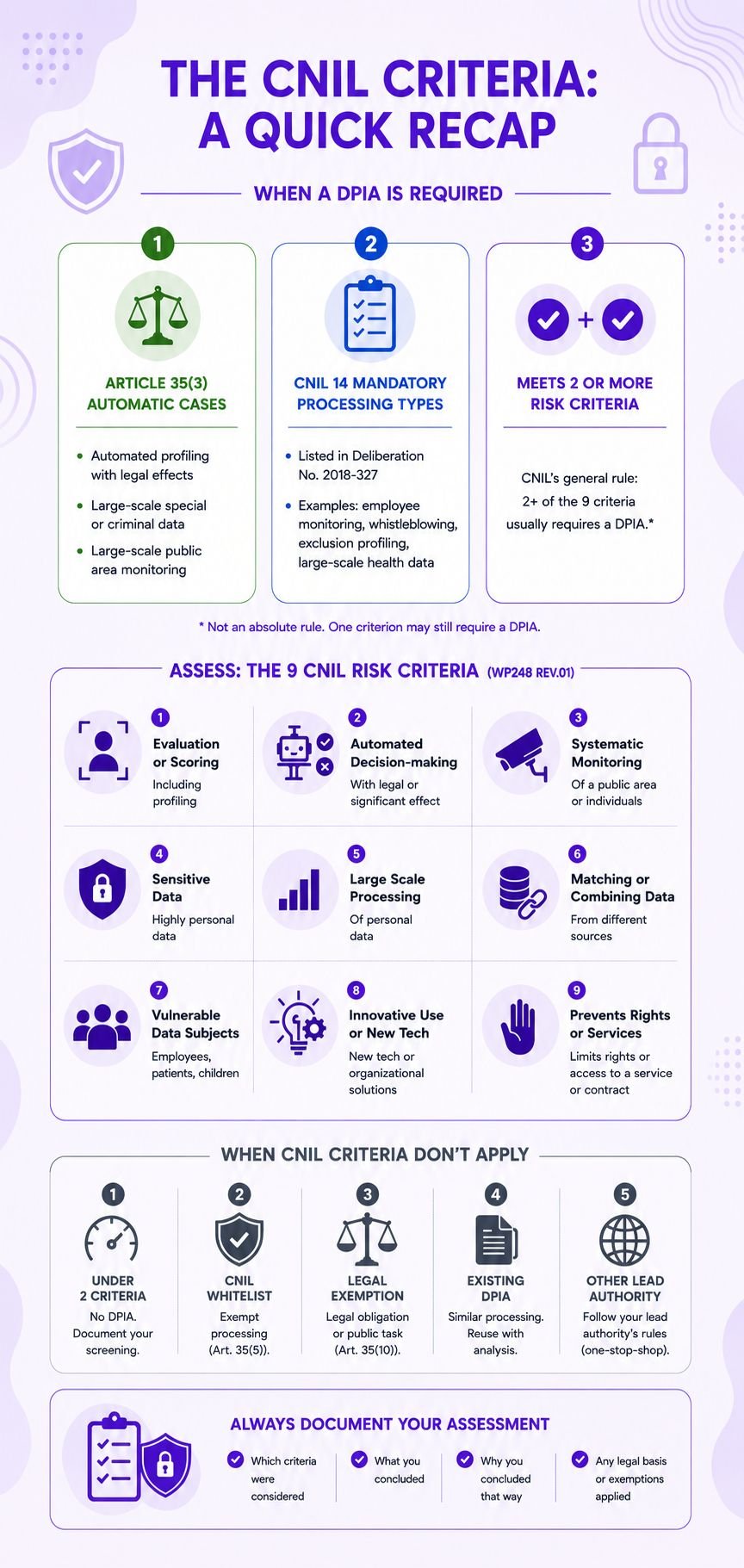
Article 35(3) names three situations where a DPIA is always mandatory: systematic and extensive automated evaluation of individuals, including profiling, with legal or similarly significant effects; large-scale processing of special categories of data (Article 9) or criminal conviction data (Article 10); and large-scale systematic monitoring of a publicly accessible area.

Beyond those, the WP29 guidelines on DPIAs (WP248 rev.01), endorsed by the European Data Protection Board (EDPB), list nine criteria that indicate likely high-risk processing: evaluation or scoring, including profiling; automated decision-making with legal or similarly significant effect; systematic monitoring; sensitive data or data of a highly personal nature; processing on a large scale; matching or combining datasets; data concerning vulnerable data subjects (employees, patients, children); innovative use or application of new technological or organizational solutions; and processing that prevents data subjects from exercising a right or using a service or contract.

The “Two Criteria” Threshold Rule

The CNIL’s position is that processing meeting at least two of the nine criteria requires a DPIA as a general rule. WP248 leaves room on both sides of that line: a controller can conclude that processing meeting two criteria still isn’t high risk, and in some cases a single criterion is enough to trigger the obligation. Either way, the reasoning has to be documented. Where there’s genuine doubt, the CNIL’s advice is simple: do the DPIA.

CNIL’s List of Processing Operations Requiring a DPIA

The CNIL also maintains a mandatory list under Article 35(4), adopted through Deliberation No. 2018-327 of October 11, 2018. It names 14 types of processing that require a DPIA outright, including systematic employee monitoring, whistleblowing schemes, profiling that can exclude people from a contract, and large-scale processing of health data. If your processing appears on this list, you can skip the criteria math because the DPIA is mandatory regardless.

Insider Note: The CNIL’s sectoral “referentials” do more work than most DPOs realize. If your processing fully complies with an applicable referential, the CNIL accepts the position that residual risk isn’t high, which takes Article 36 prior consultation off the table. Checking for a referential before scoping a DPIA can remove the most painful step of the entire process.
When CNIL Criteria Don’t Apply: Key Scenarios

Processing Falling Below the Two-Criteria Threshold

Most B2B processing lives here. A standard CRM, a newsletter list, routine supplier management: these might touch one criterion (large scale, perhaps) without hitting a second. No DPIA is required, but the screening itself is a compliance artifact. Record which criteria you tested, what you concluded, and why. If the CNIL inspects, the absence of a DPIA is defensible only when the screening decision is on paper.

Operations on CNIL’s Exemption List

Article 35(5) lets supervisory authorities publish “whitelists” of processing that doesn’t require a DPIA. The CNIL adopted one in 2019 after an EDPB opinion, covering categories such as routine HR management in organizations with fewer than 250 employees (without profiling, biometrics, or sensitive data), badge-based physical access control without biometrics, and time management systems that don’t process biometric data. France is one of only a few member states with a formal whitelist, which matters for cross-border groups: the same HR system can be exempt in France and assessable case by case in Luxembourg.

Processing Authorized by Specific Legal Provisions

Article 35(10) carves out processing based on a legal obligation or public interest task under Article 6(1)(c) or (e), where the legal basis regulates the specific operation and a general impact assessment was already carried out when that law was adopted. It’s a narrow exemption. It doesn’t cover processing that merely relates to a legal obligation; the law itself has to govern the operation in question.

Pre-Existing DPIAs Covering Similar Processing

Article 35(1) allows a single assessment to cover a set of similar processing operations presenting similar high risks. The CNIL confirms that where the nature, scope, context, and purposes of a new operation closely match processing already assessed, whether by you or by a third party such as a public authority or a group of controllers, the earlier DPIA’s results can be reused. Document the similarity analysis rather than just asserting it.

Processing Governed by Other Supervisory Authorities

CNIL lists bind processing under the CNIL’s jurisdiction. A controller whose main establishment sits in Ireland or Germany deals with its own lead supervisory authority under the one-stop-shop mechanism, and each authority publishes its own Article 35(4) list. The nine WP248 criteria still apply everywhere, since the EDPB treats them as the consistency backbone behind every national list, but the national additions and exemptions differ. The ICO’s DPIA guidance, for instance, adds UK-specific triggers such as innovative technology combined with any WP248 criterion.

What to Do When a DPIA Isn’t Triggered: The Risk Assessment Path

Even without a DPIA, three obligations remain.

  • First, conduct the Article 32 risk assessment. Map the data flows, identify realistic threats (unauthorized access, loss, alteration, unavailability), rate likelihood and severity, and select TOMs proportionate to what you find: encryption, pseudonymization, access controls, backup and recovery, and regular testing of those measures. Established methodologies work fine here; ISO/IEC 29134 provides privacy impact assessment guidance, and the NIST Privacy Framework offers a structure many teams pair with their existing security program.
  • Second, document why no DPIA was performed. Organizations skip this step more than any other, and it tends to be the first thing an inspector asks for. A one-page screening record referencing the criteria, the exemption relied on, and the date of the decision is usually enough.
  • Third, keep the accountability machinery running. The processing goes in your Records of Processing Activities (ROPA), privacy by design and by default under Article 25 still applies, and data subject rights are untouched by any DPIA exemption.

Pro Tip: Build DPIA Screening into your ROPA Workflow

Build DPIA screening into your ROPA workflow instead of treating it as a separate exercise. Add three fields to each ROPA entry: criteria met, DPIA yes/no, and rationale. You get a permanent, dated audit trail with almost no extra effort, and periodic reassessment becomes a filter query instead of a project.

Comparing the Two Approaches Side-by-Side

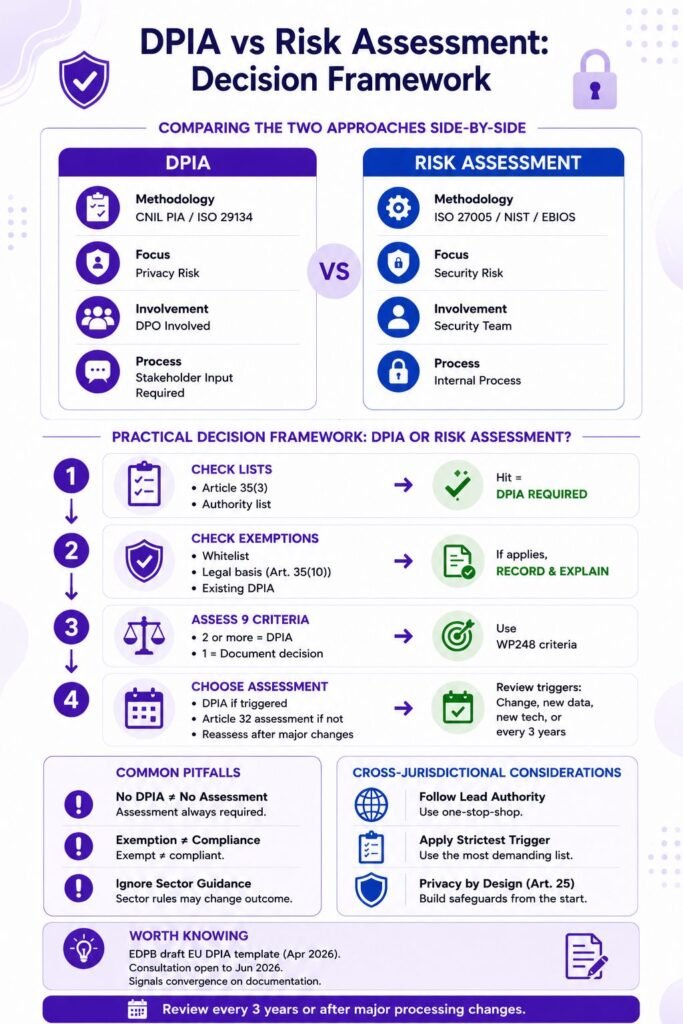
Methodology differs too. DPIAs typically follow the CNIL’s PIA methodology or ISO/IEC 29134 and demand structured stakeholder involvement: the DPO’s advice must be sought, processors have to assist under Article 28, and data subjects’ views should be gathered where appropriate. Article 32 assessments plug into whatever risk framework your security team already uses (ISO 27005, NIST, EBIOS) and can stay internal.

Practical Decision Framework: DPIA or Risk Assessment?

Step 1: Screen against the lists first. Check Article 35(3), then the applicable supervisory authority’s mandatory list. A hit at this stage ends the analysis; the DPIA is required.

Step 2: Check the exemption routes. The whitelist, the Article 35(10) legal-provision exemption, and reusable prior DPIAs. If one applies, record which one and why.

Step 3: Count the criteria. Score the processing against the nine WP248 criteria. Two or more points to a DPIA. Meeting just one deserves a documented judgment call, keeping WP248’s caveat in mind that a single criterion can be enough for genuinely risky processing.

Step 4: Choose the assessment and calendar the review. DPIA if triggered, Article 32 assessment if not. In both cases, set a reassessment trigger: material change to the processing, new data categories, new technology, or three years, whichever comes first.
DPIA vs Risk Assessment

Common Pitfalls When CNIL Criteria Don’t Apply

Assuming No Assessment Is Needed at All

The most common failure. Articles 24 and 32 apply to a two-person newsletter list the same way they apply to a biometric access system, differing only in depth. Concluding that you don’t need a DPIA settles the scoping question and nothing else.

Confusing DPIA Exemption with Compliance Exemption

The CNIL states this explicitly in its whitelist materials, and the EDPB repeats it in every whitelist opinion: exempt processing must still satisfy the Article 5 principles, lawful basis requirements, and data subject rights. If you’re weighing the broader difference between a formal standard and a legal obligation, our breakdown of DPIA exemption versus compliance exemption is worth a read.

Important: An Article 35(5) whitelist entry exempts you from one document. It doesn’t touch lawfulness, minimization, transparency, security, or breach notification. Treating the whitelist as a safe harbor is how routine HR processing ends up in an enforcement decision.

Overlooking Sector-Specific Guidance

EDPB guidelines, CNIL referentials, and codes of conduct under Article 40 can all shift the analysis. Article 35(8) requires compliance with an approved code of conduct to be taken into account when assessing impact. Ignoring the sectoral layer produces screening decisions that look fine on paper but fall apart once the sector context comes in.

You don't need a six-figure budget to be GDPR compliant. You need a clear plan and someone to do the work.

Affordable GDPR Compliance Services

Cross-Jurisdictional Considerations

Controllers established outside France aren’t bound by CNIL lists for processing under another authority’s jurisdiction. What travels is WP248: the EDPB required every national list to state that it complements and further specifies those guidelines, so the nine criteria function as the common denominator across the EU.

EDPB Guidelines 4/2019 on data protection by design and by default add the other half of the frame. Whatever assessment you run, Article 25 requires safeguards to be designed in from the start, not bolted on after the risk analysis.

For multi-jurisdictional processing, two practical rules hold. Identify your lead supervisory authority under the one-stop-shop mechanism, and where a single processing operation spans several member states’ lists, apply the most demanding trigger among them. A DPIA that meets the strictest list will hold up everywhere else, and that logic doesn’t work in reverse.

Worth Knowing: EDPB published a Draft EU-wide DPIA

In April 2026, the EDPB published a draft EU-wide DPIA template and opened a public consultation running to June 2026. It doesn't change when a DPIA is required, but it signals convergence on how DPIAs get documented, and national authorities may adopt it as a standard. It's worth tracking if you maintain DPIA templates across several jurisdictions.

Conclusion: Building a Defensible Assessment Strategy

The CNIL criteria answer one question: does this processing need a DPIA? When they don’t apply, the question changes shape instead of going away. Article 32 still demands a security risk assessment, Article 24 still demands proof of proportionate measures, and the screening decision itself becomes the document that protects you. A defensible strategy is boring by design: screen every new processing operation, record the outcome either way, run the assessment the outcome calls for, and revisit on change or every three years. Controllers get in trouble far more often for having no paper trail than for choosing the lighter assessment.

Frequently Asked Questions

Is a risk assessment mandatory even if no DPIA is required?

Yes. Article 32 obliges every controller and processor to assess risk and implement appropriate technical and organizational measures for all processing of personal data. A DPIA exemption takes one document off your list. The underlying duty stays.

You can. The CNIL’s free PIA tool is built around the DPIA methodology, so it’s heavier than an Article 32 assessment needs, but its risk mapping module works well for structuring a security-focused analysis. Many teams use it for both and skip the necessity and proportionality sections for non-DPIA processing.

Failing to carry out a required DPIA is sanctionable on its own, with fines of up to 10 million euros or 2% of global annual turnover under Article 83(4). Supervisory authorities have also treated missing DPIAs as aggravating factors in broader enforcement. A documented, good-faith screening decision materially improves your position even when a regulator disagrees with the conclusion.

Duration depends on the size of the organization, the complexity of its processes, the number of sites, and the industry risk profile — with audit time calculated under ISO/IEC 17021-1 guidance. A small organization might face a Stage 2 audit of one to two days and shorter surveillance visits, while a large multi-site operation requires considerably more.

An internal audit is conducted by or for the organization itself to check and improve its own EMS. An external audit is conducted by an outside party — either a certification body awarding or maintaining the certificate, or a second party such as a customer assessing a supplier.

Yes, a free template is a reasonable starting point, but treat it as a skeleton. Any generic template must be adapted to your significant environmental aspects, your compliance obligations, and your operations — and as of 2026 it must be updated for the new and revised clauses. An unedited template will leave gaps that produce findings.

You analyze the cause, define corrections and corrective actions, and implement them. Certification bodies typically require this within a set window after the audit and then verify it. Major nonconformities must be closed before a certificate is granted or maintained. Minor nonconformities are usually verified at the next surveillance visit.


Axipro Author

Picture of Pedro Dias

Pedro Dias

Pedro has been writing online for over 10 years. With experience in all things programming, cyber security, and compliance, he is our editor-in-chief at Axipro.

Blog Highlights

Explore More Articles

One in five breached organizations last year traced the incident to shadow AI, and those breaches cost an average of $670,000 more than standard incidents, according to IBM’s 2025 Cost of a Data Breach Report. The worst part is that most of those organizations already ran a CASB, a DLP program, or both. The tools were on, but the traffic still got through. That’s the visibility gap this article is about. AI tool usage tracking isn’t the same problem as SaaS discovery, and the security stack built for the SaaS era misses most of what matters about AI. Below, we break down what tracking actually requires, where CASB and DLP fail, which categories of AI usage slip through, and what a stack that works looks like in 2026. What AI Tool Usage Tracking Actually Means Most teams that say they “track AI usage” mean they can see that someone visited chat.openai.com. That is app discovery, and it answers almost none of the questions a security or governance team actually needs answered. Beyond App Discovery: Tracking Prompts, Data Flows, and Model Interactions Real tracking covers three layers. First, which tools are in use: chatbots, copilots, coding assistants, embedded SaaS features, agents. Second, what data moves: the content of prompts, uploaded files, and pasted context, mapped against data classifications. Third, how models behave in your environment: which endpoints get called, which OAuth grants exist, which agents hold standing permissions. Seeing that an employee opened ChatGPT gets you nowhere. What you actually need to know is whether they pasted a customer contract into a personal account while they were there. The Difference Between Detection, Monitoring, and Continuous Tracking Detection is a point-in-time answer to “what AI is here?” Monitoring watches known tools on an ongoing basis. Continuous tracking is broader: it assumes the inventory changes weekly, correlates identity, data, and endpoint signals over time, and feeds a governance program rather than a one-off report. Frameworks such as the NIST AI Risk Management Framework and ISO 42001 assume the third mode. A discovery scan from last quarter won’t satisfy an auditor, and it certainly won’t slow down an attacker. Why Traditional SaaS Monitoring Falls Short for AI SaaS monitoring was built around a stable premise: an app is a destination with a domain, a login, and an admin console. AI breaks that premise in several ways at once. The risky activity is the content of an interaction, not the visit. The tool often isn’t a destination at all but a feature inside an app you already sanctioned. And increasingly the “user” isn’t a person but an agent acting on delegated credentials. Why CASB Misses Shadow AI Usage The Cloud Access Security Broker sits between users and cloud services to enforce policy, and for classic SaaS governance it still earns its keep. AI has structural blind spots that no amount of tuning can fix. CASBs Were Built for SaaS Apps, Not Model Endpoints A CASB catalog maps domains to applications with risk scores. AI usage doesn’t resolve neatly to a domain. The same api.openai.com endpoint serves a sanctioned enterprise deployment, a developer’s weekend experiment, and a data-leaking browser extension, and the catalog sees one “app”. Meanwhile, new model endpoints, wrappers, and niche AI tools appear faster than any vendor catalog can keep up with. Gartner research from late 2025 found 69% of organizations already suspect or have evidence that employees use prohibited public generative AI tools, catalog or no catalog. Blind Spots in Encrypted API Traffic to LLM Providers Prompt content travels over TLS. Without full TLS inspection, a CASB sees connection metadata: destination, volume, timing. It can’t see that the payload contained source code or patient records. And full TLS inspection is harder than the datasheet implies. Certificate pinning breaks it for many native apps and CLI tools, legal and works-council constraints limit it in the EU, and most organizations carve out broad exemption lists that AI traffic happily rides through. The OAuth and Embedded AI Problem CASBs Can’t See When an employee grants an AI meeting-notes tool access to their calendar and mailbox via OAuth, no proxy is involved at all. The vendor’s servers communicate directly with Microsoft’s or Google’s APIs using a persistent token. The same applies to AI features embedded inside sanctioned SaaS, think Notion AI, Slack AI, or Salesforce Einstein. The CASB sees approved traffic to an approved app, while the AI processing happening inside it, and whichever sub-processor it forwards data to, stays invisible. Personal Accounts and BYO-AI Bypass CASB Proxies Netskope’s 2026 Cloud and Threat Report found that nearly half of employees who use generative AI at work do so through personal accounts. Personal accounts on managed devices are hard enough; personal accounts on personal devices, home networks, and mobile connections never touch the corporate proxy path at all. Tenant restrictions help for a handful of major providers and do nothing for the long tail. Browser-Based and Extension-Delivered AI Escape Network Inspection AI browser extensions read page content and form inputs locally, then exfiltrate via their own backend, often to generic cloud infrastructure that categorizes as “technology” rather than “AI”. From the network’s view, it is routine HTTPS to a CDN. The riskiest interaction, an extension scraping everything an employee views, produces the most boring traffic signature. Insider Note: In AI governance readiness assessments, the OAuth grant review is where clients get the biggest surprise. We routinely find dozens of AI tools holding live mail, calendar, or drive scopes that nobody in IT ever approved, granted by employees who abandoned the tool (and sometimes the company) months earlier. The tokens keep working anyway. Why DLP Fails to Catch Shadow AI Data Exposure DLP has the opposite problem. It can sometimes see content, but it doesn’t understand it, and AI interactions defeat the pattern matching it depends on. Prompt-Based Data Loss Doesn’t Match DLP Signature Patterns DLP fires on signatures: credit card regexes, SSN formats, keyword dictionaries, file fingerprints. Sensitive prompts rarely look like that. “Summarize why we’re losing

Most SOC 2 preparation effort goes into access controls, encryption, and vendor reviews. Then the auditor’s first evidence request arrives, and item one has nothing to do with technology: show us your board charter, your meeting minutes, and proof that your board operates independently from management. That’s CC1.2, and it causes more last-minute scrambling than almost any technical control in the framework. This guide explains what CC1.2 requires, provides a board charter template with sample language that auditors accept, and covers the situation most startups actually face: satisfying the criterion without a traditional board of directors. What Is a SOC 2 Board Charter and Why It Matters for CC1.2 A board charter is a formal document that defines your board’s purpose, composition, authority, meeting procedures, and oversight responsibilities. Outside of compliance, it’s a corporate governance tool and a good idea in general for companies with shareholders.  Inside a SOC 2 audit, it’s the primary design evidence for CC1.2, the criterion that asks whether an independent body oversees management and the internal control environment. The charter matters because CC1.2 is one of the few criteria where the control is a document plus behavior. The charter establishes the structure. The auditor then tests whether the structure operates: did the board actually meet, did it review the security program, did it challenge management? A beautifully drafted charter with no meeting minutes behind it fails just as surely as no charter at all. If you’re earlier in your preparation, our complete SOC 2 guide covers how the full audit fits together. Understanding CC1.2: The Board Independence Criterion CC1.2 is part of the Trust Services Criteria published by the AICPA (American Institute of Certified Public Accountants). The criterion requires that the board of directors, in the AICPA’s words, “demonstrates independence from management and exercises oversight” of how internal control is developed and how it performs. That sentence hides two separate tests. Independence means the board isn’t just management wearing a second hat. Active oversight means the board actually reviews and challenges the control environment instead of existing on paper. Plenty of companies pass one and fail the other. How CC1.2 Fits Within the CC1 Control Environment The Common Criteria run from CC1 through CC9, and the CC1 series covers the control environment: the governance and people layer everything else rests on. CC1.1 addresses integrity and ethical values, CC1.2 addresses board independence and oversight, CC1.3 covers organizational structure and reporting lines, CC1.4 covers competence and hiring, and CC1.5 covers accountability. CC1.2 is the layer that makes the other four credible. A code of conduct means little if nobody independent of management ever checks whether leadership follows it. The COSO Principle 2 Connection The Trust Services Criteria are built directly on the COSO Internal Control—Integrated Framework and its 17 principles. CC1.2 maps to COSO Principle 2, which carries four points of focus: the board establishes oversight responsibilities, applies relevant expertise, operates independently of management, and provides oversight of the system of internal control. Those four phrases are worth memorizing, because they’re effectively the outline of a good board charter. Why Auditors Prioritize Board Charter Evidence Auditors test the control environment first because failures there cascade. If governance is weak, every other control claim gets harder to trust: who approved the risk assessment, who reviewed the incident report, who held management accountable when a control slipped? An exception at CC1.2 tells the auditor that nobody independent was watching, and they’ll read the rest of your evidence with that in mind. That’s why board charter requests sit near the top of almost every evidence list. Worth Knowing: Points of Focus Points of focus are not pass/fail requirements. The AICPA describes them as characteristics that assist evaluation, and the 2022 revisions changed points of focus without changing any criteria. In practice, though, they function as the auditor’s mental checklist, so drafting your charter against them is the safest move. What Auditors Actually Look For in a Board Charter Auditors don’t grade prose style. They scan for specific, verifiable commitments. Here’s what they check, roughly in order. Documented Board Independence from Management The charter must state how many members are independent, define what independence means (no operational role, no material financial relationship beyond board compensation or equity), and describe how independence is maintained. “The board includes members independent of management” without a definition is boilerplate; auditors want criteria they can test against actual member profiles. Defined Oversight Responsibilities This is the heart of CC1.2. The charter should explicitly assign the board oversight of internal control, information security, and risk management. If the charter only mentions financial oversight and strategy, it wasn’t written with SOC 2 in mind, and the auditor will notice the gap. Clear Authority and Decision-Making Powers What can the board approve, veto, or demand? Typical provisions include approving the risk management framework, reviewing audit results, approving executive appointments, and requiring management to report on control deficiencies. Authority without teeth reads as decorative. Meeting Cadence and Quorum Requirements The charter should commit to a minimum meeting frequency (quarterly is the common standard) and define a quorum. This clause matters more than founders expect, because it’s the one auditors test directly against your calendar: if the charter says quarterly and you met twice last year, that’s an exception you wrote for yourself. Committee Structures Larger organizations delegate through audit, risk, and compensation committees, each with its own mini-charter. Smaller companies don’t need committees, but if your charter mentions them, they must exist and produce minutes. Never copy a public-company template with a phantom audit committee. Conflict of Interest Provisions A disclosure and recusal process for conflicts, usually paired with an annual attestation. This clause supports the independence claim: independence isn’t a one-time status, it’s maintained through disclosed and managed conflicts. Evidence of Board Member Expertise and Qualifications COSO’s “applies relevant expertise” point of focus means the board should be able to ask probing questions about security and risk, not just finance. Charters increasingly include a skills expectation clause, and

Most Drata reviews are written by Drata’s competitors. Scroll the first page of Google and you’ll find review posts from rival compliance platforms, each one ending with a pitch for their own tool. This one is different, and the bias runs the other way, so let’s put it on the table: Axipro is a Drata Gold Partner, and our consultants configure the platform for clients every week. That means we profit when companies choose Drata. It also means we know exactly where it saves you months, where the invoice grows faster than you planned, and when you should pick something else. This review covers all three. What Is Drata?​ Drata is a compliance automation platform (the industry calls the category GRC, for governance, risk, and compliance) founded in 2020 in San Diego by Adam Markowitz, Daniel Marashlian, and Troy Markowitz. Its core job: connect to your cloud infrastructure, identity provider, HR system, and code repositories, then continuously test your security controls against frameworks like SOC 2 and ISO 27001, collecting timestamped evidence as it goes. When your auditor shows up, most of the evidence is already packaged. Funding, Valuation, and Market Position Drata has raised $328 million, most recently a $200 million Series C in late 2022 that valued the company at $2 billion. It passed $100 million in annual recurring revenue in early 2025, acquired the trust center platform SafeBase for $250 million the same year, and now serves more than 8,000 customers. In late 2025 it earned a FedRAMP 20x Low Pilot Authorization, which puts it in a small group of compliance platforms cleared through the U.S. government’s modernized FedRAMP review track. Together with Vanta, it’s one of the two platforms almost every compliance buyer shortlists. Who Drata Is Built For The sweet spot is cloud-native companies from seed stage to mid-market: SaaS businesses pursuing their first SOC 2 or ISO 27001, and scaling teams juggling three or four frameworks at once. If your infrastructure lives in AWS, Azure, or GCP and your team uses standard tools like Okta, GitHub, and a mainstream HRIS, Drata’s automation covers a large share of your evidence collection out of the box. The further you drift from that profile (heavy on-prem systems, exotic tooling, air-gapped environments), the more manual work remains. How Drata Works: From Connection to Audit The workflow runs in five stages. First, you connect your tech stack through more than 270 native integrations covering cloud providers, identity, version control, HRIS, MDM, and ticketing. Second, continuous control monitoring kicks in: automated tests run around the clock against your connected systems, checking things like MFA enforcement, encryption settings, and access reviews. Third, automated evidence collection captures timestamped proof each time a test passes, building the evidence library your auditor will draw from. Fourth, when a test fails, remediation workflows and alerts route the issue to an owner through Slack, Jira, or email, with guidance on how to fix it. Fifth, the Audit Hub gives your auditor a scoped login to review evidence directly in the platform instead of trading spreadsheets and screenshots over email. In our client engagements, that last piece cuts back and forth more than any other feature. Auditors ask fewer clarifying questions when they can trace evidence to its source themselves. Drata’s Core Features Reviewed Overview of the Drata platform and compliance management dashboard. Multi-Framework Control Mapping Drata maintains a single control set mapped across every framework you activate. Pass an encryption control once, and it satisfies the corresponding requirements in SOC 2, ISO 27001, and HIPAA simultaneously. For multi-framework programs, this is the feature that pays for the platform. Adding ISO 27001 to an existing SOC 2 program typically starts you at 60 to 80 percent complete rather than zero. The Drata Agent The Drata Agent is a lightweight application installed on employee laptops. It checks device posture: screen lock, disk encryption, password manager, antivirus, OS updates. It reads configuration states, not files, browsing history, or keystrokes. Employees sometimes push back on installing it anyway, which is why we advise clients to communicate what it does and doesn’t see before rollout, not after the first complaint. Companies with an existing MDM like Jamf or Intune can often pull device evidence from that integration instead. Risk Management, Vendor Risk, and the Trust Center The built-in risk register lets you score risks by likelihood and impact and tie them to controls and remediation tasks. Vendor risk management got a genuine upgrade with the August 2025 agentic AI release, which now collects vendor evidence, reviews SOC 2 reports, and drafts risk summaries with far less manual chasing. The Trust Center, built on the acquired SafeBase product, gives you a public page where prospects can review your certifications and policies under NDA. Clients in active enterprise sales cycles tell us it measurably shortens security review, though note it’s a paid add-on at most tiers, not a bundled feature. Policies, Training, and the Rest Drata ships editable policy templates for every major framework, embedded security awareness training with completion tracking, and an API for anything the native integrations miss. The policy templates are a real accelerator for first-time programs, with one caveat we see constantly: teams accept templates wholesale without adapting them, then get flagged in audit when their actual practice doesn’t match their written policy. A template you don’t follow is worse than no template. Supported Compliance Frameworks Drata supports more than 30 frameworks. The ones that matter for most buyers: SOC 2 (Type I and Type II) against the AICPA Trust Services Criteria, ISO 27001, HIPAA (where Drata operationalizes safeguards, since no formal HIPAA certification exists), GDPR under the EU data protection rules, and PCI DSS. Coverage extends to CMMC, NIS2, DORA, FedRAMP, and various NIST standards. You can also build custom frameworks by mapping your own control set, useful for internal standards or customer-specific requirements. What Users Really Say Drata holds a 4.8 out of 5 on G2 across more than 1,100 reviews, the highest score among the