

As cyber threats grow in volume and sophistication, penetration testing has emerged as a critical tool to identify and address vulnerabilities before malicious actors can exploit them. But when it comes to running these tests, businesses often face a pivotal decision: should they opt for automated penetration testing or manual penetration testing?
Each approach has its strengths and blind spots, and understanding which one aligns with your needs is key to building a security strategy that actually holds up. This article breaks down the differences, the pros and cons of each, and how to figure out the best fit for your organization.

What is Penetration Testing?
Penetration testing—often shortened to pen testing—is a simulated cyberattack on your systems, applications, or network designed to uncover vulnerabilities that real attackers could exploit. Think of it as hiring someone to break into your house so you can find the unlocked windows before a burglar does.
It’s an essential part of any proactive cybersecurity strategy. According to IBM’s Cost of a Data Breach Report, the global average cost of a breach has climbed steadily year over year, which makes finding weak points before they’re exploited more valuable than ever. By identifying these gaps early, businesses can take corrective action and meaningfully improve their security posture. If you want to see what a professional engagement looks like, our penetration testing services cover the full spectrum.
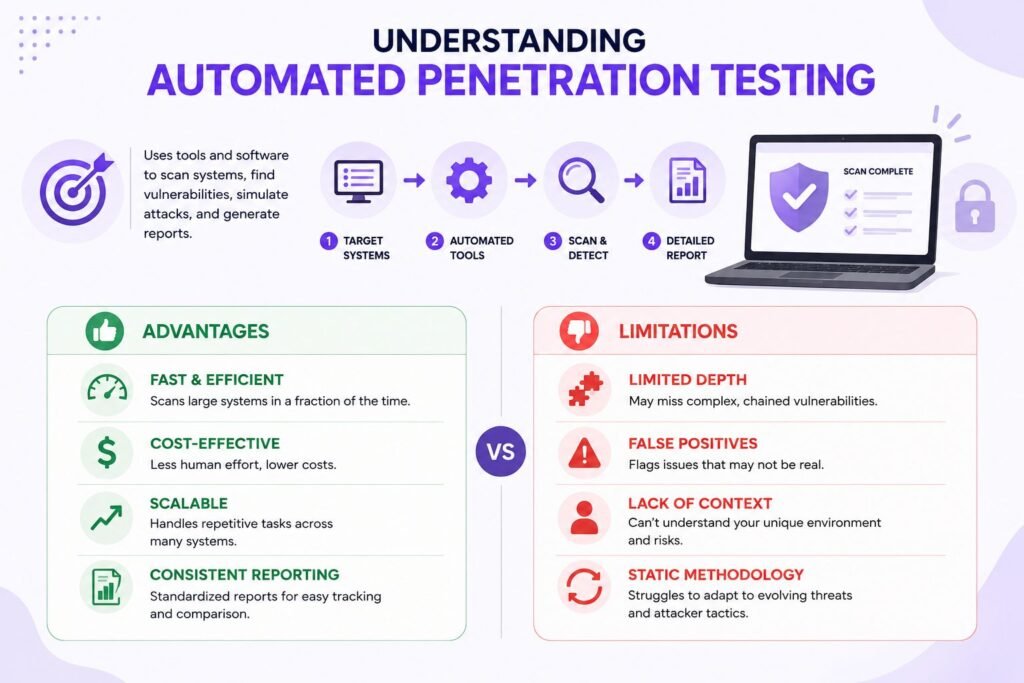
Understanding Automated Penetration Testing
Automated penetration testing uses specialized tools and software to scan and identify vulnerabilities across your systems. These tools rely on predefined scripts and algorithms to simulate attacks and then spit out detailed reports on what they found.
Advantages of Automated Penetration Testing
Speed and efficiency are the headline benefits. Automated tools can scan sprawling networks in a fraction of the time it would take a human, making them ideal for large organizations with complex infrastructures. They’re also far more cost-effective, since they require less human intervention, and they scale effortlessly—handling repetitive tasks across a wide range of systems simultaneously.
There’s also the matter of consistent reporting. Automated tools generate standardized outputs, which means you get the same reliable format every time and can track common vulnerabilities without wondering whether the methodology shifted between scans.
Limitations of Automated Penetration Testing
The trade-off is limited depth. Automated tools tend to miss the complex, chained vulnerabilities that require human intuition and creativity to uncover. They’re also prone to false positives, flagging issues that turn out to be nothing—which means someone still has to manually validate the results.
On top of that, these tools lack context. They can’t understand what makes your business unique, so real risks specific to your environment can slip through. And because they follow a static methodology, they struggle to adapt to the dynamic, evolving threats that clever attackers throw at them.
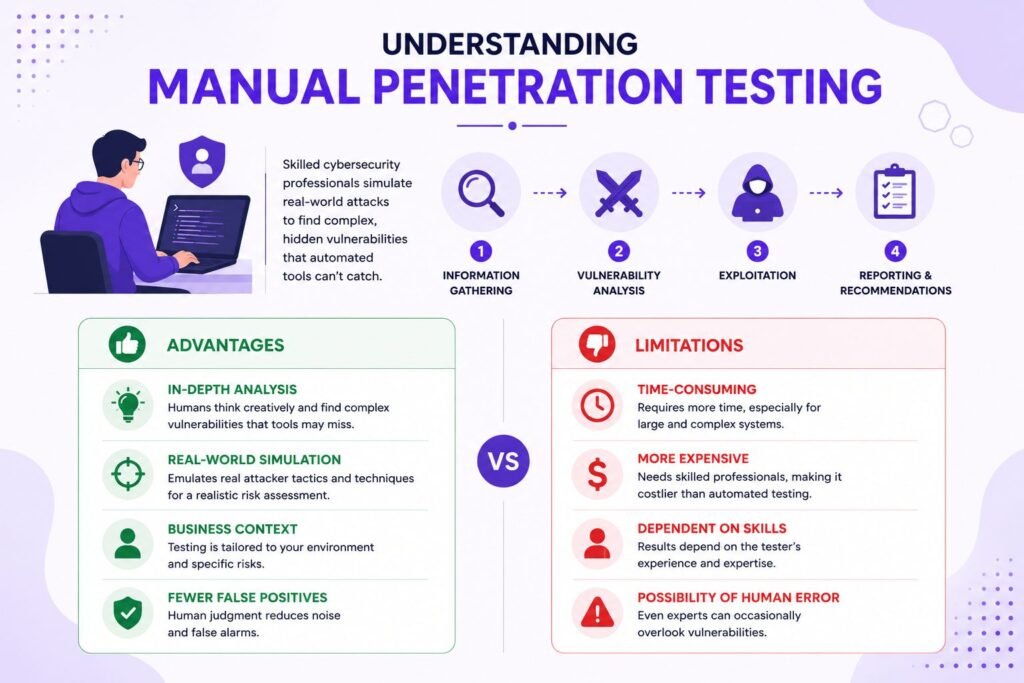
Understanding Manual Penetration Testing
Manual penetration testing puts skilled cybersecurity professionals in the driver’s seat, simulating real-world attack scenarios to root out vulnerabilities. Unlike automated testing, it leans on human expertise to find the complex, hidden weaknesses that scripts simply can’t anticipate.
Advantages of Manual Penetration Testing
The biggest win is in-depth analysis. Human testers think creatively, spot sophisticated vulnerabilities, and exploit chains of weaknesses that automated tools breeze right past. Their work is also customized to your business context, ensuring a genuinely thorough assessment of your unique risks.
Manual testing delivers real-world simulation, too. Testers emulate the actual tactics, techniques, and procedures (TTPs) used by attackers—many of which are catalogued in the MITRE ATT&CK framework—giving you a realistic picture of how your defenses would hold up. And because skilled professionals can tell the difference between a genuine threat and a false alarm, you get fewer false positives and less wasted time.
Limitations of Manual Penetration Testing
All that expertise comes at a price. Manual testing is time-consuming, especially for large-scale systems, and the specialized skills involved make it more expensive than automated alternatives. There’s also the ever-present possibility of human error—even the best testers can occasionally overlook something.
SOC 2, ISO 27001 and HIPAA done for you. Fixed fee, 100% audit pass rate.
Audit-ready in 6 weeks. Not 6 months.
Key Differences Between Automated and Manual Penetration Testing
The clearest way to think about it: automated testing is about breadth and speed, while manual testing is about depth and nuance. Automated tools excel at covering large environments quickly and cheaply, catching well-documented vulnerabilities at scale. Manual testing, by contrast, digs into the complex, context-specific weaknesses that require a human to reason through—the kind of creative problem-solving no script can replicate.
Automated scans produce consistent, standardized reports but generate more noise in the form of false positives. Manual engagements produce tailored findings with far fewer false alarms, but they take longer and cost more. A thorough VAPT report often reflects both perspectives, combining the wide net of automation with the precision of human analysis.
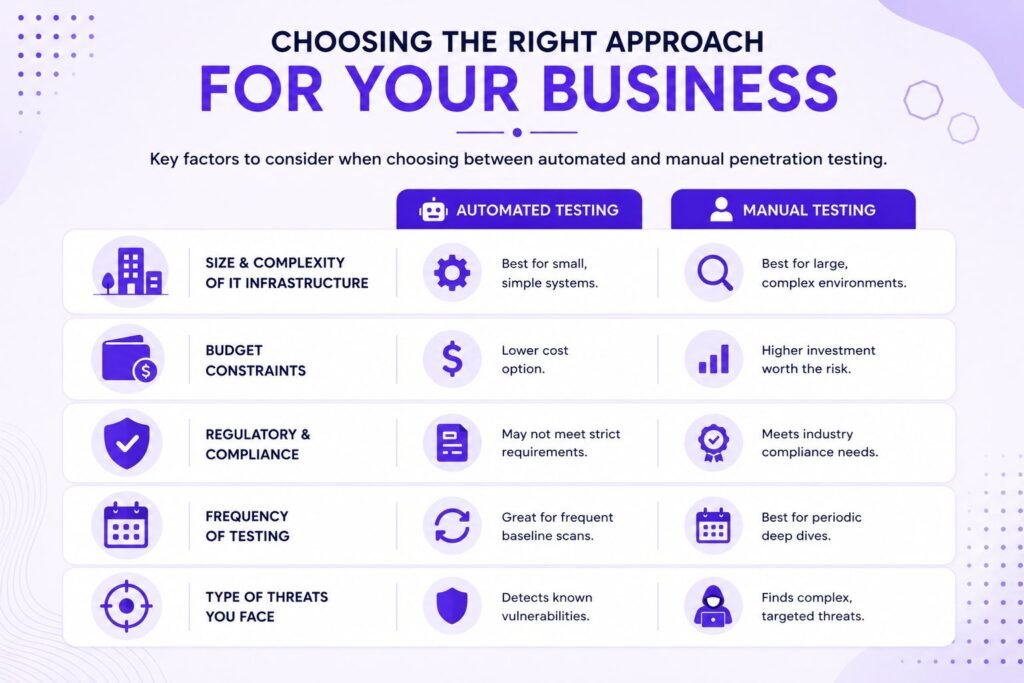
Choosing the Right Approach for Your Business
Selecting between automated and manual penetration testing comes down to a handful of factors: your organization’s size, budget, and security objectives. Here’s how to weigh them.
- Size and complexity of your IT infrastructure. Small businesses with straightforward systems may find automated testing sufficient for catching common vulnerabilities. Larger organizations with sprawling, complex environments usually need the depth and customization that only manual testing provides.
- Budget constraints. Automated testing is the cost-effective choice when funds are tight. That said, critical systems and sensitive data often justify the higher investment of manual testing—a breach in those areas would cost far more than the assessment itself.
- Regulatory and compliance requirements. Industries like finance and healthcare face strict compliance mandates. Standards such as PCI DSS and frameworks aligned with ISO/IEC 27001 frequently call for rigorous, manual-driven risk assessments to satisfy auditors.
- Frequency of testing. Automated testing shines for frequent scans that maintain a baseline level of security. Manual testing is better reserved for annual or biannual deep dives, or after significant system changes.
- Type of threats your business faces. If your main concern is well-known vulnerabilities, automated tools have you covered. If you’re worried about sophisticated, targeted attacks, manual testing is the way to go.
Hybrid Approach: The Best of Both Worlds
Here’s the not-so-secret truth: many businesses don’t choose one over the other at all. Instead, they adopt a hybrid approach that marries the speed and scalability of automated tools with the depth and expertise of manual testing.
In practice, this means using automated penetration testing for regular scans and to catch the low-hanging fruit, then following up with manual assessments to uncover the deeper, more complex vulnerabilities that scanners miss. Integrating both methods gives you comprehensive coverage without blowing your budget. Our service plans are built around exactly this kind of balanced, layered testing.
Recommended Tools for Automated Penetration Testing
If you’re building out an automated testing capability, a few tools dominate the field.
- Nessus is known for its extensive vulnerability scanning, while
- Burp Suite is the go-to for web application security testing. On the open-source side,
- OpenVAS handles network and system scans, and
- Qualys offers a cloud-based platform for automated vulnerability management.
Manual Penetration Testing Frameworks
For manual work, professionals lean on established frameworks and platforms.
- Metasploit is the widely-used standard for developing and executing exploit code.
- The OWASP Testing Guide serves as the definitive reference for assessing web application security, and
- Cobalt Strike is a favorite for adversary simulation and red team operations.
Conclusion
Both automated and manual penetration testing play crucial roles in defending your organization. Automated testing brings speed, scalability, and cost-efficiency, while manual testing delivers depth, creativity, and true real-world simulation. Understanding your unique needs—and, in most cases, blending the two—is how you build a security posture that genuinely protects your digital assets.
At Axipro, we specialize in helping businesses cut through the complexity of cybersecurity. Whether you need automated testing, manual assessments, or a hybrid solution, our team of experts is ready to guide you every step of the way.
Explore our plans to find the right fit for your organization.
Frequently Asked Questions
What is the primary difference between automated and manual penetration testing?
Automated testing relies on tools and software to identify vulnerabilities quickly, while manual testing uses human expertise to uncover complex, context-specific weaknesses.
Is automated penetration testing enough for small businesses?
For small businesses with simple IT systems, automated testing may suffice—but periodic manual testing provides valuable extra assurance.
How often should penetration testing be conducted?
At least annually, or after any significant changes to your systems. Automated scans can and should be run more frequently.
Are there any risks associated with penetration testing?
If performed incorrectly, penetration testing can cause system disruptions. Always work with certified professionals to minimize the risk.
Can manual and automated penetration testing be combined?
Absolutely. A hybrid approach offers the best coverage, balancing efficiency with depth.