
Learn how organizations can use the EU AI Act to build trust, speed up innovation, strengthen procurement, and gain a competitive advantage through effective AI governance.
The Biggest Mistake Organizations Make About the EU AI Act
When executives hear “EU AI Act,” their first thought is usually: another regulation, another compliance project, another expense.
And who could blame them? Between GDPR, DORA, and NIS2, businesses are under real pressure to show they handle technology responsibly.
Here’s what most of them miss, though. Complying with the EU AI Act does more than keep you clear of fines. Done well, it becomes a selling point.
Companies that treat AI governance as a strategic skill earn customer trust and close enterprise deals faster. That matters because customers, investors, and regulators are asking tougher questions about AI than ever:
Can you explain your AI decisions? How do you manage bias? Who’s accountable when something goes wrong? What controls protect sensitive data?
The EU AI Act gives you a framework for answering them. When you can show good governance, you satisfy regulators, and you also win over the customers and partners deciding whether to trust you in the first place.
That trust is worth real money in the AI era. And good governance doesn’t mean more bureaucracy. It means consistency. With clear ownership, defined risk processes, and transparent documentation, AI projects become easier to run and easier to scale. Teams stop reinventing governance for every new initiative and follow a repeatable framework instead, which speeds up decisions and cuts uncertainty.
Companies with mature AI governance are already seeing this play out. They build more customer confidence in their AI products and answer procurement and due diligence requests in days instead of weeks. They run less risk of expensive AI failures or reputational damage, look credible to investors and regulators, and roll out AI consistently across the organization.
In a market where trust increasingly drives purchasing decisions, that shows up in revenue. A McKinsey survey on the state of AI found that organizations investing in responsible AI practices are better positioned to capture value as adoption scales.
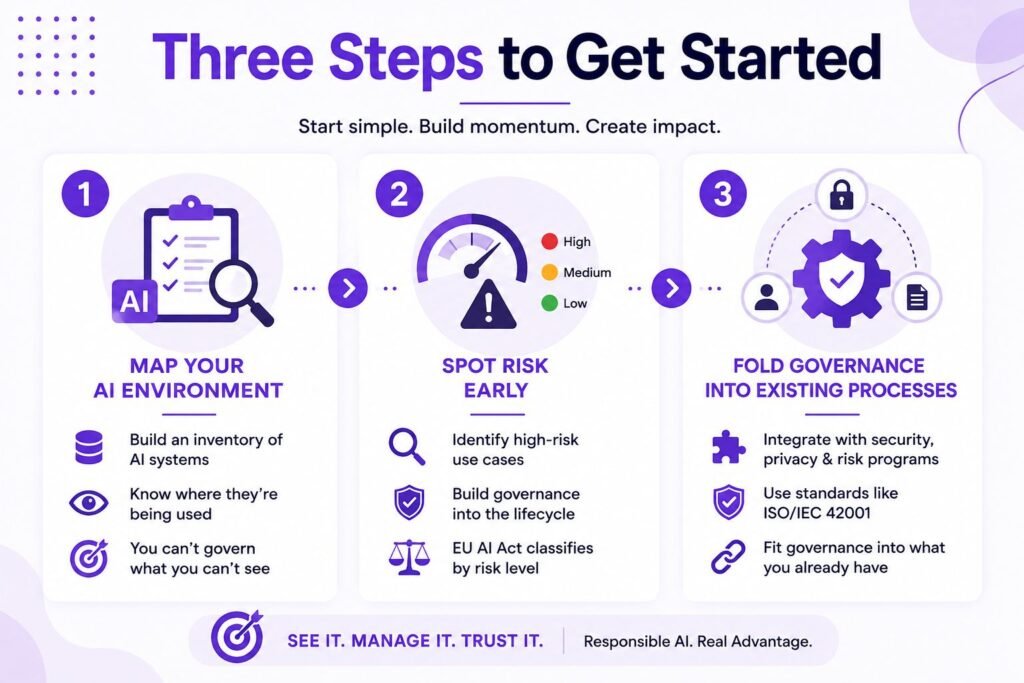
Three Steps to Get Started
You don’t need to transform the whole organization at once. Here’s where you can start:
- First, map your AI environment. Build an inventory of AI systems and know where they’re being used. You can’t govern what you can’t see, and most organizations are surprised by how many AI tools are already in play across teams.
- Second, spot risk early. Work out which high-risk use cases exist and build governance into the development lifecycle. The EU AI Act classifies systems by risk level, so knowing where your use cases fall tells you exactly how much scrutiny each one needs before it ships.
- Third, fold governance into existing processes. Add AI governance to your security, privacy, and enterprise risk programs instead of running it as a separate effort. This is where recognized standards like ISO/IEC 42001 pull their weight, giving you a structured management system that slots into what you already have rather than bolting on yet another silo.
That’s enough to set your organization up for the long run. The debate around the EU AI Act shouldn’t be about staying on the right side of regulation.
It should be about building AI that people trust and that you can actually scale.
Organizations that put governance in place now will innovate faster and earn a stronger market reputation while their competitors scramble to catch up. In a few years, the edge will go to the companies that govern AI best, not the ones that use it the most.
Is your organization preparing for the EU AI Act?
Start by assessing your AI governance maturity and aligning your AI strategy with recognized frameworks like ISO/IEC 42001 and the NIST AI RMF, and turn compliance into a business advantage.
Let Axipro help you build a business continuity plan that's practical, compliant, and audit-ready.
Schedule Your Free Assessment Today