
A SOC 2 penetration test costs between $1,000 and $30,000 for most companies. A typical SaaS scope, meaning one web application, its API layer, and the cloud infrastructure behind it, usually lands between $2,000 and $20,000. Early-stage startups with a narrow scope can get an auditor-accepted test for $1,000 to $8,000, while enterprises with multiple products and hybrid infrastructure regularly spend $20,000 to $50,000 or more.
The spread is wide because “penetration test” covers everything from an automated scan with a cover page to weeks of manual testing by senior engineers. Auditors know the difference, and so do the enterprise customers who asked for your SOC 2 report in the first place. This guide breaks down what drives the price, where the hidden costs sit, and how to buy a test that holds up in fieldwork without overpaying for it.
What Is SOC 2 Penetration Testing?
A SOC 2 penetration test is a simulated attack on your systems, performed by a qualified security professional, scoped to the environment covered by your SOC 2 report. The tester tries to exploit real weaknesses the way an attacker would: broken access controls, injection flaws, misconfigured cloud services, exposed credentials. The output is a report your auditor reads as evidence that your security controls work in practice, not only on paper.
That last part matters. A pentest bought for SOC 2 has a second audience beyond your security team. If the report doesn’t map findings to your audit scope, document its methodology, and show remediation, it fails the job you bought it for. We cover the full deliverable in our guide to what a SOC 2-ready VAPT report includes.
How Penetration Testing Fits Into SOC 2 Compliance
SOC 2 is built on the AICPA’s Trust Services Criteria, and the Security category (the Common Criteria) applies to every report. Penetration testing is the standard way to satisfy CC7.1, which expects you to detect and monitor for new vulnerabilities, and it supports CC4.1, which covers ongoing evaluations of whether controls actually function. The AICPA’s points of focus explicitly mention vulnerability scanning and penetration testing as examples of how companies meet these criteria.
In practice, the test slots into your audit timeline as an evidence item. Your auditor will ask for the report, check the test date against the audit period, and review how you handled the findings. Remediation is often scrutinized harder than the test itself, because it shows whether your vulnerability management process runs or merely exists.
Is Penetration Testing Required for SOC 2?
Strictly speaking, no. The Trust Services Criteria never use the word “mandatory” about penetration testing. You could theoretically satisfy CC7.1 with vulnerability scanning and strong monitoring alone.
In reality, almost every auditor expects one, and skipping it invites two problems. First, your auditor may push back during fieldwork or add exceptions to the report. Second, the enterprise buyers reviewing your SOC 2 report increasingly look for pentest evidence specifically, and a report without it raises questions during procurement. Treat the test as effectively required and budget for it from the start of your SOC 2 compliance checklist.
How Much Does SOC 2 Penetration Testing Cost?
Typical Price Range for SOC 2 Pen Testing
Most companies pay $1,000 to $30,000, with the median engagement for a SaaS business sitting around $12,000 to $15,000. Compliance-focused tests at the lower end of the market start around $1,000 to $5,000. Deep manual testing from established firms runs $10,000 to $30,000. Anything quoted below roughly $3,000 is almost certainly automated scanning packaged as a pentest, which auditors are getting better at spotting.
Cost by Company Size (Startup, SMB, Enterprise)
Company size is a proxy, not the driver. A 15-person company with three products and a legacy on-prem component will pay more than a 200-person company with one tightly scoped SaaS platform. Testers price effort, and effort follows scope.
Cost by Test Type (Network, Web App, API, Cloud, Internal/External)
Most SOC 2 engagements bundle two or three of these. The common package for a cloud-native SaaS company is web app plus API plus cloud configuration, which is why the $1,000 to $20,000 band comes up so often. Companies with office networks and internal systems in their audit scope add internal network testing, and the price climbs accordingly.
Factors That Influence SOC 2 Penetration Testing Cost
Scope and Number of Assets Tested
Scope is the single biggest cost driver. Every additional application, API endpoint group, cloud account, or network segment adds testing hours. A pentest priced without a scoping call is a pentest priced on guesswork, and the guess usually favors the vendor.
Complexity of Application or Infrastructure
A simple CRUD app with two user roles tests quickly. A multi-tenant platform with role hierarchies, workflow engines, file processing, and third-party integrations takes far longer, because each of those features creates attack surface a tester has to work through manually. Authentication tiers matter especially: every distinct role needs testing for privilege escalation and cross-tenant data access.
Testing Methodology (Black Box, Grey Box, White Box)
Black box testing gives the tester nothing but a URL, grey box adds credentials and documentation, and white box adds source code and architecture diagrams. Grey box is the default for SOC 2 and usually the best value, since the tester spends time exploiting rather than discovering. White box costs more upfront but finds deeper issues. Black box sounds rigorous but often wastes paid hours on reconnaissance an attacker would run for free.
Depth of Testing and Manual vs. Automated Approaches
Automated scanning finds known vulnerability patterns. Manual testing finds business logic flaws, chained exploits, and authorization gaps that no scanner catches, and it’s the part auditors and security-literate customers actually value. The ratio of manual work to automation is the honest explanation for most price differences between two quotes covering the same scope.
Tester Credentials and Firm Reputation
Senior testers holding OSCP, GPEN, or CREST credentials bill higher rates, and firms with recognized methodologies charge a premium for the credibility their letterhead carries in an audit. That premium is sometimes worth paying. When your SOC 2 report goes to a bank or a Fortune 500 procurement team, the testing firm’s name gets read too.
Remediation Testing and Retesting Fees
After you fix the findings, someone has to verify the fixes. Some firms include one retest round in the base price, others charge $1,500 to $5,000 for it. Always ask before signing, because a Type 2 audit without retest evidence for critical findings is an awkward conversation with your auditor.
Location and Compliance Requirements
Testing firms in the US and UK typically charge more than firms in other regions for equivalent work, though rates have converged as remote testing became the norm. Stacked compliance requirements also raise price: a test that must satisfy SOC 2 and PCI DSS simultaneously carries extra documentation and methodology constraints.
SOC 2 Type 1 vs. Type 2 Penetration Testing Costs
Pen Testing for Type 1 Reports
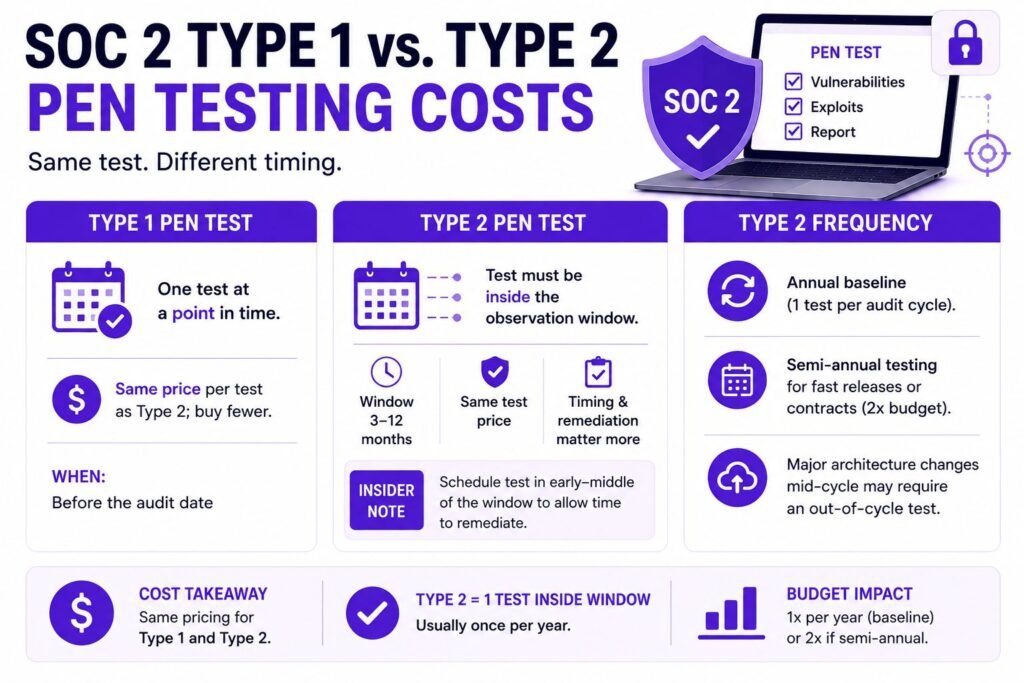
A Type 1 report assesses control design at a single point in time, so one pentest completed before the audit date is sufficient. Companies pursuing Type 1 first often buy a smaller, tightly scoped test to keep first-year costs down, then expand scope for Type 2. The per-test price doesn’t differ from Type 2 pricing; you simply buy fewer of them.
Pen Testing for Type 2 Reports
A Type 2 report covers control operation over an observation window, usually 3 to 12 months, and your pentest needs to fall inside that window. The test itself costs the same, but the timing discipline is stricter and the remediation evidence matters more, because the auditor evaluates your process over time rather than a snapshot.
Insider Note: The most common pentest problem we see in SOC 2 engagements isn’t quality, it’s timing. Companies run their test three or four months before the Type 2 observation window opens, assume it counts, and only discover during fieldwork that the auditor wants a test dated inside the period. Booking the pentest for the early-middle portion of the window solves this and still leaves room to remediate before the audit closes.
Frequency Requirements for Type 2
Annual testing is the accepted baseline, and since Type 2 reports are renewed annually, the practical effect is one pentest per audit cycle. Companies with fast release cadences or contractual obligations sometimes move to semi-annual testing, doubling the budget line. Significant architecture changes mid-cycle, like a new product launch or cloud migration, also justify an out-of-cycle test.
SOC 2 Compliant Penetration Testing, Starting at $1,000
Schedule Your Free Pentesting Assessment Today
What’s Included in a SOC 2 Penetration Test Quote
Pre-Engagement Scoping
A serious quote starts with a scoping call: what’s in your SOC 2 system boundary, how many applications and roles, which cloud accounts, what’s explicitly excluded. This produces the rules of engagement, a practice NIST SP 800-115 formalizes, covering what may be tested, when, and who gets called if something breaks.
Testing Execution
The testing window itself typically runs one to three weeks. Good firms test against a documented methodology, commonly built on the OWASP Top 10 and OWASP’s testing guides for application work, with NIST SP 800-115 or PTES structuring the overall engagement. Expect a mid-engagement heads-up if a critical finding shows up, rather than a surprise in the final report.
Reporting and Attestation Letter
The report should contain an executive summary, the methodology, findings rated by severity (usually CVSS-based) with reproduction evidence, and remediation guidance. Most firms also issue a short attestation letter you can hand to customers without exposing technical detail. Confirm the letter is included, since a few vendors sell it separately.
Remediation Support and Retesting
Quotes differ most here. Some include remediation consultation hours and one retest; others hand you the report and charge for everything after. For SOC 2 specifically, retest documentation for high and critical findings is worth having inside the audit window, so treat included retesting as a genuine pricing factor rather than a nice-to-have.
Hidden Costs to Watch For
The invoice from the testing firm is rarely the whole spend. Your engineers will spend real hours on the engagement: scoping calls, provisioning test accounts, monitoring during testing, and triaging findings, which for a small team often adds up to one to two weeks of a senior engineer’s time. Then comes remediation itself, which can range from a day of configuration changes to a quarter of refactoring if the test surfaces architectural problems.
Rush fees are the other trap. Firms charge 25 to 50 percent premiums for tests booked inside two or three weeks of the start date, and companies discover this exactly when an auditor or enterprise deal imposes a deadline. Finally, remember this is an annual cost. SOC 2 Type 2 renews yearly, and your pentest budget line renews with it.
Pro Tip: When to get a Pentest Quote
Get a pentest quote at the same time you budget your SOC 2 audit, not after. Bundling the conversation forces the scope question early, gives you a real total compliance number, and removes the rush-fee scenario entirely. If you're pricing the full stack, our breakdown of what Vanta actually costs covers the automation platform side of the budget.
How to Reduce SOC 2 Penetration Testing Costs
Scope the Engagement Strategically
Align the pentest scope with your SOC 2 system boundary, not your entire infrastructure. If the marketing website and the internal wiki sit outside the audit scope, they don’t need paid testing hours. A tight, well-documented boundary is the single most effective cost control without reducing quality.
Combine Pen Testing With Other Compliance Work
One properly scoped test can serve SOC 2, ISO 27001, and customer security questionnaires simultaneously if the scoping and reporting anticipate all three. Buying separate tests per framework is a common and entirely avoidable double-spend. Firms that do both compliance and testing can also bundle the pentest into a certification engagement at a better rate.
Choose the Right Testing Partner
Big-name firms carry enterprise overhead in their pricing. Specialist boutiques with credentialed testers frequently deliver equivalent technical work at 30 to 50 percent less, and their reports are just as audit-acceptable if the methodology and documentation are sound. The evaluation criteria in the next section matter more than the size of the vendor’s office.
Perform Internal Vulnerability Scans First
Run scans and fix the obvious findings before the pentest starts. Every hour a paid tester spends documenting an unpatched library or a default credential is an hour not spent on the deep manual work you’re actually paying for. Clean scan hygiene going in raises the value of every finding coming out.
How to Choose a SOC 2 Penetration Testing Provider
Questions to Ask Before Hiring
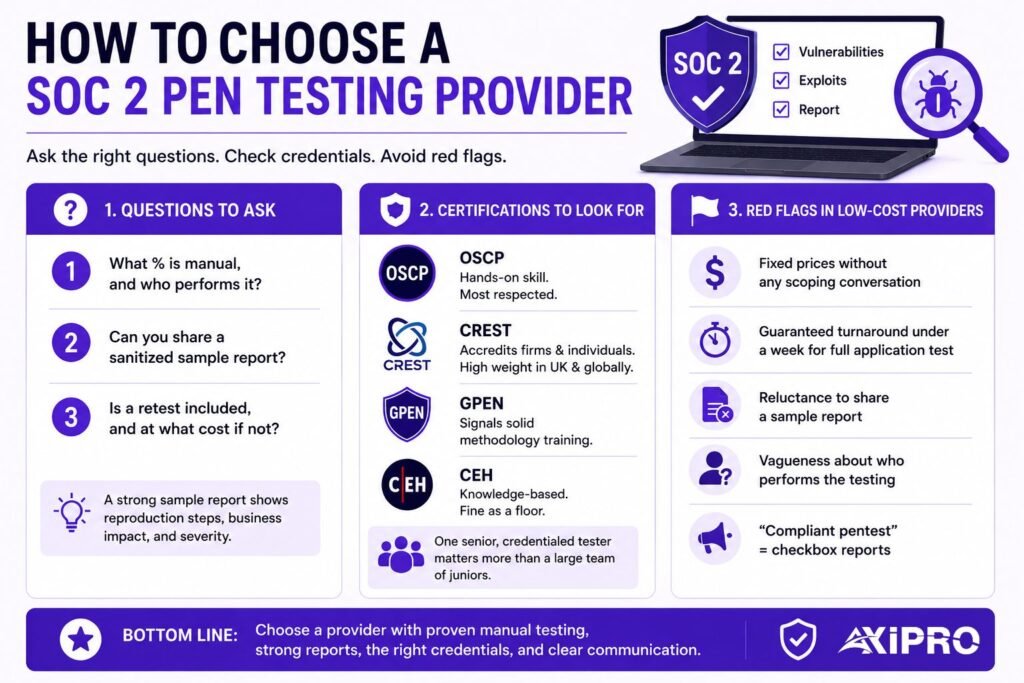
Ask five things:
- What percentage of the testing is manual, and who exactly performs it?
- Can you share a sanitized sample report?
- Is a retest included, and at what cost if not?
- Have your reports been through SOC 2 audits before, and with which audit firms?
- What happens if you find something critical mid-engagement?
The sample report answers most of what you need. A strong one shows reproduction steps, business impact per finding, and severity reasoning. A weak one lists scanner output grouped by CVSS score.
Certifications to Look For (OSCP, CREST, CEH)
OSCP demonstrates hands-on exploitation skill and is the most respected practitioner credential for this work. CREST accredits firms as well as individuals and carries particular weight in the UK and internationally. GPEN signals solid methodology training. CEH is knowledge-based rather than practical, fine as a floor but weak as the lead credential of your primary tester. On team composition, one senior credentialed tester leading the engagement matters more than a large team of juniors.
Red Flags in Low-Cost Providers
Be wary of fixed prices quoted without any scoping conversation, guaranteed turnaround under a week for a full application test, reluctance to share a sample report, and vagueness about who performs the testing.
“Compliant pentest” as a marketing phrase is itself a tell: it signals the product is a checkbox, and checkbox reports are precisely what auditors have learned to probe.
Sample SOC 2 Penetration Testing Cost Scenarios
Early-Stage SaaS Startup
A 12-person startup pursuing SOC 2 Type 1 with one web application, a REST API, and a single AWS account. Grey box test, one senior tester, one week of testing, retest included. Realistic cost: $1,000 to $9,000.
Mid-Market SaaS Company
A 120-person company on Type 2 with two applications, a public API, AWS and GCP accounts, and SSO integration. Grey box, two testers, two to three weeks, retest and attestation letter included. Realistic cost: $2,000 to $22,000.
Enterprise Multi-Product Environment
A 600-person company with four products, internal corporate network in audit scope, hybrid cloud and on-prem infrastructure, and a PCI DSS overlap. Mixed grey and white box, senior team, four to six weeks. Realistic cost: $15,000 to $60,000, often split across quarterly engagements.
A pentest for SOC 2 is a five-figure line item for most companies, and the range you land in comes down to scope, manual depth, and timing. Buy the scoping call, keep the test inside your audit window, confirm retesting upfront, and match the firm’s credentials to the audiences who’ll read the report. Done that way, the same spend covers your audit evidence, your customer questionnaires, and a genuine reduction in exploitable risk. If you want the test scoped against your actual audit boundary, Axipro delivers penetration testing built for SOC 2 and ISO 27001 audits across web, API, network, and cloud environments.
Frequently Asked Questions
Is a penetration test mandatory for SOC 2?
No, the Trust Services Criteria don’t explicitly require one. In practice nearly all auditors expect a pentest as evidence for CC7.1, and its absence commonly triggers pushback during fieldwork or questions from customers reviewing your report. Budget for it as if it were mandatory.
How often do I need a pen test for SOC 2?
Annually is the accepted standard, aligned with your yearly Type 2 audit cycle. Test more often if you ship major architecture changes, launch new products, or carry contractual obligations that demand it.
Can vulnerability scanning replace penetration testing?
Not for most audits. Scanning is automated pattern-matching against known issues, while a pentest involves a human attempting real exploitation, including business logic and authorization flaws scanners can’t find. Auditors treat them as complementary controls, and most expect both: continuous or periodic scanning plus an annual manual test.
How long does a SOC 2 penetration test take?
Testing itself takes one to three weeks for typical SaaS scopes, with the report arriving one to two weeks after testing ends. Add scheduling lead time: reputable firms book two to six weeks out, which is exactly why rush fees exist.
Does the same auditor perform the pen test?
No, and it shouldn’t. Your SOC 2 auditor is a CPA firm attesting to your controls; the pentest comes from an independent security firm and feeds into the audit as evidence. Some audit firms have testing arms, but independence between the two functions is the cleaner arrangement and the one enterprise customers prefer.
What's the cheapest way to get a SOC 2-compliant pen test?
Scope tightly to your audit boundary, fix scanner-level findings before the engagement, book six or more weeks ahead, and use a specialist boutique rather than a big-name firm. That combination gets a legitimate manual test down to the $4,000 to $8,000 range for a simple SaaS scope. Going below that usually means buying a scan, which costs less now and more later.
Do I need a new pen test every year for SOC 2 Type 2?
Yes. Each annual Type 2 report covers a new observation period, and auditors expect pentest evidence dated within that period. Last year’s report demonstrates last year’s controls, and reusing it is one of the fastest ways to collect an exception.