
Most SaaS companies that want someone to handle SOC 2 or ISO 27001 for them end up with the same four names on the shortlist: Axipro, Cognisys, Eden Data, and Workstreet. Their published timelines to audit readiness run from under six weeks to twelve months, and pricing differs by a factor of three or more. When an enterprise deal is waiting on a report, that spread can decide whether the deal closes this quarter or next.
We should say upfront that we’re Axipro, so we have a horse in this race. We built this comparison from feedback from our clients, each firm’s public website, partner directory listings, and marketplace pages. We also wrote it to be useful even if you hire someone else, and we say so where a competitor is the better fit.
There’s one more piece of context. Since the Delve allegations broke in March 2026, buyers have treated the phrase “fast compliance” with suspicion, and they’re right to. So this article answers two questions: who gets you audit-ready fastest, and how you can tell real speed from a rubber stamp.
Quick Verdict: Which Compliance Partner Fits Which Company
Axipro is our pick for most companies, and the rest of this article shows the reasoning. It gets you audit-ready in under six weeks for a fixed published fee that’s typically about half of competitors’. You also get guaranteed certification on the Achievement Plan, top-tier status with Drata plus a Vanta partnership, and regional frameworks the other three don’t list.
Cognisys is the second strongest choice for UK companies that are committed to Vanta and want penetration testing from the same in-house team.
Eden Data suits US companies that want a US-based, ex-Big 4 team on a monthly subscription and can live with a longer runway.
Axipro vs Cognisys vs Eden Data vs Workstreet at a Glance (Comparison Table)
| Axipro | Cognisys | Eden Data | Workstreet | |
|---|---|---|---|---|
| Base | Entities in Bahrain, UK, and US; team distributed across three continents | Leeds and London, UK | Austin, Texas | San Francisco, California |
| GRC platforms | Drata (Elite Partner), Vanta, and 10+ others | Vanta-centered | Drata, Vanta, and others | Vanta-centered |
| Published readiness timeline | Under 6 weeks | 4 to 6 weeks on its DTA program, with prerequisites | 3 to 12 months | No standing figure published |
| Pricing model | Fixed fee per framework, published | Quote on request | Subscription from $5,000 per month | Custom quote |
| Certification guarantee | Yes, on the Achievement Plan | None published that we found | None published that we found | None published that we found |
| Penetration testing | Yes, with a CREST Pathway+ registered partner | In-house | Add-on | Yes |
| Standout frameworks | SOC 2, ISO 27001, NCA ECC, SAMA CSF, ISO 42001, EU AI Act | Cyber Essentials Plus, NIS2, DORA | HITRUST, FedRAMP, CMMC | FedRAMP, CMMC, NIST 800-53 |
| Best for | Speed and budget, any region | UK companies on Vanta | US buyers who want a subscription | US startups on Vanta |
What a Compliance Readiness Partner Does That Your GRC Platform Doesn’t
A GRC platform such as Drata or Vanta connects to your cloud, identity, and HR systems and collects evidence automatically. It’ll tell you that 14 laptops lack disk encryption. It won’t encrypt them or write the policy that requires it. It also won’t decide whether the contractor laptops are in scope, or sit in the auditor walkthrough and explain your change management process.
That’s the work a readiness partner sells. The partner scopes the audit, writes policies that match how the company really operates, puts the missing controls in place, runs the risk assessment and internal audit, and manages the auditor until the report lands. Companies that buy a platform and skip the partner usually find this out around month three. By then the dashboard is stuck at 60 percent and the engineer who owns it has stopped answering compliance tickets.
Let Axipro help you build a business continuity plan that's practical, compliant, and audit-ready.
Schedule Your Free Assessment Today
Platform, Readiness Partner, Auditor: Who Owns Which Part of the Audit
Three parties are involved, and each has its own job.
- The platform collects and monitors evidence.
- The readiness partner builds the program and gets you to the point where an audit will succeed.
- The auditor is an independent CPA firm for SOC 2, or an accredited certification body for ISO 27001, and only the auditor forms the opinion.
The AICPA’s SOC 2 guidance treats that independence as the whole point of the attestation.
The Delve story shows what happens when those jobs collapse into one. In March 2026, an anonymous group of former customers accused the compliance startup of generating fabricated evidence and pre-written auditor conclusions, then routing clients to audit firms that signed whatever arrived. Their analysis of leaked files found that 493 of 494 SOC 2 reports shared near-identical text, down to the same grammatical error. Delve has denied the claims and says independent auditors issue all final opinions. We covered the details in our piece on what the Delve compliance leak means for SOC 2 certification.
It wasn’t the first time, either. In 2024 the SEC shut down audit firm BF Borgers for fabricating audit documentation behind more than 1,500 filings, in what its enforcement director called a “sham audit mill.” That was a financial audit and Delve’s were security audits, but the failure was the same: someone signed a report with no work behind it.
Important: None of the four firms in this comparison has been implicated in any of this. All four are human-led readiness firms that hand the final opinion to independent auditors. We bring up the scandals because they changed what buyers should ask, and we don’t mean it as a dig at competitors.
How We Compared the Four Partners
We scored each firm on eight criteria that a founder or CTO would care about with a deal on the line. Every data point comes from material the firms publish themselves. Where a firm publishes nothing, we say so and don’t guess.
Time to Audit-Ready
Audit-ready means an auditor could start fieldwork tomorrow and you’d pass. Your policies are approved, your controls are running, evidence is flowing, and the risk assessment and internal audit are done. It doesn’t mean you have the report in hand. We only counted timelines a firm commits to publicly, because a number quoted on a sales call is hard to hold anyone to.
Framework Coverage
All four firms deliver SOC 2 and ISO 27001, so those two don’t separate them. The differences are at the edges: regional frameworks such as NCA ECC and SAMA CSF, AI governance under ISO 42001 and the EU AI Act, and US public sector work such as FedRAMP and CMMC.
Drata and Vanta Partnership Status
Partner tier matters for a practical reason. Higher tiers get direct lines into the platform’s support and product teams, so an integration problem blocks your evidence for less time. We also checked whether each firm is tied to a single platform, because that decides whether it can help you at all.
Hands-On Implementation vs Advisory Only
In some engagements you get a consultant who tells your team what to do. In others you get a team that does it. All four firms here sell hands-on delivery, but Cognisys also sells a lighter cohort-style program, so check which package a quote refers to.
Penetration Testing and Technical Services
Most enterprise buyers expect a recent penetration test alongside the SOC 2 report, and ISO 27001 auditors look for technical vulnerability management. If your partner can deliver the test, that’s one less vendor to line up before the audit.
Auditor Relationships
A readiness partner should introduce you to reputable, independent audit firms. It should never write the auditor’s conclusions. After Delve, this criterion carries more weight than it used to. Ask which audit firms a partner works with, then check them yourself against the AICPA peer review records or, for ISO, the accreditation body’s register.
Pricing Model and Contract Terms
You’ll see three models: fixed fee, monthly subscription, and custom quote. Each one carries a different risk for you. A subscription with an open-ended timeline rewards slow delivery, while a fixed fee rewards fast delivery. We looked at what each firm publishes and what the minimum commitment works out to.
Regions and Time Zone Coverage
Compliance work throws up a lot of small questions. A partner whose working day overlaps yours can answer them the same day. We noted where each firm’s delivery team sits and which regions it lists.
Axipro
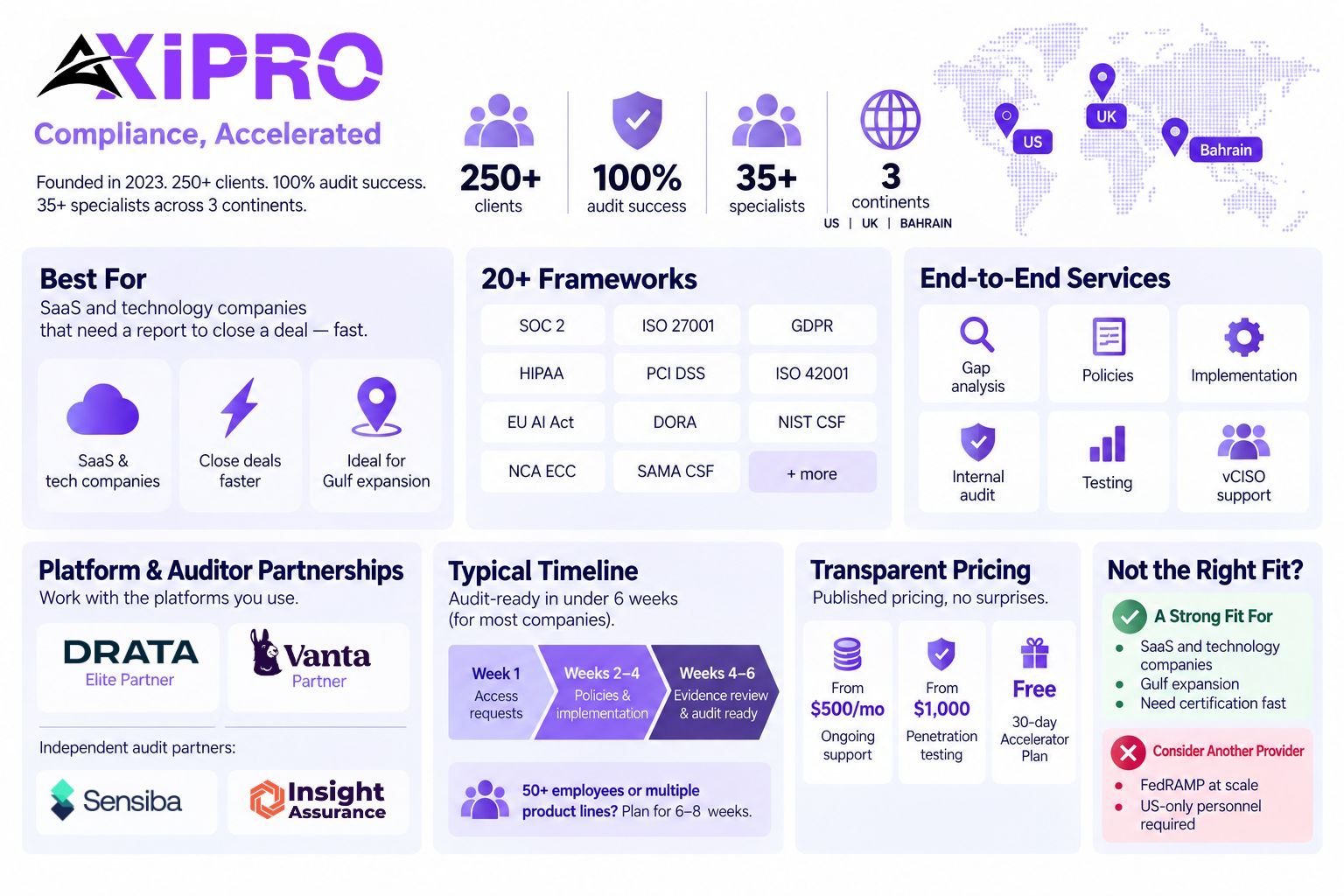
Founded in 2023, Axipro has guided more than 250 clients through certification with a 100% audit success rate. The team has 35-plus specialists spread across three continents, and the company has entities in the US, the UK, and Bahrain.
Who Axipro Is Best For
Axipro is best for SaaS and technology companies that need a report to close a deal and can’t spend six months getting there. It’s also the natural choice for any company selling into the Gulf, where Axipro is headquartered, and none of the other three firms has an office.
Frameworks and Services
Axipro covers more than 20 frameworks. They include SOC 2, ISO 27001, ISO 27701, GDPR, HIPAA, PCI DSS, ISO 42001, the EU AI Act, DORA, and NIST CSF, plus NCA ECC and SAMA CSF for Saudi Arabia. Services run end-to-end: gap analysis, policy development, control implementation, internal audit, vulnerability scanning, security questionnaire support, and vCISO coverage after certification. Penetration testing is delivered through a CREST Pathway+ registered partner. When a framework isn’t available out of the box, Axipro can build it as a custom framework on any GRC platform.
Platform and Auditor Partnerships
Axipro is a Drata Elite Partner, the top tier of Drata’s global partner program, and it’s also a Vanta partner. That makes it one of two firms here that can serve a company, whichever platform it bought. On the audit side, Axipro works with independent firms including Sensiba and Insight Assurance. The auditor forms its own opinion from your live evidence, which is how it should be.
Typical Timeline to Audit-Ready
Axipro gets companies audit-ready in under six weeks for every major framework, and SOC 2 readiness typically lands around week four. The speed comes from people doing the work. A dedicated team of named humans writes your policies around how your company really runs and sits in your Slack channel. They do the implementation work alongside your engineers, so your engineers don’t just get handed a task list.
There’s one caveat. Companies above roughly 50 employees, or with several product lines in scope, should plan for six to eight weeks. More people means more access reviews, more devices, and more evidence.
Insider Note: Policy writing is almost never the slowest item in a readiness project. Access reviews and offboarding evidence are. Someone has to pull user lists from every in-scope system, and that someone is usually an engineer with a sprint to finish. That’s why we front-load those requests in week one.
Pricing
Axipro charges a fixed fee per framework and publishes it on its compliance plans and pricing page, along with ongoing support from $500 per month and penetration tests from $1,000. The Achievement Plan includes the internal audit and vulnerability scanning that others sell as add-ons, and it comes with guaranteed certification. There’s also a free 30-day Accelerator Plan, so you can start before you commit.
The price is roughly half of what US-based readiness firms charge, and the reason is structural. Axipro is bootstrapped and lean, and its specialists are distributed across three continents. There’s no expensive US headquarters or enterprise sales floor built into the rate. The savings come out of overhead, and the people doing your work are just as senior.
Where Axipro Is Not the Right Fit
For FedRAMP at scale, you’re better served by a US firm with a deep public sector bench, which is Eden Data’s territory. If your customers contractually require US-only personnel on the engagement, choose Eden Data.
Cognisys
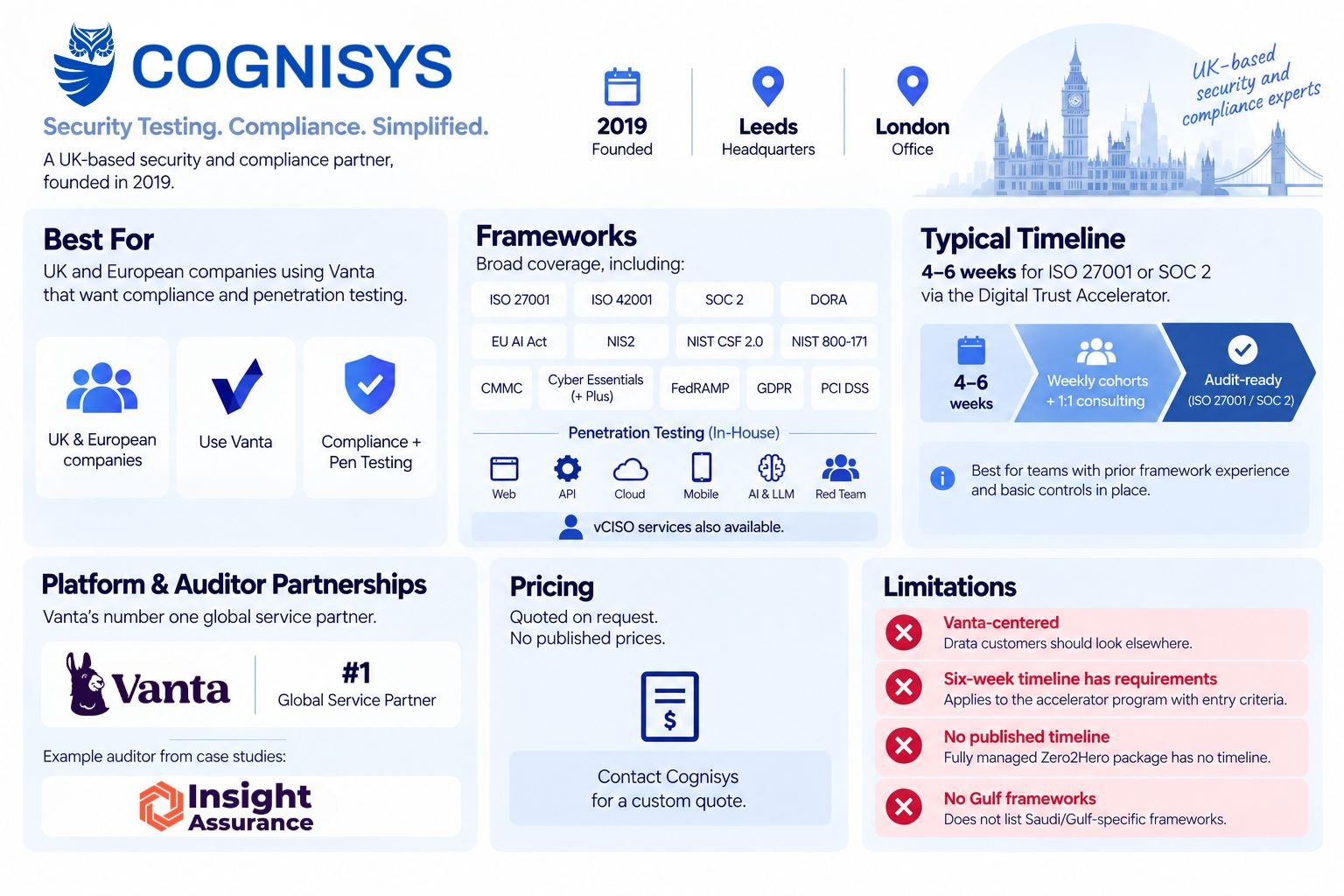
Cognisys is a managed security service provider founded in 2019. It’s headquartered in Leeds and has a London office. It came to compliance from the security testing side, and you can see that in the service mix.
Who Cognisys Is Best For
Cognisys is best for UK and European companies that have chosen Vanta and want compliance, Cyber Essentials Plus, and penetration testing from one UK vendor.
Frameworks and Services
The framework list is broad: ISO 27001, ISO 42001, SOC 2, DORA, EU AI Act, NIS2, NIST CSF 2.0, NIST 800-171, CMMC, Cyber Essentials and Cyber Essentials Plus, FedRAMP, GDPR, and PCI DSS. Its penetration testing catalog is the deepest of the four. It covers web, API, cloud, mobile, AI and LLM, and red team work, all delivered in-house. vCISO services are available too.
Platform and Auditor Partnerships
Cognisys describes itself as Vanta’s number one global service partner and builds its compliance delivery on Vanta. Workstreet makes a very similar claim, so it’s safest to treat both as very large Vanta partners. One of Cognisys’s published case studies names Insight Assurance as the auditor.
Typical Timeline to Audit-Ready
Cognisys publishes four to six weeks for ISO 27001 or SOC 2 through its Digital Trust Accelerator, a sprint program built on weekly cohort sessions plus one-to-one consulting. That’s a fast number, and its case studies back it up. The fine print matters, though. Cognisys’s own site says the accelerated route suits teams that have prior framework experience, basic policies and technical controls already in place, and a designated security contact with time to commit. Its fully managed Zero2Hero package has no published timeline.
Pricing
Cognisys quotes on request. We found no published prices.
Limitations
Cognisys is Vanta-centered, so Drata customers should look elsewhere. The headline six weeks applies to a program with entry requirements, and the fully managed service has no equivalent number. It lists no Gulf frameworks.
Eden Data
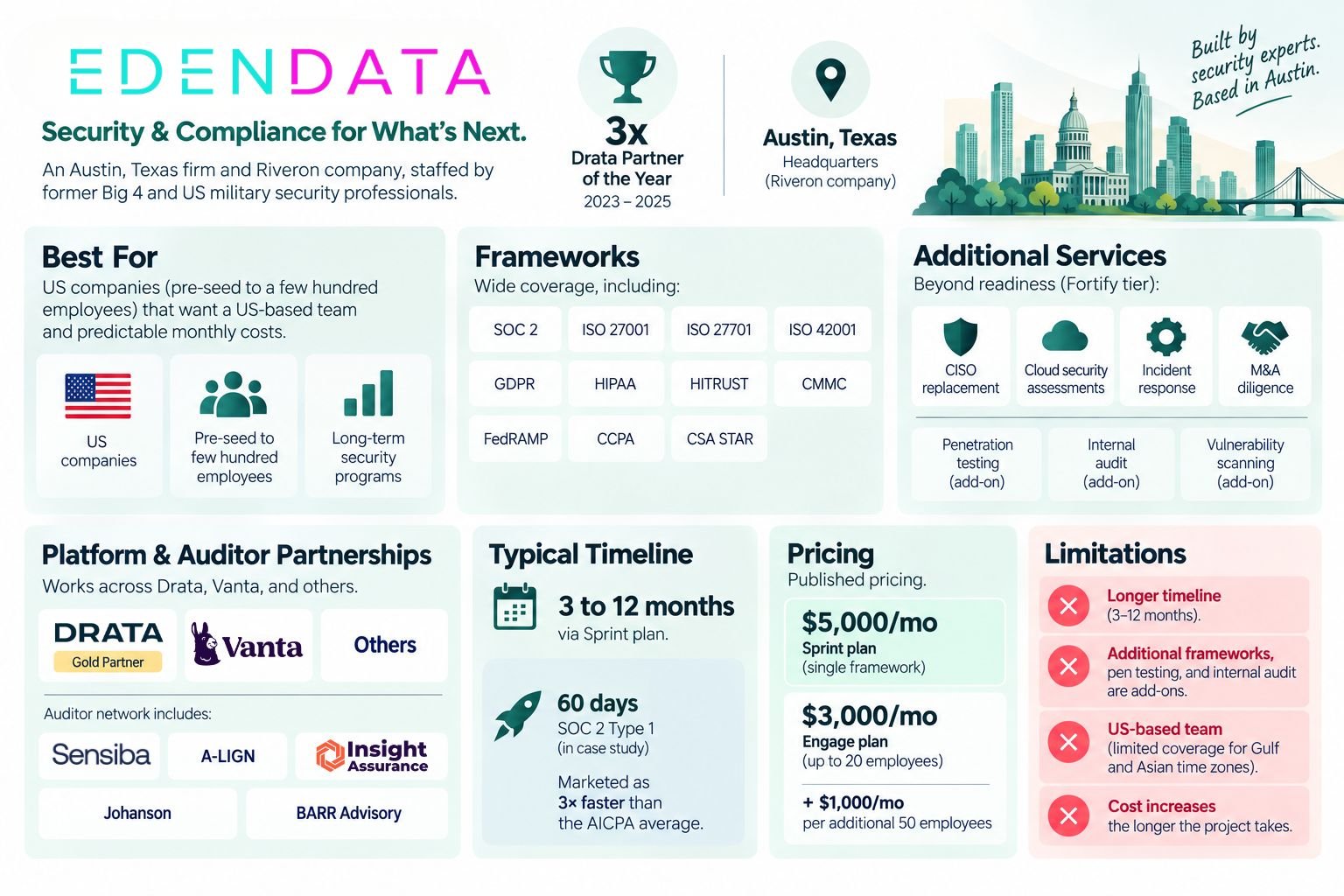
Eden Data is an Austin, Texas firm staffed by former Big 4 and US military security professionals, and it now operates as a Riveron company. It has won Drata’s Partner of the Year three years running, from 2023 to 2025.
Who Eden Data Is Best For
Eden Data is best for US companies, from pre-seed to a few hundred employees, that want a US-based team and like a predictable monthly bill. It fits companies building a security program for the long term more than those racing a deal deadline.
Frameworks and Services
Eden Data covers SOC 2, ISO 27001, ISO 27701, ISO 42001, GDPR, HIPAA, HITRUST, CMMC, FedRAMP, CCPA, and CSA STAR. Beyond readiness, its Fortify tier covers CISO replacement, cloud security assessments, incident response, and M&A diligence. Penetration testing, internal audit, and vulnerability scanning are add-ons to the base subscription.
Platform and Auditor Partnerships
Eden Data is platform-flexible. It works on Drata, Vanta, and others, and Drata’s service directory lists it as a Gold Partner. Its site shows a wide auditor network that includes Sensiba, A-LIGN, Insight Assurance, Johanson, and BARR Advisory.
Typical Timeline to Audit-Ready
Eden Data’s Sprint plan lists a timeline of 3 to 12 months. One of its own case studies cites SOC 2 Type 1 in 60 days. It markets this as three times faster than the AICPA average. That may be true, but it’s still the slowest published figure of the four.
Pricing
Eden Data deserves credit for publishing prices, which most of this industry refuses to do. Sprint begins at $5,000 per month for a single framework. Ongoing compliance under its Engage plan begins at $3,000 per month for up to 20 employees, plus $1,000 per month for each additional 50. At the minimum three-month timeline, a single-framework Sprint costs $15,000 before add-ons or auditor fees.
Limitations
Because the subscription runs across a 3 to 12 month window, the cost grows the longer the project takes. Additional frameworks, penetration testing, and internal audit all sit outside the base price. The delivery team is US-based, which suits US buyers but leaves Gulf and Asian time zones thinly covered.
Workstreet
Workstreet was founded in 2019 and is based in San Francisco. It describes itself as an AI-powered security firm and as Vanta’s largest services partner and only Platinum partner. It says it has supported more than 2,000 Vanta customers and manages over 100 audits a month.
Who Workstreet Is Best For
Workstreet is best for venture-backed US startups and scale-ups already on Vanta. Its client list includes Cursor and Clay, which tells you the profile: fast-growing, engineering-led, and well-funded.
Frameworks and Services
Workstreet covers SOC 2, ISO 27001, GDPR, HIPAA, CMMC, NIST 800-171, NIST 800-53, FedRAMP, and what it counts as 35-plus frameworks in total. Its services include vCISO, penetration testing, vulnerability management, and Vanta implementation and migration. It also handles security questionnaires using AI with a human in the loop.
Platform and Auditor Partnerships
Workstreet is built entirely around Vanta, and by its own count it has more Vanta-certified specialists than any other partner. It works with auditors from Vanta’s approved network.
Typical Timeline to Audit-Ready
Workstreet doesn’t publish a standing timeline. Its site promises Vanta implementation “in days,” and one customer testimonial mentions a SOC 2 turnaround of about two weeks. That may be achievable for a small, clean environment. Ask for the number for your environment in writing.
Pricing
Workstreet prices by custom quote. Its AWS Marketplace listing directs buyers to request a private offer.
Limitations
Workstreet can’t help Drata customers. It publishes no pricing and no committed timeline to compare against. One G2 reviewer notes that the value of the managed service drops once a team is ready to run compliance in-house, which is a big red flag.
Let Axipro help you build a business continuity plan that's practical, compliant, and audit-ready.
Schedule Your Free Assessment Today
Head-to-Head: Which Partner Gets You Audit-Ready Fastest?
On the timelines the firms publicly commit to, Axipro and Cognisys lead, Eden Data trails, and Workstreet gives no number to compare. Axipro’s figure applies to its fully managed plan, while Cognisys’s applies to a program with prerequisites.
SOC 2 Type 1 Readiness Timelines Compared
Axipro typically reaches SOC 2 readiness in about four weeks. Cognisys publishes four to six weeks through its accelerator, and Eden Data’s fastest published case is 60 days. Workstreet doesn’t publish a figure. After readiness, the Type 1 audit itself typically takes an independent auditor a few weeks, whoever prepared you.
SOC 2 Type 2 Readiness Timelines Compared
Readiness for Type 2 takes the same time as Type 1 because the controls are identical. The difference is the observation period. The auditor has to watch those controls operate, and most enterprise buyers expect at least three months of coverage. No partner can compress that window, and a firm that claims it can is describing the behavior behind this year’s scandals. The fastest legitimate path is to reach readiness quickly so the clock starts sooner.
ISO 27001 Readiness Timelines Compared
Axipro and Cognisys both publish six weeks, and Eden Data’s 3 to 12 month range applies here too. ISO/IEC 27001 certification then requires a Stage 1 and a Stage 2 audit by an accredited certification body, so the certificate date depends partly on that body’s calendar. Book the certification body in week one. If you wait until week six, you’ll be ready with nobody available to audit you.
What Actually Slows Down Audit Readiness (And Which Partner Removes It)
Four things cause nearly every delay: waiting on the client’s engineers, policies that describe a company that doesn’t exist, scope that keeps growing, and auditor scheduling. A partner fixes the first by doing the implementation work itself, and the second by interviewing your team before writing a word. Fixed-fee pricing takes care of the third, because the partner has every reason to lock scope early. Established auditor relationships take care of the fourth.
Pro Tip: Ask for a Week-by-Week Readiness Plan Before Signing
Ask any partner for the week-by-week plan before you sign. A firm that has delivered six-week readiness many times can show you what happens in week two. If a firm can't show you that, treat its timeline as a guess.
Which Compliance Partner Should You Choose?
US SaaS Startup Closing Its First Enterprise Deal
Choose Axipro if the deadline and the budget are both tight. Start with SOC 2 readiness and audit support, and you can show the buyer a Type 1 report within the quarter. Workstreet is a sound alternative for a funded startup on Vanta that wants a Bay Area partner. Eden Data fits if your customers insist on US-only personnel.
UK or EU Company Needing ISO 27001 and GDPR
Here it’s Axipro or Cognisys. Choose Cognisys if you also need Cyber Essentials Plus and want penetration testers under the same roof. Choose Axipro if you’re on Drata, want a fixed published fee, or will need SOC 2 next for US customers. If you’re unsure which to pursue first, our guide to the differences between ISO 27001 and SOC 2 covers the decision.
Middle East and GCC Companies (NCA ECC, SAMA CSF, DIFC)
Axipro is the clear choice here. It’s headquartered in Bahrain and works in Gulf business hours. It delivers the National Cybersecurity Authority’s Essential Cybersecurity Controls and the SAMA Cyber Security Framework alongside ISO 27001. We couldn’t find either framework on the public lists of the other three firms.
AI Companies Needing ISO 42001 or EU AI Act Readiness
This one is competitive. Axipro, Cognisys, and Eden Data all list ISO 42001, and Axipro and Cognisys both list readiness for the EU AI Act. The deciding factors are the usual ones: platform, timeline, and price. Most AI companies need ISO 42001 stacked on ISO 27001 or SOC 2, so ask each firm how it prices the bundle.
Teams Already on Drata
Your options are Axipro and Eden Data. Axipro holds Elite status, the highest tier in Drata’s partner program, and Eden Data has three Partner of the Year awards. Cognisys and Workstreet are built around Vanta.
Companies That Need Multiple Frameworks at Once
Axipro bundles ISO 27001 and SOC 2 into one engagement at a combined fixed fee, since most of the controls overlap. Eden Data prices additional frameworks as add-ons to a single-framework subscription. Cognisys and Workstreet both deliver multi-framework programs on quote.
Questions to Ask Any Compliance Partner Before You Sign
- Who signs the final opinion, and can I choose the auditor? The answer has to be an independent CPA firm or accredited certification body, and yes, you can choose.
- Who writes the auditor’s test procedures and conclusions? Only the auditor should. If you hear any other answer, walk away.
- Will I work with named people, and where are they? You want humans you can message. A ticket queue or a chatbot with a compliance skin won’t do. Where they sit matters less than whether you can reach them and how senior they are.
- Is the timeline in the contract? A timeline written into the contract beats a verbal one every time.
- What is outside the price? Auditor fees and the GRC platform subscription are almost always separate. Internal audit, penetration testing, and extra frameworks sometimes are.
- What happens if I fail the audit? Axipro’s answer is guaranteed certification on the Achievement Plan. Ask the others for theirs.
Worth Knowing: Verify any SOC 2 Auditor
Verify any SOC 2 auditor through AICPA peer review records, and any ISO certification body through its accreditation body, such as UKAS in the UK or ANAB in the US. It takes ten minutes, and it's the one check that would have protected most of the companies caught up in this year's scandal.
The Bottom Line
All four firms are legitimate and human-led, and any of them can get a company through an audit. They differ on speed, price, platform, and geography. Eden Data is the premium US subscription. Workstreet is the Vanta heavyweight for funded US startups. Cognisys is the UK security house with the deepest testing bench.
Axipro commits publicly to under six weeks, a fixed fee at around half the going US rate, and guaranteed certification. It does that on whichever platform you already own, and in regions the others don’t cover. For most companies with a deal waiting on a report, that combination is why we rank it first. Test the claim the way you’d test anyone’s, by asking for the week-by-week plan.
Frequently Asked Questions
What is the difference between a compliance readiness partner and an auditor?
A readiness partner builds your compliance program and prepares you for the audit. An auditor independently examines that program and issues the SOC 2 report or ISO certificate. The two have to be separate firms, because an auditor can’t credibly assess work it produced itself.
Do I still need a compliance partner if I already use Drata or Vanta?
Most companies do. The platform automates evidence collection and monitoring, and that’s where it stops. Scoping, policy writing, control implementation, risk assessment, internal audit, and auditor management still need people. A partner supplies them without pulling your engineers off the roadmap.
How long does it take to get audit-ready for SOC 2 with a partner?
Published timelines among these four firms range from about four weeks to twelve months. Axipro typically reaches SOC 2 readiness in around four weeks and commits to under six. A Type 1 audit adds a few weeks, and a Type 2 adds an observation period that most buyers expect to be at least three months.
How much does a compliance readiness partner cost?
It depends on the pricing model. Eden Data publishes subscriptions from $5,000 per month over a 3 to 12 month timeline, which puts the floor at $15,000 for one framework. Axipro publishes a fixed fee per framework that comes to less than half of that floor. Cognisys and Workstreet quote privately. Auditor fees and GRC platform subscriptions are separate in every case.
Is Axipro a Drata or a Vanta partner?
It’s both. Axipro is a Drata Elite Partner, the highest tier in Drata’s partner program, and it’s also a Vanta partner. It can implement on either platform, or build custom frameworks on others.
Can one partner handle SOC 2 and ISO 27001 at the same time?
Yes, and it’s usually the efficient route because the two frameworks share most of their controls. Axipro offers a combined ISO 27001 and SOC 2 engagement at a bundled fixed fee. Check with any partner whether the second framework is included or billed as an add-on.
Which compliance partner is best for companies outside the US?
For the UK and Europe, Axipro and Cognisys both have local entities and ISO 27001 depth. For the Middle East, Axipro is the only one of the four headquartered in the region, and the only one we found listing NCA ECC and SAMA CSF. Eden Data and Workstreet are built mainly around US buyers.
Can I switch compliance partners mid-audit?
Yes. Your evidence, policies, and controls live in your GRC platform and belong to you, so a new partner can pick up where the last one stopped. The cleanest moments to switch are before the audit window opens or between a Type 1 and a Type 2. Let your auditor know. Most won’t mind as long as the evidence trail is intact.