
/

  / AI Governance Maturity Model: 5 Levels Explained

AI Governance Maturity Model: 5 Levels Explained

Most organizations think their AI governance is further along than it is. McKinsey’s 2026 AI Trust Maturity Survey of roughly 500 organizations found an average maturity score of 2.3 out of 4, and only about a third reported level three or higher in strategy, governance, and agentic AI oversight. Adoption is outpacing control, and regulators have noticed.

An AI governance maturity model gives you a way to measure that gap honestly. This guide covers what a maturity model is, the six dimensions it should measure, the five levels most models use, and how to assess your own organization and build a roadmap to the next level.
What Is an AI Governance Maturity Model?

An AI governance maturity model is a structured framework that describes how capable an organization is at governing its AI systems, usually across five progressive levels. The concept borrows directly from the Capability Maturity Model (CMM) that software engineering has used since the early 1990s: define the capability, describe what it looks like at each stage of development, and score yourself against it.

The purpose is diagnosis. A maturity model tells you where governance is strong, where it’s theater, and where it doesn’t exist at all.

How It Differs from General AI Governance Frameworks

Frameworks like the NIST AI Risk Management Framework or ISO/IEC 42001 tell you what good governance contains: policies, risk assessments, accountability structures, monitoring. A maturity model tells you how well you’re doing those things today. The framework is the destination. The maturity model is the odometer.

That distinction matters in practice. Plenty of companies can point to an AI policy document. Far fewer can show that the policy changes what teams actually ship.

Why Enterprises Need a Maturity Model

Three reasons.

  • First, budget: you can’t prioritize governance investment without knowing which dimension lags.
  • Second, accountability: a maturity score gives boards something concrete to track quarter over quarter.
  • Third, regulation: the EU AI Act and frameworks like ISO 42001 assume a functioning management system, and a maturity assessment is the fastest way to find out whether yours would survive scrutiny.

Let Axipro help you build a business continuity plan that's practical, compliant, and audit-ready.

Schedule Your Free Assessment Today

Core Dimensions of an AI Governance Maturity Model

A useful model measures more than policy coverage. Six dimensions show up consistently across the credible models, including the IEEE-USA flexible maturity model built on the NIST AI RMF.

  • Strategy and leadership. Does the organization have a stated position on AI risk, an executive owner (increasingly a Chief AI Officer), and board visibility? Gartner’s 2025 polling found 55% of organizations now have an AI board or dedicated oversight committee, which means nearly half still govern by improvisation.
  • Policies, standards, and accountability. Written policies mapped to regulations, a RACI matrix for AI decisions, and clear escalation paths. Many organizations adapt the three lines of defense model from financial risk: the teams building AI, the risk function overseeing them, and internal audit checking both.
  • Data governance and model lifecycle. Training data lineage, quality controls, and lifecycle management from development through deployment, monitoring, and retirement. This is where AI governance meets MLOps, and where mature organizations maintain an AI register, a live inventory of every model and system in production.
  • Risk, compliance, and ethics. Risk classification of AI systems, impact assessments, bias and fairness testing, and explainability requirements. Banks will recognize the DNA of model risk management under SR 11-7 here.
  • People, skills, and culture. Training, role clarity, and whether people outside the governance team actually understand their obligations.
  • Tools, automation, and monitoring. Drift detection, automated policy checks, audit logging, and dashboards. Governance that lives in spreadsheets caps out around level three.
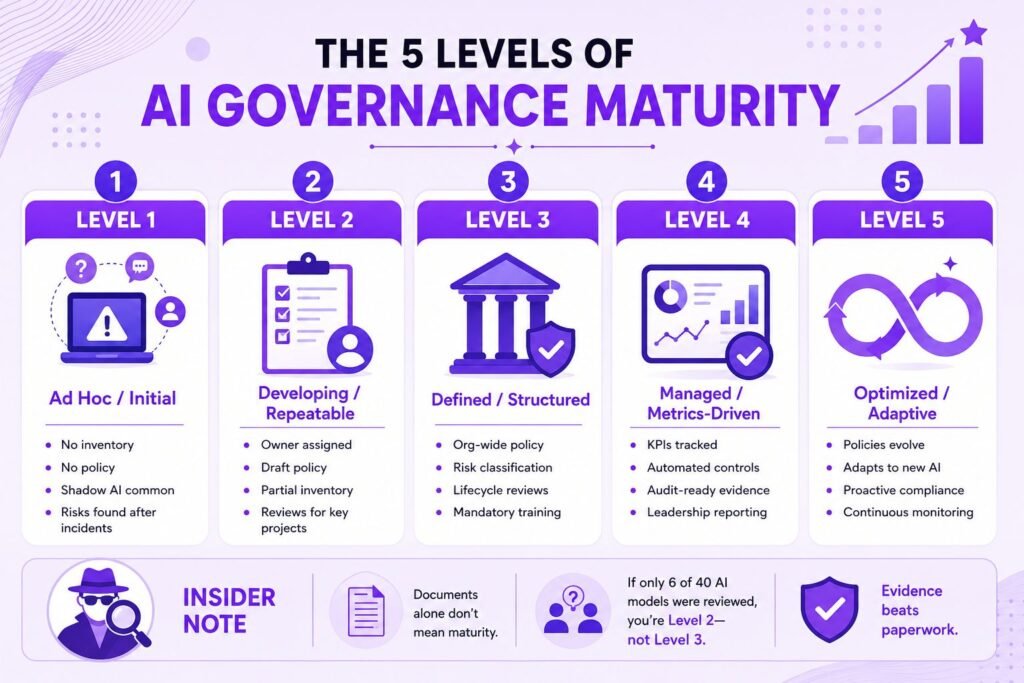
The 5 Levels of AI Governance Maturity

Level 1: Ad Hoc / Initial

AI use happens without oversight. There’s no inventory, no policy, or a policy nobody follows. Shadow AI is common, and risk surfaces only when something breaks publicly.

Level 2: Developing / Repeatable

Someone has been assigned responsibility. A draft policy exists, a partial inventory exists, and reviews happen for high-profile projects. The practices are repeatable but depend on specific people rather than defined processes.

Level 3: Defined / Structured

Governance is documented, standardized, and applied across the organization. There’s a governance committee, a risk classification scheme, defined lifecycle gates, and mandatory training. Most organizations pursuing ISO 42001 certification are working to reach and formalize this level.

Level 4: Managed / Metrics-Driven

Governance produces numbers. Coverage rates, review cycle times, incident counts, and risk reduction are measured and reported to leadership. Controls are enforced by tooling rather than goodwill, and audits confirm the system works as described.

Level 5: Optimized / Adaptive

Governance improves itself. Monitoring feeds back into policy, controls adapt to new model types (agentic systems being the current test), and the organization anticipates regulatory change rather than reacting to it. Almost nobody is here yet, and that’s fine. Level 5 is a direction, not a deadline.

Insider Note: In assessments, the most common self-scoring error is claiming level 3 on the strength of documents alone. If your policy says every model gets a pre-deployment review and your inventory shows 40 models but your review log shows 6, you’re at level 2. Evidence beats paperwork every time, and auditors check the logs first.

AI Governance Maturity Matrix

The matrix crosses dimensions with levels so you can score each one independently. Organizations are rarely uniform: it’s normal to sit at level 3 on policy and level 1 on monitoring.

For scoring, keep the rubric simple: 1 to 5 per dimension, scored on evidence you could show an auditor, not on intentions. Board-level indicators (does the board see AI risk reporting?) and operational indicators (does every production model have a completed impact assessment?) should be scored separately, because they fail independently.

How to Assess Your Current AI Governance Maturity

Start with a baseline self-assessment. Pull together a cross-functional group covering engineering, legal, risk, security, and the business owners of major AI use cases, and score each dimension against the matrix. Half a day is usually enough for a first pass.

For each dimension, the assessment comes down to a few blunt questions. Do we know every AI system we run? Who approved the last model that went to production, and can we prove it? When did we last test a model for bias or drift? Would our documentation survive an external audit? What happens, step by step, when an AI system misbehaves?

The signs of each level are usually obvious once you look. If the answer to “who owns this?” is a shrug, that’s level 1. If it’s a name, level 2. If it’s a role with a documented mandate, level 3 or better.

For benchmarking, McKinsey’s 2026 data is a reasonable reference point: the average organization sits between levels 2 and 3, with technology and financial services ahead of other sectors. If you’re at level 2, you’re normal. Staying there is the problem.

Pro Tip: Score your Agentic AI

Score your agentic AI use separately from everything else. Autonomous agents that take actions, call tools, and chain decisions break assumptions that traditional model governance relies on, and McKinsey added agentic governance as its own dimension in 2026 for exactly this reason. A level 3 program for predictive models can easily be level 1 for agents.

Aligning the Maturity Model with Established Frameworks

  • NIST AI Risk Management Framework. The AI RMF organizes governance into four functions: Govern, Map, Measure, and Manage. It deliberately avoids prescribing a rigid maturity scale, which is why the IEEE-USA model built a questionnaire and scoring rubric on top of it. If you want a US-anchored, sector-neutral basis for your maturity dimensions, start here.
  • ISO/IEC 42001. Published in December 2023, ISO 42001 is the first certifiable AI management system standard. It follows the same Plan-Do-Check-Act structure as ISO 27001, which makes it a natural extension for organizations that already run an ISMS. In maturity terms, certification roughly demonstrates a defined, audited level 3 with elements of level 4.
  • EU AI Act. The Act’s obligations phase in over several years, and the timeline moved in 2026: under the Digital Omnibus agreed in May and formally endorsed in June 2026, obligations for standalone high-risk systems under Annex III shift to December 2, 2027, and AI embedded in regulated products under Annex I to August 2028. Penalties still reach €35 million or 7% of global turnover for prohibited practices. The extension buys time, but the high-risk obligations still assume exactly the inventory, documentation, and lifecycle controls that levels 3 and 4 describe.
  • OECD and other global standards. The OECD AI Principles, adopted by nearly 50 countries, underpin most national AI policies and give multinationals a common vocabulary. ISO/IEC 23894 adds AI-specific risk management guidance that pairs well with 42001. GDPR continues to apply alongside all of it wherever personal data is involved.
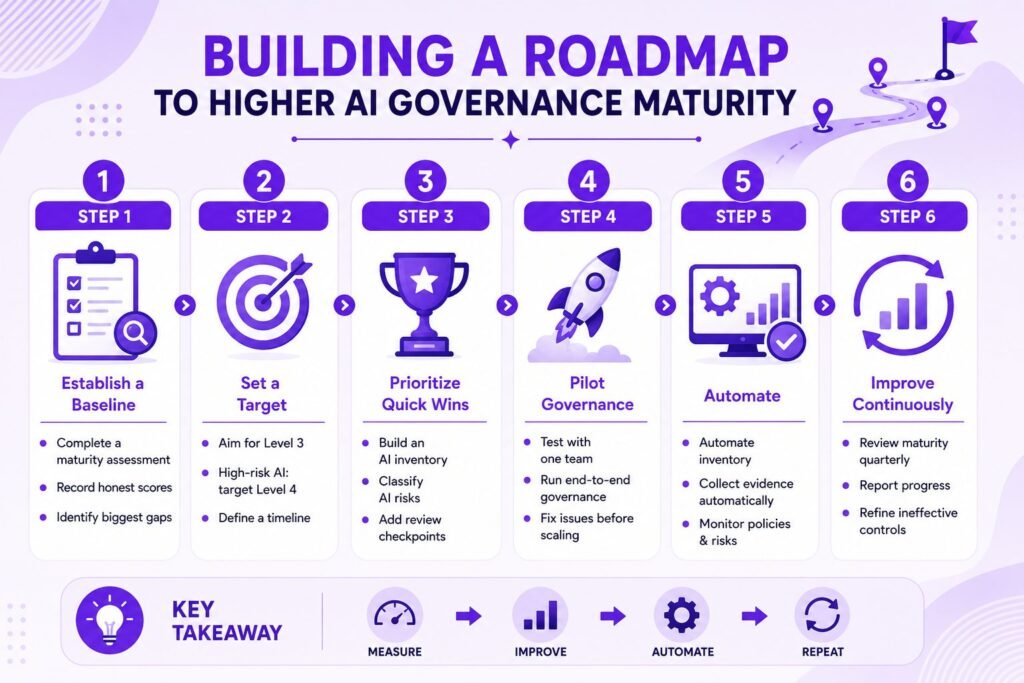
Building a Roadmap to Advance Maturity

Step 1: Establish a baseline. Run the self-assessment above and write the scores down, including the embarrassing ones. The baseline only works if it’s honest.

Step 2: Define a target maturity level. Level 3 across all dimensions is the right target for most enterprises within 12 to 18 months. Regulated industries and anyone deploying high-risk systems under the EU AI Act should aim for level 4 on risk, lifecycle, and monitoring.

Step 3: Prioritize gaps and quick wins. An AI inventory is almost always the first quick win: it’s cheap, fast, and everything else depends on it. Follow with risk classification and a lightweight review gate for new deployments.

Step 4: Run a governance pilot sprint. Pick one business unit or one model class and run the full governance process end to end for 60 to 90 days. A pilot surfaces the friction (unclear ownership, slow reviews, missing evidence) before you scale the pain organization-wide.

Step 5: Scale with automation and tooling. Manual governance doesn’t survive contact with dozens of models. Automate inventory updates, evidence collection, monitoring alerts, and policy checks. Gartner’s 2025 research found organizations investing in third-party AI governance tools were 1.9 times more likely to report high value from generative AI.

Step 6: Quarterly review and continuous improvement. Reassess maturity quarterly, report the trend to the board, and retire controls that create work without reducing risk. Maturity that isn’t re-measured decays.

Let Axipro help you build a business continuity plan that's practical, compliant, and audit-ready.

Schedule Your Free Assessment Today

Metrics and KPIs to Measure Maturity Progress

  • Governance coverage metrics answer “how much of our AI estate is actually governed”: percentage of AI systems in the inventory, percentage risk-classified, percentage with completed impact assessments, and training completion rates.
  • Risk reduction indicators track whether governance changes outcomes: AI incidents per quarter, time to detect and resolve model issues, drift alerts actioned, and bias findings remediated.
  • Operational and efficiency metrics keep governance honest about its own cost: average review cycle time, percentage of reviews meeting SLA, and evidence collection effort per audit.
  • Business outcome and ROI metrics connect governance to value, which is what keeps it funded. Gartner’s 2025 survey found that organizations running regular AI assessments were three times more likely to report high value from generative AI. Done well, governance also speeds delivery, because approvals stop being bespoke investigations.

Common Pitfalls When Implementing a Maturity Model

  1. Treating maturity as a checklist. A maturity model measures capability. An organization that writes twelve policies in a quarter hasn’t advanced a level; it’s produced twelve documents. Advancement means behavior changed and you can prove it.
  2. Ignoring cross-functional ownership. AI governance owned solely by legal produces policies engineers ignore. Owned solely by engineering, it produces monitoring nobody reports upward. The maturity assessment itself should be cross-functional, and so should the operating model that follows.
  3. Underinvesting in monitoring and automation. This is the most common ceiling. Organizations reach level 3 on documentation and stall because every control is manual. Without drift detection, automated evidence collection, and continuous checks, level 4 stays permanently out of reach.

Where to Go from Here

An AI governance maturity model turns a vague obligation into a measurable program: six dimensions, five levels, a baseline score, and a roadmap. The organizations getting this right treat maturity as an operating metric, reassess quarterly, and automate early. With EU AI Act high-risk deadlines now set for late 2027, the window to build toward level 3 deliberately, rather than in a panic, is open but not indefinite.

Frequently Asked Questions

When should an organization adopt an AI governance maturity model?

As soon as AI touches production systems or customer-facing decisions. Earlier is cheaper: retrofitting governance onto dozens of deployed models costs far more than building gates before scale.

A single accountable executive (CAIO, CISO, or chief risk officer depending on structure) with a cross-functional working group doing the scoring. Ownership without cross-functional input produces blind spots; input without a single owner produces stalemate.

Moving from level 1 to 2 can take a quarter. Level 2 to 3 typically takes 6 to 12 months because it requires standardization across teams. Level 3 to 4 depends heavily on tooling investment and often takes another year.

Quarterly for the operational scorecard, annually for a full formal assessment. Anything less frequent and the score stops reflecting reality; AI estates change too fast.

No. The Act requires specific outcomes (risk management, documentation, human oversight, monitoring) rather than any particular maturity model. But a maturity assessment is the most practical way to find out how far you are from those outcomes, and ISO 42001 certification built on a level 3+ program is emerging as the cleanest way to demonstrate readiness.

Axipro Author

Picture of Pedro Dias

Pedro Dias

Pedro has been writing online for over 10 years. With experience in all things programming, cyber security, and compliance, he is our editor-in-chief at Axipro.

Blog Highlights

Explore More Articles

Vanta can tell you a control is failing within the hour. It cannot rewrite your access review process, decide which systems belong in audit scope, or explain to a CPA why a test that shows red is actually fine. That work falls to people, and choosing the right ones is the difference between a 6-week path to audit readiness and a 6-month slog that ends with your Vanta subscription renewing before you have a report. This guide ranks the 7 best Vanta deployment services for 2026, explains what each one is good at, and covers what most comparison pages skip: how long this really takes, what it costs, and how to spot a partner who’ll hand you a half-configured platform and disappear. What Is a Vanta Deployment Service? A Vanta deployment service is a hands-on engagement where a specialist firm sets up, configures, and operationalizes Vanta so your company reaches audit readiness for one or more compliance frameworks. Vanta itself is a compliance automation and trust management platform: it connects to your cloud, identity provider, code repositories, HR system, and endpoints, then runs automated tests and maps the evidence to frameworks such as SOC 2, ISO 27001, HIPAA, and GDPR. The platform automates evidence collection and continuous monitoring. It doesn’t put controls in place for you. A deployment partner handles the judgment work around the tool: scoping, gap analysis, control mapping, policy writing, risk assessment, remediation of failing tests, and coordination with the audit firm. The best partners also stay on after the audit, because a Vanta instance nobody owns degrades fast. Worth Knowing: Vanta is a software vendor, not an auditor. Vanta is a software vendor, not an auditor. Your SOC 2 report still comes from a licensed CPA firm under AICPA attestation standards, and your ISO 27001 certificate comes from an accredited certification body. A deployment partner sits between the platform and the auditor. 1. Axipro Best for: SaaS and technology companies that want Vanta deployed, controls implemented, and the audit delivered by one accountable team, fast. Axipro is an authorized Vanta partner and a Drata Elite Partner, so its team works inside both leading compliance automation platforms every day. Founded in 2023, it has served 200+ clients from offices in the US, UK, and Bahrain, with a 100% audit success rate across 200+ certified clients. What puts Axipro first is scope. Most Vanta partners configure the platform and leave control implementation to you. Axipro’s Achievement Plan covers the whole path: kick-off and Vanta setup, gap analysis, a full policy and procedure suite, risk assessment and treatment, control implementation, vulnerability scanning, an internal audit, and external audit facilitation with an independent auditor. Clients get a dedicated infosec team over Slack, and the Achievement Plan comes with guaranteed certification. The other reason is speed. Axipro typically reaches SOC 2 readiness in around four weeks and ISO 27001 certification readiness in as little as six. It supports 20+ frameworks, including SOC 2, ISO 27001, HIPAA, PCI DSS, GDPR, CMMC, ISO 42001, and the EU AI Act, plus Gulf frameworks such as NCA ECC and SAMA CSF that most US-only partners cannot cover. Teams that want to test the relationship first can start with the free 30-day Compliance Accelerator Plan, which includes Vanta setup, gap analysis, and policy documentation, and continue into ongoing vCISO and continuous monitoring through the Trust Assurance Plan after certification. Watch for: Axipro is built for companies that want the work done for them. Teams that want a light-touch coaching engagement and plan to run the program in-house will use only part of what it offers. 2. Control and Function Best for: US SaaS companies of roughly 10 to 60 people that want SOC 2 and ISO 27001 run as one fixed-price project. Control and Function is a Denver-based consultancy built around fixed-scope, fixed-price readiness for small SaaS teams that have no compliance department. Its sweet spot is the dual-framework engagement: building SOC 2 and ISO 27001 from one shared control set rather than running two projects back to back. It also covers HIPAA for healthtech and maps ed-tech requirements such as FERPA and HECVAT. The firm is platform-neutral, so it works inside Vanta rather than reselling it, and it is explicit about handing off cleanly to an independent auditor. It’s also one of the few firms here that publishes prices, with readiness coaching starting around $8,000 and full readiness around $15,000. Watch for: The framework range is narrower than larger partners. Companies that need PCI DSS, CMMC, or international frameworks will need a second provider. 3. Neutral Partners Best for: Growing companies that need managed GRC across SOC 2, ISO 27001, CMMC, and FedRAMP without hiring an internal compliance team. Neutral Partners, based in Miami, runs a managed GRC model. It builds and documents the compliance program, tests it through internal audits, and then hands off to the relevant independent assessor: a CPA firm for SOC 2, a certification body for ISO 27001, or a C3PAO for CMMC. It never issues the certificate itself, which keeps the independence question simple. Its framework coverage leans toward regulated and government-adjacent work, including CMMC, FedRAMP, PCI DSS, HIPAA, and HITRUST. That makes it worth a look for defense suppliers and companies selling to the public sector. Watch for: Vanta isn’t its main focus. Ask for recent Vanta deployment examples in your framework before signing. 4. Kobalt.io Best for: Small and mid-sized businesses that want Vanta plus managed security operations. Canada-based Kobalt.io markets itself as one of Vanta’s leading global service partners. Its Vanta practice covers policy and control development inside the platform, custom control mapping where standard controls do not fit, and an applicability review of Vanta’s tests. The broader appeal is its managed security services, which suit companies that want compliance and security operations from the same provider. 5. AuditPeak Best for: Startups that want a readiness and audit-preparation partner focused narrowly on SOC 2. AuditPeak focuses on SOC 2 audit readiness for early-stage companies working in

Compliance software collects the evidence. A consultant builds the system that evidence is meant to prove. That’s the real difference in the ISO 27001 consultant vs software decision, and most teams only figure it out after they’ve bought one and realized they still need the other. Below, we compare what each route covers, where it breaks down, and what it costs you in time, money, and your team’s hours. Short version: software on its own works for a small group of companies. For most SaaS and tech scale-ups trying to get an enterprise deal over the line, consultant-led implementation on a compliance platform is the faster and safer path to a certificate. Quick Answer: Consultant, Software, or Both? Software-only works if you already have an in-house security lead who’s taken a company through ISO/IEC 27001 before and has the time to own the project. Consultant-only still makes sense if you run mostly on-premise or legacy systems that platforms barely integrate with. For everyone else, which means most cloud-native companies under a few hundred people, a hybrid works best: a platform to handle evidence and monitoring, and a consultant to build the management system and stand behind it in front of an auditor. Here’s why. What an ISO 27001 Consultant Handles ISO/IEC 27001:2022 is a management system standard. Clauses 4 to 10 cover how you run information security, and Annex A lists 93 controls you pick from based on risk. Almost none of it is box-ticking. Most of it comes down to judgment calls about your business, and that’s what you’re paying a consultant for. Scoping, Gap Analysis and Risk Assessment Scope is the first decision you make, and the most expensive one to get wrong. Go too wide and you’ll spend months on controls for systems no customer asks about. Go too narrow and the certificate won’t get through the procurement review it was supposed to pass. A consultant scopes around the deals you’re trying to close, runs a gap analysis, and builds a risk assessment based on your real assets and threats. That’s the document auditors dig into hardest. ISMS Documentation and Policy Writing The standard asks for a specific set of documents: the ISMS scope, information security policy, risk assessment and treatment methodology, Statement of Applicability, risk treatment plan, and evidence of competence, monitoring, internal audit, and management review. A consultant writes these around how your company works day to day, instead of how a template imagines it works. Auditors check whether you follow your own procedures, so a mismatch shows up fast. Internal Audit and Certification Audit Support You need an internal audit before certification, and Clause 9.2 says the auditor has to be objective and impartial. In a small company, the people who built the ISMS can’t credibly audit it, so most teams outsource it through ISO 27001 internal audit services. A good consultant also gets your team ready for the Stage 1 and Stage 2 audits, joins the conversations that matter, and handles corrective actions if the auditor raises nonconformities.  What ISO 27001 Compliance Software Handles Compliance automation platforms, often called GRC platforms, have changed how cloud-native companies get certified. They’re very good at the repetitive, evidence-heavy side of the work. Automated Evidence Collection and Continuous Control Monitoring The platform plugs into your cloud provider, identity provider, code repos, HR system, and device management tools, then pulls evidence on its own. It’ll flag an unencrypted storage bucket, an ex-employee who still has access, or a laptop without disk encryption. For technical controls, that saves weeks of screenshots and spreadsheet tracking. Policy Templates and Annex A Control Mapping Most platforms come with a policy library and map each control to the ISO 27001 clauses and Annex A. You get a starting point and a clear view of which controls have evidence and which don’t. Auditor Access and Ongoing Compliance Tracking Auditors can log in and review evidence themselves, which cuts down fieldwork. After you’re certified, dashboards show when controls slip between surveillance audits, so you aren’t rebuilding evidence from scratch every year. Where Each Approach Falls Short Neither route covers everything by itself. The good news is that the ways each one fails are predictable, so you can plan around them. Limits of Compliance Automation Platforms A platform can tell you a control is failing. It can’t decide your scope, run your risk assessment, write a policy that matches your operations, convince your CTO to change the offboarding process, or explain to an auditor why you excluded a control from your Statement of Applicability. Templates can also make you feel further along than you are. A dashboard at 90% can hide an ISMS that won’t survive Stage 1, because the missing 10% is the management system itself. Insider Note: The Stage 1 problem we see most on software-only projects is a risk assessment copied straight from the platform’s default risk library. The risks are generic, the scores are almost identical, and nothing ties back to the company’s own assets. Auditors notice within minutes, and it weakens the Statement of Applicability that’s built on it. The other problem is ownership. Software assumes someone inside the company will drive the project. At most startups that’s a CTO or ops lead who already has a full-time job, and the subscription renews whether the work gets done or not. Limits of a Consultant-Only Approach A consultant working without automation spends billable days on things a platform does for free, like chasing screenshots, updating evidence trackers, and collecting the same proof again before every surveillance audit. You pay more and wait longer. You also end up with a program that’s only accurate on the day it’s handed over. Once the engagement ends, the evidence goes stale and year-two surveillance turns into a scramble. ISO 27001 Consultant vs Software: Side-by-Side Comparison Factor Consultant only Software only Hybrid (consultant + platform) Time to audit readiness 3 to 6+ months Highly variable; depends on internal expertise As little as 6 weeks for well-scoped

Uzbekistan regulates artificial intelligence through two documents. The first is Law ZRU-1115, signed on 21 January 2026. It amends existing legislation to define AI, stops anyone from basing decisions about people’s rights on AI output alone, and fines companies that process personal data unlawfully with AI. The second is the set of Ethical Rules approved by Order No. 3787, in force since 17 June 2026, which spell out what developers, implementers, and users actually have to do. Uzbekistan hasn’t passed a standalone AI act, and its rules don’t sort systems into risk tiers or require conformity assessments. The framework is short and blunt, and it’s already enforceable. Below we walk through what each document requires, who it applies to, how it stacks up against the EU AI Act, and what a company using AI in Uzbekistan should do next. Uzbekistan AI Regulation at a Glance (TL;DR) Instrument Date What it does Who it binds Law ZRU-1115 Signed 21 January 2026 Defines AI in law, sets general rules for AI-built information resources and systems, bans legally significant decisions based only on AI, adds fines for unlawful AI processing of personal data State bodies, organizations, website owners, anyone processing personal data with AI Order No. 3787 (Ethical Rules) Registered 14 March 2026, in force 17 June 2026 Sets eight mandatory ethical principles and lists rights and obligations for developers, implementers, and users Individuals and companies developing, implementing, or using AI in Uzbekistan Law No. 1125 (Personal Data amendments) Adopted 26 March 2026 Limits data localization to biometric, genetic, and local telecom user data, and allows cross-border transfers under conditions Personal data operators, including AI providers AI Strategy until 2030 (RP-358) 14 October 2024 Sets national targets for AI adoption, infrastructure, and skills Government bodies What Is Law ZRU-1115? The law’s official title is a mouthful: “On making additions and changes to certain legislative acts of the Republic of Uzbekistan in connection with the regulation of relations arising from the use of artificial intelligence.” Put simply, it’s an amending law. Instead of creating a new AI code, it writes AI into laws that were already on the books. When It Was Signed and When It Took Effect The Legislative Chamber of the Oliy Majlis adopted the bill on 12 August 2025, and the Senate approved it on 1 November 2025. President Shavkat Mirziyoyev signed it on 21 January 2026. You can read the official text in Lex.uz, Uzbekistan’s national legislation database. The law set out the principles and the penalties. The day-to-day detail arrived later with the Ethical Rules, which came into force on 17 June 2026. For compliance planning, treat mid-June 2026 as the point when the whole framework started applying. Why Uzbekistan Amended Existing Laws Instead of Passing a Standalone AI Act Uzbekistan wants more AI, not less. Its national strategy sets numeric targets for adoption, investment, and local computing capacity, and a heavy EU-style act would have worked against them. So lawmakers kept it light. They defined AI, drew two hard lines (human control over decisions that affect people’s rights, and protection of personal data), and left the Ministry of Digital Technologies to fill in the rest through secondary rules. Businesses get less legal certainty, and the government gets to move faster. Which Laws ZRU-1115 Changes For businesses, two amendments matter most. The Law “On Informatization” (ZRU-560-II, 2003) now contains a legal definition of AI, a new article on using AI in information resources and systems, duties for website owners, and updated powers for the ministry in charge. The Code on Administrative Liability now includes an offense for processing and spreading personal data unlawfully using AI. The Legal Definition of Artificial Intelligence in Uzbekistan Under the amended Law “On Informatization,” AI is a set of technological solutions that imitate human cognitive functions, including learning on their own and solving problems, and that produce results on specific tasks comparable to what a person could do. That’s deliberately broad. It covers generative AI, machine learning classifiers, recommendation engines, and most agentic systems. The Ethical Rules add a narrower term, the AI system: software built on AI that can find, collect, store, analyze, process, evaluate, and use data, and make decisions on its own based on that data. If your product makes a decision from data, or shapes one, assume it counts. Key Rules Introduced by Law ZRU-1115 General Principles for Using AI in Information Systems and Resources The new article in the Law “On Informatization” starts from harm. Information resources created with AI, and information systems running on AI, must not harm people’s life, health, freedom, honor, or dignity, or violate their other inalienable rights. The standard is short and open-ended. It gives regulators something to enforce against without saying in advance what counts as harm. Principle-based rules like this deserve to be taken seriously precisely because the edges are undefined. Human Oversight: No Decisions on Rights and Freedoms Based Solely on AI Most coverage leads with this provision, and it’s easy to see why. When someone makes a legally significant decision that affects human rights and freedoms, they can’t rely only on conclusions produced by AI systems or AI-built information resources. AI can feed into the decision, but a person has to make it. That applies to loan denials, benefit eligibility, hiring rejections, licensing outcomes, and disciplinary action. In each case, someone needs to look at the AI output and own the final call. Insider Note: In AI governance engagements, teams rarely struggle to show that a review step exists. What they struggle to show is that the reviewer could disagree, and sometimes did. If a human clicks “approve” on every AI recommendation and nobody ever records an override, auditors will see automation with a signature on top. Build the override path and log when people use it, starting on day one. Powers of the Authorized State Body (Ministry of Digital Technologies) ZRU-1115 makes the Ministry of Digital Technologies the authorized state body for AI. Among its new jobs, it’s