
/

  / EU AI Act Article 50: AI Transparency Rules from August 2026

EU AI Act Article 50: AI Transparency Rules from August 2026

The EU AI Act’s transparency requirements take effect on 2 August 2026, and most of the companies they cover still think the rules are not their problem. Article 50 applies to any business that publishes AI-generated content or runs an AI system that talks to people in the EU. That includes the marketing team generating campaign images and the support team running a chatbot. It also covers the AI agents you’ve wired into customer email. Penalties reach €15 million or 3% of total worldwide annual turnover, whichever is higher, and you don’t need an office in Europe to be in scope. If your content or your chatbot reaches EU users, the obligations reach you.

In a nutshell: if you publish AI-generated images or video, deploy chatbots or AI agents that interact with EU users, or publish AI-written text on matters of public interest, then yes, the EU AI Act applies, starting 2 August 2026.

A quick word on the “AI Act delay” headlines. The Digital Omnibus package did push the high-risk system deadlines back, in some cases by more than a year, but it did not move the deployer obligations in Article 50. Companies that read those headlines and stood down their AI Act work made an expensive mistake, because the rules most likely to touch an ordinary business are the ones that stayed on the calendar.
What Article 50 Actually Requires

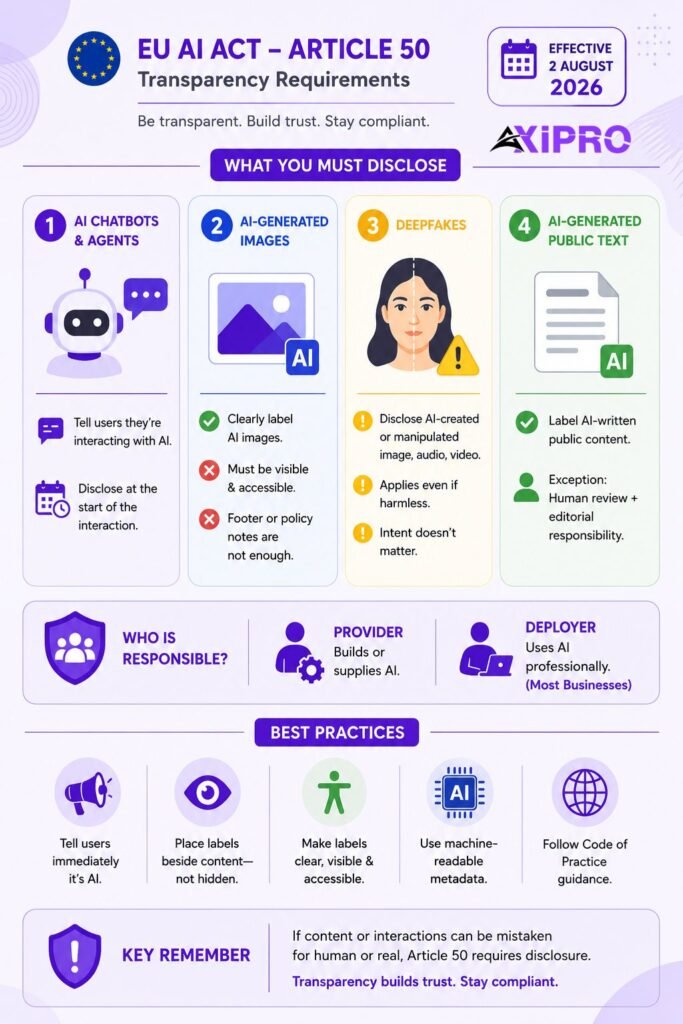
Article 50 of the AI Act sets out transparency obligations in four situations. In plain English:

  • Tell people when they’re talking to AI. Systems designed to interact directly with people — chatbots, voice assistants, and AI agents — must make clear that the user is dealing with AI, unless that’s already obvious.
  • Mark AI-generated content so machines can detect it. Providers of generative AI systems must mark outputs in a machine-readable format, typically through metadata and watermarking, so the content is detectable as artificially generated.
  • Label deepfakes. Anyone deploying AI to generate or manipulate image, audio, or video content that resembles real people, places, objects, or events, and could falsely appear authentic, must disclose that the content is artificial.
  • Label AI-generated text on matters of public interest. Text published to inform the public must carry a label if AI-generated or manipulated, unless a human reviewed it and a person or organization holds editorial responsibility for it.

Article 50 also covers emotion recognition and biometric categorization systems, which carry their own disclosure duties. Far fewer businesses run into those, so this article sticks to the four above.

The distinction running through all of this is provider vs deployer. The provider builds or supplies the AI system. The deployer uses it professionally. Most companies reading this are deployers.

Let Axipro help you build a business continuity plan that's practical, compliant, and audit-ready.

Schedule Your Free Assessment Today

If You Use AI-Generated Images

Realistic AI images sit closer to the deepfake rules than most marketing teams assume. The Act’s definition covers content depicting people, objects, places, and events that could falsely appear authentic to a viewer, which describes a large share of what image generators produce for campaigns, social posts, and landing pages.

So what does “clearly and distinguishably labeled” mean? The threshold is best described by its failures: a tiny disclosure hidden in the website footer doesn’t qualify. Neither does a faint label on an image, a label that flashes for an instant in a video, or a disclosure buried in your terms and conditions.

The label has to be visible right where someone sees the content, and it has to meet accessibility standards so people with disabilities can perceive it too.

The Code of Practice proposes a standardized “AI” visual label, localized per language (“KI” in German, “IA” in French). It also draws a useful line between fully AI-generated content and AI-assisted content, with lighter requirements for the latter. A designer who used AI to extend a background is in a different position from a team publishing a fully synthetic image of a person who doesn’t exist.

Important: The deepfake duty doesn’t care about intent. A flattering, harmless AI image of your CEO at an event that never happened is still a deepfake under the Act. Marketing teams generate this kind of content casually. From August, every one of those images needs a label.
EU AI Act Article 50

If You Deploy AI Agents or Chatbots

The rule itself is simple: people must know they’re dealing with AI. The provider carries the design obligation, but as the deployer you’re the one putting the system in front of your customers, and you’re the one an EU regulator will contact if your branded assistant pretends to be human.

The Act contains an exception for cases where it’s “obvious” the user is talking to AI, judged from the perspective of a reasonably well-informed and observant person. Don’t lean on it. What’s obvious to your product team isn’t obvious to every customer, and the human-sounding voice agents and email-writing AI agents rolling out right now are designed specifically to not feel like software. If an AI agent negotiates a renewal over email or handles a support ticket end to end, disclose it.

Pro Tip: Put the Disclosure at the Start of the Interaction

Put the disclosure at the start of the interaction, in the interface itself: "You're chatting with an AI assistant." A line in your privacy policy doesn't meet the standard, and a disclosure that appears after the conversation ends is worthless. For voice agents, say it up front in the greeting.

What Your AI Vendors Owe You

The machine-readable marking obligation in Article 50(2) sits with providers — the companies supplying your generative AI tools. The final Code of Practice expects providers to apply at least two layers of marking where necessary, such as embedded metadata combined with watermarking, and to offer detection mechanisms so deployers, authorities, and researchers can verify whether a piece of content came from AI.

One timing caveat: the Digital Omnibus gives generative AI systems already on the market before 2 August 2026 until 2 December 2026 to comply with the marking requirement. Every other Article 50 obligation stays on the August date.

The practical consequence lands in your contracts. The hard part of Article 50 is deciding who is the provider and who is the deployer at each link in the supply chain, and your vendor agreements need to say which party holds each duty. Ask your generative AI vendors three things: what marking technology they apply, how you can access their detection tooling, and whether they’ve signed the Code of Practice.

Insider Note: The four-month marking grace period creates an awkward window. Between August and December 2026, some of the tools you use daily won’t watermark their output yet, while your deployer duties apply in full from day one. So don’t build your labeling process on the assumption that vendor watermarks have you covered. Label at your own layer, visibly, and treat vendor-side marking as reinforcement rather than the plan.

The Code of Practice: Voluntary, but the De Facto Standard

The European Commission published the final Code of Practice on marking and labelling of AI-generated content, drafted by independent experts with input from more than 180 stakeholders. It has two sections: one for providers, covering marking and detection, and one for deployers, covering the labeling of deepfakes and public-interest text.

Signing is voluntary. Ignoring it is unwise. The Code is the only official, concrete answer to “what does compliance actually look like,” and regulators will most likely use it as their reference point when they judge whether a company made a good-faith effort. The Commission has also prepared guidelines interpreting Article 50’s scope, definitions, and exceptions, with the final version expected around the application date.
Behind on This? A 7-Day Catch-Up Plan

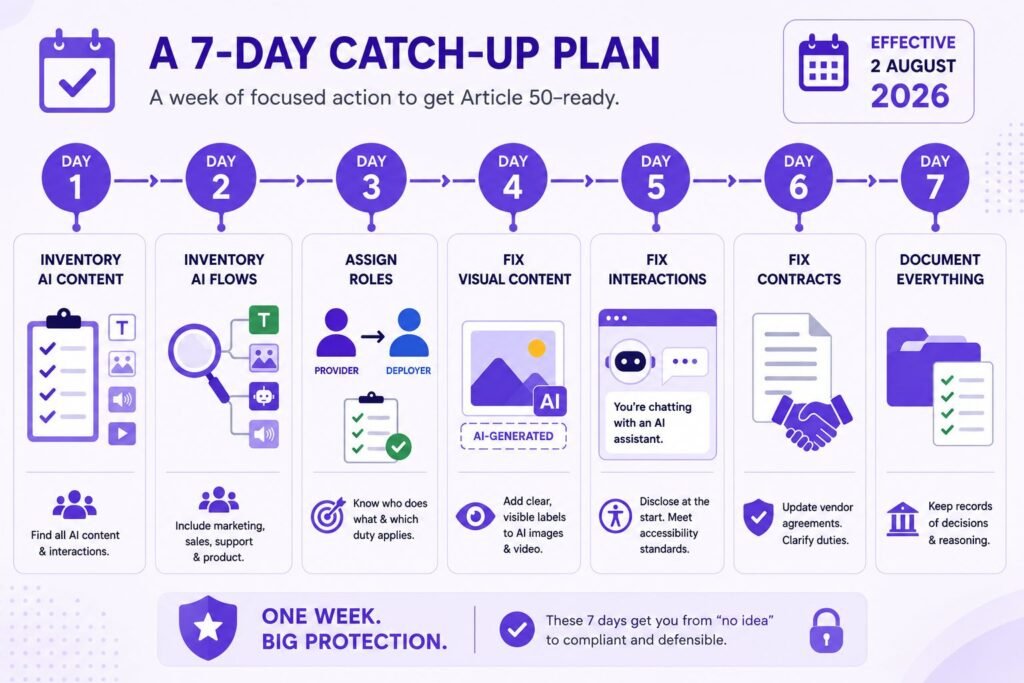
If today is the first time anyone in your company has looked hard at Article 50, a week of focused work covers most of the exposure.

Days 1 and 2 — Inventory your AI content flows.
List every place AI-generated text, images, audio, or video reaches an EU audience, plus every chatbot, voice assistant, or AI agent that interacts with EU users. Count what marketing, sales, and support produce with AI tools, alongside anything built into your product.

Day 3 — Assign roles.
For each tool and use case, decide whether you’re the provider or the deployer, and note which Article 50 duty attaches. This one exercise clears up most of the confusion.

Day 4 — Fix your visual content.
Add clear labels to realistic AI-generated images and video, and audible disclosures to synthetic audio, following the Code’s guidance on visible, persistent labels.

Day 5 — Fix your interactions.
Add disclosures to every chatbot, assistant, and agent at the start of the interaction, and check they meet accessibility requirements.

Day 6 — Fix your contracts.
Write to your generative AI vendors, request their marking and detection documentation, and update agreements to state who holds each duty.

Day 7 — Document everything.
Document everything — record what you inventoried, the roles you assigned, the labels you applied, and the reasoning behind each judgment call. If a regulator ever asks, this record is your first line of defense.

Let Axipro help you build a business continuity plan that's practical, compliant, and audit-ready.

Schedule Your Free Assessment Today

Where Article 50 Fits in Your AI Governance Program

Nothing in that checklist should live as a one-off project. An AI system inventory, assigned roles and responsibilities, transparency controls, vendor management, and documented decisions are all core requirements of ISO 42001, the international standard for AI management systems. Companies that already run an ISO 42001 program will find that Article 50 mostly falls out of controls they operate anyway. Companies scrambling this week are usually the ones without a governance structure to hang the work on.

That’s the real lesson of this deadline. The EU has more AI rules coming: the marking obligation lands in December, and the high-risk regime arrives later. Treating each deadline as a fire drill doesn’t scale. Axipro helps companies build ISO 42001-aligned AI governance programs that absorb requirements like Article 50 as routine control updates instead of emergencies. If the checklist above turned up gaps you can’t close on your own, that’s the work we do. Talk to us.

The short version: Article 50’s transparency requirements apply from 2 August 2026 to any business whose AI-generated content or AI systems reach EU users. Deployers must label deepfakes and public-interest AI text and make sure people know when they’re talking to AI. Providers must mark synthetic content, from December for tools already on the market. The final Code of Practice explains what good looks like.

Heavy AI use isn’t what puts a company at risk here. The risk comes from never writing down where that AI shows up.

Frequently Asked Questions

Does Article 50 apply to companies outside the EU?

Yes. The obligations follow the content and the users, not your headquarters. A US or GCC company publishing AI-generated campaigns to EU audiences, or running a chatbot that serves EU customers, is in scope.

Partly. The Digital Omnibus moved the high-risk system deadlines back and gave providers of generative AI systems already on the market until 2 December 2026 for the machine-readable marking duty. The deployer obligations — deepfake labeling, public-interest text labeling, and chatbot disclosure — all apply from 2 August 2026 as originally scheduled.

No. The text-labeling duty covers AI-generated or AI-manipulated text published to inform the public on matters of public interest, and it includes a carve-out where a human reviewed the text and someone holds editorial responsibility for it. Ordinary marketing content that goes through human review generally doesn’t need a label. Realistic synthetic images and video face stricter treatment.

No, it’s voluntary. But it’s the Commission-backed description of what compliance looks like in practice, and following it is the most defensible way to show good faith. Most companies should treat it as the standard.
Axipro Author

Picture of Pedro Dias

Pedro Dias

Pedro has been writing online for over 10 years. With experience in all things programming, cyber security, and compliance, he is our editor-in-chief at Axipro.

Blog Highlights

Explore More Articles

MetisJean, a technology startup with no governance framework, earned ISO/IEC 27001 and ISO/IEC 27701 certification and implemented ISO/IEC 42001 with Axipro in five months.
Axipro vs Cognisys vs Eden Data vs Workstreet

Most SaaS companies that want someone to handle SOC 2 or ISO 27001 for them end up with the same four names on the shortlist: Axipro, Cognisys, Eden Data, and Workstreet. Their published timelines to audit readiness run from under six weeks to twelve months, and pricing differs by a factor of three or more. When an enterprise deal is waiting on a report, that spread can decide whether the deal closes this quarter or next. We should say upfront that we’re Axipro, so we have a horse in this race. We built this comparison from feedback from our clients, each firm’s public website, partner directory listings, and marketplace pages. We also wrote it to be useful even if you hire someone else, and we say so where a competitor is the better fit. There’s one more piece of context. Since the Delve allegations broke in March 2026, buyers have treated the phrase “fast compliance” with suspicion, and they’re right to. So this article answers two questions: who gets you audit-ready fastest, and how you can tell real speed from a rubber stamp. Quick Verdict: Which Compliance Partner Fits Which Company Axipro is our pick for most companies, and the rest of this article shows the reasoning. It gets you audit-ready in under six weeks for a fixed published fee that’s typically about half of competitors’. You also get guaranteed certification on the Achievement Plan, top-tier status with Drata plus a Vanta partnership, and regional frameworks the other three don’t list. Cognisys is the second strongest choice for UK companies that are committed to Vanta and want penetration testing from the same in-house team. Eden Data suits US companies that want a US-based, ex-Big 4 team on a monthly subscription and can live with a longer runway. Axipro vs Cognisys vs Eden Data vs Workstreet at a Glance (Comparison Table)   Axipro Cognisys Eden Data Workstreet Base Entities in Bahrain, UK, and US; team distributed across three continents Leeds and London, UK Austin, Texas San Francisco, California GRC platforms Drata (Elite Partner), Vanta, and 10+ others Vanta-centered Drata, Vanta, and others Vanta-centered Published readiness timeline Under 6 weeks 4 to 6 weeks on its DTA program, with prerequisites 3 to 12 months No standing figure published Pricing model Fixed fee per framework, published Quote on request Subscription from $5,000 per month Custom quote Certification guarantee Yes, on the Achievement Plan None published that we found None published that we found None published that we found Penetration testing Yes, with a CREST Pathway+ registered partner In-house Add-on Yes Standout frameworks SOC 2, ISO 27001, NCA ECC, SAMA CSF, ISO 42001, EU AI Act Cyber Essentials Plus, NIS2, DORA HITRUST, FedRAMP, CMMC FedRAMP, CMMC, NIST 800-53 Best for Speed and budget, any region UK companies on Vanta US buyers who want a subscription US startups on Vanta What a Compliance Readiness Partner Does That Your GRC Platform Doesn’t A GRC platform such as Drata or Vanta connects to your cloud, identity, and HR systems and collects evidence automatically. It’ll tell you that 14 laptops lack disk encryption. It won’t encrypt them or write the policy that requires it. It also won’t decide whether the contractor laptops are in scope, or sit in the auditor walkthrough and explain your change management process. That’s the work a readiness partner sells. The partner scopes the audit, writes policies that match how the company really operates, puts the missing controls in place, runs the risk assessment and internal audit, and manages the auditor until the report lands. Companies that buy a platform and skip the partner usually find this out around month three. By then the dashboard is stuck at 60 percent and the engineer who owns it has stopped answering compliance tickets. Platform, Readiness Partner, Auditor: Who Owns Which Part of the Audit Three parties are involved, and each has its own job. The platform collects and monitors evidence. The readiness partner builds the program and gets you to the point where an audit will succeed. The auditor is an independent CPA firm for SOC 2, or an accredited certification body for ISO 27001, and only the auditor forms the opinion. The AICPA’s SOC 2 guidance treats that independence as the whole point of the attestation. The Delve story shows what happens when those jobs collapse into one. In March 2026, an anonymous group of former customers accused the compliance startup of generating fabricated evidence and pre-written auditor conclusions, then routing clients to audit firms that signed whatever arrived. Their analysis of leaked files found that 493 of 494 SOC 2 reports shared near-identical text, down to the same grammatical error. Delve has denied the claims and says independent auditors issue all final opinions. We covered the details in our piece on what the Delve compliance leak means for SOC 2 certification. It wasn’t the first time, either. In 2024 the SEC shut down audit firm BF Borgers for fabricating audit documentation behind more than 1,500 filings, in what its enforcement director called a “sham audit mill.” That was a financial audit and Delve’s were security audits, but the failure was the same: someone signed a report with no work behind it. Important: None of the four firms in this comparison has been implicated in any of this. All four are human-led readiness firms that hand the final opinion to independent auditors. We bring up the scandals because they changed what buyers should ask, and we don’t mean it as a dig at competitors. How We Compared the Four Partners We scored each firm on eight criteria that a founder or CTO would care about with a deal on the line. Every data point comes from material the firms publish themselves. Where a firm publishes nothing, we say so and don’t guess. Time to Audit-Ready Audit-ready means an auditor could start fieldwork tomorrow and you’d pass. Your policies are approved, your controls are running, evidence is flowing, and the risk assessment and internal audit are

Hardly any startup starts a compliance program because it wants one. It usually starts the week an enterprise buyer sends over a 200-question security questionnaire, the deal stalls, and it turns out nobody on a team of 20 engineers knows what a Statement of Applicability is. Managed cybersecurity compliance means handing that problem to an outside team. They scope the framework, put the controls in place, write the policies, run the GRC platform, and deal with the auditor until you have a report or certificate in hand. Below: what a managed service should include, how it’s different from buying software or hiring an MSSP, what it costs, how long it takes, and how to tell a good provider from a bad one. What Is Managed Cybersecurity Compliance? Managed cybersecurity compliance is an outsourced service in which a provider designs, implements, and maintains your compliance program against one or more frameworks, such as SOC 2, ISO 27001, HIPAA, or GDPR. You stay accountable for your own security, but the provider does the work that gets you audit-ready and keeps you there. You’ll also see it sold as Compliance as a Service. Managed Compliance vs. Compliance Automation Software Alone A GRC platform automates evidence collection and monitors your cloud accounts, identity provider, and devices for control failures. It doesn’t decide your audit scope, write a risk assessment that reflects your business, fix the failing controls, or answer the auditor’s follow-up questions. Somebody still has to own all of that, and in most startups it lands on the CTO by default. With a managed service, it lands on the provider. Managed Compliance vs. Managed Security Services (MSSP) An MSSP runs security operations: monitoring, detection, incident response, often through a Security Operations Center. A managed compliance provider runs the governance side: controls, policies, evidence, audits. There’s overlap, since every framework asks for monitoring and incident response. But an MSSP contract won’t get you a SOC 2 report, and a compliance engagement won’t watch your logs at 3 a.m. unless the scope says so. Where a vCISO or CISO-as-a-Service Fits In A virtual CISO is part-time security leadership. They set direction, make the risk calls, and take the awkward calls with a customer’s security team. Many managed services add a vCISO after certification, because somebody has to chair management reviews and sign off on risk treatment once the project team has gone. If a provider’s offer ends the day the certificate arrives, ask who plays that role in year two.   GRC platform alone MSSP Managed compliance Primary output Dashboards and automated evidence Threat monitoring and response Audit report or certification Who implements controls Your team Your team (security tooling only) Provider, with your engineers Policies and risk assessment Templates Not included Written for your business Auditor coordination Not included Not included Included Internal time required High Medium Low Why Startups Outsource Cybersecurity Compliance No In-House Security or GRC Headcount Most startups don’t hire a security person until somewhere around 50 to 75 employees, and a GRC specialist comes later than that. Bigger companies have the same problem. The 2025 ISC2 Cybersecurity Workforce Study found that 59% of security teams report critical or significant skills gaps, up from 44% a year earlier, and a third of respondents said their organizations can’t afford to staff security adequately. A Series A company is competing for the same people with a smaller budget. Enterprise Deals Blocked by Security Questionnaires Revenue is the usual trigger. A prospect’s procurement team asks for a SOC 2 Type II report or an ISO 27001 certificate, and the deal sits there until you produce one. Every week you spend working out compliance from scratch is another week the contract stays unsigned. Investor and Due Diligence Expectations Security now comes up in most due diligence processes, especially for companies that hold customer data, health data, or payments. A current report or certificate answers most of those questions in a single document, which a half-finished controls spreadsheet won’t. The Hidden Cost of Engineer-Led, DIY Compliance DIY compliance looks cheap because the cost is buried in engineering time. A senior engineer who spends a quarter configuring a GRC platform and chasing screenshots isn’t shipping product that quarter. The work also tends to stall around 70%. By then the easy integrations are connected, and what’s left is a pile of judgment calls nobody on the team has made before. Insider Note: The controls startups fail most often are rarely technical. They’re process controls that need a paper trail. Think quarterly access reviews that never happened, a former contractor who still has repository access, or vendor reviews that exist only as a sentence in a policy. A platform will flag all of these, but someone still has to go and do them. What a Managed Compliance Service Includes Scope varies a lot between providers, so compare offers line by line. A complete service covers everything below. Framework Scoping and Gap Assessment The provider confirms which framework you need, what is in scope (products, environments, teams, locations), and where you stand against the requirements today. Most of the savings in a compliance project come from good scoping. A narrow scope you can defend to an auditor means fewer controls to run and a smaller audit fee. Risk Assessment and Risk Treatment Both SOC 2 and ISO 27001 require a documented risk assessment. The provider runs it with your leadership, writes down the risks that matter to your business, and agrees a treatment plan with you. For ISO 27001 this feeds the Statement of Applicability, which is the first document an auditor reads. Policy and Procedure Development Expect a set of 15 to 25 policies covering access control, change management, incident response, vendor management, business continuity, and acceptable use. What matters is whether the policies describe what your company really does. Auditors check practice against policy, so a template promising weekly vulnerability scans you don’t run will turn into a finding. Compliance Platform Setup and Control Implementation The provider