

Table of Contents

Reach SOC 2 Compliance in 6 Weeks or Less.

  /

  / Personal Data Protection Law in Bahrain, UAE, and Saudi Arabia

Personal Data Protection Law in Bahrain, UAE, and Saudi Arabia

Three Gulf states now run three different data protection regimes.

Saudi Arabia’s regulator has already issued dozens of enforcement decisions. Bahrain has had a working statute since 2019, and the UAE has a federal law on the books but is still waiting on the executive regulations that will give it teeth. For any company operating across the region, the practical question is no longer whether these laws apply but how far apart they sit, and where compliance built for one falls short of another.

This is a structured comparison of the personal data protection laws in Bahrain, UAE, and Saudi Arabia: what each one demands, where they converge on familiar GDPR principles, and the specific points where treating them as interchangeable will get you fined.

Personal Data Protection Law in Bahrain, UAE, and Saudi Arabia

The Three Laws at a Glance

Bahrain moved first. Law No. 30 of 2018, the Personal Data Protection Law (PDPL), came into force on August 1, 2019, making it the first comprehensive standalone data protection statute in the Gulf Cooperation Council. It is supplemented by ten ministerial resolutions issued in 2022 that cover transfers, security measures, and notification procedures.

The UAE followed with Federal Decree-Law No. 45 of 2021, effective January 2, 2022 — the country’s first federally applicable, GDPR-style law, issued alongside Federal Decree-Law No. 44 of 2021, which created the UAE Data Office as the federal regulator. The catch is that the executive regulations meant to flesh out timelines and penalties have still not been published, which leaves parts of the regime in a holding pattern.

Saudi Arabia’s Personal Data Protection Law, issued by Royal Decree M/19 in September 2021 and amended in March 2023, is the strictest and the most actively enforced of the three. It came into force on September 14, 2023, and a one-year grace period ended on September 14, 2024. Since then, every organization processing the personal data of people in the Kingdom has been fully on the hook.

Worth knowing: Saudi Arabia's PDPL

Saudi Arabia's PDPL protects a person's data not only during their lifetime but after death. That post-mortem protection is unusual among global privacy laws and means retention and disclosure decisions cannot assume an individual's rights simply lapse when they die.

Who the Laws Actually Reach

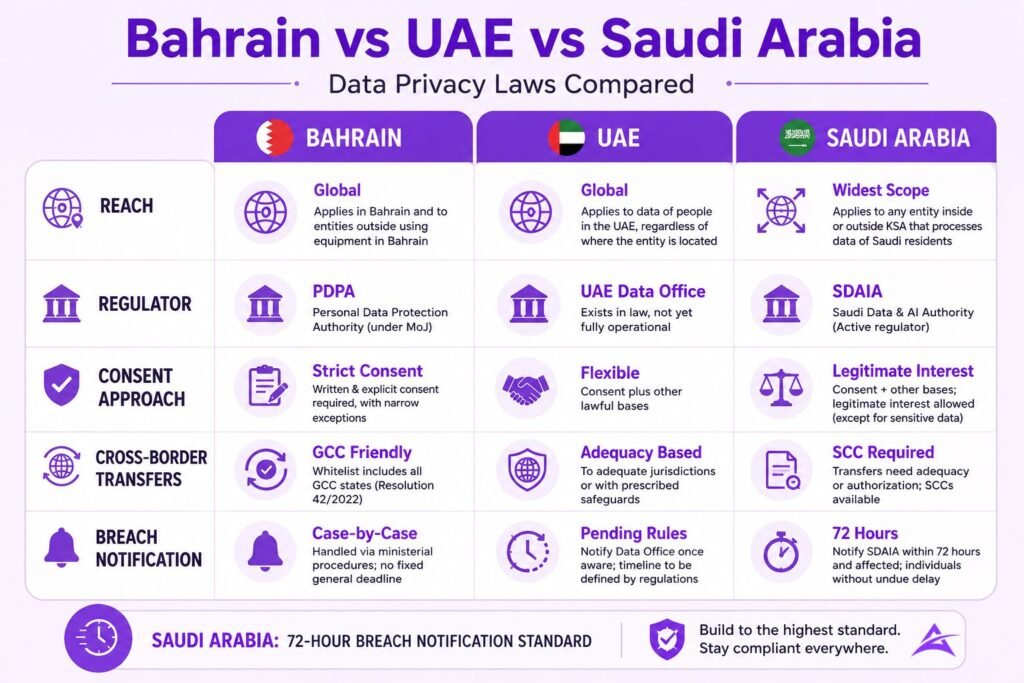
All three statutes reach beyond their own borders. Bahrain’s PDPL applies to anyone residing or doing business in Bahrain, and to entities outside the country that process personal data using equipment located inside it. The UAE law applies to the processing of data belonging to people in the UAE, regardless of where the controller or processor is based. Saudi Arabia goes furthest, applying to any entity inside or outside the Kingdom that processes the personal data of Saudi residents — a scope that pulls in international businesses that may never have considered themselves subject to Gulf regulation.

The big structural difference is the UAE’s free zones. The federal PDPL does not apply inside zones that maintain their own data protection regimes, most notably the Dubai International Finance Centre (DIFC) and the Abu Dhabi Global Market (ADGM), each of which runs its own established framework. A company in the DIFC answers to DIFC rules, not the federal law. That carve-out has no equivalent in Bahrain or Saudi Arabia, and it matters enormously for regional structuring decisions.

Ready for GCC data privacy compliance?

Talk to our experts and simplify Bahrain, UAE, and Saudi data privacy compliance.

The Regulators

Each country has its own supervisory authority, and they are at very different stages of maturity. Bahrain’s Personal Data Protection Authority (PDPA) operates under the Ministry of Justice, Islamic Affairs and Waqf and has full investigation, audit, and penalty powers. SDAIA — the Saudi Data and Artificial Intelligence Authority — is the current regulator in Saudi Arabia, with long-term supervision potentially moving to the National Data Management Office under the Kingdom’s wider data governance framework. SDAIA is visibly active: its enforcement committees issued 48 decisions confirming PDPL violations across the 2025 and 2026 review cycles, a level of regulatory output that should get the attention of any compliance team operating in the region.

The UAE is the outlier. The UAE Data Office exists in law but is not yet fully operational, and the Telecommunications and Digital Government Regulatory Authority was tasked with providing administrative support during the office’s early years. In practice this means data subjects in the UAE currently lack a clear federal route to lodge a complaint, and enforcement guidance is still maturing. That ambiguity cuts both ways: it reduces immediate enforcement risk, but it also makes it harder to know exactly what compliance looks like.
PDPL Bahrain UAE Saudi Arabia

Lawful Basis, Consent, and Core Principles

Consent sits at the center of all three regimes, but Bahrain leans on it hardest. Bahrain’s PDPL sets a default rule that personal data may not be processed without the data subject’s written and explicit consent, with a narrow set of alternative bases such as contract performance, legal obligation, and vital interests. Saudi Arabia and the UAE both recognize consent alongside other grounds, and Saudi Arabia’s amended law added legitimate interest as a basis — though it cannot be used for sensitive data and controllers are warned against treating consent as a convenient fallback when a more specific ground applies.

Beneath the lawful-basis question, the three laws share the principles that anyone familiar with the same GDPR-shaped foundation will recognize: lawfulness, fairness and transparency, purpose limitation, data minimization, accuracy, storage limitation, and security. The vocabulary and structure track the European model closely, and deliberately so. That means a mature GDPR program is a strong starting point, not a finished one — the architecture transfers, but the local rules introduce enough variation to demand dedicated attention.


Data Subject Rights

The rights packages are broadly similar across the three jurisdictions, but the enforcement emphasis differs. Individuals in all three countries can access their data, request correction, and object to certain processing. Saudi Arabia’s PDPL spells out the most comprehensive set — including access, correction, deletion, objection, and portability — and SDAIA has flagged failure to honor these requests as one of its most common enforcement findings, which means it is not a theoretical obligation. Bahrain grants access, correction, and a specific right to object to direct marketing such as behavioral targeting and SMS or email advertising. The UAE law likewise provides for access, correction, erasure, restriction, portability, and objection, though the procedural mechanics depend in part on the awaited executive regulations.

For organizations receiving high volumes of data subject requests across all three markets, the practical challenge is building workflows that satisfy each regime’s specific framing — not just a single generic process dressed up in three languages.


Registration, DPO, and Record-Keeping

This is where the day-to-day compliance burden diverges most visibly. Bahrain requires controllers to submit prior notifications or authorization requests to the PDPA for certain processing activities, and it maintains a register of accredited data protection officers — referred to in the law as Data Protection Guardians. Saudi Arabia requires controllers to register on the National Data Governance Platform, maintain records of processing activities, and appoint a DPO where they carry out large-scale or sensitive processing, per SDAIA’s dedicated rules on the role. The UAE requires the appointment of a DPO in defined circumstances and the keeping of processing records, with detail again deferred to the pending regulations.

Insider note: Bahrain quietly solved a problem the other two have not. Its adequacy list under Resolution 42/2022 includes all other GCC states, so transfers from Bahrain to Saudi Arabia, the UAE, Qatar, Kuwait, and Oman proceed without prior PDPA authorization. For a regional operation, routing certain intra-Gulf data flows through a Bahrain entity can remove an approval step that Saudi Arabia’s regime would otherwise require.


Cross-Border Transfers

Transfer rules are where the three laws feel least alike in practice. Bahrain prohibits transfers outside the Kingdom without the data subject’s specific consent unless the destination appears on a ministerial whitelist or a special authorization is issued — and as noted above, the whitelist already covers the rest of the GCC. Saudi Arabia restricts transfers under Article 29, permitting them only to countries SDAIA deems adequate or under explicit authorization; SDAIA issued standard contractual clauses and dedicated transfer regulations in September 2024 to provide compliant mechanisms for transfers that cannot rely on adequacy. The UAE law also restricts transfers to jurisdictions with adequate protection or under prescribed safeguards, with the specifics once more tied to the pending regulations.

The practical implication is that a single transfer mechanism — whether that is an SCC, a whitelist reliance, or a consent capture — will not work uniformly across all three. Each transfer route needs to be mapped and validated against the rules of the specific originating jurisdiction.


Breach Notification

This is the single clearest divergence across the three regimes, and the one most likely to trip up a unified incident response policy. Saudi Arabia imposes a hard deadline: controllers must notify SDAIA within 72 hours of becoming aware of a breach that poses a risk to data or data subjects, and must inform affected individuals without undue delay where the risk is serious. The UAE PDPL requires notification to the Data Office once a controller becomes aware of a breach, but a precise statutory timeline awaits the executive regulations, leaving the practical standard somewhat open. Bahrain does not set a single fixed general deadline equivalent to Saudi Arabia’s 72-hour rule, handling notification instead through its ministerial procedures — though failure to notify where required carries its own penalty.

Pro tip: Build your Incident Response

Build your incident response plan to the Saudi standard and apply it everywhere. A documented 72-hour clock with predefined breach-classification criteria and clear internal ownership satisfies the strictest regime in the region, and it gives you a defensible process in the UAE and Bahrain even while their procedural detail keeps shifting.

Penalties

The financial exposure differs by an order of magnitude across the three. Bahrain’s penalties top out at BHD 20,000 for serious violations such as processing without a lawful basis or unauthorized cross-border transfers, with failure to notify a breach drawing fines up to BHD 10,000, and imprisonment available for certain offenses. Saudi Arabia carries the heaviest sanctions: general violations attract fines up to SAR 5 million, doubled for repeat offenses, while disclosing or publishing sensitive personal data with intent to harm can bring imprisonment of up to two years and a fine of up to SAR 3 million. The UAE’s penalty structure is set to be defined in the executive regulations, and commentary widely anticipates administrative fines in the range of AED 50,000 to AED 5 million.

The gap between Bahrain’s ceiling and Saudi Arabia’s is not marginal — it reflects a deliberate regulatory choice to make non-compliance genuinely expensive. For large organizations, the reputational and operational consequences of an enforcement action in any of the three markets are likely to exceed the fines themselves, but the Saudi penalty structure removes any temptation to treat compliance as a low-stakes calculation.

Comparison of Major Provisions

Provision

Bahrain

UAE

Saudi Arabia

Legislation

PDPL, Law No. 30 of 2018

Federal Decree-Law No. 45 of 2021

PDPL, Royal Decree M/19 (2021, amended 2023)

In force

August 1, 2019

January 2, 2022

September 14, 2023

Regulator

Personal Data Protection Authority (PDPA)

UAE Data Office (not yet fully operational)

SDAIA

Default lawful basis

Explicit written consent

Consent plus alternatives

Consent plus alternatives including legitimate interest (non-sensitive)

Breach notification deadline

No single fixed deadline; ministerial procedures apply

Prompt notification; precise timeline pending regulations

72 hours to SDAIA; individuals notified without undue delay

Cross-border transfers

Whitelist (covers GCC) or consent or authorization

Adequacy or safeguards; detail pending regulations

SDAIA adequacy or SCCs or authorization

DPO requirement

Accredited Data Protection Guardian; mandatory for licensed financial institutions

Required in defined circumstances; detail pending regulations

Required for large-scale or sensitive processing

Maximum fine

BHD 20,000

Anticipated AED 50,000–5 million (pending regulations)

SAR 5 million (doubled for repeat offenses)

Free-zone carve-out

None

Yes — DIFC and ADGM operate separate regimes

None

Post-mortem data protection

No equivalent provision

No equivalent provision

Yes — rights extend beyond the data subject’s death

Building One Program Across Three Jurisdictions

The temptation is to pick the strictest law, comply with it, and assume the rest follow. That instinct is broadly right but incomplete. Saudi Arabia is the high-water mark on enforcement, breach timing, and penalties, so building to its 72-hour notification rule, registration requirements, and DPO expectations covers a great deal of ground. What it does not cover is the structural quirks: Bahrain’s consent-first default and whitelist transfer mechanism, and the UAE’s free-zone carve-out that may put part of your operation under DIFC or ADGM rules entirely.

A workable approach starts with a multi-jurisdictional gap assessment that maps where personal data actually flows between the three countries and out of the region. From there, a unified framework should adopt the strictest common requirement as the baseline, then layer country-specific controls on top: a Bahrain whitelist check before intra-GCC routing, a DIFC or ADGM determination for any UAE entity, and SDAIA registration and SCC mechanics for Saudi transfers. Vendor contracts need processor clauses that satisfy all three, and staff handling data in any of the markets need training that reflects local rules rather than a single generic module. The frameworks rhyme, but the details bite.

Underpinning all of this is a documentation and accountability structure that can demonstrate compliance to three different regulators with three different priorities. ISO 27001 certification provides a strong technical and organizational security baseline that is recognized across the region and maps naturally onto the security obligations in all three laws — it will not substitute for legal compliance, but it gives regulators and counterparties something concrete to point to, and it structures the internal controls that make compliance sustainable rather than reactive.

Ready for GCC data privacy compliance?

Talk to our experts and simplify Bahrain, UAE, and Saudi data privacy compliance.

The Bottom Line

Bahrain, the UAE, and Saudi Arabia have each built data protection laws on the same GDPR-shaped foundation, which makes a single coherent program achievable. The risk lies in the gaps between them: Saudi Arabia enforcing hard today, the UAE still waiting on the regulations that will define its edges, and Bahrain running its own consent and transfer logic. Treat the strictest regime as your floor, then account for the structural differences each country adds, and you have a defensible position across all three. Treat them as one law, and you will be compliant with none of them.

Frequently Asked Questions

Which is stricter: Bahrain, UAE, or Saudi Arabia's data protection law?

Saudi Arabia’s PDPL is the strictest in practice. It is fully enforced, carries the highest penalties, imposes a firm 72-hour breach notification deadline, and is backed by an active regulator that has already issued dozens of enforcement decisions. Bahrain has a mature and functioning regime, while the UAE is still developing the executive regulations that will complete its framework.

Yes. All three have extraterritorial reach. A company anywhere in the world that processes the personal data of people in Saudi Arabia, the UAE, or Bahrain can fall within scope, particularly if it offers goods or services to, or monitors the behavior of, individuals in those countries. The extraterritorial logic mirrors the GDPR’s Article 3 approach and should be taken seriously by any organization with Gulf-based customers or users.

No, but it is central, and Bahrain in particular treats explicit written consent as the default. All three laws recognize alternative bases such as contract performance, legal obligation, and vital interests, and Saudi Arabia’s amended law also allows legitimate interest for non-sensitive data. Controllers should identify the most appropriate lawful basis for each processing activity rather than defaulting to consent across the board.

They share the GDPR’s core architecture: lawful bases, data subject rights, breach notification, accountability, and transfer restrictions. The main differences are substantially lower maximum fines in Bahrain, the use of regulator-issued adequacy decisions and authorization mechanisms for transfers rather than the EU’s adequacy framework, and varying degrees of enforcement maturity across the three regulators.

Not universally. Saudi Arabia and the UAE require a DPO in defined circumstances, typically large-scale or sensitive processing. Bahrain maintains a register of accredited Data Protection Guardians, and recent financial-sector directives have made appointment mandatory for licensed institutions. Organizations operating across all three markets should assess the DPO requirement independently in each jurisdiction rather than applying a single determination.

Not automatically, but Bahrain makes it easier than the others. Bahrain’s adequacy list covers the other GCC states, so transfers from Bahrain into the region avoid prior authorization. Transfers out of Saudi Arabia still require SDAIA adequacy determination, SCCs, or specific authorization. UAE transfers depend on safeguards detailed in its pending regulations. For now, Bahrain’s whitelist mechanism is the most streamlined intra-GCC transfer route available.


Axipro Author

Picture of Pedro Dias

Pedro Dias

Pedro has been writing online for over 10 years. With experience in all things programming, cyber security, and compliance, he is our editor-in-chief at Axipro.

Blog Highlights

Explore More Articles

Three Gulf states now run three different data protection regimes. Saudi Arabia’s regulator has already issued dozens of enforcement decisions. Bahrain has had a working statute since 2019, and the UAE has a federal law on the books but is still waiting on the executive regulations that will give it teeth. For any company operating across the region, the practical question is no longer whether these laws apply but how far apart they sit, and where compliance built for one falls short of another. This is a structured comparison of the personal data protection laws in Bahrain, UAE, and Saudi Arabia: what each one demands, where they converge on familiar GDPR principles, and the specific points where treating them as interchangeable will get you fined. The Three Laws at a Glance Bahrain moved first. Law No. 30 of 2018, the Personal Data Protection Law (PDPL), came into force on August 1, 2019, making it the first comprehensive standalone data protection statute in the Gulf Cooperation Council. It is supplemented by ten ministerial resolutions issued in 2022 that cover transfers, security measures, and notification procedures. The UAE followed with Federal Decree-Law No. 45 of 2021, effective January 2, 2022 — the country’s first federally applicable, GDPR-style law, issued alongside Federal Decree-Law No. 44 of 2021, which created the UAE Data Office as the federal regulator. The catch is that the executive regulations meant to flesh out timelines and penalties have still not been published, which leaves parts of the regime in a holding pattern. Saudi Arabia’s Personal Data Protection Law, issued by Royal Decree M/19 in September 2021 and amended in March 2023, is the strictest and the most actively enforced of the three. It came into force on September 14, 2023, and a one-year grace period ended on September 14, 2024. Since then, every organization processing the personal data of people in the Kingdom has been fully on the hook. Worth knowing: Saudi Arabia’s PDPL Saudi Arabia’s PDPL protects a person’s data not only during their lifetime but after death. That post-mortem protection is unusual among global privacy laws and means retention and disclosure decisions cannot assume an individual’s rights simply lapse when they die. Who the Laws Actually Reach All three statutes reach beyond their own borders. Bahrain’s PDPL applies to anyone residing or doing business in Bahrain, and to entities outside the country that process personal data using equipment located inside it. The UAE law applies to the processing of data belonging to people in the UAE, regardless of where the controller or processor is based. Saudi Arabia goes furthest, applying to any entity inside or outside the Kingdom that processes the personal data of Saudi residents — a scope that pulls in international businesses that may never have considered themselves subject to Gulf regulation. The big structural difference is the UAE’s free zones. The federal PDPL does not apply inside zones that maintain their own data protection regimes, most notably the Dubai International Finance Centre (DIFC) and the Abu Dhabi Global Market (ADGM), each of which runs its own established framework. A company in the DIFC answers to DIFC rules, not the federal law. That carve-out has no equivalent in Bahrain or Saudi Arabia, and it matters enormously for regional structuring decisions. Ready for GCC data privacy compliance? Talk to our experts and simplify Bahrain, UAE, and Saudi data privacy compliance. Schedule The Regulators Each country has its own supervisory authority, and they are at very different stages of maturity. Bahrain’s Personal Data Protection Authority (PDPA) operates under the Ministry of Justice, Islamic Affairs and Waqf and has full investigation, audit, and penalty powers. SDAIA — the Saudi Data and Artificial Intelligence Authority — is the current regulator in Saudi Arabia, with long-term supervision potentially moving to the National Data Management Office under the Kingdom’s wider data governance framework. SDAIA is visibly active: its enforcement committees issued 48 decisions confirming PDPL violations across the 2025 and 2026 review cycles, a level of regulatory output that should get the attention of any compliance team operating in the region. The UAE is the outlier. The UAE Data Office exists in law but is not yet fully operational, and the Telecommunications and Digital Government Regulatory Authority was tasked with providing administrative support during the office’s early years. In practice this means data subjects in the UAE currently lack a clear federal route to lodge a complaint, and enforcement guidance is still maturing. That ambiguity cuts both ways: it reduces immediate enforcement risk, but it also makes it harder to know exactly what compliance looks like. Lawful Basis, Consent, and Core Principles Consent sits at the center of all three regimes, but Bahrain leans on it hardest. Bahrain’s PDPL sets a default rule that personal data may not be processed without the data subject’s written and explicit consent, with a narrow set of alternative bases such as contract performance, legal obligation, and vital interests. Saudi Arabia and the UAE both recognize consent alongside other grounds, and Saudi Arabia’s amended law added legitimate interest as a basis — though it cannot be used for sensitive data and controllers are warned against treating consent as a convenient fallback when a more specific ground applies. Beneath the lawful-basis question, the three laws share the principles that anyone familiar with the same GDPR-shaped foundation will recognize: lawfulness, fairness and transparency, purpose limitation, data minimization, accuracy, storage limitation, and security. The vocabulary and structure track the European model closely, and deliberately so. That means a mature GDPR program is a strong starting point, not a finished one — the architecture transfers, but the local rules introduce enough variation to demand dedicated attention.   Data Subject Rights The rights packages are broadly similar across the three jurisdictions, but the enforcement emphasis differs. Individuals in all three countries can access their data, request correction, and object to certain processing. Saudi Arabia’s PDPL spells out the most comprehensive set — including access, correction, deletion, objection, and portability —

ISO 14001:2026 took effect on April 15, 2026, and it carries the first genuinely new clause the environmental standard has seen in over a decade. Any checklist built against the 2015 edition is now partly out of date. The structure auditors examine has shifted to the ISO Harmonized Structure, climate change is written into the requirements rather than bolted on through an amendment, and a new change management clause gives certification bodies a fresh place to record findings. This guide breaks down what an ISO 14001 certification audit checklist needs to cover now, clause by clause, and how to use it without turning your environmental management system into a paperwork exercise. What Is an ISO 14001 Audit Checklist? An ISO 14001 audit checklist is a structured set of questions and verification points an auditor works through to confirm an environmental management system (EMS) meets the requirements of the standard. It maps each clause to specific evidence: documents, records, interviews, and observed practice. The checklist is the auditor’s working tool, not the audit itself. A good checklist prompts the auditor to look for objective evidence rather than tick boxes, and it leaves room to record where the documented system and actual practice diverge. That gap — between what the procedure says and what people actually do — is where most findings come from. Stay Ahead of ISO 14001:2026 Changes Book an ISO 14001 Gap Assessment Schedule Why You Need an ISO 14001 Audit Checklist Without a checklist, audits drift. Auditors skip clauses, linger on the areas they find interesting, and produce findings that are hard to compare year over year. A checklist enforces coverage and consistency, which matters most when more than one auditor works the program or when you want surveillance results that trend cleanly against the baseline. It also protects you before the certification body arrives. A disciplined internal audit run against a checklist that mirrors the external audit surfaces the same nonconformities your registrar would — while you still have time to fix them. The checklist turns a once-a-year scramble into a repeatable process. Worth knowing: ISO 19011 ISO 19011 is the international guideline for auditing management systems, and it is not a standard you can certify against. You cannot become “ISO 19011 certified.” It exists to make your audit program competent and consistent — which is exactly what a third-party auditor checks when they review your internal audit records. Types of ISO 14001 Audits Not every audit serves the same purpose, and your checklist depth should match the audit type. The four you will encounter are internal, second-party, third-party certification, and the surveillance and recertification audits that follow. Internal Audit Sometimes called a first-party audit, this is conducted by or on behalf of the organization itself. It is a requirement of Clause 9.2, and it is the single most important audit you run, because it is the one you control. Internal audits should be planned across a program, cover the full EMS over the cycle, and use auditors who are competent and independent of the work they assess. Second-Party Audit A second-party audit is one organization auditing another it has a relationship with — most often a customer auditing a supplier or a company auditing its contractors. Under the 2026 revision, with its sharper focus on externally provided processes, products, and services, expect more of these as larger buyers push environmental criteria down their supply chains. Third-Party Certification Audit This is the audit that earns the certificate. An accredited certification body assesses your EMS against ISO 14001 in two stages. Stage 1 is a readiness review that checks whether the system exists, is documented, and is ready to be assessed. Stage 2 verifies that the EMS is fully implemented, effective, and producing the results it claims. Certification follows only once any major nonconformities are closed. Surveillance and Recertification Audits ISO management system certificates run on a three-year cycle governed by ISO/IEC 17021-1. After initial certification, the body conducts annual surveillance audits in years two and three to confirm the system is still operating, then a recertification audit before the certificate expires. Surveillance audits are narrower than the full assessment, but they are not a formality — and many organizations will fold their move to ISO 14001:2026 into a surveillance or recertification visit to keep cost and disruption down. ISO 14001 Audit Checklist: Clause-by-Clause Breakdown ISO 14001:2026 follows the ISO Harmonized Structure, the common framework shared with ISO 9001, ISO 45001, and ISO/IEC 27001. The familiar Plan-Do-Check-Act cycle still runs underneath it. Clauses 1 through 3 cover scope, references, and terms. The auditable requirements live in Clauses 4 through 10, and that is where your checklist does its work. Clause 4: Context of the Organization Verify that internal and external issues, interested parties, and the EMS scope are identified and documented. This is where the 2026 revision lands hardest. Context analysis must now explicitly weigh environmental conditions — including climate change, biodiversity, pollution levels, and the availability of natural resources. A context review that mentions only commercial and regulatory factors will draw a finding. Clause 5: Leadership and Commitment Check for evidence that top management is involved in substance, not ceremony. The environmental policy must be documented, communicated, and appropriate to the organization. Auditors look for real engagement: leaders who can speak to the policy, the objectives, and how environmental performance feeds into business decisions. The 2026 wording tightens leadership accountability, so a policy signed once and forgotten will not hold up. Clause 6: Planning and Risk Assessment This clause covers environmental aspects and impacts, compliance obligations, risks and opportunities, and objectives. It generates more nonconformities than almost any other. The life cycle perspective in Clause 6.1.2 is strengthened, with clearer expectations on upstream and downstream impacts. The headline change is Clause 6.3, Planning of Changes — the only entirely new clause in the revision. It requires a structured, planned approach to changes that affect the EMS, such as new products, site relocations, supplier changes, or process

A 3PAO is the independent firm that decides whether a cloud service is secure enough to handle federal data. The acronym stands for Third-Party Assessment Organization, and these accredited auditors sit at the center of the FedRAMP process. A federal agency will not grant an Authority to Operate (ATO) at the Moderate or High impact level without a 3PAO assessment behind it. That makes the 3PAO one of the most consequential vendors a cloud service provider (CSP) will hire on the road to the federal market. This guide explains what a 3PAO is, what it actually does, how a firm earns the accreditation, and when you should bring one in. It also covers how the role is changing under FedRAMP’s 2025 overhaul, because the job looks different now than it did even a year ago. What Does 3PAO Stand For? 3PAO stands for Third-Party Assessment Organization. The “third party” part is the whole point. The assessor is independent of both the cloud provider being evaluated and the government agency relying on the results. That independence is what gives a 3PAO report its weight. An agency can trust the findings precisely because the assessor has no stake in the outcome. What Is a 3PAO? A 3PAO is an independent firm accredited to evaluate the security of cloud services seeking authorization under FedRAMP, the Federal Risk and Authorization Management Program. The FedRAMP Program Management Office (PMO) recognizes these firms only after they pass a demanding accreditation process. Once recognized, a 3PAO is listed publicly on the FedRAMP Marketplace under the Assessors tab, where CSPs and agencies can find them. 3PAOs are not limited to federal work. The same firms are commonly authorized to perform GovRAMP assessments, the program formerly known as StateRAMP, for state and local government cloud procurement. The skill set transfers directly, since both programs lean on the same NIST control foundations. What Does a 3PAO Do? A 3PAO independently tests whether a cloud service offering (CSO) does what its documentation claims. The longer version breaks into four distinct areas: 1- Independent Security Assessments The core deliverable is a security assessment. The 3PAO evaluates a CSP’s controls against the relevant FedRAMP baseline, which maps to NIST SP 800-53. It builds a Security Assessment Plan (SAP), executes the testing, and documents the findings in a Security Assessment Report (SAR). The SAR is the artifact an agency’s Authorizing Official reads when deciding whether to grant an ATO. 2- Documentation Review and Validation Before any testing happens, the 3PAO reviews the System Security Plan (SSP), the primary document describing how each control is implemented. SSPs routinely run to hundreds of pages, and a vague or incomplete one will stall the schedule fast. The assessor checks that what the SSP claims matches what the system actually does, then tracks unresolved issues in a Plan of Action and Milestones (POA&M). 3- Penetration Testing FedRAMP assessments include mandatory penetration testing, and the 3PAO performs it. The assessor probes the system the way an attacker would, looking for exploitable weaknesses that control documentation alone would never surface. A clean SSP means little if a tester can walk straight through the front door. 4- Ongoing Continuous Monitoring Support Authorization is not a one-time event. CSPs must sustain compliance through continuous monitoring (ConMon), which includes regular scanning, vulnerability remediation, and periodic reassessment. 3PAOs often support annual assessments and significant-change reviews. One structural note worth tracking: as of March 2025, FedRAMP stopped running centralized continuous monitoring, and that responsibility now sits with each sponsoring agency. Worth knowing: 3PAO Reports FedRAMP states that 3PAO reports “serve as the basis from which the federal government makes informed, risk-based authorization decisions.” The assessment is not a formality. It is the evidence the entire authorization rests on. How Does an Organization Become an Accredited 3PAO? Becoming a 3PAO is nearly as demanding as the assessments these firms perform. There is one accreditation body, and the bar is high. A2LA Accreditation Requirements The American Association for Laboratory Accreditation (A2LA) is the sole body that accredits FedRAMP 3PAOs. Its FedRAMP 3PAO accreditation program puts applicants through a rigorous evaluation of technical competence. A firm must spend at least a year in A2LA’s Cybersecurity Inspection Body Program before it can even be considered for FedRAMP recognition, and it must pass technical proficiency testing administered through A2LA’s testing partner. ISO/IEC 17020 Compliance Accreditation hinges on conformance with ISO/IEC 17020, the international standard for bodies that perform inspections. The standard sets requirements for impartiality, independence, technical competence, and a functioning quality management system. In practice, this is what stops a 3PAO from cutting corners or playing favorites. The accreditation certifies the firm’s process, not just the talent of its people. FedRAMP-Specific Requirements Beyond ISO/IEC 17020, FedRAMP layers on its own recognition requirements covering program-specific knowledge and assessment methodology. A firm has to demonstrate it understands FedRAMP’s baselines, templates, and reporting expectations — not just general inspection practice. Only after clearing both bars does the firm appear on the Marketplace as a recognized 3PAO. Why Are 3PAOs Important for FedRAMP? FedRAMP runs on a “do once, use many” philosophy. One rigorous, independent assessment lets multiple federal agencies reuse the same authorization package instead of each running its own review. The 3PAO is what makes that trust transferable. Because the assessor is accredited and independent, an agency in one department can rely on a SAR produced for another. The program exists because federal systems must meet security obligations set under FISMA, the Federal Information Security Modernization Act, and the General Services Administration (GSA) runs FedRAMP to standardize how cloud services meet them. Without accredited assessors, every agency would judge cloud security on its own terms — which is exactly the fragmentation FedRAMP was built to end. Worth knowing: The FedRAMP Authorization The FedRAMP authorization landscape changed significantly in 2024 and 2025. The Joint Authorization Board (JAB) and its provisional ATO path were dissolved under OMB Memorandum M-24-15, leaving a single “FedRAMP Authorized” designation. Authorizations now flow through agency authorization or