

A 3PAO is the independent firm that decides whether a cloud service is secure enough to handle federal data. The acronym stands for Third-Party Assessment Organization, and these accredited auditors sit at the center of the FedRAMP process. A federal agency will not grant an Authority to Operate (ATO) at the Moderate or High impact level without a 3PAO assessment behind it.
That makes the 3PAO one of the most consequential vendors a cloud service provider (CSP) will hire on the road to the federal market. This guide explains what a 3PAO is, what it actually does, how a firm earns the accreditation, and when you should bring one in. It also covers how the role is changing under FedRAMP’s 2025 overhaul, because the job looks different now than it did even a year ago.
What Does 3PAO Stand For?
3PAO stands for Third-Party Assessment Organization. The “third party” part is the whole point. The assessor is independent of both the cloud provider being evaluated and the government agency relying on the results. That independence is what gives a 3PAO report its weight. An agency can trust the findings precisely because the assessor has no stake in the outcome.
What Is a 3PAO?
A 3PAO is an independent firm accredited to evaluate the security of cloud services seeking authorization under FedRAMP, the Federal Risk and Authorization Management Program. The FedRAMP Program Management Office (PMO) recognizes these firms only after they pass a demanding accreditation process. Once recognized, a 3PAO is listed publicly on the FedRAMP Marketplace under the Assessors tab, where CSPs and agencies can find them.
3PAOs are not limited to federal work. The same firms are commonly authorized to perform GovRAMP assessments, the program formerly known as StateRAMP, for state and local government cloud procurement. The skill set transfers directly, since both programs lean on the same NIST control foundations.
What Does a 3PAO Do?
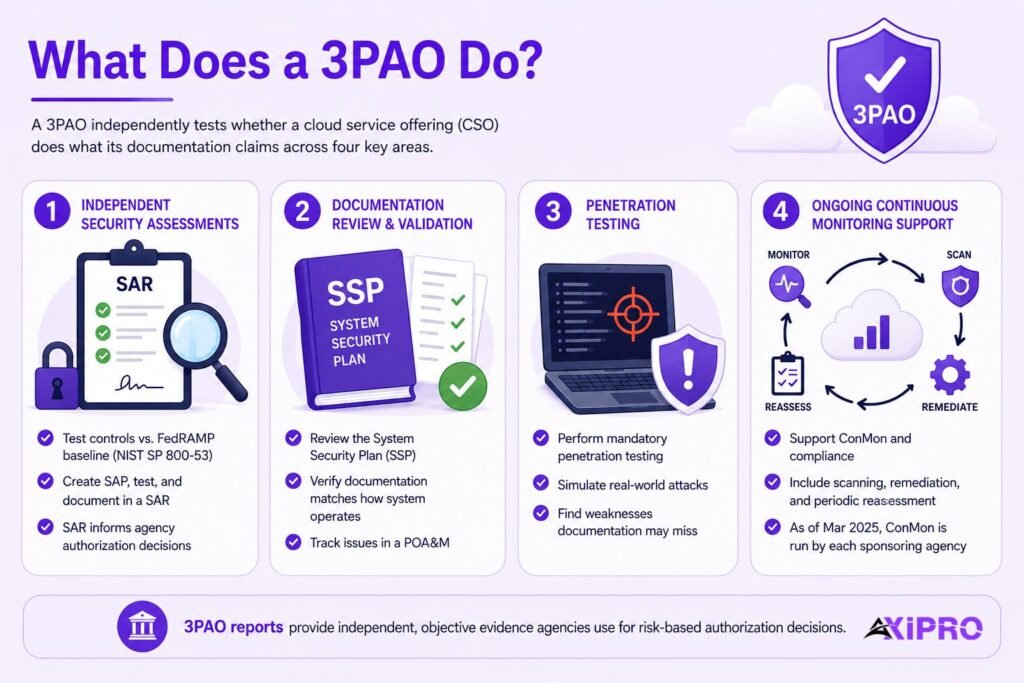
A 3PAO independently tests whether a cloud service offering (CSO) does what its documentation claims. The longer version breaks into four distinct areas:
1- Independent Security Assessments
The core deliverable is a security assessment. The 3PAO evaluates a CSP’s controls against the relevant FedRAMP baseline, which maps to NIST SP 800-53. It builds a Security Assessment Plan (SAP), executes the testing, and documents the findings in a Security Assessment Report (SAR). The SAR is the artifact an agency’s Authorizing Official reads when deciding whether to grant an ATO.
2- Documentation Review and Validation
Before any testing happens, the 3PAO reviews the System Security Plan (SSP), the primary document describing how each control is implemented. SSPs routinely run to hundreds of pages, and a vague or incomplete one will stall the schedule fast. The assessor checks that what the SSP claims matches what the system actually does, then tracks unresolved issues in a Plan of Action and Milestones (POA&M).
3- Penetration Testing
FedRAMP assessments include mandatory penetration testing, and the 3PAO performs it. The assessor probes the system the way an attacker would, looking for exploitable weaknesses that control documentation alone would never surface. A clean SSP means little if a tester can walk straight through the front door.
4- Ongoing Continuous Monitoring Support
Authorization is not a one-time event. CSPs must sustain compliance through continuous monitoring (ConMon), which includes regular scanning, vulnerability remediation, and periodic reassessment. 3PAOs often support annual assessments and significant-change reviews. One structural note worth tracking: as of March 2025, FedRAMP stopped running centralized continuous monitoring, and that responsibility now sits with each sponsoring agency.
Worth knowing: 3PAO Reports
FedRAMP states that 3PAO reports "serve as the basis from which the federal government makes informed, risk-based authorization decisions." The assessment is not a formality. It is the evidence the entire authorization rests on.
How Does an Organization Become an Accredited 3PAO?
Becoming a 3PAO is nearly as demanding as the assessments these firms perform. There is one accreditation body, and the bar is high.
A2LA Accreditation Requirements
The American Association for Laboratory Accreditation (A2LA) is the sole body that accredits FedRAMP 3PAOs. Its FedRAMP 3PAO accreditation program puts applicants through a rigorous evaluation of technical competence. A firm must spend at least a year in A2LA’s Cybersecurity Inspection Body Program before it can even be considered for FedRAMP recognition, and it must pass technical proficiency testing administered through A2LA’s testing partner.
ISO/IEC 17020 Compliance
Accreditation hinges on conformance with ISO/IEC 17020, the international standard for bodies that perform inspections. The standard sets requirements for impartiality, independence, technical competence, and a functioning quality management system. In practice, this is what stops a 3PAO from cutting corners or playing favorites. The accreditation certifies the firm’s process, not just the talent of its people.
FedRAMP-Specific Requirements
Beyond ISO/IEC 17020, FedRAMP layers on its own recognition requirements covering program-specific knowledge and assessment methodology. A firm has to demonstrate it understands FedRAMP’s baselines, templates, and reporting expectations — not just general inspection practice. Only after clearing both bars does the firm appear on the Marketplace as a recognized 3PAO.
Why Are 3PAOs Important for FedRAMP?
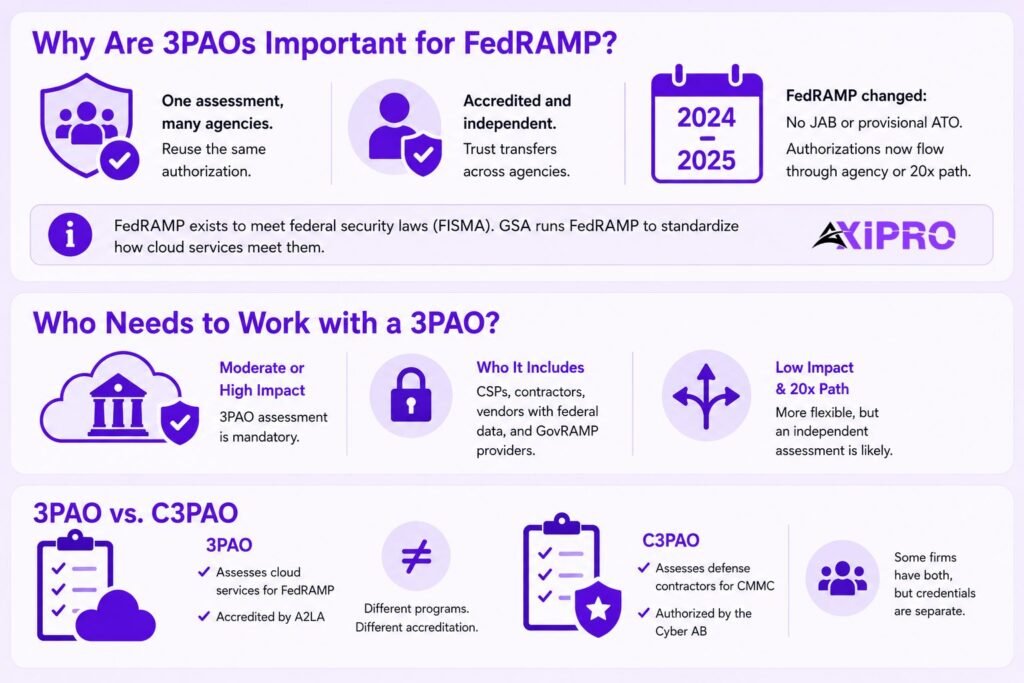
FedRAMP runs on a “do once, use many” philosophy. One rigorous, independent assessment lets multiple federal agencies reuse the same authorization package instead of each running its own review. The 3PAO is what makes that trust transferable. Because the assessor is accredited and independent, an agency in one department can rely on a SAR produced for another.
The program exists because federal systems must meet security obligations set under FISMA, the Federal Information Security Modernization Act, and the General Services Administration (GSA) runs FedRAMP to standardize how cloud services meet them. Without accredited assessors, every agency would judge cloud security on its own terms — which is exactly the fragmentation FedRAMP was built to end.
Worth knowing: The FedRAMP Authorization
The FedRAMP authorization landscape changed significantly in 2024 and 2025. The Joint Authorization Board (JAB) and its provisional ATO path were dissolved under OMB Memorandum M-24-15, leaving a single "FedRAMP Authorized" designation. Authorizations now flow through agency authorization or the new 20x path, but the 3PAO's role as independent assessor carried straight through the transition.
Who Needs to Work with a 3PAO?
Any CSP that wants to sell a cloud service to the federal government at the Moderate or High impact level needs a 3PAO. At those levels, the assessment is mandatory, and an authorization package cannot be accepted without it. Providers handling federal data, contractors building CSOs for agency use, and vendors pursuing GovRAMP all fall into the same category.
At the Low impact level, the picture is more flexible, and the emerging 20x pathway is reshaping expectations there. Still, the safe assumption for most providers chasing meaningful federal business is that an independent assessment will be required at some point. The question is usually when, not whether.
One common point of confusion: a 3PAO is not a C3PAO. The names differ by a single letter, but they serve different programs. A 3PAO assesses cloud services for FedRAMP authorization and is accredited by A2LA. A Certified Third-Party Assessor Organization (C3PAO) assesses defense contractors for CMMC, the Cybersecurity Maturity Model Certification, and is authorized by the Cyber AB rather than A2LA. A handful of firms hold both, but the credentials are entirely separate.
How to Find an Accredited 3PAO
Start with the FedRAMP Marketplace. Its Assessors tab is the authoritative, public list of recognized 3PAOs, and any firm not on it is not a valid FedRAMP assessor — full stop. From there, the real work is vetting fit rather than legitimacy.
Pro tip: Do not choose on price or brand alone.
Do not choose on price or brand alone. Ask for verified experience at your target impact level, the names and credentials of the assessors who will actually do the work, and redacted samples that show SAR quality. A cheap assessment that an agency rejects is the most expensive option there is.
When Should You Engage a 3PAO?
Timing matters. Engage a 3PAO after your system and security program have matured, not before. Bringing in an assessor while controls are half-built guarantees findings, delays, and rework you will pay for twice. Most providers take a readiness step first, often producing a Readiness Assessment Report (RAR), which FedRAMP strongly recommends for the agency authorization process and which surfaces gaps before the formal assessment begins.
Insider note: FedRAMP 20x is changing when and how you work with assessors. As the program shifts toward automated, machine-readable validation built on Key Security Indicators and OSCAL, the 3PAO’s job is moving from reviewing screenshots to verifying that automated checks actually enforce the controls they claim to. Assessors now validate and verify rather than certify, and the CSP carries responsibility for the accuracy of what it submits. Expect to involve a 3PAO earlier in your process, and expect the engagement to be far more technical than the old document-review model.
There is also a hard rule worth flagging on independence. A 3PAO can offer advisory or consulting services, but it cannot assess a system it helped build. If you use one 3PAO as an advisor, you must hire a different one to perform the assessment, or the impartiality that A2LA accreditation depends on collapses entirely.
The Bottom Line
A 3PAO is the independent, accredited firm that turns a cloud provider’s security claims into evidence an agency can act on. The role is mandatory at higher impact levels, the accreditation behind it is hard-won, and the way 3PAOs work is shifting fast under FedRAMP 20x. Choose carefully, engage at the right moment, and treat the assessment as what it is: the foundation your entire authorization stands on.
Frequently Asked Questions
Is a 3PAO the same as an auditor?
Functionally, yes — with a caveat. A 3PAO performs an independent assessment much like a financial auditor, but under FedRAMP 20x the framing has shifted. Assessors now validate and verify a provider’s security claims rather than certify them or recommend an ATO. The agency, not the assessor, makes the final authorization decision.
How much does a 3PAO assessment cost?
There is no fixed price, and the assessment is only one line item in a larger FedRAMP budget. The fee scales with impact level, system complexity, and scope. Serious engagements run well into six figures — industry estimates commonly place a full initial FedRAMP authorization in the low-to-mid six figures once preparation, the assessment itself, and remediation are included. Get fixed-scope quotes from more than one recognized 3PAO before committing.
Can a 3PAO also provide consulting services?
Yes, but not for the same system it assesses. FedRAMP allows 3PAOs to act as advisors, but impartiality rules mean a separate, independent 3PAO must perform the actual assessment of a service the first firm helped prepare. Mixing the two roles on one engagement is not permitted.
How long is a 3PAO accreditation valid?
Accreditation is not permanent. A2LA recognition runs on a recurring cycle with ongoing surveillance and periodic reassessment, and a 3PAO must keep demonstrating independence, quality, and current FedRAMP knowledge to hold its standing. Firms that let competence or impartiality slip can lose recognition.
Who governs and accredits 3PAOs?
The FedRAMP PMO, operated under the GSA, recognizes 3PAOs and sets program requirements. A2LA is the sole accreditation body and verifies conformance with ISO/IEC 17020 plus FedRAMP-specific criteria. Recognized firms appear on the FedRAMP Marketplace.