
ISO 27001 vs SOC 2 is a common comparison for organizations looking to strengthen data security and meet customer compliance expectations. While both standards focus on protecting sensitive information and building trust, they differ in scope, structure, and regional acceptance. ISO 27001 is an internationally recognized certification centered on building a risk-based Information Security Management System, while SOC 2 is a North America–focused attestation that evaluates specific security and operational controls. Understanding these differences is essential for choosing the right framework based on your customers, industry, and growth plans. In this blog, Axipro explains how ISO 27001 and SOC 2 compare, when you may need one or both, and how businesses can achieve compliance efficiently without slowing down growth.
Every organization that stores, processes, or handles customer data has a responsibility to protect that information. Today, customers, partners, and investors expect clear proof that your security controls are effective and independently validated.
Two of the most commonly requested security frameworks are ISO 27001 and SOC 2. While both focus on protecting information and building trust, they serve different purposes, markets, and business needs.
TL;DR
- ISO 27001 vs SOC 2 both focus on data security but serve different markets and business needs.
- ISO 27001 is an international certification built around a risk-based Information Security Management System.
- SOC 2 is a North America–focused attestation that evaluates specific security and operational controls.
- Many growing companies pursue both ISO 27001 and SOC 2 to meet global customer expectations
- With the right guidance, organizations can achieve ISO 27001 and SOC 2 faster and with less effort.
What ISO 27001 Means for Modern Businesses?
ISO 27001 is an international standard published by the International Organization for Standardization (ISO). It defines the requirements for establishing, implementing, maintaining, and continually improving an Information Security Management System (ISMS).
Rather than focusing only on technical controls, ISO 27001 takes a risk-based, management-driven approach to information security. Organizations are required to identify risks, assess their impact, and implement appropriate controls based on business context.
Key characteristics of ISO 27001 include:
• A formal ISMS covering people, processes, and technology
• Ongoing risk assessment and risk treatment
• Defined policies, procedures, and governance
• Continuous improvement through internal audits and management reviews
To achieve ISO 27001, organizations must pass a third-party certification audit, resulting in an internationally recognized certificate.
ISO 27001 is widely accepted across Europe, Asia, the Middle East, and global enterprise markets.
What Is SOC 2?
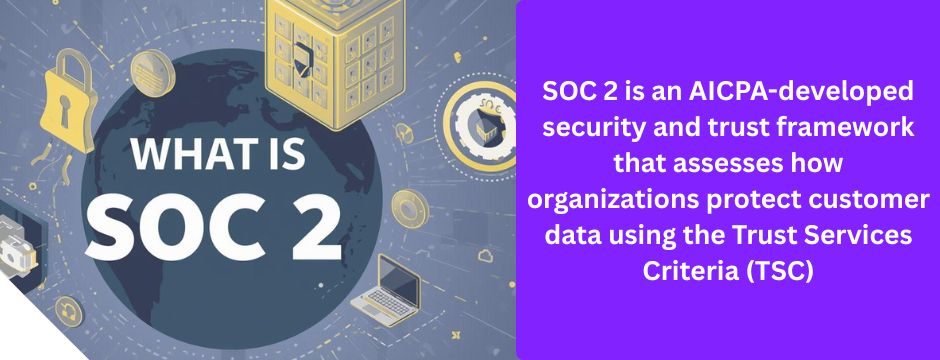
SOC 2 is a security and trust framework developed by the American Institute of Certified Public Accountants (AICPA). It is designed to evaluate how organizations protect customer data based on specific criteria known as the Trust Services Criteria (TSC).
SOC 2 focuses on operational controls related to:
• Security
• Availability
• Confidentiality
• Processing Integrity
• Privacy
All SOC 2 reports must include the Security criterion, while the remaining categories are included based on relevance to the organization’s services.
Unlike ISO 27001 certification, SOC 2 results in an attestation report, prepared by an independent auditor, that provides detailed insight into how controls are designed and operating.
SOC 2 is most commonly requested by:
• SaaS companies
• Technology vendors
• Cloud service providers
• Organizations selling into North America
Key Similarities Between ISO 27001 and SOC 2
Although they are different frameworks, ISO 27001 and SOC 2 share several foundational principles.
Shared Purpose
Both standards aim to:
• Protect sensitive and customer data
• Reduce information security risks
• Demonstrate trust and credibility to customers and stakeholders
They help organizations formalize security practices and show evidence of responsible data handling.
Overlapping Security Controls
Many core security practices overlap between the two frameworks, including:
• Risk management processes
• Access control and user management
• Incident response planning
• Employee security awareness training
• Physical and environmental security
Because both are based on widely accepted security best practices, implementing one often provides a strong foundation for the other.
Difference Between ISO 27001 and SOC 2
Despite their similarities, ISO 27001 and SOC 2 differ in several important ways.
Scope and Structure
ISO 27001 requires organizations to implement a comprehensive ISMS and select applicable controls from Annex A based on risk assessment results.
SOC 2, on the other hand, evaluates controls against the Trust Services Criteria and allows organizations to define scope more flexibly based on their services and systems.
Certification vs Report
• ISO 27001 results in a formal certification that confirms compliance with the standard
• SOC 2 results in a detailed auditor report that explains how controls are designed and operating
SOC 2 reports often provide more operational detail, while ISO 27001 certificates provide a high-level validation.
Geographic Recognition
• SOC 2 is the de facto standard in North America
• ISO 27001 is more widely recognized internationally
Customer expectations often depend on where your clients are located.
Audit Timeline
SO 27001 typically requires:
• ISMS design and implementation
• Internal audit and management review
• Stage 1 and Stage 2 certification audits
Traditional timelines can range from 6 to 12 months, depending on maturity.
SOC 2 timelines vary based on report type:
• Type 1 evaluates controls at a point in time
Type 2 evaluates control effectiveness over a period, typically 3 to 12 months
Which Is Right for You: ISO 27001 or SOC 2?
Choosing the right framework depends on your business model, customers, and growth plans.
Ask yourself:
• Where are your customers located?
• Which compliance standard do prospects most often request?
• Are you building a formal security management system or validating existing controls?
• Are you preparing for enterprise sales, partnerships, or global expansion?
For many growing SaaS and technology companies, the answer is not one or the other — but eventually both.
When and Why Businesses Choose Both ISO 27001 and SOC 2?
-
In practice, many organizations pursue both ISO 27001 and SOC 2 to avoid sales friction and future rework.
Having both standards allows you to:
• Sell confidently in both North American and global markets
• Meet diverse customer and enterprise procurement requirements
• Strengthen your overall security posture
• Reduce repetitive security questionnaires and due diligence
Because of the overlap between controls, implementing both together can be more efficient than pursuing them separately.
At Axipro, we help businesses navigate the certification journey, reduce risks, and strengthen trust with clients.
Can ISO 27001 and SOC 2 Be Achieved Together?
Yes. With the right approach, organizations can pursue ISO 27001 and SOC 2 in parallel.
A unified control framework, shared risk assessment, and aligned documentation can significantly reduce duplication of effort. This is where expert guidance and structured implementation make a major difference.
At Axipro, clients often pursue both frameworks together using a tailored roadmap aligned to their business size, risk profile, and timeline.
Is ISO 27001 Equivalent to SOC 2?
No. ISO 27001 and SOC 2 are not interchangeable.
Customers requesting ISO 27001 certification typically will not accept a SOC 2 report as a substitute, and vice versa. Each framework serves a distinct purpose and market expectation.
Are ISO 27001 or SOC 2 Mandatory?
Neither ISO 27001 nor SOC 2 is legally mandatory. However, they are often commercially required.
Many organizations will not onboard vendors or partners without seeing proof of compliance, making these standards essential for growth, not just security.
How Axipro Helps You Get ISO 27001 and SOC 2 Faster
3. Inadequate Risk Assessment
Achieving ISO 27001 and SOC 2 can feel complex, time-consuming, and overwhelming without the right support.
Axipro simplifies the process through:
• Tailored gap analysis and risk assessment
• End-to-end control implementation
• Policy and procedure creation
• Audit readiness and external auditor coordination
• Ongoing compliance support
Through Axipro’s Achievement Plan, many clients reach certification readiness in as little as six weeks, combining expert human guidance with leading compliance automation platforms like Drata, Vanta, Secureframe, and Sprinto.
Rather than replacing automation tools, Axipro helps organizations maximize their value and avoid common pitfalls that delay audits.
Final Thoughts
ISO 27001 and SOC 2 are both powerful trust signals that demonstrate your commitment to security and risk management. The right choice depends on your customers, geography, and growth goals — and for many organizations, understanding ISO 27001 vs SOC 2 can reveal that pursuing both is the most strategic path forward.
With the right partner, compliance does not have to slow your business down.
Simplifying compliance. Your success, our priority.
Mesh ID Achieves ISO 27001 with Axipro in Just 6 Weeks
They provide the best value for money for our ISO 27001 audit readiness. Seriously, if you don't go with Axipro...you made a bad decision.
Frequently Asked Questions (FAQ)
What is the main difference between ISO 27001 and SOC 2?
ISO 27001 is an international certification focused on building and maintaining an Information Security Management System, while SOC 2 is an attestation report that evaluates specific security and operational controls, primarily used in North America.
Is ISO 27001 better than SOC 2?
Neither standard is better overall. ISO 27001 is preferred for global recognition and structured security management, while SOC 2 is often required by North American customers and enterprise buyers. The right choice depends on your market and customer expectations.
Can a company have both ISO 27001 and SOC 2?
Yes. Many organizations pursue both ISO 27001 and SOC 2 to meet global and regional compliance requirements. Since the frameworks share overlapping controls, they can be implemented together efficiently.
How long does it take to achieve ISO 27001 and SOC 2?
Timelines vary based on business size and readiness. Traditionally, ISO 27001 and SOC 2 can take several months, but with expert guidance and automation, organizations can significantly shorten the process.
Are ISO 27001 or SOC 2 legally required?
No, neither ISO 27001 nor SOC 2 is legally mandatory. However, they are often required by customers, partners, or enterprise procurement teams, making them essential for trust and business growth.