

Table of Contents

Reach SOC 2 Compliance in 6 Weeks or Less.

  /

  / How to Turn EU AI Act Compliance into a Competitive Advantage

How to Turn EU AI Act Compliance into a Competitive Advantage

Learn how organizations can use the EU AI Act to build trust, speed up innovation, strengthen procurement, and gain a competitive advantage through effective AI governance.
The Biggest Mistake Organizations Make About the EU AI Act

When executives hear “EU AI Act,” their first thought is usually: another regulation, another compliance project, another expense.

And who could blame them? Between GDPR, DORA, and NIS2, businesses are under real pressure to show they handle technology responsibly.

Here’s what most of them miss, though. Complying with the EU AI Act does more than keep you clear of fines. Done well, it becomes a selling point.

Companies that treat AI governance as a strategic skill earn customer trust and close enterprise deals faster. That matters because customers, investors, and regulators are asking tougher questions about AI than ever:

Can you explain your AI decisions? How do you manage bias? Who’s accountable when something goes wrong? What controls protect sensitive data?

The EU AI Act gives you a framework for answering them. When you can show good governance, you satisfy regulators, and you also win over the customers and partners deciding whether to trust you in the first place.

That trust is worth real money in the AI era. And good governance doesn’t mean more bureaucracy. It means consistency. With clear ownership, defined risk processes, and transparent documentation, AI projects become easier to run and easier to scale. Teams stop reinventing governance for every new initiative and follow a repeatable framework instead, which speeds up decisions and cuts uncertainty.

Companies with mature AI governance are already seeing this play out. They build more customer confidence in their AI products and answer procurement and due diligence requests in days instead of weeks. They run less risk of expensive AI failures or reputational damage, look credible to investors and regulators, and roll out AI consistently across the organization.

In a market where trust increasingly drives purchasing decisions, that shows up in revenue. A McKinsey survey on the state of AI found that organizations investing in responsible AI practices are better positioned to capture value as adoption scales.
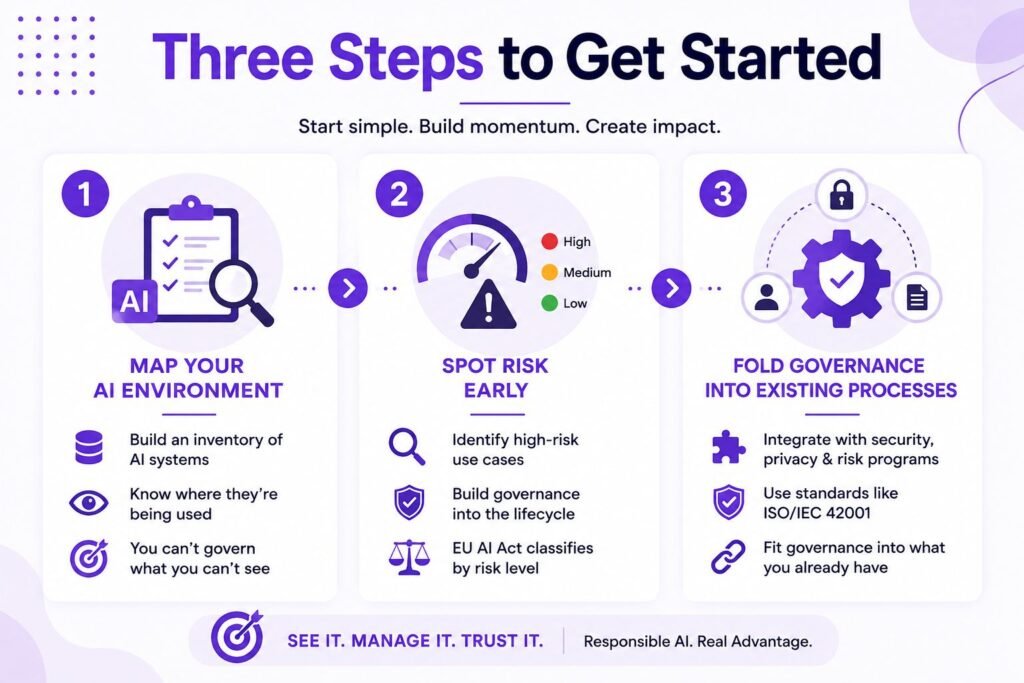
Three Steps to Get Started

You don’t need to transform the whole organization at once. Here’s where you can start:

  • First, map your AI environment. Build an inventory of AI systems and know where they’re being used. You can’t govern what you can’t see, and most organizations are surprised by how many AI tools are already in play across teams.
  • Second, spot risk early. Work out which high-risk use cases exist and build governance into the development lifecycle. The EU AI Act classifies systems by risk level, so knowing where your use cases fall tells you exactly how much scrutiny each one needs before it ships.
  • Third, fold governance into existing processes. Add AI governance to your security, privacy, and enterprise risk programs instead of running it as a separate effort. This is where recognized standards like ISO/IEC 42001 pull their weight, giving you a structured management system that slots into what you already have rather than bolting on yet another silo.

That’s enough to set your organization up for the long run. The debate around the EU AI Act shouldn’t be about staying on the right side of regulation.

It should be about building AI that people trust and that you can actually scale.

Organizations that put governance in place now will innovate faster and earn a stronger market reputation while their competitors scramble to catch up. In a few years, the edge will go to the companies that govern AI best, not the ones that use it the most.

Is your organization preparing for the EU AI Act?
Start by assessing your AI governance maturity and aligning your AI strategy with recognized frameworks like ISO/IEC 42001 and the NIST AI RMF, and turn compliance into a business advantage.

Let Axipro help you build a business continuity plan that's practical, compliant, and audit-ready.

Schedule Your Free Assessment Today

Axipro Author

Picture of Yuna Olorunfemi

Yuna Olorunfemi

Yuna is an Information Security and Compliance professional and virtual Chief Information Security Officer (vCISO) specializing in governance, risk, and compliance (GRC) for fintech and financial services organizations. She has experience implementing frameworks such as ISO/IEC 27001, ISO 22301, ISO 420001 EU AI Act, NIST CSF, COSO and COBIT, with expertise in risk management, control testing, and compliance-by-design. Yuna is a SANS Advisory Board Member and a two-time SANS GIAC-certified cybersecurity professional who writes about AI governance, cybersecurity, and emerging regulations.

Blog Highlights

Explore More Articles

Learn how organizations can use the EU AI Act to build trust, speed up innovation, strengthen procurement, and gain a competitive advantage through effective AI governance. The Biggest Mistake Organizations Make About the EU AI Act When executives hear “EU AI Act,” their first thought is usually: another regulation, another compliance project, another expense. And who could blame them? Between GDPR, DORA, and NIS2, businesses are under real pressure to show they handle technology responsibly. Here’s what most of them miss, though. Complying with the EU AI Act does more than keep you clear of fines. Done well, it becomes a selling point. Companies that treat AI governance as a strategic skill earn customer trust and close enterprise deals faster. That matters because customers, investors, and regulators are asking tougher questions about AI than ever: Can you explain your AI decisions? How do you manage bias? Who’s accountable when something goes wrong? What controls protect sensitive data? The EU AI Act gives you a framework for answering them. When you can show good governance, you satisfy regulators, and you also win over the customers and partners deciding whether to trust you in the first place. That trust is worth real money in the AI era. And good governance doesn’t mean more bureaucracy. It means consistency. With clear ownership, defined risk processes, and transparent documentation, AI projects become easier to run and easier to scale. Teams stop reinventing governance for every new initiative and follow a repeatable framework instead, which speeds up decisions and cuts uncertainty. Companies with mature AI governance are already seeing this play out. They build more customer confidence in their AI products and answer procurement and due diligence requests in days instead of weeks. They run less risk of expensive AI failures or reputational damage, look credible to investors and regulators, and roll out AI consistently across the organization. In a market where trust increasingly drives purchasing decisions, that shows up in revenue. A McKinsey survey on the state of AI found that organizations investing in responsible AI practices are better positioned to capture value as adoption scales. Three Steps to Get Started You don’t need to transform the whole organization at once. Here’s where you can start: First, map your AI environment. Build an inventory of AI systems and know where they’re being used. You can’t govern what you can’t see, and most organizations are surprised by how many AI tools are already in play across teams. Second, spot risk early. Work out which high-risk use cases exist and build governance into the development lifecycle. The EU AI Act classifies systems by risk level, so knowing where your use cases fall tells you exactly how much scrutiny each one needs before it ships. Third, fold governance into existing processes. Add AI governance to your security, privacy, and enterprise risk programs instead of running it as a separate effort. This is where recognized standards like ISO/IEC 42001 pull their weight, giving you a structured management system that slots into what you already have rather than bolting on yet another silo. That’s enough to set your organization up for the long run. The debate around the EU AI Act shouldn’t be about staying on the right side of regulation. It should be about building AI that people trust and that you can actually scale. Organizations that put governance in place now will innovate faster and earn a stronger market reputation while their competitors scramble to catch up. In a few years, the edge will go to the companies that govern AI best, not the ones that use it the most. Is your organization preparing for the EU AI Act? Start by assessing your AI governance maturity and aligning your AI strategy with recognized frameworks like ISO/IEC 42001 and the NIST AI RMF, and turn compliance into a business advantage.

ISO 27001 for Startups

ISO/IEC 27001 certificates nearly doubled in a single year, from 48,671 in 2023 to 96,709 in 2024, according to ISO’s own certification survey. A big share of that jump comes from startups, not enterprises. The reason is simple: buyers stopped taking “we take security seriously” at face value, and a certificate is the fastest way to prove it.  This guide covers when a startup should pursue ISO 27001, what it costs, how long it takes, and how a small team gets certified without a dedicated security department. What Is ISO 27001 and Why It Matters for Startups ISO/IEC 27001 is the international standard for information security management. It doesn’t hand you a checklist of firewalls to buy. Instead, it asks you to build and run an Information Security Management System (ISMS): a documented, repeatable way of finding your security risks and doing something about them. Certification means an accredited third party checked that your ISMS works and matches the standard. For a startup, that distinction matters. You’re not being graded on whether you own expensive tools. You’re being graded on whether you can show a system, which is exactly what an enterprise buyer’s procurement team wants to see before they sign. The Core Principles: Confidentiality, Integrity, and Availability Everything in ISO 27001 traces back to the CIA triad: confidentiality, integrity, and availability. Confidentiality means only the right people see the data. Integrity means the data is accurate and hasn’t been tampered with. Availability means the data is there when someone needs it. Every control you put in place, and every risk you assess, ties back to protecting one of those three properties. ISO puts it plainly: an ISMS that meets the standard preserves the confidentiality, integrity, and availability of information by running a risk management process. Keep the triad in mind, and the rest of the framework stops feeling abstract. How ISO 27001 Differs from Other Security Frameworks for Early-Stage Companies SOC 2 is the framework startups usually bump into first, especially when selling into the US. It results in an attestation report from a CPA firm, scoped to specific systems. ISO 27001 is a certification, recognized in over 150 countries, and it covers your whole organization through a formal ISMS with management reviews and company-wide risk assessment. The two overlap heavily. Roughly 70 to 80 percent of the controls line up, so if you do one, the second gets much cheaper. The real difference is structure. SOC 2 checks whether specific controls work. ISO 27001 checks whether you’ve built a management system that keeps those controls working over time. It also aligns closely with GDPR, which is why it travels well in Europe. Insider Note: Auditors can usually tell within an hour whether your ISMS is real or was assembled the week before the audit. A management review meeting with actual notes, decisions, and follow-ups from three months ago is worth more than a perfect-looking policy binder with no evidence anyone ever used it. When Should a Startup Pursue ISO 27001 Certification? The honest answer: when a deal, a market, or an investor is asking for it, or is about to. Certifying purely because it feels responsible is a good way to burn cash and calendar time you don’t have yet. Early-Stage vs. Growth-Stage: Timing the Certification At pre-seed and seed, ISO 27001 is usually early unless you’re selling into regulated industries or the EU from day one. Your product and processes are still shifting, and certifying a moving target means re-documenting everything a quarter later. At Series A and beyond, the math changes. Deals get bigger, buyers get more careful, and investor due diligence starts probing your security posture. Certifying while you’re 15 to 40 people is often the sweet spot: mature enough to have stable processes, small enough that scoping the ISMS is still manageable. When ISO 27001 Might Be Overkill for Your Startup If your customers are US SMBs who only ever ask for SOC 2, leading with ISO 27001 may be solving a problem you don’t have. If you’re pre-revenue and still hunting for product-market fit, your time is better spent shipping. And if no one in your sales pipeline has ever mentioned a certificate, that silence is data. Pro Tip: Pull your Last 20 Security Questionnaires Before you commit, pull your last 20 security questionnaires or RFPs and count how many explicitly asked for ISO 27001 versus SOC 2 versus nothing. That single tally answers the “which framework, and when” question faster than any consultant’s discovery call. Key Benefits of ISO 27001 for Startups Unlocking Enterprise Sales and Bigger Deals The clearest return is revenue you couldn’t touch before. Large buyers often won’t even start a security review without a recognized certificate on file. ISO 27001 gets you past the first gate of enterprise sales, and it shortens the review itself because a big chunk of the questionnaire is already answered by your certification. Building Investor and Board Confidence Certification signals operational maturity. When an investor sees a functioning ISMS, they see a founder who can build systems, not only ship features. That plays well in investor due diligence, where a security gap can stall a term sheet, and it gives your board something concrete to point to on risk. Establishing Customer Trust from Day One A certificate is third-party proof, and third-party proof beats self-assurance every time. For a young company with no brand equity yet, it’s a shortcut to being taken seriously by customers who’ve never heard of you. Creating a Scalable Security Foundation Because ISO 27001 makes you build a system rather than a one-off fix, it scales as you grow. New hires, new products, and new data types slot into an ISMS you already run. You’re not rebuilding security from scratch at every stage. Reducing Long-Term Compliance Costs Adding SOC 2, HIPAA, or ISO 42001 later is far cheaper once an ISMS exists, thanks to that 70 to 80 percent control overlap. The first framework is the expensive one.

Most organizations think their AI governance is further along than it is. McKinsey’s 2026 AI Trust Maturity Survey of roughly 500 organizations found an average maturity score of 2.3 out of 4, and only about a third reported level three or higher in strategy, governance, and agentic AI oversight. Adoption is outpacing control, and regulators have noticed. An AI governance maturity model gives you a way to measure that gap honestly. This guide covers what a maturity model is, the six dimensions it should measure, the five levels most models use, and how to assess your own organization and build a roadmap to the next level. What Is an AI Governance Maturity Model? An AI governance maturity model is a structured framework that describes how capable an organization is at governing its AI systems, usually across five progressive levels. The concept borrows directly from the Capability Maturity Model (CMM) that software engineering has used since the early 1990s: define the capability, describe what it looks like at each stage of development, and score yourself against it. The purpose is diagnosis. A maturity model tells you where governance is strong, where it’s theater, and where it doesn’t exist at all. How It Differs from General AI Governance Frameworks Frameworks like the NIST AI Risk Management Framework or ISO/IEC 42001 tell you what good governance contains: policies, risk assessments, accountability structures, monitoring. A maturity model tells you how well you’re doing those things today. The framework is the destination. The maturity model is the odometer. That distinction matters in practice. Plenty of companies can point to an AI policy document. Far fewer can show that the policy changes what teams actually ship. Why Enterprises Need a Maturity Model Three reasons. First, budget: you can’t prioritize governance investment without knowing which dimension lags. Second, accountability: a maturity score gives boards something concrete to track quarter over quarter. Third, regulation: the EU AI Act and frameworks like ISO 42001 assume a functioning management system, and a maturity assessment is the fastest way to find out whether yours would survive scrutiny. Core Dimensions of an AI Governance Maturity Model A useful model measures more than policy coverage. Six dimensions show up consistently across the credible models, including the IEEE-USA flexible maturity model built on the NIST AI RMF. Strategy and leadership. Does the organization have a stated position on AI risk, an executive owner (increasingly a Chief AI Officer), and board visibility? Gartner’s 2025 polling found 55% of organizations now have an AI board or dedicated oversight committee, which means nearly half still govern by improvisation. Policies, standards, and accountability. Written policies mapped to regulations, a RACI matrix for AI decisions, and clear escalation paths. Many organizations adapt the three lines of defense model from financial risk: the teams building AI, the risk function overseeing them, and internal audit checking both. Data governance and model lifecycle. Training data lineage, quality controls, and lifecycle management from development through deployment, monitoring, and retirement. This is where AI governance meets MLOps, and where mature organizations maintain an AI register, a live inventory of every model and system in production. Risk, compliance, and ethics. Risk classification of AI systems, impact assessments, bias and fairness testing, and explainability requirements. Banks will recognize the DNA of model risk management under SR 11-7 here. People, skills, and culture. Training, role clarity, and whether people outside the governance team actually understand their obligations. Tools, automation, and monitoring. Drift detection, automated policy checks, audit logging, and dashboards. Governance that lives in spreadsheets caps out around level three. The 5 Levels of AI Governance Maturity Level 1: Ad Hoc / Initial AI use happens without oversight. There’s no inventory, no policy, or a policy nobody follows. Shadow AI is common, and risk surfaces only when something breaks publicly. Level 2: Developing / Repeatable Someone has been assigned responsibility. A draft policy exists, a partial inventory exists, and reviews happen for high-profile projects. The practices are repeatable but depend on specific people rather than defined processes. Level 3: Defined / Structured Governance is documented, standardized, and applied across the organization. There’s a governance committee, a risk classification scheme, defined lifecycle gates, and mandatory training. Most organizations pursuing ISO 42001 certification are working to reach and formalize this level. Level 4: Managed / Metrics-Driven Governance produces numbers. Coverage rates, review cycle times, incident counts, and risk reduction are measured and reported to leadership. Controls are enforced by tooling rather than goodwill, and audits confirm the system works as described. Level 5: Optimized / Adaptive Governance improves itself. Monitoring feeds back into policy, controls adapt to new model types (agentic systems being the current test), and the organization anticipates regulatory change rather than reacting to it. Almost nobody is here yet, and that’s fine. Level 5 is a direction, not a deadline. Insider Note: In assessments, the most common self-scoring error is claiming level 3 on the strength of documents alone. If your policy says every model gets a pre-deployment review and your inventory shows 40 models but your review log shows 6, you’re at level 2. Evidence beats paperwork every time, and auditors check the logs first. AI Governance Maturity Matrix The matrix crosses dimensions with levels so you can score each one independently. Organizations are rarely uniform: it’s normal to sit at level 3 on policy and level 1 on monitoring. For scoring, keep the rubric simple: 1 to 5 per dimension, scored on evidence you could show an auditor, not on intentions. Board-level indicators (does the board see AI risk reporting?) and operational indicators (does every production model have a completed impact assessment?) should be scored separately, because they fail independently. How to Assess Your Current AI Governance Maturity Start with a baseline self-assessment. Pull together a cross-functional group covering engineering, legal, risk, security, and the business owners of major AI use cases, and score each dimension against the matrix. Half a day is usually enough for a first pass. For each dimension, the