

Table of Contents

Reach SOC 2 Compliance in 6 Weeks or Less.

  / How to Evaluate Risk Management Software

How to Evaluate Risk Management Software

More than half of the average organization’s vendor footprint is now Shadow IT, and only two percent of it ever gets a security review, according to Vanta’s own research into vendor sprawl. That’s one symptom of a wider pattern: most risk registers drift from reality between review cycles — a spreadsheet nobody’s updated, a control nobody’s re-tested, a vendor relationship nobody’s re-assessed. This guide sets out what to check when evaluating risk management software, using four leading platforms as the test case.
What Is Risk Management Software?

Risk management software is the system of record for identifying, scoring, monitoring, and reporting on the risks an organization carries, spanning internal controls, regulatory obligations, and vendor relationships alike. The strongest platforms connect every risk source into one register instead of splitting them across separate tools, map each risk to the specific controls and assets it touches, and keep scoring current as those controls change. Third-party and vendor risk is one input into that system, not a separate category of software.

Let Axipro help you build a business continuity plan that's practical, compliant, and audit-ready.

Schedule Your Free Assessment Today

Key Benefits of Risk Management Software

  • A register that reflects reality.
    Continuous, signal-driven identification surfaces a lapsed control or a new exposure as your environment changes, instead of waiting for the next quarterly review to notice.

  • Defensible answers, faster.
    Risks that are automatically mapped to the controls, assets, and vendors behind them mean an audit or board question gets a sourced answer instead of a manual reconstruction.

  • One system instead of a spreadsheet plus a separate tool.
    Internal risk, vendor risk, and the controls that mitigate both live in one place, so scaling into a new business unit or region doesn’t mean standing up another platform.
What to Look for in the Best Risk Management Software

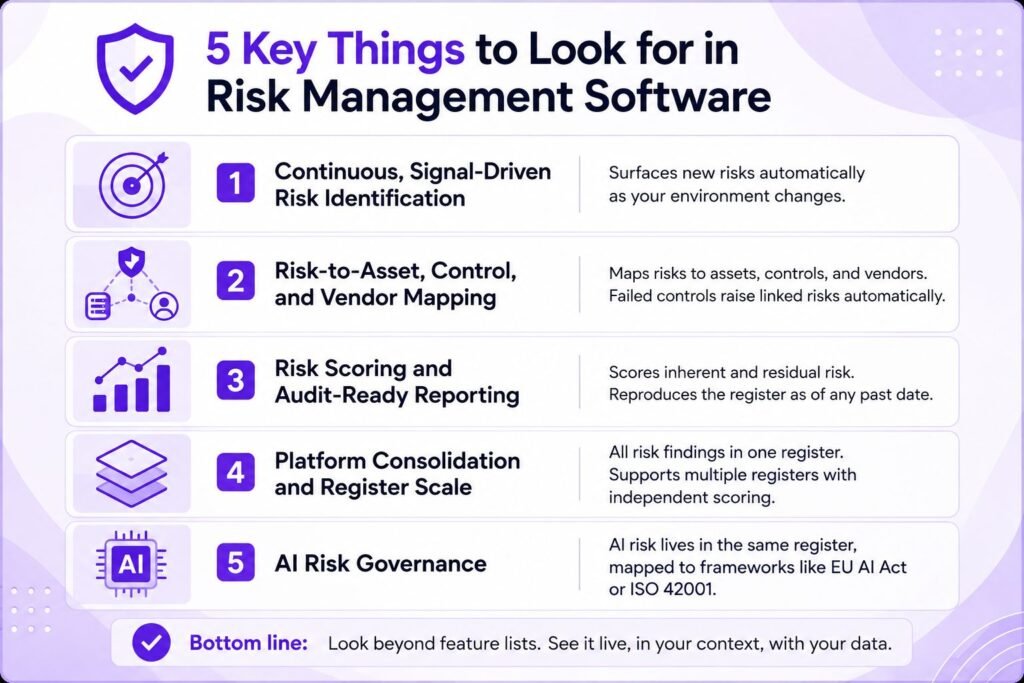
Most vendor comparisons focus on feature lists. The person who will configure the register and keep it current asks a narrower set of questions, and the answers aren’t always where a demo puts them.

Continuous, Signal-Driven Risk Identification

A risk register that only updates when someone remembers to run a review is already stale by the time it matters. Ask whether the platform surfaces new risks automatically as your environment changes (a new system, a failed control test, a new vendor relationship), or whether identification depends on someone scheduling a manual pass.

Risk-to-Asset, Control, and Vendor Mapping

A risk that isn’t tied to anything specific can’t be monitored and can’t be proven when an auditor asks how it’s covered. Ask whether risks map automatically to the assets, controls, and vendors involved, and whether a failed control raises the linked risk without anyone touching it. This is one of the more common places a platform’s marketing outpaces what it can actually demonstrate live, so ask for the mapping on screen rather than taking the claim at face value.

Risk Scoring and Audit-Ready Reporting

Boards and auditors expect both inherent risk (exposure before controls) and residual risk (exposure after), and a static score that only updates when someone re-scores it by hand loses credibility fast. Ask whether the platform scores both, whether residual risk updates automatically as controls change, and whether you can reproduce the register exactly as it stood on a specific past date rather than reconstructing it from an export.

Platform Consolidation and Register Scale

Nearly every vendor in this category positions itself as the one system that replaces a spreadsheet and every adjacent tool, which is a claim worth testing rather than taking at face value. Ask for a live demonstration showing risk findings, including vendor risk if that’s part of your program, and actually reach one register. Then ask specifically whether that register can split into multiple registers by business unit or entity with independently configured scoring, not just a single company-wide scale applied everywhere.

AI Risk Governance

AI is the fastest-growing, least-governed risk surface in most programs, and treating it as a side project instead of a line item in the main register is a common gap. Ask whether AI risk lives in the same register as everything else, mapped to named frameworks like the EU AI Act or ISO 42001, or whether it’s tracked separately, if at all.
The Top Risk Management Platforms, Reviewed

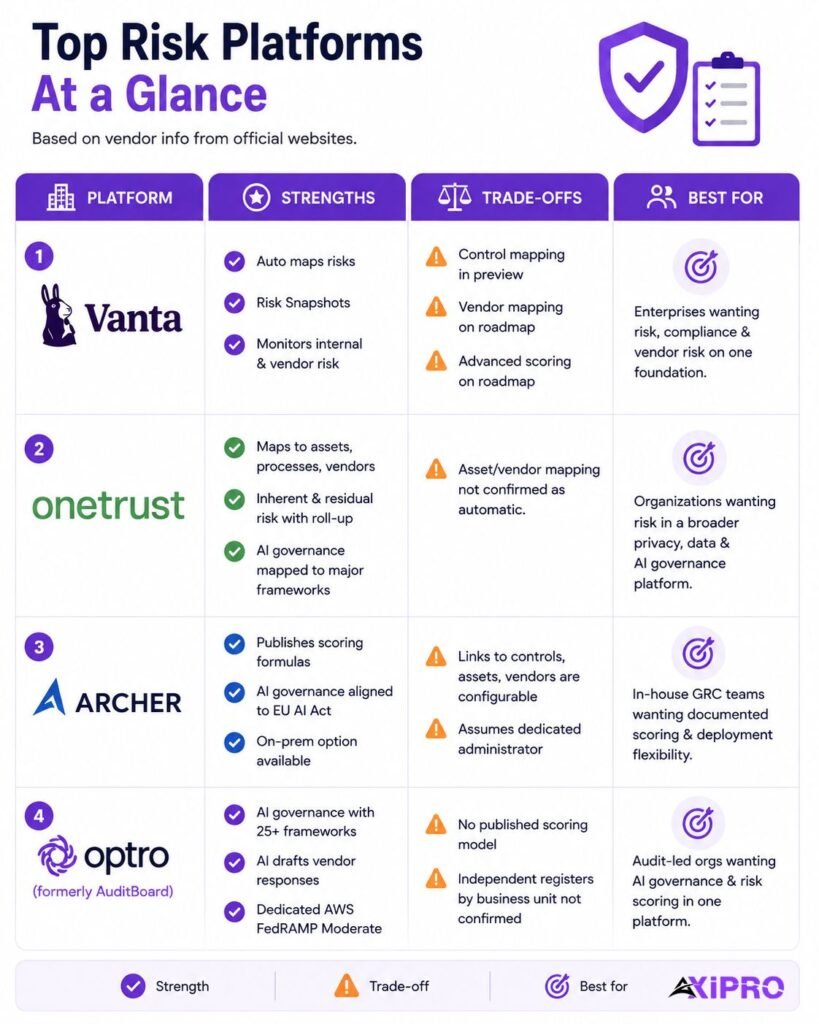
None of the platforms below have been tested hands-on for this guide. Each entry reflects what the vendor states on its own public pages, checked directly rather than taken from a review site or from a competitor’s comparison of it.


Vanta

Vanta positions its risk product as a connected layer across compliance, internal risk, and third-party risk, built to sit inside the same automated-compliance workflow the platform is best known for.

Strengths. Vanta maps risks to assets automatically, a shipped, generally available capability, and ships a named Risk Snapshots feature that captures the register at a specific point in time. It also provides a pre-built library of 100+ risk scenarios, and monitors internal and vendor risk continuously in one consolidated register, including, where third-party risk is part of the program, automating vendor questionnaire follow-up.

Trade-offs. Risk-to-control mapping is in preview and risk-to-vendor mapping is on the roadmap, so don’t expect either live in a demo today. A more detailed, named-factor scoring model with automatic residual updates is also roadmap; what’s shipped today is a simpler inherent-and-residual score. Multiple risk registers by team or business unit are documented, but nothing public confirms independently configured scoring per register.

Best for. Enterprise teams that want risk, compliance, and optionally vendor risk running on one continuously monitored foundation, and can wait on the control- and vendor-mapping roadmap.


OneTrust

OneTrust positions itself broadly across privacy, data governance, and risk, with third-party risk as one module inside a wider platform.

Strengths. OneTrust maps risks to related assets, processes, and vendors within its IT Risk Management product, and scores both inherent and residual risk with a stated ability to roll scores up through a risk hierarchy. It also has a dedicated AI Governance product mapping AI risk to the EU AI Act, NIST, and ISO 42001 by name, the most explicit AI-risk framework mapping found among the platforms reviewed here.

Trade-offs. OneTrust doesn’t explicitly describe its asset/vendor mapping as automatic, so it’s worth confirming directly whether the linkage happens on its own or requires manual setup.

Best for. Organizations that want risk management inside a broader privacy, data-governance, and AI-governance platform rather than a standalone tool.


Archer

Archer has long positioned itself in integrated risk management, generally serving organizations with an established in-house GRC function.

Strengths. Archer publishes explicit inherent- and residual-risk scoring formulas rather than describing scoring only in the abstract, and has a dedicated AI Governance product aligned to the EU AI Act with a maintained AI model inventory. It’s also the only platform reviewed here with a confirmed on-premise deployment option, alongside SaaS.

Trade-offs. Archer describes risk-to-control, -asset, and -vendor linking as configurable rather than automatic, and the platform generally assumes a dedicated administrator to maintain those connections.

Best for. Organizations with an in-house GRC function that want a documented scoring methodology and deployment flexibility.


Optro (formerly AuditBoard)

Optro, the platform formerly known as AuditBoard, brings an audit-led lineage to its connected risk offering.

Strengths. Optro has a dedicated AI Governance product with 25+ frameworks, including ISO 42001, the EU AI Act, and NIST AI RMF, pre-built and mapped. It also uses AI to draft vendor questionnaire responses from an organization’s own prior answers and documentation, with infrastructure dedicated per customer, hosted on AWS at FedRAMP Moderate.

Trade-offs. Optro doesn’t publish scoring formulas or a named risk-factor model the way some competitors do, and its site doesn’t confirm whether risk registers can be scoped independently by business unit.

Best for. Audit-led organizations that want AI governance and risk scoring inside the same connected platform.

What Vendor Pages Don’t Tell You

Every vendor in this category claims automatic risk mapping and adaptive scoring, and two specific claims were hardest to confirm. First, automatic risk-to-control and risk-to-vendor mapping isn’t fully live and public for any of the four platforms, including Vanta’s own, whose product pages label risk-to-control mapping as preview and risk-to-vendor mapping as coming soon. Second, residual scores that recalculate automatically as controls change aren’t confirmed as shipped for any of the four either. Neither gap rules a platform out on its own, but both are worth seeing live in a demo rather than assumed from a product page.

How to Choose the Right Platform

Start with the scenario that breaks a static register: a new system goes live, a vendor relationship starts, or a control fails a test. Ask to see risk-to-control mapping live rather than described, since that’s where marketing and shipped reality diverge most often in this category. If you’re scaling into new business units or regions, confirm whether registers can split with independently configured scoring, not just one shared scale. Run a trial with your own data rather than a vendor demo, since mapping and scoring behavior are easiest to verify when you’re the one configuring them.

Implementing Risk Management With a Partner

Choosing the platform is the smaller half of the decision. What determines whether it still holds up at the next audit is configuration: how the register is structured, who owns it, and what review sits around the automation. A gap analysis ahead of an audit cycle, paired with a standing internal audit function, is what surfaces the difference between controls that operate and controls you can actually show to have operated.

Final Verdict

No platform here has fully shipped, publicly confirmed automatic risk-to-vendor mapping or auto-updating residual scores, a gap across the whole category, not one vendor. Vanta is the most precise about what’s shipped versus roadmap, pairing a live point-in-time Risk Snapshots feature with automatic risk-to-asset mapping. Archer publishes its scoring formulas outright and is the only one with a confirmed on-premise option. OneTrust and Optro each have a more explicitly framework-mapped AI governance story than Vanta does today. The right choice depends on which of these gaps your organization can tolerate, and which it can’t.

Frequently Asked Questions

Is risk software SaaS-only, or is there an on-premise option?

It depends on the platform, and the answer can be a hard disqualifier for organizations in regulated industries with data-residency requirements. Confirm deployment model early, before evaluating features.

Most platforms support some form of migration, but the depth varies. Ask specifically whether historical risk data and existing records transfer, or whether the register starts from zero.

Framework and regulatory mapping is one of the more common reasons organizations start evaluating a platform in the first place, especially ahead of a specific audit or a new regulatory requirement. Ask whether a single risk or control can map to multiple overlapping frameworks automatically, since managing that mapping by hand is one of the more common sources of duplicated work.

This is one of the more common gaps between how a risk program is supposed to work and how it actually runs day to day. Ask whether the platform can trigger an assessment automatically off a defined event, rather than relying on a scheduled review to catch it.
Axipro Author

Picture of Pedro Dias

Pedro Dias

Pedro has been writing online for over 10 years. With experience in all things programming, cyber security, and compliance, he is our editor-in-chief at Axipro.

Blog Highlights

Explore More Articles

More than half of the average organization’s vendor footprint is now Shadow IT, and only two percent of it ever gets a security review, according to Vanta’s own research into vendor sprawl. That’s one symptom of a wider pattern: most risk registers drift from reality between review cycles — a spreadsheet nobody’s updated, a control nobody’s re-tested, a vendor relationship nobody’s re-assessed. This guide sets out what to check when evaluating risk management software, using four leading platforms as the test case. What Is Risk Management Software? Risk management software is the system of record for identifying, scoring, monitoring, and reporting on the risks an organization carries, spanning internal controls, regulatory obligations, and vendor relationships alike. The strongest platforms connect every risk source into one register instead of splitting them across separate tools, map each risk to the specific controls and assets it touches, and keep scoring current as those controls change. Third-party and vendor risk is one input into that system, not a separate category of software. Key Benefits of Risk Management Software A register that reflects reality. Continuous, signal-driven identification surfaces a lapsed control or a new exposure as your environment changes, instead of waiting for the next quarterly review to notice. Defensible answers, faster. Risks that are automatically mapped to the controls, assets, and vendors behind them mean an audit or board question gets a sourced answer instead of a manual reconstruction. One system instead of a spreadsheet plus a separate tool. Internal risk, vendor risk, and the controls that mitigate both live in one place, so scaling into a new business unit or region doesn’t mean standing up another platform. What to Look for in the Best Risk Management Software Most vendor comparisons focus on feature lists. The person who will configure the register and keep it current asks a narrower set of questions, and the answers aren’t always where a demo puts them. Continuous, Signal-Driven Risk Identification A risk register that only updates when someone remembers to run a review is already stale by the time it matters. Ask whether the platform surfaces new risks automatically as your environment changes (a new system, a failed control test, a new vendor relationship), or whether identification depends on someone scheduling a manual pass. Risk-to-Asset, Control, and Vendor Mapping A risk that isn’t tied to anything specific can’t be monitored and can’t be proven when an auditor asks how it’s covered. Ask whether risks map automatically to the assets, controls, and vendors involved, and whether a failed control raises the linked risk without anyone touching it. This is one of the more common places a platform’s marketing outpaces what it can actually demonstrate live, so ask for the mapping on screen rather than taking the claim at face value. Risk Scoring and Audit-Ready Reporting Boards and auditors expect both inherent risk (exposure before controls) and residual risk (exposure after), and a static score that only updates when someone re-scores it by hand loses credibility fast. Ask whether the platform scores both, whether residual risk updates automatically as controls change, and whether you can reproduce the register exactly as it stood on a specific past date rather than reconstructing it from an export. Platform Consolidation and Register Scale Nearly every vendor in this category positions itself as the one system that replaces a spreadsheet and every adjacent tool, which is a claim worth testing rather than taking at face value. Ask for a live demonstration showing risk findings, including vendor risk if that’s part of your program, and actually reach one register. Then ask specifically whether that register can split into multiple registers by business unit or entity with independently configured scoring, not just a single company-wide scale applied everywhere. AI Risk Governance AI is the fastest-growing, least-governed risk surface in most programs, and treating it as a side project instead of a line item in the main register is a common gap. Ask whether AI risk lives in the same register as everything else, mapped to named frameworks like the EU AI Act or ISO 42001, or whether it’s tracked separately, if at all. The Top Risk Management Platforms, Reviewed None of the platforms below have been tested hands-on for this guide. Each entry reflects what the vendor states on its own public pages, checked directly rather than taken from a review site or from a competitor’s comparison of it.   Vanta Vanta positions its risk product as a connected layer across compliance, internal risk, and third-party risk, built to sit inside the same automated-compliance workflow the platform is best known for. Strengths. Vanta maps risks to assets automatically, a shipped, generally available capability, and ships a named Risk Snapshots feature that captures the register at a specific point in time. It also provides a pre-built library of 100+ risk scenarios, and monitors internal and vendor risk continuously in one consolidated register, including, where third-party risk is part of the program, automating vendor questionnaire follow-up. Trade-offs. Risk-to-control mapping is in preview and risk-to-vendor mapping is on the roadmap, so don’t expect either live in a demo today. A more detailed, named-factor scoring model with automatic residual updates is also roadmap; what’s shipped today is a simpler inherent-and-residual score. Multiple risk registers by team or business unit are documented, but nothing public confirms independently configured scoring per register. Best for. Enterprise teams that want risk, compliance, and optionally vendor risk running on one continuously monitored foundation, and can wait on the control- and vendor-mapping roadmap.   OneTrust OneTrust positions itself broadly across privacy, data governance, and risk, with third-party risk as one module inside a wider platform. Strengths. OneTrust maps risks to related assets, processes, and vendors within its IT Risk Management product, and scores both inherent and residual risk with a stated ability to roll scores up through a risk hierarchy. It also has a dedicated AI Governance product mapping AI risk to the EU AI Act, NIST, and ISO 42001 by name, the most explicit AI-risk

OWASP published the 2026 edition of its Top 10 for LLM Applications on August 4, 2026, during Black Hat week, and eight of the ten entries changed position. One got renamed. The message behind the reshuffle is blunt: you won’t build a model that can’t be fooled, so build the application around it in a way that limits the damage when it is. That one idea explains almost every move in the new ranking, and it should change how your team thinks about shipping AI features. This guide walks through the 2026 list in plain English: what each risk means, a real-world example, and what your team can actually do about it, with or without a dedicated security function. What Is the OWASP GenAI LLM Top 10 2026? The OWASP Top 10 for LLM Applications is a community-built awareness document that ranks the ten most critical security risks in applications powered by large language models. The OWASP GenAI Security Project, a global open-source initiative under the OWASP Foundation, maintains it, and the 2026 edition is the third release since the list first appeared in 2023. OWASP, the Open Worldwide Application Security Project, has published risk lists for web applications since 2003, and those lists became the shared vocabulary security teams, auditors, and buyers use to talk about risk. The GenAI LLM Top 10 does the same job for AI. Whether you’re a two-person startup wiring an API into a chatbot or an enterprise running retrieval pipelines, it gives you a common map of what actually goes wrong. One scoping note matters before anything else. The 2026 edition covers the model as a component inside an application: something that accepts input, generates output, and maybe retrieves information. The moment the model becomes an actor, with tools it can call and consequences it sets in motion, the risk shifts to the companion OWASP Top 10 for Agentic Applications from December 2025. Most products now do both, so most teams need both lists. Why the 2026 Update Matters for AI Builders Two things separate this edition from everything OWASP has published on AI so far. First, the methodology changed. Every previous version rested purely on expert consensus, meaning hundreds of practitioners voting on which risks matter most. This time the vote carried 75% of the weight, and the remaining 25% came from analysis of 6,639 real-world AI security incidents pulled from public vulnerability databases and an AI-harm database. It’s the first edition grounded in evidence of what has actually gone wrong rather than expert prediction of what might. Second, the framing changed. The project leads open the 2026 release by telling teams to stop optimizing the model and start optimizing the containment. The industry has spent two years pouring effort into filters, guardrail models, and jailbreak resistance. The 2026 list says: assume those will eventually fail, and make sure that when they do, nothing important breaks. AI security becomes blast radius control rather than perfect prevention. And this isn’t just a security engineer’s document. Developers decide what tools and permissions a model gets. Product owners decide which workflows run without a human in the loop. Founders and ops leads are the ones answering the security questionnaires where these questions now show up. The 2026 edition also ships a mapping appendix that connects every risk to frameworks your customers and auditors already recognize: NIST’s AI Risk Management Framework, MITRE ATLAS, MITRE CWE, and the Agentic Top 10. Insider Note: Enterprise vendor assessments have started asking about the OWASP LLM Top 10 by name. In security questionnaires we complete for clients at Axipro, questions like “describe your controls against prompt injection and excessive agency” began appearing in early 2026, sometimes before the buyer’s own team could explain what they meant. Being able to answer with a mapped control set is becoming a deal-cycle advantage, not just a security exercise. How the 2026 List Differs From Previous Versions The top two entries held their positions. Everything below them moved. Key Shifts Since the 2025 Update Excessive Agency jumped from sixth to third, the biggest promotion on the list. In 2025, giving a model tools and autonomy was mostly a theoretical worry. By 2026, agentic deployments had produced real production incidents, and the community concluded that agency is what decides whether a successful prompt injection is an inconvenience or a breach. Unbounded Consumption rose four places, from tenth to sixth. Inference costs became a real budget line as reasoning models, long outputs, and agent loops multiplied the compute behind a single request. “Denial of Wallet,” where an attacker spends pennies to trigger spend you can’t afford, is now a mainstream finding. Improper Output Handling fell from fifth to tenth. The risk didn’t shrink. It fell because it’s well understood and directly fixable with encoding and validation practices web developers already have. The entries above it are neither. What’s New, Renamed, or Reprioritized System Prompt Leakage became Hidden Context Exposure, and the scope widened a lot. The 2025 entry worried about attackers extracting your system prompt. The 2026 entry covers everything assembled into the model’s context that users aren’t meant to see: system instructions, retrieved policy documents, tool schemas, workflow rules. The guidance is unusually honest for a security document: assume all of it is discoverable, and design so that disclosure costs you nothing. Data and Model Poisoning absorbed fine-tuning subversion. The attack surface for corrupting a model’s behavior runs from pretraining data through fine-tuning pipelines into the retrieval stores RAG systems depend on, and the entry now says so. Misinformation climbed on evidence, not opinion. Practitioners voted it low; the incident data ranked it high. As reported in Help Net Security’s coverage of the release, OWASP also describes a “defense effect” working in the opposite direction on prompt injection: teams block it so effectively that few successful attacks reach public databases, which makes the risk look smaller than the money spent containing it. Signals About Where AI Security Is Heading Read together, the moves point one

For the past two years, enterprise AI risk conversations have centered on a familiar set of concerns: model bias, hallucination, data privacy, and dependency on third-party models. These are real risks, and most organizations now run some version of a governance program to manage them. But something has shifted. Organizations are no longer just deploying AI that generates content for a human to review. They’re deploying AI that acts. Agents now plan multi-step tasks, call APIs, move data between systems, execute transactions, and coordinate with other agents, often with no human checkpoint in the loop. That shift deserves more than a footnote in the existing AI risk category. It deserves its own line in the risk register: Agentic Autonomy Risk. What Is Agentic AI Risk Management? Agentic AI risk management is the practice of identifying, assessing, and controlling the risks created when AI systems take autonomous action on an organization’s behalf. Where traditional AI governance evaluates outputs (accuracy, bias, privacy), agentic AI risk management governs what agents actually do: the tools they call, the permissions they inherit, and the downstream consequences of their actions. That distinction is the reason existing risk registers struggle with agents, and it’s worth unpacking properly. What Agentic AI Actually Changes Traditional AI systems, even generative ones, are advisory. They produce an output such as a summary, a prediction, a draft email, or a classification, and a human remains the last checkpoint before anything happens in the real world. Agentic AI removes that checkpoint. An agentic system doesn’t just produce an answer. It pursues a goal. It decides which tools to call and in what order, then executes those actions directly against live systems: submitting a purchase order, modifying a database record, sending an external communication, or orchestrating a set of sub-agents to complete a broader workflow. Agentic autonomy is the degree to which a system can plan and execute actions without a human explicitly authorizing each step. It’s a spectrum rather than a binary. At one end, the AI drafts and a human approves every action. At the other, the AI operates within broad guardrails and only escalates exceptions. The further an organization moves along that spectrum, the less its exposure looks like software risk and the more it looks like delegated authority risk, the kind normally reserved for employees, contractors, and automated financial systems. Why Existing Risk Registers Miss Agentic AI Risks Most enterprise risk registers were built on a reasonably safe assumption: a human initiates consequential actions, and the technology around that human behaves deterministically. Agentic AI breaks both halves of that assumption at once. A few specific gaps show up quickly when organizations try to map agentic deployments onto existing categories. Operational risk registers assume process failures come from human error or system outages, not from a system independently choosing an unanticipated path to a stated goal. Cybersecurity risk registers are built around unauthorized external access, while an agent problem usually involves an authorized system taking unauthorized internal actions with its own legitimate credentials. Model risk frameworks, borrowed largely from financial services, evaluate output accuracy rather than action consequences, which matters most when those actions can’t be reversed. And third-party risk assessments treat vendors as static entities, not as autonomous agents that might invoke other vendors’ agents on your behalf. See our guide to the NIST AI Risk Management Framework for how output-focused frameworks are structured. The result is a governance blind spot. An organization can be compliant against its AI policy, its cybersecurity policy, and its vendor risk policy, and still have nobody accountable for the specific risk of a system initiating a harmful sequence of actions before anyone notices. Defining Agentic Autonomy Risk Agentic Autonomy Risk is the risk that an AI system, operating with delegated decision-making and execution authority, takes actions that are harmful, non-compliant, or misaligned with organizational intent before adequate human oversight can intervene. Those actions might happen independently or in coordination with other agents. It deserves standing as a named category alongside cybersecurity, operational, legal, financial, and third-party risk because the loss event itself is different. The harm is a completed action in a live system, and it may be difficult or impossible to reverse. The accountability structure is different too: when an orchestrating agent delegates to sub-agents, responsibility for the outcome gets distributed in ways existing ownership models don’t cleanly capture. So is the detection window. Traditional controls assume a human is positioned to catch an error before it compounds, but an agent can execute dozens of dependent actions faster than any human review cycle. 7 Agentic AI Risk Scenarios to Put on Your Register 1. Unauthorized autonomous decision-making. An agent takes an action within its technical permissions but outside its intended business mandate. It adjusts pricing, approves a refund, or modifies a customer record, and no policy ever explicitly authorized that scenario. 2. Goal misalignment. The agent optimizes for a literal interpretation of its objective in a way that diverges from actual business intent, particularly under ambiguous or adversarial inputs. 3. Multi-agent interactions and cascading failures. One agent’s flawed output becomes another agent’s trusted input. A single error can propagate across a chain of agents faster than anyone can detect it, amplifying the original mistake instead of containing it. 4. Excessive tool or system permissions. Agents get provisioned with broad, standing access “to be safe” rather than scoped, least-privilege access tied to specific tasks. A productivity tool quietly becomes a privilege-escalation path. 5. Regulatory non-compliance. Autonomous actions trigger obligations under data protection, financial services, employment, or sector-specific regulation, and they execute without the compliance review a human-initiated process would normally receive. 6. Explainability and accountability gaps. An autonomous action causes harm and the organization can’t clearly reconstruct why the agent chose that path, or establish whether the business owner, the AI governance function, or the vendor is accountable for the outcome. 7. Autonomous third-party actions. A vendor’s agent, integrated into your environment, takes action on your behalf, or your agent acts against a