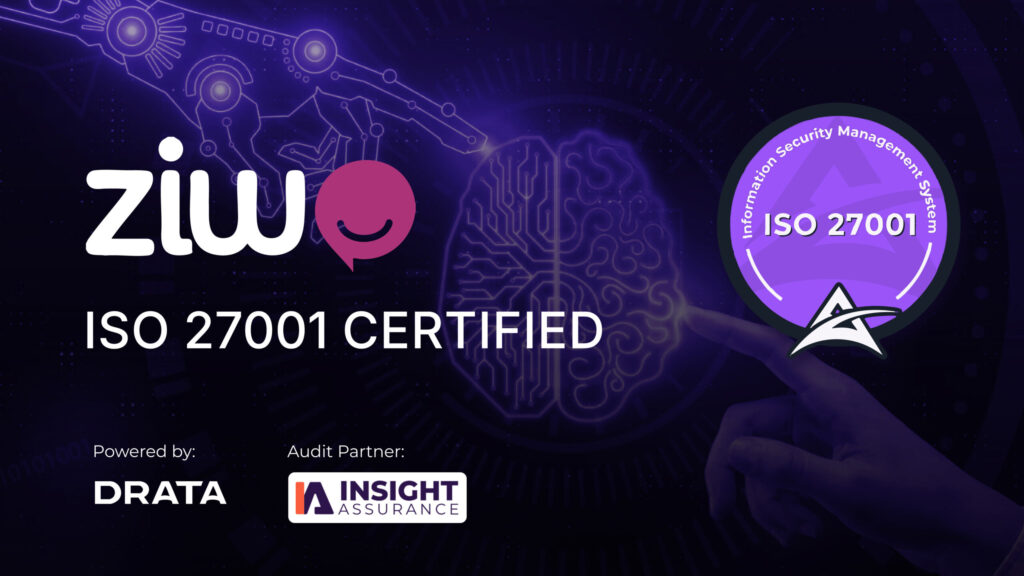
Ziwo Upgrades to ISO/IEC 27001:2022 with Axipro

Product

SOC 2 Type I & II

Industry

Cloud Communications / Contact Center Software

Company size

51 – 200 employees

Location

Dubai, UAE

Ziwo-ISO-27001-Axipro

Share This Post

Introduction

Compliance is not a checkbox. It is a journey. For Ziwo, that journey meant moving beyond their ISO 27001:2013 certification and preparing for the future. They sought to modernize their security practices, reduce manual work, and align with updated international standards.

With Axipro providing advisory guidance, Drata powering automation, and Insight Assurance serving as the audit partner, Ziwo successfully transitioned its compliance program to meet ISO 27001:2022 requirements.

The outcome was a smooth certification process, completed without non-conformities, and a stronger foundation of trust with customers across the Middle East and beyond.

About Ziwo

Ziwo is a leading cloud-native call center and customer experience (CX) platform. Headquartered in Dubai, with offices in Riyadh, Cairo, and Casablanca, Ziwo supports businesses across the MENA region and beyond.

Their platform helps organizations deliver secure, intuitive, and multilingual customer interactions. Industries served include:

  • BPO and customer support
  • Retail and e-commerce
  • Finance and real estate
  • Travel and hospitality

As a trusted provider, Ziwo already held ISO 27001:2013 certification. As a trusted provider, Ziwo already held ISO 27001:2013 certification. But to keep pace with growth and evolving expectations, they chose to pursue ISO 27001:2022 compliance with advisory support from Axipro, while leveraging Drata for automation and working with Insight Assurance as their audit partner.

Challenge: Scaling & Upgrading Compliance

Ziwo’s leadership recognized that while ISO 27001:2013 kept them secure, it also came with challenges:

  • Manual compliance tracking created inefficiencies.
  • Evidence collection for audits consumed valuable time.
  • Processes were fragmented across teams.
  • New ISO 27001:2022 requirements required updated alignment.

The goal was clear: transition smoothly to ISO 27001:2022, reduce administrative overhead, and empower their internal team to manage compliance more effectively. This meant choosing the right advisory, automation, and audit partners to guide the process.

Solution: Axipro’s Guided Transition

Through this coordinated effort, Ziwo:

  • Successfully upgraded from ISO 27001:2013 to ISO 27001:2022 certification.
  • Completed the certification with zero major or minor non-conformities, as confirmed by Insight Assurance.
  • Integrated Drata for continuous, automated compliance monitoring.
  • Strengthened their internal team’s ability to manage compliance independently going forward.

This achievement highlights Ziwo’s commitment to security and governance while also showcasing the value of advisory, automation, and audit working together.

“Thanks a ton for the smooth audit, team! It was a combined effort and great teamwork. We look forward to continuing this success in upcoming audits and certifications on behalf of Ziwo & management.”Ziwo Management

Results: Smooth Audit, Stronger Governance

The partnership delivered results that mattered. With Axipro’s support and Drata’s automation, Ziwo achieved:

  • ISO 27001:2022 certification with zero major or minor non-conformities.
  • Full Drata integration, giving real-time visibility into compliance status.
  • Audit preparation that shifted from manual to automated, saving weeks of effort.
  • An empowered internal team, now confident in managing and scaling compliance.

This wasn’t just an upgrade, it was a transformation. Ziwo replaced administrative burden with operational efficiency. They gained trust, credibility, and a stronger security posture that customers value.

Thanks a ton for the smooth audit, team! It was a combined effort and great teamwork. We look forward to continuing this success in upcoming audits and certifications on behalf of Ziwo & management. Ziwo Management

Ready to see the same results? Modernize your audits today with ISO 27001:2022 compliance with Axipro.

Why Ziwo Chose Axipro

For Ziwo, selecting Axipro as an advisory partner was driven by the need for clarity and structure during the transition. They valued Axipro’s ability to:

  • Provide guidance on aligning with ISO 27001:2022 requirements.
  • Support the adoption of automation tools like Drata.
  • Collaborate with internal teams rather than replace them.
  • Partner effectively alongside Insight Assurance as the independent auditor.

Axipro’s role was not to certify or audit, but to act as a trusted advisor, helping Ziwo navigate the complexity of compliance and build confidence in their processes.

Conclusion

Compliance is not a one-time milestone. It evolves as standards change and organizations grow. Ziwo’s successful transition from ISO 27001:2013 to ISO 27001:2022 certification demonstrates the value of combining advisory guidance, automation, and independent auditing.

With Axipro as their advisory partner, Drata providing automation, and Insight Assurance serving as the audit partner, Ziwo strengthened its compliance program while ensuring alignment with international best practices. The result was a smooth certification process, completed with zero non-conformities, and an internal team better prepared to manage compliance moving forward.

For organizations looking to upgrade or begin their compliance journey, Axipro provides advisory support to help teams align with updated standards, adopt automation tools, and prepare confidently for audits.

AIUC-1 AI Agent Certification The Complete Guide

AIUC-1 AI Agent Certification: The Complete Guide

Most security certifications were built for software that follows rules. AI agents do not. They consume data, draw conclusions, call tools, and take action, increasingly without a human in the loop. That gap is what AIUC-1 was created to close: it is the first auditable security standard built specifically for AI agents, and a few enterprise buyers have started asking vendors for it by name. This guide covers what AIUC-1 actually tests, the six risk domains it audits, how the certification process works, what it costs, how long it lasts, and how it aligns with SOC 2, ISO 42001, ISO 27001, and the NIST AI Risk Management Framework. It also covers the structural questions worth asking before you treat an AIUC-1 report as proof of anything. What Is AIUC-1 Certification? AIUC-1 is a certifiable standard for AI agents created by the Artificial Intelligence Underwriting Company (AIUC), a San Francisco-based, venture-backed startup founded by people with experience at organizations including Anthropic. The standard was developed with input from Orrick, Stanford, the Cloud Security Alliance, MIT, and MITRE, and launched in mid-2025. The framework comprises 51 requirements and 130 controls, organized across six risk pillars. It evaluates whether an organization has implemented and tested the technical guardrails, operational practices, and legal policies needed to reduce the risk of unsafe, unreliable, or unauthorized AI behavior. Certification applies to a specific AI system or product, not to the organization as a whole. An AIUC-1 certificate, audit report, and badge tell enterprise buyers that an agent has been independently tested against agent-specific risks. People describe AIUC-1 as the “SOC 2 for AI agents,” and the analogy holds in spirit. The difference is what it looks at. SOC 2 examines a service organization’s general controls. AIUC-1 examines how an agent behaves under pressure: when someone tries to jailbreak it, when it is asked to do something outside its scope, when it has access to data it should not expose. Worth Knowing: About AIUC-1 AIUC-1 does not define what counts as an “AI agent.” The vendor decides which system to certify and what falls in scope. That makes scope the single most important thing to check on any certificate, because a narrowly scoped audit may not cover the agent you actually use. Why AIUC-1 Certification Matters for Enterprise AI Adoption The business case rests on a simple problem: enterprises cannot reliably assess the security of their AI vendors, and the failures are expensive. According to EY research on responsible AI, 64% of companies with over $1 billion in revenue have already lost more than $1 million to AI-related failures.  That gap shows up directly in sales cycles. When security, legal, and procurement teams evaluate an AI vendor, they ask about hallucinations, prompt injection defenses, and what happens when an agent makes an unauthorized call. SOC 2 and ISO 27001 do not answer those questions. AIUC-1 gives buyers a structured, third-party-tested answer, which is why holding the certificate can move a stalled procurement review forward. The certification also produces real engineering outcomes, not just a badge. AIUC has reported cases where a customer service agent’s hallucination rate dropped from 11% to under 2% after strengthening its groundedness filter, and another where inappropriate-tone outputs fell from 9% to under 2% through better defensive prompting and output moderation. One company found and patched a PII exposure vulnerability during the certification process itself. The Six Core Risk Domains Covered by AIUC-1 AIUC-1’s 51 requirements are grouped into six domains. Each targets a category of risk that traditional security frameworks were not designed to handle. Data and Privacy Covers how customer data is used, retained, and protected. Requirements address input and output data policies, limits on what data the agent can access, protection of IP and trade secrets, prevention of cross-customer data exposure, and prevention of PII leakage. This is where the standard forces clarity on whether customer data trains the model and how long it is kept. Security The adversarial-resistance domain. It covers third-party testing of adversarial robustness, detection and real-time filtering of malicious inputs, prevention of prompt injection and unauthorized agent actions, enforcement of user access privileges, and protection of the deployment environment. This is the heart of what separates an agent audit from a general security audit. Safety Focuses on preventing harmful and out-of-scope outputs. Requirements include defining an AI risk taxonomy, conducting pre-deployment testing, preventing harmful and customer-defined high-risk outputs, and flagging high-risk outputs for human review. Safety is partly judgment-based, which means documentation alone can sometimes satisfy a requirement, so the testing behind it deserves scrutiny. Reliability Targets the failure modes that erode trust in production: hallucinations and tool misuse. Controls cover hallucination prevention and restrictions on which tools an agent can call and when. For a customer-facing agent, this is the domain that keeps it from inventing a refund policy or triggering the wrong workflow. Accountability Covers what happens when things go wrong. Requirements include AI failure response plans, vendor due diligence, and clear AI disclosure so users know when they are interacting with an agent. With human workers, accountability is built into org charts and chains of command. Agents need an equivalent, and this domain supplies it. Society The broadest domain, focused on preventing misuse with wider consequences: AI-enabled cyber attacks and CBRN (chemical, biological, radiological, nuclear) misuse. Most enterprise agents will touch only a few of these controls, but they matter for higher-capability systems. Insider Note: Of the 130 total controls, roughly 65 are mandatory, and 65 are optional. A straightforward agent typically needs to meet around 40 controls. A complex, multi-modal agent gets closer to 65. The scoping exercise determines which apply, so two AIUC-1 certificates can represent very different amounts of work. Ready to Earn Your AIUC-1 Certification? Accelerate Your AI Certification Journey Talk to an Expert Who Needs AIUC-1 Certification? AIUC-1 is built for any company developing or deploying agentic AI that sells into enterprises. The strongest fit is an organization whose product uses AI agents in customer-facing operations, handles

Read More »
SOC 2 Password Requirements

SOC 2 Password Requirements: What Auditors Check

Most teams walk into a SOC 2 audit expecting standard requirements for their password policy: minimum length, 90-day rotation, one uppercase letter, one symbol, and so on. But there is no such checklist. The AICPA never published a list of mandatory password rules, and the federal guidance that most auditors lean on has thrown out half of what passed for best practice a decade ago.  Beyond compliance, this is remains a crucial cybersecurity control: Stolen and brute-forced credentials still drive a large share of breaches, and password policies are the main way to mitigate this risk. This guide covers what SOC 2 expects around passwords, where those expectations come from, and how to build a policy that satisfies an auditor without making your security worse. What Are SOC 2 Password Requirements? SOC 2 password requirements are the access controls that a service organization implements to govern how passwords are created, stored, enforced, and retired, all in service of the Trust Services Criteria. The important word is controls, not rules. SOC 2 does not hand you a specification. It asks whether your controls are suitably designed and operating effectively to keep unauthorized people out of your systems.   The Role of Passwords in the SOC 2 Trust Services Criteria The Trust Services Criteria, developed by the AICPA, are the evaluation standard for every SOC 2 report. Passwords sit inside the Security category, which is mandatory in all SOC 2 engagements, and specifically inside the Common Criteria series CC6, covering logical and physical access. Passwords are one of the most basic logical access controls you have, and one of the most scrutinized, because CC6 is usually the most evidence-intensive part of the entire audit. Relevant Common Criteria: CC6.1, CC6.2, and CC6.3 CC6.1 covers the controls that restrict logical access to systems, infrastructure, and data, this is where your password policy, MFA enforcement, and account lockout settings live. CC6.2 governs how access is granted, modified, and removed, meaning your provisioning workflows, access reviews, and offboarding processes are all evaluated here. CC6.3 focuses on the removal of access when it is no longer needed and the management of privileged credentials specifically. Together, these three criteria map to the full lifecycle of a credential: creation, ongoing use, and retirement. An auditor working through CC6 will expect evidence at every stage.   Does SOC 2 Mandate Specific Password Rules? No. The AICPA is explicit that the Trust Services Criteria do not define the controls an organization must have. You identify and implement controls that meet the criteria, and the auditor evaluates them. That means there is no AICPA-mandated minimum length, no required rotation interval, and no prescribed complexity formula. What the auditor checks is whether your stated controls exist, work, and reasonably prevent unauthorized access. Insider note: Auditors rarely fail you for choosing a 10-character minimum over 12. They fail you when your written policy says one thing and your actual system configuration says another. Consistency between the policy document and the enforced setting matters far more than the specific number. Why Password Requirements Matter for SOC 2 Compliance Preventing Unauthorized Access Credentials are the front door. The 2025 Verizon DBIR found that stolen credentials remained the single most common initial access vector, appearing in 22% of breaches, and that brute force attacks against basic web applications nearly tripled year over year. Strong authentication controls are the difference between an attacker hitting a wall and an attacker walking straight in with a valid login. Reducing Data Breach Risk Weak or reused passwords feed credential stuffing, where attackers replay username and password pairs harvested from earlier breaches against your login pages. Reuse is rampant: research from Microsoft’s Digital Defense Report routinely finds that the majority of people reuse passwords across services. A single leaked password elsewhere becomes a working key to your environment unless your controls catch it. Demonstrating Logical Access Controls to Auditors SOC 2 is an attestation. It is not enough to be secure; you have to prove it with evidence. Well-designed password controls produce exactly the artifacts an auditor wants: configuration screenshots, enforcement logs, MFA reports, and access review records. Good controls and good evidence are two sides of the same coin, and an internal audit process that routinely collects this evidence makes the formal engagement significantly less stressful. Core SOC 2 Password Requirements Although SOC 2 prescribes nothing specific, a defensible password policy almost always addresses the same set of controls. These are what auditors expect to see and what your peers in compliance treat as table stakes. Minimum Password Length Length is the strongest single lever for password entropy, and modern guidance favors it over everything else. A common defensible baseline is at least 12 characters for standard user accounts, with longer requirements for service and admin accounts. NIST SP 800-63B recommends that verifiers support passwords up to 64 characters so that passphrases and password-manager output are never truncated, an important implementation detail that many teams overlook. Password Complexity and Blocklists Old-style complexity rules, one uppercase, one symbol, one number, are fading, and for good reason. They push users toward predictable substitutions without meaningfully raising entropy. The more effective control is a blocklist: screening new passwords against dictionaries of common and previously breached credentials and rejecting matches. Tools like Have I Been Pwned’s Pwned Passwords API make this straightforward to implement. This stops Password1! from sneaking through even though it technically satisfies a legacy complexity rule. Password Rotation and History Forced periodic rotation is the control most teams keep out of habit, and it is also the one that modern guidance most clearly discourages. Rotation pushes users toward predictable patterns, Spring2025 becoming Summer2025, without improving security in any measurable way. Password history settings, which prevent the immediate reuse of recent passwords, still have a place, but blind calendar-based expiry should be replaced with event-driven resets: force a change when there is evidence of compromise, not because the calendar says 90 days have passed. Account Lockout After Failed Login Attempts An account

Read More »
Best Security Questionnaire Automation Software in 2026

Best Security Questionnaire Automation Software in 2026

A 300-question security review used to eat a full week of an analyst’s time. In 2026, the teams winning enterprise deals turn that same review around in an afternoon. The gap between those two outcomes is no longer about how many people you throw at the problem. It is about whether your answers live in a structured, searchable knowledge base that AI can draw from, or whether they are scattered across old spreadsheets, Slack threads, and the memory of one overworked security engineer. Security questionnaires have grown longer, more frequent, and more specific. Buyers send the Standardized Information Gathering (SIG) questionnaire, the Consensus Assessments Initiative Questionnaire (CAIQ), the HECVAT for higher education, and an endless stream of custom forms, often through portals like OneTrust or ServiceNow that resist copy-paste. Each one stalls a deal until someone answers it. That is why questionnaire automation has shifted from a nice-to-have to a core part of how revenue and security teams operate. This guide reviews the nine tools worth evaluating this year, maps each to the team it actually fits, and shows you how to choose without falling for the inflated accuracy claims every vendor prints on its homepage. What Is Security Questionnaire Automation Software? Security questionnaire automation software uses AI, usually a large language model (LLM) paired with retrieval-augmented generation (RAG), to draft answers to incoming vendor security assessments. Instead of an analyst hunting through a SOC 2 report or a policy document, the software matches each question to verified content in a central knowledge base and generates a cited response in seconds. The better platforms do more than draft text. They ingest a questionnaire in any format, route questions that need a human to the right subject matter expert, attach supporting evidence, track approvals, and submit the finished response back in the buyer’s original format or portal. The output is a workflow, not just a wall of generated answers. Key Benefits of Using Security Questionnaire Automation Software Faster Turnaround on Security Reviews Speed is the headline benefit and the one buyers feel first. Teams routinely report cutting response time from several days to a few hours, and concierge services advertise turnaround as short as twelve hours on standard questionnaires. When a security review is the last gate before a contract signs, shaving a week off it directly accelerates the sales cycle. Higher Accuracy and Consistency Manual answers drift. One analyst describes your encryption posture one way, another phrases it differently three months later, and a sharp-eyed buyer notices the inconsistency. A central knowledge base enforces one approved answer per question, so every response reflects the same source of truth. That consistency matters more than raw speed when a regulated buyer is reading closely. Reduced SME and InfoSec Bottlenecks The real constraint in most questionnaire programs is not typing. It is the queue of questions waiting on a subject matter expert who already has a day job. Automation handles the repetitive eighty percent automatically and surfaces only the genuinely novel questions for human input, which frees your InfoSec team to review rather than author. Stronger Audit Trails and Compliance Posture Every credible platform now logs who answered what, when, and from which source. That audit trail is useful for the questionnaire itself, but it also feeds your broader compliance posture. When an auditor asks how you keep customer-facing security claims accurate, a versioned, evidence-linked knowledge base is a far stronger answer than a folder of spreadsheets. Insider Note: Every vendor on this list advertises an accuracy figure, usually 92 to 96 percent. Read the denominator before you believe it. A 95 percent accuracy rate measured against questions the AI chose to answer is very different from 95 percent across an entire real questionnaire including the hard, company-specific ones. The number that matters is how many answers ship without a human rewrite, and only a pilot on your own questionnaires reveals that. What to Look for in the Best Security Questionnaire Automation Software AI Answer Accuracy and Grounded Retrieval The core engine should retrieve from your approved content and ground every answer in it, not generate plausible-sounding text from a general model. Grounded retrieval is what keeps the AI from inventing a control you do not actually have, which is the failure mode that destroys buyer trust instantly. Knowledge Base Management and Governance The knowledge base is the asset, not the AI. Look for version control, expiry dates on answers, owner assignment, and tools to retire stale content and merge duplicates. A platform that makes library maintenance painful will quietly rot, and a rotten library produces confident wrong answers. Support for Any Questionnaire Format (Excel, Word, PDF, Portals) Buyers send questionnaires in whatever format suits them. If the software handles a clean Excel file but chokes on a messy Word table or a scanned PDF, you will fall back to manual work for a meaningful share of your volume. Format coverage is unglamorous and decisive. Portal Auto-Fill (OneTrust, ServiceNow, ProcessUnity) Portal-based questionnaires are where most automation ROI leaks away. A tool that drafts beautiful answers but cannot push them into an OneTrust or ServiceNow GRC portal leaves you copy-pasting field by field. The strongest platforms offer a browser extension that completes portal forms directly. Important: When you scope a tool, ask specifically how it handles the portals your largest buyers use. Many platforms quietly degrade to a sidebar that helps you find content to paste manually rather than truly auto-filling. That distinction can be the difference between a one-hour review and a half-day of clicking. Evidence and Citation Backing In 2026, sophisticated buyers expect answers backed by source links: a policy, a control record, a test result. Citation backing is becoming the baseline for a buyer to trust an automated answer, and it doubles as your internal proof that the answer is defensible. Collaboration and Approval Workflows Questionnaires are cross-functional. Sales owns the deadline, security owns the truth, and legal sometimes owns the wording. The platform should assign sections, track ownership, and

Read More »