A fractional CISO costs anywhere from $500 to $25,000 a month in 2026. This range might look absurd until you analyze what’s included at each level of spending, and that’s exactly what we’ll do in this article.
At $500 you’re buying a compliance-led security program with a virtual CISO attached, run by a team that already knows SOC 2 and ISO 27001 well. At $25,000 you’re buying two or three days a week of a senior executive’s time and team, to run security for a company with real headcount and a board that asks hard questions.
Both make sense for the right company. Buy the wrong one and you either overspend by six figures or end up short on leadership right before a breach or a failed audit. This guide covers fractional CISO pricing by model, tier, company stage and framework, compares it with the full cost of a full-time hire, and shows where Axipro’s published price of $500 per month fits.
TL;DR: Fractional CISO Cost at a Glance
| Engagement type | Typical 2026 cost | Best fit |
|---|---|---|
| Early-stage Startup compliance vCISO (Axipro Trust Assurance Plan) | $500 to $850 per month, certification billed separately | Startups and SaaS teams that need SOC 2 or ISO 27001 kept running, with a dedicated vCISO |
| Advisory retainer (1 to 2 days per month) | $3,000 to $6,000 per month | Teams with a capable IT lead who need executive direction |
| Operational retainer (4 to 6 days per month) | $8,000 to $16,000 per month | Growth-stage companies running several frameworks |
| Embedded retainer (close to half-time) | $15,000 to $25,000+ per month | Mid-market and regulated organizations |
| Hourly advisory | $200 to $500 per hour | One-off questions, incident support |
| Fixed-fee project | $4,000 to $75,000 per project | Gap assessments, roadmaps, certification |
| Full-time CISO (total compensation) | $250,000 to $700,000+ per year | Large or heavily regulated companies with a security team to lead |
Most companies under a few hundred employees don’t need a full-time Chief Information Security Officer (CISO). They need one person who’s accountable for security, audits and customer questionnaires. A fractional or virtual CISO (vCISO) fills that role. What you pay mostly comes down to two things: how many hours of senior time you buy, and how much of the hands-on work is included.
Let Axipro help you build a business continuity plan that's practical, compliant, and audit-ready.
Schedule Your Free Assessment Today
Average Fractional CISO Cost Breakdown
People use fractional CISO and vCISO interchangeably. Both mean a part-time security executive who owns strategy, risk and compliance without joining your payroll, so the pricing below applies to both.
Monthly Retainer Pricing Ranges
Retainers are the standard way to buy fractional security leadership. Most providers price them by days of senior time per month, and 2026 rate cards fall into three bands. Advisory retainers of one to two days a month run $3,000 to $6,000. Operational retainers of four to six days run $8,000 to $16,000. Embedded retainers, close to half-time, run $15,000 to $25,000 or more.
There’s now a fourth band below all three. Early-stage vCISO plans pair a virtual CISO with a GRC team, continuous compliance monitoring, and audit preparation for a flat monthly fee. Axipro’s Trust Assurance Plan costs $500 a month for one framework (ISO 27001 or SOC 2) and $650 a month for the ISO 27001 + SOC 2 bundle, and you can cancel anytime. The monthly fee covers keeping your program running after certification. Getting certified is a separate fixed fee through Axipro’s Achievement Plan. The pricing works because the scope is fixed, and the vCISO team does most of the work instead of billing by the hour.
Hourly Rate Pricing
Hourly rates for fractional CISOs run $200 to $400 for general advisory work in 2026. Senior operators and incident command go up to $500 an hour. Day rates usually sit between $1,200 and $2,500.
Hourly billing suits narrow jobs, like reviewing one security questionnaire or getting a second opinion before a board meeting. It’s a poor fit for building or running a program. Nobody owns the outcome, and the meter runs every time your team asks a question.
Project-Based Pricing
Fixed-fee projects cover a defined deliverable: a risk assessment, a gap analysis, a security roadmap, an incident response plan or certification. Traditional consultancies charge $25,000 to $75,000 for these, depending on scope.
Startup-focused providers charge far less. Axipro’s Achievement Plan covers full SOC 2 or ISO 27001 implementation, from gap analysis to certification audit, for a fixed $4,000 for companies under 50 employees and $5,500 for larger ones, with certification guaranteed. For a lot of startups, that one project is most of what they’d have hired a fractional CISO to do in year one.
Annual Cost Expectations
Here’s what the bands add up to over a year:
| Engagement | Annual cost |
|---|---|
| Axipro Trust Assurance Plan (single framework) | $6,000 |
| Axipro Trust Assurance Plan (ISO 27001 + SOC 2) | $7,800 |
| Advisory retainer | $36,000 to $72,000 |
| Operational retainer | $96,000 to $192,000 |
| Embedded retainer | $180,000 to $300,000+ |
Budget separately for costs that rarely sit inside a retainer: the external audit fee paid to your CPA firm or certification body, penetration testing and security tools. On Axipro, certification is also separate. It comes through the Achievement Plan’s one-off fixed fee.

What You Get at Each Price Point
Entry-Level: $6,000 to $40,000 Per Year
Productized, compliance-led vCISO services sit in this tier. At $500 a month, Axipro’s Trust Assurance Plan includes a dedicated vCISO, continuous compliance monitoring, updates when regulations and standards change, and preparation for your annual surveillance audit. It also covers policy and documentation upkeep, GRC platform integration and management, post-incident analysis, security awareness campaigns, post-certification metric reporting, and 24/7/365 SOC monitoring with SIEM-based threat detection and alerting. Getting certified in the first place is a separate fixed fee through the Achievement Plan.
This tier is built for SaaS and tech companies whose need for security leadership comes from SOC 2 compliance, ISO 27001, customer security questionnaires and enterprise procurement reviews. It isn’t built to give you a named executive who spends two days a week inside your company, manages a team of security engineers and presents to a public-company audit committee. If that’s what you need, you’re shopping in a higher tier.
Most other offers at this price are advisory-only retainers of a few hours a month, so check what you’re getting. A low price with nobody doing the work buys you recommendations, and recommendations don’t close audit findings.
Mid-Tier: $60,000 to $150,000 Per Year
Mid-tier engagements buy four to six days a month of a senior operator. Expect a named fractional CISO who runs your security program day to day and owns the roadmap. They’ll also handle vendor risk management and third-party risk, board reporting and incident response planning, and they’ll join customer security calls on your behalf.
This tier fits growth-stage companies with 100 to 500 employees, several frameworks (say SOC 2, ISO 27001 and HIPAA) and an internal IT or DevOps team that can do the work once someone sets direction. Implementation is often billed separately, so ask.
Premium: $200,000 to $350,000+ Per Year
At this level you’re paying for close to half-time executive presence from a CISO who’s held the seat at a bigger company. Engagements usually include an interim CISO mandate, managing an internal security team or a Managed Security Service Provider (MSSP), work with regulators, and M&A or fundraising due diligence.
Once spend reaches roughly $180,000 to $220,000 a year, the math starts to favor a full-time hire. More on that below.
Top Fractional CISO Providers and What They Charge in 2026
Most fractional CISO providers don’t publish prices. The table below covers the types of providers a growing company usually gets quotes from, ranked on price transparency, what’s included, and fit for companies selling to enterprise buyers.
| Provider | Published starting price | Model | Best for |
|---|---|---|---|
| 1. Axipro | $500/month (one framework), $650/month (ISO 27001 + SOC 2); certification from $4,000 one-off | Productized vCISO + GRC team, cancel anytime | Startups and SaaS teams in the US, UK, and GCC that need certification and ongoing compliance |
| 2. Big Four firms (Deloitte, PwC, EY, KPMG) | Not published, scoped per engagement | Large cyber advisory practices, including interim and virtual CISO support | Large enterprises and regulated groups |
| 3. Grant Thornton and Crowe | Not published | vCISO services sold through national member firms | Mid-market companies already using them for audit or tax |
| 4. Independent vCISO consultants | Usually hourly ($200 to $500) or small retainers | One senior person, advice-led | Narrow advisory needs with a capable internal team |
1. Axipro
Axipro is the only provider here with fixed, published vCISO pricing. The Trust Assurance Plan covers 20+ frameworks and pairs each client with a dedicated vCISO and a GRC team. It includes continuous monitoring, surveillance audit prep and 24/7 SOC monitoring, while the Achievement Plan handles certification for a separate fixed fee. Axipro is a Drata Elite Partner, also partners with Vanta, and is CREST certified for penetration testing. It has served 300+ companies with a 100% audit success rate, and its prices come in at roughly half of comparable firms because the team is distributed globally and the company doesn’t carry the cost of an expensive US office.
2. Big Four firms
Deloitte, PwC, EY, and KPMG all run large cyber advisory practices that can supply interim or virtual CISO support. Expect bespoke scoping, pricing built around enterprise budgets, and engagements sized for organizations that already have security teams. For a 40-person SaaS company chasing its first SOC 2 report, that’s usually far more than the problem needs.
3. Grant Thornton and Crowe
Both accounting networks sell vCISO services through some of their national member firms. Grant Thornton in Poland, for example, sells its vCISO as a 12-month service at a flat monthly rate, and Crowe offers a vCISO service through its UAE firm. Neither publishes pricing, and what’s on offer varies by country.
4. Independent vCISO consultants
Solo consultants, often former CISOs, sell hourly advice or small retainers. The good ones are excellent value for strategic questions. The catch is capacity: one person can’t write your policies, run your controls and prepare your audit while also advising four other clients.
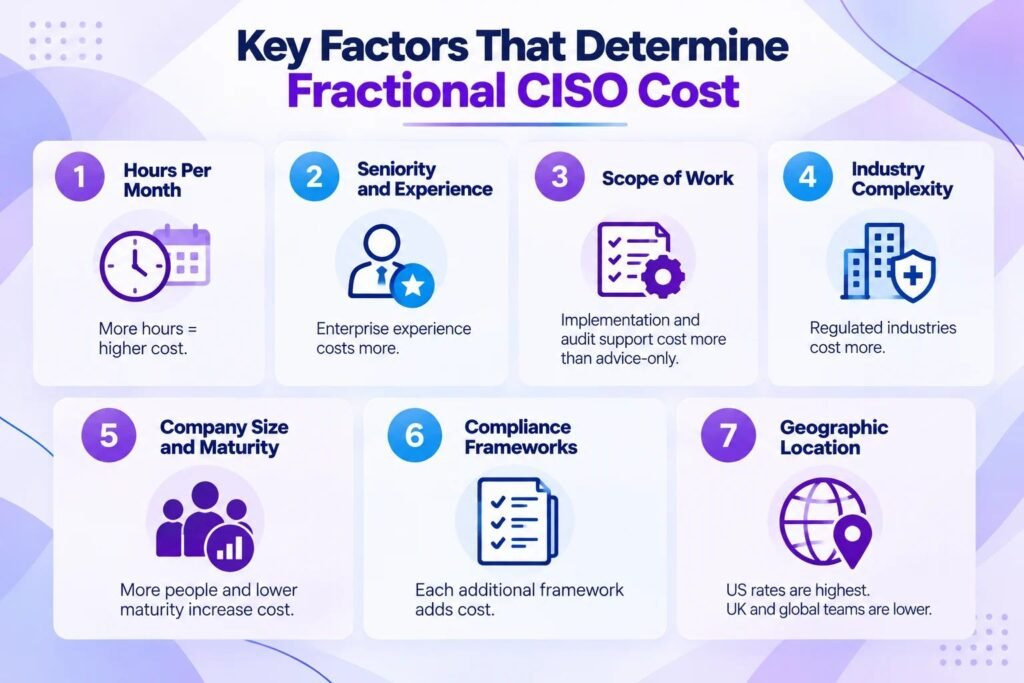
Key Factors That Determine Fractional CISO Cost
Hours Per Month Required
Hours drive price more than anything else. A retainer covering eight hours a month and one covering 80 are both sold as “fractional CISO,” but they aren’t the same product. Productized plans get around this by bundling a team instead of selling one person’s hours, so the price follows scope rather than time.
Insider Note: Ask every provider how many clients each named vCISO carries. Fractional leaders usually work across several companies at once, and some firms give one vCISO 7 to 10 accounts. That works when a GRC team handles execution underneath. It’s a problem when the vCISO is the only one doing the work.
Seniority and Experience Level of the Operator
Someone who’s run security at a large enterprise costs more than someone a few years into the field, and often pays for it in faster decisions and fewer wrong turns. The CISSP certification from ISC2 and the CISM certification from ISACA show baseline competence, but audit and incident experience counts for more. Ask how many audits they’ve taken a client through, and how many came back clean.
Scope of Work and Deliverables
Strategy-only engagements look cheap per month and cost more in total, because someone still has to write the policies, implement the controls and chase the evidence. Engagements that include that work cost more per month and less overall. Check whether your quote covers policy writing, control implementation, internal audit and audit-day support, or just advice about them.
Industry and Regulatory Complexity
Healthcare, fintech and payments companies pay more. HIPAA, PCI DSS, DORA, and regional rules such as Saudi Arabia’s NCA ECC or SAMA CSF add controls, paperwork, and time spent with regulators. A SaaS company with one framework and no regulated data sits at the bottom of every band.
Company Size and Operational Maturity
More people, systems, vendors and cloud accounts mean more to govern. Maturity pulls the other way. A company with a working vulnerability management process, clean access controls and documented policies needs less fractional CISO time than one starting from scratch. Security program maturity is why two companies of the same size can get quotes $5,000 a month apart.
Compliance Framework Requirements (SOC 2, HIPAA, PCI, ISO 27001)
Each extra framework adds work, but overlap helps. SOC 2 and ISO 27001 certification share a lot of controls, which is why bundles exist: Axipro charges $650 a month for both versus $500 for one. HIPAA, GDPR and the NIST Cybersecurity Framework add their own requirements. PCI DSS is usually the most expensive single addition because it goes deep into technical controls.
Geographic Location
US-based fractional CISOs charge the most, and the big tech hubs charge the most of all. UK rates tend to be lower, and firms with globally distributed teams can price well under US norms. Since nearly all fractional work is remote, location matters less than it used to, but it still sets the cost base behind a quote.
Worth Knowing: The NIST Cybersecurity Framework
The NIST Cybersecurity Framework is free and maps well to most commercial frameworks. If your fractional CISO builds the program on it, adding SOC 2 or ISO 27001 later usually takes less rework than if they'd built straight to one audit checklist.
Fractional CISO Pricing Models Explained
Monthly Retainer Model
You pay a fixed amount each month for an agreed level of availability. You get predictable costs and one person accountable for results. The downside is unused time: if quiet months cost the same as audit months, you’re paying for slack.
Hourly Engagement Model
You pay for the time you use. That works for small, occasional needs and for incident support on top of a retainer. It works badly for owning a program, because the incentive is to bill more hours rather than to finish.
Fixed-Fee Project Model
You pay a set price for a defined deliverable with a clear end date. Fixed fees protect you from scope creep, and they’re the best way to buy a certification, a gap analysis, or a roadmap. Read the scope closely, because the price only holds for what’s written down.
Hybrid Pricing Structures
Most mature engagements end up hybrid. You pay a fixed fee to get certified, a monthly retainer to stay certified, and hourly rates for incidents and out-of-scope work. Axipro works the same way: the Achievement Plan is the fixed fee for certification, the Trust Assurance Plan is the monthly vCISO coverage afterward, and penetration testing and internal audits are add-ons from $1,000 each.
What’s Included vs. What Costs Extra
Services Typically Included in the Retainer
Most retainers cover security strategy and the roadmap, writing and reviewing policies, risk assessments, vendor risk reviews, help with security questionnaires, executive and board reporting, and incident response planning. Compliance-led plans add continuous compliance monitoring, audit preparation and GRC platform management.
Expect to pay separately for penetration testing, the external security audit (your CPA firm or ISO certification body bills you directly), compliance automation software, managed detection and response, and legal review. Hands-on incident response during a live incident, as opposed to planning for one, is often billed hourly at a premium.
Hidden Costs to Watch For
The expensive surprises are usually in the contract. Watch for onboarding fees equal to a month of retainer, and for 12-month minimum terms with early exit penalties. Some providers require you to buy specific tools, occasionally with a referral fee going back to them. Others charge overage rates once you pass your allotted hours, which tends to happen during audit season, exactly when you can’t cut back.
Important: A vCISO who resells the security tools they recommend has a conflict of interest. Ask outright whether the provider earns commission on anything they might tell you to buy.
Fractional CISO Cost vs. Full-Time CISO Salary
Total Cost of a Full-Time CISO (Salary, Benefits, Equity)
Full-time CISOs are expensive, and the base salary understates it. The 2026 CISO Report from Cybersecurity Ventures cites a Glassdoor median of $321,000 and a Salary.com figure of $385,000. The IANS Research and Artico Search benchmark of 566 US and Canadian CISOs found pay rose 6.7% in 2025, with most packages between $250,000 and $700,000. Technology companies pay the most, and CISOs at the largest US enterprises averaged closer to $500,000.
Even the role one level down isn’t cheap. The US Bureau of Labor Statistics puts the median wage for computer and information systems managers at $171,200 before benefits.
Then come the loaded costs. Payroll taxes, executive benefits, and equity sit on top of salary. Executive search fees commonly run 25% to 35% of first-year cash pay, and the role can sit empty for three to six months while you search. CISO tenures are short, so you’ll probably pay that search cost more than once.
Side-by-Side Cost Comparison
| Full-time CISO | Mid-tier fractional CISO | Axipro Trust Assurance Plan | |
|---|---|---|---|
| Annual cost | $350,000 to $700,000+ loaded | $60,000 to $150,000 | $6,000 to $7,800, plus certification from $4,000 one-off |
| Time to start | 3 to 6 months of hiring | 2 to 4 weeks | Weeks |
| Availability | Full-time | 4 to 6 days per month | Dedicated vCISO + team, Slack support |
| Bench depth | One person | One person, sometimes a small team | vCISO backed by a GRC team |
| Exit cost | Severance, re-hiring | Notice period | Cancel anytime |
| Best for | Large or regulated companies with a security team | Growth-stage, several frameworks | Startups and SaaS teams driven by compliance |
Cost Savings Analysis
Take a 60-person Series A SaaS company that needs SOC 2 and ISO 27001 to close enterprise deals. A full-time CISO costs at least $350,000 in year one once salary, benefits and recruiting are counted, and that’s before they hire anyone. A mid-tier fractional CISO at $10,000 a month costs $120,000, about two-thirds less, though implementation may still be extra.
On Axipro, the same company pays $5,500 for the Achievement Plan to get certified, then $650 a month for the bundled Trust Assurance Plan to keep both certifications running. That’s about $13,300 in year one plus the external auditor’s fee, or under 4% of the full-time cost. The trade-off is that the engagement centers on compliance and security operations, without a full-time executive in every leadership meeting. At this stage, that’s the right trade for most companies.
How to Budget for a Fractional CISO by Company Stage
Early-Stage Startups (Pre-Seed to Series A)
Budget: $500 to $5,000 per month, plus a one-off certification fee. At this stage the trigger is almost always a sale. The first enterprise prospect sends a security questionnaire, or a procurement team asks for a SOC 2 report. Startup security means getting the basics right once, proving it with a certification and keeping it from slipping. A fixed-fee certification project followed by a vCISO plan covers that without burning runway.
Growth-Stage Companies (Series B and Beyond)
Budget: $5,000 to $15,000 per month. After a Series B round, customers, headcount and vendors grow faster than the security program. Many companies at this stage keep a compliance-led plan for frameworks and audits, then add a few days of senior advisory time for architecture, board reporting and cyber insurance renewals.
Mid-Market Organizations
Budget: $8,000 to $20,000 per month. Mid-market companies usually pair a fractional CISO with an internal security lead or a small team. The fractional leader sets direction and owns risk at executive level, and the internal team does the work. SMB cybersecurity programs at this size often run three or more frameworks at once.
Enterprise Supplemental Engagements
Budget: $15,000 to $25,000+ per month, or project-based. Enterprises use fractional CISOs to fill gaps: an interim CISO between hires, a specialist for a new regulation like DORA or the EU AI Act, or security leadership for one business unit or a recent acquisition.
Let Axipro help you build a business continuity plan that's practical, compliant, and audit-ready.
Schedule Your Free Assessment Today
Pricing Red Flags to Avoid
Rates That Seem Too Good to Be True
A low price isn’t a problem by itself. A low price nobody can explain is. Ask what makes it possible: a fixed scope, a team model, automation or a lower-cost delivery base. If the answer is vague, you’re probably looking at a vCISO spread across too many clients, or an “assessment” that’s mostly a questionnaire.
Vague Scope Definitions
“Strategic security guidance” isn’t a deliverable. A good proposal lists the documents, assessments, meetings, and audit work you’ll get, and says what’s excluded.
Lack of Deliverable Timelines
If a provider can’t tell you when your risk assessment, policy set, or audit readiness review will be done, they haven’t planned the work. Timelines are also how you’ll know whether the engagement is on track.
No Clear Exit or Transition Plan
Every fractional engagement should end cleanly, whether that’s a full-time hire, a handover to your own team, or a smaller maintenance retainer. Ask who owns the documentation, the GRC platform setup, and the evidence when the contract ends. The answer should be you.
How to Maximize ROI on Your Fractional CISO Investment
Defining Clear Success Metrics
Tie the engagement to results the business cares about: certifications achieved, audits passed without exceptions, how fast security questionnaires get answered, deals unblocked, and critical vulnerabilities closed. “Improved security posture” can’t be measured. “SOC 2 Type II report with zero exceptions by Q3” can.
Pro Tip: The Most Common Failure
The most common failure we see after certification isn't a technical control. It's the recurring ones. Quarterly access reviews, vendor reviews and security awareness training happen on schedule during the audit window, then stop. Make "zero missed recurring controls" one of your vCISO's metrics.
Scoping the Engagement Correctly
Start with what’s driving the need. If you need certification to close deals, buy certification and ongoing compliance first, not a broad strategy retainer. A gap analysis before you sign shows how much work there really is, so you don’t pay for a premium tier when a productized plan would do.
Knowing When to Transition to Full-Time
The usual signs it’s time: fractional spend passes roughly $180,000 to $220,000 a year, you’re building a security team of three or more people who need daily management, regulators or the board expect a full-time accountable executive, or security has become part of what you sell rather than a box to tick for sales. A good fractional CISO will help write the job description, screen candidates and hand over cleanly.
Conclusion
In 2026 a fractional CISO costs anywhere from $500 a month for a productized, compliance-led vCISO to $25,000 a month for a senior executive working close to half-time. A full-time hire costs $350,000 or more a year. Which end you need depends on why you need security leadership. If enterprise customers and frameworks like SOC 2 and ISO 27001 are the reason, a compliance-led plan gets you there for a fraction of the cost. If you need someone to manage a security team and deal with regulators, budget for the higher tiers.
Either way, buy the outcome you need, check what’s included, and make sure everything stays yours when the engagement ends. For the first group, Axipro gets you certified through the fixed-fee Achievement Plan, and Axipro’s fractional CISO services through the Trust Assurance Plan keep you there from $500 a month with no long-term contract. Every plan is listed on the Axipro pricing page.
Frequently Asked Questions
How much does a fractional CISO cost per month?
Most fractional CISOs cost $3,000 to $25,000 a month, depending on how many days of senior time you buy. Productized, compliance-led vCISO plans cost less: Axipro’s Trust Assurance Plan starts at $500 a month for one framework, with certification handled separately through the Achievement Plan. Hourly rates run $200 to $500.
Is a fractional CISO cheaper than a full-time CISO?
Yes, for almost every company under a few hundred employees. A full-time CISO costs $350,000 to $700,000 or more a year once salary, equity, benefits and recruiting are counted. Fractional engagements usually cost 10% to 40% of that, and productized plans cost a small fraction of even the cheapest fractional retainer.
Do fractional CISOs charge hourly or by retainer?
Most charge a monthly retainer, because that suits ongoing ownership of a program. Hourly billing is common for one-off advice and incident support, and fixed fees are standard for set projects like a gap analysis or a certification. Many engagements use all three.
How many hours per month do you get with a fractional CISO?
Advisory retainers usually cover 8 to 16 hours a month, operational retainers 32 to 48, and embedded engagements 80 or more. Productized plans like Axipro’s don’t sell hours. They give you a dedicated vCISO and a GRC team for a fixed scope, with Slack support between meetings.
Are cheap fractional CISO services worth it?
They are when the low price comes from a fixed scope and a team doing the work. They aren’t when it comes from one overloaded consultant, or from advice nobody acts on. Ask how the price is possible, who does the work and what’s left out.
Does the price change over the length of the engagement?
Often, yes. Many retainers cost more in the first two or three months while the fractional CISO assesses risk and builds the roadmap, then drop to a maintenance level. Flat-fee productized plans cost the same every month.
What's the minimum engagement length for a fractional CISO?
Traditional providers often ask for 6 to 12 months, and the best engagements tend to run 12 to 24. Some productized plans have no minimum. Axipro’s Trust Assurance Plan is billed monthly and you can cancel anytime.